REVIEW 4 major objections 5 minor 45 references
Multiple D2D Multicasts in Underlay Cellular Networks
T0 review · 4 major / 5 minor · reviewed 2026-08-14 · deepseek-v4-flash
Pith's one-line read This paper claims that splitting the joint resource allocation problem into channel assignment and power control lets multiple D2D multicast groups share a cellular uplink while maximizing sum throughput under QoS and power limits.
desk verdict A useful D2D multicast heuristic with unsupported optimality claims; the Gk=2 corner-search proof fails, but the two-step scheme is worth refereeing as a major revision. read the letter →
The pith
A machine-rendered reading of the paper's core claim, the machinery that carries it, and where it could break.
The reading
What carries the argument
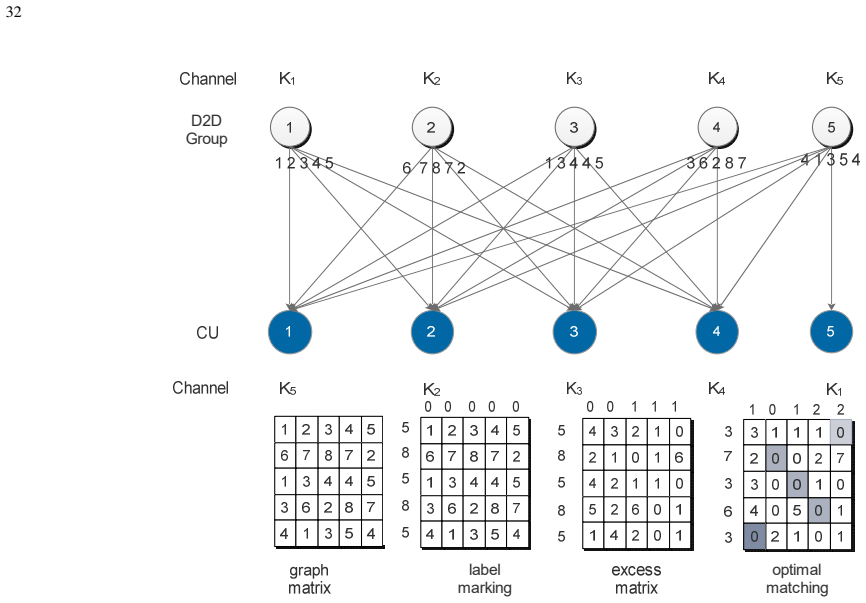
The load-bearing object is the geometry of the feasible power region for a channel shared by a CU and one or two multicast groups. For one group per channel, Lemmas 2 and 3 place the optimum on the boundary of the region, at a corner where either the CU or the group transmitter transmits at maximum power, making bipartite matching plus a corner check sufficient. For two groups per channel, Lemma 5 asserts that the sum-rate function is quasi-convex on the boundary of the feasible region, so the maximum lies among the corner points generated by intersecting the three SINR planes (equations (16a)-(16c)) with the faces of the power cube; the paper lists seven candidate regions and evaluates those points. For the general many-group case, STIM replaces geometric corner search with a fixed-point iteration adapted from the GDCPC algorithm, updating each transmitter's power by the ratio of its target SINR to its current SINR and capping interference to the shared CU. This combination reduces an NP-hard MINLP to a polynomial-time channel assignment followed by a small corner search or an iterative power update.
What would settle it
Pick a random channel realization with two multicast groups and one cellular user, compute the sum rate on a fine grid over the boundary faces of the feasible power region, and compare the best interior boundary point with the best of the seven corner-region candidates from Section V-B; if any interior boundary point beats the corner candidates, Lemma 5's quasi-convexity is false and the corner-search optimality claim fails.
Extended reading notes
Core claim
The central claim is that the intractable joint channel-and-power allocation problem for multiple D2D multicast groups sharing uplinks can be decomposed without losing much throughput. For each channel, the base station first admits the set of multicast groups that will be allowed to share that channel, using either an interference-aware rule (keep mutually interfering groups apart, admit only groups that add positive throughput) or an outage-aware rule (choose channels that minimize outage probabilities subject to an aggregate interference budget). The STIM power-allocation stage then updates each group transmitter's power through a modified GDCPC iteration so that SINR targets are met and the shared CU is protected. For the special cases of one or two groups per channel, the paper proves that the optimal power vector lies on the boundary of the feasible power region and, for two groups, that the sum-rate function is quasi-convex on that boundary, so the maximum can be located by checking only corner points. The numerical section concludes that the proposed schemes outperform existing resource allocation schemes in sum throughput.
Load-bearing premise
The claim that the corner search is optimal for two multicast groups per channel rests on the sum-rate function being quasi-convex on the boundary of the feasible power region; if that property fails on realistic channel gains, the corner search is only an uncalibrated heuristic and the paper's strongest optimality claim collapses.
Editorial extensions
If this is right
- For exactly one multicast group per channel, the optimal power allocation is the corner solution used with bipartite matching, so no continuous power search is needed at all.
- For exactly two groups per channel, testing the seven listed corner candidates gives the maximum sum rate, provided the quasi-convexity premise holds; this makes the two-group case computationally cheap.
- The STIM iteration makes the general problem tractable and, in simulations, yields sum throughput that first increases and then decreases with the maximum D2D transmit power, with the best point near 15 dBm in the tested configuration.
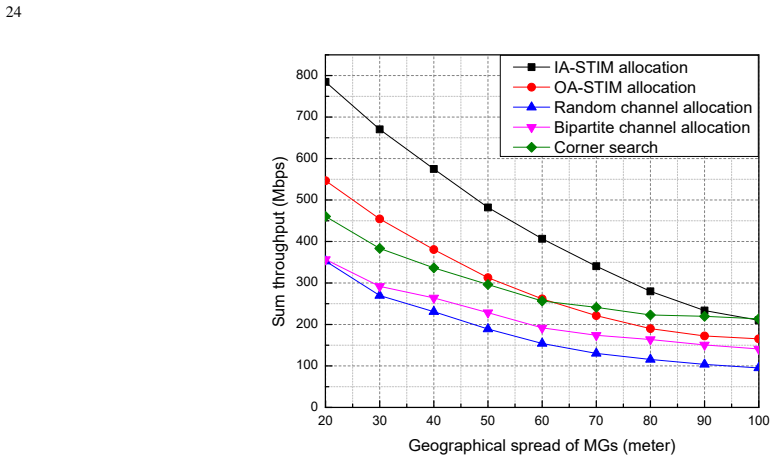
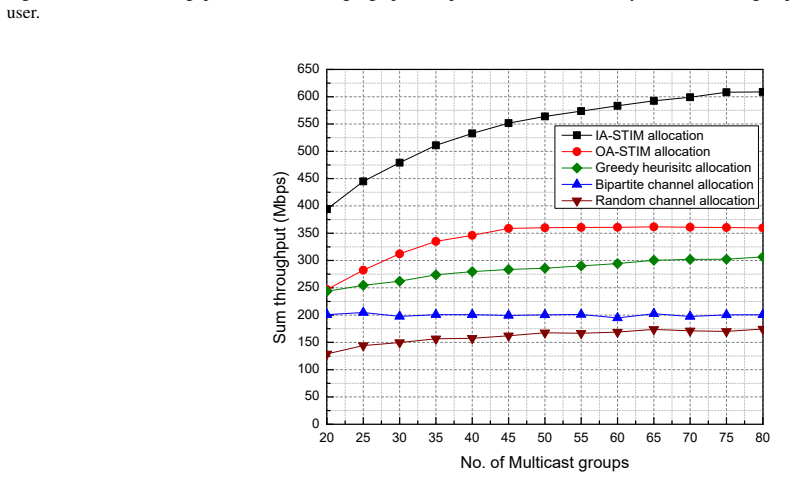
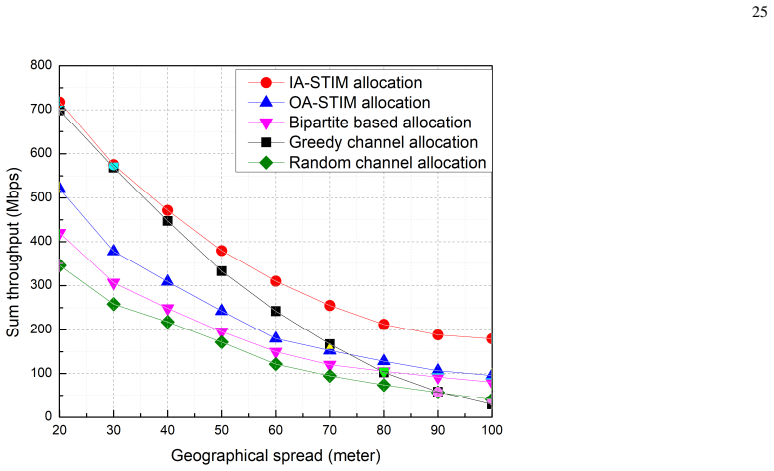
- As the number of multicast groups grows, sum throughput saturates once co-channel interference blocks further admission, and both IA-STIM and OA-STIM beat the random, greedy, and bipartite baselines in most simulated regimes.
- Higher CU QoS thresholds reduce the room for D2D sharing, so the achievable gain shrinks as the CU rate requirement rises; the proposed schemes still outperform the baselines across the reported range.
Reading between the lines
- A natural testable extension is to run the same two-step scheme in a multi-cell layout with inter-cell interference, since the paper only treats a single cell and lists multi-cell operation as future work.
- Because Lemma 5's proof simplifies the SINR expression to an interference-limited form and drops the noise term at one step, one can stress-test it numerically by fine-grid search on the boundary; if a non-corner boundary point wins, the corner-search claim is only heuristic.
- The simulation peak near 15 dBm suggests a system-design rule the authors do not state: even when hardware maximum power is higher, capping D2D multicast transmitters near that level can maximize sum throughput by limiting co-channel interference.
Signed reviews
Editorial analysis
A structured set of objections, weighed in public.
Referee Report
Summary. The paper studies uplink underlay D2D multicast in a single cell, where multiple multicast groups may share a cellular user's channel. It formulates a sum-throughput maximization problem as a mixed-integer nonlinear program (P1), then proposes a two-stage solution: channel allocation algorithms (interference-aware IA-STIM and outage-aware OA-STIM) followed by power allocation. For the special cases of one or two multicast groups per channel, it claims optimal corner-based power allocation; for the general case, it proposes an iterative STIM power-control algorithm. The numerical section compares the proposed schemes with bipartite matching, random allocation, and greedy heuristics, reporting higher sum throughput under the chosen scenarios.
Significance. If the optimality claims were correct, the paper would provide a useful decomposition of a hard MINLP into a polynomial-time channel allocation step and provably optimal power allocation for small channel-sharing groups, together with a stochastic-geometry outage expression and extensive simulations. The paper's strengths include a clearly stated system model, a standard outage derivation in Lemma 1, and a broad set of numerical comparisons. However, the central load-bearing proofs for the claimed optimality of the corner-search power allocation are invalid, and the general STIM algorithm does not optimize the stated objective. These issues undermine the paper's main theoretical contribution, so the current manuscript does not meet the standard for publication.
major comments (4)
- [Section V.B, Lemma 5 and Appendix G] The proof of Lemma 5 does not establish that the sum-rate function is quasi-convex on the boundary of the feasible power region. Appendix G first invokes a first-order condition (G.1) that is, in fact, a valid characterization for differentiable quasi-convex functions, but the proof then makes two unjustified steps: it assumes that a sum of quasi-convex functions is quasi-convex, which is false in general, and it analyzes a sum of SINR ratios rather than the actual objective, which is a sum of log(1+SINR) terms. The derivation from (G.4) to (G.5) essentially restates the target inequality without proving it. Consequently, the claim that the maximum of the sum rate over the polytope defined by (16a)–(16c) and the power bounds occurs at a corner point is unproven. This is load-bearing because the corner-search algorithm for Gk=2 is presented as optimal. The paper's own Section VI.B later calls corner search 'a good heuristic' and 'a lower bound to the optimal throughput,' which directly contradicts Lemma 5 and the abstract's optimality claim.
- [Section V.A, Lemmas 2 and 3, Appendices C and D] The proofs of Lemmas 2 and 3, which assert optimality at the corners for the Gk=1 case, are invalid as written. Appendix C scales both transmit powers by α>1 and claims C(αP_i,αP_j) > C(P_i,P_j). In an interference-limited setting (which the paper assumes in Proposition 1 and Appendix A), a common scaling of both powers leaves all SINRs invariant up to the noise term, so the displayed expressions for β1 and β2 do not imply the claimed inequality. The subsequent argument then asserts convexity of a product-like quantity T(P_i,P_j) in Appendix D without deriving it from the actual sum-rate objective. Thus the corner-optimality result for the single-MG case is not proven by the material supplied.
- [Section V.C, Algorithm 3, and equations (17)–(19)] The STIM power-allocation algorithm for the general case does not maximize the throughput objective of Problem P1. Equation (17) merely caps each MGTX's power by an evenly split interference budget, and the update rule (18)–(19) iterates toward meeting SINR thresholds. No objective function appears in this procedure, so there is no mechanism by which it 'maximizes the system throughput,' as claimed in the abstract and in Section I.B. The numerical results show that the proposed scheme outperforms the chosen baselines under certain parameters, but outperforming heuristics does not establish throughput optimality or provide a performance guarantee relative to the optimum of P1.
- [Section VI.B, Figure 4 and surrounding text] The manuscript is internally inconsistent about the status of the corner-search power allocation. Section V.B and the abstract present it as optimal for Gk=2, while Section VI.B states that the corner-search method 'tries to support minimum SINR thresholds' and 'may serve as a good heuristic to efficiently provide a lower bound to the optimal throughput.' A heuristic lower bound is not an optimal solution. The authors need to either provide a valid proof of optimality or explicitly reframe all such claims as heuristic, with appropriate empirical validation against exhaustive search for small instances.
minor comments (5)
- [Section IV, Algorithms 1 and 2] The pseudocode contains notation that is difficult to follow: in Algorithm 1, the set G_k of multicast groups sharing channel k is updated using objects that appear to be MGs, while in Algorithm 2 the update 'G_k = G_k ∪ k' mixes a set of MGs with a CU index k. These lines should be rewritten with explicit indices so that the set-membership operations are unambiguous.
- [Appendix H, first paragraph] The phrase 'γth_r = γth_{r'} = γth_c = 3 watt or 5 dB' is dimensionally inconsistent: 3 watts is a linear power value and 5 dB is a logarithmic ratio; they cannot be equal. The intended units and conversion should be stated correctly.
- [Section II.B and Lemma 1 (Appendix B)] The outage probability formula in (10) uses intensities λ_c and λ_g, but these are not defined in the system model in Section II. The relation of these intensities to the PPP models of CUs and MGs should be stated explicitly before Lemma 1 is used.
- [Section II.C, equations (12)–(14)] In the Gk=2 SINR constraints, the receivers r and r' are introduced without specifying that they are the worst-case receivers of MG 1 and MG 2, respectively; this should be clarified to match the definition in (3).
- [Section I.B and Section IV] The novelty claim 'for the first time considers the general problem of optimal resource allocation for multiple D2D multicasts' should be tempered or qualified, since references [10], [28], and [29] address closely related underlay D2D multicast resource allocation, and the authors should state explicitly what is new beyond those works and beyond their own conference papers (WCNC 2016/2017) and preprint [32].
Circularity Check
No significant circularity; the only self-citation is background and the central derivations rest on external models and baselines.
full rationale
I find no circular reduction in the claimed derivation chain. The MINLP formulation in (9) follows from the stated system model and QoS constraints, and the proposed channel-allocation and power-allocation schemes are evaluated against external baselines rather than fitted to the authors' own outputs. The outage probability in Lemma 1 is derived from stochastic geometry tools with an external citation [45], the G_k=1 power-allocation lemmas are argued from feasible-region geometry, and the general STIM power update is based on the external GDCPC algorithm [42]. The single self-citation [32] to the authors' prior work on exclusion zones appears only as background in the related-work discussion and is not used to justify the paper's optimality or throughput claims. One mathematical concern is that Appendix G's proof of Lemma 5 does not rigorously establish quasi-convexity of the sum-rate function, since quasi-convexity of a sum does not follow from quasi-convexity of its terms; however, this is a proof gap and correctness risk, not a circular step, because the claimed conclusion is not assumed as an input or made equivalent to an earlier fitted parameter. Therefore, the paper does not exhibit self-definitional, fitted-input-as-prediction, or self-citation-load-bearing circularity, and the appropriate score is low. The most notable weakness is the unproven Lemma 5, which affects the strength of the G_k=2 corner-search optimality claim, but it is not circularity under the specified criteria.
Assumptions & free parameters
free parameters (4)
- gamma_th (interference-aware channel gain ratio threshold)
- Theta_th_g (outage probability threshold)
- I_k^th (CU interference threshold)
- lambda_c, lambda_g (PPP intensities in outage formula)
assumptions (4)
- domain assumption Interfering CUs and MGs form independent homogeneous Poisson point processes over the plane
- domain assumption The throughput contribution Delta R_g,k of an MG can be evaluated independently of the co-channel MG set in channel allocation
- ad hoc to paper The sum-rate function is quasi-convex on the boundary of the feasible power region
- domain assumption For two MGs per channel, the augmented matrix of the SINR inequalities (12)-(14) is full rank
Cite this review
Pith. "Pith review of Multiple D2D Multicasts in Underlay Cellular Networks." pith.science (2026). https://pith.science/paper/HDYS353C
@misc{pith2026190808866,
  author       = {Pith},
  title        = {Pith review of: Multiple D2D Multicasts in Underlay Cellular Networks},
  year         = {2026},
  howpublished = {\url{https://pith.science/paper/HDYS353C}},
  note         = {Machine review of arXiv:1908.08866}
}
read the original abstract
Multicasting for disseminating popular data is an interesting solution for improving the energy and spectral efficiencies of cellular networks. To improve the achievable performance of such networks, underlay device-to-device (D2D) multicast communication offers a practical solution. However, despite significant potential for providing higher throughput and lower delay, implementing underlay D2D multicast communication poses several challenges, such as mutual interference among cellular users (CUs) and D2D multicast groups (MGs), and overhead signaling to provide channel state information, that may limit potential gains. We study a scenario where multiple D2D multicast groups may share a CU's uplink channel. We formulate an optimization problem to maximize the achievable system throughput while fulfilling quality of service (QoS) requirements of every CU and D2D MGs, subject to their corresponding maximum transmit power constraints. The formulated optimization problem is an instance of mixed integer non-linear programming (MINLP) problem, which is computationally intractable, in general. Therefore, to find a feasible solution, we propose a pragmatic two-step process of channel allocation and power allocation. In the first-step, we propose a channel allocation algorithm, which determines the subset of MGs that may share a channel subject to criteria based on two different parameters: interference and outage probabilities. Then, we propose an algorithm to allocate power to these MG subsets that maximizes the system throughput, while satisfying transmit power constraint. Numerical results show the efficacy of proposed approach in terms of higher achievable sum throughput and better spectrum efficiency with respect to various existing schemes.
Figures


Figures from the paper (13 more)




Reference graph
Works this paper leans on
-
[1]
Forecast and Trends, 2017-2022,
C. V . N. Index, “Forecast and Trends, 2017-2022,” Feb. 2019
work page 2017
-
[2]
Fifth report on international broadband data report,
F. C. Commission, “Fifth report on international broadband data report,” Jan. 2016
work page 2016
-
[3]
New physical layer features of 3GPP LTE Release-13 [Industry Perspectives],
P.-H. Kuo, “New physical layer features of 3GPP LTE Release-13 [Industry Perspectives],” IEEE Wireless Commun. , vol. 22, no. 4, 2015
work page 2015
-
[4]
Multicast scheduling and resource allocation algorithms for OFDMA-based systems: A survey,
R. O. Afolabi, A. Dadlani, and K. Kim, “Multicast scheduling and resource allocation algorithms for OFDMA-based systems: A survey,” IEEE Commun. Surveys & Tutorials , vol. 15, no. 1, 2013
work page 2013
-
[5]
Analyzing assisted offloading of cellular user sessions onto D2D links in unlicensed bands,
S. Andreev, O. Galinina, A. Pyattaev, K. Johnsson, and Y . Koucheryavy, “Analyzing assisted offloading of cellular user sessions onto D2D links in unlicensed bands,” IEEE JSAC, vol. 33, no. 1, 2015
work page 2015
-
[6]
D2D task offloading: A dataset-based Q&A,
D. Chatzopoulos, C. Bermejo, E. ul Haq, Y . Li, and P. Hui, “D2D task offloading: A dataset-based Q&A,” IEEE Commun. Magazine , vol. 57, no. 2, 2019
work page 2019
-
[7]
Device-to-Device Communications over 5G Systems: Standardization, Challenges and Open Issues,
G. Araniti, A. Raschell `a, A. Orsino, L. Militano, and M. Condoluci, “Device-to-Device Communications over 5G Systems: Standardization, Challenges and Open Issues,” in 5G Mobile Communications , Springer, 2017
work page 2017
-
[8]
A survey on predicting the popularity of web content,
A. Tatar, M. D. de Amorim, S. Fdida, and P. Antoniadis, “A survey on predicting the popularity of web content,” Journal of Internet Services and Applications , vol. 5, no. 1, 2014
work page 2014
Show all 45 references
-
[9]
Modeling, analysis, and optimization of multicast device-to-device transmissions,
X. Lin, R. Ratasuk, A. Ghosh, and J. G. Andrews, “Modeling, analysis, and optimization of multicast device-to-device transmissions,” IEEE Trans. on Wireless Commun. , vol. 13, no. 8, 2014
2014
-
[10]
A resource allocation scheme for D2D multicast with QoS protection in OFDMA-based systems,
B. Peng, C. Hu, T. Peng, Y . Yang, and W. Wang, “A resource allocation scheme for D2D multicast with QoS protection in OFDMA-based systems,” in Proc. IEEE PIMRC , London, UK, Sept. 2013
2013
-
[11]
Device-to-device communication in LTE-Advanced networks: A survey,
J. Liu, N. Kato, J. Ma, and N. Kadowaki, “Device-to-device communication in LTE-Advanced networks: A survey,” IEEE Commun. Surveys & Tutorials , vol. 17, no. 4, 2015
2015
-
[12]
In-band device-to-device communication in OFDMA cellular networks: A survey and challenges,
P. Mach, Z. Becvar, and T. Vanek, “In-band device-to-device communication in OFDMA cellular networks: A survey and challenges,” IEEE Commun. Surveys & Tutorials , vol. 17, no. 4, 2015
2015
-
[13]
Resource allocation for device-to-device Communication Underlaying Cellular Networks: An alternating optimization method,
W. Zhao and S. Wang, “Resource allocation for device-to-device Communication Underlaying Cellular Networks: An alternating optimization method,” IEEE Commun. Letters , vol. 19, no. 8, 2015
2015
-
[14]
Game-theoretic resource allocation methods for device-to-device communication,
L. Song, D. Niyato, Z. Han, and E. Hossain, “Game-theoretic resource allocation methods for device-to-device communication,” IEEE Wireless Commun., vol. 21, no. 3, 2014
2014
-
[15]
Performance analysis and resource allocation for cooperative D2D communication in cellular networks with multiple D2D pairs,
J. Lee and J. H. Lee, “Performance analysis and resource allocation for cooperative D2D communication in cellular networks with multiple D2D pairs,” IEEE Commun. Lett. , vol. 23, no. 5, 2019
2019
-
[16]
Resource allocation for 5G D2D multicast content sharing in social-aware cellular networks,
L. Feng, P. Zhao, F. Zhou, M. Yin, P. Yu, W. Li, and X. Qiu, “Resource allocation for 5G D2D multicast content sharing in social-aware cellular networks,” IEEE Commun. Magazine , vol. 56, no. 3, 2018
2018
-
[17]
Interference mitigation for multicast D2D communications underlay cellular networks,
D. D. Ningombam, C. G. Lee, and S. Shin, “Interference mitigation for multicast D2D communications underlay cellular networks,” in Proc. IEEE ICAIIC , Okinawa, Japan, March 2019
2019
-
[18]
Downlink resource sharing in multichannel device-to-device communication,
L. Ma, X. Deng, J. Wang, Y . Huang, and F. Shi, “Downlink resource sharing in multichannel device-to-device communication,” IEEE Wireless Commun. Lett. , 2019. 36
2019
-
[19]
CDMA2000 R© High rate broadcast packet data air interface design,
P. Agashe, R. Rezaiifar, and P. Bender, “CDMA2000 R© High rate broadcast packet data air interface design,” IEEE Commun. Magazine , vol. 42, no. 2, 2004
2004
-
[20]
Efficient resource allocation for OFDMA multicast systems with fairness consideration,
D. T. Ngo, C. Tellambura, and H. H. Nguyen, “Efficient resource allocation for OFDMA multicast systems with fairness consideration,” in Proc. on IEEE Radio and Wireless Symposium , CA, USA, Jan. 2009
2009
-
[21]
Multicast scheduling in cellular data networks,
H. Won, H. Cai, D. Y . Eun, K. Guo, A. Netravali, I. Rhee, and K. Sabnani, “Multicast scheduling in cellular data networks,” IEEE Trans. on Wireless Commun. , vol. 8, no. 9, 2009
2009
-
[22]
Layered multicast with inter-layer network coding for multimedia streaming,
M. Shao, S. Dumitrescu, and X. Wu, “Layered multicast with inter-layer network coding for multimedia streaming,” IEEE Trans. on Multimedia, vol. 13, no. 2, 2011
2011
-
[23]
Two-stage cooperative multicast transmission with optimized power consumption and guaranteed coverage,
Y . Zhou, H. Liu, Z. Pan, L. Tian, J. Shi, and G. Yang, “Two-stage cooperative multicast transmission with optimized power consumption and guaranteed coverage,” IEEE JSAC, vol. 32, no. 2, 2014
2014
-
[24]
Multimedia broadcast/multicast service (MBMS); Architecture and functional description,
3GPP TS 23.246 V13.3.0, “Multimedia broadcast/multicast service (MBMS); Architecture and functional description,” Mar. 2015
2015
-
[25]
Evolved multimedia broadcast/multicast service (eMBMS) in LTE-Advanced: overview and Rel-11 enhancements,
D. Lecompte and F. Gabin, “Evolved multimedia broadcast/multicast service (eMBMS) in LTE-Advanced: overview and Rel-11 enhancements,” IEEE Commun. Magazine , vol. 50, no. 11, 2012
2012
-
[26]
Efficient incremental raptor decoding over BEC for 3GPP MBMS and DVB IP-Datacast Services,
T. Mladenov, S. Nooshabadi, and K. Kim, “Efficient incremental raptor decoding over BEC for 3GPP MBMS and DVB IP-Datacast Services,” IEEE Trans. on Broadcasting , vol. 57, no. 2, 2011
2011
-
[27]
Joint delivery of unicast and E-MBMS services in LTE networks,
J. F. Monserrat, J. Calabuig, A. Fernandez-Aguilella, and D. Gomez-Barquero, “Joint delivery of unicast and E-MBMS services in LTE networks,” IEEE Trans. on Broadcasting , vol. 58, no. 2, 2012
2012
-
[28]
Particle swarm optimization based power allocation schemes of device-to-device multicast communication,
W. Gong and X. Wang, “Particle swarm optimization based power allocation schemes of device-to-device multicast communication,” Wireless Personal Communications, vol. 85, no. 3, 2015
2015
-
[29]
Optimal resource allocation in multicast device-to-device communications underlaying LTE networks,
H. Meshgi, D. Zhao, and R. Zheng, “Optimal resource allocation in multicast device-to-device communications underlaying LTE networks,” IEEE Trans. on V ehicular Techno., vol. 66, no. 9, 2017
2017
-
[30]
Network controlled D2D communications: Licensed or unlicensed spectrum?
F. Wu, H. Zhang, B. Di, J. Wu, and L. Song, “Network controlled D2D communications: Licensed or unlicensed spectrum?” in Proc. IEEE ICC . Shanghai, China: IEEE, May 2019
2019
-
[31]
Full-duplex device-to-device cellular networks: Power control and performance analysis,
H. V . Vu, N. H. Tran, and T. Le-Ngoc, “Full-duplex device-to-device cellular networks: Power control and performance analysis,” IEEE Trans. on V ehicular Techno., vol. 68, no. 4, 2019
2019
-
[32]
D2D multicast in underlay cellular networks with exclusion zones,
A. Bhardwaj and S. Agnihotri, “D2D multicast in underlay cellular networks with exclusion zones,” arXiv preprint arXiv:1905.00300 , 2019
1905 arXiv
-
[33]
Efficiency resource allocation for device-to-device underlay communication systems: A reverse iterative combinatorial auction based approach,
C. Xu, L. Song, Z. Han, Q. Zhao, X. Wang, X. Cheng, and B. Jiao, “Efficiency resource allocation for device-to-device underlay communication systems: A reverse iterative combinatorial auction based approach,” IEEE JSAC, vol. 31, no. 9, 2013
2013
-
[34]
Energy-aware resource allocation for device-to-device underlay communication,
F. Wang, C. Xu, L. Song, Q. Zhao, X. Wang, and Z. Han, “Energy-aware resource allocation for device-to-device underlay communication,” in Proc. IEEE ICC , Budapest, Hungary, Jun. 2013
2013
-
[35]
Single frequency-based device-to-device-enhanced video delivery for evolved multimedia broadcast and multicast services,
L. Militano, M. Condoluci, G. Araniti, A. Molinaro, A. Iera, and G.-M. Muntean, “Single frequency-based device-to-device-enhanced video delivery for evolved multimedia broadcast and multicast services,” IEEE Trans. on Broadcasting , vol. 61, no. 2, 2015
2015
-
[36]
Resource allocation for multicell device-to-device communications in cellular network: a game theoretic approach,
J. Huang, Y . Sun, J. Li, and Y . Zhao, “Resource allocation for multicell device-to-device communications in cellular network: a game theoretic approach,” in Proc. ICST MOBIMEDIA , China, May 2015
2015
-
[37]
Optimized smart grid energy procurement for LTE networks using evolutionary algorithms,
H. Ghazzai, E. Yaacoub, M.-S. Alouini, and A. Abu-Dayya, “Optimized smart grid energy procurement for LTE networks using evolutionary algorithms,” IEEE Trans. on V ehicular Techno., vol. 63, no. 9, 2014
2014
-
[38]
Resource allocation under channel uncertainties for relay-aided device-to-device communication underlaying LTE-A cellular networks,
M. Hasan, E. Hossain, and D. I. Kim, “Resource allocation under channel uncertainties for relay-aided device-to-device communication underlaying LTE-A cellular networks,” IEEE Trans. on Wireless Commun. , vol. 13, no. 4, 2014
2014
-
[39]
On the computational complexity of integer programming problems,
R. Kannan and C. L. Monma, “On the computational complexity of integer programming problems,” Optimization and Operations Research, Springer, 1978
1978
-
[40]
An nˆ5/2 algorithm for maximum matchings in bipartite graphs,
J. E. Hopcroft and R. M. Karp, “An nˆ5/2 algorithm for maximum matchings in bipartite graphs,” SIAM Journal on computing , vol. 2, no. 4, 1973
1973
-
[41]
The Hungarian method for the assignment problem,
H. W. Kuhn, “The Hungarian method for the assignment problem,” Naval Research Logistics (NRL) , vol. 52, no. 1, 2005
2005
-
[42]
Autonomous distributed power control for cognitive radio networks,
S. Im, H. Jeon, and H. Lee, “Autonomous distributed power control for cognitive radio networks,” in Proc. IEEE VTC , Canada, Sept. 2008
2008
-
[43]
Device-to-device communications underlaying cellular networks,
D. Feng, L. Lu, Y . Yuan-Wu, G. Li, G. Feng, and S. Li, “Device-to-device communications underlaying cellular networks,” IEEE Trans. on Commun. , vol. 61, no. 8, 2013
2013
-
[44]
Efficient resource allocation for device-to-device communication underlaying LTE network,
M. Zulhasnine, C. Huang, and A. Srinivasan, “Efficient resource allocation for device-to-device communication underlaying LTE network,” in Proc. IEEE WiMob , China, Oct. 2010
2010
-
[45]
Haenggi, Stochastic geometry for wireless networks
M. Haenggi, Stochastic geometry for wireless networks . Cambridge University Press, 2012
2012
Reviewed August 14, 2026 · model on record in the stance chip above.
Discussion (0). Continue with ORCID to comment.