REVIEW 3 major objections 5 minor 40 references
Resonant excitation of whistler waves by a helical electron beam
T0 review · 3 major / 5 minor · reviewed 2026-08-14 · deepseek-v4-flash
Pith's one-line read A helical electron beam in a cold magnetized plasma spontaneously excites whistler waves through three distinct resonances at once, and linear growth theory reproduces their frequency and propagation angle.
desk verdict Solid experimental identification of three simultaneous whistler resonances, with a linear-theory comparison that is plausible but rests on an unmeasured beam distribution. read the letter →
The pith
A machine-rendered reading of the paper's core claim, the machinery that carries it, and where it could break.
The reading
What carries the argument
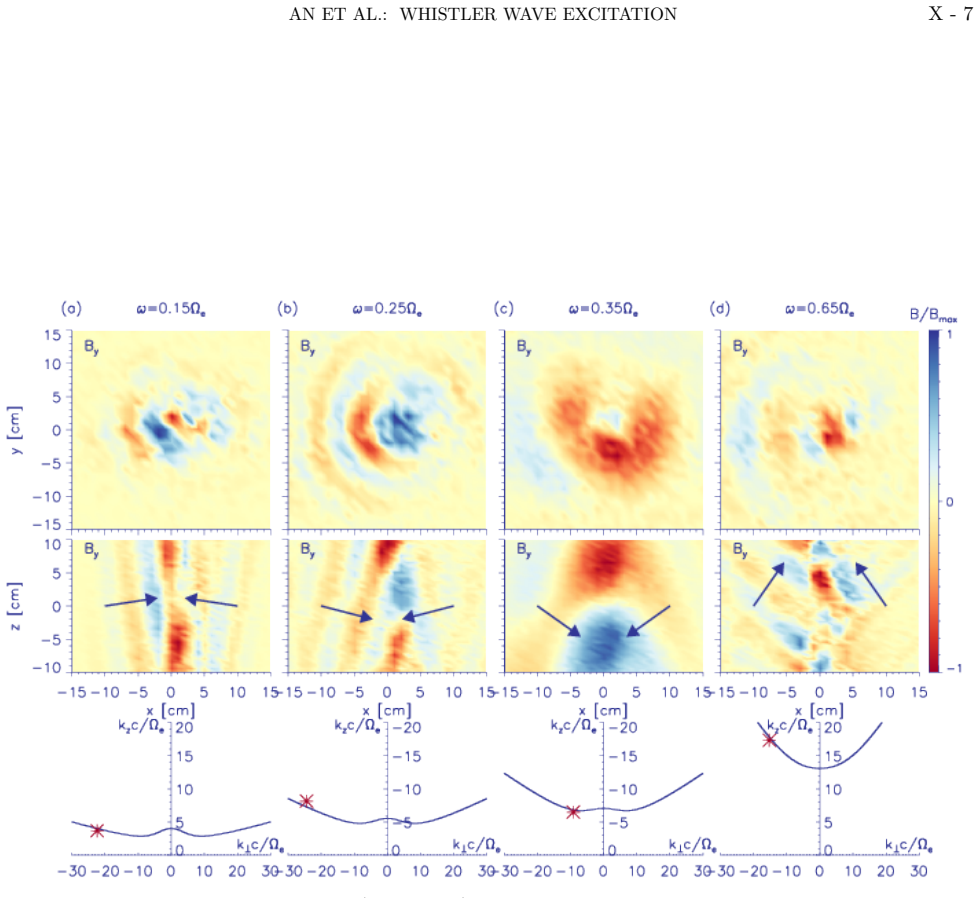
The experimental machinery is a phase-correlation technique: a moving magnetic probe paired with a fixed reference probe measures the phase delay $\Delta\varphi(\rho,z,\omega)$ over many identical plasma shots, and a linear fit to $\Delta\varphi = k_z(\omega)z + k_\perp(\omega)\rho$ yields the parallel and perpendicular wave numbers at every frequency. This converts a broadband spectrogram into a $k_z-\omega$ diagram color-coded by wave-normal angle. The theoretical machinery is a beam-ring electron distribution function, a drifting Maxwellian in the parallel direction with a hollow perpendicular distribution, inserted into the hot-plasma dispersion relation; its free parameters are inferred from how the beam slows by generating plasma oscillations, and from beam geometry, rather than measured directly. Together, these pieces place the observed wave power on the resonance lines $\omega - k_z v_d = n\Omega_e$, which is the paper's evidence that three resonance branches coexist.
What would settle it
Directly probe the electron velocity distribution near the wave excitation region. The inferred beam-ring distribution predicts a positive slope of the distribution at Landau-resonant velocities and a negative slope at cyclotron-resonant velocities; if the measured distribution lacks these slopes at those velocities, or the wave numbers do not satisfy $\omega - k_z v_z = n\Omega_e$ for the measured resonant velocities, the three-branch resonance assignment is falsified.
Extended reading notes
Core claim
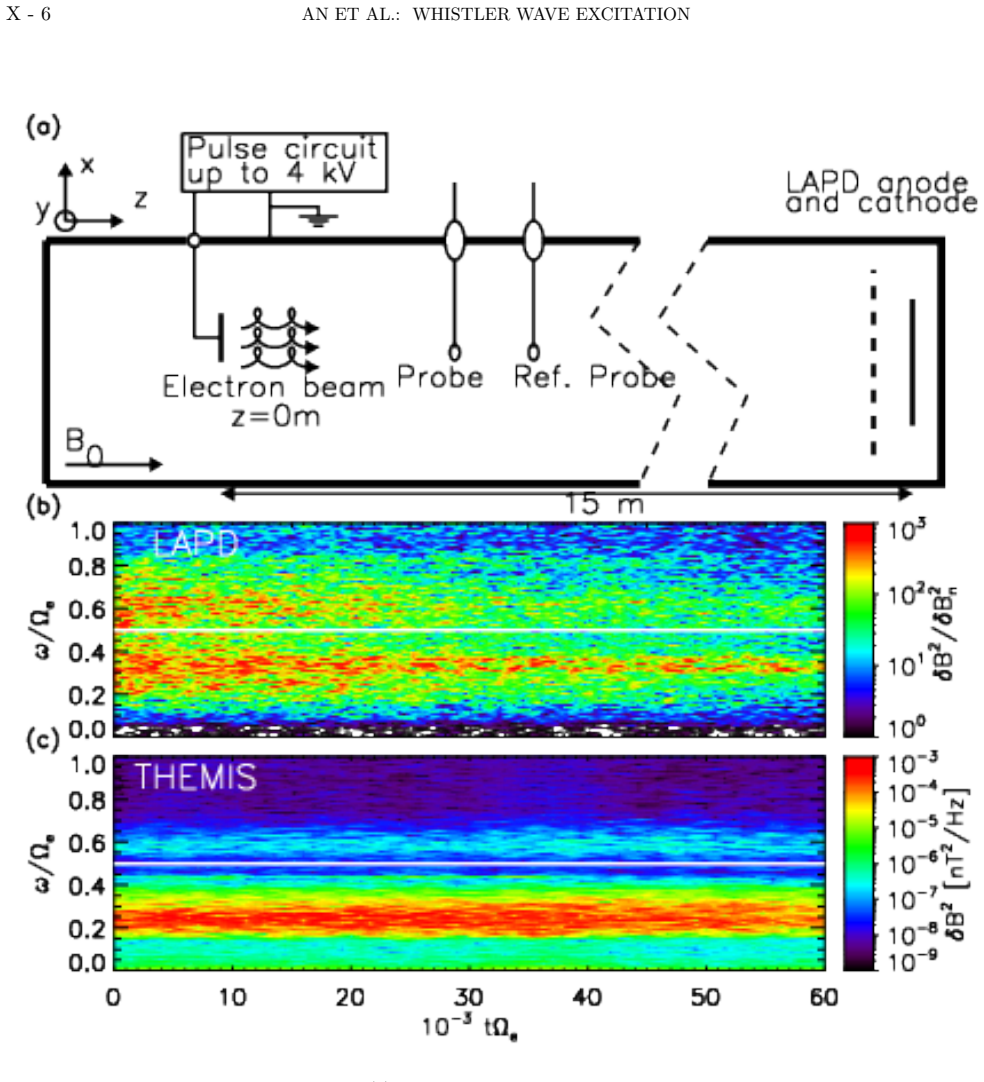
The central discovery is that a helical electron beam in a cold, magnetized afterglow plasma excites broadband whistler waves whose frequency spectrum has the same two-band shape as magnetospheric chorus, with a gap near half the electron gyrofrequency. Reconstructing the wave field with a phase-correlation technique, the experiment resolves wave energy in wavenumber space organized along the resonance conditions $\omega - k_z v_d = n\Omega_e$ for $n = 1, 0, -1$, which the paper interprets as normal cyclotron, Landau, and anomalous cyclotron resonances acting simultaneously. The normal cyclotron mode is the dominant, quasi-parallel, counter-streaming wave and carries the largest amplitude; the Landau and anomalous cyclotron modes are oblique, with wave-normal angles near the resonance cone. Linear hot-plasma dispersion calculations using a beam-ring distribution reproduce all three branches in approximately the correct locations with consistent wave-normal angles, and parameter scans show that spectral peaks shift with plasma density and beam energy exactly as the resonance condition predicts.
Load-bearing premise
The growth-rate calculations depend on an assumed shape for the electron beam's velocity distribution, inferred from how the beam relaxes and from geometry rather than from direct measurement; if that assumed shape is wrong, the match with observations does not independently confirm the resonance mechanism.
Editorial extensions
If this is right
- A two-band chorus spectrum with a gap at $0.5\Omega_e$ can be produced by a single unmodulated beam-ring electron distribution, simply because the three resonance branches populate different frequency ranges.
- Linear growth-rate theory can predict the dominant frequency and wave-normal angle of beam-excited whistler waves without invoking nonlinear mechanisms, at least for the parameter range tested.
- Very oblique lower-band chorus waves in the magnetosphere may be explained by low-energy electron beams generating waves through simultaneous cyclotron and Landau resonances, a mechanism the experiment reproduces in scaled laboratory conditions.
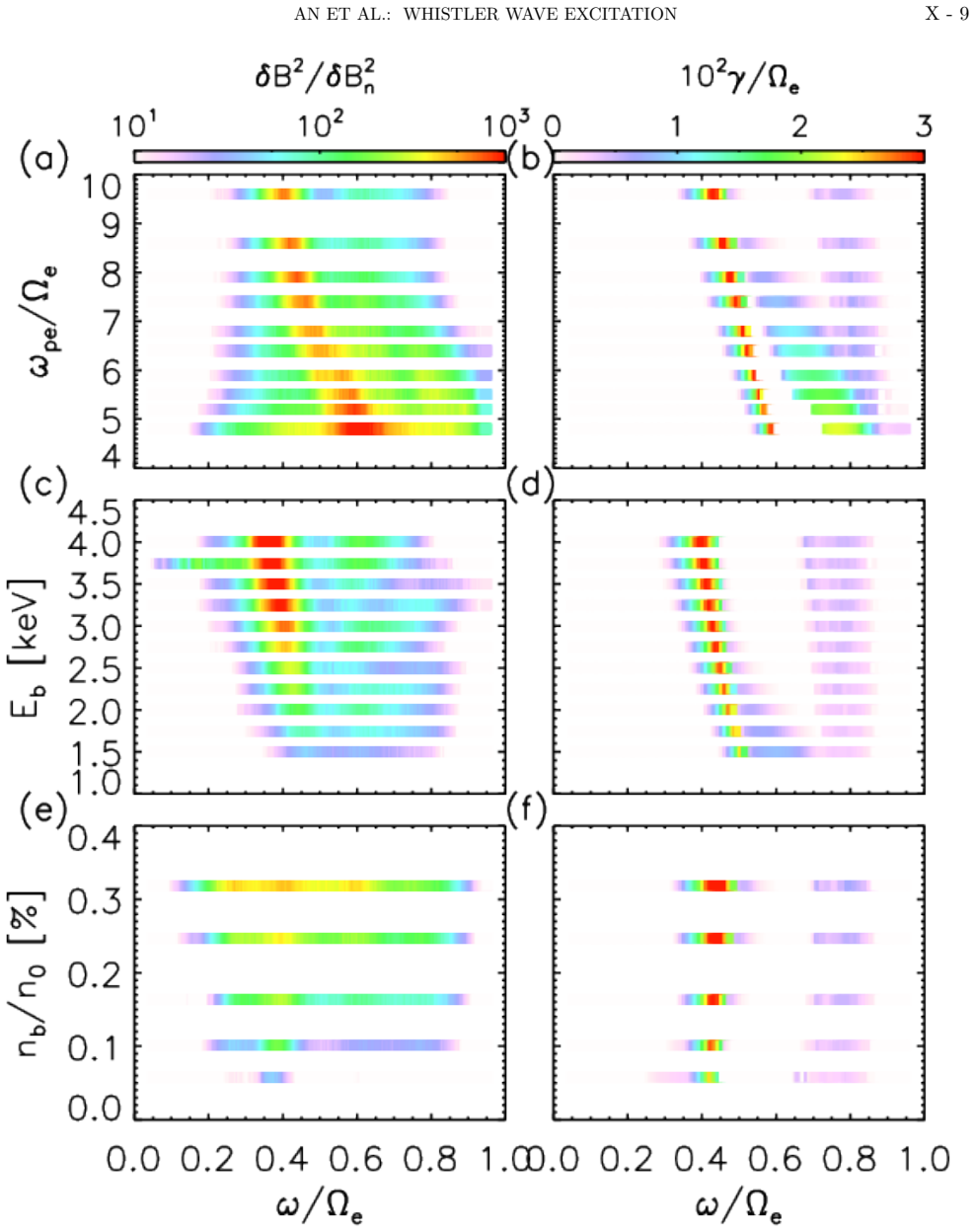
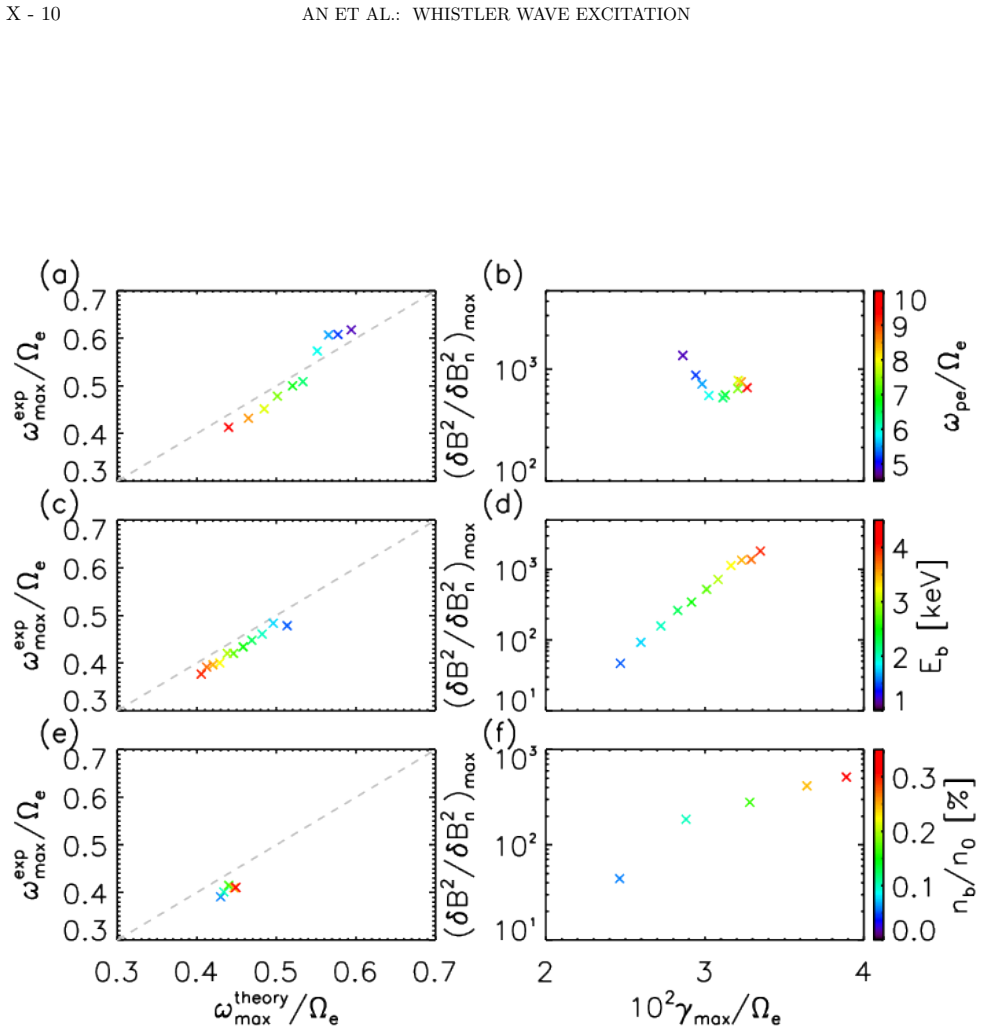
- The spectral peak frequency of whistler waves should shift upward when the background plasma density or the beam energy decreases, because the cyclotron resonance condition must remain satisfied.
- The dominant, most intense modes will be quasi-parallel and counter-streaming relative to the beam, consistent with the primarily parallel propagation of lower-band chorus.
Reading between the lines
- If direct velocity-space measurements of the beam electrons were added, the inferred beam-ring parameters could be checked rather than assumed; the paper itself lists beam-distribution diagnostics as a future need.
- The experiment uses a beam-ring distribution, whereas magnetospheric chorus is usually attributed to a bi-Maxwellian anisotropic distribution; if the same three-branch resonance structure appears for both, resonance-branch analysis could unify different chorus generation theories.
- The inverse correlation between saturated wave power and linear growth rate at low plasma density suggests nonlinear processes take over control of wave amplitude there; a dedicated scan at even smaller $n_b/n_0$ could identify where linear growth stops predicting saturation.
- The phase-correlation mapping technique could be applied to other unmodulated beam-plasma experiments to test whether $n = \pm1$ and $n=0$ resonance branches appear near other plasma boundaries.
Signed reviews
Editorial analysis
A structured set of objections, weighed in public.
Referee Report
Summary. This letter reports laboratory observations on the Large Plasma Device of whistler-mode waves excited by a helical electron beam injected into a cold helium plasma. The authors use a phase-correlation technique with moving and fixed magnetic probes to reconstruct the three-dimensional mode structure, from which they extract parallel and perpendicular wavenumbers as functions of frequency. The resulting k_z-omega diagram shows the measured waves aggregating onto three resonance lines corresponding to omega - k_z u = n Omega_e with n = 1, 0, -1, which they identify as normal cyclotron, Landau, and anomalous cyclotron resonance branches. They compare these observations with linear growth rate calculations from the HOTRAY code, using a beam-ring distribution function described by Eq. (2), and report qualitative and quantitative agreement in branch locations, wave normal angles, and parametric dependencies for scans of plasma density, beam energy, and beam density. The main claim is that this experiment demonstrates simultaneous excitation of whistler waves through three resonance mechanisms and that linear theory reproduces the major observed features.
Significance. If the results hold, this is a valuable laboratory demonstration that a helical electron beam in a cold plasma can spontaneously excite whistler-mode waves through three simultaneous resonance branches, and that the experimentally measured mode structure can be organized onto the corresponding resonance conditions. The phase-correlation technique used to extract the k_z-omega dispersion is a strength and provides the first, to my knowledge, direct experimental measurement of the resonance structure of beam-driven whistler waves in a laboratory plasma. The parameter scans in Section 4, especially the peak-frequency dependencies, lend support to the cyclotron-resonance interpretation. However, the comparison to linear theory depends on a four-parameter model beam distribution that is not directly measured, and the manuscript contains no sensitivity analysis for those parameters. In addition, two acknowledged discrepancies -- the poorly captured Landau branch above 0.4 Omega_e and the inverse intensity correlation in the low-density scan limit the strength of the 'linear theory captures the observations' claim.
major comments (3)
- [Section 3, Eq. (2), Fig. 3(c,d)] The HOTRAY calculations rely on four unmeasured beam distribution parameters (vd, alpha_parallel, alpha_perp, beta) that are inferred from Langmuir-relaxation scaling and beam geometry arguments. Since no direct measurement of the beam distribution is available, the agreement between the computed resonance branches and the observed kz-omega structure is not an independent confirmation of the excitation mechanism. I request a systematic sensitivity analysis in which each parameter is varied over a physically plausible range while the others are held fixed, with the resulting changes in linear growth rates, branch locations, and wave normal angles shown. If the qualitative agreement is robust to such variations, the claim is substantially strengthened; if it is not, the inference procedure must be made explicit and justified.
- [Section 3, final paragraph] The manuscript states that waves in Landau resonance with the beam in the frequency range omega/Omega_e > 0.4 are 'not well captured by the linear growth rate calculations.' This is an explicit discrepancy in one of the three claimed resonance branches, and it appears to be at odds with the Abstract's statement that 'linear wave growth rates captures the major observations.' Please either quantify the discrepancy (e.g., by comparing the computed growth rates and observed power for that branch) or provide a more complete model that incorporates the spatial growth geometry described in the same paragraph. At minimum, the Abstract and Summary should be qualified so that the reader is not left with the impression that all three resonance branches are equally well reproduced by the linear calculation.
- [Section 4, Fig. 5(b)] The claim that linear theory shows 'consistent behavior in both intensity and wave normal angle' is only partially supported by the parameter scans. While the spectral peak frequencies agree well, the saturated wave power and the maximum linear growth rate are inversely correlated in the low plasma density regime, as shown in Fig. 5(b). The text acknowledges this but does not provide a quantitative explanation. Please clarify how this inverse correlation is consistent with the central claim, or explicitly restrict the 'intensity' part of the claim to the regimes where a positive correlation is observed. Without this, the reader cannot assess whether the mismatch represents a physical limitation of linear theory or an artifact of the comparison procedure.
minor comments (5)
- [Section 3, Eq. (2)] The parameter beta is described as a 'ring-distribution shape parameter,' but the normalization of Eq. (2) becomes singular for beta = 1. Please state the allowed range of beta and note that values in (0,1) are assumed throughout.
- [Section 3, Fig. 3] The wave normal angle is reported as values above 90 degrees (e.g., WNA about 105 degrees for the cyclotron mode). Since wave normal angle is often defined in the range [0,90] degrees, please state the sign convention used here, for example whether psi = arccos(k_z/k) with signed k_z, so that counter-streaming waves take values between 90 and 180 degrees.
- [Section 4, captions of Fig. 4] The caption says 'maximum linear growth rates' while the text says the largest linear growth rate is extracted over all possible WNAs for each frequency. Please clarify whether the maximum is taken over WNA only, and whether the same mode (cyclotron, Landau, or anomalous) is selected consistently across the scan.
- [Section 4] In Fig. 4(a,b), the density scan at fixed beam energy and beam density simultaneously varies omega_pe/Omega_e and n_b/n_0; the text notes this but the coupling between these two dimensionless parameters is not discussed. A brief comment on how the comparison would change if the beam density were adjusted to maintain a constant n_b/n_0 would be helpful.
- [Section 1 and 5] The introduction and summary refer to 'bi-Maxwellian distribution is observed to be responsible for the excitation of whistler-mode chorus waves in space' and to 'a beam ring distribution in velocity space' here. Adding a citation for the space-observation claim and a brief reference to the beam-ring geometry would improve the context.
Circularity Check
No circular derivation: HOTRAY is a forward model with parameters inferred from independent beam-plasma arguments, not from the observed whistler spectrum.
full rationale
The paper's central comparison is between measured kz-omega mode structures (Figures 3a-b) and linear growth rates computed with the HOTRAY code (Figures 3c-d). The HOTRAY input distribution, Eq. (2), has four shape parameters: vd, alpha_parallel, alpha_perp, and beta. These are not fitted to the wave data. The paper states that 'direct measurements of the distribution function are not available at this stage' and that the distribution is 'roughly inferred based on physical arguments.' The inference uses the Langmuir-wave relaxation estimate Delta-v from O'Neil et al. (1971), the trapping condition giving alpha_parallel = sqrt(2 Delta-v), and beam geometry giving alpha_perp = v_perp0, with beta = 0.8 as a lower-limit choice. All of these inputs come from beam parameters and separate plasma physics arguments, not from the measured whistler dispersion or wave normal angles. The resonance lines themselves, omega - kz u = n Omega_e, are a direct kinematic overlay on the experimentally extracted wave numbers, and the HOTRAY growth rates are subsequently computed, not reverse-engineered to match the data. Discrepancies, such as the Landau-resonance modes above 0.4 Omega_e and the inverse relation between saturated power and linear growth rate at low density, are explicitly acknowledged, which further indicates that the linear calculation is not tautologically consistent with the observations. Self-citations to Van Compernolle et al. (2014, 2015) document the beam source and setup rather than supplying the load-bearing resonance mechanism. The lack of direct electron distribution measurements is a legitimate empirical limitation and a correctness risk, but it does not make the derivation circular: the claimed agreement is a forward-model prediction with physically motivated, independently derived inputs. Therefore no circular step is present.
Assumptions & free parameters
free parameters (4)
- vd (beam drift velocity in HOTRAY distribution) =
u - delta_v, where u = v_beam_parallel, delta_v = [2 - (4/3)(nb/n0)^(1/3)] u
- alpha_parallel (parallel thermal spread of beam distribution) =
sqrt(2 delta_v)
- alpha_perp (perpendicular thermal spread) =
v_perp0 (initial perpendicular beam velocity)
- beta (ring-distribution shape parameter) =
0.8
assumptions (5)
- standard math Cold plasma whistler dispersion relation n^2 = omega_pe^2 / [omega (Omega_e cos psi - omega)]
- domain assumption Hot plasma dispersion relation with Maxwellian/ring distributions as implemented in HOTRAY
- standard math Resonance condition omega - k_z u = n Omega_e (n = 1, 0, -1)
- domain assumption Langmuir wave relaxation model of O'Neil et al. (1971) to estimate beam slowing and spread
- domain assumption Spatial growth approximated by temporal growth from a single representative distribution
Cite this review
Pith. "Pith review of Resonant excitation of whistler waves by a helical electron beam." pith.science (2026). https://pith.science/paper/HEH7THBQ
@misc{pith2026190806952,
  author       = {Pith},
  title        = {Pith review of: Resonant excitation of whistler waves by a helical electron beam},
  year         = {2026},
  howpublished = {\url{https://pith.science/paper/HEH7THBQ}},
  note         = {Machine review of arXiv:1908.06952}
}
read the original abstract
Chorus-like whistler-mode waves that are known to play a fundamental role in driving radiation-belt dynamics are excited on the Large Plasma Device by the injection of a helical electron beam into a cold plasma. The mode structure of the excited whistler wave is identified using a phase-correlation technique showing that the waves are excited through a combination of Landau resonance, cyclotron resonance and anomalous cyclotron resonance. The dominant wave mode excited through cyclotron resonance is quasi-parallel propagating, whereas wave modes excited through Landau resonance and anomalous cyclotron resonance propagate at oblique angles that are close to the resonance cone. An analysis of the linear wave growth rates captures the major observations in the experiment. The results have important implications for the generation process of whistler waves in the Earth's inner magnetosphere.
Figures

Figures from the paper (2 more)
Reference graph
Works this paper leans on
-
[1]
Agapitov, O., A. Artemyev, V. Krasnoselskikh, Y. V. Khotyaint- sev, D. Mourenas, H. Breuillard, M. Balikhin, and G. Rolland (2013), Statistics of whistler mode waves in the outer radi- ation belt: Cluster staff-sa measurements, Journal of Geo- physical Research: Space Physics , 118(6), 3407–3420, doi: 10.1002/jgra.50312
-
[2]
(2009), The THEMIS mission , Springer
Angelopoulos, V. (2009), The THEMIS mission , Springer
work page 2009
-
[3]
Bell, T. F., and O. Buneman (1964), Plasma instability in the whistler mode caused by a gyrating electron stream, Phys. Rev., 133, A1300–A1302, doi:10.1103/PhysRev.133.A1300
-
[4]
Burtis, W. J., and R. A. Helliwell (1969), Banded chorusa new type of vlf radiation observed in the magnetosphere by ogo 1 and ogo 3, Journal of Geophysical Research , 74(11), 3002– 3010, doi:10.1029/JA074i011p03002
-
[5]
Cornilleau-Wehrlin, N., R. Gendrin, F. Lefeuvre, M. Par- rot, R. Grard, D. Jones, A. Bahnsen, E. Ungstrup, and W. Gibbons (1978), Vlf electromagnetic waves observed on- board geos-1, Space Science Reviews , 22(4), 371–382, doi: 10.1007/BF00210874
-
[6]
Dupree, T. H. (1966), A perturbation theory for strong plasma turbulence, Physics of Fluids , 9(9)
work page 1966
-
[7]
Farrell, W. M., D. A. Gurnett, P. M. Banks, R. I. Bush, and W. J. Raitt (1988), An analysis of whistler mode radia- tion from the spacelab 2 electron beam, Journal of Geo- physical Research: Space Physics , 93(A1), 153–161, doi: 10.1029/JA093iA01p00153
-
[8]
Fu, X., M. M. Cowee, R. H. Friedel, H. O. Funsten, S. P. Gary, G. B. Hospodarsky, C. Kletzing, W. Kurth, B. A. Larsen, K. Liu, E. A. MacDonald, K. Min, G. D. Reeves, R. M. Skoug, and D. Winske (2014), Whistler anisotropy instabil- ities as the source of banded chorus: Van allen probes ob- servations and particle-in-cell simulations, Journal of Geo- physic...
Show all 40 references
-
[9]
Fu, X., Z. Guo, C. Dong, and S. P. Gary (2015), Nonlinear subcy- clotron resonance as a formationmechanism for gaps in banded chorus, Geophysical Research Letters , 42(9), 3150–3159, doi: 10.1002/2015GL064182, 2015GL064182
2015 doi
-
[10]
Pfister, Z
Gekelman, W., H. Pfister, Z. Lucky, J. Bamber, D. Leneman, and J. Maggs (1991), Design, construction, and properties of the large plasma research device - The LAPD at UCLA, Rev. Sci. Instrum., 62, 2875–2883
1991
-
[11]
W., and J
Gentle, K. W., and J. Lohr (1973), Experimental determination of the nonlinear interaction in a one dimensional beamplasma system, Physics of Fluids , 16(9)
1973
-
[12]
Gurnett, D. A., S. D. Shawhan, and R. R. Shaw (1983), Auro- ral hiss, z mode radiation, and auroral kilometric radiation in the polar magnetosphere: De 1 observations, Journal of Geophysical Research: Space Physics , 88(A1), 329–340, doi: 10.1029/JA088iA01p00329
1983 doi
-
[13]
Gurnett, D. A., W. S. Kurth, J. T. Steinberg, P. M. Banks, R. I. Bush, and W. J. Raitt (1986), Whistler-mode radiation from the spacelab 2 electron beam, Geophysical Research Letters , 13(3), 225–228, doi:10.1029/GL013i003p00225
1986 doi
-
[14]
Yamanaka, M
Hayakawa, M., Y. Yamanaka, M. Parrot, and F. Lefeu- vre (1984), The wave normals of magnetospheric chorus emissions observed on board geos 2, Journal of Geophys- ical Research: Space Physics , 89(A5), 2811–2821, doi: 10.1029/JA089iA05p02811
1984 doi
-
[15]
Horne, R., and S. Sazhin (1990), Quasielectrostatic and electro- static approximations for whistler mode waves in the magne- tospheric plasma, Planetary and Space Science , 38(2), 311 – 318, doi:http://dx.doi.org/10.1016/0032-0633(90)90095-8
1990 doi
-
[16]
Horne, R. B. (1989), Path-integrated growth of electrostatic waves: The generation of terrestrial myriametric radiation, Journal of Geophysical Research: Space Physics , 94(A7), 8895–8909, doi:10.1029/JA094iA07p08895
1989 doi
-
[17]
(1966), Lowfrequency whistler mode, Physics of Flu- ids, 9(11)
Kennel, C. (1966), Lowfrequency whistler mode, Physics of Flu- ids, 9(11)
1966
-
[18]
F., and H
Kennel, C. F., and H. E. Petschek (1966), Limit on stably trapped particle fluxes, Journal of Geophysical Research , 71(1), 1–28, doi:10.1029/JZ071i001p00001
1966 doi
-
[19]
Koons, H. C. (1981), The role of hiss in magnetospheric chorus emissions, Journal of Geophysical Research: Space Physics , 86(A8), 6745–6754, doi:10.1029/JA086iA08p06745. Krafft, C., P. Th´ evenet, G. Matthieussent, B. Lundin, G. Belmont, B. Lemb` ege, J. Solomon, J. Lavergnat,...
1981 doi
-
[20]
R., and A
Kusse, B. R., and A. Bers (1970), Interactions of a plasma with a spiraling electron beam, Physics of Fluids , 13(9)
1970
-
[21]
Lavergnat, J., and R. Pellat (1979), High-frequency spontaneous emission of an electron beam injected into the ionospheric plasma, Journal of Geophysical Research: Space Physics , 84(A12), 7223–7238, doi:10.1029/JA084iA12p07223. AN ET AL.: WHISTLER W A VE EXCITATION X - 5
1979 doi
-
[22]
Gekelman, and J
Leneman, D., W. Gekelman, and J. Maggs (2006), The plasma source of the Large Plasma Device at University of California, Los Angeles, Rev. Sci. Instrum. , 77, 015,108
2006
-
[23]
Li, W., R. M. Thorne, J. Bortnik, X. Tao, and V. Angelopoulos (2012), Characteristics of hiss-like and discrete whistler-mode emissions, Geophysical Research Letters, 39(18), n/a–n/a, doi: 10.1029/2012GL053206, l18106
2012 doi
-
[24]
Bortnik, R
Li, W., J. Bortnik, R. M. Thorne, C. M. Cully, L. Chen, V. Angelopoulos, Y. Nishimura, J. B. Tao, J. W. Bonnell, and O. LeContel (2013), Characteristics of the poynting flux and wave normal vectors of whistler-mode waves observed on themis, Journal of Geophysical Research: Spac...
2013 doi
-
[25]
Liu, K., S. P. Gary, and D. Winske (2011), Excitation of banded whistler waves in the magnetosphere, Geophysical Research Letters, 38(14), L14,108, doi:10.1029/2011GL048375
2011 doi
-
[26]
Maggs, J. E. (1976), coherent generation of vlf hiss, Jour- nal of Geophysical Research , 81(10), 1707–1724, doi: 10.1029/JA081i010p01707
1976 doi
-
[27]
Sugaya, and S
Mizuno, K., R. Sugaya, and S. Tanaka (1971), erenkov and cyclotron excitation of bernstein waves with elec- tron beams, Physics Letters A , 36(5), 441 – 442, doi: http://dx.doi.org/10.1016/0375-9601(71)90299-4
1971 doi
-
[28]
Mourenas, D., A. V. Artemyev, O. V. Agapitov, V. Kras- noselskikh, and F. S. Mozer (2015), Very oblique whistler generation by low-energy electron streams, Journal of Geo- physical Research: Space Physics , 120(5), 3665–3683, doi: 10.1002/2015JA021135, 2015JA021135
2015 doi
-
[29]
Neubert, T., and P. M. Banks (1992), Recent results from studies of electron beam phenomena in space plasmas, Planetary and Space Science , 40(23), 153 – 183, doi: http://dx.doi.org/10.1016/0032-0633(92)90055-S
1992 doi
-
[30]
Hikishima, Y
Omura, Y., M. Hikishima, Y. Katoh, D. Summers, and S. Yagi- tani (2009), Nonlinear mechanisms of lower-band and upper- band vlf chorus emissions in the magnetosphere, Journal of Geophysical Research: Space Physics , 114(A7), A07,217, doi: 10.1029/2009JA014206. O’Neil, T. M., J...
2009 doi
-
[31]
Pope, J. H. (1963), A high-latitude investigation of the nat- ural very-low-frequency electromagnetic radiation known as chorus, Journal of Geophysical Research , 68(1), 83–99, doi: 10.1029/JZ068i001p00083
1963 doi
-
[32]
Santolk, O., D. A. Gurnett, J. S. Pickett, J. Chum, and N. Cornilleau-Wehrlin (2009), Oblique propagation of whistler mode waves in the chorus source region, Journal of Geo- physical Research: Space Physics , 114(A12), n/a–n/a, doi: 10.1029/2009JA014586, a00F03
2009 doi
-
[33]
Bullough, and M
Sazhin, S., K. Bullough, and M. Hayakawa (1993), Auroral hiss: a review, Planetary and Space Science , 41(2), 153 – 166, doi: http://dx.doi.org/10.1016/0032-0633(93)90045-4
1993 doi
-
[34]
Krafft (1999), Resonant cyclotron emis- sion of whistler waves by a modulated electron beam, Phys
Starodubtsev, M., and C. Krafft (1999), Resonant cyclotron emis- sion of whistler waves by a modulated electron beam, Phys. Rev. Lett., 83, 1335–1338, doi:10.1103/PhysRevLett.83.1335
1999 doi
-
[35]
Krafft, P
Starodubtsev, M., C. Krafft, P. Thvenet, and A. Kostrov (1999), Whistler wave emission by a modulated electron beam through transition radiation, Physics of Plasmas , 6(5)
1999
-
[36]
Stenzel, R. L. (1977), Observation of beam-generated vlf hiss in a large laboratory plasma, Journal of Geophysical Research , 82(29), 4805–4814, doi:10.1029/JA082i029p04805
1977 doi
-
[37]
Thorne, R., W. Li, B. Ni, Q. Ma, J. Bortnik, L. Chen, D. Baker, H. E. Spence, G. Reeves, M. Henderson, C. A. AU Kletzing, W. S. Kurth, G. B. Hospodarsky, J. B. Blake, J. F. Fen- nell, S. G. Claudepierre, and S. G. Kanekal (2013), Rapid local acceleration of relativistic radiat...
2013 doi
-
[38]
Thorne, R. M. (2010), Radiation belt dynamics: The importance of wave-particle interactions, Geophysical Research Letters , 37(22), L22,107, doi:10.1029/2010GL044990
2010 doi
-
[39]
Tokar, R. L., D. A. Gurnett, and W. C. Feldman (1984), Whistler mode turbulence generated by electron beams in earth’s bow shock, Journal of Geophysical Research: Space Physics, 89(A1), 105–114, doi:10.1029/JA089iA01p00105
1984 doi
-
[40]
T., and E
Tsurutani, B. T., and E. J. Smith (1974), Postmidnight chorus: A substorm phenomenon, Journal of Geophysical Research , 79(1), 118–127, doi:10.1029/JA079i001p00118. Van Compernolle, B., J. Bortnik, P. Pribyl, W. Gekelman, M. Nakamoto, X. Tao, and R. M. Thorne (2014), Direct de...
1974 doi
Reviewed August 14, 2026 · model on record in the stance chip above.
Discussion (0). Continue with ORCID to comment.