Datasets for Face and Object Detection in Fisheye Images
Pith reviewed 2026-05-25 14:36 UTC · model grok-4.3
The pith
Two synthetic fisheye datasets are created from standard collections to train face and object detectors.
A machine-rendered reading of the paper's core claim, the machinery that carries it, and where it could break.
Core claim
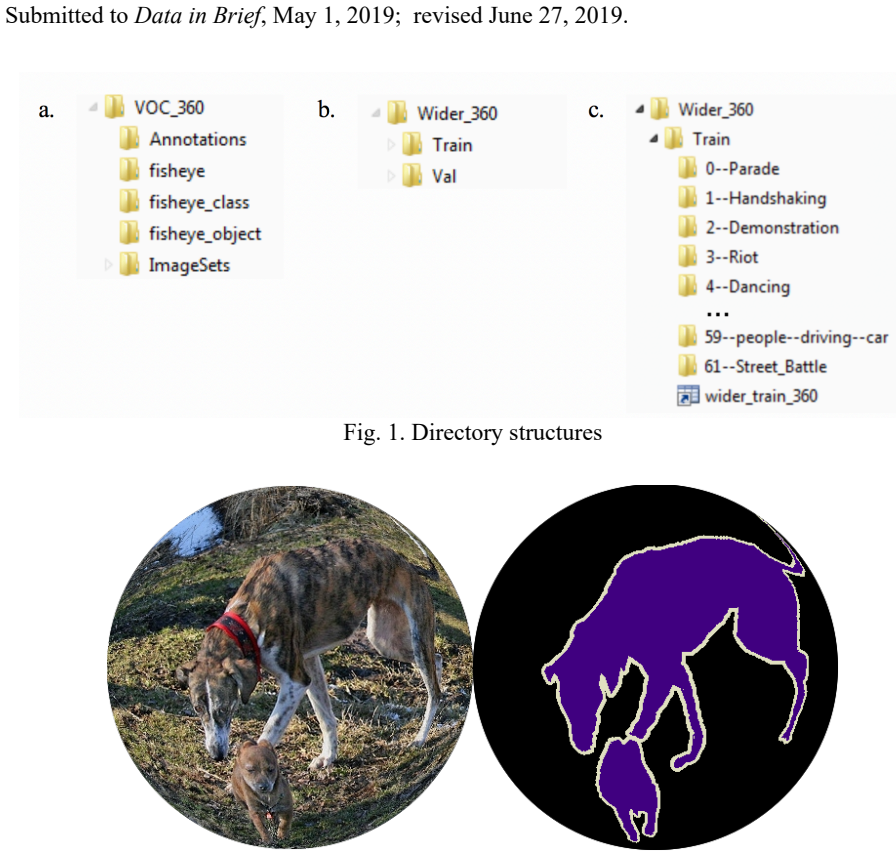
We present two new fisheye image datasets for training face and object detection models: VOC-360 and Wider-360. The fisheye images are created by post-processing regular images collected from two well-known datasets, VOC2012 and Wider Face, using a model for mapping regular to fisheye images implemented in Matlab. VOC-360 contains 39,575 fisheye images for object detection, segmentation, and classification. Wider-360 contains 63,897 fisheye images for face detection. These datasets will be useful for developing face and object detectors as well as segmentation modules for fisheye images while the efforts to collect and manually annotate true fisheye images are underway.
What carries the argument
The Matlab model for mapping regular images to fisheye images, which transforms the source datasets into the new labeled fisheye collections.
If this is right
- Object detection and segmentation models can be trained directly on the 39,575 labeled images in VOC-360.
- Face detection models can be trained on the 63,897 labeled images in Wider-360.
- Development of fisheye-specific detectors and segmentation modules can proceed without waiting for new manual annotations.
- The datasets serve as a temporary resource until collections of true fisheye images become available.
Where Pith is reading between the lines
- The same mapping process could be applied to additional existing datasets to expand coverage of fisheye tasks.
- Models trained on these synthetic sets could later be compared against models trained on real fisheye captures to measure domain gap.
- The approach offers a fast way to generate training data for any lens distortion model once the mapping code exists.
Load-bearing premise
The generated fisheye images match real camera captures closely enough to produce useful trained models.
What would settle it
Training detectors on the new datasets and measuring large accuracy drops when the same models are tested on images captured by actual fisheye cameras.
Figures
read the original abstract
We present two new fisheye image datasets for training face and object detection models: VOC-360 and Wider-360. The fisheye images are created by post-processing regular images collected from two well-known datasets, VOC2012 and Wider Face, using a model for mapping regular to fisheye images implemented in Matlab. VOC-360 contains 39,575 fisheye images for object detection, segmentation, and classification. Wider-360 contains 63,897 fisheye images for face detection. These datasets will be useful for developing face and object detectors as well as segmentation modules for fisheye images while the efforts to collect and manually annotate true fisheye images are underway.
Editorial analysis
A structured set of objections, weighed in public.
Referee Report
Summary. The manuscript introduces two new datasets for fisheye image analysis: VOC-360, derived from VOC2012 and containing 39,575 images for object detection, segmentation, and classification, and Wider-360, derived from Wider Face and containing 63,897 images for face detection. The fisheye images are generated by post-processing the original perspective images using a Matlab-implemented mapping model, serving as a temporary resource until real fisheye images can be collected and annotated.
Significance. If the synthetic fisheye images accurately represent the distortions of actual fisheye cameras, these datasets could provide valuable training material for developing specialized detection and segmentation models. The paper's approach of leveraging existing annotated datasets is efficient, but the lack of any validation or baseline experiments in the provided text limits the assessed significance to the data release itself.
minor comments (2)
- [Abstract] The mapping model is referred to only generically as 'a model for mapping regular to fisheye images implemented in Matlab' without providing the specific model, parameters, or code, which would be necessary for full reproducibility of the datasets.
- [Abstract] It is not stated how the original annotations are handled or transformed under the fisheye mapping, which is essential for the datasets to be usable for supervised detection tasks.
Simulated Author's Rebuttal
We thank the referee for their review and recommendation of minor revision. The manuscript is a data release paper, and we address the single point raised in the significance assessment below.
read point-by-point responses
-
Referee: If the synthetic fisheye images accurately represent the distortions of actual fisheye cameras, these datasets could provide valuable training material for developing specialized detection and segmentation models. The paper's approach of leveraging existing annotated datasets is efficient, but the lack of any validation or baseline experiments in the provided text limits the assessed significance to the data release itself.
Authors: We agree that the manuscript's contribution is the release of the two synthetic datasets (VOC-360 and Wider-360) created via the described Matlab mapping from existing annotated sources. As is standard for dataset papers, we do not include baseline detection experiments or quantitative validation of the synthetic distortion model; the text focuses on dataset construction, statistics, and intended use cases while real fisheye collection efforts continue. This scope is intentional and does not require revision. revision: no
Circularity Check
No circularity in derivation chain
full rationale
The paper is a dataset announcement describing the generation of VOC-360 and Wider-360 via post-processing of VOC2012 and Wider Face images with a fixed Matlab mapping model. No equations, predictions, fitted parameters, uniqueness theorems, or self-citations appear in the provided text. The claim reduces directly to the stated transformation process with no internal reduction or load-bearing assumption that loops back on itself.
Axiom & Free-Parameter Ledger
Reference graph
Works this paper leans on
-
[2]
Data We present two new datasets - VOC-360 and Wider-360 - for visual analytics based on fisheye images. The datasets contain raw data files: JPG images (both datasets), XML annotations (VOC-360) and MAT file annotations (Wider-360). VOC-360 can be used to train machine learning models for object detection, classification, and segmentation. Wider-360 can ...
work page 2019
-
[3]
Sample fisheye image with its ground-truth bounding boxes from Wider-360 Submitted to Data in Brief, May 1, 2019; revised June 27,
work page 2019
-
[5]
M. Everingham, L. Van Gool, C. K. I. Williams, J. Winn, and A. Zisserman. The PASCAL Visual Object Classes Challenge 2012 (VOC2012) Results. http://www.pascal-network.org/challenges/VOC/voc2012/workshop/index.html
work page 2012
-
[6]
Submitted to Data in Brief, May 1, 2019; revised June 27,
work page 2019
-
[7]
Specifications Table Subject area Computer vision, pattern recognition, machine learning More specific subject area Object classification, object detection, object recognition, object segmentation, face detection Type of data Images, annotations How data was acquired Data was created by processing images and annotations from two existing public datasets: ...
discussion (0)
Sign in with ORCID, Apple, or X to comment. Anyone can read and Pith papers without signing in.