REVIEW 3 major objections 7 minor 40 references
SourceDetMamba: A Graph-aware State Space Model for Source Detection in Sequential Hypergraphs
T0 review · 3 major / 7 minor · reviewed 2026-08-15 · deepseek-v4-flash
Pith's one-line read SourceDetMamba claims that replaying hypergraph rumor snapshots in reverse order through a Mamba state space model with a graph-aware state update detects rumor sources more accurately and faster than state-of-the-art baselines.
desk verdict The architecture is a plausible new combination, but the empirical claim is undermined by an input-information asymmetry: the model gets infection timestamps and the baselines apparently don't, which could explain the entire reported margin. read the letter →
The pith
A machine-rendered reading of the paper's core claim, the machinery that carries it, and where it could break.
The reading
What carries the argument
The load-bearing mechanism is the graph-aware state update inside a Mamba state space model. Mamba is a selective state space model that processes sequences in linear time by maintaining a hidden state; here the hidden state of each node is not updated only from the sequence input $B x_t$ and the recurrent term $A h_{t-1}$, but also gets a topological term $H D_E^{-1} \Omega H^T D_V^{-1} h_{t-1}$ that propagates and refines states through hyperedges in two stages. This term is what lets the model combine temporal dependencies with hypergraph structure, and the learned hyperedge weights $\Omega$ let different hyperedges contribute according to their role in the spread.
What would settle it
Train SourceDetMamba on the paper's synthetic cascades and evaluate it on real social-media rumor traces with independently verified ground-truth sources using the same three snapshots; if its F-Score no longer beats GIN-SD and IVGD by the reported margins, the central claim that reverse-order snapshot learning generalizes to real propagation dynamics is falsified.
Extended reading notes
Core claim
The central claim is that SourceDetMamba detects rumor sources more accurately than existing methods because it learns the propagation process directly from sequential hypergraph snapshots rather than from a fitted model or a single snapshot. Snapshots are fed in reverse order, so the first element the model sees is the most recent state and the last is the earliest, and the final output element is used to identify sources. To keep the topology from being lost, the paper adds a graph-aware state update: each node's state is updated as $h_t = A h_{t-1} + B x_t + H D_E^{-1} \Omega H^T D_V^{-1} h_{t-1}$, where the added term aggregates neighbor states through node-to-hyperedge and hyperedge-to-node passes, with hyperedge weights learned from the current state. On eight datasets, the method reports consistently higher ACC, F-Score, and AUC than all baselines, with the largest claimed gains over propagation-aware methods.
Load-bearing premise
The reported gains depend on cascades generated by the paper's synthetic heterogeneous independent cascade model—5% random sources, $p_i \sim U(0,0.5)$, high-order thresholds $p_\Delta = 0.3$ times the informed fraction, snapshots at 10/20/30% informed—faithfully representing real rumor dynamics; if real cascades have different thresholds, recovery, or observation noise, the reversal-learning signal may disappear.
Editorial extensions
If this is right
- On cascade data generated by similar hypergraph contagion models, SourceDetMamba should keep beating propagation-fitting baselines across the eight datasets evaluated, since the multi-snapshot reverse-order signal is the source of the gain.
- Removing any component of the design—the sequential snapshots, the positional encodings, or the graph-aware state update—degrades performance, so each part is doing load-bearing work.
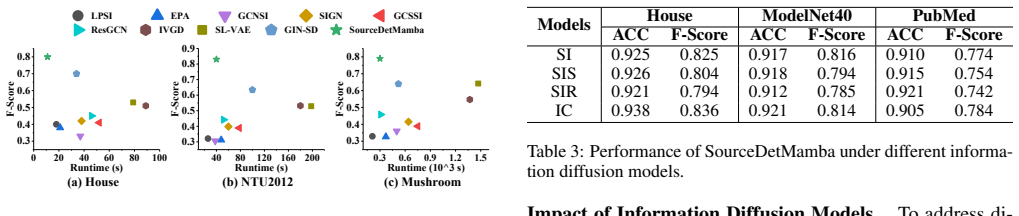
- The method stays accurate under SI, SIS, SIR, and IC diffusion models, with a slight drop when sources can recover, so the reversal signal is not tied to one specific spreading rule.
- Because the model reads only snapshots and outputs source scores directly, it avoids the extra error of first fitting a propagation model to the observed state.
- Snapshot interval matters: intervals too small miss dynamics and intervals too large over-weight non-source influence, so choosing an appropriate observation timescale is part of the method's success.
Reading between the lines
- A testable extension is to train on synthetic cascades and evaluate on real propagation traces with verified ground-truth sources; if the reported gains shrink, the synthetic-cascade assumption would be the bottleneck.
- The same reversal-learning recipe could apply to other inverse problems on temporal hypergraphs, such as identifying the first adopters in opinion dynamics or the origin of a computer worm, where reverse-ordered snapshots are available.
- The graph-aware state update is a generic plug-in for Mamba-style models, so it could be used not just for source detection but for any sequential task on hypergraphs that needs topology-aware hidden states.
- Because hyperedge weights are learned per state, the model may implicitly identify which group interactions carried the rumor, giving a by-product explanation of the main transmission channels—something the paper does not test.
Signed reviews
Editorial analysis
A structured set of objections, weighed in public.
Referee Report
Summary. The paper proposes SourceDetMamba, a state-space-model-based method for source detection in sequential hypergraph snapshots. Hypergraph snapshots are embedded with user states, diffusion timestamps, and Laplacian positional encodings, then fed in reverse chronological order into Mamba blocks. A graph-aware state update mechanism propagates node states through hyperedges, and the final sequence element is used for per-node source classification. Experiments on eight datasets with synthetic hypergraph propagation report consistent and substantial improvements over nine baselines in ACC, F-Score, and AUC, plus an ablation study of the main components.
Significance. If the empirical claims hold, the paper provides a meaningful step toward using linear-complexity sequence models for temporal source localization on higher-order networks. The idea of reverse-order snapshot sequences and a graph-aware state update is interesting and the ablations are largely consistent. However, the evaluation rests on a potentially privileged input feature (exact infection timestamps), and the results are reported without variance or code release, so the magnitude of the stated advantage over baselines is not yet verified. The paper also contains a technical inconsistency in its description of the state-space convolution kernel.
major comments (3)
- [§4.1 Eq. (4); §5.1; §5.2] The diffusion timestamp feature X2_i = t_{v_i} is given only to SourceDetMamba for every informed node. In the Section 5.1 simulation, propagation starts at t=0 with 5% randomly selected sources, so the true sources are exactly the informed nodes with t_{v_i}=0. A trivial rule that flags these nodes would solve the task. The paper does not state that the nine baselines receive this timestamp feature; Section 5.1 only mentions that hypergraph snapshots are clique-expanded before being applied to baselines. Table 2 ablates positional encodings and the graph-aware state update, but never ablates the timestamp feature, so the 10%-23% accuracy advantage claimed in Section 5.2 may stem from an input-information asymmetry rather than from the proposed Mamba mechanism. Please either remove the timestamp feature from SourceDetMamba, provide equivalent temporal information to all baselines, or add an ablation 'w/o timestamps' and a comparison against a threshold-based rule (informed and t=0) to establish that the reported gains survive without this privileged information.
- [§5.1; Table 3] All evaluations are on synthetic cascades generated by a heterogeneous independent cascade model with 5% random sources and p_i ~ U(0,0.5). The central claim of 'consistently outperforms state-of-the-art approaches' therefore depends on the faithfulness of this simulation to real rumor dynamics on hypergraphs. The paper does not justify that the reversal-learning signal remains strong under different thresholds, recovery, or observation noise. Table 3 tests SIR/SIS but only for SourceDetMamba, not for baselines, and no variance is reported. Please add experiments with observation noise or partial observability, report baseline performance under SIR/SIS, and explicitly discuss this synthetic-data limitation in the text.
- [§4.2] The paragraph states that 'by utilizing convolution kernel K = (CB, CAB, ..., CA^k B, ...), we achieve the sequence-to-sequence transformation through y = X' * K'. This convolution representation is valid for a linear time-invariant (LTI) state space model, but the paragraphs immediately before introduce Mamba's selective SSM, where B, C, and Δ are input-dependent functions, so a fixed convolution kernel does not exist. The description as written is internally inconsistent. Please correct this to state that the selective-scan (input-dependent) formulation is used, and that the convolution form applies only in the non-selective LTI case, or remove the fixed-K statement entirely.
minor comments (7)
- [§5.1; Table 1] No standard deviations, confidence intervals, or repeated runs are reported. Since neural network training is stochastic, please report mean and standard deviation over at least five random seeds for the proposed method and all baselines.
- [§5.1] The eight datasets are standard machine learning benchmark datasets used as hypergraph structures; calling them 'real-world datasets' for rumor source detection is misleading because the cascades are simulated. Please clarify that the evaluation is synthetic propagation over real-world hypergraph structures.
- [§3; §4.2] The symbol Ω is overloaded: it denotes the given hyperedge weight matrix in Eqs. (1) and (9) but also the learned hyperedge weights in Eqs. (15)-(16). Please use a different symbol (e.g., Ω̂) for the learned weights.
- [§4.2] In 'y = X′ ∗ K', the star operator is not defined; please specify that it denotes temporal convolution along the sequence dimension, to avoid confusion with graph convolution used elsewhere.
- [§4.3] The sentence 'for a sample x with corresponding label z, L(x,z) = −log(x) × z' is unclear; please rewrite using standard cross-entropy notation for binary classification.
- [§5.3; Table 3] The robustness experiment with SIR/SIS models reports only SourceDetMamba results. For a fair robustness claim, please also report the performance of at least the strongest baselines under these diffusion models.
- [§5.2; Fig. 4] The runtime comparison appears to be on a single device without timing details (e.g., whether timings include data loading) or error bars. Please specify the exact hardware/software configuration and the number of independent runs.
Circularity Check
SourceDetMamba's input feature X2_i is the exact infection timestamp; in the synthetic evaluation sources are precisely the nodes with t=0, so the SOTA result reduces to thresholding the input.
-
self definitional
[Section 4.1, Eq. (4); Section 5.1, Implementation; Section 3, Propagation Process on Hypergraphs]
"Diffusion information X2 i is defined as: X2 i = tvi, vi∈G+ ti; −1, otherwise. (4) ... The propagation process is triggered by randomly selecting 5% of the nodes as sources. ... the initially uninformed source nodes transition to the informed state at t = 0, triggering the spread of information."
The ground-truth source set in the synthetic benchmark is, by construction, the nodes with infection time t=0: Section 3 states sources transition to informed at t=0, and Section 5.1 triggers propagation by randomly selecting 5% of nodes as sources. Eq. (4) gives every informed node's exact infection time t_{v_i} as input feature X2_i. Therefore the target label (is source) is a deterministic function of the input feature (X2_i == 0) up to learned thresholding; no propagation-pattern learning or graph-aware state update is needed to solve the task. Table 2 ablates positional encodings and the graph-aware update but never removes X2_i, so the reported 10%-23% SOTA margin in Section 5.2 is consistent with input-information asymmetry rather than with the proposed mechanism.
full rationale
The paper is otherwise empirically self-contained: no fitted parameter is renamed as a prediction, and the citations to the authors' prior GIN-SD and to Mamba are not load-bearing for the architecture's derivation. However, the central empirical claim is compromised because the timestamp feature in Eq. (4) encodes the answer in the synthetic setup: sources are exactly the nodes with t=0. The 'reverse-order Mamba learns propagation patterns' explanation is therefore circular with respect to the evaluation design. If the timestamp feature were removed or the baselines were also given it, the comparison could still support the method, but as reported the SOTA advantage is forced by construction. Score 8 reflects that the main empirical result reduces to the input feature by definition.
Assumptions & free parameters
free parameters (6)
- source fraction =
5% (0.05)
- low-order propagation probability p_i =
Uniform(0, 0.5)
- high-order transition probability coefficient =
0.3
- snapshot capture thresholds =
10%, 20%, 30% informed
- loss imbalance weight xi =
|s| / (n - |s|)
- regularization and optimization hyperparameters =
lr=1e-3, weight decay=1e-5, state size=128, two Mamba layers
assumptions (5)
- domain assumption Rumor propagation on the tested hypergraphs is adequately described by the heterogeneous independent cascade model with the stated low- and high-order probabilities.
- domain assumption The observed snapshots (10%, 20%, 30% informed) contain enough information to uniquely or approximately identify the source set.
- domain assumption Reverse chronological snapshot order provides a learnable signal of propagation dynamics.
- standard math Mamba state-space recurrence (Eq. 10) and hypergraph convolution (Eq. 9) from cited prior work are accepted as given.
- domain assumption Laplacian positional encodings of the infected subgraph are informative about source location.
Cite this review
Pith. "Pith review of SourceDetMamba: A Graph-aware State Space Model for Source Detection in Sequential Hypergraphs." pith.science (2026). https://pith.science/paper/HEYYDJR2
@misc{pith2026250512910,
  author       = {Pith},
  title        = {Pith review of: SourceDetMamba: A Graph-aware State Space Model for Source Detection in Sequential Hypergraphs},
  year         = {2026},
  howpublished = {\url{https://pith.science/paper/HEYYDJR2}},
  note         = {Machine review of arXiv:2505.12910}
}
read the original abstract
Source detection on graphs has demonstrated high efficacy in identifying rumor origins. Despite advances in machine learning-based methods, many fail to capture intrinsic dynamics of rumor propagation. In this work, we present SourceDetMamba: A Graph-aware State Space Model for Source Detection in Sequential Hypergraphs, which harnesses the recent success of the state space model Mamba, known for its superior global modeling capabilities and computational efficiency, to address this challenge. Specifically, we first employ hypergraphs to model high-order interactions within social networks. Subsequently, temporal network snapshots generated during the propagation process are sequentially fed in reverse order into Mamba to infer underlying propagation dynamics. Finally, to empower the sequential model to effectively capture propagation patterns while integrating structural information, we propose a novel graph-aware state update mechanism, wherein the state of each node is propagated and refined by both temporal dependencies and topological context. Extensive evaluations on eight datasets demonstrate that SourceDetMamba consistently outperforms state-of-the-art approaches.
Figures


Figures from the paper (2 more)

Reference graph
Works this paper leans on
-
[1]
EPA: Exoneration and prominence based age for infection source identification
[Ali et al., 2019] Syed Shafat Ali, Tarique Anwar, Ajay Ras- togi, and Syed Afzal Murtaza Rizvi. EPA: Exoneration and prominence based age for infection source identification. In Proceedings of the 28th ACM International Conference on Information and Knowledge Management, pages 891– 900,
work page 2019
-
[7]
Graph mamba: Towards learning on graphs with state space models
[Behrouz and Hashemi, 2024] Ali Behrouz and Farnoosh Hashemi. Graph mamba: Towards learning on graphs with state space models. In Proceedings of the 30th ACM SIGKDD Conference on Knowledge Discovery and Data Mining, pages 119–130,
2024
-
[8]
On visual similarity based 3d model retrieval
[Chen et al., 2003] Ding-Yun Chen, Xiao-Pei Tian, Yu-Te Shen, and Ming Ouhyoung. On visual similarity based 3d model retrieval. In Computer graphics forum, volume 22, pages 223–232. Wiley Online Library,
work page 2003
-
[9]
Generative hypergraph clustering: From blockmodels to modularity
[Chodrow et al., 2021] Philip S Chodrow, Nate Veldt, and Austin R Benson. Generative hypergraph clustering: From blockmodels to modularity. Science Advances , 7(28):eabh1303,
work page 2021
-
[10]
Social contagion models on hypergraphs
[de Arruda et al., 2020] Guilherme Ferraz de Arruda, Gio- vanni Petri, and Yamir Moreno. Social contagion models on hypergraphs. Physical Review Research, 2(2):023032,
work page 2020
-
[11]
Multiple ru- mor source detection with graph convolutional networks
[Dong et al., 2019] Ming Dong, Bolong Zheng, Nguyen Quoc Viet Hung, Han Su, and Guohui Li. Multiple ru- mor source detection with graph convolutional networks. In Proceedings of the 28th ACM International Conference on Information and Knowledge Management, pages 569– 578,
work page 2019
-
[12]
Wavefront- based multiple rumor sources identification by multi-task learning
[Dong et al., 2022] Ming Dong, Bolong Zheng, Guohui Li, Chenliang Li, Kai Zheng, and Xiaofang Zhou. Wavefront- based multiple rumor sources identification by multi-task learning. IEEE Transactions on Emerging Topics in Com- putational Intelligence, 6(5):1068–1078,
work page 2022
-
[14]
[Feng et al., 2019] Yifan Feng, Haoxuan You, Zizhao Zhang, Rongrong Ji, and Yue Gao. Hypergraph neural networks. In Proceedings of the AAAI Conference on Ar- tificial Intelligence, volume 33, pages 3558–3565,
work page 2019
Show all 40 references
-
[15]
Backdoor attacks on unsu- pervised graph representation learning
[Feng et al., 2024] Bingdao Feng, Di Jin, Xiaobao Wang, Fangyu Cheng, and Siqi Guo. Backdoor attacks on unsu- pervised graph representation learning. Neural Networks, 180:106668,
2024
-
[16]
HGNN+: General hypergraph neural networks
[Gao et al., 2022] Yue Gao, Yifan Feng, Shuyi Ji, and Ron- grong Ji. HGNN+: General hypergraph neural networks. IEEE Transactions on Pattern Analysis and Machine In- telligence, 45(3):3181–3199,
2022
-
[17]
Mamba: Linear- time sequence modeling with selective state spaces
[Gu and Dao, 2023] Albert Gu and Tri Dao. Mamba: Linear- time sequence modeling with selective state spaces. arXiv preprint arXiv:2312.00752,
2023 arXiv
-
[19]
Combining recurrent, convolutional, and continuous-time models with linear state space layers
[Gu et al., 2021] Albert Gu, Isys Johnson, Karan Goel, Khaled Saab, Tri Dao, Atri Rudra, and Christopher R ´e. Combining recurrent, convolutional, and continuous-time models with linear state space layers. Advances in neural information processing systems, 34:572–585,
2021
-
[20]
Efficiently modeling long sequences with structured state spaces
[Gu et al., 2022] Albert Gu, Karan Goel, and Christopher R´e. Efficiently modeling long sequences with structured state spaces. In The International Conference on Learning Representations (ICLR),
2022
-
[21]
Enhancing multi-scale diffusion prediction via sequential hypergraphs and adver- sarial learning
[Jiao et al., 2024] Pengfei Jiao, Hongqian Chen, Qing Bao, Wang Zhang, and Huaming Wu. Enhancing multi-scale diffusion prediction via sequential hypergraphs and adver- sarial learning. In Proceedings of the AAAI Conference on Artificial Intelligence, volume 38, pages 8571–8581,
2024
-
[22]
Semi-supervised classification with graph convolutional networks
[Kipf and Welling, 2017] Thomas N Kipf and Max Welling. Semi-supervised classification with graph convolutional networks. In 5th International Conference on Learning Representations, ICLR,
2017
-
[24]
PointMamba: A simple state space model for point cloud analysis
[Liang et al., 2024] Dingkang Liang, Xin Zhou, Wei Xu, Xingkui Zhu, Zhikang Zou, Xiaoqing Ye, Xiao Tan, and Xiang Bai. PointMamba: A simple state space model for point cloud analysis. In The Thirty-eighth Annual Confer- ence on Neural Information Processing Systems,
2024
-
[25]
Source localization of graph diffusion via variational autoencoders for graph inverse problems
[Ling et al., 2022] Chen Ling, Junji Jiang, Junxiang Wang, and Zhao Liang. Source localization of graph diffusion via variational autoencoders for graph inverse problems. In Proceedings of the 28th ACM SIGKDD Conference on Knowledge Discovery and Data Mining , pages 1010– 1020,
2022
-
[26]
Active surveillance via group sparse bayesian learning
[Pei et al., 2020] Hongbin Pei, Bo Yang, Jiming Liu, and Kevin Chen-Chuan Chang. Active surveillance via group sparse bayesian learning. IEEE Transactions on Pat- tern Analysis and Machine Intelligence, 44(3):1133–1148,
2020
-
[27]
Multi-track message passing: tackling oversmoothing and oversquashing in graph learning via preventing heterophily mixing
[Pei et al., 2024] Hongbin Pei, Yu Li, Huiqi Deng, Jingxin Hai, Pinghui Wang, Jie Ma, Jing Tao, Yuheng Xiong, and Xiaohong Guan. Multi-track message passing: tackling oversmoothing and oversquashing in graph learning via preventing heterophily mixing. In Forty-first Internatio...
2024
-
[28]
Locating the source of diffusion in large-scale networks
[Pinto et al., 2012] Pedro C Pinto, Patrick Thiran, and Mar- tin Vetterli. Locating the source of diffusion in large-scale networks. Physical Review Letters, 109(6):068702,
2012
-
[30]
Rumors in a network: Who’s the culprit? IEEE Transac- tions on Information Theory, 57(8):5163–5181,
[Shah and Zaman, 2011] Devavrat Shah and Tauhid Zaman. Rumors in a network: Who’s the culprit? IEEE Transac- tions on Information Theory, 57(8):5163–5181,
2011
-
[32]
On the equivalence between posi- tional node embeddings and structural graph representa- tions
[Srinivasan and Ribeiro, 2019] Balasubramaniam Srinivasan and Bruno Ribeiro. On the equivalence between posi- tional node embeddings and structural graph representa- tions. In International Conference on Learning Represen- tations,
2019
-
[33]
Multiple source detection without knowing the underlying propagation model
[Wang et al., 2017] Zheng Wang, Chaokun Wang, Jisheng Pei, and Xiaojun Ye. Multiple source detection without knowing the underlying propagation model. In Proceed- ings of the AAAI Conference on Artificial Intelligence, vol- ume 31,
2017
-
[34]
An invertible graph diffusion neural network for source localization
[Wang et al., 2022] Junxiang Wang, Junji Jiang, and Liang Zhao. An invertible graph diffusion neural network for source localization. In Proceedings of the ACM Web Con- ference 2022, pages 1058–1069,
2022
-
[35]
3d shapenets: A deep representation for volumetric shapes
[Wu et al., 2015] Zhirong Wu, Shuran Song, Aditya Khosla, Fisher Yu, Linguang Zhang, Xiaoou Tang, and Jianxiong Xiao. 3d shapenets: A deep representation for volumetric shapes. In Proceedings of the IEEE conference on com- puter vision and pattern recognition , pages 1912–1920,
2015
-
[37]
Locating the propaga- tion source in complex networks with a direction-induced search based gaussian estimator
[Yang et al., 2020] Fan Yang, Shuhong Yang, Yong Peng, Yabing Yao, Zhiwen Wang, Houjun Li, Jingxian Liu, Ruisheng Zhang, and Chungui Li. Locating the propaga- tion source in complex networks with a direction-induced search based gaussian estimator. Knowledge-Based Sys- tems, 1...
2020
-
[38]
Dynamic hypergraph convolutional network
[Yin et al., 2022] Nan Yin, Fuli Feng, Zhigang Luo, Xiang Zhang, Wenjie Wang, Xiao Luo, Chong Chen, and Xian- Sheng Hua. Dynamic hypergraph convolutional network. In 2022 IEEE 38th International Conference on Data En- gineering (ICDE), pages 1621–1634. IEEE,
2022
-
[39]
Catch’em all: Locating multiple diffusion sources in net- works with partial observations
[Zhu et al., 2017] Kai Zhu, Zhen Chen, and Lei Ying. Catch’em all: Locating multiple diffusion sources in net- works with partial observations. In Proceedings of the AAAI Conference on Artificial Intelligence , volume 31,
2017
-
[40]
Locating multi-sources in social networks with a low infection rate
[Zhu et al., 2022] Peican Zhu, Le Cheng, Chao Gao, Zhen Wang, and Xuelong Li. Locating multi-sources in social networks with a low infection rate. IEEE Transactions on Network Science and Engineering, 9(3):1853–1865, 2022
2022
-
[2007]
Hypergraph convolution and hypergraph attention
[Bai et al., 2021] Song Bai, Feihu Zhang, and Philip HS Torr. Hypergraph convolution and hypergraph attention. Pattern Recognition, 110:107637,
2021
-
[2011]
Finding patient zero: Learn- ing contagion source with graph neural networks
[Shah et al., 2020] Chintan Shah, Nima Dehmamy, Nicola Perra, Matteo Chinazzi, Albert-L ´aszl´o Barab´asi, Alessan- dro Vespignani, and Rose Yu. Finding patient zero: Learn- ing contagion source with graph neural networks. arXiv preprint arXiv:2006.11913,
2020 arXiv
-
[2012]
Spotting culprits in epidemics: How many and which ones? In 2012 IEEE 12th International Conference on Data Mining, pages 11–20
[Prakash et al., 2012] B Aditya Prakash, Jilles Vreeken, and Christos Faloutsos. Spotting culprits in epidemics: How many and which ones? In 2012 IEEE 12th International Conference on Data Mining, pages 11–20. IEEE,
2012
-
[2015]
Hypergcn: A new method for training graph convolutional networks on hypergraphs
[Yadati et al., 2019] Naganand Yadati, Madhav Nimishakavi, Prateek Yadav, Vikram Nitin, Anand Louis, and Partha Talukdar. Hypergcn: A new method for training graph convolutional networks on hypergraphs. Advances in Neural Information Processing Systems , 32,
2019
-
[2017]
Propagation source identification of infec- tious diseases with graph convolutional networks
[Li et al., 2021] Liang Li, Jianye Zhou, Yuewen Jiang, and Biqing Huang. Propagation source identification of infec- tious diseases with graph convolutional networks. Journal of Biomedical Informatics, 116:103720,
2021
-
[2019]
Clustering in graphs and hypergraphs with cate- gorical edge labels
[Amburg et al., 2020] Ilya Amburg, Nate Veldt, and Austin Benson. Clustering in graphs and hypergraphs with cate- gorical edge labels. InProceedings of The Web Conference 2020, pages 706–717,
2020
-
[2020]
Uci machine learning repository,
[Asuncion et al., 2007] Arthur Asuncion, David Newman, et al. Uci machine learning repository,
2007
-
[2021]
Graph contrastive learning for source localization in social networks
[Bao et al., 2024] Qing Bao, Ying Jiang, Wang Zhang, Pengfei Jiao, and Jing Su. Graph contrastive learning for source localization in social networks. Information Sci- ences, page 121090,
2024
-
[2022]
Benchmarking graph neural net- works
[Dwivedi et al., 2020] Vijay Prakash Dwivedi, Chaitanya K Joshi, Anh Tuan Luu, Thomas Laurent, Yoshua Bengio, and Xavier Bresson. Benchmarking graph neural net- works. arXiv preprint arXiv:2003.00982,
2020 arXiv
-
[2023]
Hippo: Recurrent memory with optimal polynomial projections
[Gu et al., 2020] Albert Gu, Tri Dao, Stefano Ermon, Atri Rudra, and Christopher R ´e. Hippo: Recurrent memory with optimal polynomial projections. Advances in neural information processing systems, 33:1474–1487,
2020
-
[2024]
Networks beyond pairwise interactions: Structure and dynamics
[Battiston et al., 2020] Federico Battiston, Giulia Cencetti, Iacopo Iacopini, Vito Latora, Maxime Lucas, Alice Pata- nia, Jean-Gabriel Young, and Giovanni Petri. Networks beyond pairwise interactions: Structure and dynamics. Physics Reports, 874:1–92,
2020
Reviewed August 15, 2026 · model on record in the stance chip above.
Discussion (0). Continue with ORCID to comment.