Sensitivity of MAGIX@MESA to BSM effects via Bethe-Heitler pair production
Pith reviewed 2026-05-20 09:04 UTC · model grok-4.3
The pith
MAGIX at MESA can probe light BSM mediator couplings down to order 10 to the minus 4 via optimized Bethe-Heitler production.
A machine-rendered reading of the paper's core claim, the machinery that carries it, and where it could break.
Core claim
Utilizing high-intensity electron beams of 55 MeV and 105 MeV on a heavy tantalum-181 target, the production of scalar, pseudoscalar, vector, and axial-vector mediators via the Bethe-Heitler process is studied. By optimizing the asymmetric kinematic acceptance of the double-spectrometer setup to enhance the signal over background ratio, the analysis demonstrates that MAGIX can probe mediator-electron couplings down to order 10 to the minus 4, offering a competitive probe of the dark sector in the sub-GeV mass range.
What carries the argument
The asymmetric kinematic acceptance of the double-spectrometer setup, which selects phase-space regions where the BSM mediator signal is enhanced relative to the standard-model Bethe-Heitler background.
If this is right
- The same setup covers all four mediator types (scalar, pseudoscalar, vector, axial-vector) across the few-to-hundred MeV mass window.
- Existing beam energies at MESA are sufficient; no new accelerator is required.
- The resulting limits would be competitive with other searches for sub-GeV dark-sector particles.
- The method relies on existing detector technology at the facility.
Where Pith is reading between the lines
- Combining data from the two beam energies could tighten the coupling reach beyond what either energy achieves alone.
- The same acceptance-optimization logic might improve sensitivity in other fixed-target experiments searching for light new physics.
- Absence of a signal would exclude a sizable portion of parameter space for dark-photon and axion-like-particle models that couple to electrons.
Load-bearing premise
That the standard-model background can be modeled accurately enough and sufficiently suppressed or subtracted by the chosen kinematic cuts so that any excess can be attributed to BSM mediators.
What would settle it
A direct measurement of the pair-production rate inside the optimized acceptance that agrees with the pure standard-model prediction to the precision needed to exclude couplings of order 10 to the minus 4 would show that the projected sensitivity is not reached.
Figures


read the original abstract
We explore the sensitivity of the upcoming MAGIX experiment at the MESA facility to light Beyond the Standard Model (BSM) mediators in the few to hundred MeV mass range. Utilizing high-intensity electron beams of 55 MeV and 105 MeV on a heavy $^{181}\text{Ta}$ target, we investigate the production of scalar, pseudoscalar, vector, and axial vector mediators via the Bethe-Heitler process. By optimizing the asymmetric kinematic acceptance of the double-spectrometer setup to enhance the signal over background ratio, we demonstrate that MAGIX can probe mediator-electron couplings down to $\mathcal{O}(10^{-4})$, offering a competitive probe of the dark sector in the sub-GeV mass range.
Editorial analysis
A structured set of objections, weighed in public.
Referee Report
Summary. The manuscript presents a sensitivity study for the MAGIX@MESA experiment to light BSM mediators (scalar, pseudoscalar, vector, axial-vector) with masses in the few-to-100 MeV range. Using 55 MeV and 105 MeV electron beams incident on a ^{181}Ta target, the authors compute Bethe-Heitler production at leading order and optimize asymmetric kinematic acceptance cuts in the double-spectrometer setup to enhance the signal-to-background ratio, claiming a reach down to mediator-electron couplings of O(10^{-4}).
Significance. If the projections are robust, the work would provide a competitive constraint on sub-GeV dark-sector models, exploiting the high beam intensity and spectrometer geometry at MESA. The explicit treatment of four mediator types and the focus on an existing experimental setup are positive features.
major comments (1)
- [§3.3 and §4.1] §3.3 and §4.1: The kinematic cuts are optimized and applied directly to tree-level four-momenta for both SM Bethe-Heitler background and BSM signal. For mediator masses 10–100 MeV the differential distributions peak near the kinematic boundaries; without folding in multiple scattering in the Ta target, finite spectrometer momentum resolution, or reconstruction efficiencies, the quoted S/B improvement and O(10^{-4}) coupling reach cannot be verified and may be optimistic.
minor comments (2)
- [Abstract and §2] The abstract and §2 would benefit from a brief statement of the precise figure of merit (e.g., expected significance or upper limit) used to select the asymmetric acceptance.
- [§2] Notation for the mediator couplings (g_e, g_γ, etc.) should be defined once in §2 and used consistently in the sensitivity plots.
Simulated Author's Rebuttal
We thank the referee for the positive assessment of our work and for the detailed major comment. We address the point below and have made revisions to the manuscript to incorporate the referee's feedback.
read point-by-point responses
-
Referee: [§3.3 and §4.1] §3.3 and §4.1: The kinematic cuts are optimized and applied directly to tree-level four-momenta for both SM Bethe-Heitler background and BSM signal. For mediator masses 10–100 MeV the differential distributions peak near the kinematic boundaries; without folding in multiple scattering in the Ta target, finite spectrometer momentum resolution, or reconstruction efficiencies, the quoted S/B improvement and O(10^{-4}) coupling reach cannot be verified and may be optimistic.
Authors: We agree that our analysis applies kinematic cuts directly to tree-level four-momenta and does not fold in multiple scattering in the Ta target, finite spectrometer momentum resolution, or reconstruction efficiencies. This is a valid limitation, especially for mediator masses 10–100 MeV where distributions peak near kinematic boundaries and such effects could reduce the quoted S/B improvement. In the revised manuscript we have added a paragraph in §4.1 that qualitatively discusses the expected impact of these effects, notes that they are likely to make the projections somewhat optimistic, and qualifies the O(10^{-4}) coupling reach as an idealized leading-order estimate. We have also updated the abstract and conclusions to reflect this caveat. A full detector simulation lies beyond the scope of the present sensitivity study. revision: partial
Circularity Check
No significant circularity detected in derivation chain
full rationale
The manuscript computes leading-order differential cross sections for both SM Bethe-Heitler background and BSM mediator signal, then applies kinematic cuts to an asymmetric double-spectrometer acceptance to estimate signal-over-background reach. These steps rely on standard QED matrix elements and phase-space integration rather than any self-referential definition, fitted parameter renamed as prediction, or load-bearing self-citation. The optimization is performed on the same theoretical distributions used for the final projection, but this is a conventional forward simulation of experimental acceptance and does not constitute circularity under the enumerated patterns. No uniqueness theorems, ansatze smuggled via citation, or renaming of known results appear in the provided text. The central sensitivity claim therefore remains independent of its own inputs.
Axiom & Free-Parameter Ledger
Lean theorems connected to this paper
-
IndisputableMonolith/Foundation/AlexanderDuality.leanalexander_duality_circle_linking unclear?
unclearRelation between the paper passage and the cited Recognition theorem.
By optimizing the asymmetric kinematic acceptance of the double-spectrometer setup to enhance the signal over background ratio, we demonstrate that MAGIX can probe mediator-electron couplings down to O(10^{-4}).
-
IndisputableMonolith/Cost/FunctionalEquation.leanwashburn_uniqueness_aczel unclear?
unclearRelation between the paper passage and the cited Recognition theorem.
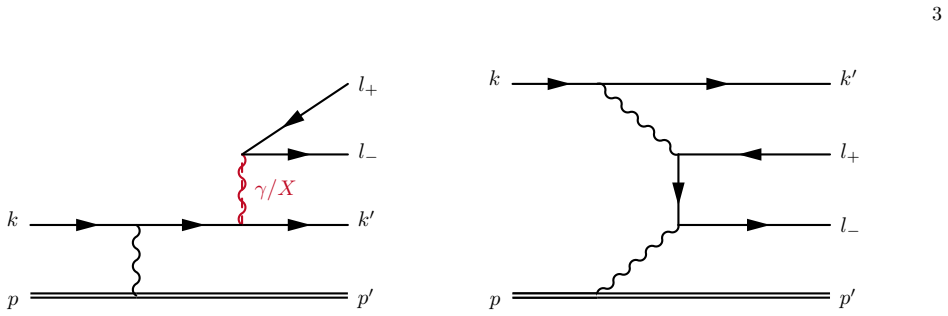
differential cross sections for the timelike and spacelike diagrams... Setup I ... Setup II
What do these tags mean?
- matches
- The paper's claim is directly supported by a theorem in the formal canon.
- supports
- The theorem supports part of the paper's argument, but the paper may add assumptions or extra steps.
- extends
- The paper goes beyond the formal theorem; the theorem is a base layer rather than the whole result.
- uses
- The paper appears to rely on the theorem as machinery.
- contradicts
- The paper's claim conflicts with a theorem or certificate in the canon.
- unclear
- Pith found a possible connection, but the passage is too broad, indirect, or ambiguous to say the theorem truly supports the claim.
Reference graph
Works this paper leans on
- [1]
-
[2]
N. Aghanimet al.(Planck), Astron. Astrophys.641, A6 (2020), [Erratum: Astron.Astrophys. 652, C4 (2021)]
work page 2020
-
[3]
A. J. Krasznahorkayet al., Phys. Rev. Lett.116, 042501 (2016)
work page 2016
-
[4]
A. J. Krasznahorkay, M. Csatl´ os, L. Csige, J. Guly´ as, A. Krasznahorkay, B. M. Nyak´ o, I. Rajta, J. Tim´ ar, I. Va- jda, and N. J. Sas, Phys. Rev. C104, 044003 (2021)
work page 2021
- [5]
- [6]
- [7]
- [8]
-
[9]
Bakeret al., Annalen Phys.525, A93 (2013)
K. Bakeret al., Annalen Phys.525, A93 (2013)
work page 2013
- [10]
- [11]
-
[12]
M. Fabbrichesi, E. Gabrielli, and G. Lanfranchi, The Dark Photon (2020), arXiv:2005.01515 [hep-ph]
- [13]
- [14]
-
[15]
Schlimmeet al., EPJ Web Conf.303, 06002 (2024)
S. Schlimmeet al., EPJ Web Conf.303, 06002 (2024)
work page 2024
- [16]
-
[17]
Christmannet al.(MAGIX), PoSEPS-HEP2021, 129 (2022)
M. Christmannet al.(MAGIX), PoSEPS-HEP2021, 129 (2022)
work page 2022
-
[18]
B. S. Schlimmeet al.(A1, MAGIX), Nucl. Instrum. Meth. A1013, 165668 (2021)
work page 2021
- [19]
- [20]
-
[21]
X. Fan, T. G. Myers, B. A. D. Sukra, and G. Gabrielse, Phys. Rev. Lett.130, 071801 (2023)
work page 2023
- [22]
-
[23]
J. P. Leeset al.(BaBar), Phys. Rev. Lett.113, 201801 (2014)
work page 2014
-
[24]
J. R. Batleyet al.(NA48/2), Phys. Lett. B746, 178 (2015)
work page 2015
- [25]
- [26]
- [27]
-
[28]
A. Pustyntsev, M. S. Ramasamy, and M. Vanderhaeghen, Phys. Rev. D113, 075032 (2026)
work page 2026
- [29]
-
[30]
L. Di Luzio, P. Paradisi, and N. Selimovic, Nucl. Phys. B1021, 117177 (2025)
work page 2025
discussion (0)
Sign in with ORCID, Apple, or X to comment. Anyone can read and Pith papers without signing in.