REVIEW 4 major objections 5 minor 1 cited by
Multi-Objective Preference Optimization: Improving Human Alignment of Generative Models
T0 review · 4 major / 5 minor · reviewed 2026-08-15 · deepseek-v4-flash
Pith's one-line read MOPO provably finds Pareto-optimal policies from pairwise preferences.
desk verdict The constrained preference-only formulation is promising, but the provable Pareto-optimality claim collapses on a false distributional assumption and a sign error; worth a major-revision round, not acceptance as is. read the letter →
The pith
A machine-rendered reading of the paper's core claim, the machinery that carries it, and where it could break.
The reading
What carries the argument
The load-bearing object is the dual of the constrained optimization problem: the multiplier vector $\lambda$ balances the primary objective against the secondary thresholds, and stationarity forces the optimal importance sampling ratio to be $\rho_\lambda^\star(y)=\exp(\tau^{-1}\mathbb{E}_{y'\sim\mu}[p(y\succ y')+\lambda^\top q(y\succ y')]-1)$. This exponential tilt of the reference policy is what makes the method preference-only, since it never requires a pointwise reward model. A second mechanism, the $\chi$-update, computes a lower bound on each constrained preference by solving a KL-constrained adversarial minimization, which is meant to keep the constraints satisfied despite estimation error in finite offline data.
What would settle it
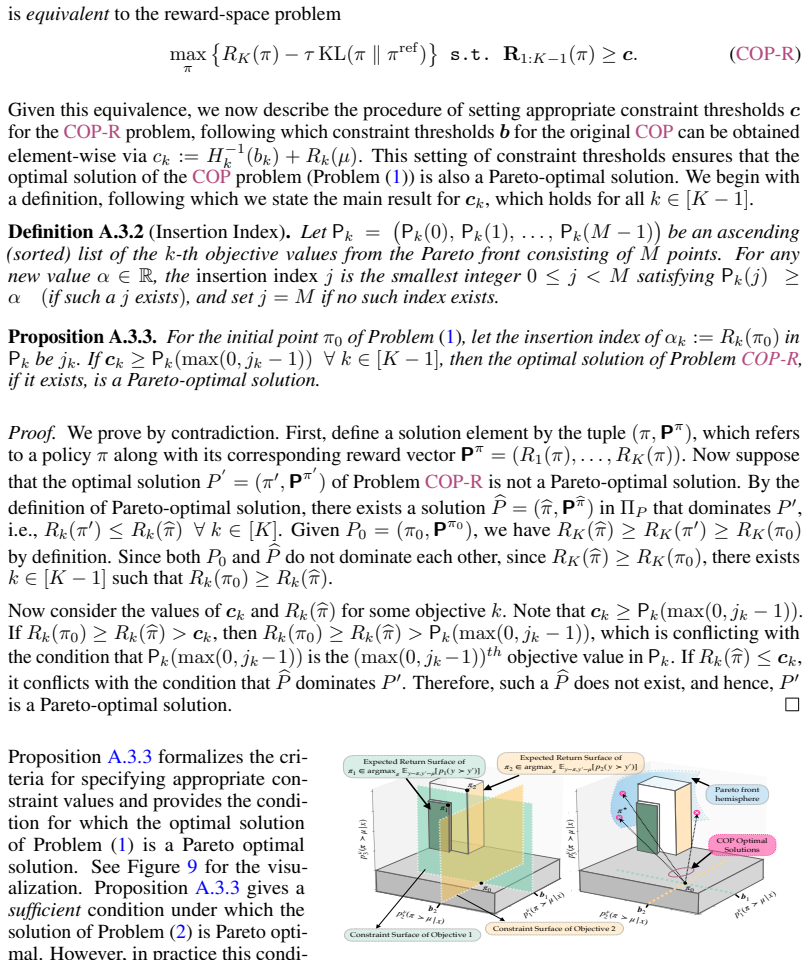
Build a two-objective bandit with skewed reward differences, for example $r_1(y)=y$ with $\pi$ concentrated near $y=1$ and $\mu$ uniform on $[0,1]$, compute the preference objective $F_1(\pi)=\mathbb{E}[p_1(y\succ y')]$ directly, and compare it with $H_1(R_1(\pi)-R_1(\mu))$. Whenever $F_1$ is not a strictly increasing function of the reward gap, Lemma A.3.1 is false and the threshold-setting result Proposition A.3.3 loses its foundation; a numerical check on such an instance would settle the provable-Pareto claim.
Extended reading notes
Core claim
The central claim is that multi-objective preference alignment can be solved as a constrained KL-regularized optimization over importance sampling ratios. For a primary objective $p$ and secondary preferences $q$, the optimal ratio takes the closed form $\rho_\lambda^\star(y)=\exp(\tau^{-1}\mathbb{E}_{y'\sim\mu}[p(y\succ y')+\lambda^\top q(y\succ y')]-1)$, where $\lambda$ are Lagrange multipliers that enforce lower bounds $b$ on the secondary objectives. Against finite-sample noise, MOPO replaces the secondary preferences with a conservative lower bound computed by an adversarially chosen distribution inside a KL ball, then extracts the final policy by importance-weighted behavioral cloning. The paper argues that this procedure recovers policies on the Pareto front whenever the front is attainable, and that scalarization- or joint-data-based baselines miss large portions of that front on the same benchmarks.
Load-bearing premise
The proof that MOPO's preference constraints can be replaced by reward constraints assumes that, for every objective, the reward difference between the policy's action and the behavior policy's action is symmetrically distributed and uniform on a fixed-width interval centered at the mean reward gap; pairwise preference data generated by the paper's own preference model (Equation (25)) does not guarantee this.
Editorial extensions
If this is right
- If the Pareto-optimality claim holds, alignment pipelines no longer need to scalarize conflicting objectives into a weighted sum; a single training run produces policies that span the trade-off frontier.
- Because MOPO operates directly on pairwise preference data, it applies where reward models are unavailable or unreliable, such as safety-critical or fast-changing preference domains.
- The closed-form updates keep the method scalable; the paper reports a 1.3B-parameter model whose outputs Pareto-dominate DPO, RiC, HaM, and MODPO on helpfulness/safety and summarization tasks.
- The adaptive threshold rule $b=\beta^\top \hat{G}(\rho^{(t-t_0)})$ and the lagged reference policy remove the need to know exact constraint values in advance, making threshold selection a hyperparameter-robust procedure.
Reading between the lines
- The same checkpoint could be queried at different threshold vectors at deployment time, effectively turning one trained model into a family of safety policies that interpolate between conservative and permissive behavior without retraining.
- The KL-ball lower bound is a robustness device that could be re-interpreted as a distribution-shift certificate; making the ball radius data-dependent might yield a finite-sample guarantee that the constraints hold on unseen preference evaluations.
- Applying MOPO to preference labels grouped by annotator population would test whether a single threshold vector can serve multiple demographic groups or whether the Pareto front itself is population-dependent, a question the current evaluation does not address.
- A direct stress test on non-uniform reward gaps—where the paper's symmetry assumption fails—would clarify how much of the empirical Pareto improvement survives outside the theoretical condition.
Signed reviews
Editorial analysis
A structured set of objections, weighed in public.
Referee Report
Summary. The paper addresses multi-objective alignment of generative models from pairwise preference data without pointwise rewards. It formulates a constrained KL-regularized problem (COP) that maximizes a primary preference objective subject to lower bounds on secondary preference objectives, derives a closed-form dual update for an importance-sampling ratio, and adds an adversarial lower-bound estimation step plus behavior-cloning policy extraction. The resulting algorithm, MOPO, is tested on synthetic bandit datasets with five canonical preference structures and on 1.3B-parameter phi-1.5 models fine-tuned on HH-RLHF and Reddit summarization data, where it is reported to Pareto-dominate RiC, HaM, MODPO, and DPO baselines. The abstract and Section 1 claim that MOPO 'achieves Pareto optimality provably.'
Significance. The problem is timely and practically important, and the high-level idea of enforcing lower bounds on secondary objectives directly in preference space is attractive. The empirical study is fairly extensive for a preprint, including ablations on the regularization coefficient, constraint relaxation, and reference lag. However, the central theoretical claims rest on Lemma A.3.1 and Proposition 3.2, both of which contain serious errors. Since the provable Pareto-optimality guarantee is the paper's headline contribution, the current manuscript cannot be accepted; the empirical results, while suggestive, do not compensate for the invalid theory.
major comments (4)
- [Appendix A.3, Lemma A.3.1] The lemma's assertion that z = r_k(x,y) - r_k(x,y') under (y,y') ~ (pi,mu) is symmetrically distributed around U = R_k(pi) - R_k(mu) and uniform on a fixed-width interval is not implied by Eq. (25) and is false for general reward functions and policies. For a concrete counterexample, take Y={0,1,2}, r_k(y)=y, mu=delta_0, sigma logistic, phi=id; then pi_a=delta_1 and pi_b=0.5 delta_0 + 0.5 delta_2 both give U=1, yet F_a = sigma(1) ~ 0.731 and F_b = 0.5 sigma(0) + 0.5 sigma(2) ~ 0.691. No strictly increasing H_k can satisfy F_k(pi) = H_k(U) for both policies. The equivalence between the preference-space problem (COP) and the reward-space problem (COP-R), and hence Proposition A.3.3's sufficient condition for Pareto optimality, is therefore unfounded.
- [Proposition 3.2 / Appendix A.4, Eq. (5)] The proposed optimal auxiliary policy in Eq. (5) has the wrong sign in the exponent. Minimizing E_{y~pi_k,y'~mu}[rho(y) q_k(y,y')] subject to KL(pi_k || pi_ref) <= epsilon gives pi*_k proportional to pi_ref exp(-chi^{-1} E_{y'~mu}[rho(y) q_k(y,y')]), not the positive-exponent expression printed. The stated solution maximizes the constrained objective rather than minimizing it, so the quantity called LowerBound(G(rho)) in Eq. (6) is actually an upper bound and does not enforce the intended safety constraint. In addition, the proof's approximation 'pi_k(y) rho(y) approximately pi(y)' is unjustified and is used without any condition ensuring pi_k is close to pi_ref.
- [Section 3.1, Algorithm 1; Section 5] The adaptive constraint schedule b = beta^T G_hat(rho^{(t-t0)}) in Algorithm 1 sets thresholds from the algorithm's own previous iterates. Proposition A.3.3, even if its assumptions held, gives a sufficient condition for a fixed b only; no theorem connects this adaptive feedback rule to Pareto optimality. Section 5 explicitly states that 'a rigorous theoretical analysis of MOPO' is future work, which directly qualifies the abstract's claim of achieving Pareto optimality 'provably.'
- [Section 4.1, Figure 4] The synthetic sanity check does not verify the claimed Pareto recovery. Figure 4 only plots three action probabilities over training; there are no reported reward vectors, no known Pareto front for the D1-D5 preference structures, and no quantitative metric such as hypervolume or distance to the Pareto set. The text's claim that MOPO 'exactly recovers - or provably approximates - the optimal policy' is therefore not substantiated by the presented experiment.
minor comments (5)
- [Appendix A.1, Eq. (14)] Equation (14) defines Pr(z=y|x,y,y') = r(x,y)/(r(x,y)+r(x,y')), which is not a valid probability when the rewards can be negative, as is the case for r2 = -sin(x) - y^2 in the same appendix; the main text's earlier use of exp(r) is the correct Bradley-Terry form and should be used consistently.
- [Appendix A.3, Lemma A.3.1] The notation H_k(u) = E_{z~Unif[-u,u]}[sigma o phi_k(z)] is inconsistent with its later use as H_k(R_k(pi) - R_k(mu)), and the remark about replacing Unif[-u,u] with a symmetric density rho_u(z) = rho(z-u) does not repair the confusion because H_k is not redefined accordingly.
- [Algorithm 1] Algorithm 1 takes b as input but line 10 overwrites it; the initialization of b and the precise role of the input beta are not specified, which makes the procedure difficult to reproduce exactly.
- [References] References [46] and [47] are duplicate entries for the same TRL repository and should be merged or removed.
- [Appendix A.6.2, Inference code] The 'Inference code' block implements f-divergence arithmetic that is not used anywhere in MOPO, and appears to be leftover material from a different method; it should be removed or clearly tied to the algorithm.
Circularity Check
Self-referential adaptive threshold b=beta*G(rho_old) is the only circular element; core dual and lower-bound derivations are self-contained.
-
self definitional
[Section 3.1, 'Adaptive constraint schedule' paragraph and Algorithm 1, line 10; used with Eq. (10) and Eq. (13)]
"We therefore, after every t0 steps, set the constraint vector only from the policy of the previously optimized iterates: b = β⊤bG (ρ(t−t0)) for some hyperparameter β ∈ (0, 1)K−1"
The threshold b is defined as a scaled version of the same statistic \hat G that appears on the left-hand side of the constraint \hat G(ρ) ≥ b in Eq. (10). Thus the constrained feasible set is self-referential: it only requires \hat G(ρ_new) ≥ β \hat G(ρ_old). No externally specified or absolute safety threshold is ever provided; any update that keeps the secondary preference within a factor β of its previous value is feasible by construction. The paper's claim that this 'retains the theoretical lower bound interpretation of the constraints' therefore reduces the constraint to a bookkeeping condition on the algorithm's own iterates rather than an independently grounded input.
full rationale
Most of the derivation chain is self-contained and not circular. Problem (2) is a concave KL-regularized constrained optimization; Proposition 3.1 (Appendix A.4) derives the closed-form importance-sampling ratio via KKT conditions and strong duality; Proposition 3.2 (Appendix A.4) is a standard variational dual of the KL-constrained underestimation problem; and the empirical objective in Eq. (10) is the sample analog of Eq. (2). The appendix's 'provable Pareto optimality' argument is not a circular reduction: Lemma A.3.1 rests on an unstated and in general false assumption that reward differences are uniformly and symmetrically distributed around the reward gap, but that is a soundness defect, not a definitional equivalence. The one self-referential element is the adaptive constraint schedule in Section 3.1, where b is set from the algorithm's own previous estimate of the constrained preference statistic. Because this schedule is explicitly practical, is not used in the theoretical Pareto guarantee, and the empirical evaluation compares against external reward models and independent baselines, the circularity score is low rather than severe.
Assumptions & free parameters
free parameters (5)
- KL regularization coefficient tau =
0.08 (Table 2)
- Lower-bound KL radius epsilon =
0.15 (Table 2)
- Constraint relaxation beta =
0.9995 (Table 2)
- Reference policy lag t0 =
500 (Table 2)
- Initial constraint vector b =
Not reported
assumptions (6)
- domain assumption For each objective k there exists a reward r_k and strictly increasing phi_k, sigma such that p_k(y > y'|x) = sigma(phi_k(r_k(x,y) - r_k(x,y'))).
- ad hoc to paper The distribution of r_k(x,y) - r_k(x,y') under (pi, mu) is symmetric around R_k(pi) - R_k(mu) and uniform over a fixed interval.
- ad hoc to paper pi_k(y) * rho(y) is approximately pi(y) in the proof of Proposition 3.2.
- standard math Strong duality holds for the concave constrained problem (2).
- domain assumption Supp(pi) = Supp(pi_ref) for importance sampling.
- domain assumption The behavior policy mu is known and samples from pi_ref and mu are available in the offline dataset.
Cite this review
Pith. "Pith review of Multi-Objective Preference Optimization: Improving Human Alignment of Generative Models." pith.science (2026). https://pith.science/paper/HFSUFVQX
@misc{pith2026250510892,
  author       = {Pith},
  title        = {Pith review of: Multi-Objective Preference Optimization: Improving Human Alignment of Generative Models},
  year         = {2026},
  howpublished = {\url{https://pith.science/paper/HFSUFVQX}},
  note         = {Machine review of arXiv:2505.10892}
}
read the original abstract
Post-training LLMs with RLHF and preference optimization methods (e.g., DPO, IPO) has greatly improved alignment, yet these approaches assume a single objective. In reality, humans express multiple, often conflicting objectives, such as helpfulness and harmlessness, with no natural scalarization. We study the multi-objective preference alignment problem, where a policy must balance several objectives simultaneously. We propose Multi-Objective Preference Optimization (MOPO), a constrained KL-regularized framework that maximizes a primary objective while enforcing lower bounds on secondary objectives via tunable safety thresholds. MOPO operates directly on pairwise preferences without point-wise rewards, and admits simple closed-form iterative updates. Empirically, MOPO recovers Pareto-optimal policies on synthetic benchmarks and, when fine-tuned on human-preference data, yields multi-billion parameter models that achieve higher rewards and Pareto-dominate baselines, with stable and robust optimization dynamics.
Figures


Figures from the paper (7 more)



Forward citations
Cited by 1 Pith paper
-
Multi-Objective Exploration and Preference Optimization via Mutual Information
MI-EPO maximizes joint conditional mutual information among responses, feedback, and preference vectors, using probabilistic routing to improve alignment and controllability in multi-objective LLM optimization.
Reference graph
Works this paper leans on
- [1]
-
[2]
A. Agnihotri, R. Jain, and H. Luo. ACPO: A policy optimization algorithm for average MDPs with constraints. In R. Salakhutdinov, Z. Kolter, K. Heller, A. Weller, N. Oliver, J. Scarlett, and F. Berkenkamp, editors,Proceedings of the 41st International Conference on Machine Learning, volume 235 of Proceedings of Machine Learning Research, pages 397–415. PML...
work page 2024
-
[3]
A. Agnihotri, R. Jain, D. Ramachandran, and S. Singla. e-cop : Episodic constrained optimiza- tion of policies. In A. Globerson, L. Mackey, D. Belgrave, A. Fan, U. Paquet, J. Tomczak, and C. Zhang, editors, Advances in Neural Information Processing Systems, volume 37, pages 110909–110934. Curran Associates, Inc., 2024
work page 2024
-
[4]
S. M. Ali and S. D. Silvey. A general class of coefficients of divergence of one distribution from another. Journal of the Royal Statistical Society. Series B (Methodological), 28(1):131–142, 1966
work page 1966
-
[5]
Y . Bai, A. Jones, K. Ndousse, A. Askell, A. Chen, N. DasSarma, D. Drain, S. Fort, D. Ganguli, T. Henighan, et al. Training a helpful and harmless assistant with reinforcement learning from human feedback. arXiv preprint arXiv:2204.05862, 2022
arXiv 2022
-
[6]
R. A. Bradley and M. E. Terry. Rank analysis of incomplete block designs: I. the method of paired comparisons. Biometrika, 39(3/4):324–345, 1952
1952
-
[7]
Z. Chen, Y . Deng, H. Yuan, K. Ji, and Q. Gu. Self-play fine-tuning converts weak language models to strong language models. arXiv preprint arXiv:2401.01335, 2024
arXiv 2024
-
[8]
P. F. Christiano, J. Leike, T. Brown, M. Martic, S. Legg, and D. Amodei. Deep reinforcement learning from human preferences. Advances in neural information processing systems , 30, 2017
2017
Show all 62 references
-
[9]
I. Csiszár. Eine informationstheoretische ungleichung und ihre anwendung auf beweis der ergodizitaet von markoffschen ketten. Magyer Tud. Akad. Mat. Kutato Int. Koezl., 8:85–108, 1964
1964
-
[10]
I. Csiszár. On information-type measure of difference of probability distributions and indirect observations. Studia Sci. Math. Hungar., 2:299–318, 1967
1967
-
[11]
R. Durrett. Probability: Theory and Examples, 4th Edition. Cambridge University Press, 2010
2010
-
[12]
Efron and R
B. Efron and R. J. Tibshirani. An introduction to the bootstrap. Chapman and Hall/CRC, 1994
1994
-
[13]
Gheshlaghi Azar, Z
M. Gheshlaghi Azar, Z. Daniel Guo, B. Piot, R. Munos, M. Rowland, M. Valko, and D. Ca- landriello. A general theoretical paradigm to understand learning from human preferences. In S. Dasgupta, S. Mandt, and Y . Li, editors,Proceedings of The 27th International Conference on Ar...
2024
-
[14]
Grattafiori, A
A. Grattafiori, A. Dubey, A. Jauhri, A. Pandey, A. Kadian, A. Al-Dahle, A. Letman, A. Mathur, A. Schelten, A. Vaughan, et al. The llama 3 herd of models. arXiv preprint arXiv:2407.21783, 2024
2024 arXiv
-
[15]
C. Guo, G. Pleiss, Y . Sun, and K. Q. Weinberger. On calibration of modern neural networks. In International conference on machine learning, pages 1321–1330. PMLR, 2017
2017
-
[16]
Y . Guo, G. Cui, L. Yuan, N. Ding, Z. Sun, B. Sun, H. Chen, R. Xie, J. Zhou, Y . Lin, et al. Controllable preference optimization: Toward controllable multi-objective alignment. arXiv preprint arXiv:2402.19085, 2024
2024 arXiv
-
[17]
C. F. Hayes, R. R˘adulescu, E. Bargiacchi, J. Källström, M. Macfarlane, M. Reymond, T. Ver- straeten, L. M. Zintgraf, R. Dazeley, F. Heintz, et al. A practical guide to multi-objective reinforcement learning and planning. Autonomous Agents and Multi-Agent Systems, 36(1):26, 2022
2022
-
[18]
E. J. Hu, Y . Shen, P. Wallis, Z. Allen-Zhu, Y . Li, S. Wang, L. Wang, W. Chen, et al. Lora: Low-rank adaptation of large language models. ICLR, 1(2):3, 2022. 11
2022
-
[19]
J. Hu, L. Tao, J. Yang, and C. Zhou. Aligning language models with offline learning from human feedback. arXiv preprint arXiv:2308.12050, 2023
2023 arXiv
-
[20]
Huang, A
S. Huang, A. Abdolmaleki, G. Vezzani, P. Brakel, D. J. Mankowitz, M. Neunert, S. Bohez, Y . Tassa, N. Heess, M. Riedmiller, and R. Hadsell. A constrained multi-objective reinforcement learning framework. In A. Faust, D. Hsu, and G. Neumann, editors, Proceedings of the 5th Conf...
2022
-
[21]
J. Jang, S. Kim, B. Y . Lin, Y . Wang, J. Hessel, L. Zettlemoyer, H. Hajishirzi, Y . Choi, and P. Ammanabrolu. Personalized soups: Personalized large language model alignment via post- hoc parameter merging. CoRR, abs/2310.11564, 2023
-
[22]
R. L. Keeney and H. Raiffa.Decisions with multiple objectives: preferences and value trade-offs. Cambridge university press, 1993
1993
-
[23]
D. P. Kingma and J. Ba. Adam: A method for stochastic optimization. arXiv preprint arXiv:1412.6980, 2014
2014 arXiv
-
[24]
K. Lee, X. Li, Q. Wang, J. He, J. Ke, M.-H. Yang, I. Essa, J. Shin, F. Yang, and Y . Li. Calibrated multi-preference optimization for aligning diffusion models. arXiv preprint arXiv:2502.02588, 2025
2025
-
[25]
K. Li, T. Zhang, and R. Wang. Deep reinforcement learning for multiobjective optimization. IEEE transactions on cybernetics, 51(6):3103–3114, 2020
2020
-
[26]
M. Li, Y . Zhang, W. Wang, W. Shi, Z. Liu, F. Feng, and T.-S. Chua. Self-improvement towards pareto optimality: Mitigating preference conflicts in multi-objective alignment. arXiv preprint arXiv:2502.14354, 2025
2025
-
[27]
Y . Li, S. Bubeck, R. Eldan, A. Del Giorno, S. Gunasekar, and Y . T. Lee. Textbooks are all you need ii: phi-1.5 technical report. arXiv preprint arXiv:2309.05463, 2023
2023 arXiv
-
[28]
R. Liu, Y . Pan, L. Xu, L. Song, P. You, Y . Chen, and J. Bian. C-morl: Multi-objective reinforce- ment learning through efficient discovery of pareto front. arXiv preprint arXiv:2410.02236, 2024
2024 arXiv
-
[29]
Mavromatis, P
C. Mavromatis, P. Karypis, and G. Karypis. Pack of llms: Model fusion at test-time via perplexity optimization. arXiv preprint arXiv:2404.11531, 2024
2024 arXiv
-
[30]
Miettinen
K. Miettinen. Nonlinear multiobjective optimization, volume 12. Springer Science & Business Media, 1999
1999
-
[31]
V . Mnih, K. Kavukcuoglu, D. Silver, A. Graves, I. Antonoglou, D. Wierstra, and M. Riedmiller. Playing atari with deep reinforcement learning. arXiv preprint arXiv:1312.5602, 2013
2013 arXiv
-
[32]
Mukherjee, A
S. Mukherjee, A. Lalitha, S. Sengupta, A. Deshmukh, and B. Kveton. Multi-objective alignment of large language models through hypervolume maximization.arXiv preprint arXiv:2412.05469, 2024
2024 arXiv
-
[33]
Munos, M
R. Munos, M. Valko, D. Calandriello, M. G. Azar, M. Rowland, Z. D. Guo, Y . Tang, M. Geist, T. Mesnard, A. Michi, et al. Nash learning from human feedback. arXiv preprint arXiv:2312.00886, 18, 2023
2023 arXiv
-
[34]
Nesterov.Lectures on Convex Optimization
Y . Nesterov.Lectures on Convex Optimization. Springer Publishing Company, Incorporated, 2nd edition, 2018
2018
-
[35]
Ouyang, J
L. Ouyang, J. Wu, X. Jiang, D. Almeida, C. Wainwright, P. Mishkin, C. Zhang, S. Agarwal, K. Slama, A. Ray, et al. Training language models to follow instructions with human feedback. Advances in neural information processing systems, 35:27730–27744, 2022
2022
-
[36]
R. Y . Pang, W. Yuan, H. He, K. Cho, S. Sukhbaatar, and J. Weston. Iterative reasoning preference optimization. Advances in Neural Information Processing Systems, 37:116617–116637, 2024
2024
-
[37]
B. Peng, C. Li, P. He, M. Galley, and J. Gao. Instruction tuning with gpt-4. arXiv preprint arXiv:2304.03277, 2023
2023 arXiv
-
[38]
Rafailov, A
R. Rafailov, A. Sharma, E. Mitchell, C. D. Manning, S. Ermon, and C. Finn. Direct preference optimization: Your language model is secretly a reward model. Advances in Neural Information Processing Systems, 36:53728–53741, 2023. 12
2023
-
[39]
A. Rame, G. Couairon, C. Dancette, J.-B. Gaya, M. Shukor, L. Soulier, and M. Cord. Rewarded soups: towards pareto-optimal alignment by interpolating weights fine-tuned on diverse rewards. Advances in Neural Information Processing Systems, 36:71095–71134, 2023
2023
-
[40]
D. M. Roijers, P. Vamplew, S. Whiteson, and R. Dazeley. A survey of multi-objective sequential decision-making. Journal of Artificial Intelligence Research, 48:67–113, 2013
2013
-
[41]
Schulman, F
J. Schulman, F. Wolski, P. Dhariwal, A. Radford, and O. Klimov. Proximal policy optimization algorithms. arXiv preprint arXiv:1707.06347, 2017
2017 arXiv
-
[42]
R. Shi, Y . Chen, Y . Hu, A. Liu, H. Hajishirzi, N. A. Smith, and S. S. Du. Decoding-time language model alignment with multiple objectives. Advances in Neural Information Processing Systems, 37:48875–48920, 2024
2024
-
[43]
Stiennon, L
N. Stiennon, L. Ouyang, J. Wu, D. Ziegler, R. Lowe, C. V oss, A. Radford, D. Amodei, and P. F. Christiano. Learning to summarize with human feedback. Advances in neural information processing systems, 33:3008–3021, 2020
2020
-
[44]
G. Team, A. Kamath, J. Ferret, S. Pathak, N. Vieillard, R. Merhej, S. Perrin, T. Matejovicova, A. Ramé, M. Rivière, et al. Gemma 3 technical report. arXiv preprint arXiv:2503.19786, 2025
2025 arXiv
-
[45]
Van Moffaert and A
K. Van Moffaert and A. Nowé. Multi-objective reinforcement learning using sets of pareto dominating policies. The Journal of Machine Learning Research, 15(1):3483–3512, 2014
2014
-
[46]
von Werra, Y
L. von Werra, Y . Belkada, L. Tunstall, E. Beeching, T. Thrush, N. Lambert, and S. Huang. Trl: Transformer reinforcement learning. https://github.com/huggingface/trl, 2020
2020
-
[47]
von Werra, Y
L. von Werra, Y . Belkada, L. Tunstall, E. Beeching, T. Thrush, N. Lambert, S. Huang, K. Ra- sul, and Q. Gallouédec. Trl: Transformer reinforcement learning. https://github.com/ huggingface/trl, 2020
2020
-
[48]
C. Wang, Y . Jiang, C. Yang, H. Liu, and Y . Chen. Beyond reverse KL: Generalizing direct preference optimization with diverse divergence constraints. In The Twelfth International Conference on Learning Representations, 2024
2024
-
[49]
H. Wang, Y . Lin, W. Xiong, R. Yang, S. Diao, S. Qiu, H. Zhao, and T. Zhang. Arithmetic control of llms for diverse user preferences: Directional preference alignment with multi-objective rewards. In Proceedings of the 62nd Annual Meeting of the Association for Computational L...
2024
-
[50]
H. Wang, Y . Lin, W. Xiong, R. Yang, S. Diao, S. Qiu, H. Zhao, and T. Zhang. Arithmetic control of llms for diverse user preferences: Directional preference alignment with multi-objective rewards. CoRR, abs/2402.18571, 2024
2024 arXiv
-
[51]
T. Wolf, L. Debut, V . Sanh, J. Chaumond, C. Delangue, A. Moi, P. Cistac, T. Rault, R. Louf, M. Funtowicz, et al. Huggingface’s transformers: State-of-the-art natural language processing. arXiv preprint arXiv:1910.03771, 2019
1910 arXiv
-
[52]
Wortsman, G
M. Wortsman, G. Ilharco, S. Y . Gadre, R. Roelofs, R. G. Lopes, A. S. Morcos, H. Namkoong, A. Farhadi, Y . Carmon, S. Kornblith, and L. Schmidt. Model soups: averaging weights of multi- ple fine-tuned models improves accuracy without increasing inference time. In K. Chaudhuri,...
2022
-
[53]
Z. Wu, Y . Hu, W. Shi, N. Dziri, A. Suhr, P. Ammanabrolu, N. A. Smith, M. Ostendorf, and H. Hajishirzi. Fine-grained human feedback gives better rewards for language model training. Advances in Neural Information Processing Systems, 36:59008–59033, 2023
2023
-
[54]
R. Yang, X. Pan, F. Luo, S. Qiu, H. Zhong, D. Yu, and J. Chen. Rewards-in-context: Multi- objective alignment of foundation models with dynamic preference adjustment, 2024
2024
-
[55]
Z. Yuan, H. Yuan, C. Tan, W. Wang, S. Huang, and F. Huang. Rrhf: Rank responses to align language models with human feedback without tears. arXiv preprint arXiv:2304.05302, 2023
2023 arXiv
-
[56]
Zhang, J
R. Zhang, J. Han, C. Liu, P. Gao, A. Zhou, X. Hu, S. Yan, P. Lu, H. Li, and Y . Qiao. Llama- adapter: Efficient fine-tuning of language models with zero-init attention. arXiv preprint arXiv:2303.16199, 2023
2023 arXiv
-
[57]
Zhang, S
T. Zhang, S. G. Patil, N. Jain, S. Shen, M. Zaharia, I. Stoica, and J. E. Gonzalez. Raft: Adapting language model to domain specific rag. In First Conference on Language Modeling, 2024. 13
2024
-
[58]
Zhong, C
Y . Zhong, C. Ma, X. Zhang, Z. Yang, H. Chen, Q. Zhang, S. Qi, and Y . Yang. Panacea: Pareto alignment via preference adaptation for llms. Advances in Neural Information Processing Systems, 37:75522–75558, 2024
2024
-
[59]
Z. Zhou, J. Liu, J. Shao, X. Yue, C. Yang, W. Ouyang, and Y . Qiao. Beyond one-preference-fits- all alignment: Multi-objective direct preference optimization. arXiv preprint arXiv:2310.03708, 2023
2023 arXiv
-
[60]
KX i=1 wiRi(y) # ≤ E y∼π′
D. M. Ziegler, N. Stiennon, J. Wu, T. B. Brown, A. Radford, D. Amodei, P. Christiano, and G. Irv- ing. Fine-tuning language models from human preferences. arXiv preprint arXiv:1909.08593, 2019. 14 A Appendix Definition A.1. For any two policiesP,Q∈ ∆X Y such that Supp(P ) = Su...
1909 arXiv
-
[61]
KX i=1 wiRi(y) # =p +q +r +s. (18) While by the selection ofk, we have E y∼πA,w
= 0, (16) NX i=1 π⋆ 1(yi) = 1, π⋆ 1(yi)≥ 0, µ⋆ i≥ 0, µ⋆ iπ⋆ 1(yi) = 0. (17) Equation (16) implies −R1(yi) +∇f(N·π⋆ 1(yi)) +λ⋆−µ⋆ i = 0. Ifπ⋆ 1(y1)> 0, we have λ⋆ =R1(y1)−∇f(N·π⋆ 1(y1)) ≥p + 2r + 2s, 18 and then for∀j̸= 1 , µ⋆ j =−R1(yj) +∇f(N·π⋆ 1(yj)) +λ⋆ ≥−p−q−r−s +q +p + 2r...
-
[62]
reverse_kld
with an additional KL penalty relative to the SFT policy: arg max πθ Ex∼D,y∼πθ(y|x) rϕ(x,y )−τ log πθ(y|x) πsft(y|x) , whereτ >0 is the KL penalty coefficient. 24 A.6.2 Training details. We summarize the key implementation details of text generation tasks in Table 2. This tabl...
Reviewed August 15, 2026 · model on record in the stance chip above.
Discussion (0). Continue with ORCID to comment.