Detection of extensive cosmic ray air showers by measuring radio emission
Pith reviewed 2026-05-24 19:19 UTC · model grok-4.3
The pith
Radio detection of cosmic ray air showers becomes feasible with self-triggering antennas and modern RF technology.
A machine-rendered reading of the paper's core claim, the machinery that carries it, and where it could break.
Core claim
Detection of radio emission from cosmic ray air showers is possible with a self-trigger antenna system that distinguishes the low-level shower signal from thermal and artificial noise, enabling continuous observation without the timing limits of optical methods.
What carries the argument
Self-trigger antenna system that generates triggers from the radio signal itself and applies identification techniques to separate air-shower events from noise.
If this is right
- Air-shower observations would run continuously rather than only on moonless nights.
- Calibrated antennas would yield direct absolute measurements of radio intensity from showers.
- The method could supplement or reduce reliance on large ground arrays of scintillation counters.
Where Pith is reading between the lines
- If the noise rejection succeeds, radio arrays could be deployed at lower cost per station than dense particle detectors.
- Continuous radio monitoring would allow study of diurnal or seasonal variations in shower rates that optical methods miss.
Load-bearing premise
The low-level radio signal can be reliably separated from thermal and artificial noise using the described self-trigger and identification method.
What would settle it
A controlled test in which the antenna array records no excess events above the expected noise rate when pointed at clear sky during periods with no known air showers, or conversely records a statistically significant excess rate matching the expected air-shower flux.
Figures

read the original abstract
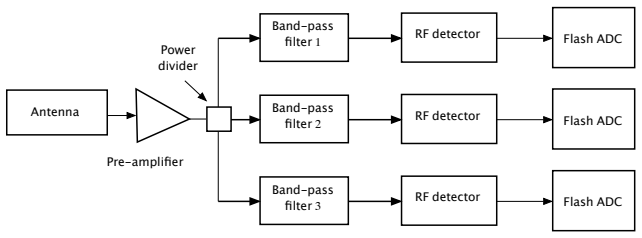
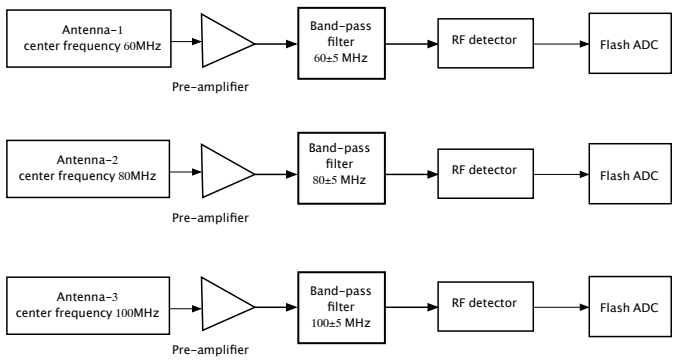
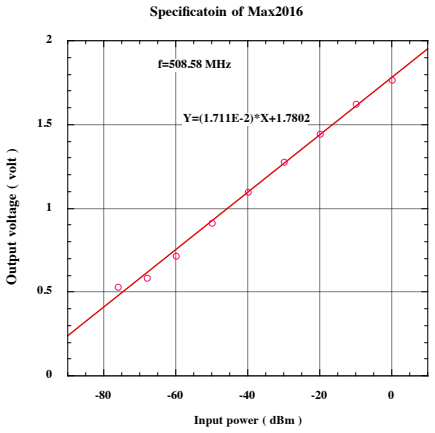
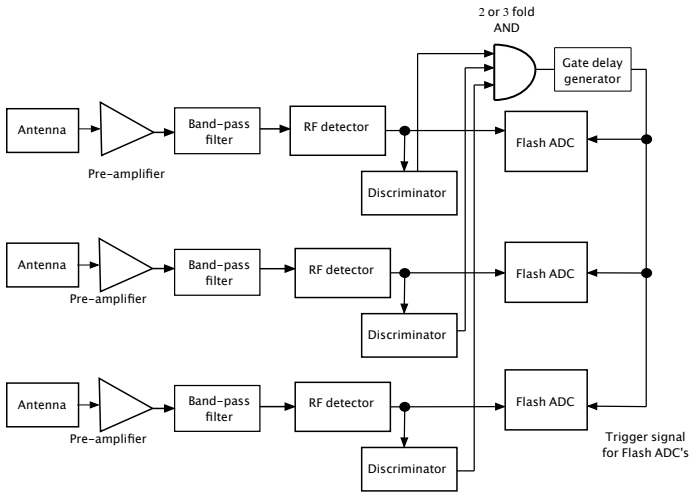
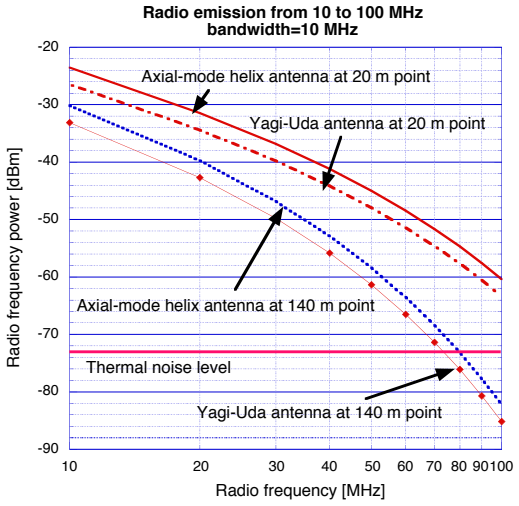
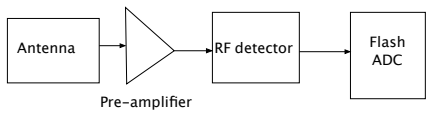
So far, cosmic ray air showers have been detected using scintillation counter arrays on the ground widely. And also air Cherenkov detection method, which is limited its observation period in moonless nights, has been adopted. The detection method of radio emission from cosmic ray air showers is not new, but rather old method. Radio emission from cosmic ray air showers has not been detected with the method of self-trigger system. If the detection method of radio emission were available, there is no limit of the observation like Cherenkov counter. The developments of high radio frequency (RF) technology might make the detection of radio emission from extensive air showers possible. Antennas calibrated in laboratory are available. With those antennas, we can directly obtain the absolute intensity of radio frequency from cosmic ray air showers. Main issue to detect radio emission is that signal level is quite low. The thermal noise particularly causes background noise source. Those issues and detection method are discussed. We also describe an antenna detection method to generate self-trigger signal and a method to identify air shower events from natural and artificial noises.
Editorial analysis
A structured set of objections, weighed in public.
Referee Report
Summary. The manuscript discusses the potential use of modern high-frequency RF technology to detect radio emission from extensive cosmic ray air showers via a self-trigger antenna system. It contrasts this approach with scintillation counter arrays and air Cherenkov detection (noting the latter's restriction to moonless nights), states that radio detection with self-triggering has not previously been achieved, identifies low signal levels and thermal noise as primary challenges, and outlines an antenna-based self-trigger method plus noise-identification techniques to distinguish air-shower events from natural and artificial backgrounds. Calibrated antennas are proposed to yield absolute intensity measurements.
Significance. If the proposed self-trigger method can be shown to work, it would enable continuous, all-weather observations of air showers without the temporal restrictions of Cherenkov detection and would supply absolute radio-intensity data. The manuscript supplies no simulations, signal-to-noise calculations, or experimental results, so its significance remains that of a conceptual methods discussion rather than a demonstrated advance.
major comments (2)
- [Abstract] Abstract and main text: the central feasibility claim (that high-RF technology 'might make the detection possible') rests on the unquantified assertion that the self-trigger antenna and noise-identification techniques can reliably separate the low-level radio signal from thermal and artificial noise; no section supplies signal-strength estimates, expected SNR values, false-trigger rates, or any derivation supporting this discrimination.
- [Throughout manuscript] No section, equation, or table presents performance metrics, Monte-Carlo results, or laboratory tests of the proposed self-trigger system, leaving the load-bearing assumption about noise rejection unsupported.
minor comments (3)
- [Abstract] The English phrasing in the abstract and introduction contains several grammatical issues (e.g., 'limited its observation period', 'Those issues and detection method are discussed') that should be corrected for clarity.
- [Introduction] The manuscript would benefit from explicit references to prior radio-detection experiments (e.g., historical attempts at self-triggered radio arrays) to place the novelty claim in context.
- [Methods description] Notation for antenna calibration and absolute intensity is introduced without a clear definition or units; a short methods subsection would improve reproducibility.
Simulated Author's Rebuttal
We thank the referee for the constructive comments on our conceptual discussion of self-triggered radio detection for cosmic ray air showers. We agree that the manuscript lacks quantitative support for the feasibility claims and will revise to clarify its scope as a methods proposal while adding basic estimates drawn from the literature.
read point-by-point responses
-
Referee: [Abstract] Abstract and main text: the central feasibility claim (that high-RF technology 'might make the detection possible') rests on the unquantified assertion that the self-trigger antenna and noise-identification techniques can reliably separate the low-level radio signal from thermal and artificial noise; no section supplies signal-strength estimates, expected SNR values, false-trigger rates, or any derivation supporting this discrimination.
Authors: We agree that no quantitative estimates, SNR values, or derivations are provided. The manuscript is framed as a conceptual outline of challenges and a proposed method rather than a performance demonstration. We will revise the abstract and main text to explicitly state this scope and add a short section with order-of-magnitude radio-signal estimates and required sensitivity based on existing air-shower radio literature to better contextualize the feasibility discussion. revision: yes
-
Referee: [Throughout manuscript] No section, equation, or table presents performance metrics, Monte-Carlo results, or laboratory tests of the proposed self-trigger system, leaving the load-bearing assumption about noise rejection unsupported.
Authors: Correct; the paper contains no new simulations, metrics, or tests because it is a discussion of the method and noise issues rather than an experimental report. We will revise to state clearly that detailed performance evaluation (including false-trigger rates) lies beyond the current scope and would require dedicated future simulations or measurements. We will also reference prior radio-detection experiments that have observed air-shower signals to provide supporting context for the proposed approach. revision: partial
Circularity Check
No significant circularity; paper is a methodological proposal without derivations or quantitative claims
full rationale
The manuscript contains no equations, fitted parameters, predictions, or derivation chains. The abstract and described content frame the work as a discussion of potential detection methods using self-trigger antennas and noise identification, with the core statement explicitly tentative ('might make the detection possible'). No self-citations, ansatzes, or renamings of results appear. The absence of any load-bearing mathematical steps means the paper is self-contained as a conceptual outline rather than a derivation.
Axiom & Free-Parameter Ledger
Reference graph
Works this paper leans on
- [1]
-
[2]
Jelley et al., Nuovo Cimento, A46, 649 (1966)
V. Jelley et al., Nuovo Cimento, A46, 649 (1966)
work page 1966
- [3]
- [4]
- [5]
-
[6]
V.B. Atrashkevich et al., Proc. 14th ICRC, Munchen, 8, 3086 (1975)
work page 1975
- [7]
-
[8]
Hoover et al., Physical Review Letters, 105, 151101 (2010)
S. Hoover et al., Physical Review Letters, 105, 151101 (2010)
work page 2010
- [9]
-
[10]
Ardouin et al., Astroparticle Physics, Volume 31, Issue 3, April 2009, 192-200
D. Ardouin et al., Astroparticle Physics, Volume 31, Issue 3, April 2009, 192-200
work page 2009
-
[11]
Petrovic et al., 29th International Cosmic Ray Conference, Pune (2005) 101-106
J. Petrovic et al., 29th International Cosmic Ray Conference, Pune (2005) 101-106
work page 2005
-
[12]
Huege et al., Astroparticle Physics 24 (2005) 116-136
T. Huege et al., Astroparticle Physics 24 (2005) 116-136
work page 2005
- [13]
- [14]
-
[15]
Wiedemann, Handbook of Accelerator Physics and Engineering, op cit, Sec 3.1
H. Wiedemann, Handbook of Accelerator Physics and Engineering, op cit, Sec 3.1. 26
-
[16]
http://www.kakioka-jma.go.jp/en/index.html
-
[17]
M. Tanabashi et al. (Particle Data Group), Phys. Rev. D98, 010001 (2018)
work page 2018
-
[18]
Muraki et al., Physical Review D, vol
Y. Muraki et al., Physical Review D, vol. 28, number 1, (1983) 40-48
work page 1983
-
[19]
M. Fujii and J. Nishmura, ”Radio wave emission from extensive air shower”, Proc. 11th. Int. Conf. on Cosmic Rays, Budapest (1969) 709-715
work page 1969
-
[20]
J. D. Kraus, R. J. Marhefka and A. S. Khan, ”Antennas for all applications”, The McGraw-Hill Companies
-
[21]
W. L. Stutzman and G. A. Thiele, ”Antenna Theory and Design”, John Willey & Sons, INC. 27 A Antenna factor A.1 Antenna factor: definition Antenna factor AF is defined as the ratio of the field intensity illuminating Ei to the received voltage VA across the antenna terminals [21]: AF = Ei VA (m−1). (35) This is an electric field antenna factor. Taking (10 log)...
discussion (0)
Sign in with ORCID, Apple, or X to comment. Anyone can read and Pith papers without signing in.