REVIEW 3 major objections 5 minor 53 references
CutS3D: Cutting Semantics in 3D for 2D Unsupervised Instance Segmentation
T0 review · 3 major / 5 minor · reviewed 2026-08-12 · deepseek-v4-flash
Pith's one-line read 3D min-cut on depth separates touching objects in 2D images.
desk verdict Genuinely new 3D-aware pseudo-mask pipeline with consistent but small gains; the missing error bars and val2017 tuning make the headline margin insecure. read the letter →
The pith
A machine-rendered reading of the paper's core claim, the machinery that carries it, and where it could break.
The reading
What carries the argument
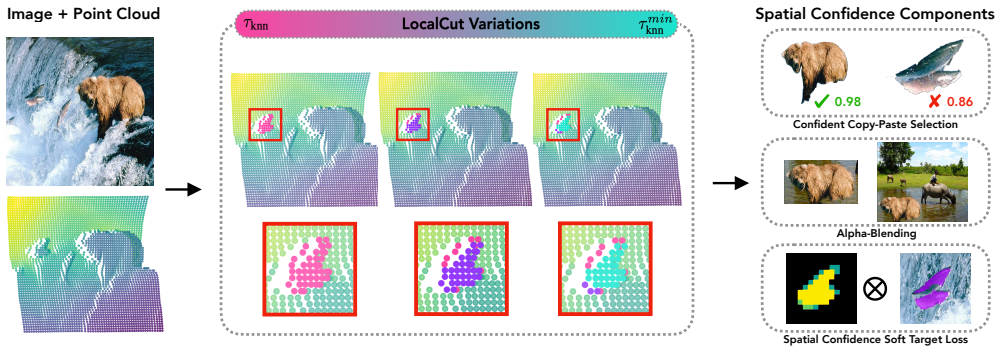
The load-bearing object is LocalCut: from a monocular depth estimate, the depth map is orthographically unprojected to a point cloud, points outside the initial semantic bipartition are pushed to background level, and a k-NN graph is cut by min-cut with the source set to the point of maximum absolute NCut eigenvalue and the sink to the minimum. Alongside it, the Spatial Importance function $\Delta D = |G_\sigma \ast D - D|$ rewrites each semantic affinity as $W_{i,j}^{(1-\Delta D_n)}$ to sharpen similarities at depth discontinuities, and Spatial Confidence maps are the accumulated average of $T$ binary cuts at different thresholds $\tau_{knn}$, used to reweight masking, copy-paste, and the mask loss. These three mechanisms together carry the argument from 2D semantics to separated 3D instances.
What would settle it
Construct or collect a set of images in which two same-class objects touch with no depth discontinuity (for example, identical books lying flat against a wall) and compare LocalCut against 2D connected-component separation: if the 3D cut produces the same merged mask as the 2D baseline on such scenes, the central 3D-boundary assumption is falsified.
Extended reading notes
Core claim
On the paper's own terms, the central discovery is that instance boundaries that are invisible in 2D semantics become visible when the semantic mask is lifted into a point cloud: a min-cut on the Euclidean k-NN graph of an orthographic depth unprojection separates adjacent same-class instances that connected-component analysis in 2D would fuse. The semantic graph from Normalized Cuts supplies the seed points (most-foreground and most-background by eigenvalue extremes) for the source and sink of the 3D cut, and depth-derived Spatial Importance maps reweight the semantic affinities so cuts are drawn along high-frequency depth change. Repeated 3D cuts at different k-NN thresholds yield per-patch confidence maps, and the detector is trained with confidence-selected copy-paste, confidence alpha-blending, and a confidence-weighted mask loss. The central claim is that this pipeline outperforms prior unsupervised methods in zero-shot settings on COCO, LVIS, VOC, Objects365, and KITTI.
Load-bearing premise
The load-bearing premise is that monocular depth, unprojected into a point cloud, gives a Euclidean boundary between adjacent same-class instances that should be separated; the paper's own Limitations section concedes the approach struggles when such boundaries are absent.
Editorial extensions
If this is right
- Because LocalCut separates instances in 3D, touching same-class objects that 2D connected components merge are split into separate pseudo-masks, which is the paper's central improvement over MaskCut.
- The Spatial Importance sharpening and Spatial Confidence components each add measurable gains in the ablation (roughly +0.1 to +0.4 APmask per component), and combining them with self-training yields the reported zero-shot results.
- Zero-shot unsupervised object detection improves on average by +2.3 APbox50 and +0.9 APbox across COCO, VOC, Objects365, KITTI, and LVIS compared with the best baseline.
- The approach stays unsupervised under the paper's definition because depth comes from zero-shot monocular estimators trained without human annotations.
- Performance is robust to the choice of depth estimator, so future improvements in monocular depth are expected to transfer directly to better pseudo-masks.
Reading between the lines
- The confidence maps could plausibly serve as uncertainty estimates for active learning or human-in-the-loop curation, though the paper does not explore that use.
- Using metric depth with proper camera intrinsics and perspective unprojection instead of orthographic unprojection might further improve boundary accuracy on scenes with strong perspective.
- A natural extension is video: temporal consistency of depth could stabilize LocalCut on frames where single-image depth is ambiguous.
- The method's own limitation statement implies a testable boundary condition: scenes where adjacent instances share no depth discontinuity (for example, two identical books flat on a table) should show no gain over 2D separation.
Editorial analysis
A structured set of objections, weighed in public.
Referee Report
Summary. The paper proposes CutS3D, an unsupervised instance segmentation pipeline that augments the CutLER/CuVLER pseudo-mask-plus-detector-training paradigm with 3D information. It unprojects monocular depth (ZoeDepth) into a point cloud, performs LocalCut (a k-NN graph min-cut) on an NCut-derived semantic mask to separate instances along 3D boundaries, sharpens the semantic affinity graph with a Spatial Importance map computed from depth edges, and computes Spatial Confidence maps by averaging LocalCut results over threshold variations. These maps are used to select and alpha-blend copy-paste augmentations and to re-weight the mask BCE loss during Cascade Mask R-CNN training. On COCO20K/COCO val2017, LVIS, VOC, Objects365, and KITTI, the method reports improvements over CutLER and CuVLER of about 0.9-1.5 APmask and up to 2.3 APbox@50 in zero-shot evaluation, with an additional in-domain self-training comparison on COCO/LVIS.
Significance. If the reported improvements hold, the paper makes a useful empirical contribution: it is the first to show that monocular-depth-derived 3D structure can replace 2D connected-component separation in this pipeline, and it does so with a clean set of ablations (Table 4), a depth-source robustness study (Table 7), and a fair backbone/self-training comparison (Table 5). The Spatial Confidence idea is simple and potentially reusable. The paper also acknowledges the key failure mode (adjacent instances without discernible 3D boundaries) and includes pseudo-mask failure cases. The main weakness is statistical: all conclusions rest on single-run numbers with hyperparameters tuned on the evaluation set, and the manuscript contains a direct contradiction about the number of self-training rounds.
major comments (3)
- [§4.1, §5 (Tables 1, 4, 8a)] The central performance claim is not supported by statistical evidence. All reported results are single runs, no standard deviations or error bars are given, and the key hyperparameters β=0.45 (Eq. 2), τknn=0.115 (§3.2), and SC_min=0.5 (§3.4) were selected using COCO val2017, which is also the headline zero-shot evaluation set. The reported gains over CutLER/CuVLER are 0.9-1.5 APmask (Table 1), while the τknn ablation in Table 8a alone spans 0.2 APmask; run-to-run variation in training a Cascade Mask R-CNN on 1.3M images can plausibly be of similar magnitude. Please provide multi-seed results or a properly held-out validation split for hyperparameter selection, and report mean±std for at least the main comparisons.
- [Section 4 vs. Supplementary E.3] There is a direct contradiction about the number of self-training rounds. Section 4 ('Experiment Setup') states 'we perform three rounds of self-training like CutLER', and Tables 4 and 5 report results after rounds 1-3, but Supplementary E.3 says 'Different from CutLER, we only conduct 1 round of self-training, saving computational costs.' This must be resolved; the manuscript should state unambiguously which protocol produced Tables 1-3 and Table 12, since self-training is a major contributor to the final numbers.
- [§3.2] The orthographic unprojection of the depth map without camera intrinsics is not geometrically justified. For a perspective image, lateral point spacing in the point cloud depends on unknown focal length and on the camera-to-scene relationship; only relative depth is available from monocular estimators. The k-NN Euclidean graph and the τknn threshold therefore operate in an arbitrary metric. The empirical depth-source ablation (Table 7) mitigates the practical risk, but the paper should either justify why the orthographic approximation preserves the relevant adjacency structure or state explicitly that τknn is calibrated to absorb this scaling.
minor comments (5)
- [Eq. (3)] The notation in Eq. (3) is mangled: 'Wi,j = W 1−∆Dn i,j i,j' should be written as W_{i,j}^{1-∆D_n}; please fix the typesetting and define the exponent unambiguously.
- [References] References [31] and [32] are the same paper (Ranftl et al., 'Towards robust monocular depth estimation'); the duplicate should be removed.
- [§4.1] The phrase 'significant margins' overstates differences of 0.9-1.5 APmask; please replace it with the quantitative values or with a statistically supported statement.
- [§3.1] The notation p_λmax and p_λmin is introduced without defining p; please clarify that these denote the nodes whose eigenvector components attain the maximum and minimum absolute eigenvalue values.
- [Figure 1] Figure 1's bar chart should state which AP variant is plotted and whether the numbers are APmask or APbox; the caption currently leaves this ambiguous.
Circularity Check
No circular derivation; the 3D-cut pipeline is self-contained and the central SOTA claim is evaluated on external benchmarks, with only a motivational self-citation.
full rationale
CutS3D's derivation chain does not reduce to its own inputs. The pseudo-mask pipeline combines external components (DINO/DiffNCuts features, NCut, ZoeDepth monocular depth, min-cut point-cloud segmentation) in a fixed procedure: the semantic bipartition from NCut initializes source and sink for LocalCut, and Spatial Importance sharpens the affinity graph from depth, but no output quantity is defined as the thing being predicted. The detector is trained on pseudo-masks and then evaluated against human-annotated COCO, LVIS, VOC, Objects365, and KITTI labels that were not used in pseudo-mask generation, so the central comparison is externally grounded. The one self-citation, to the authors' prior depth-guided semantic segmentation work [39], appears only as motivation ('previous work has already shown that using spatial information is helpful for unsupervised semantic segmentation [39]') and is not load-bearing: the 3D min-cut, Spatial Importance, and Spatial Confidence components are introduced and ablated in this paper independently of that citation. Hyperparameters such as beta=0.45, tau_knn=0.115, and SC_min=0.5 are tuned and then reported on COCO val2017, which is a statistical validity concern, especially with single runs and roughly 1 AP margins, but tuning parameters on an evaluation set is not circular reasoning because the reported metrics are not equal to the tuned values by construction. The Limitations section honestly concedes that the method fails when adjacent instances lack discernible 3D boundaries, which is an empirical scope limitation rather than a sign that the method assumes its conclusion. No uniqueness theorem is imported from the authors' prior work, no fitted parameter is renamed as a prediction, and no known result is repackaged under new coordinates. Overall, the paper's central claims are empirical and self-contained; any weakness lies in evaluation robustness, not circularity.
Assumptions & free parameters
free parameters (8)
- Beta (Spatial Importance lower bound) =
0.45
- Tau_knn (LocalCut edge threshold) =
0.115
- Tau_knn_min (Spatial Confidence sampling lower bound) =
0.05
- T (number of LocalCut threshold samples) =
6
- SC_min (Spatial Confidence lower bound) =
0.5
- Tau_NCut (NCut binarization threshold) =
0.13
- N (number of semantic cut iterations) =
3
- Gaussian blur sigma in Eq. 1
assumptions (5)
- domain assumption Monocular depth from ZoeDepth provides a geometrically reliable 3D representation when orthographically unprojected without camera intrinsics.
- ad hoc to paper NCut eigenvector extremes p_lambda_max and p_lambda_min correspond to foreground and background points for seeding the 3D min-cut.
- ad hoc to paper Spatial Confidence maps, obtained by averaging binary cuts over varied tau_knn, measure pseudo-mask quality.
- domain assumption Self-training a class-agnostic detector on its own predictions improves accuracy.
- domain assumption DINO and DiffNCuts features encode semantic similarity suitable for Normalized Cuts.
Cite this review
Pith. "Pith review of CutS3D: Cutting Semantics in 3D for 2D Unsupervised Instance Segmentation." pith.science (2026). https://pith.science/paper/HHXGPAYC
@misc{pith2026241116319,
  author       = {Pith},
  title        = {Pith review of: CutS3D: Cutting Semantics in 3D for 2D Unsupervised Instance Segmentation},
  year         = {2026},
  howpublished = {\url{https://pith.science/paper/HHXGPAYC}},
  note         = {Machine review of arXiv:2411.16319}
}
read the original abstract
Traditionally, algorithms that learn to segment object instances in 2D images have heavily relied on large amounts of human-annotated data. Only recently, novel approaches have emerged tackling this problem in an unsupervised fashion. Generally, these approaches first generate pseudo-masks and then train a class-agnostic detector. While such methods deliver the current state of the art, they often fail to correctly separate instances overlapping in 2D image space since only semantics are considered. To tackle this issue, we instead propose to cut the semantic masks in 3D to obtain the final 2D instances by utilizing a point cloud representation of the scene. Furthermore, we derive a Spatial Importance function, which we use to resharpen the semantics along the 3D borders of instances. Nevertheless, these pseudo-masks are still subject to mask ambiguity. To address this issue, we further propose to augment the training of a class-agnostic detector with three Spatial Confidence components aiming to isolate a clean learning signal. With these contributions, our approach outperforms competing methods across multiple standard benchmarks for unsupervised instance segmentation and object detection.
Figures


Figures from the paper (6 more)


Reference graph
Works this paper leans on
-
[1]
Cuvler: Enhanced unsupervised object discoveries through exhaustive self-supervised transformers
Shahaf Arica, Or Rubin, Sapir Gershov, and Shlomi Laufer. Cuvler: Enhanced unsupervised object discoveries through exhaustive self-supervised transformers. In Proceedings of the IEEE/CVF Conference on Computer Vision and Pattern Recognition, pages 23105–23114, 2024. 2, 5, 6, 7, 1
work page 2024
-
[2]
Zoedepth: Zero-shot trans- fer by combining relative and metric depth
Shariq Farooq Bhat, Reiner Birkl, Diana Wofk, Peter Wonka, and Matthias M ¨uller. Zoedepth: Zero-shot trans- fer by combining relative and metric depth. arXiv preprint arXiv:2302.12288, 2023. 3, 8, 2, 6, 7
arXiv 2023
-
[3]
Depth pro: Sharp monocular metric depth in less than a second
Aleksei Bochkovskii, Ama ¨el Delaunoy, Hugo Germain, Marcel Santos, Yichao Zhou, Stephan R Richter, and Vladlen Koltun. Depth pro: Sharp monocular metric depth in less than a second. arXiv preprint arXiv:2410.02073, 2024. 8
arXiv 2024
-
[4]
Cascade r-cnn: High quality object detection and instance segmentation
Zhaowei Cai and Nuno Vasconcelos. Cascade r-cnn: High quality object detection and instance segmentation. IEEE transactions on pattern analysis and machine intelligence , 43(5):1483–1498, 2019. 1, 6, 3, 4
work page 2019
-
[5]
Unsupervised learning of visual features by contrasting cluster assignments
Mathilde Caron, Ishan Misra, Julien Mairal, Priya Goyal, Pi- otr Bojanowski, and Armand Joulin. Unsupervised learning of visual features by contrasting cluster assignments. Ad- vances in neural information processing systems , 33:9912– 9924, 2020. 2
2020
-
[6]
Emerg- ing properties in self-supervised vision transformers
Mathilde Caron, Hugo Touvron, Ishan Misra, Herv ´e J´egou, Julien Mairal, Piotr Bojanowski, and Armand Joulin. Emerg- ing properties in self-supervised vision transformers. In Pro- ceedings of the IEEE/CVF international conference on com- puter vision, pages 9650–9660, 2021. 2, 3, 8
work page 2021
-
[7]
Groco: Ground constraint for metric self-supervised monocular depth
Aur ´elien Cecille, Stefan Duffner, Franck Davoine, Thibault Neveu, and R´emi Agier. Groco: Ground constraint for metric self-supervised monocular depth. In European Conference on Computer Vision (ECCV), 2024. 8
work page 2024
-
[8]
Hybrid task cascade for instance seg- mentation
Kai Chen, Jiangmiao Pang, Jiaqi Wang, Yu Xiong, Xiaox- iao Li, Shuyang Sun, Wansen Feng, Ziwei Liu, Jianping Shi, Wanli Ouyang, et al. Hybrid task cascade for instance seg- mentation. In Proceedings of the IEEE/CVF conference on computer vision and pattern recognition, pages 4974–4983,
Show all 53 references
-
[9]
Masked-attention mask transformer for universal image segmentation
Bowen Cheng, Ishan Misra, Alexander G Schwing, Alexan- der Kirillov, and Rohit Girdhar. Masked-attention mask transformer for universal image segmentation. In Proceed- ings of the IEEE/CVF conference on computer vision and pattern recognition, pages 1290–1299, 2022. 1
2022
-
[10]
Algorithm for solution of a problem of max- imum flow in networks with power estimation
Efim A Dinic. Algorithm for solution of a problem of max- imum flow in networks with power estimation. In Soviet Math. Doklady, pages 1277–1280, 1970. 3
1970
-
[11]
An image is worth 16x16 words: Transformers for image recognition at scale
Alexey Dosovitskiy. An image is worth 16x16 words: Transformers for image recognition at scale. arXiv preprint arXiv:2010.11929, 2020. 3
2010 arXiv
-
[12]
The pascal visual object classes (voc) challenge
Mark Everingham, Luc Van Gool, Christopher KI Williams, John Winn, and Andrew Zisserman. The pascal visual object classes (voc) challenge. International journal of computer vision, 88:303–338, 2010. 6
2010
-
[13]
Vision meets robotics: The kitti dataset
Andreas Geiger, Philip Lenz, Christoph Stiller, and Raquel Urtasun. Vision meets robotics: The kitti dataset. The Inter- national Journal of Robotics Research , 32(11):1231–1237,
-
[14]
Sim- ple copy-paste is a strong data augmentation method for in- stance segmentation
Golnaz Ghiasi, Yin Cui, Aravind Srinivas, Rui Qian, Tsung- Yi Lin, Ekin D Cubuk, Quoc V Le, and Barret Zoph. Sim- ple copy-paste is a strong data augmentation method for in- stance segmentation. In Proceedings of the IEEE/CVF con- ference on computer vision and pattern recogni...
2021
-
[15]
Min-cut based segmentation of point clouds
Aleksey Golovinskiy and Thomas Funkhouser. Min-cut based segmentation of point clouds. In 2009 IEEE 12th International Conference on Computer Vision Workshops, ICCV Workshops, pages 39–46. IEEE, 2009. 3
2009
-
[16]
Lvis: A dataset for large vocabulary instance segmentation
Agrim Gupta, Piotr Dollar, and Ross Girshick. Lvis: A dataset for large vocabulary instance segmentation. In Pro- ceedings of the IEEE/CVF conference on computer vision and pattern recognition, pages 5356–5364, 2019. 6
2019
-
[17]
Unsupervised semantic segmentation by distilling feature correspondences
Mark Hamilton, Zhoutong Zhang, Bharath Hariharan, Noah Snavely, and William T Freeman. Unsupervised semantic segmentation by distilling feature correspondences. arXiv preprint arXiv:2203.08414, 2022. 2
2022 arXiv
-
[18]
Lotus: Diffusion-based visual foundation model for high-quality dense prediction
Jing He, Haodong Li, Wei Yin, Yixun Liang, Leheng Li, Kaiqiang Zhou, Hongbo Liu, Bingbing Liu, and Ying- Cong Chen. Lotus: Diffusion-based visual foundation model for high-quality dense prediction. arXiv preprint arXiv:2409.18124, 2024. 8
2024 arXiv
-
[19]
Mask r-cnn
Kaiming He, Georgia Gkioxari, Piotr Doll ´ar, and Ross Gir- shick. Mask r-cnn. In Proceedings of the IEEE international conference on computer vision, pages 2961–2969, 2017. 1, 2
2017
-
[20]
Momentum contrast for unsupervised visual rep- resentation learning
Kaiming He, Haoqi Fan, Yuxin Wu, Saining Xie, and Ross Girshick. Momentum contrast for unsupervised visual rep- resentation learning. In Proceedings of the IEEE/CVF con- ference on computer vision and pattern recognition , pages 9729–9738, 2020. 2
2020
-
[21]
Learning to segment every thing
Ronghang Hu, Piotr Doll ´ar, Kaiming He, Trevor Darrell, and Ross Girshick. Learning to segment every thing. InProceed- ings of the IEEE conference on computer vision and pattern recognition, pages 4233–4241, 2018. 1
2018
-
[22]
Repurpos- ing diffusion-based image generators for monocular depth estimation
Bingxin Ke, Anton Obukhov, Shengyu Huang, Nando Met- zger, Rodrigo Caye Daudt, and Konrad Schindler. Repurpos- ing diffusion-based image generators for monocular depth estimation. In Proceedings of the IEEE/CVF Conference on Computer Vision and Pattern Recognition , pages 9492...
2024
-
[23]
Eagle: Eigen aggregation learning for object-centric unsupervised semantic segmentation
Chanyoung Kim, Woojung Han, Dayun Ju, and Seong Jae Hwang. Eagle: Eigen aggregation learning for object-centric unsupervised semantic segmentation. In Proceedings of the IEEE/CVF Conference on Computer Vision and Pattern Recognition, pages 3523–3533, 2024. 2
2024
-
[24]
Segment any- thing
Alexander Kirillov, Eric Mintun, Nikhila Ravi, Hanzi Mao, Chloe Rolland, Laura Gustafson, Tete Xiao, Spencer White- 9 head, Alexander C Berg, Wan-Yen Lo, et al. Segment any- thing. In Proceedings of the IEEE/CVF international confer- ence on computer vision, 2023. 2
2023
-
[25]
Efficient inference in fully connected crfs with gaussian edge potentials
Philipp Kr ¨ahenb¨uhl and Vladlen Koltun. Efficient inference in fully connected crfs with gaussian edge potentials. Ad- vances in neural information processing systems , 24, 2011. 4
2011
-
[26]
Promerge: Prompt and merge for unsupervised instance segmentation
Dylan Li and Gyungin Shin. Promerge: Prompt and merge for unsupervised instance segmentation. In European Con- ference on Computer Vision (ECCV), 2024. 2, 6
2024
-
[27]
Microsoft coco: Common objects in context
Tsung-Yi Lin, Michael Maire, Serge Belongie, James Hays, Pietro Perona, Deva Ramanan, Piotr Doll´ar, and C Lawrence Zitnick. Microsoft coco: Common objects in context. In Computer Vision–ECCV 2014: 13th European Conference, Zurich, Switzerland, September 6-12, 2014, Proceeding...
2014
-
[28]
Unsupervised dense predic- tion using differentiable normalized cuts
Yanbin Liu and Stephen Gould. Unsupervised dense predic- tion using differentiable normalized cuts. In ECCV, 2024. 2, 6, 7, 8, 3
2024
-
[29]
Image enhancement by unsharp masking the depth buffer
Thomas Luft, Carsten Colditz, and Oliver Deussen. Image enhancement by unsharp masking the depth buffer. ACM Transactions on Graphics (ToG), 25(3):1206–1213, 2006. 4
2006
-
[30]
Dinov2: Learning robust visual features without supervision
Maxime Oquab, Timoth ´ee Darcet, Th ´eo Moutakanni, Huy V o, Marc Szafraniec, Vasil Khalidov, Pierre Fernandez, Daniel Haziza, Francisco Massa, Alaaeldin El-Nouby, et al. Dinov2: Learning robust visual features without supervision. arXiv preprint arXiv:2304.07193, 2023. 2
2023 arXiv
-
[31]
Towards robust monocular depth estimation: Mixing datasets for zero-shot cross-dataset transfer
Ren ´e Ranftl, Katrin Lasinger, David Hafner, Konrad Schindler, and Vladlen Koltun. Towards robust monocular depth estimation: Mixing datasets for zero-shot cross-dataset transfer. IEEE transactions on pattern analysis and machine intelligence, 44(3):1623–1637, 2020. 8, 6
2020
-
[32]
Towards robust monocular depth estimation: Mixing datasets for zero-shot cross-dataset transfer
Ren ´e Ranftl, Katrin Lasinger, David Hafner, Konrad Schindler, and Vladlen Koltun. Towards robust monocular depth estimation: Mixing datasets for zero-shot cross-dataset transfer. IEEE transactions on pattern analysis and machine intelligence, 44(3):1623–1637, 2020. 8
2020
-
[33]
Imagenet large scale visual recognition challenge
Olga Russakovsky, Jia Deng, Hao Su, Jonathan Krause, San- jeev Satheesh, Sean Ma, Zhiheng Huang, Andrej Karpathy, Aditya Khosla, Michael Bernstein, et al. Imagenet large scale visual recognition challenge. International journal of computer vision, 115:211–252, 2015. 6, 1, 2
2015
-
[34]
Spreading vectors for similarity search
Alexandre Sablayrolles, Matthijs Douze, Cordelia Schmid, and Herv´e J´egou. Spreading vectors for similarity search. In ICLR 2019-7th International Conference on Learning Rep- resentations, pages 1–13, 2019. 2
2019
-
[35]
Leveraging hidden positives for unsupervised semantic segmentation
Hyun Seok Seong, WonJun Moon, SuBeen Lee, and Jae-Pil Heo. Leveraging hidden positives for unsupervised semantic segmentation. In Proceedings of the IEEE/CVF conference on computer vision and pattern recognition, 2023. 2
2023
-
[36]
Objects365: A large-scale, high-quality dataset for object detection
Shuai Shao, Zeming Li, Tianyuan Zhang, Chao Peng, Gang Yu, Xiangyu Zhang, Jing Li, and Jian Sun. Objects365: A large-scale, high-quality dataset for object detection. In Pro- ceedings of the IEEE/CVF international conference on com- puter vision, pages 8430–8439, 2019. 6
2019
-
[37]
Dct-mask: Discrete cosine transform mask rep- resentation for instance segmentation
Xing Shen, Jirui Yang, Chunbo Wei, Bing Deng, Jian- qiang Huang, Xian-Sheng Hua, Xiaoliang Cheng, and Kewei Liang. Dct-mask: Discrete cosine transform mask rep- resentation for instance segmentation. In Proceedings of the IEEE/CVF conference on computer vision and pattern reco...
2021
-
[38]
Normalized cuts and image segmentation
Jianbo Shi and Jitendra Malik. Normalized cuts and image segmentation. IEEE Transactions on pattern analysis and machine intelligence, 22(8):888–905, 2000. 3, 4
2000
-
[39]
Unsupervised semantic segmentation through depth-guided feature correlation and sampling
Leon Sick, Dominik Engel, Pedro Hermosilla, and Timo Ropinski. Unsupervised semantic segmentation through depth-guided feature correlation and sampling. In Proceed- ings of the IEEE/CVF Conference on Computer Vision and Pattern Recognition, pages 3637–3646, 2024. 2
2024
-
[40]
V o, Simon Roburin, Spyros Gidaris, Andrei Bursuc, Patrick P ´erez, Renaud Mar- let, and Jean Ponce
Oriane Sim ´eoni, Gilles Puy, Huy V . V o, Simon Roburin, Spyros Gidaris, Andrei Bursuc, Patrick P ´erez, Renaud Mar- let, and Jean Ponce. Localizing objects with self-supervised transformers and no labels. 2021. 2
2021
-
[41]
Kick back & relax: Learning to reconstruct the world by watching slowtv
Jaime Spencer, Chris Russell, Simon Hadfield, and Richard Bowden. Kick back & relax: Learning to reconstruct the world by watching slowtv. In Proceedings of the IEEE/CVF International Conference on Computer Vision, pages 15768– 15779, 2023. 8, 2, 3, 6
2023
-
[42]
Kick back & relax++: Scaling beyond ground- truth depth with slowtv & cribstv
Jaime Spencer, Chris Russell, Simon Hadfield, and Richard Bowden. Kick back & relax++: Scaling beyond ground- truth depth with slowtv & cribstv. arXiv preprint arXiv:2403.01569, 2024. 8
2024 arXiv
-
[43]
Discovering object masks with transformers for unsupervised semantic segmentation
Wouter Van Gansbeke, Simon Vandenhende, and Luc Van Gool. Discovering object masks with transformers for unsupervised semantic segmentation. arXiv preprint arXiv:2206.06363, 2022. 2
2022 arXiv
-
[44]
Dense contrastive learning for self-supervised visual pre-training
Xinlong Wang, Rufeng Zhang, Chunhua Shen, Tao Kong, and Lei Li. Dense contrastive learning for self-supervised visual pre-training. In Proceedings of the IEEE/CVF confer- ence on computer vision and pattern recognition, 2021. 2
2021
-
[45]
Solo: A simple framework for instance segmen- tation
Xinlong Wang, Rufeng Zhang, Chunhua Shen, Tao Kong, and Lei Li. Solo: A simple framework for instance segmen- tation. IEEE transactions on pattern analysis and machine intelligence, 44(11):8587–8601, 2021. 2
2021
-
[46]
Freesolo: Learning to segment objects without annotations
Xinlong Wang, Zhiding Yu, Shalini De Mello, Jan Kautz, Anima Anandkumar, Chunhua Shen, and Jose M Alvarez. Freesolo: Learning to segment objects without annotations. In Proceedings of the IEEE/CVF conference on computer vi- sion and pattern recognition, 2022. 2, 6
2022
-
[47]
Cut and learn for unsupervised object detection and instance segmentation
Xudong Wang, Rohit Girdhar, Stella X Yu, and Ishan Misra. Cut and learn for unsupervised object detection and instance segmentation. In Proceedings of the IEEE/CVF conference on computer vision and pattern recognition , pages 3124– 3134, 2023. 1, 2, 3, 4, 5, 6, 7, 8
2023
-
[48]
Segment anything without supervision
Xudong Wang, Jingfeng Yang, and Trevor Darrell. Segment anything without supervision. Advances in Neural Informa- tion Processing Systems, 37, 2025. 2, 6
2025
-
[49]
Tokencut: Segmenting objects in images and videos with self-supervised transformer and normalized cut
Yangtao Wang, Xi Shen, Yuan Yuan, Yuming Du, Maomao Li, Shell Xu Hu, James L Crowley, and Dominique Vaufrey- daz. Tokencut: Segmenting objects in images and videos with self-supervised transformer and normalized cut. IEEE transactions on pattern analysis and machine intelligence ,
-
[50]
Mask encoding for single shot instance seg- mentation
Rufeng Zhang, Zhi Tian, Chunhua Shen, Mingyu You, and Youliang Yan. Mask encoding for single shot instance seg- mentation. In Proceedings of the IEEE/CVF conference on computer vision and pattern recognition , pages 10226– 10235, 2020. 1
2020
-
[51]
Image bert pre-training with online tokenizer
Jinghao Zhou, Chen Wei, Huiyu Wang, Wei Shen, Cihang Xie, Alan Yuille, and Tao Kong. Image bert pre-training with online tokenizer. In International Conference on Learning Representations. 2 11 CutS3D: Cutting Semantics in 3D for 2D Unsupervised Instance Segmentation Supplemen...
-
[52]
Overall, we observe that the CutS3D Cascade Mask R-CNN [4] is able to better differentiate instances that are connected in 2D, e.g
predictions of our CutS3D zero-shot model and compare to zero-shot competitors, namely CutLER [47] and CuVLER [1]. Overall, we observe that the CutS3D Cascade Mask R-CNN [4] is able to better differentiate instances that are connected in 2D, e.g. located together in groups. On...
-
[53]
†Results reproduced using the authors’ official implementation
for our baseline, MaskCut, and with our pseudo-mask con- tributions added (+ Ours). †Results reproduced using the authors’ official implementation. Since they do not provide pseudo-mask evaluation code, we use our own implementation only for this. main paper, and, in Table 13,...
Reviewed August 12, 2026 · model on record in the stance chip above.
Discussion (0). Continue with ORCID to comment.