REVIEW 3 major objections 6 minor 73 references
Adaptive Tokenization: On the Hop-Overpriority Problem in Tokenized Graph Learning Models
T0 review · 3 major / 6 minor · reviewed 2026-08-15 · deepseek-v4-flash
Pith's one-line read A learnable token list fixes the nearby-node bias in graph models
desk verdict Real empirical finding wrapped in a theory that doesn't yet prove the headline claim; worth revising, not rejecting. read the letter →
The pith
A machine-rendered reading of the paper's core claim, the machinery that carries it, and where it could break.
The reading
What carries the argument
The load-bearing object is the hop contribution matrix $M^{HO}_{k,i}$, which records how much a token at depth $k$ is built from features of $i$-hop neighbors. It obeys a recursion that yields two consequences Theorem 4.2 states: near-hop dominance, where closer hops receive more effective attention, and within-hop indistinguishability, where all nodes at the same hop share one attention weight. Theorem 4.3 then converts this bias into a smoothness bound that grows when attention falls on hops with low label consistency. LGTL's machinery is a pair of graph-attention modules: a gate module producing per-hop softmax weights from the central node's subgraph, and a selection module weighting sampled neighbors inside each hop. The gate weights renormalize the transformer attention, which is the step that lets the model shift priority away from noisy nearby hops.
What would settle it
Train LGTL on a heterophilic benchmark, record the learned gate weight per hop, and compare it with the label-consistency of that hop; the paper's mechanism would be refuted if the gate systematically assigns higher weights to hops with lower label consistency while the accuracy gains remain, since then the gains would have to come from something other than the stated hop rebalancing.
Extended reading notes
Core claim
The paper's central claim is that the failure of pre-defined token lists is not accidental but structural. For the hop-overview template, the paper derives a hop contribution matrix $M^{HO}_{k,i}$ and proves two properties: distant hops get exponentially less effective attention than nearby hops, and every node within the same hop receives identical attention. On low-homophily graphs, where nearby hops have low label consistency and farther hops have higher label consistency, this near-hop bias forces the model to emphasize noisy signals. LGTL counters the bias directly: a graph-attention gate module learns a softmax weight for each hop from the central node's subgraph, and a selection module computes within-hop attention over sampled neighbors; the model's raw attention scores are then renormalized by the learned hop weights. The paper proves that LGTL generalizes the hop-overview and neighborhood-detail templates as special cases and that its smoothness bound is minimized when gate weights track label consistency across hops.
Load-bearing premise
The whole argument rests on the assumption that the gate module learns to give more weight to the hops whose neighbors share the central node's label; the theory only describes what happens if that alignment is achieved, not what makes the training procedure reach it.
Editorial extensions
If this is right
- Substituting LGTL for the fixed token list in LLaGA improves node-classification accuracy on all six text-attributed datasets tested, with the largest margins on low-homophily graphs such as Texas and Wisconsin.
- Integrating LGTL into NAGphormer and VCR-Graphormer raises accuracy on heterophilic benchmarks by about ten points on average while preserving or slightly improving homophilic performance.
- The theoretical bounds imply the benefit is mechanism-driven: assigning higher gate scores to hops with higher label consistency directly shrinks the smoothness bound.
- Because HO and ND are special cases of LGTL, existing token-list designs are not wasted; they become one endpoint of the learnable family.
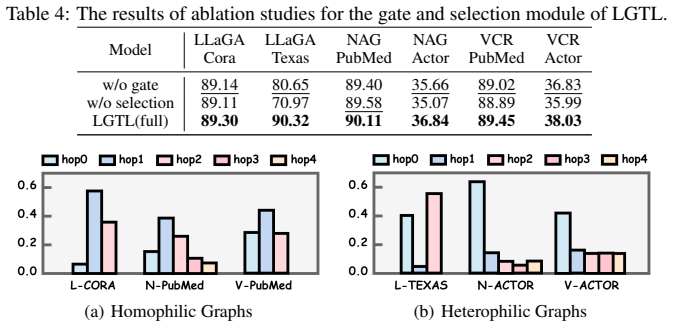
- Removing either the gate module or the selection module degrades results, and the degradation is larger on heterophilic graphs, so both hop-level and within-hop adaptation are necessary parts of the proposal.
Reading between the lines
- Editorial inference: if hop-overpriority is as general as the paper argues, other pre-defined tokenizations — random-walk sequences, PPR-based context, or sampled computational trees — should show the same near-hop bias, and a gate module like LGTL's could be tested directly on them.
- Editorial inference: the learned gate scores provide a cheap empirical diagnostic for heterophily: a model that systematically down-weights hop 1 and up-weights hop 2 is telling you the graph's 1-hop neighbors are label-inconsistent, which could seed a lightweight homophily estimator.
- Editorial inference: in the frozen-LLM setting LGTL approximates attention adjustment by scaling token features rather than training attention; fine-tuning the LLM jointly is the natural next experiment, though it would give up some plug-and-play simplicity.
Signed reviews
Editorial analysis
A structured set of objections, weighed in public.
Referee Report
Summary. The paper studies Tokenized Graph Learning Models (TGLMs), which convert a graph into an ordered token list that is processed by a Graph Transformer or a Graph LLM. The authors claim that hand-designed token lists suffer from a previously unrecognized 'hop-overpriority problem': fixed templates allocate excessive per-node attention to nearby hops, which is especially harmful on heterophilic graphs where 1-hop neighbors are label-inconsistent. The paper supports this with preliminary experiments on LLaGA (Table 1), theoretical results on the Hop-field Overview (HO) template (Theorems 4.1--4.3) and on the Neighborhood Detail (ND) template (Appendix E), and proposes LGTL, a plug-and-play module with a gate module that reweights hops and a selection module that reweights nodes within a hop. The authors prove that LGTL generalizes HO and ND (Theorem 5.1) and claim a smoothness bound showing LGTL mitigates the hop-overpriority problem (Theorem 5.2). Experiments on text-attributed graphs with LLaGA and on non-text benchmarks with NAGphormer and VCR-Graphormer show consistent gains, particularly on heterophilic datasets.
Significance. If the claims hold, LGTL is a practically valuable contribution: it is simple, plug-and-play, and the reported gains on heterophilic graphs are large across three distinct backbones and multiple datasets. The paper also provides a useful empirical documentation of the failure modes of fixed token lists on heterophilic graphs, and it ships code and error bars, which strengthens reproducibility. However, the theoretical component is load-bearing for the paper's central narrative: the 'hop-overpriority problem' is defined and motivated through Theorems 4.2--4.3, and the claim that LGTL 'provably' fixes the problem rests on Theorem 5.2. As detailed below, the hop-level conclusion does not follow from the per-node theorem, and the proof of Theorem 5.2 contains an unjustified replacement of attention sums by label-count constants. The empirical results may well be genuine, but the theoretical justification in the current manuscript is not yet established.
major comments (3)
- [Section 4.2, Theorems 4.2--4.3] The inference from per-node near-hop dominance to a hop-level overpriority problem is not justified. Theorem 4.2 proves that the effective attention of a single node v in N_k^u, denoted \hat\alpha_k, decreases with k. But the total influence of hop k on the representation is \hat\alpha_k |N_k^u|, and this product is not shown to decrease. This matters because the smoothness bound in Theorem 4.3 is stated with the aggregate term \hat\alpha_i |N_i^u|(1-C_i^u), and the concluding paragraph of Section 4.2 compares per-node weights \hat\alpha_i with whole-hop label consistency C_i^u. On an n-regular tree, the HO token T_3 carries coefficient 2(n-1)/n^2 on hop 1 and (n-1)^2/n^2 on hop 3; for n>3 the hop-3 aggregate exceeds the hop-1 aggregate even though the per-node weight on hop 1 is larger. Thus the claimed mismatch between low-C hops and high attention is not established at the hop level, and the central theoretical motivation for LGTL is weakened. Additionally, Theorem 4.1's recurrence assumes a fixed degree n for all nodes; for irregular graphs the substitution \sum_{v\in N_u} H_i^v = H_{i+1}^u +(n-1)H_{i-1}^u is only an approximation and should be stated as an assumption rather than a definition.
- [Section 5.2, Eq. (10), and Appendix F.3] The proof of Theorem 5.2 is not a valid derivation from the model equations. In Eq. (6), the within-hop attention weights \beta_{u,i,v} are normalized inside each subgraph G_i^u, but the second equality in Appendix F.3 replaces the sum over mismatched labels by a global softmax denominator containing \gamma_u and \eta_u over all hops, with no derivation connecting these objects. In addition, the actual adjusted attention in Eq. (7) is \hat\alpha_{u,i} = \alpha_{u,i}\hat{s}_{u,i}/\langle\alpha\cdot\hat{s}\rangle, so the base attention \alpha_{u,i} appears in the aggregation; Eq. (10) and the F.3 proof drop this factor entirely and bound an object involving only \hat{s}_{u,i}, which is not the LGTL output defined in Eq. (8). Furthermore, Eq. (5) defines \hat{s} by a softmax that sums to 1, while F.3 begins by assuming \sum_i \hat{s}_{u,i}=L+1, changing the effective scaling of the bound. Finally, the theorem's bound is independent of \beta_{u,i,v}, so the selection module's within-hop prioritization is not covered by the theorem at all.
- [Section 5.2, Appendix F.4.1, and Section 6.1] The theoretical claim is conditional in a way that is not acknowledged, and it does not match the frozen-LLM experimental setup. Theorem 5.2 only states that IF the gate scores \hat{s}_{u,i} are larger for hops with larger label consistency C_i^u, THEN the smoothness error decreases. Nothing in the paper proves that minimizing the downstream classification loss drives a gate module to learn this alignment; the gate is trained on the same labels that appear in C_i^u, so the improvement is partly a fitted outcome rather than an independent prediction. Moreover, the main derivation assumes the Transformer attention \alpha can be adjusted as in Eq. (7), but Appendix F.4.1 states that for a frozen LLM, LGTL instead scales the input tokens directly (Eq. (55)). The LLaGA experiments in Table 2 use this frozen-LLM setting, so the theorem is not shown to apply to the variant that actually produces the headline results.
minor comments (6)
- [Section 5 heading] The heading 'Theoreical Analysis' is misspelled; it should be 'Theoretical Analysis'.
- [Section 5.1, first paragraph] The sentence 'LGTL s a simple-yet-effective plug-and-play module' is missing the letter 'i' in 'is'.
- [Table 3, PubMed row] The entry '92.70±0.2747.37±3.25' is missing a separator between the Photo accuracy and the Cornell accuracy; the table is hard to read at that point.
- [Theorems 4.3 and 5.2] The symbol L is used both for the hop depth and for the Lipschitz constant in the same bound, which is confusing; use a distinct symbol such as \mathcal{L} for the Lipschitz constant.
- [Section 6.1, baseline list] The citation for NodeFormer appears as 'NodeFormer [?]' and should be completed.
- [Appendix C.1] The limitations discussion lists only future graph types and does not mention the theoretical assumptions behind Theorems 4.3 and 5.2, such as approximately regular graphs, Lipschitz continuity of features with respect to labels, and the softmax-normalization approximations in Appendix F.3.
Circularity Check
No circular derivation found: the paper's theorems follow from stated recursions and explicit bounds, and the LGTL analysis is conditional rather than a fitted prediction renamed as theory.
full rationale
Walking the derivation chain, the core results are not circular. Theorem 4.1 defines the hop-contribution matrices MHO from the recursive message-passing definition of HO and proves their recurrence; Theorem 4.2 substitutes the token expansion into the Transformer attention sum to obtain per-node effective attention and derives near-hop dominance from the row-monotonicity property of MHO; Theorem 4.3 bounds the smoothness error by the triangle inequality plus a Lipschitz condition on features versus labels. None of these equations assumes the conclusion that predefined token lists overemphasize nearby nodes; the conclusion is a derived property of the HO recursion. Theorem 5.1 is a parameter-flexibility statement: by specializing the gate and selection weights, LGTL can recover HO and ND. That is a generality claim about the model family, not a self-justifying input to the argument. Theorem 5.2 and Appendix F.3 provide a conditional bound: if the learned gate scores are larger for hops with higher label consistency, the smoothness error is smaller. This is a mathematical property of the bound, and the paper separately supports the alignment condition empirically in Figure 3. The fact that the gate is trained with downstream labels makes that alignment a fitted behavior, but the paper does not present the observed gate scores as an independent prediction, so this is not a fitted-input-called-prediction circularity. The self-citations present in the paper, such as [4], [28], and [50], are contextual references and baselines; none carries the load-bearing derivation. The only notable concern in the derivation chain is interpretive rather than circular: Theorem 4.3's bound contains the factor |N_i^u|, while the surrounding prose contrasts the per-node attention alpha_i with the hop-level label consistency C_i^u. That is a potential correctness gap in the 'hop-overpriority mismatch' narrative, but it is not a reduction of a result to its own inputs and therefore does not raise the circularity score.
Assumptions & free parameters
free parameters (4)
- Hop depth L =
not reported in main text
- Neighbor sample sizes n_i =
not reported in main text
- Lipschitz constant in bounds =
not estimated
- Attention expectation constants gamma_u and eta_u =
defined as expectations, not estimated
assumptions (5)
- domain assumption Raw node features are Lipschitz continuous with respect to labels, ||H0_u - H0_v||_F <= L ||y_u - y_v||_F
- domain assumption There exists an invertible linear map from features to one-hot labels, H0 W_C = Y
- domain assumption The graph is approximately regular with average degree n, so the recursion sum_{v in N1_u} H_i^v = H_{i+1} + (n-1) H_{i-1} holds
- ad hoc to paper The attention softmax over differing labels can be summarized by constants gamma_u and eta_u that are approximately uniform over hops
- domain assumption Downstream training drives the gate scores to align with label consistency C_i^u
Cite this review
Pith. "Pith review of Adaptive Tokenization: On the Hop-Overpriority Problem in Tokenized Graph Learning Models." pith.science (2026). https://pith.science/paper/HI4M7VMJ
@misc{pith2026250515845,
  author       = {Pith},
  title        = {Pith review of: Adaptive Tokenization: On the Hop-Overpriority Problem in Tokenized Graph Learning Models},
  year         = {2026},
  howpublished = {\url{https://pith.science/paper/HI4M7VMJ}},
  note         = {Machine review of arXiv:2505.15845}
}
read the original abstract
Graph Transformers, leveraging the global attention to capture long-range dependencies in graph structures, have significantly advanced graph machine learning, but face prohibitive computational complexity. Tokenized Graph Learning Models (TGLMs) address this issue by converting graphs into ordered token lists for scalable processing. Besides, TGLMs also empower Large Language Models (LLMs) to handle text-attributed graphs more effectively and thus are also employed in Graph LLMs. However, existing TGLMs rely on hand-designed token lists and their adaptability to diverse graph learning scenarios remains unexplored. In this paper, we first conduct extensive empirical and theoretical preliminary studies for hand-designed token lists. Surprisingly, we identify an unexplored hop-overpriority problem: the common pre-defined token lists overemphasize nearby nodes and overwhelm the ability of TGLMs to balance local and global signals. This phenomenon is especially harmful for heterophilic graphs. To address this problem, we propose the Learnable Graph Token List (LGTL), a plug-and-play module to replace hand-designed token lists in TGLMs. Specifically, LGTL adaptively adjusts the weights across hops and prioritizes informative nodes within hops through a graph attention gate module and a selection module, respectively. In this way, contextually informative nodes can be adaptively emphasized for both homophilic and heterophilic graphs. Besides, we theoretically show that LGTL can address the hop-overpriority problem. Extensive experiments on benchmarks validate the efficacy of LGTL across both Graph Transformers and Graph LLM backbones.
Figures


Figures from the paper (2 more)


Reference graph
Works this paper leans on
-
[1]
Llaga: Large language and graph assistant
Runjin Chen, Tong Zhao, Ajay Jaiswal, Neil Shah, and Zhangyang Wang. Llaga: Large language and graph assistant. Forty-first International Conference on Machine Learning, 2024
work page 2024
-
[2]
The emerging field of signal processing on graphs: Extending high-dimensional data analysis to networks and other irregular domains
David I Shuman, Sunil K Narang, Pascal Frossard, Antonio Ortega, and Pierre Vandergheynst. The emerging field of signal processing on graphs: Extending high-dimensional data analysis to networks and other irregular domains. IEEE signal processing magazine, 30(3):83–98, 2013
2013
-
[3]
How to learn a graph from smooth signals
Vassilis Kalofolias. How to learn a graph from smooth signals. In Artificial intelligence and statistics, pages 920–929. PMLR, 2016
2016
-
[4]
Less is more: on the over-globalizing problem in graph transformers
Yujie Xing, Xiao Wang, Yibo Li, Hai Huang, and Chuan Shi. Less is more: on the over-globalizing problem in graph transformers. Forty-first International Conference on Machine Learning, 2024
work page 2024
-
[5]
Semi-supervised classification with graph convolutional networks
Thomas N Kipf and Max Welling. Semi-supervised classification with graph convolutional networks. International Conference on Learning Representations, 2017
2017
-
[6]
Petar Veliˇckovi´c, Guillem Cucurull, Arantxa Casanova, Adriana Romero, Pietro Lio, and Yoshua Bengio. Graph attention networks. International Conference on Learning Representations, 2018
work page 2018
-
[7]
Beyond homophily in graph neural networks: Current limitations and effective designs
Jiong Zhu, Yujun Yan, Lingxiao Zhao, Mark Heimann, Leman Akoglu, and Danai Koutra. Beyond homophily in graph neural networks: Current limitations and effective designs. Advances in neural information processing systems, 33:7793–7804, 2020
2020
-
[8]
Nodeformer: A scalable graph structure learning transformer for node classification
Qitian Wu, Wentao Zhao, Zenan Li, David Wipf, and Junchi Yan. Nodeformer: A scalable graph structure learning transformer for node classification. In Advances in Neural Information Processing Systems, 2022
2022
Show all 73 references
-
[9]
Nagphormer: A tokenized graph transformer for node classification in large graphs
Jinsong Chen, Kaiyuan Gao, Gaichao Li, and Kun He. Nagphormer: A tokenized graph transformer for node classification in large graphs. International Conference on Learning Representations, 2022
2022
-
[10]
Vcr-graphormer: A mini-batch graph transformer via virtual connections
Dongqi Fu, Zhigang Hua, Yan Xie, Jin Fang, Si Zhang, Kaan Sancak, Hao Wu, Andrey Malevich, Jingrui He, and Bo Long. Vcr-graphormer: A mini-batch graph transformer via virtual connections. In The Twelfth International Conference on Learning Representations, 2024
2024
-
[11]
A neural network approach to jointly modeling social networks and mobile trajectories
Cheng Yang, Maosong Sun, Wayne Xin Zhao, Zhiyuan Liu, and Edward Y Chang. A neural network approach to jointly modeling social networks and mobile trajectories. ACM Transactions on Information Systems (TOIS), 35(4):1–28, 2017
2017
-
[12]
Skipgnn: predicting molecular interactions with skip-graph networks
Kexin Huang, Cao Xiao, Lucas M Glass, Marinka Zitnik, and Jimeng Sun. Skipgnn: predicting molecular interactions with skip-graph networks. Scientific reports, 10(1):21092, 2020
2020
-
[13]
Graphgpt: Graph instruction tuning for large language models
Jiabin Tang, Yuhao Yang, Wei Wei, Lei Shi, Lixin Su, Suqi Cheng, Dawei Yin, and Chao Huang. Graphgpt: Graph instruction tuning for large language models. In Proceedings of the 47th International ACM SIGIR Conference on Research and Development in Information Retrieval, pages 4...
2024
-
[14]
Training language models to follow instructions with human feedback
Long Ouyang, Jeffrey Wu, Xu Jiang, Diogo Almeida, Carroll Wainwright, Pamela Mishkin, Chong Zhang, Sandhini Agarwal, Katarina Slama, Alex Ray, et al. Training language models to follow instructions with human feedback. Advances in neural information processing systems, 35:2773...
2022
-
[15]
Do transformers really perform badly for graph representation? Advances in neural information processing systems, 34:28877–28888, 2021
Chengxuan Ying, Tianle Cai, Shengjie Luo, Shuxin Zheng, Guolin Ke, Di He, Yanming Shen, and Tie-Yan Liu. Do transformers really perform badly for graph representation? Advances in neural information processing systems, 34:28877–28888, 2021
2021
-
[16]
Attention is all you need
Ashish Vaswani, Noam Shazeer, Niki Parmar, Jakob Uszkoreit, Llion Jones, Aidan N Gomez, Łukasz Kaiser, and Illia Polosukhin. Attention is all you need. Advances in neural information processing systems, 30, 2017
2017
-
[17]
A generalization of transformer networks to graphs
Vijay Prakash Dwivedi and Xavier Bresson. A generalization of transformer networks to graphs. AAAI 2021 Workshop on Deep Learning on Graphs: Methods and Applications, 2020
2021
-
[18]
Graphit: Encoding graph structure in transformers
Grégoire Mialon, Dexiong Chen, Margot Selosse, and Julien Mairal. Graphit: Encoding graph structure in transformers. arXiv preprint arXiv:2106.05667, 2021
2021 arXiv
-
[19]
Rethinking graph transformers with spectral attention
Devin Kreuzer, Dominique Beaini, Will Hamilton, Vincent Létourneau, and Prudencio Tossou. Rethinking graph transformers with spectral attention. Advances in Neural Information Processing Systems , 34: 21618–21629, 2021. 10
2021
-
[20]
Representing long-range context for graph neural networks with global attention
Zhanghao Wu, Paras Jain, Matthew Wright, Azalia Mirhoseini, Joseph E Gonzalez, and Ion Stoica. Representing long-range context for graph neural networks with global attention. Advances in neural information processing systems, 34:13266–13279, 2021
2021
-
[21]
Structure-aware transformer for graph representa- tion learning
Dexiong Chen, Leslie O’Bray, and Karsten Borgwardt. Structure-aware transformer for graph representa- tion learning. In International conference on machine learning, pages 3469–3489. PMLR, 2022
2022
-
[22]
Pure transformers are powerful graph learners
Jinwoo Kim, Dat Nguyen, Seonwoo Min, Sungjun Cho, Moontae Lee, Honglak Lee, and Seunghoon Hong. Pure transformers are powerful graph learners. Advances in Neural Information Processing Systems, 35: 14582–14595, 2022
2022
-
[23]
Recipe for a general, powerful, scalable graph transformer
Ladislav Rampášek, Michael Galkin, Vijay Prakash Dwivedi, Anh Tuan Luu, Guy Wolf, and Dominique Beaini. Recipe for a general, powerful, scalable graph transformer. Advances in Neural Information Processing Systems, 35:14501–14515, 2022
2022
-
[24]
Specformer: Spectral graph neural networks meet transformers
Deyu Bo, Chuan Shi, Lele Wang, and Renjie Liao. Specformer: Spectral graph neural networks meet transformers. International Conference on Learning Representations, 2023
2023
-
[25]
Graph inductive biases in transformers without message passing
Liheng Ma, Chen Lin, Derek Lim, Adriana Romero-Soriano, Puneet K Dokania, Mark Coates, Philip Torr, and Ser-Nam Lim. Graph inductive biases in transformers without message passing. In International Conference on Machine Learning, pages 23321–23337, 2023
2023
-
[26]
Exphormer: Sparse transformers for graphs
Hamed Shirzad, Ameya Velingker, Balaji Venkatachalam, Danica J Sutherland, and Ali Kemal Sinop. Exphormer: Sparse transformers for graphs. In International Conference on Machine Learning, pages 31613–31632, 2023
2023
-
[27]
Leveraging contrastive learning for enhanced node representations in tokenized graph transformers
Jinsong Chen, Hanpeng Liu, John Hopcroft, and Kun He. Leveraging contrastive learning for enhanced node representations in tokenized graph transformers. Advances in Neural Information Processing Systems, 37:85824–85845, 2024
2024
-
[28]
Graphtranslator: Aligning graph model to large language model for open-ended tasks
Mengmei Zhang, Mingwei Sun, Peng Wang, Shen Fan, Yanhu Mo, Xiaoxiao Xu, Hong Liu, Cheng Yang, and Chuan Shi. Graphtranslator: Aligning graph model to large language model for open-ended tasks. In Proceedings of the ACM Web Conference 2024, pages 1003–1014, 2024
2024
-
[29]
Language is all a graph needs
Ruosong Ye, Caiqi Zhang, Runhui Wang, Shuyuan Xu, and Yongfeng Zhang. Language is all a graph needs. Findings of the Association for Computational Linguistics, 2024
2024
-
[30]
Deeper insights into graph convolutional networks for semi-supervised learning
Qimai Li, Zhichao Han, and Xiao-Ming Wu. Deeper insights into graph convolutional networks for semi-supervised learning. In Proceedings of the AAAI conference on artificial intelligence, volume 32, 2018
2018
-
[31]
Revisiting graph neural networks: All we have is low-pass filters
Hoang Nt and Takanori Maehara. Revisiting graph neural networks: All we have is low-pass filters. arXiv preprint arXiv:1905.09550, 2019
1905 arXiv
-
[32]
Graph neural networks exponentially lose expressive power for node classification
Kenta Oono and Taiji Suzuki. Graph neural networks exponentially lose expressive power for node classification. International Conference on Learning Representations, 2019
2019
-
[33]
Understanding over-squashing and bottlenecks on graphs via curvature
Jake Topping, Francesco Di Giovanni, Benjamin Paul Chamberlain, Xiaowen Dong, and Michael M Bron- stein. Understanding over-squashing and bottlenecks on graphs via curvature. International Conference on Learning Representations, 2021
2021
-
[34]
Expander graph propagation
Andreea Deac, Marc Lackenby, and Petar Veliˇckovi´c. Expander graph propagation. In Learning on Graphs Conference, pages 38–1, 2022
2022
-
[35]
Inductive representation learning on large graphs
Will Hamilton, Zhitao Ying, and Jure Leskovec. Inductive representation learning on large graphs. Advances in neural information processing systems, 30, 2017
2017
-
[36]
How powerful are graph neural networks? International Conference on Learning Representations, 2019
Keyulu Xu, Weihua Hu, Jure Leskovec, and Stefanie Jegelka. How powerful are graph neural networks? International Conference on Learning Representations, 2019
2019
-
[37]
Query-driven active surveying for collective classification
Galileo Namata, Ben London, Lise Getoor, Bert Huang, and U Edu. Query-driven active surveying for collective classification. In 10th international workshop on mining and learning with graphs, volume 8, page 1, 2012
2012
-
[38]
Pitfalls of graph neural network evaluation
Oleksandr Shchur, Maximilian Mumme, Aleksandar Bojchevski, and Stephan Günnemann. Pitfalls of graph neural network evaluation. Relational Representation Learning Workshop, NeurIPS 2018, 2018
2018
-
[39]
Geom-gcn: Geometric graph convolutional networks
Hongbin Pei, Bingzhe Wei, Kevin Chen-Chuan Chang, Yu Lei, and Bo Yang. Geom-gcn: Geometric graph convolutional networks. International Conference on Learning Representations, 2020. 11
2020
-
[40]
Predict then propagate: Graph neural networks meet personalized pagerank
Johannes Gasteiger, Aleksandar Bojchevski, and Stephan Günnemann. Predict then propagate: Graph neural networks meet personalized pagerank. In International Conference on Learning Representations, 2018
2018
-
[41]
Simplifying graph convolutional networks
Felix Wu, Amauri Souza, Tianyi Zhang, Christopher Fifty, Tao Yu, and Kilian Weinberger. Simplifying graph convolutional networks. In International conference on machine learning, pages 6861–6871. Pmlr, 2019
2019
-
[42]
Vicuna: An open-source chatbot impressing gpt-4 with 90%* chatgpt quality
Wei-Lin Chiang, Zhuohan Li, Ziqing Lin, Ying Sheng, Zhanghao Wu, Hao Zhang, Lianmin Zheng, Siyuan Zhuang, Yonghao Zhuang, Joseph E Gonzalez, et al. Vicuna: An open-source chatbot impressing gpt-4 with 90%* chatgpt quality. See https://vicuna. lmsys. org (accessed 14 April 2023...
2023
-
[43]
Llama 2: Open foundation and fine-tuned chat models
Hugo Touvron, Louis Martin, Kevin Stone, Peter Albert, Amjad Almahairi, Yasmine Babaei, Nikolay Bashlykov, Soumya Batra, Prajjwal Bhargava, Shruti Bhosale, et al. Llama 2: Open foundation and fine-tuned chat models. arXiv preprint arXiv:2307.09288, 2023
2023 arXiv
-
[44]
Exploring the potential of large language models (llms) in learning on graphs
Zhikai Chen, Haitao Mao, Hang Li, Wei Jin, Hongzhi Wen, Xiaochi Wei, Shuaiqiang Wang, Dawei Yin, Wenqi Fan, Hui Liu, et al. Exploring the potential of large language models (llms) in learning on graphs. ACM SIGKDD Explorations Newsletter, 25(2):42–61, 2024
2024
-
[45]
Can llms effectively leverage graph structural information: When and why
Jin Huang, Xingjian Zhang, Qiaozhu Mei, and Jiaqi Ma. Can llms effectively leverage graph structural information: When and why. In NeurIPS 2023 Workshop: New Frontiers in Graph Learning, 2023
2023
-
[46]
Graphtext: Graph reasoning in text space
Jianan Zhao, Le Zhuo, Yikang Shen, Meng Qu, Kai Liu, Michael Bronstein, Zhaocheng Zhu, and Jian Tang. Graphtext: Graph reasoning in text space. NeurIPS Workshop: Adaptive Foundation Models, Evolving AI for Personalized and Efficient Learning, 2025
2025
-
[47]
Walklm: A uniform language model fine-tuning framework for attributed graph embedding
Yanchao Tan, Zihao Zhou, Hang Lv, Weiming Liu, and Carl Yang. Walklm: A uniform language model fine-tuning framework for attributed graph embedding. Advances in neural information processing systems, 36:13308–13325, 2023
2023
-
[48]
Instructgraph: Boosting large language models via graph-centric instruction tuning and preference alignment
Jianing Wang, Junda Wu, Yupeng Hou, Yao Liu, Ming Gao, and Julian McAuley. Instructgraph: Boosting large language models via graph-centric instruction tuning and preference alignment. Findings of the Association for Computational Linguistics ACL, 2024
2024
-
[49]
Gophormer: Ego-graph transformer for node classification
Jianan Zhao, Chaozhuo Li, Qianlong Wen, Yiqi Wang, Yuming Liu, Hao Sun, Xing Xie, and Yanfang Ye. Gophormer: Ego-graph transformer for node classification. arXiv preprint arXiv:2110.13094, 2021
2021 arXiv
-
[50]
Graph meets llms: Towards large graph models
Ziwei Zhang, Haoyang Li, Zeyang Zhang, Yijian Qin, Xin Wang, and Wenwu Zhu. Graph meets llms: Towards large graph models. In NeurIPS 2023 Workshop: New Frontiers in Graph Learning, 2023
2023
-
[51]
A survey of large language models for graphs
Xubin Ren, Jiabin Tang, Dawei Yin, Nitesh Chawla, and Chao Huang. A survey of large language models for graphs. In Proceedings of the 30th ACM SIGKDD Conference on Knowledge Discovery and Data Mining, pages 6616–6626, 2024
2024
-
[52]
[Yes] " is generally preferable to
Yuhan Li, Zhixun Li, Peisong Wang, Jia Li, Xiangguo Sun, Hong Cheng, and Jeffrey Xu Yu. A survey of graph meets large language model: progress and future directions. In Proceedings of the Thirty-Third International Joint Conference on Artificial Intelligence, pages 8123–8131, ...
2024
-
[53]
Guidelines: • The answer NA means that the abstract and introduction do not include the claims made in the paper
Claims Question: Do the main claims made in the abstract and introduction accurately reflect the paper’s contributions and scope? Answer: [Yes] Justification: The abstract and introduction accurately reflect the paper’s contributions and scope. Guidelines: • The answer NA mean...
-
[54]
Limitations
Limitations Question: Does the paper discuss the limitations of the work performed by the authors? Answer: [Yes] Justification: We provide detailed discussions about limitations in Appendix C.1. Guidelines: • The answer NA means that the paper has no limitation while the answe...
-
[55]
Furthermore, we provide the theory assumptions and proofs of LGTL in Appendix F
Theory assumptions and proofs Question: For each theoretical result, does the paper provide the full set of assumptions and a complete (and correct) proof? Answer: [Yes] Justification: We provide complete theory assumptions and proofs of pre-defined token list in Appendix D an...
-
[56]
Guidelines: • The answer NA means that the paper does not include experiments
Experimental result reproducibility Question: Does the paper fully disclose all the information needed to reproduce the main ex- perimental results of the paper to the extent that it affects the main claims and/or conclusions of the paper (regardless of whether the code and da...
-
[57]
Guidelines: • The answer NA means that paper does not include experiments requiring code
Open access to data and code Question: Does the paper provide open access to the data and code, with sufficient instruc- tions to faithfully reproduce the main experimental results, as described in supplemental material? Answer: [Yes] Justification: Yes, we provide our code in...
-
[58]
Guidelines: • The answer NA means that the paper does not include experiments
Experimental setting/details Question: Does the paper specify all the training and test details (e.g., data splits, hyper- parameters, how they were chosen, type of optimizer, etc.) necessary to understand the results? Answer: [Yes] Justification: Yes, all the training and tes...
-
[59]
Guidelines: • The answer NA means that the paper does not include experiments
Experiment statistical significance 15 Question: Does the paper report error bars suitably and correctly defined or other appropriate information about the statistical significance of the experiments? Answer: [Yes] Justification: Yes, our main experimental results in Table 2 a...
-
[60]
Guidelines: • The answer NA means that the paper does not include experiments
Experiments compute resources Question: For each experiment, does the paper provide sufficient information on the com- puter resources (type of compute workers, memory, time of execution) needed to reproduce the experiments? Answer: [Yes] Justification: Sufficient information ...
-
[61]
Guidelines: • The answer NA means that the authors have not reviewed the NeurIPS Code of Ethics
Code of ethics Question: Does the research conducted in the paper conform, in every respect, with the NeurIPS Code of Ethics https://neurips.cc/public/EthicsGuidelines? Answer: [Yes] Justification: Yes, we have read the NeurIPS Code of Ethics and our paper conforms, in every r...
-
[62]
Guidelines: • The answer NA means that there is no societal impact of the work performed
Broader impacts Question: Does the paper discuss both potential positive societal impacts and negative societal impacts of the work performed? Answer: [Yes] Justification: We discuss both potential positive societal impacts and negative societal impacts of the work in Appendix...
-
[63]
Guidelines: • The answer NA means that the paper poses no such risks
Safeguards Question: Does the paper describe safeguards that have been put in place for responsible release of data or models that have a high risk for misuse (e.g., pretrained language models, image generators, or scraped datasets)? Answer: [NA] Justification: The paper poses...
-
[64]
17 Guidelines: • The answer NA means that the paper does not use existing assets
Licenses for existing assets Question: Are the creators or original owners of assets (e.g., code, data, models), used in the paper, properly credited and are the license and terms of use explicitly mentioned and properly respected? Answer: [Yes] Justification: We have cited th...
-
[65]
Guidelines: • The answer NA means that the paper does not release new assets
New assets Question: Are new assets introduced in the paper well documented and is the documentation provided alongside the assets? Answer: [NA] Justification: The paper does not release new assets. Guidelines: • The answer NA means that the paper does not release new assets. ...
-
[66]
Guidelines: • The answer NA means that the paper does not involve crowdsourcing nor research with human subjects
Crowdsourcing and research with human subjects Question: For crowdsourcing experiments and research with human subjects, does the paper include the full text of instructions given to participants and screenshots, if applicable, as well as details about compensation (if any)? A...
-
[67]
Guidelines: • The answer NA means that the paper does not involve crowdsourcing nor research with human subjects
Institutional review board (IRB) approvals or equivalent for research with human subjects Question: Does the paper describe potential risks incurred by study participants, whether such risks were disclosed to the subjects, and whether Institutional Review Board (IRB) approvals...
-
[68]
18" pay more attention to 2-hop neighbors and itself. Moreover, the selection module increases the proportion of the feature of node
Declaration of LLM usage Question: Does the paper describe the usage of LLMs if it is an important, original, or non-standard component of the core methods in this research? Note that if the LLM is used only for writing, editing, or formatting purposes and does not impact the ...
2025
-
[69]
MND 0,0 = 1 (root node, 0-hop)
-
[70]
MND 1,0 = 0, MND 1,1 = 1 (layer 1 contains only 1-hop neighbors)
-
[71]
For i≥ 1 andj≥ 1: MND i,j = MND i−1,j−1 + (n− 1)MND i−1,j+1. Proof. Fori = 0 (the root layer), ND contains onlyu itself, so MND 0,0 = 1 and MND 0,j = 0 forj >0. Rule 1 holds. Fori = 1, sinceu does not appear in layer 1, MND 1,0 = 0;N 1 u appear exactly once per sampled node, s...
-
[72]
Near-Hop Dominance: ϕL,k >ϕ L,k+2 for allk≤L (closer hops have higher total weights)
-
[73]
) have ϕL,k > ϕL,k−1 and ϕL,k > (n− 1)ϕL,k+1
Layer Parity Bias: • If L is odd (L = 2k + 1), odd hops ( k = 1, 3,... ) have ϕL,k > ϕL,k−1 and ϕL,k > (n− 1)ϕL,k+1. • IfL is even (L = 2k), even hops (k = 0, 2,... ) have ϕL,k > ϕL,k−1 andϕL,k > (n− 1)ϕL,k+1. Proof. From within-layer decay, MND i,k > MND i,k+2 for alli≥k. The...
Reviewed August 15, 2026 · model on record in the stance chip above.
Discussion (0). Continue with ORCID to comment.