REVIEW 5 major objections 5 minor 45 references
The 'Brazil-nut effect' in bidisperse particle laden flow on an incline
T0 review · 5 major / 5 minor · reviewed 2026-08-07 · deepseek-v4-flash
Pith's one-line read This paper argues that the Brazil-nut effect emerges naturally from a three-equation thin-film model of a viscous bidisperse slurry on an incline, and proves that the large-particle fraction increases with height.
desk verdict A genuinely new equilibrium result — a proof that the larger-particle fraction rises with height — sits inside a dynamic model whose load-bearing timescale assumption is unchecked and whose settling term contradicts its own text. read the letter →
The pith
A machine-rendered reading of the paper's core claim, the machinery that carries it, and where it could break.
The reading
What carries the argument
The load-bearing object is the vertical equilibrium system for stress $\sigma(z)$, total concentration $\phi(z)$, and species ratio $\chi(z)$, obtained by setting each species' normal flux to zero in a thin-film lubrication expansion. The monotonicity of $\chi(z)$ is the mechanism behind the Brazil-nut claim: once large particles occupy the free surface, the faster surface velocity carries them to the front. Two ingredients make this possible: the size-coupling matrix $A_{ij}$ in the shear-induced migration flux, whose off-diagonal entries control how collisions between particles of different sizes displace them, and the maximum packing fraction $\phi_m(\chi)$, which increases when smaller particles fill the gaps between larger ones. These equilibrium profiles define fluxes that close a $3\times3$ hyperbolic conservation-law system for film height and the two depth-averaged concentrations; its Hugoniot-locus structure produces the triple-shock and singular-shock solutions seen in the dynamics.
What would settle it
Measure the vertical species-ratio profile in a thin-film slurry shortly after release: if the large-particle fraction does not increase toward the free surface of the film, the central Brazil-nut claim fails. A sharper variant is to lower the inclination angle until settling dominates shear-induced migration and tracer diffusion; the model then predicts the segregation ordering should weaken or reverse, and an experiment showing large particles still leading the front there would falsify the proposed mechanism.
Extended reading notes
Core claim
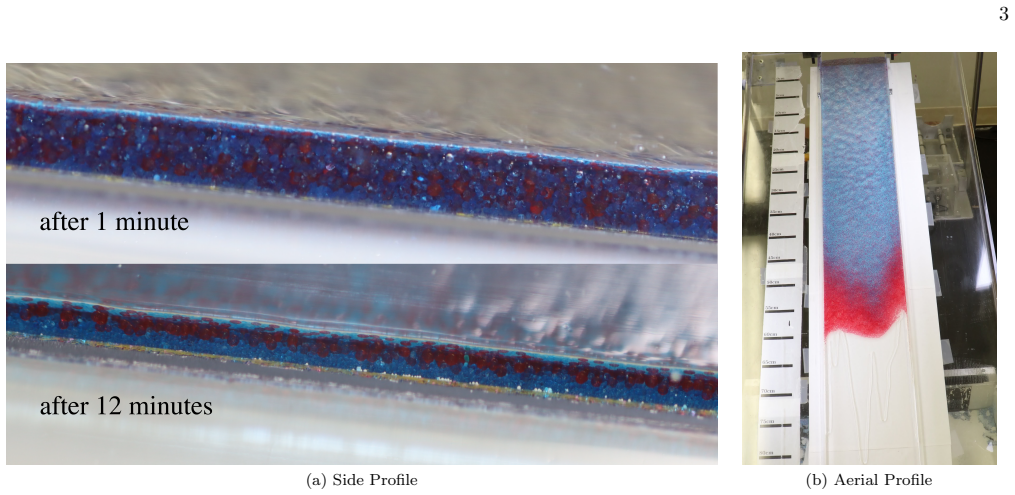
The paper's central claim is that the Brazil-nut effect occurs in viscous bidisperse suspensions on an incline and follows from the same physical fluxes used for single-species and bidensity slurries: shear-induced migration, settling, and tracer diffusion. In the equilibrium vertical profile, the larger-particle fraction $\chi(z)=\phi_1/(\phi_1+\phi_2)$ is proven to increase monotonically from the substrate to the free surface (Proposition 1), so large particles sit in the faster-moving upper part of the film and therefore reach the front first. The dynamic system of three conservation laws then predicts either a triple-shock structure with distinct fluid, large-particle, and small-particle fronts in the settled regime, or a singular shock with a high-concentration particle ridge in the ridged regime. Qualitative comparison with laboratory experiments shows the same ordering of fronts and the same regime transition, with larger particles visibly leading the particle front.
Load-bearing premise
The whole dynamic model rests on the assumption that particles find their vertical equilibrium profile much faster than the current moves down the incline, so the flux balance in the direction normal to the substrate is at steady state at every downstream position.
Editorial extensions
If this is right
- Large particles will sit above small particles in the vertical profile and will therefore arrive at the leading edge of any particle-laden viscous current on an incline.
- At low inclination angles and low total volume fractions the model produces three separated fronts—clear fluid, then large particles, then small particles—matching the triple-shock structure.
- At high inclination angles and high volume fractions the particles form a concentrated ridge at the leading front, matching the singular-shock solution.
- The equilibrium proof applies across the settled-to-ridged parameter range, so the ordering of species by size is robust within the model as long as the determinant of the coupling matrix stays positive.
Reading between the lines
- Because the mechanism is driven by the size-coupling matrix and the gap-filling maximum-packing correction, a natural test is to vary the diameter ratio: the model predicts segregation weakens as $d_2/d_1$ approaches the regime where $\det A<0$, which the paper flags but does not test experimentally.
- The same equilibrium-flux machinery could be applied to a continuous size distribution, predicting a graded front in which particles order by size, with the largest species farthest downstream.
- If the vertical-equilibration assumption fails on steep inclines or short tracks, the model's front predictions should degrade; experiments timed before equilibration would reveal the timescale on which the Brazil-nut ordering actually sets in.
Editorial analysis
A structured set of objections, weighed in public.
Referee Report
Summary. This paper proposes a depth-averaged lubrication model for a bidisperse suspension (two particle sizes, same density) flowing down an incline. The vertical equilibrium of each species is obtained from a flux balance of shear-induced migration, settling, and tracer diffusion; depth averages of the resulting profiles yield a 3x3 hyperbolic system (19). The authors prove (Proposition 1) that the larger-particle fraction χ increases monotonically with height, which they identify with the Brazil-nut effect, and compare numerical simulations with laboratory experiments in 'settled' and 'ridged' regimes, reporting qualitative agreement in front structure.
Significance. The contribution is a plausible extension of the authors' earlier monodisperse and bidensity thin-film models to size-polydisperse suspensions, and the monotonicity result for χ is a clean structural statement. The model makes falsifiable qualitative predictions: larger particles lead the particle front in both regimes, with a triple-shock structure at low concentration/angle and a singular shock at high concentration/angle. If the derivation issues below are resolved, the paper would provide a useful mechanistic explanation of the Brazil-nut effect in viscous films. The experimental data, however, are compared only qualitatively, and the model parameters are not fully tied to the experiments.
major comments (5)
- [Section II, Eq. (6) and system (17)] The stress boundary condition is stated as σ(0) = 1 + ρ_s ∫_0^z φ(s) ds together with σ(h)=0. As written this is not a boundary condition: the right-hand side depends on the running variable z. With the stated no-slip condition u(0)=0 and free-surface condition μ∂_z u(h)=0, integration of ∂_z σ = −1 − ρ_s φ gives σ(z)=∫_z^h (1+ρ_s φ(s)) ds, so σ(0)=h(1+ρ_s ϕ_0). Because the vertical equilibrium profiles and the closure (18)–(19) are built on this equation, the manuscript must be corrected and the equilibrium solutions re-verified.
- [Section II, Eq. (12) and Conclusion] The tracer flux J_tracer,i = −γdot d_i²/4 D_tr(ϕ) ϕ ∇(ϕ_i/ϕ) does not conserve total particle concentration because the d_i² prefactors differ, so Σ_i J_tracer,i is proportional to (d_1²−d_2²)∇(ϕ_1/ϕ) and is not zero. The text states that 'the net concentration of particles ϕ does not change under tracer flux,' and the Conclusion concedes that this is not true in the present formulation. Since J_tracer,i enters the flux balance (8) that determines the vertical equilibration and hence the fluxes in (18), this is a load-bearing inconsistency; please modify the tracer model or justify that neglecting the non-conservative part is quantitatively valid.
- [Section II, Eq. (11) and Conclusion] The sentence 'We also assume particles settle the same regardless of their size' is inconsistent with Eq. (11), which contains d_i², and with the later statement in the Conclusion that 'our settling flux does not include size effects.' Please clarify which settling law is intended and, if Eq. (11) is intended, revise the text and re-examine the sedimentation interpretation of Proposition 1.
- [Section II, Eq. (19)] The quasi-static vertical equilibrium assumption is load-bearing for the derivation of the hyperbolic system. The inequality δ << (d̄/H)² << 1 is asserted but not checked: no film thickness H is reported for the experiments, and the new species-ratio relaxation channel (tracer/shear migration with unequal diameters) has a vertical equilibration time H²/(γ d̄²) that may be comparable to the advection time for the reported particle sizes and plausible H. Please provide measured H (or an equivalent estimate) and demonstrate the separation of timescales, or state the applicability conditions explicitly.
- [Section IV/V and Fig. 6] The numerical simulations use small-particle diameter 0.200 mm while the experiments report a small-particle species with diameter 0.2–0.4 mm (mean 0.3 mm), and the text gives ϕ_0=0.4 for the ridged case while the caption gives ϕ_0=0.55. These mismatches affect the computed b, ϕ_m, and the predicted regime boundary; please reconcile the parameters or explain why the chosen values are appropriate.
minor comments (5)
- [Throughout] 'Equilibriate' should be 'equilibrate'.
- [Section III B] 'Hugonoit' should be 'Hugoniot'.
- [Conclusion] The phrase 'we do not qualitatively match the front positions' should presumably be 'quantitatively'.
- [Section V] The sentence 'Figs. 6b and 6d show the case where χ_0=0.75' should refer to Figs. 6e and 6g.
- [Eq. (10)] The expression for A_ij would benefit from parentheses to make the exponents unambiguous.
Circularity Check
No significant circularity: the Brazil-nut result is a proved consequence of the derived equilibrium ODEs and is checked against new experiments.
full rationale
The derivation chain is self-contained and not circular. The paper starts from Stokes/continuum equations and explicit flux closures (shear-induced migration, settling, tracer) taken from the literature, derives the vertical equilibrium ODE system (17), and proves Proposition 1 mathematically: the sign of chi-prime is positive for all chi in (0,1) given Lemma 1, so the larger-particle fraction increases with height. That conclusion is a theorem about the derived equations, not an assumption or a fitted input. The dynamic front prediction then follows by coupling these equilibrium profiles to the computed velocity field and is compared with newly reported laboratory experiments; no fitted parameter is renamed as a prediction. The quasi-static vertical-equilibration assumption and the imposed transition time t* = 150 s are explicit modeling choices inherited from prior work, and the paper acknowledges limitations (timescale condition not experimentally verified, tracer flux size dependence, lack of quantitative front matching). These are correctness and robustness caveats, not circular reductions: no equation in the paper is equivalent to its own input by construction.
Assumptions & free parameters
free parameters (4)
- Kc and Kv =
0.41 and 0.62
- phi_m,0 =
0.61
- phi_tr =
0.4
- Transition time t* =
150 s
assumptions (5)
- domain assumption Thin-film lubrication reduction with delta = H/L much less than 1
- domain assumption Rapid vertical equilibration of particle concentrations
- domain assumption Scale separation delta much less than (d_bar/H)^2 much less than 1
- domain assumption Empirical flux closure forms, Eqs. (9)-(12)
- ad hoc to paper det A >= 0 and 0 <= phi <= 1 in Proposition 1
Cite this review
Pith. "Pith review of The 'Brazil-nut effect' in bidisperse particle laden flow on an incline." pith.science (2026). https://pith.science/paper/HI6BVQHQ
@misc{pith2026250524114,
  author       = {Pith},
  title        = {Pith review of: The 'Brazil-nut effect' in bidisperse particle laden flow on an incline},
  year         = {2026},
  howpublished = {\url{https://pith.science/paper/HI6BVQHQ}},
  note         = {Machine review of arXiv:2505.24114}
}
read the original abstract
We study bidisperse suspensions -- suspensions where there are two particle species of the same density but different sizes -- of a viscous fluid on an incline. We use a lubrication theory/thin film model to form a hyperbolic system of three conservation laws for the height and particle volume fractions. The model predicts, over a range of parameters, that the larger particles rise to the top of the layer, consistent with the well-known `Brazil-nut effect' for granular media. The model predicts well-separated fronts of the two species of particles, behind a clear fluid front, at lower inclination angles and volume fractions. This corresponds to a triple shock structure in the system of conservations. At higher inclination angles and volume fractions the particles congregate at a high concentration at the leading front corresponding to a singular shock in the model. We find excellent agreement between theory and experiments in terms of the overall dynamic structures as the parameters vary.
Figures


Figures from the paper (3 more)


Reference graph
Works this paper leans on
-
[1]
N. Santangelo, G. Forte, M. De Falco, G. B. Chirico, and A. Santo, New insights on rainfall triggering flow-like landslides and flash floods in Campania (Southern Italy), Landslides 18, 2923 (2021)
work page 2021
-
[2]
´E. Guazzelli, Rheology of dense granular suspensions across flow regimes, Physical Review Fluids 9, 090501 (2024)
work page 2024
-
[3]
M. Larcher and J. T. Jenkins, The influence of granular segregation on gravity-driven particle-fluid flows, Advances in Water Resources 129, 365 (2019)
work page 2019
-
[4]
N. J. Balmforth, R. V. Craster, P. Perona, A. C. Rust, and R. Sassi, Viscoplastic dam breaks and the Bostwick consis- tometer, Journal of Non-Newtonian Fluid Mechanics Viscoplastic fluids: From theory to application, 142, 63 (2007). 15
work page 2007
-
[5]
C. Mouquet, V. Greffeuille, and S. Treche, Characterization of the consistency of gruels consumed by infants in developing countries: assessment of the Bostwick consistometer and comparison with viscosity measurements and sensory perception, International Journal of Food Sciences and Nutrition 57, 459 (2006)
work page 2006
-
[6]
M. M. Tehrani and A. Ghandi, Modification of Bostwick method to determine tomato concentrate consistency, Journal of Food Engineering 79, 1483 (2007)
work page 2007
-
[7]
D. C. Wright, A spiral separator (EU Patent 0039139). (1981)
work page 1981
-
[8]
Q. Dehaine and L. O. Filippov, Modelling heavy and gangue mineral size recovery curves using the spiral concentration of heavy minerals from kaolin residues, Powder Technology 292, 331 (2016)
work page 2016
Show all 45 references
-
[9]
A. B. Holland-Batt and P. N. Holtham, Particle and fluid motion on spiral separators, Minerals Engineering 4, 457 (1991)
1991
-
[10]
Rosato, K
A. Rosato, K. J. Strandburg, F. Prinz, and R. H. Swendsen, Why the Brazil nuts are on top: Size segregation of particulate matter by shaking, Physical Review Letters 58, 1038 (1987)
1987
-
[11]
Jullien and P
R. Jullien and P. Meakin, A mechanism for particle size segregation in three dimensions, Nature 344, 425 (1990)
1990
-
[12]
This establishes the desired inequality (1 − ϵ)2 < ˜a12 < 1
-
[13]
M. E. M¨ obius, B. E. Lauderdale, S. R. Nagel, and H. M. Jaeger, Size separation of granular particles, Nature 414, 270 (2001)
2001
-
[14]
Fan and K
Y. Fan and K. M. Hill, Phase Transitions in Shear-Induced Segregation of Granular Materials, Physical Review Letters 106, 218301 (2011)
2011
-
[15]
J. B. Knight, H. M. Jaeger, and S. R. Nagel, Vibration-induced size separation in granular media: The convection connec- tion, Physical Review Letters 70, 3728 (1993)
1993
-
[16]
Gajjar, C
P. Gajjar, C. G. Johnson, J. Carr, K. Chrispeels, J. M. N. T. Gray, and P. J. Withers, Size segregation of irregular granular materials captured by time-resolved 3D imaging, Scientific Reports 11, 8352 (2021)
2021
-
[17]
Burnett, Q
S. Burnett, Q. Luan, S. Bloom, L. Ding, and A. L. Bertozzi, Separation of bidisperse particles in viscous thin-film flow down an incline, Gallery of Fluid Motion, APS Division of Fluid Dynamics Meeting 2024 (2024)
2024
-
[18]
J. B. Knight, E. E. Ehrichs, V. Y. Kuperman, J. K. Flint, H. M. Jaeger, and S. R. Nagel, Experimental study of granular convection, Physical Review E 54, 5726 (1996)
1996
-
[19]
Neveu, M
A. Neveu, M. Larcher, R. Delannay, J. T. Jenkins, and A. Valance, Particle segregation in inclined high-speed granular flows, Journal of Fluid Mechanics 935, A41 (2022)
2022
-
[20]
J. R. Johanson, Particle segregation and what to do about it, Chemical Engineering 8, 183 (1978)
1978
-
[21]
Using a similar framework, [26] extended the model in [21] to the case of two particle species of the same size but different densities
develops a quantitative dynamic lubrication model that shows excellent quantitative agreement with dynamic experiments in the settled regime. Using a similar framework, [26] extended the model in [21] to the case of two particle species of the same size but different densities...
-
[22]
S. B. Savage and C. K. K. Lun, Particle size segregation in inclined chute flow of dry cohesionless granular solids, Journal of Fluid Mechanics 189, 311 (1988)
1988
-
[23]
J. Zhou, B. Dupuy, A. Bertozzi, and A. Hosoi, Theory for shock dynamics in particle-laden thin films, Physical Review Letters 94, 117803 (2005)
2005
-
[24]
Murisic, B
N. Murisic, B. Pausader, D. Peschka, and A. L. Bertozzi, Dynamics of particle settling and resuspension in viscous liquid films, Journal of Fluid Mechanics 717, 203 (2013)
2013
-
[25]
H. E. Huppert, Flow and instability of a viscous current down a slope, Nature 300, 427 (1982)
1982
-
[26]
J. T. Wong and A. L. Bertozzi, A conservation law model for bidensity suspensions on an incline, Physica D: Nonlinear Phenomena 330, 47 (2016)
2016
-
[27]
B. P. Cook, Theory for particle settling and shear-induced migration in thin-film liquid flow, Physical Review E 78, 045303 (2008)
2008
-
[28]
In [29], the authors examine the case of bidisperse suspensions in channel flow and expand upon the modeling of the shear-induced migration flux term for the bidisperse case
model shear-induced migration of polydisperse suspensions and introduce an dynamic expression for the maximum packing fraction in the bidisperse case depending on the relative diameters of the particles and their volume fractions. In [29], the authors examine the case of bidis...
2022
-
[29]
Murisic, J
N. Murisic, J. Ho, V. Hu, P. Latterman, T. Koch, K. Lin, M. Mata, and A. Bertozzi, Particle-laden viscous thin-film flows on an incline: Experiments compared with a theory based on shear-induced migration and particle settling, Physica D: Nonlinear Phenomena 240, 1661 (2011)
2011
-
[30]
S. Lee, J. Wong, and A. L. Bertozzi, Equilibrium Theory of Bidensity Particle-Laden Flows on an Incline, in Mathematical Modelling and Numerical Simulation of Oil Pollution Problems, edited by M. Ehrhardt (Springer International Publishing, Cham, Switzerland, 2015) pp. 85–97
2015
-
[31]
Shauly, A
A. Shauly, A. Wachs, and A. Nir, Shear-induced particle migration in a polydisperse concentrated suspension, Journal of Rheology 42, 1329 (1998)
1998
-
[32]
Kanehl and H
P. Kanehl and H. Stark, Hydrodynamic segregation in a bidisperse colloidal suspension in microchannel flow: A theoretical study, J. Chem. Phys. 142, 214901 (2015)
2015
-
[33]
A. A. Howard, M. R. Maxey, and S. Gallier, Bidisperse suspension balance model, Physical Review Fluids 7, 124301 (2022)
2022
-
[34]
A. R. Thornton, J. M. N. T. Gray, and A. J. Hogg, A three-phase mixture theory for particle size segregation in shallow granular free-surface flows, Journal of Fluid Mechanics 550, 1 (2006)
2006
-
[35]
L. Ding, S. C. Burnett, and A. L. Bertozzi, Equilibrium theory of bidensity particle-laden suspensions in thin-film flow down a spiral separator, Physics of Fluids 37, 023397 (2025)
2025
-
[36]
I. M. Krieger and T. J. Dougherty, A mechanism for non-newtonian flow in suspensions of rigid spheres, Transactions of The Society of Rheology 3, 137 (1959)
1959
-
[37]
T. Ward, C. Wey, R. Glidden, A. E. Hosoi, and A. L. Bertozzi, Experimental study of gravitation effects in the flow of a particle-laden thin film on an inclined plane, Physics of Fluids 21, 083305 (2009)
2009
-
[38]
Leighton and A
D. Leighton and A. Acrivos, The shear-induced migration of particles in concentrated suspensions, Journal of Fluid Me- chanics 181, 415 (1987)
1987
-
[39]
R. J. Phillips, R. C. Armstrong, R. A. Brown, A. L. Graham, and J. R. Abbott, A constitutive equation for concentrated suspensions that accounts for shear-induced particle migration, Physics of Fluids A: Fluid Dynamics 4, 30 (1992)
1992
-
[40]
Tripathi and A
A. Tripathi and A. Acrivos, Viscous resuspension in a bidensity suspension, International Journal of Multiphase Flow 25, 1 (1999). 16
1999
-
[41]
Leighton and A
D. Leighton and A. Acrivos, Measurement of shear-induced self-diffusion in concentrated suspensions of spheres, Journal of Fluid Mechanics 177, 109 (1987)
1987
-
[42]
Sierou and J
A. Sierou and J. F. Brady, Shear-induced self-diffusion in non-colloidal suspensions, Journal of Fluid Mechanics 506, 285 (2004)
2004
-
[43]
P. D. Lax, 1. Hyperbolic Systems of Conservation Laws and the Mathematical Theory of Shock Waves, in Hyperbolic Systems of Conservation Laws and the Mathematical Theory of Shock Waves, CBMS-NSF Regional Conference Series in Applied Mathematics (Society for Industrial and Appli...
1973
-
[44]
L. Wang, A. Mavromoustaki, A. L. Bertozzi, G. Urdaneta, and K. Huang, Rarefaction-singular shock dynamics for con- served volume gravity driven particle-laden thin film, Physics of Fluids 27, 033301 (2015)
2015
-
[45]
Wang and A
L. Wang and A. L. Bertozzi, Shock solutions for high concentration particle-laden thin films, SIAM Journal on Applied Mathematics 74, 322 (2014)
2014
Reviewed August 7, 2026 · model on record in the stance chip above.
Discussion (0). Sign in to comment.