REVIEW 2 major objections 4 minor 89 references
Two-point measurement correlations beyond the quantum regression theorem
T0 review · 2 major / 4 minor · reviewed 2026-08-06 · deepseek-v4-flash
Pith's one-line read This paper shows that failure of the quantum regression theorem can certify genuine quantum memory in an open system, and turns that failure into measurable two-point correlation witnesses.
desk verdict Solid witness theory for quantum memory with the core results proven and worth citing; the unproven heat-flow inequality (19) is a genuine gap that should be fixed before the thermodynamic claims are taken at face value. read the letter →
The pith
A machine-rendered reading of the paper's core claim, the machinery that carries it, and where it could break.
The reading
What carries the argument
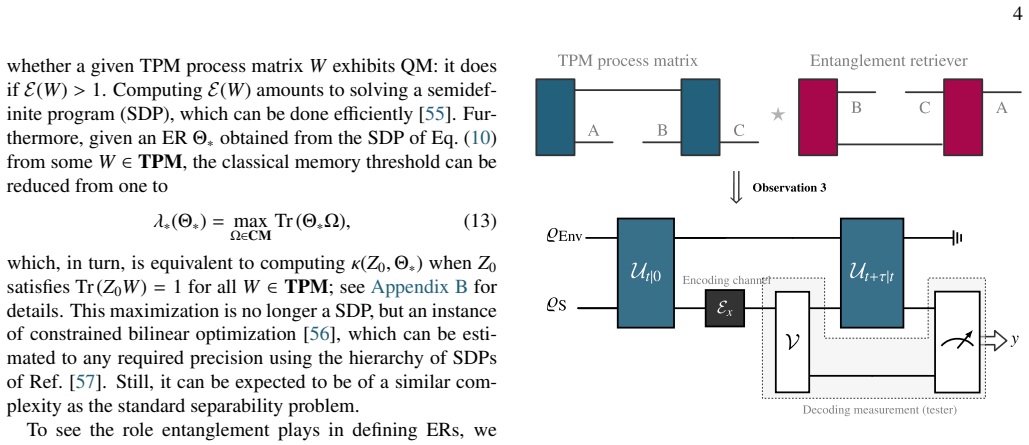
The central object is the two-point-measurement process matrix $W(t,\tau)$, the Choi\textendash Jamio\l{}kowski representation of a time window from $t$ to $t+\tau$, together with the set $\mathrm{CM}$ of classical-memory processes admitting $W=\int \varrho_\lambda\otimes\mathcal N_\lambda\,d\omega_\lambda$ with $\operatorname{Tr}_C \mathcal N_\lambda=\mathrm{id}_B$. The load-bearing new objects are entanglement retrievers (ERs): positive operators $\Theta\succeq0$ on $A\otimes B\otimes C$ with $\eta\otimes\mathrm{id}_C\succeq\operatorname{Tr}_A\Theta$ for some density operator $\eta$ on $B$. They act as witnesses because $\max_{\Theta\in\mathrm{ER}}\operatorname{Tr}(\Theta W)\le1$ for every classical-memory process; on a quantum-memory process the same optimization, solved as a semidefinite program, exceeds one. The spin-boson application identifies a particular retriever $\Theta^*=2|g\rangle\langle g|\otimes|\Psi^-\rangle\langle\Psi^-|$, which is time-independent and yields the compact witness $m(t,\tau)$ via a Taylor expansion of Heisenberg-picture correlations.
What would settle it
Reproduce the omitted symbolic proof of inequality (19) for an Ohmic bath with a hard cutoff and an initially thermal state; if a classically simulable process violates the bound, the claimed heat-flow characterization of quantum memory collapses.
Extended reading notes
Core claim
On the paper's own terms, the discovery is that the class of two-point processes satisfying a generalized quantum regression formula, statistical mixtures of regression-satisfying correlations, coincides exactly with processes whose process matrix can be written as $W=\int \varrho_\lambda\otimes\mathcal N_\lambda\,d\omega_\lambda$, i.e., classical-memory processes. For any such $W$, the maximum over entanglement retrievers $\Theta$ of $\operatorname{Tr}(\Theta W)$ is bounded by one (Observation 2), so $E(W)>1$ is a complete witness of quantum memory. The same retrievers have an operational meaning: the optimal average success probability in a memory-assisted decoding game is $E(W)/\dim\mathcal H_A$ (Observation 3), and any witness can be decomposed into ordinary two-time correlations (Observation 4). Applied to the spin-boson model, the witness becomes the explicitly computable quantity $m(t,\tau)$ of Eq. (20), whose value above one detects quantum memory; the paper further claims a general heat-flow inequality (19) that any classical-memory process must obey.
Load-bearing premise
The general heat-flow inequality (19), claimed to hold for all initial bath states and spectral densities, rests on a lengthy symbolic derivation that the authors say was conjectured from a Taylor expansion and verified only as an induction hypothesis with computer algebra, not on a fully written proof.
Editorial extensions
If this is right
- A two-point process whose correlations violate Eq. (4) cannot be simulated by any classical-memory model; the violation simultaneously witnesses system-environment entanglement, environmental coherence, and quantum memory.
- Quantum memory can be certified in practice from ordinary two-time correlations with fixed operators, without first reconstructing the process tensor, because every witness decomposes into $g^{(2)}(E_i,F_j;t,\tau)$.
- For the spin-boson model, the condition $m(t,\tau)>1$ is a definite, spectral-density-independent signature of quantum memory, even though the underlying retriever was derived in the single-mode limit.
- The heat-flow inequality (19) implies that classical temporal correlations place a bound on the rate at which energy flows between system and bath; exceeding that bound in a two-point measurement would certify quantum memory by thermodynamic data alone.
- Standard non-Markovianity does not imply quantum memory: in the Lorentzian cavity example, memory is first detected only when the coupling is strong enough, $\Omega\gtrsim7\lambda$, which the cavity-QED experiment already reaches.
Reading between the lines
- Beyond the paper: the operational decoding-game interpretation of $E(W)$ suggests that the same witness could be used as a semi-device-independent test of quantum memory, needing only the system dimension and unital encoding channels, without trusting the measurement apparatus.
- Beyond the paper: the Schmidt-rank bound $E(W)>d$ points to a dimension witness for the effective quantum memory; measuring $E(W)$ across different system sizes or interaction strengths could map out how many environmental qubits carry the memory.
- Beyond the paper: the Fock and thermal initial-state examples raise the testable prediction that quantum memory in a single-mode cavity disappears above a characteristic temperature or excitation number; scanning those parameters while monitoring $m(t,\tau;n)$ would check the boundary.
Editorial analysis
A structured set of objections, weighed in public.
Referee Report
Summary. The paper studies two-point measurement (TPM) correlations in open quantum systems beyond the quantum regression theorem. It defines classical-memory (CM) processes as convex mixtures of product process matrices (Eq. 7) and introduces 'entanglement retrievers' (ERs) to witness quantum memory (QM). Observation 1 relates the generalized regression formula to the CM decomposition; Observation 2 states that E(W)≤1 for all W∈CM and that every QM witness can be cast in the form given by Eq. (11); Observation 3 gives an operational decoding interpretation of E(W); Observation 4 shows that any QM witness can be expressed as a linear combination of TPM correlations. The framework is applied to the spin-boson model, where the authors derive a witness m(t,τ) (Eq. 20) that detects QM for arbitrary spectral densities in the single-excitation subspace, and they claim a general heat-flow inequality (Eq. 19) that is independent of the initial bath state and spectral density.
Significance. If the results hold, the paper provides a substantial advance in the characterization of non-classical memory in open quantum systems: a complete witness formalism with SDP computability, an operational game interpretation, and a concrete route to detecting QM through ordinary TPM correlations. Observations 1–4 are supported by written proofs in the appendices, and the m(t,τ) witness for the spin-boson model is a fully derived, experimentally relevant signature. However, the advertised general heat-flow inequality (19), which underpins the thermodynamic interpretation, is not actually proven in the manuscript, and the formula as written suffers from a dimensional inconsistency. These issues currently prevent the paper from fully supporting its strongest claims.
major comments (2)
- [Appendix F / Eq. (A76) (main text Eq. (19))] The general heat-flow inequality is load-bearing for the claimed thermodynamic signature of quantum memory, but its derivation is omitted. The text states that the derivation 'will be omitted', that the closed form was conjectured from a Taylor expansion, and that it was verified only as an induction hypothesis using Mathematica. No notebook, ancillary file, or reproducible symbolic proof is supplied. Consequently, the claim that the bound holds for all initial bath states and spectral densities is not established. Please provide the complete derivation, or explicitly label the inequality as a conjecture and weaken the associated claims of generality.
- [Eq. (19)] The inequality appears dimensionally inconsistent under the definitions in Eqs. (16)–(17). With B(t) having dimensions of energy, the operator N(t)=B(t)†B(t) has dimensions of energy squared, whereas B(t)†σ(t) has dimensions of energy; the two terms inside the real-part expectation cannot be added. The prefactor 2ℏω0 does not repair this mismatch. This strongly suggests a missing factor or an error in the stated formula, and since the derivation is omitted, the reader cannot resolve the inconsistency. The authors must correct this and provide a checkable derivation.
minor comments (4)
- [Appendix F, first paragraph] The text refers to 'Eq. (18) there' when describing the inequality, but the inequality appears as Eq. (19) in the main text; please correct the cross-reference.
- [Fig. A5] The plot in Fig. A5 has no axis labels or numerical scale on the axes, which makes it difficult to verify the statement that the cutoff frequency is ωC≈3ω0; please add labels or a descriptive caption.
- [Eq. (20) and surrounding text] The statement 'Eq. (20) holds true for all spectral densities' should be qualified in the main text: the derivation in Appendix F assumes the single-excitation initial state |e⟩⊗|vac⟩ and the rotating-wave-approximation Hamiltonian, so the witness is not derived for arbitrary initial bath states.
- [Fig. 3 caption] The caption mentions a 'magenta curve' but the figure colors are not otherwise described; adding a legend or explicit curve labels would improve readability.
Circularity Check
No significant circularity: the classical-memory bound and the spin-boson witness are independently proven, though Eq. (19)/(A76) rests on an explicitly omitted Mathematica proof.
-
other
[Appendix F, derivation of Eq. (A76) (= Eq. (19) in main text)]
"The derivation of this bound is length as it involves applications of the previous results together with symbolic calculations that was done with the help of Mathematica that will be omitted. ... By expanding in different orders of τ, we conjectured the form of the inequality given in Eq. (A76), based on its consistency with the Taylor expansion. Finally, we verified this conjecture by treating it as an induction hypothesis, which was confirmed using Mathematica."
This is not an equivalence-to-input circularity; it is a disclosed omitted proof. The threshold 1 and the inequality for all W in CM are proven independently by Observation 2, and the left-hand side is an explicit evaluation of the fixed ER Theta* of Eq. (18), so no fitted parameter is renamed as a prediction. However, the closed-form identity expressing Tr(Theta* W) for arbitrary spectral density and initial bath state is asserted from a Taylor-expansion conjecture and an undisclosed Mathematica induction check. This is flagged because the manuscript itself states that the derivation 'will be omitted'; it is a completeness/correctness gap, not a circular reduction.
full rationale
The central derivation chain is self-contained. Observation 1 (Eq. 4 iff Eq. 7) is proven in Appendix B from the process-matrix form rather than assumed, and the classical-memory set is independently characterized. Observation 2's bound E(W) <= 1 for W in CM is proven directly from the ER constraints and the channel marginal Tr_C N_lambda = id_B; it does not presuppose the spin-boson results. The witness Theta* in Eq. (18) was found numerically in the single-mode case, but it is verified to satisfy the ER constraints (Tr_A Theta* = id_A tensor |g><g|), and any ER gives a valid bound for every W in CM; applying it to other spectral densities is not fitting-to-data. The m(t,tau) expression in Eq. (20) is a direct evaluation of Tr(Theta* W) using Lemma 2 and hence holds for all spectral densities once Theta* is fixed. Self-citations (Refs. [27] and [32]) are background and not load-bearing. The one internal caveat is Appendix F: Eq. (19)/(A76) is said to follow from a lengthy symbolic calculation that is omitted, conjectured from Taylor expansion, and checked by Mathematica as an induction hypothesis. This is a genuine proof gap and a possible dimensional-consistency concern, but it is not circularity: the <= 1 side is independently proven by Observation 2, and the left side is an explicit computation for a fixed ER. No result reduces to its own input, so the low score reflects minor non-load-bearing self-citation rather than circular reasoning.
Assumptions & free parameters
assumptions (4)
- domain assumption Initial system-environment state is a product state, rho_SEnv(0) = rho_S tensor rho_Env.
- standard math TPM process matrices must be positive, normalized, and satisfy the causal constraint Tr_C W = (dim H_B)^-1 Tr_BC W tensor id.
- domain assumption The equivalence between classical memory and the decomposition W = integral rho tensor N domega is adopted from Ref. [21].
- domain assumption The spin-boson model is treated in the rotating-wave approximation with a number-conserving Hamiltonian (Eqs. 16-17).
Cite this review
Pith. "Pith review of Two-point measurement correlations beyond the quantum regression theorem." pith.science (2026). https://pith.science/paper/HIEDPO7K
@misc{pith2026250706088,
  author       = {Pith},
  title        = {Pith review of: Two-point measurement correlations beyond the quantum regression theorem},
  year         = {2026},
  howpublished = {\url{https://pith.science/paper/HIEDPO7K}},
  note         = {Machine review of arXiv:2507.06088}
}
read the original abstract
Temporal correlations are fundamental in quantum physics, yet their computation is often challenging. The regression theorem (or hypothesis) serves as a key tool in this context, offering a seemingly straightforward approach. However, it fails for systems strongly coupled to their surroundings, where memory effects become significant. Here, we extend the analysis of temporal correlations beyond the regression theorem, revealing what can be learned about open quantum systems when this hypothesis fails. We introduce robust, operationally meaningful methods to explore how the breakdown of the regression hypothesis can uncover fundamental quantum features of non-Markovian open systems, including entanglement, coherence, and quantum memory, namely, the fundamental impossibility of simulating memory in non-Markov processes with classical feedback mechanisms. Finally, we demonstrate how these quantum features are linked to microscopic properties such as the bath spectral density and heat flow.
Figures


Reference graph
Works this paper leans on
-
[21]
C. Giarmatzi and F. Costa, Witnessing quantum memory in non-markovian processes, Quantum5, 440 (2021)
work page 2021
- [32]
-
[1]
C. W. Gardiner,Handbook of Stochastic Methods for Physics, Chemistry and the Natural Sciences(Springer Berlin Heidel- berg, 1985)
1985
-
[2]
B. B. Mandelbrot and J. W. Van Ness, Fractional brownian motions, fractional noises and applications, SIAM Review10, 422–437 (1968)
1968
-
[3]
Vijay, C
R. Vijay, C. Macklin, D. H. Slichter, S. J. Weber, K. W. Murch, R. Naik, A. N. Korotkov, and I. Siddiqi, Stabilizing Rabi os- cillations in a superconducting qubit using quantum feedback, Nature490, 77–80 (2012)
2012
-
[4]
A. M. Alhambra, J. Riddell, and L. P. Garcia-Pintos, Time evo- lution of correlation functions in quantum many-body systems, Physical Review Letters124(2020)
2020
-
[5]
Dowling, P
N. Dowling, P. Figueroa-Romero, F. A. Pollock, P. Strasberg, and K. Modi, Relaxation of multitime statistics in quantum sys- tems, Quantum7, 1027 (2023)
2023
-
[6]
Dowling, P
N. Dowling, P. Figueroa-Romero, F. A. Pollock, P. Strasberg, and K. Modi, Equilibration of multitime quantum processes in finite time intervals, SciPost Physics Core6(2023)
2023
Show all 89 references
-
[7]
R. J. Glauber, The quantum theory of optical coherence, Physi- cal Review130, 2529–2539 (1963)
1963
-
[8]
Lax, Quantum noise
M. Lax, Quantum noise. XI. Multitime correspondence be- tween quantum and classical stochastic processes, Physical Re- view172, 350–361 (1968)
1968
-
[9]
C. W. Gardiner and P. Zoller,Quantum Noise: A Handbook of Markovian and Non-Markovian Quantum Stochastic Methods with Applications to Quantum Optics, 2nd ed. (Springer, Berlin, 2004)
2004
-
[10]
G. T. Landi, M. J. Kewming, M. T. Mitchison, and P. P. Potts, Current fluctuations in open quantum systems: Bridging the gap between quantum continuous measurements and full counting statistics, PRX Quantum5(2024)
2024
-
[11]
L. Li, M. J. Hall, and H. M. Wiseman, Concepts of quan- tum non-markovianity: A hierarchy, Physics Reports759, 1–51 (2018)
2018
-
[12]
G. W. Ford and R. F. O’Connell, There is no quantum regression theorem, Physical Review Letters77, 798–801 (1996)
1996
-
[13]
Alonso and I
D. Alonso and I. de Vega, Multiple-time correlation functions for non-markovian interaction: Beyond the quantum regression theorem, Physical Review Letters94(2005)
2005
-
[14]
Alonso and I
D. Alonso and I. de Vega, Hierarchy of equations of multiple- time correlation functions, Physical Review A75(2007)
2007
-
[15]
Guarnieri, A
G. Guarnieri, A. Smirne, and B. Vacchini, Quantum regression theorem and non-markovianity of quantum dynamics, Physical Review A90(2014)
2014
-
[16]
de Vega and D
I. de Vega and D. Alonso, Dynamics of non-markovian open quantum systems, Reviews of Modern Physics89(2017)
2017
-
[17]
Cosacchi, T
M. Cosacchi, T. Seidelmann, M. Cygorek, A. Vagov, D. E. Re- iter, and V . M. Axt, Accuracy of the quantum regression theo- rem for photon emission from a quantum dot, Physical Review Letters127(2021)
2021
-
[18]
Kurt, Two-time correlation functions beyond quantum re- gression theorem: effect of external noise, Quantum Informa- tion Processing20(2021)
A. Kurt, Two-time correlation functions beyond quantum re- gression theorem: effect of external noise, Quantum Informa- tion Processing20(2021)
2021
-
[19]
Lonigro and D
D. Lonigro and D. Chru ´sci´nski, Quantum regression in dephas- ing phenomena, Journal of Physics A: Mathematical and Theo- retical55, 225308 (2022)
2022
-
[20]
Lonigro and D
D. Lonigro and D. Chru´sci´nski, Quantum regression beyond the born-markov approximation for generalized spin-boson mod- els, Physical Review A105(2022)
2022
-
[22]
S. Milz, C. Spee, Z.-P. Xu, F. Pollock, K. Modi, and O. G ¨uhne, Genuine multipartite entanglement in time, SciPost Physics10 (2021)
2021
-
[23]
M. Nery, M. T. Quintino, P. A. Gu´erin, T. O. Maciel, and R. O. Vianna, Simple and maximally robust processes with no classi- cal common-cause or direct-cause explanation, Quantum5, 538 (2021)
2021
-
[24]
Taranto, M
P. Taranto, M. T. Quintino, M. Murao, and S. Milz, Character- ising the hierarchy of multi-time quantum processes with clas- sical memory, Quantum8, 1328 (2024)
2024
-
[25]
A. K. Roy, V . Srivastava, S. Mahanti, C. Giarmatzi, and A. Gilchrist, Semi-device-independent certification of quantum non-markovianity using sequential random access codes, Phys- ical Review A110(2024)
2024
-
[26]
B ¨acker, K
C. B ¨acker, K. Beyer, and W. T. Strunz, Local disclosure of quantum memory in non-markovian dynamics, Physical Re- view Letters132(2024)
2024
-
[27]
Santos, Z.-P
L. Santos, Z.-P. Xu, J. Piilo, and O. G ¨uhne, Quanti- fying information flow in quantum processes, (2024), arXiv:2402.04213v2 [quant-ph]
2024 arXiv
-
[28]
T.-A. Ohst, S. Zhang, H. C. Nguyen, M. Pl ´avala, and M. T. Quintino, Characterising memory in quantum channel dis- crimination via constrained separability problems, (2024), arXiv:2411.08110v1 [quant-ph]
2024
-
[29]
Goswami, A
K. Goswami, A. K. Roy, V . Srivastava, B. Perez, C. Giar- matzi, A. Gilchrist, and F. Costa, Hamiltonian characterisa- tion of multi-time processes with classical memory, (2024), arXiv:2412.01998v1 [quant-ph]
2024
-
[30]
Foligno, T
A. Foligno, T. Zhou, and B. Bertini, Temporal entanglement in chaotic quantum circuits, Physical Review X13(2023)
2023
-
[31]
Carignano, C
S. Carignano, C. R. Marim ´on, and L. Tagliacozzo, Temporal entropy and the complexity of computing the expectation value of local operators after a quench, Physical Review Research6 (2024). 7
2024
-
[33]
Lindblad, On the generators of quantum dynamical semi- groups, Communications in Mathematical Physics48, 119 (1976)
G. Lindblad, On the generators of quantum dynamical semi- groups, Communications in Mathematical Physics48, 119 (1976)
1976
-
[34]
Gorini, A
V . Gorini, A. Kossakowski, and E. C. G. Sudarshan, Completely positive dynamical semigroups of n-level systems, Journal of Mathematical Physics17, 821 (1976)
1976
-
[35]
Albash, S
T. Albash, S. Boixo, D. A. Lidar, and P. Zanardi, Quantum adi- abatic markovian master equations, New Journal of Physics14, 123016 (2012)
2012
-
[36]
Yamaguchi, T
M. Yamaguchi, T. Yuge, and T. Ogawa, Markovian quantum master equation beyond adiabatic regime, Physical Review E 95(2017)
2017
-
[37]
R. Dann, A. Levy, and R. Kosloff, Time-dependent markovian quantum master equation, Physical Review A98(2018)
2018
-
[38]
Di Meglio, M
G. Di Meglio, M. B. Plenio, and S. F. Huelga, Time dependent markovian master equation beyond the adiabatic limit, Quan- tum8, 1534 (2024)
2024
-
[39]
Rivas, S
´A. Rivas, S. F. Huelga, and M. B. Plenio, Quantum non- markovianity: characterization, quantification and detection, Reports on Progress in Physics77, 094001 (2014)
2014
-
[40]
F. A. Pollock, C. Rodr ´ıguez-Rosario, T. Frauenheim, M. Pater- nostro, and K. Modi, Operational markov condition for quan- tum processes, Physical Review Letters120(2018)
2018
-
[41]
F. A. Pollock, C. Rodr ´ıguez-Rosario, T. Frauenheim, M. Pater- nostro, and K. Modi, Non-markovian quantum processes: Com- plete framework and efficient characterization, Physical Review A97(2018)
2018
-
[42]
Milz and K
S. Milz and K. Modi, Quantum stochastic processes and quan- tum non-markovian phenomena, PRX Quantum2(2021)
2021
-
[43]
Choi, Completely positive linear maps on complex ma- trices, Linear Algebra and its Applications10, 285 (1975)
M.-D. Choi, Completely positive linear maps on complex ma- trices, Linear Algebra and its Applications10, 285 (1975)
1975
-
[44]
Jamiołkowski, Linear transformations which preserve trace and positive semidefiniteness of operators, Reports on Mathe- matical Physics3, 275 (1972)
A. Jamiołkowski, Linear transformations which preserve trace and positive semidefiniteness of operators, Reports on Mathe- matical Physics3, 275 (1972)
1972
-
[45]
White, F
G. White, F. Pollock, L. Hollenberg, K. Modi, and C. Hill, Non-markovian quantum process tomography, PRX Quantum 3(2022)
2022
-
[46]
Chiribella, G
G. Chiribella, G. M. D'Ariano, and P. Perinotti, Transforming quantum operations: Quantum supermaps, EPL (Europhysics Letters)83, 30004 (2008)
2008
-
[47]
Chiribella, G
G. Chiribella, G. M. D’Ariano, and P. Perinotti, Quantum cir- cuit architecture, Physical Review Letters101(2008)
2008
-
[48]
Chiribella, G
G. Chiribella, G. M. D’Ariano, and P. Perinotti, Theoreti- cal framework for quantum networks, Physical Review A80 (2009)
2009
-
[49]
Yadin, J
B. Yadin, J. Ma, D. Girolami, M. Gu, and V . Vedral, Quantum processes which do not use coherence, Physical Review X6 (2016)
2016
-
[50]
[49] for details)
This is because any strictly incoherent operation, which in- cludes pure dephasing, can be performed in terms of incoherent unitary operations (see Ref. [49] for details)
-
[51]
B.-H. Liu, L. Li, Y .-F. Huang, C.-F. Li, G.-C. Guo, E.-M. Laine, H.-P. Breuer, and J. Piilo, Experimental control of the transi- tion from markovian to non-markovian dynamics of open quan- tum systems, Nature Physics7, 931 (2011)
2011
-
[52]
Z.-D. Liu, H. Lyyra, Y .-N. Sun, B.-H. Liu, C.-F. Li, G.-C. Guo, S. Maniscalco, and J. Piilo, Experimental implementation of fully controlled dephasing dynamics and synthetic spectral den- sities, Nature Communications9(2018)
2018
-
[53]
quantum memory
It is therefore consistent with previous definitions of “quantum memory” in different contexts; cf. [80–84]
-
[54]
G ¨uhne and G
O. G ¨uhne and G. T ´oth, Entanglement detection, Physics Re- ports474, 1–75 (2009)
2009
-
[55]
Skrzypczyk and D
P. Skrzypczyk and D. Cavalcanti,Semidefinite Programming in Quantum Information Science(IOP Publishing, 2023)
2023
-
[56]
Berta, O
M. Berta, O. Fawzi, and V . B. Scholz, Quantum bilinear optimization, SIAM Journal on Optimization26, 1529–1564 (2016)
2016
-
[57]
Berta, F
M. Berta, F. Borderi, O. Fawzi, and V . B. Scholz, Semidefinite programming hierarchies for constrained bilinear optimization, Mathematical Programming194, 781–829 (2021)
2021
-
[58]
It can be understood as a simple way to translate composition between channels in the CJ picture; see Ref
The link product between two operators, sayXandYon Hilbert spacesH A⊗H B andH B⊗H C respectively, is defined as X⋆Y=Tr B XΓB⊗id C idA⊗Y . It can be understood as a simple way to translate composition between channels in the CJ picture; see Ref. [48] for details
-
[59]
B. M. Terhal and P. Horodecki, Schmidt number for density matrices, Physical Review A61(2000)
2000
-
[60]
Moroder and O
T. Moroder and O. Gittsovich, Calibration-robust entangle- ment detection beyond bell inequalities, Physical Review A85, 10.1103/physreva.85.032301 (2012)
2012 doi
-
[61]
Breuer and F
H.-P. Breuer and F. Petruccione,The Theory of Open Quantum Systems(Oxford University Press, Oxford, 2007)
2007
-
[62]
Brune, F
M. Brune, F. Schmidt-Kaler, A. Maali, J. Dreyer, E. Hagley, J. M. Raimond, and S. Haroche, Quantum rabi oscillation: A direct test of field quantization in a cavity, Physical Review Let- ters76, 1800–1803 (1996)
1996
-
[63]
Budroni, T
C. Budroni, T. Moroder, M. Kleinmann, and O. G¨uhne, Bound- ing temporal quantum correlations, Physical Review Letters 111(2013)
2013
-
[64]
Budroni and C
C. Budroni and C. Emary, Temporal quantum correlations and leggett-garg inequalities in multilevel systems, Physical Review Letters113(2014)
2014
-
[65]
Budroni,Temporal Quantum Correlations and Hidden Vari- able Models(Springer International Publishing, 2016)
C. Budroni,Temporal Quantum Correlations and Hidden Vari- able Models(Springer International Publishing, 2016)
2016
-
[66]
Hoffmann, C
J. Hoffmann, C. Spee, O. G ¨uhne, and C. Budroni, Structure of temporal correlations of a qubit, New Journal of Physics20, 102001 (2018)
2018
-
[67]
Costa, M
F. Costa, M. Ringbauer, M. E. Goggin, A. G. White, and A. Fedrizzi, Unifying framework for spatial and temporal quan- tum correlations, Physical Review A98(2018)
2018
-
[68]
C. Spee, H. Siebeneich, T. F. Gloger, P. Kaufmann, M. Johan- ning, M. Kleinmann, C. Wunderlich, and O. G ¨uhne, Genuine temporal correlations can certify the quantum dimension, New Journal of Physics22, 023028 (2020)
2020
-
[69]
Budroni, G
C. Budroni, G. Vitagliano, and M. P. Woods, Ticking-clock performance enhanced by nonclassical temporal correlations, Physical Review Research3(2021)
2021
-
[70]
L. B. Vieira, S. Milz, G. Vitagliano, and C. Budroni, Witnessing environment dimension through temporal correlations, Quan- tum8, 1224 (2024)
2024
-
[71]
Strathearn, P
A. Strathearn, P. Kirton, D. Kilda, J. Keeling, and B. W. Lovett, Efficient non-markovian quantum dynamics using time- evolving matrix product operators, Nature Communications9 (2018)
2018
-
[72]
F. C. Binder, J. Thompson, and M. Gu, Practical unitary sim- ulator for non-markovian complex processes, Physical Review Letters120(2018)
2018
-
[73]
M. R. Jørgensen and F. A. Pollock, Exploiting the causal ten- sor network structure of quantum processes to efficiently simu- late non-markovian path integrals, Physical Review Letters123 (2019)
2019
-
[74]
Cygorek, M
M. Cygorek, M. Cosacchi, A. Vagov, V . M. Axt, B. W. Lovett, J. Keeling, and E. M. Gauger, Simulation of open quantum sys- 1 tems by automated compression of arbitrary environments, Na- ture Physics18, 662–668 (2022)
2022
-
[75]
G. A. L. White, P. Jurcevic, C. D. Hill, and K. Modi, Unify- ing non-markovian characterisation with an efficient and self- consistent framework, (2023), arXiv:2312.08454v1 [quant-ph]
2023 arXiv
-
[76]
Dowling, K
N. Dowling, K. Modi, R. N. Mu ˜noz, S. Singh, and G. A. L. White, Capturing long-range memory structures with tree- geometry process tensors, Physical Review X14(2024)
2024
-
[77]
Cygorek and E
M. Cygorek and E. M. Gauger, Understanding and utilizing the inner bonds of process tensors, (2024), arXiv:2404.01287v1 [quant-ph]
2024 arXiv
-
[78]
Cygorek, B
M. Cygorek, B. W. Lovett, J. Keeling, and E. M. Gauger, Tree- like process tensor contraction for automated compression of environments, (2024), arXiv:2405.16548v1 [quant-ph]
2024 arXiv
-
[79]
Li, X.-L
Z.-T. Li, X.-L. He, C.-C. Zheng, Y .-Q. Dong, T. Luan, X.-T. Yu, and Z.-C. Zhang, Quantum comb tomography via learn- ing isometries on Stiefel manifold, Physical Review Letters134 (2025)
2025
-
[80]
M. A. Nielsen, Quantum computation by measurement and quantum memory, Physics Letters A308, 96–100 (2003)
2003
-
[81]
Chiribella, G
G. Chiribella, G. M. D’Ariano, and P. Perinotti, Memory ef- fects in quantum channel discrimination, Physical Review Let- ters101(2008)
2008
-
[82]
A. I. Lvovsky, B. C. Sanders, and W. Tittel, Optical quantum memory, Nature Photonics3, 706–714 (2009)
2009
-
[83]
B. M. Terhal, Quantum error correction for quantum memories, Reviews of Modern Physics87, 307–346 (2015)
2015
-
[84]
Rosset, F
D. Rosset, F. Buscemi, and Y .-C. Liang, Resource theory of quantum memories and their faithful verification with minimal assumptions, Physical Review X8(2018)
2018
-
[85]
Oreshkov, F
O. Oreshkov, F. Costa, and ˇC. Brukner, Quantum correlations with no causal order, Nature Communications3(2012)
2012
-
[86]
Ara ´ujo, C
M. Ara ´ujo, C. Branciard, F. Costa, A. Feix, C. Giarmatzi, and ˇC. Brukner, Witnessing causal nonseparability, New Journal of Physics17, 102001 (2015)
2015
-
[87]
positive over tensor products
To be fair, at this point one would only need to impose thatW be “positive over tensor products” to guarantee positivity of the probabilities (see Refs. [85, 86] for in-depth discussions). The need forWto bede factopositive semidefinite comes from the possibility of probing th...
-
[88]
Bengtsson, M
I. Bengtsson, M. Grassl, and G. McConnell, SIC-POVMs from Stark units: Dimensionsn 2 +3=4p,pprime, (2024), arXiv:2403.02872v1 [quant-ph]
2024 arXiv
-
[89]
number operator
M. Appleby, S. T. Flammia, and G. S. Kopp, A constructive ap- proach to Zauner’s conjecture via the Stark conjectures, (2025), arXiv:2501.03970v1 [math.NT]. APPENDIX A. FROM HEISENBERG TO CHOI-JAMIOŁKOWSKI AND BACK Herein, we aim to succinctly explain how to transition be- twe...
2025 arXiv
Reviewed August 6, 2026 · model on record in the stance chip above.
Discussion (0). Continue with ORCID to comment.