REVIEW 3 major objections 6 minor 95 references
First-principles carrier mobility and optical absorption of strained ZnO with self-consistent Hubbard interactions
T0 review · 3 major / 6 minor · reviewed 2026-08-03 · deepseek-v4-flash
Pith's one-line read Uniaxial tensile strain of 4.8% along [1-10] increases room-temperature electron mobility of ZnO by 19% without changing visible absorption.
desk verdict Solid transport prediction; the constant scissor shift makes the 'visible absorption unchanged' claim fragile. read the letter →
The pith
A machine-rendered reading of the paper's core claim, the machinery that carries it, and where it could break.
The reading
What carries the argument
The central mechanism is the self-consistent Hubbard-corrected density-functional perturbation theory (DFPT+U), which supplies phonon dispersions and electron-phonon matrix elements from a DFT+U ground state with the Hubbard parameter determined self-consistently for each strained geometry. This is combined with Wannier interpolation, the iterative Boltzmann transport equation for mobility, and quasi-degenerate perturbation theory for phonon-assisted optical absorption. A scissor correction aligns the computed band gap to experiment for the optical spectra.
What would settle it
Grow or bend a ZnO film to 4.8% uniaxial in-plane tensile strain, measure Hall or drift mobility along the strain direction and optical absorption in the visible range; if the mobility increase is not ~19% or the absorption changes by more than a few percent, the central prediction fails. Alternatively, recompute the optical spectrum with a strain-dependent scissor shift and check whether the visible absorption remains unchanged.
Extended reading notes
Core claim
Within density-functional perturbation theory augmented with a self-consistent Hubbard U applied only to O 2p orbitals, the paper computes electron-phonon interactions from the DFT+U ground state and evaluates phonon-limited mobility and optical absorption of wurtzite ZnO under uniaxial tensile strain. It finds that 4.8% strain along [1-10] raises the 300 K electron mobility along the strain direction by 19% (with the perpendicular in-plane component up 4.2% and the out-of-plane component down 8%) while the absorption spectrum below 3.2 eV changes negligibly. The deformation potential near Gamma is essentially strain-independent, so the scattering reduction is attributed to changes in electr
Load-bearing premise
The load-bearing premise is that applying the Hubbard correction only to O 2p orbitals, together with a single scissor shift held fixed across all strains, captures the strain dependence of the conduction band and electron-phonon coupling accurately enough that the computed 19% mobility increase and unchanged absorption are quantitatively meaningful.
Editorial extensions
If this is right
- In a ZnO thin-film transistor, bending-induced tensile strain of a few percent could raise channel mobility without degrading transparency.
- The strain-dependent band-gap shift (~12 meV per 1% strain) can serve as a benchmark for future calculations and experiments.
- The same parameter-free DFPT+U pipeline can be applied to other wide-band-gap oxides (e.g., InGaZnO) to screen strain-engineered transport.
- The finding that deformation potentials stay nearly constant under strain indicates that mobility changes in this material are dominated by phase-space and effective-mass effects.
Reading between the lines
- The 19% gain is computed at 4.8% strain; whether the trend continues at larger strains is an open question, since the paper does not test beyond 4.8% and structural instabilities could set in.
- Because the strain is uniaxial, the in-plane mobility is anisotropic; a device aligned with the strain direction should benefit more than one aligned perpendicularly, which could be checked in experiments.
- If the fixed scissor correction were allowed to vary with strain, the visible-absorption 'unchanged' conclusion might need revisiting; a strain-dependent gap correction is a natural next test.
- The claim that visible transparency is unaffected relies on direct transitions dominating; phonon-assisted transitions grow slightly but stay small, so future resonant Raman or sub-gap absorption measurements could probe this.
Signed reviews
Editorial analysis
A structured set of objections, weighed in public.
Referee Report
Summary. The manuscript applies a newly developed DFPT+U implementation, with a self-consistent ACBN0 Hubbard U on O 2p orbitals, to wurtzite ZnO under uniaxial tensile strain. It computes electronic and phonon band structures, electron-phonon matrix elements, iterative Boltzmann transport mobilities, and direct plus phonon-assisted optical absorption for three strain directions, focusing on ε_yy ([1-10]) strain. The central claim is that 4.8% uniaxial tensile strain along [1-10] increases the room-temperature electron mobility along the strain direction by 19% while leaving visible-range optical absorption essentially unchanged, which the authors interpret as a strain-selective transport enhancement relevant to transparent flexible display backplanes.
Significance. If confirmed, the result would establish a practical design principle for strain-engineered oxide TFT channels and demonstrate the usefulness of DFPT+U with self-consistent Hubbard parameters for transport and optical response in correlated wide-gap oxides. The transport calculations are carefully executed: dense k/q grids, iterative solution of the Boltzmann equation, Wannier interpolation cross-checked against direct DFPT+U deformation potentials (Fig. 4c,d), verification of phonon stability, and a clear decomposition of the mobility enhancement into effective-mass and scattering-rate contributions. The main weakness is the optical half of the headline, which relies on a constant empirical scissor shift without accounting for the strain dependence of the DFT+U gap error. After this calibration issue is addressed, the paper would be a solid contribution.
major comments (3)
- [III.C, Fig. 3(d)] The 'visible absorption essentially unchanged' claim is not robust because the same scissor shift Δ=1.61 eV is applied to all strained structures. The text reports dE_g/dε ≈ -12 meV/% for DFT+U, versus ≈ -16 meV/% in Ref. [33]; hence the corrected absorption edge at 4.8% strain is miscalibrated by ~19 meV. This is not a negligible calibration error: Fig. 3(e) places strain-induced direct-transition changes at 3.1–3.2 eV, inside the quoted visible range (1.6–3.3 eV). Please repeat the optical calculation with a strain-dependent scissor calibrated to the experimental gap-strain coefficient, or at minimum show that a rigid 20 meV shift of the strained spectra leaves the conclusion unchanged. The abstract's 'parameter-free' wording is also inconsistent with the empirical scissor input.
- [II/III.B, Table I] The method applies a Hubbard U only to O 2p, with no U on Zn 3d, following Ref. [61] without an independent justification under strain. The headline mobility increase is driven by the strain dependence of the conduction-band effective mass and acoustic-phonon scattering phase space (§III.D, Fig. 4). The same U_p-only ground state already underestimates the gap-strain coefficient by 25% relative to experiment, so it is plausible that the strain dependence of m* and the el-ph matrix elements is also biased. Please provide a sensitivity test at, e.g., 4.8% strain with a self-consistent U_d on Zn 3d (or compare against a GW/hybrid-functional strain coefficient), or explicitly state this as a limitation of the transport conclusion.
- [III.C] The phrase 'essentially unchanged' is not quantified. Fig. 3(d) displays spectra without a quantitative tolerance, and Fig. 3(f) shows a weak phonon-assisted peak developing in the visible range with increasing strain. Please report the maximum relative change in α(ω) over 1.6–3.3 eV at 4.8% strain and state what threshold is used for 'essentially unchanged'.
minor comments (6)
- [Abstract/Conclusion] The 19% increase is direction-specific: µ_y +19%, µ_x +4.2%, µ_z -8% at 300 K and 4.8% strain. The abstract and conclusion should explicitly say 'along the strain direction' to avoid overstatement.
- [Eq. (1)] Define all symbols in Eq. (1), especially the sum over k and the meaning of N. As written, Dν(Γ,q) appears on the left while the right-hand side contains g_{mnν}(k,q) with no explicit k summation or normalization over the BZ.
- [Appendix B] The text says 'Wannierization converged within 10 4 iterations'; this should read 10^4 iterations. Also, the frozen-window values in Table A1 would benefit from a statement of the energy reference.
- [Appendix C] Title has a typo: 'principle axis' should be 'principal axes'.
- [Page 1] Typo: 'accelerateing' should be 'accelerating'.
- [III.C, visible range] The quoted visible range 1.6–3.3 eV extends beyond the conventional visible spectrum (≈1.6–3.1 eV). Specify the convention, since the near-edge changes at 3.1–3.2 eV are relevant to the discussion.
Circularity Check
No significant circularity: the strain-dependent mobility and absorption are computed outputs, not fitted targets.
full rationale
The core derivation chain is self-contained. The Hubbard U_p is recomputed self-consistently for each strained structure via ACBN0, and the phonon-limited mobility is obtained by solving the Boltzmann transport equation with DFPT+U electron-phonon matrix elements; no transport or optical observable is used as input to set U_p. The mobility enhancement is therefore a computed output, not a fit. The only explicit calibration is the scissor correction: 'Following Ref. [87], a scissor operator ... is introduced ... Δ = 1.61 eV ... For simplicity and to enable direct comparison across strain conditions, the same scissor correction is applied to all strained structures.' This is a transparent one-parameter alignment of the zero-strain DFT+U gap to experiment; the strain dependence of the gap, effective mass, and absorption are still computed rather than imposed. Thus the 'visible absorption essentially unchanged' statement is a prediction, albeit one whose near-edge robustness is limited by the DFT+U strain coefficient (-12 meV/% vs. the cited experimental ~-16 meV/%), a calibration concern rather than circularity. The U_p-only approximation is inherited from the same group's Ref. [61] ('According to a recent work [61], we adopt a minimal Hubbard correction applied only to the O 2p orbital'), which is a self-citation; however, the paper states that work reproduces experimental phonon-limited mobility and optical absorption, so it is externally benchmarked supporting evidence, not an unverified premise. No equation in the paper reduces the claimed 19% mobility change or the absorption flatness to an input parameter by construction.
Assumptions & free parameters
free parameters (1)
- Scissor correction Δ =
1.61 eV
assumptions (5)
- domain assumption DFT+U with Hubbard U applied only to O 2p orbitals gives reliable electronic structure and electron-phonon coupling for ZnO
- domain assumption The ACBN0 self-consistent scheme yields accurate U_p without external fitting
- ad hoc to paper The same scissor shift Δ=1.61 eV applies to all strain conditions
- domain assumption Wannier interpolation faithfully reproduces the DFPT+U electron-phonon matrix elements
- domain assumption The iterative solution of the linearized Boltzmann transport equation gives accurate phonon-limited mobility
Cite this review
Pith. "Pith review of First-principles carrier mobility and optical absorption of strained ZnO with self-consistent Hubbard interactions." pith.science (2026). https://pith.science/paper/HIT6HJX7
@misc{pith2026260729030,
  author       = {Pith},
  title        = {Pith review of: First-principles carrier mobility and optical absorption of strained ZnO with self-consistent Hubbard interactions},
  year         = {2026},
  howpublished = {\url{https://pith.science/paper/HIT6HJX7}},
  note         = {Machine review of arXiv:2607.29030}
}
read the original abstract
Carrier mobility and optical absorption are key performance parameters of oxide semiconductors in transparent and flexible displays. We use a newly developed density-functional perturbation theory with a self-consistent Hubbard correction (DFPT+U) to study phonon-limited electron transport and phonon-assisted optical absorption in strained zinc oxide (ZnO). This parameter-free approach accounts for electron-phonon interactions and on-site correlation effects simultaneously. Electronic structures and phonon dispersions are computed under three distinct uniaxial strain directions. Uniaxial tensile strain up to 4.8% along [\bar110] is found to increase the room-temperature electron mobility by 19% while leaving visible-range optical absorption essentially unchanged. These results demonstrate that moderate strain can selectively enhance carrier transport without degrading optical transparency, and establish DFPT+U as an effective framework for predicting strain-dependent transport and optical properties in wide-band-gap oxides with implications for strain-engineered display and optoelectronic applications.
Figures
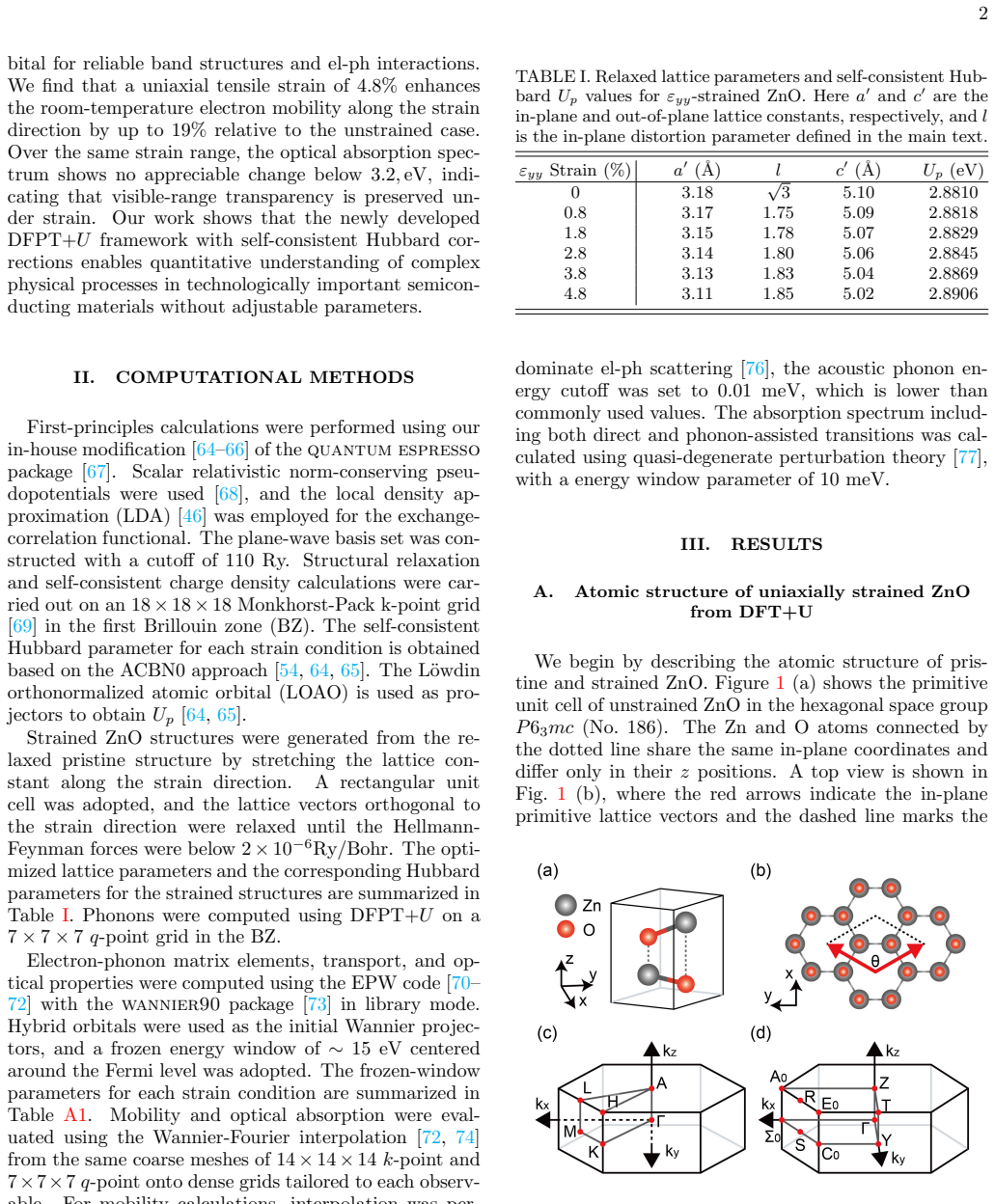


Figures from the paper (1 more)

Reference graph
Works this paper leans on
-
[33]
K. Eun, W. Hwang, B. Sharma, J. Ahn, Y. Lee, and S. Choa, Mechanical flexibility of zinc oxide thin-film transistors prepared by transfer printing method, Mod- ern Physics Letters B26, 1250077 (2012)
2012
-
[61]
Floris, S
A. Floris, S. de Gironcoli, E. Gross, and M. Cococcioni, Vibrational properties of mno and nio from dft+ u-based density functional perturbation theory, Physical Review B—Condensed Matter and Materials Physics84, 161102 (2011)
2011
-
[1]
Shockley, The theory of p-n junctions in semiconduc- tors and p-n junction transistors, Bell system technical journal28, 435 (1949)
W. Shockley, The theory of p-n junctions in semiconduc- tors and p-n junction transistors, Bell system technical journal28, 435 (1949)
1949
-
[2]
Bardeen and W
J. Bardeen and W. H. Brattain, The transistor, a semi- conductor triode, Physical review74, 230 (1948)
1948
-
[3]
In this case, the out-of-plane lattice parameter 9 FIG. A5. Electronic and phonon band structures of ZnO under tensile strain. The left panels, (a), (c), and (e), corre- spond toε xx strain, while the right panels, (b), (d), and (f), correspond toε zz strain. (a),(b) Electronic band structures. (c),(d) phonon band structures. (e),(f) Relative change in th...
-
[4]
G. E. Mooreet al., Cramming more components onto integrated circuits (1965)
1965
-
[5]
S. M. Sze, Y. Li, and K. K. Ng,Physics of semiconductor devices(John wiley & sons, 2021)
2021
-
[6]
Bohr, A 30 year retrospective on dennard’s mosfet scaling paper, IEEE Solid-State Circuits Society Newslet- ter12, 11 (2007)
M. Bohr, A 30 year retrospective on dennard’s mosfet scaling paper, IEEE Solid-State Circuits Society Newslet- ter12, 11 (2007)
2007
Show all 95 references
-
[7]
Dennard, F
R. Dennard, F. Gaensslen, H.-N. Yu, V. Rideout, E. Bas- sous, and A. LeBlanc, Design of ion-implanted mosfet’s with very small physical dimensions, IEEE Journal of 10 Solid-State Circuits9, 256 (1974)
1974
-
[8]
Kahng, Silicon-silicon dioxide field induced surface de- vices, inIRE Solid State Device Res
D. Kahng, Silicon-silicon dioxide field induced surface de- vices, inIRE Solid State Device Res. Conf.(1960)
1960
-
[9]
M. M. Atalla, E. Tannenbaum, and E. Scheibner, Sta- bilization of silicon surfaces by thermally grown oxides, Bell System Technical Journal38, 749 (1959)
1959
-
[10]
B. E. Deal and A. Grove, General relationship for the thermal oxidation of silicon, Journal of applied physics 36, 3770 (1965)
1965
-
[11]
Hofstein and F
S. Hofstein and F. Heiman, The silicon insulated-gate field-effect transistor, Proceedings of the IEEE51, 1190 (1963)
1963
-
[12]
Le Comber, W
P. Le Comber, W. Spear, and A. Ghaith, Amorphous- silicon field-effect device and possible application, Elec- tronics Letters15, 179 (1979)
1979
-
[13]
P. K. Weimer, The tft a new thin-film transistor, Pro- ceedings of the IRE50, 1462 (1962)
1962
-
[14]
H. Sato, T. Minami, S. Takata, and T. Yamada, Trans- parent conducting p-type nio thin films prepared by mag- netron sputtering, Thin solid films236, 27 (1993)
1993
-
[15]
C. R. Kagan and P. Andry,Thin-film transistors(CRC Press, 2003)
2003
-
[16]
Hoffman, B
R. Hoffman, B. J. Norris, and J. Wager, Zno-based trans- parent thin-film transistors, Applied Physics Letters82, 733 (2003)
2003
-
[17]
Orita, H
M. Orita, H. Tanji, M. Mizuno, H. Adachi, and I. Tanaka, Mechanism of electrical conductivity of transparent ingazno 4, Physical Review B61, 1811 (2000)
2000
-
[18]
Yabuta, M
H. Yabuta, M. Sano, K. Abe, T. Aiba, T. Den, H. Ku- momi, K. Nomura, T. Kamiya, and H. Hosono, High- mobility thin-film transistor with amorphous ingazno4 channel fabricated by room temperature rf-magnetron sputtering, Applied physics letters89(2006)
2006
-
[19]
Nomura, H
K. Nomura, H. Ohta, A. Takagi, T. Kamiya, M. Hirano, and H. Hosono, Room-temperature fabrication of trans- parent flexible thin-film transistors using amorphous ox- ide semiconductors, nature432, 488 (2004)
2004
-
[20]
Ohta and H
H. Ohta and H. Hosono, Transparent oxide optoelectron- ics, Materials Today7, 42 (2004)
2004
-
[21]
Fortunato, P
E. Fortunato, P. Barquinha, and R. Martins, Oxide semi- conductor thin-film transistors: a review of recent ad- vances, Advanced materials24, 2945 (2012)
2012
-
[22]
B. J. Lechner, F. J. Marlowe, E. O. Nester, and J. Tults, Liquid crystal matrix displays, Proceedings of the IEEE 59, 1566 (1971)
1971
-
[23]
T. P. Brody, J. A. Asars, and G. D. Dixon, A 6×6 inch 20 lines-per-inch liquid-crystal display panel, IEEE Transac- tions on Electron Devices20, 995 (1973)
1973
-
[24]
Byeon, S
G. Byeon, S. C. Jang, T. Roh, J.-M. Park, H.-S. Kim, and Y.-Y. Noh, Recent progress in the development of backplane thin film transistors for information displays, Journal of Information Display24, 159 (2023)
2023
-
[25]
D. W. Kim, S. W. Kim, G. Lee, J. Yoon, S. Kim, J.- H. Hong, S.-C. Jo, and U. Jeong, Fabrication of practi- cal deformable displays: advances and challenges, Light: Science & Applications12, 61 (2023)
2023
-
[26]
Park, T.-W
J.-S. Park, T.-W. Kim, D. Stryakhilev, J.-S. Lee, S.-G. An, Y.-S. Pyo, D.-B. Lee, Y. G. Mo, D.-U. Jin, and H. K. Chung, Flexible full color organic light-emitting diode display on polyimide plastic substrate driven by amorphous indium gallium zinc oxide thin-film transis- tors...
2009
-
[27]
E. M. Fortunato, P. M. Barquinha, A. Pimentel, A. M. Goncalves, A. J. Marques, L. M. Pereira, and R. F. Martins, Fully transparent zno thin-film transistor pro- duced at room temperature, Advanced Materials17, 590 (2005)
2005
-
[28]
T. Jun, K. Song, Y. Jeong, K. Woo, D. Kim, C. Bae, and J. Moon, High-performance low-temperature solution- processable zno thin film transistors by microwave- assisted annealing, Journal of Materials Chemistry21, 1102 (2011)
2011
-
[29]
K. Song, J. Noh, T. Jun, Y. Jung, H.-Y. Kang, and J. Moon, Fully flexible solution-deposited zno thin-film transistors, Adv. Mater22, 4308 (2010)
2010
-
[30]
K. H. Cherenack, N. S. Munzenrieder, and G. Troster, Impact of mechanical bending on zno and igzo thin- film transistors, IEEE Electron Device Letters31, 1254 (2010)
2010
-
[31]
Lin, C.-C
Y.-Y. Lin, C.-C. Hsu, M.-H. Tseng, J.-J. Shyue, and F.- Y. Tsai, Stable and high-performance flexible zno thin- film transistors by atomic layer deposition, ACS applied materials & interfaces7, 22610 (2015)
2015
-
[32]
Y. Li, B. Yao, Y. Lu, C. Cong, Z. Zhang, Y. Gai, C. Zheng, B. Li, Z. Wei, D. Shen,et al., Characterization of biaxial stress and its effect on optical properties of zno thin films, Applied physics letters91(2007)
2007
-
[34]
Fan, Temperature dependence of the energy gap in semiconductors, Physical Review82, 900 (1951)
H. Fan, Temperature dependence of the energy gap in semiconductors, Physical Review82, 900 (1951)
1951
-
[35]
J. Liu, Z. Zhou, H. Gu, J. Zhu, H. Jiang, and S. Liu, Asymmetric optical properties and bandgap shift of pre- strained flexible zno films, APL Materials12(2024)
2024
-
[36]
Grimvall, New aspects on the electron-phonon system at finite temperatures with an application on lead and mercury, Physik der kondensierten Materie9, 283 (1969)
G. Grimvall, New aspects on the electron-phonon system at finite temperatures with an application on lead and mercury, Physik der kondensierten Materie9, 283 (1969)
1969
-
[37]
Bardeen and W
J. Bardeen and W. Shockley, Deformation potentials and mobilities in non-polar crystals, Physical review80, 72 (1950)
1950
-
[38]
Kohn and L
W. Kohn and L. J. Sham, Self-consistent equations in- cluding exchange and correlation effects, Phys. Rev.140, A1133 (1965)
1965
-
[39]
Hohenberg and W
P. Hohenberg and W. Kohn, Inhomogeneous electron gas, Physical review136, B864 (1964)
1964
-
[40]
Giannozzi, S
P. Giannozzi, S. De Gironcoli, P. Pavone, and S. Baroni, Ab initio calculation of phonon dispersions in semicon- ductors, Physical Review B43, 7231 (1991)
1991
-
[41]
Baroni, P
S. Baroni, P. Giannozzi, and A. Testa, Green’s-function approach to linear response in solids, Physical review let- ters58, 1861 (1987)
1987
-
[42]
Gonze, Erratum: Adiabatic density-functional pertur- bation theory, Phys
X. Gonze, Erratum: Adiabatic density-functional pertur- bation theory, Phys. Rev. A54, 4591 (1996)
1996
-
[43]
Gonze, Adiabatic density-functional perturbation the- ory, Physical Review A52, 1096 (1995)
X. Gonze, Adiabatic density-functional perturbation the- ory, Physical Review A52, 1096 (1995)
1995
-
[44]
Giustino, Electron-phonon interactions from first prin- ciples, Reviews of Modern Physics89, 015003 (2017)
F. Giustino, Electron-phonon interactions from first prin- ciples, Reviews of Modern Physics89, 015003 (2017)
2017
-
[45]
Baroni, S
S. Baroni, S. De Gironcoli, A. Dal Corso, and P. Gi- annozzi, Phonons and related crystal properties from density-functional perturbation theory, Reviews of mod- ern Physics73, 515 (2001)
2001
-
[46]
J. P. Perdew and A. Zunger, Self-interaction correction to density-functional approximations for many-electron systems, Physical review B23, 5048 (1981)
1981
-
[47]
R. O. Jones, Density functional theory: Its origins, rise to prominence, and future, Reviews of modern physics 11 87, 897 (2015)
2015
-
[48]
Mori-S´ anchez, A
P. Mori-S´ anchez, A. J. Cohen, and W. Yang, Localiza- tion and delocalization errors in density functional the- ory¡? format?¿ and implications for band-gap prediction, Physical review letters100, 146401 (2008)
2008
-
[49]
J. P. Perdew, K. Burke, and M. Ernzerhof, Generalized gradient approximation made simple, Physical review let- ters77, 3865 (1996)
1996
-
[50]
F. Oba, M. Choi, A. Togo, and I. Tanaka, Point defects in zno: an approach from first principles, Science and Technology of Advanced Materials12, 034302 (2011)
2011
-
[51]
L. Y. Lim, S. Lany, Y. J. Chang, E. Rotenberg, A. Zunger, and M. F. Toney, Angle-resolved photoemis- sion and quasiparticle calculation of zno: The need for d band shift in oxide semiconductors, Physical Review B—Condensed Matter and Materials Physics86, 235113 (2012)
2012
-
[52]
S. L. Dudarev, G. A. Botton, S. Y. Savrasov, C. Humphreys, and A. P. Sutton, Electron-energy-loss spectra and the structural stability of nickel oxide: An lsda+ u study, Physical Review B57, 1505 (1998)
1998
-
[53]
V. I. Anisimov, F. Aryasetiawan, and A. Lichtenstein, First-principles calculations of the electronic structure and spectra of strongly correlated systems: the lda+ u method, Journal of Physics: Condensed Matter9, 767 (1997)
1997
-
[54]
L. A. Agapito, S. Curtarolo, and M. Buongiorno Nardelli, Reformulation of dft+ u as a pseudohybrid hubbard den- sity functional for accelerated materials discovery, Phys- ical Review X5, 011006 (2015)
2015
-
[55]
Himmetoglu, A
B. Himmetoglu, A. Floris, S. De Gironcoli, and M. Co- coccioni, Hubbard-corrected dft energy functionals: The lda+ u description of correlated systems, International Journal of Quantum Chemistry114, 14 (2014)
2014
-
[56]
H. J. Kulik, M. Cococcioni, D. A. Scherlis, and N. Marzari, Density functional theory in transition-metal chemistry:¡? format?¿ a self-consistent hubbard u ap- proach, Physical Review Letters97, 103001 (2006)
2006
-
[57]
Cococcioni and S
M. Cococcioni and S. De Gironcoli, Linear response approach to the calculation of the effective interaction parameters in the lda+ u method, Physical Review B—Condensed Matter and Materials Physics71, 035105 (2005)
2005
-
[58]
N. J. Mosey, P. Liao, and E. A. Carter, Rotationally in- variant ab initio evaluation of coulomb and exchange pa- rameters for dft+ u calculations, The Journal of chemical physics129(2008)
2008
-
[59]
N. J. Mosey and E. A. Carter, Ab initio evaluation of coulomb and exchange parameters for dft+ u calcula- tions, Physical Review B—Condensed Matter and Mate- rials Physics76, 155123 (2007)
2007
-
[60]
Floris, I
A. Floris, I. Timrov, B. Himmetoglu, N. Marzari, S. de Gironcoli, and M. Cococcioni, Hubbard-corrected density functional perturbation theory with ultrasoft pseudopotentials, Physical Review B101, 064305 (2020)
2020
-
[62]
Lany and A
S. Lany and A. Zunger, Assessment of correction meth- ods for the band-gap problem and for finite-size effects in supercell defect calculations: Case studies for zno and gaas, Physical Review B—Condensed Matter and Mate- rials Physics78, 235104 (2008)
2008
-
[63]
W. Yang, S. Tiwari, F. Giustino, and Y.-W. Son, First-principles electron-phonon interactions with self- consistent hubbard interaction: Application to transpar- ent conducting oxides, Physical Review B112, 075203 (2025)
2025
-
[64]
Lee and Y.-W
S.-H. Lee and Y.-W. Son, First-principles approach with a pseudohybrid density functional for extended hubbard interactions, Physical Review Research2, 043410 (2020)
2020
-
[65]
Gopal, M
P. Gopal, M. Fornari, S. Curtarolo, L. A. Agapito, L. S. Liyanage, and M. B. Nardelli, Improved predictions of the physical properties of zn-and cd-based wide band-gap semiconductors: A validation of the acbn0 functional, Physical Review B91, 245202 (2015)
2015
-
[67]
Yang, S.-H
W. Yang, S.-H. Jhi, S.-H. Lee, and Y.-W. Son, Ab ini- tio study of lattice dynamics of group iv semiconductors using pseudohybrid functionals for extended hubbard in- teractions, arXiv preprint arXiv:2106.07201 (2021). [66]https://github.com/KIAS-CMT/DFT-U-V
2021 arXiv
-
[68]
Giannozzi, S
P. Giannozzi, S. Baroni, N. Bonini, M. Calandra, R. Car, C. Cavazzoni, D. Ceresoli, G. L. Chiarotti, M. Cococ- cioni, I. Dabo,et al., Quantum espresso: a modular and open-source software project for quantumsimulations of materials, Journal of physics: Condensed matter21, 395502 (2009)
2009
-
[69]
The self-consistent Hubbard parameter for each strain condition is obtained based on the ACBN0 approach [54, 64, 65]
in the first Brillouin zone (BZ). The self-consistent Hubbard parameter for each strain condition is obtained based on the ACBN0 approach [54, 64, 65]. The L¨ owdin orthonormalized atomic orbital (LOAO) is used as pro- jectors to obtainU p [64, 65]. Strained ZnO structures wer...
-
[70]
Hamann, Optimized norm-conserving vanderbilt pseu- dopotentials, Physical Review B—Condensed Matter and Materials Physics88, 085117 (2013)
D. Hamann, Optimized norm-conserving vanderbilt pseu- dopotentials, Physical Review B—Condensed Matter and Materials Physics88, 085117 (2013)
2013
-
[71]
H. J. Monkhorst and J. D. Pack, Special points for brillouin-zone integrations, Physical review B13, 5188 (1976)
1976
-
[72]
Ponc´ e, E
S. Ponc´ e, E. R. Margine, C. Verdi, and F. Giustino, Epw: Electron–phonon coupling, transport and super- conducting properties using maximally localized wannier functions, Computer Physics Communications209, 116 (2016)
2016
-
[73]
H. Lee, S. Ponc´ e, K. Bushick, S. Hajinazar, J. Lafuente- Bartolome, J. Leveillee, C. Lian, J.-M. Lihm, F. Macheda, H. Mori,et al., Electron–phonon physics from first principles using the epw code, npj Computa- tional Materials9, 156 (2023)
2023
-
[74]
Giustino, M
F. Giustino, M. L. Cohen, and S. G. Louie, Electron- phonon interaction using wannier functions, Physical Re- view B—Condensed Matter and Materials Physics76, 165108 (2007)
2007
-
[75]
Pizzi, V
G. Pizzi, V. Vitale, R. Arita, S. Bl¨ ugel, F. Freimuth, G. G´ eranton, M. Gibertini, D. Gresch, C. Johnson, T. Koretsune,et al., Wannier90 as a community code: new features and applications, Journal of Physics: Con- densed Matter32, 165902 (2020)
2020
-
[76]
A. A. Mostofi, J. R. Yates, G. Pizzi, Y.-S. Lee, I. Souza, D. Vanderbilt, and N. Marzari, An updated version of wannier90: A tool for obtaining maximally-localised wannier functions, Computer Physics Communications 185, 2309 (2014)
2014
-
[77]
Ponc´ e, E
S. Ponc´ e, E. R. Margine, and F. Giustino, Towards pre- dictive many-body calculations of phonon-limited car- rier mobilities in semiconductors, Physical Review B97, 121201 (2018)
2018
-
[78]
J.-M. Lihm, S. Ponc´ e, and C.-H. Park, Self-consistent electron lifetimes for electron-phonon scattering, Physical 12 Review B110, L121106 (2024)
2024
-
[79]
Tiwari, E
S. Tiwari, E. Kioupakis, J. Menendez, and F. Giustino, Unified theory of optical absorption and luminescence in- cluding both direct and phonon-assisted processes, Phys- ical Review B109, 195127 (2024)
2024
-
[80]
Abrahams and J
S. Abrahams and J. Bernstein, Remeasurement of the structure of hexagonal zno, Structural Science25, 1233 (1969)
1969
-
[81]
Schulz and K
H. Schulz and K. Thiemann, Structure parameters and polarity of the wurtzite type compounds sic—2h and zno, Solid State Communications32, 783 (1979)
1979
-
[82]
E. H. Kisi and M. M. Elcombe, u parameters for the wurtzite structure of zns and zno using powder neutron diffraction, Crystal Structure Communications45, 1867 (1989)
1989
-
[83]
J. F. Nye,Physical Properties of Crystals: Their Rep- resentation by Tensors and Matrices(Oxford University Press, New York, 1985)
1985
-
[84]
Kohan, G
A. Kohan, G. Ceder, D. Morgan, and C. G. Van de Walle, First-principles study of native point defects in zno, Physical Review B61, 15019 (2000)
2000
-
[85]
Janotti and C
A. Janotti and C. G. Van de Walle, Fundamentals of zinc oxide as a semiconductor, Reports on progress in physics 72, 126501 (2009)
2009
-
[86]
A. Mang, K. Reimann,et al., Band gaps, crystal-field splitting, spin-orbit coupling, and exciton binding ener- gies in zno under hydrostatic pressure, Solid state com- munications94, 251 (1995)
1995
-
[87]
C. Dong, C. Persson, L. Vayssieres, A. Augustsson, T. Schmitt, M. Mattesini, R. Ahuja, C. Chang, and J.-H. Guo, Electronic structure of nanostructured zno from x- ray absorption and emission spectroscopy and the local density approximation, Physical Review B—Condensed Matter a...
2004
-
[88]
Reynolds, D
D. Reynolds, D. C. Look, B. Jogai, C. Litton, G. Cantwell, and W. Harsch, Valence-band ordering in zno, Physical Review B60, 2340 (1999)
1999
-
[89]
Zacharias and F
M. Zacharias and F. Giustino, One-shot calculation of temperature-dependent optical spectra and phonon- induced band-gap renormalization, Physical Review B 94, 075125 (2016)
2016
-
[90]
Kobayashi, O
A. Kobayashi, O. F. Sankey, S. M. Volz, and J. D. Dow, Semiempirical tight-binding band structures of wurtzite semiconductors: Aln, cds, cdse, zns, and zno, Physical Review B28, 935 (1983)
1983
-
[91]
Ivanov and J
I. Ivanov and J. Pollmann, Electronic structure of ideal and relaxed surfaces of zno: A prototype ionic wurtzite semiconductor and its surface properties, Physical Re- view B24, 7275 (1981)
1981
-
[92]
J. C. Slater and G. F. Koster, Simplified lcao method for the periodic potential problem, Physical review94, 1498 (1954)
1954
-
[93]
Ponc´ e, W
S. Ponc´ e, W. Li, S. Reichardt, and F. Giustino, First- principles calculations of charge carrier mobility and con- ductivity in bulk semiconductors and two-dimensional materials, Reports on Progress in Physics83, 036501 (2020)
2020
-
[94]
Ponc´ e, M
S. Ponc´ e, M. Schlipf, and F. Giustino, Origin of low car- rier mobilities in halide perovskites, ACS Energy Letters 4, 456 (2019)
2019
-
[95]
Ponc´ e, F
S. Ponc´ e, F. Macheda, E. R. Margine, N. Marzari, N. Bonini, and F. Giustino, First-principles predictions of hall and drift mobilities in semiconductors, Physical Review Research3, 043022 (2021)
2021
-
[96]
N. Pant, S. Tiwari, S. G. Louie, Z. Li, and F. Giustino, First-principles predictions of carrier mobility with record accuracy using gw perturbation theory, Phys. Rev. Lett. (2026)
2026
Reviewed August 3, 2026 · model on record in the stance chip above.
Discussion (0). Continue with ORCID to comment.