REVIEW 4 major objections 5 minor 31 references
Non-equilibrium nature of non-linear optical response: Application to the bulk photo voltaic effect
T0 review · 4 major / 5 minor · reviewed 2026-08-14 · deepseek-v4-flash
Pith's one-line read This paper claims that the bulk photovoltaic effect, once phonon scattering and uneven illumination are included, requires an out-of-time-ordered three-operator correlator that equilibrium field theory cannot compute.
desk verdict Strong formalism and a clean strong-drive prediction, but the advertised OTOC necessity for inhomogeneous response rests on a locality premise that is almost certainly false. read the letter →
The pith
A machine-rendered reading of the paper's core claim, the machinery that carries it, and where it could break.
The reading
What carries the argument
The central object is the second-order current response written as four terms: linear response, two time-ordered nonlinear terms $\chi_{n,2}$ and $\chi_{n,3}$, and an out-of-time-ordered term $\chi_{\mathrm{otoc}}$ built from three current operators with a non-time-ordered product. The paper's arguments are carried by three tools: a semiclassical exciton-dipole picture in which phonon scattering interrupts coherent electron-hole pair evolution as a Poisson process, a Floquet quantum master equation that yields steady-state density matrices in the Floquet basis, and a diffusion-equation analysis for inhomogeneous illumination. The out-of-time-ordered term is the load-bearing piece: because $\chi_{n,2}$ and $\chi_{n,3}$ are argued to be local from analytic continuation of imaginary-time correlations, the nonlocal diffusion current is attributed to $\chi_{\mathrm{otoc}}$, and the paper uses the semiclassical solution to constrain its long-range form.
What would settle it
Compute, on the Rice-Mele model with a phonon bath, all three nonlinear response kernels in Eq. (2) using a Keldysh scheme and check whether the nonlocal part of the steady-state DC current is carried by $\chi_{\mathrm{otoc}}$, or by $\chi_{n,2}$ and $\chi_{n,3}$; experimentally, scanning the carrier-density profile under a tightly focused beam and comparing the diffusion current with Eq. (22) would test the same attribution.
Extended reading notes
Core claim
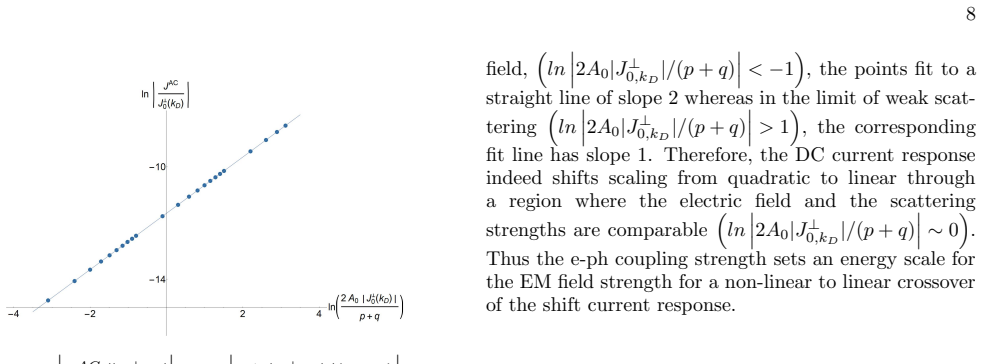
The central claim is that the nonlinear optical response contains three distinct three-operator correlation functions—$\chi_{n,2}$, $\chi_{n,3}$, and $\chi_{\mathrm{otoc}}$—and that $\chi_{\mathrm{otoc}}$ is an out-of-time-ordered correlator that equilibrium field theory cannot compute. For the bulk photovoltaic effect with electron-phonon interactions, the shift current in a homogeneous excitation profile is reproduced by the dipole moment of optically generated excitons and agrees with the noninteracting shift-current formula in the zero-scattering limit. The master-equation treatment shows a quadratic-to-linear crossover in the vector-potential amplitude, with the electron-phonon scattering rate setting the crossover scale. In an inhomogeneous excitation profile, charge conservation forces a diffusion current that cancels the local shift current in steady state; because the time-ordered correlators are argued to be spatially local, the paper concludes that this strongly nonlocal DC response must be carried by $\chi_{\mathrm{otoc}}$, making the nonlinear response an intrinsically nonequilibrium object rather than an equilibrium Kubo-style response.
Load-bearing premise
The argument depends on the assertion that the time-ordered correlators $\chi_{n,2}$ and $\chi_{n,3}$ are spatially local because equilibrium analytic continuation says so; if they are not local in the driven, phonon-coupled system, the nonlocal diffusion current need not come from the out-of-time-ordered correlator.
Editorial extensions
If this is right
- Under inhomogeneous illumination, the bulk photovoltaic response cannot be obtained from equilibrium response functions; a Keldysh-type nonequilibrium computation is required.
- The steady-state density profile of photoexcited carriers encodes the shift current, so the current can be measured capacitively without electrical contacts.
- In the weak-scattering regime the DC shift current scales linearly with the vector potential rather than quadratically, with the electron-phonon scattering rate setting the crossover between the two scalings.
- The homogeneous-excitation shift current reduces to the established shift-current formula in the zero-scattering limit, confirming consistency with earlier noninteracting results.
- Energy-conservation considerations imply that the DC current in a photovoltaic device is accompanied by phonon-mediated dissipation, so efficiency estimates must include scattering.
Reading between the lines
- A natural extension is to compute the full Keldysh three-operator response for a microscopic model with phonons; if the nonlocal response decomposes differently, the locality assumption on $\chi_{n,2}$ and $\chi_{n,3}$ would be falsified.
- The same three-correlator structure should appear in other nonlinear probes, such as pump-probe spectroscopy and superconducting nonlinear responses, where equilibrium diagrammatics would similarly miss the out-of-time-ordered part.
- Because the nonlocal diffusion current is linked to the density profile, spatially resolved imaging of carrier density under a tightly focused beam could provide a contact-free experimental test of the out-of-time-ordered contribution.
- The linear-in-field DC response at weak scattering suggests that photovoltaic devices in clean, strongly driven materials could behave differently from the perturbative $A^2$ scaling, with implications for power extraction at high intensity.
Signed reviews
Editorial analysis
A structured set of objections, weighed in public.
Referee Report
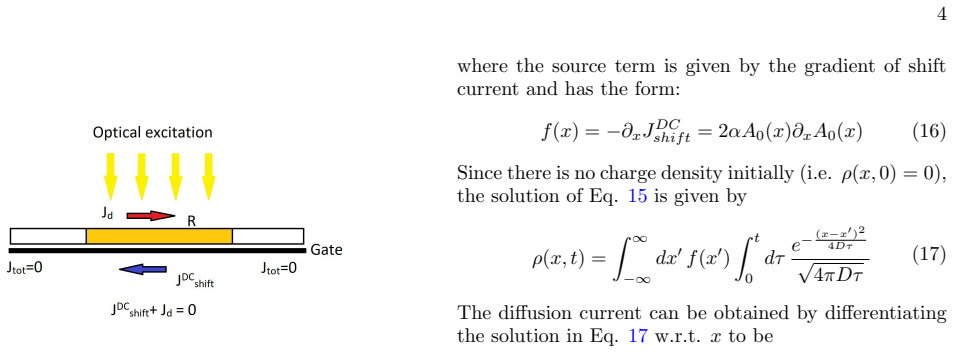
Summary. The paper studies the bulk photovoltaic effect (BPVE) in a two-band semiconductor with electron-phonon scattering. It decomposes the second-order current response into linear, time-ordered, and 'out-of-time-ordered' correlation functions, argues that the last cannot be computed from equilibrium field theory, and develops a semiclassical model in which the DC shift current is generated by the dipole moment of photo-excited electron-hole pairs and interrupted by phonon scattering. The semiclassical result is shown to reduce to the known shift-current formula in the homogeneous limit. A Floquet quantum master equation treatment reproduces the small-amplitude shift current and predicts a crossover from quadratic to linear scaling of the DC current with vector-potential amplitude as the scattering rate is decreased. For inhomogeneous illumination, the paper derives a nonlocal diffusion current and claims that this nonlocality requires the out-of-time-ordered correlator χotoc.
Significance. If the central claim about χotoc were established, the paper would point to a qualitative limitation of equilibrium response theory for nonlinear transport in open systems and would be of broad interest in nonlinear optics and photovoltaics. The paper also contains useful independent derivations: the semiclassical exciton-dipole picture is benchmarked against the conventional shift-current expression, the Floquet master equation provides an alternative derivation of the DC current, and the numerical crossover from quadratic to linear scaling in the Rice-Mele model is clearly presented. These parts are internally consistent and give a plausible physical picture. However, the headline claim about the necessity of OTOCs for inhomogeneous excitation is not currently supported, as detailed below.
major comments (4)
- [Sec. III B, Eqs. (15)-(22)] The assertion that the nonlocal diffusion current 'must involve' χotoc is not established. Equation (19) is obtained from the ordinary linear diffusion equation (15), whose Green's function produces the kernel sgn(x−x') in the long-time limit; this is the standard hydrodynamic diffusion pole of a conserved density, which appears in retarded and time-ordered equilibrium response functions and does not require an out-of-time-ordered correlator. The preceding paragraph argues from Refs. [27,28] that χn,2 and χn,3 are local, but the argument is not derived for the present driven, finite-temperature, zero-frequency situation, and the text explicitly labels the locality as an assumption ('Assuming that χn,2 and χn,3 are local...'). Since the conclusion that χotoc must carry the nonlocal response follows only from this assumption, the central claim is unsupported. Please provide a direct calculation of the nonlocal parts of χn,2 and χn,3, or a controlled argument for their locality in the relevant limit; otherwise the abstract's statement about 'must involve' should be withdrawn.
- [Sec. II, Eq. (6)] The correlator in Eq. (6) is a three-point function with a specified operator ordering; it is not an out-of-time-ordered correlator in the sense of nested commutators and Lyapunov growth, and it can be evaluated in the Keldysh formalism. The statement that this term 'cannot be computed from equilibrium field theory' is stronger than what is shown: equilibrium finite-temperature response is not limited to the imaginary-time Matsubara channel, and time-ordered/retarded correlators can be obtained by analytic continuation. If the intended claim is that the zero-frequency DC limit is not accessible from the imaginary-time functional integral, that limitation should be stated precisely and proven. As written, the dichotomy between time-ordered equilibrium correlators (χn,2, χn,3) and the non-equilibrium χotoc is not justified.
- [Sec. IV, Eq. (47)] The linear-in-A0 scaling in the weak-scattering limit is a headline result, but the double limit in Eq. (47) is not defined unambiguously: taking A0|J⊥0,k| → 0 while requiring p,q ≪ A0|J⊥0,k| requires a specified ordering of the two small parameters. As written, the linear term could be an artifact of taking p,q to zero first. Please state the limiting procedure precisely (for example, a fixed small ratio p/A0 or p,q → 0 at fixed nonzero A0) and demonstrate that the linear scaling survives a controlled A0 → 0 limit. Without this, the claim that the result 'contradicts Kubo formula' is not fully supported.
- [Sec. III B, Eqs. (16) and (21)] There is a sign inconsistency in the diffusion-current derivation. With JDC_shift = αA0^2, Eq. (16) should read f(x) = −∂xJDC_shift = −2αA0∂xA0; the printed expression has the opposite sign. Equation (21) is consistent with the corrected sign after integration by parts, but not with the printed Eq. (16). Please correct the sign and confirm that Eq. (20), JDC_shift = −Jd = D∂xρ, follows. This is a technical error, but it occurs in the derivation that underpins the nonlocal-response conclusion.
minor comments (5)
- [References] Ref. [8] lists 'Struman'; the correct spelling is 'Sturman'.
- [Sec. III C] The abbreviation 'BVPE' appears in Sec. III C while the abstract and elsewhere use 'BPVE'; please standardize the terminology.
- [Eq. (42)] The expression '1−ι + ...' in Eq. (42) appears to contain a typo; the imaginary unit should be written consistently with the rest of the paper.
- [Fig. 4] The caption of Fig. 4 should state explicitly that kD is the degeneracy-point momentum defined in the text, rather than leaving this to the body.
- [Sec. II, Eq. (6)] The term 'out-of-time-ordered correlator' is used for a three-point function; consider adding a sentence distinguishing it from the standard four-point OTOC used in many-body chaos.
Circularity Check
No circularity: the response decomposition, semiclassical benchmark, and Floquet master-equation derivation are self-contained.
full rationale
The paper's central results are derived from an explicit second-order Dyson expansion (Appendix A) rather than assumed. The decomposition into χlin, χn,2, χn,3, and χotoc follows from expanding the time-evolution operator and its Hermitian conjugate; χotoc is not defined as a nonlocal remainder but as the specific three-operator correlator in Eq. 6. The semiclassical shift current in Eq. 12 is benchmarked in Appendix B against the established shift-current expression, and the Floquet master-equation treatment in Secs. IV–V is an independent derivation that reproduces the semiclassical result in the weak-field limit and predicts the scaling crossover. No parameter is fitted to data and no prior result by the same authors is invoked. The claim that χn,2 and χn,3 are local is an explicit assumption ('Assuming that χn,2 and χn,3 are local for the reasons outlined in the previous paragraph...'), used to attribute nonlocality to χotoc; this is a substantive premise whose correctness may be questioned, but it is not circular because the form of χotoc in Eq. 22 is a consistency constraint derived from the diffusion model, not an input to it. Therefore no circularity is found.
Assumptions & free parameters
free parameters (2)
- p and q (electron and hole phonon scattering rates)
- η (semiclassical scattering rate)
assumptions (4)
- domain assumption Electron-phonon interaction is symmetric and does not directly contribute to the shift current.
- domain assumption The phonon bath is Markovian, at zero temperature, and has a constant density of states G.
- ad hoc to paper The time-ordered response functions χn,2 and χn,3 are local in space and time for the driven system.
- domain assumption A0|J⊥| is small compared to the electronic bandwidth, so Floquet perturbation theory applies.
Cite this review
Pith. "Pith review of Non-equilibrium nature of non-linear optical response: Application to the bulk photo voltaic effect." pith.science (2026). https://pith.science/paper/HITVAIDB
@misc{pith2026190801793,
  author       = {Pith},
  title        = {Pith review of: Non-equilibrium nature of non-linear optical response: Application to the bulk photo voltaic effect},
  year         = {2026},
  howpublished = {\url{https://pith.science/paper/HITVAIDB}},
  note         = {Machine review of arXiv:1908.01793}
}
read the original abstract
The bulk photovoltaic effect is an example of a non-linear optical response that leads to a DC current that is relevant for photo-voltaic applications. In this work, we theoretically study this effect in the presence of electron-phonon interactions. Using the response function formalism we find that the non-linear optical response, in general, contains three operator correlation functions, one of which is not ordered in time. This latter correlator cannot be computed from equilibrium field theory. Using a semiclassical approach instead, we show that the bulk photovoltaic effect can be attributed to the dipole moment of the generated excitons. We then confirm the validity of the semiclassical result (which agrees with the non-interacting result) for non-linear DC response from a quantum master equation approach. From this formalism we find that, in contrast to usual linear response, the scattering rate has a strong implicit effect on the non-linear DC response. Most interestingly, the semiclassical treatment shows that the non-linear DC response for spatially inhomogeneous excitation profiles is strongly non-local and must involve the aforementioned out-of-time-ordered correlators that cannot be computed by equilibrium field theory.
Figures

Figures from the paper (1 more)

Reference graph
Works this paper leans on
-
[1]
The shift current in the absence of a voltage can only be stable for perfect translation invariance with periodic boundary conditions. Any variations of parameters in the system that would change the shift current, leads to a finite volt- age. Let us now consider boundary conditions different from periodic so that a finite voltage V can be generated over len...
-
[2]
J. W. Harter, Z. Y. Zhao, J.Q. Yan, D. G. Mandrus, and D. Hsieh. Science, 356:295, 2017
work page 2017
-
[3]
Zhou Li and Franco Nori. Phys. Rev. B , 99(155146), 2019
work page 2019
-
[4]
Kun Woo Kim, Takahiro Morimoto, and Naoto Nagaosa. Phys. Rev. B , 95(035134), 2017
work page 2017
-
[5]
Grushin, Takahiro Mori- moto, and Joel E Moore
Fernando de Juan, Adolfo G. Grushin, Takahiro Mori- moto, and Joel E Moore. Nat. Commun., 8(15995), 2017
work page 2017
- [6]
-
[7]
V. I. Belinicher, V. K. Malinovski, and B. I. Sturman. Zh. Eksp. Teor. Fiz. , 73:692–699, 1977
work page 1977
-
[8]
V. I. Belinicher. Zh. Eksp. Teor. Fiz. , 75:641–652, 1978
work page 1978
Show all 31 references
-
[9]
V. I. Belinicher and B. I. Struman. Usp. Fiz. Nauk , 130:415–458, 1980
1980
-
[10]
B. I. Struman and V. M. Fridkin. The photovoltaic and photorefractive effects in noncentrosymmetric materials
-
[11]
V. M. Fridkin. Photoferroelectrics
-
[12]
E. Deyo, L. E. Golub, E. L. Ivchenko, and B. Spivak. arxiv.org/pdf/0904.1917.pdf
1917 arXiv
-
[13]
Sipe and A.I
J.E. Sipe and A.I. Shkrebtii. Phys. Rev. B , 61(5337), 2000
2000
-
[14]
Ralph von Baltz and Wolfgang Kraut. Phys. Rev. B , 23(10), 1981
1981
-
[15]
Takahiro Morimoto and Naoto Nagaosa. Phys. Rev. B , 94(035117), 2016
2016
-
[16]
Cook, Benjamin M
Ashley M. Cook, Benjamin M. Fregoso, Fernando de Juan, Sinisa Coh, and Joel E. Moore. Nat. Commun., 8(14176), 2017
2017
-
[17]
Tan and Andrew M
Liang Z. Tan and Andrew M. Rappe. Phys. Rev. Lett. , 116(237402), 2016
2016
-
[18]
Fregoso T
Benjamin M. Fregoso T. Rangel, Bernardo S. Men- doza, Takahiro Morimoto, Joel E. Moore, and Jeffery B. Neaton. Phys. Rev. Lett., 119(067402), 2017
2017
-
[19]
Young and Andrew M
Steve M. Young and Andrew M. Rappe. . Phys. Rev. Lett., 109(116601), 2012
2012
-
[20]
Tan, Fan Zheng, Steve M
Liang Z. Tan, Fan Zheng, Steve M. Young, Fenggong Wang, Shi Liu, and Andrew M Rappe. npj Computa- tional materials, 2(16026), 2016
2016
-
[21]
Nakamura, S
M. Nakamura, S. Horiuchi, F. Kagawa, N. Ogawa, T. Ku- rumaji, Y. Tokura, and M. Kawasaki. Nat. Commun. , 8(281), 2017
2017
-
[22]
Chong Wang, Xiaoyu Liu, Lei Kang, Bing-Lin Gu, Yong Xu, and Wenhui Duan. Phys. Rev. B , 96(115147), 2017
2017
-
[23]
Shi-Jing Gong, Fan Zheng, and Andrew M. Rappe. Phys. Rev. Lett., 121(017402), 2018
2018
-
[24]
Ogawa, M
N. Ogawa, M. Sotome, Y. Kaneko, M. Ogino, and Y. Tokura. Phys. Rev. B , 96(241203(R)), 2017
2017
-
[25]
A. I. Larkin and Yu. N. Ovchinnikov. Zh. Eksp. Teor. Fiz., 55:2262–2272, 1968
1968
-
[26]
Rice and E
M. Rice and E. Mele. Phys. Rev. Lett., 49(1455), 1982
1982
-
[27]
private communication
Victor Yakovenko. private communication
-
[28]
Quantum Phase Transitions
Subir Sachdev. Quantum Phase Transitions. Second edi- tion edition
-
[29]
Lectures on phase transitions and the renormalization group
Nigel Goldenfeld. Lectures on phase transitions and the renormalization group
-
[30]
V.M. Fridkin. Crystallographic Reports, 46(4):654–658, 2001
2001
-
[31]
Thomas Iadecola, Titus Neupert, and Claudio Chamon. Phys. Rev. B , 91(235133), 2015. Appendix A DERIVATION OF SECOND ORDER RESPONSE We will derive the current response,⟨ ˆJ(r)⟩, up to sec- ond order in the excitation amplitude, A0(x), due to the EM perturbation, ∫ dxA (r) ˆJ(r...
2015
Reviewed August 14, 2026 · model on record in the stance chip above.
Discussion (0). Continue with ORCID to comment.