REVIEW 3 major objections 6 minor 1 cited by
Retrofitting a two-way peg between blockchains
T0 review · 3 major / 6 minor · reviewed 2026-08-14 · deepseek-v4-flash
Pith's one-line read This paper constructs a forkless two-way Dogecoin-Ethereum peg: Operator ETH collateral backs minted WOW tokens, and disputes over relayed Dogecoin locks are settled by bulletproofs verified through Truebit.
desk verdict A detailed, honest design for a forkless Dogecoin-Ethereum peg whose 'trustless' claim depends on an unstated liveness assumption that someone will always challenge bogus relay submissions. read the letter →
The pith
A machine-rendered reading of the paper's core claim, the machinery that carries it, and where it could break.
The reading
What carries the argument
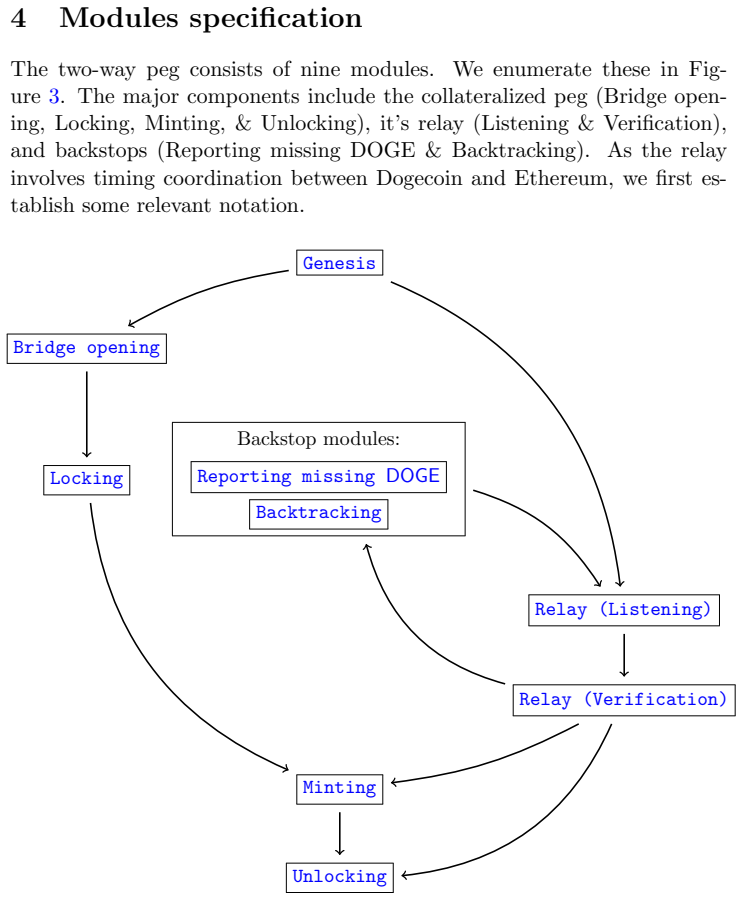
The load-bearing object is the Bridge Contract, an Ethereum smart contract that escrows Operator ETH collateral, mints and burns parametrized WOW[$y$] tokens, and maintains the relay's history. The core mechanism is the collateralized peg: locked DOGE is not locked in the Dogecoin sense but is held by an Operator whose ETH deposit is forfeitable, so economic incentives substitute for a lock opcode. The relay's valid-extension requirements — Maximality, Validity, and Shallow-fork-free — are enforced through a challenge protocol; a challenged submission must be backed by a bulletproof, a succinct proof that a committed arithmetic circuit is satisfiable, showing that the committed block sequence is a valid, confirmed chain of scrypt proof-of-work, and Truebit verifies that proof on-chain.
What would settle it
Run a testnet where every participant except one malicious Relayer is passive; the Relayer submits a fabricated lock with a valid-looking Merkle commitment and no one challenges. If the Bridge Contract mints WOW[$y$] after the verification timeout even though no DOGE is actually controlled by an Operator, the unanimous-consensus security claim is refuted in exactly the case the invariants depend on.
Extended reading notes
Core claim
The central claim is that a 'lock' on Dogecoin does not have to be a consensus-level operation. In this design it is a cryptoeconomic fact: an Operator who has posted ETH collateral accepts DOGE into an address she controls, the Bridge Contract treats that transfer as a lock and mints WOW[$y$] to the sender, and if the Operator spends the DOGE before the corresponding WOW[$y$] is burned, she loses her ETH. The relay that carries Dogecoin events into Ethereum accepts only extensions that are maximal, valid, and shallow-fork-free, so orphaned block submissions cannot pollute the history. Disputed extensions are settled by a bulletproof that a committed sequence of scrypt proof-of-work is a confirmed valid extension of the history, with the proof itself checked by Truebit. Under the paper's rational-actor assumptions, two reserve invariants follow: WOW[$y$] in circulation equals $y$ times the ETH collateralized at rate $y$, and, per exchange-rate class, the number of locked DOGE equals the number of WOW[$y$] in circulation.
Load-bearing premise
The load-bearing premise is that Hodlers, Operators, and Crossers will actively monitor Dogecoin and the Bridge Contract and challenge bogus relay submissions before the timeout; the paper also assumes away block-withholding and 51% attacks, so a passive user base can leave a malicious relayer free to mint unbacked WOW.
Editorial extensions
If this is right
- A DOGE holder can receive WOW[$y$] tokens in Ethereum within minutes of a lock, and can burn them to reclaim DOGE, with no Dogecoin client update.
- Ethereum smart contracts can read Dogecoin data through the same relay, giving Dogecoin a form of smart-contract functionality.
- The same construction adapts to Bitcoin, letting Ethereum smart contracts hold tokenized bitcoin and access Bitcoin data.
- Parametrized WOW tokens keep the peg solvent under exchange-rate moves down to the threshold $y$, without any price oracle.
- The bridge remains live with any number of participants and is snoozable: it consumes gas only when used.
Reading between the lines
- The passive-participant case is the real stress test: if few users monitor the relay, the unanimous-consensus design degrades toward first-submitter-wins, and a testnet with deliberately passive users would reveal the minimum active-Relayer population needed to keep the invariants.
- The collateralized peg is a general pattern: pairing any Nakamoto-consensus chain with an expressive smart-contract chain reduces to building an arithmetic circuit for the source chain's hash, and the paper's Bitcoin extension already exhibits this.
- Parameterized tokens could be reused outside bridges, for example to keep any smart-contract escrow solvent under exchange-rate volatility without an oracle; the paper uses them narrowly but the construction is not peg-specific.
- The deep-backtracking modes imply a residual liveness gap: a sufficiently long bogus extension can stall the bridge permanently, which the authors accept only because it happens when no one is using the system; a deployment would want a stronger liveness mechanism.
Signed reviews
Editorial analysis
A structured set of objections, weighed in public.
Referee Report
Summary. The paper proposes Dogethereum, a two-way peg between Dogecoin and Ethereum that requires no fork. An Operator posts ETH collateral in a Bridge Contract; a Crosser sends DOGE to the Operator's address; a Relayer relays the lock to Ethereum; the Bridge Contract mints WOW tokens; burning WOW triggers a DOGE unlock or forfeiture of the Operator's ETH collateral. The relay uses Merkle commitments and challenge-based verification, with bulletproofs and Truebit to verify scrypt proofs-of-work in disputes. The paper claims the construction is efficient, trustless, and retrofitting, and it argues via invariants in Section 5.1 that rational agents' monitoring keeps the reserves balanced. The paper also sketches an extension to Bitcoin/Ethereum and reports extrapolated performance estimates for scrypt bulletproof verification.
Significance. If the security claim held, this would be a significant contribution: a forkless, economically collateralized two-way peg with a permissionless relay, plus parametrized tokens to handle exchange-rate variability. The paper gives a detailed module-by-module specification that is useful for comparison with XCLAIM and with superblock relay designs, and it is unusually candid in Section 4.9 and Section 6 about the limits of the analysis and the uncompleted circuit implementation. However, the central 'trustless' claim is not established: the security argument assumes the availability and diligence of challengers, and the paper's own text concedes that an attacker gains when the bridge is actively in use but no one is watching. The protocol may be repairable by stating an explicit liveness assumption and by pairing the design with a formal game-theoretic proof, but as written the main claim overreaches.
major comments (3)
- [§4.4–4.6, §4.9] The relay's acceptance path is not secure against an unchallenged bogus submission. Under §4.5, the Bridge Contract appends a submission to its history when no challenge arrives within d−k Dogecoin blocks, without any on-chain validation of the Merkle commitment at that time. §4.6 then mints WOW against any commitment in the history, verifying only that a Merkle proof is consistent with the stored, adversary-chosen root. An attacker can therefore submit a fabricated commitment with a plausible range, wait out the timeout, present a Merkle proof of a fake 'lock' transaction from an attacker-controlled address to an open bridge head, and obtain WOW backed by an Operator's real ETH collateral; burning those WOW in §4.7 transfers the collateral to the attacker. §4.9 explicitly concedes that the attacker gains when 'ETH collateral is staked.' The only defense is a timely challenge, but nothing in the protocol guarantees that a challenger exists: §2.4(C) states that individual Relayers 'need not monitor Dogecoin continuously,' and the rationality assumptions in §2 do not imply continuous monitoring. The abstract's 'trustless' claim therefore depends on an unstated liveness assumption, and the claim as written is unsupported.
- [§5.1, Invariant 3] The reserve equilibrium argument assumes the behaviors it is supposed to establish. Invariant 3's hypotheses are that rational Hodlers report missing DOGE, that Operators challenge Relayers who relay bogus locks, and that Crossers challenge bogus relay submissions. These are exactly the vigilance conditions the protocol's incentives are meant to guarantee. The surrounding argument (§2.4, §5.4) only asserts that incentives 'exist'; it does not prove that some rational agent is always online, informed, and willing to bear the cost of challenging within the verification window. Consequently, Invariant 3 does not provide a security proof of the DOGE–WOW bijection; it states a conditional whose antecedent includes the property to be shown.
- [§6] The efficiency claim for the Dogecoin relay is not yet supported. The 12, 20, and 80 minute estimates for verifying 1, 10, and 100 Dogecoin proofs-of-work are extrapolations from benchmarks on secp256k1, and the text concedes 'Arithmetic circuits for general proofs have not yet been implemented.' Since the abstract advertises the construction as 'efficient,' the central performance claim for the Dogecoin-specific circuit remains unmeasured; the concrete SHA256 numbers do not validate the scrypt-based Dogecoin relay.
minor comments (6)
- [Fig. 4] The suggested value for 'maximum extension length' reads '10,0000 Dogecoin blocks,' which appears to have an extra zero; presumably it should be 10,000.
- [§4.5] The sentence 'If no challenges occurs within d-k Dogecoin blocks' mixes singular and plural; it should read 'If no challenge occurs' or 'If no challenges occur.'
- [§4.6] There is a doubled article in 'the the Merkle proof' in condition 1(a); the duplicate 'the' should be removed.
- [§4.7] There is a duplicated 'the' in 'the the y-bridge queue's first element,' and the spelling 'Holder' appears alongside 'Hodler' throughout; the terminology should be unified.
- [§5.1] The phrase 'Thus we obtain the the following' contains a duplicated 'the'; it should read 'the following.'
- [§1.3 and §6] The claims about extending the construction to Bitcoin are speculative: Section 1.3 mentions 'a similar technique adds Ethereum-based smart contracts to Bitcoin,' but the paper only provides SHA256 benchmarks and does not describe a Bitcoin-side locking mechanism; the abstract's wording should be softened or the construction specified.
Circularity Check
No significant circularity: the Dogethereum construction is a protocol specification whose security invariants are either accounting identities or explicitly conditional on stated agent-behavior assumptions, not reductions to the paper's own conclusions.
full rationale
The paper does not fit any parameter to data and then rename the fit as a prediction; there is no empirical fitting anywhere in the text, and the central claims are protocol-level structural guarantees. Invariant 1 is explicitly an accounting identity enforced by the Bridge Contract's mint and burn rules: the contract only mints WOW[y] after ETH collateral is deposited and only releases collateral when WOW[y] is burned, so the equality between circulating WOW and collateralized ETH is true by construction and is presented as such rather than as an empirical discovery. Invariant 3 is a conditional security statement: it assumes rational Hodlers, Operators, and Crossers perform specified monitoring, reporting, and challenging actions, and then concludes that locked DOGE equals circulating WOW. The conclusion does not appear among the hypotheses by construction, so this is an unproven liveness and participation assumption, not circular reasoning; the paper's own Section 4.9 concedes the practical gap when no agents are watching and collateral is staked, which is a security limitation rather than a circular derivation. The reliance on Truebit and bulletproofs is supported by citations to prior work, including work by the present authors (Truebit is co-created by Teutsch), but these are external primitives with stated assumptions that do not include the Dogethereum result, and Truebit is treated as a black box with implementations and public demos cited; accordingly, the self-citation is not load-bearing in the sense of reducing the present claim to an unverified assertion. There is no imported uniqueness theorem, no ansatz smuggled in via citation, and no renaming of a known result: the collateralized-peg idea is explicitly credited to earlier discussions and to Habibian's unpublished manuscript, and the relay requirements of Maximality, Validity, and Shallow-fork-free are design requirements argued from Nakamoto consensus. Overall, the derivation chain is internally non-circular; the main caveats are unproven liveness and participation assumptions, which belong to correctness risk rather than circularity.
Assumptions & free parameters
free parameters (9)
- confirmation depth c =
≈ 10 Dogecoin blocks
- recently confirmed threshold d =
≈ 20 Dogecoin blocks
- security parameter k =
≈ 2 Dogecoin blocks
- maximum extension length =
≈ 10,000 Dogecoin blocks (paper text says '10,0000')
- relayer deposit =
maximum of 5 USD, or cost to verify a 10,000-block extension
- registration void fee =
≈ 1% of crossing value in ETH
- penalty for non-maximal extension =
≈ 10% of ETH deposit
- reward for correct challenge =
≈ 1% of verification cost
- bridge exchange rate y =
chosen by each Operator per bridge
assumptions (5)
- domain assumption Rational actors monitor exchange rates and challenge bad relay submissions
- domain assumption No block withholding attacks on Dogecoin
- domain assumption Attackers cannot execute double spends or 51% attacks on Dogecoin
- domain assumption No profitable denial-of-service attacks on the Bridge Contract or Ethereum, and no censorship of smart contract transactions
- domain assumption Ethereum block time gives an approximately well-defined global clock
invented entities (2)
-
WOW token (parametrized token)
-
Bridge Contract
Cite this review
Pith. "Pith review of Retrofitting a two-way peg between blockchains." pith.science (2026). https://pith.science/paper/HJNTLABE
@misc{pith2026190803999,
  author       = {Pith},
  title        = {Pith review of: Retrofitting a two-way peg between blockchains},
  year         = {2026},
  howpublished = {\url{https://pith.science/paper/HJNTLABE}},
  note         = {Machine review of arXiv:1908.03999}
}
read the original abstract
In December 2015, a bounty emerged to establish both reliable communication and secure transfer of value between the Dogecoin and Ethereum blockchains. This prized "Dogethereum bridge" would allow parties to "lock" a DOGE coin on Dogecoin and in exchange receive a newly minted WOW token in Ethereum. Any subsequent owner of the WOW token could burn it and, in exchange, earn the right to "unlock" a DOGE on Dogecoin. We describe an efficient, trustless, and retrofitting Dogethereum construction which requires no fork but rather employs economic collateral to achieve a "lock" operation in Dogecoin. The protocol relies on bulletproofs, Truebit, and parametrized tokens to efficiently and trustlessly relay events from the "true" Dogecoin blockchain into Ethereum. The present construction not only enables cross-platform exchange but also allows Ethereum smart contracts to trustlessly access Dogecoin. A similar technique adds Ethereum-based smart contracts to Bitcoin and Bitcoin data to Ethereum smart contracts.
Figures


Figures from the paper (1 more)

Forward citations
Cited by 1 Pith paper
-
Enhancing Blockchain Cross Chain Interoperability: A Comprehensive Survey
A systematic survey that organizes blockchain cross-chain interoperability techniques into a classification and compares them with industry practice, while identifying open challenges.
Reference graph
Works this paper leans on
-
[1]
https://www.algorand.com/
Algorand. https://www.algorand.com/
-
[2]
http://artproject.io/
#ArtProject. http://artproject.io/
-
[3]
https://www
BigChainDB 2.0: The blockchain database. https://www. bigchaindb.com/whitepaper/
-
[4]
http://btcrelay.org/
BTC Relay. http://btcrelay.org/
-
[5]
https://github.com/dalek-cryptography/ bulletproofs
Bulletproofs. https://github.com/dalek-cryptography/ bulletproofs
-
[6]
https://crypto.stanford.edu/bulletproofs/
Bulletproofs: Short proofs for confidential transactions and more. https://crypto.stanford.edu/bulletproofs/
-
[7]
https://www.commonwealthcrypto.com/
Commonwealth Crypto. https://www.commonwealthcrypto.com/
-
[8]
https://dfinity.org/
DFINITY - The Decentralized Cloud. https://dfinity.org/
Show all 90 references
-
[9]
https://etherscan.io/address/ 0xdbf03b407c01e7cd3cbea99509d93f8dddc8c6fb
Doge-Eth-Bounty. https://etherscan.io/address/ 0xdbf03b407c01e7cd3cbea99509d93f8dddc8c6fb
-
[10]
https://dogecoin.com/
Dogecoin. https://dogecoin.com/
-
[11]
https://bitinfocharts.com/ comparison/dogecoin-confirmationtime.html
Dogecoin block time historical chart. https://bitinfocharts.com/ comparison/dogecoin-confirmationtime.html
-
[12]
https://github.com/dogecoin/dogecoin/ commits/master
Dogecoin commits. https://github.com/dogecoin/dogecoin/ commits/master
-
[13]
https://github.com/dogecoin/ dogecoin
Dogecoin Core [DOGE, D]. https://github.com/dogecoin/ dogecoin
-
[14]
https://www.reddit.com/r/dogecoin/comments/1xdl18/ dogecoin_hype_video_competition_all_9_winners_and/
Dogecoin hype video competition: All 9 winners and final re- marks. https://www.reddit.com/r/dogecoin/comments/1xdl18/ dogecoin_hype_video_competition_all_9_winners_and/. 42
-
[15]
https://dogesontrial.dog/
Doges on Trial. https://dogesontrial.dog/
-
[16]
https://en.wikipedia.org/wiki/ERC-20
ERC-20. https://en.wikipedia.org/wiki/ERC-20
-
[17]
https://etherscan.io/chart/ blocktime
Ethereum Average BlockTime Chart. https://etherscan.io/chart/ blocktime
-
[18]
https://ethereum.org/
Ethereum project. https://ethereum.org/
-
[19]
https:// funfair.io/
Game-changing blockchain casino technology — FunFair. https:// funfair.io/
-
[20]
https://github.com/apoelstra/secp256k1-mw/tree/ bulletproofs
libsecp256k1. https://github.com/apoelstra/secp256k1-mw/tree/ bulletproofs
-
[21]
https://github.com/ scipr-lab/libsnark
libsnark: a C++ library for zkSNARK proofs. https://github.com/ scipr-lab/libsnark
-
[22]
https://getmonero.org/
Monero, a digital currency that is secure, private, and untraceable. https://getmonero.org/
-
[23]
https://github.com/ethereum/wiki/wiki/White-Paper
A next-generation smart contract and decentralized application plat- form. https://github.com/ethereum/wiki/wiki/White-Paper
-
[24]
https://nipopows.com/
Non-interactive proofs of proof-of-work. https://nipopows.com/
-
[25]
https://polkadot.network
Polkadot. https://polkadot.network
-
[26]
https://raiden.network/
The Raiden Network. https://raiden.network/
-
[27]
https://www.rsk
Sidechains, drivechains, and RSK 2-way peg design. https://www.rsk. co/blog/sidechains-drivechains-and-rsk-2-way-peg-design
-
[28]
starkware.co/
Starkware industries — We are not conducting an ICO! https://www. starkware.co/
-
[29]
https://tezos.com/
Tezos. https://tezos.com/
-
[30]
https://www
Thundercore — Scalable blockchain delivered. https://www. thundercore.com/
-
[31]
https://truebit.io
TrueBit. https://truebit.io
-
[32]
https://github.com/TrueBitFoundation/
TrueBit GitHub. https://github.com/TrueBitFoundation/
-
[33]
https://github.com/akosba/xjsnark
xJsnark. https://github.com/akosba/xjsnark. 43
-
[34]
https://z.cash/
Zcash - all coins are created equal. https://z.cash/
-
[35]
https://zilliqa.com/
Zilliqa. https://zilliqa.com/
-
[36]
https://github.com/TrueBitFoundation/ scrypt-interactive, February 2018
GitHub - TrueBitFoundation/scrypt-interactive: Truebit Verifi- cation for Scrypt. https://github.com/TrueBitFoundation/ scrypt-interactive, February 2018
2018
-
[37]
https://github
Too large or otherwise inaccessible IPFS files #65. https://github. com/TrueBitFoundation/webasm-solidity/issues/65, March 2018
2018
-
[38]
Scrypt is maximally memory-hard
Jo¨ el Alwen, Binyi Chen, Krzysztof Pietrzak, Leonid Reyzin, and Ste- fano Tessaro. Scrypt is maximally memory-hard. In Jean-S´ ebastien Coron and Jesper Buus Nielsen, editors, Advances in Cryptology – EUROCRYPT 2017, pages 33–62, Cham, 2017. Springer International Publishing
2017
-
[39]
Enabling blockchain innovations with pegged sidechains
Adam Back, Matt Corallo, Luke Dashjr, Mark Friedenbach, Gre- gory Maxwell, Andrew Miller, Andrew Poelstra, Jorge Tim´ on, and Pieter Wuille. Enabling blockchain innovations with pegged sidechains. https://blockstream.com/sidechains.pdf, October 2014
2014
-
[40]
Using superblocks to bridge Dogecoin to Ethereum
Ismael Bejarano and Oscar Guindzberg. Using superblocks to bridge Dogecoin to Ethereum. https://github.com/dogethereum/docs/ blob/master/superblocks/superblocks-white-paper.pdf, 2018
2018
-
[41]
Dogecoin <–> Ethereum bridge docs
Ismael Bejarano, Catalina Juarros, Pablo Yabo, and Oscar Guindzberg. Dogecoin <–> Ethereum bridge docs. https://github.com/ dogethereum/docs
-
[42]
Scalable, transparent, and post-quantum secure computational in- tegrity
Eli Ben-Sasson, Iddo Bentov, Yinon Horesh, and Michael Riabzev. Scalable, transparent, and post-quantum secure computational in- tegrity. https://eprint.iacr.org/2018/046, 2018. Cryptology ePrint Archive, Report 2018/046
2018
-
[43]
SNARKs for C: Verifying program executions succinctly and in zero knowledge
Eli Ben-Sasson, Alessandro Chiesa, Daniel Genkin, Eran Tromer, and Madars Virza. SNARKs for C: Verifying program executions succinctly and in zero knowledge. In Ran Canetti and Juan A. Garay, editors, Advances in Cryptology – CRYPTO 2013: 33rd Annual Cryptology Conference, San...
2013
-
[44]
Efficient zero-knowledge arguments for arithmetic circuits in the discrete log setting
Jonathan Bootle, Andrea Cerulli, Pyrros Chaidos, Jens Groth, and Christophe Petit. Efficient zero-knowledge arguments for arithmetic circuits in the discrete log setting. In Marc Fischlin and Jean-S´ ebastien Coron, editors, Advances in Cryptology – EUROCRYPT 2016 , pages 327–35...
2016
-
[45]
Bulletproofs: Short proofs for confidential transactions and more
Benedikt B¨ unz, Jonathan Bootle, Dan Boneh, Andrew Poelstra, Pieter Wuille, and Greg Maxwell. Bulletproofs: Short proofs for confidential transactions and more. https://eprint.iacr.org/2017/1066, 2017. Cryptology ePrint Archive, Report 2017/1066
2017
-
[46]
(Doge/Ethereum two-way peg) I wrote up an im- plementation of scrypt in EVM for use in verifying dogecoin block headers
Vitalik Buterin. (Doge/Ethereum two-way peg) I wrote up an im- plementation of scrypt in EVM for use in verifying dogecoin block headers. https://www.reddit.com/r/dogecoin/comments/3xc0co/ dogeethereum_twoway_peg_i_wrote_up_an/, December 2015
2015
-
[47]
Online donors send Jamaican bobsled team to Sochi
Bill Chappell. Online donors send Jamaican bobsled team to Sochi. https://www.npr. org/sections/thetwo-way/2014/01/22/265060754/ wow-dogecoin-other-donors-send-jamaican-bobsled-team-to-sochi , January 2014
2014
-
[48]
Usman W. Chohan. A history of Dogecoin. http://dx.doi.org/10. 2139/ssrn.3091219, 2017
2017
-
[49]
Counterfactual: Generalized state channels
Jeff Coleman, Liam Horne, and Li Xuanji. Counterfactual: Generalized state channels. https://l4.ventures/papers/statechannels.pdf
-
[50]
Ristretto bullet- proofs
Henry de Valence, Cathie Yun, and Oleg Andreev. Ristretto bullet- proofs. https://github.com/dalek-cryptography/bulletproofs
-
[51]
Majority is not enough: Bitcoin mining is vulnerable
Ittay Eyal and Emin G¨ un Sirer. Majority is not enough: Bitcoin mining is vulnerable. Communications of the ACM , 61(7):95–102, July 2018
2018
-
[52]
Dogethereum bridge live demo for judges
Ethereum Foundation. Dogethereum bridge live demo for judges. https://www.youtube.com/watch?v=gdTd9Djt9gA, February 2018
2018
-
[53]
The Doge-Ethereum bridge: a cryptoeconomic two-way peg
Sina Habibian. The Doge-Ethereum bridge: a cryptoeconomic two-way peg. Manuscript, January 2018
2018
-
[54]
Dogecoin community celebrates as merge mining with Litecoin begins
Stan Higgins. Dogecoin community celebrates as merge mining with Litecoin begins. https://www.coindesk.com/ dogecoin-celebrates-litecoin-merge-mining/ , September 2014. 45
2014
-
[55]
Moelius III
Samuel E. Moelius III. Ethereum input bus (alpha). https://github. com/smoelius/ethereum_input_bus
-
[56]
Non-interactive proofs of proof-of-work
Aggelos Kiayias, Andrew Miller, and Dionysis Zindros. Non-interactive proofs of proof-of-work. https://eprint.iacr.org/2017/963, 2017. Cryptology ePrint Archive, Report 2017/963
2017
-
[57]
Cosmos: the Hub and Zones
Jae Kwon and Ethan Buchman. Cosmos: the Hub and Zones. https://cosmos.network/docs/resources/whitepaper. html#the-hub-and-zones
-
[58]
Drivechains, sidechains and hybrid 2-way peg designs
Sergio Demian Lerner. Drivechains, sidechains and hybrid 2-way peg designs. https://uploads.strikinglycdn.com/ files/27311e59-0832-49b5-ab0e-2b0a73899561/Drivechains_ Sidechains_and_Hybrid_2-way_peg_Designs_R9.pdf
-
[59]
PeaceRelay: Connecting the many Ether- eum blockchains
Loi Luu. PeaceRelay: Connecting the many Ether- eum blockchains. https://medium.com/@loiluu/ peacerelay-connecting-the-many-ethereum-blockchains-22605c300ad3 , July 2017
2017
-
[60]
Demys- tifying incentives in the consensus computer
Loi Luu, Jason Teutsch, Raghav Kulkarni, and Prateek Saxena. Demys- tifying incentives in the consensus computer. Proceedings of the 22nd ACM SIGSAC Conference on Computer and Communications Security - CCS ’15 , 2015
2015
-
[61]
Smart- pool: Practical decentralized pooled mining
Loi Luu, Yaron Velner, Jason Teutsch, and Prateek Saxena. Smart- pool: Practical decentralized pooled mining. In 26th USENIX Security Symposium (USENIX Security 17) , pages 1409–1426, Vancouver, BC,
-
[62]
How to speak Doge
Tessa Marshall. How to speak Doge. https://blogs.unimelb.edu. au/sciencecommunication/2016/10/22/how-to-speak-doge/, Oc- tober 2016
2016
-
[63]
Pisa: Arbitration outsourcing for state channels
Patrick McCorry, Surya Bakshi, Iddo Bentov, Andrew Miller, and Sarah Meiklejohn. Pisa: Arbitration outsourcing for state channels. https:// eprint.iacr.org/2018/582, 2018. Cryptology ePrint Archive, Report 2018/582
2018
-
[64]
The High-Value-Hash Highway
Andrew Miller. The High-Value-Hash Highway. https:// bitcointalk.org/index.php?topic=98986.0, August 2012. 46
2012
-
[65]
Bitcoin P2P e-cash paper
Satoshi Nakamoto. Bitcoin P2P e-cash paper. http://www. mail-archive.com/cryptography@metzdowd.com/msg09959.html, November 2008
2008
-
[66]
Bitcoin: A peer-to-peer electronic cash system
Satoshi Nakamoto. Bitcoin: A peer-to-peer electronic cash system. https://bitcoin.org/bitcoin.pdf, November 2018
2018
-
[67]
The anatomy of ERC721: Understanding non- fungible Ethereum tokens
Gerald Nash. The anatomy of ERC721: Understanding non- fungible Ethereum tokens. https://medium.com/crypto-currently/ the-anatomy-of-erc721-e9db77abfc24 , December 2017
2017
-
[68]
The rise and rise of the Dogecoin and internet tipping culture
Will Ockenden. The rise and rise of the Dogecoin and internet tipping culture. TheriseandriseoftheDogecoinandinternettippingculture, Jan- uary 2014
2014
-
[69]
Doge-Eth second demo
Oscar Channel. Doge-Eth second demo. https://www.youtube.com/ watch?v=zOCdtJmCruc, September 2018
2018
-
[70]
Pinoc- chio: Nearly practical verifiable computation
Bryan Parno, Craig Gentry, Jon Howell, and Mariana Raykova. Pinoc- chio: Nearly practical verifiable computation. https://eprint.iacr. org/2013/279, 2013. Cryptology ePrint Archive, Report 2013/279
2013
-
[71]
Stronger key derivation via sequential memory-hard functions
Colin Percival. Stronger key derivation via sequential memory-hard functions. https://www.tarsnap.com/scrypt/scrypt.pdf
-
[72]
Bulletproofs: Faster rangeproofs and much more
Andrew Poelstra. Bulletproofs: Faster rangeproofs and much more. https://blockstream.com/2018/02/21/ bulletproofs-faster-rangeproofs-and-much-more.html , Febru- ary 2018
2018
-
[73]
PHANTOM: A Scalable BlockDAG Protocol
Yonatan Sompolinsky and Aviv Zohar. PHANTOM: A Scalable BlockDAG Protocol. https://eprint.iacr.org/2018/104, 2018. Cryptology ePrint Archive, Report 2018/104
2018
-
[74]
The idea of smart contracts
Nick Szabo. The idea of smart contracts. http://szabo.best.vwh. net/smart_contracts_idea.html, 1997
1997
-
[75]
The Zilliqa technical whitepaper
The Zilliqa team. The Zilliqa technical whitepaper. https://docs. zilliqa.com/whitepaper.pdf
-
[76]
DOGETHEREUM: We can do this Do- gether! https://www.reddit.com/r/dogecoin/comments/61vg5k/ dogethereum_we_can_do_this_dogether/, March 2017
Jason Teutsch. DOGETHEREUM: We can do this Do- gether! https://www.reddit.com/r/dogecoin/comments/61vg5k/ dogethereum_we_can_do_this_dogether/, March 2017. 47
2017
-
[77]
On decentralized oracles for data availabil- ity
Jason Teutsch. On decentralized oracles for data availabil- ity. https://people.cs.uchicago.edu/~teutsch/papers/ decentralized_oracles.pdf, December 2017
2017
-
[78]
When cryptocurren- cies mine their own business
Jason Teutsch, Sanjay Jain, and Prateek Saxena. When cryptocurren- cies mine their own business. In Jens Grossklags and Bart Preneel, edi- tors, Financial Cryptography and Data Security, pages 499–514, Berlin, Heidelberg, 2017. Springer Berlin Heidelberg
2017
-
[79]
A scalable verification so- lution for blockchains
Jason Teutsch and Christian Reitwießner. A scalable verification so- lution for blockchains. http://people.cs.uchicago.edu/~teutsch/ papers/truebit.pdf, 2017
2017
-
[80]
Re: Alt chains and atomic transfers
TierNolan. Re: Alt chains and atomic transfers. https: //bitcointalk.org/index.php?topic=193281.msg2224949# msg2224949, May 2013
2013
-
[81]
Truebit verification for Scrypt on the Rinkeby testnet
Truebit. Truebit verification for Scrypt on the Rinkeby testnet. https: //www.youtube.com/watch?v=8VLg3RuvYNI, February 2018
2018
-
[82]
ANNOUNMENT: Dogecoin complete integration with ethereum
/u/42points. ANNOUNMENT: Dogecoin complete integration with ethereum. https://www.reddit.com/r/dogecoin/comments/ 62p3b8/announment_dogecoin_complete_integration_with/, April 2017
2017
-
[83]
The Doge connection Bounty Dao is live and work- ing
Alex van de Sande. The Doge connection Bounty Dao is live and work- ing. https://www.reddit.com/r/ethereum/comments/41ohhr/the_ doge_connection_bounty_dao_is_live_and_working/, 2016
2016
-
[84]
Wahby, Ioanna Tzialla, abhi shelat, Justin Thaler, and Michael Walfish
Riad S. Wahby, Ioanna Tzialla, abhi shelat, Justin Thaler, and Michael Walfish. Doubly-efficient zkSNARKs without trusted setup. https: //eprint.iacr.org/2017/1132, 2017. Cryptology ePrint Archive, Re- port 2017/1132
2017
-
[85]
How to generate SNARK parameters securely
Zooko Wilcox. How to generate SNARK parameters securely. https: //blog.z.cash/snark-parameters/, February 2016
2016
-
[86]
Polkadot: vision for a heterogeneous multi-chain frame- work
Gavin Wood. Polkadot: vision for a heterogeneous multi-chain frame- work. https://polkadot.network/PolkaDotPaper.pdf, 2016
2016
-
[87]
Knottenbelt
Alexei Zamyatin, Dominik Harz, Joshua Lind, Panayiotis Panayiotou, Arthur Gervais, and William J. Knottenbelt. XCLAIM: Trustless, in- teroperable, cryptocurrency-backed assets. In 2019 IEEE Symposium 48 on Security and Privacy (S&P) , pages 1254–1271, Los Alamitos, CA, USA, Ma...
2019
-
[88]
Zcash Ceremony
Zcash. Zcash Ceremony. https://www.youtube.com/watch?v= D6dY-3x3teM, January 2017
2017
-
[89]
D is for Dogecoin
ZimoNitrome. D is for Dogecoin. https://www.youtube.com/watch? v=000al7ru3ms, 2014. 49
2014
-
[2017]
USENIX Association, https://www.usenix.org/conference/ usenixsecurity17/technical-sessions/presentation/luu
Reviewed August 14, 2026 · model on record in the stance chip above.
Discussion (0). Continue with ORCID to comment.