REVIEW 4 major objections 6 minor 43 references
StimulHeat: a Low-Energy Wearable Thermal Feedback Device Using Peltier Elements with Heat Flow Controlled Loop for Hand Interactions in Virtual Reality
T0 review · 4 major / 6 minor · reviewed 2026-08-05 · deepseek-v4-flash
Pith's one-line read A clip-on Peltier device brings low-power hot and cold feedback to VR palm interactions.
desk verdict A solid, open-source thermal haptic clip-on for Valve Index with a genuine heat-flow control mode; the precision claim rests on a circular validation, but the device and user study stand on their own. read the letter →
The pith
A machine-rendered reading of the paper's core claim, the machinery that carries it, and where it could break.
The reading
What carries the argument
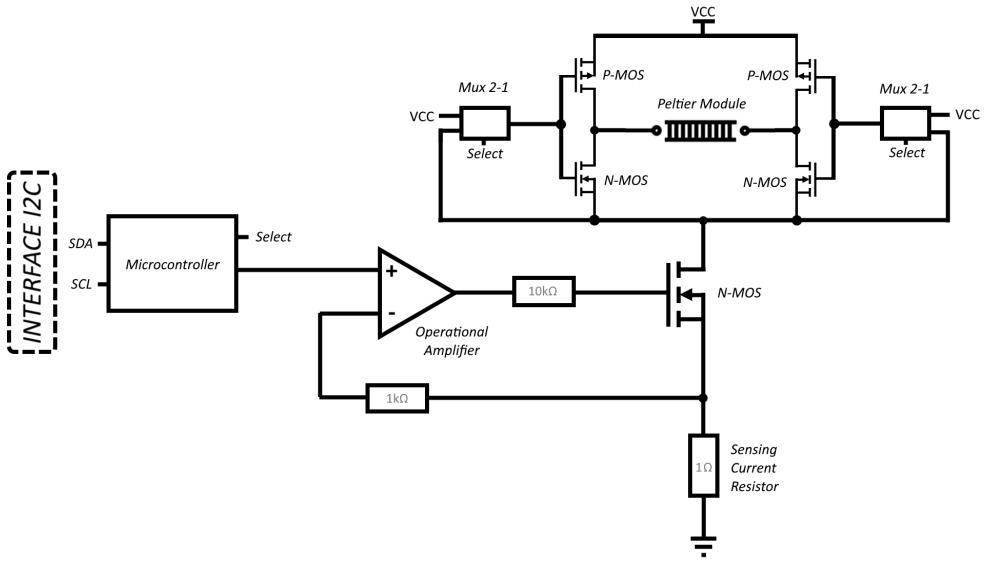
The central object is Equation (1), the steady-state relation between the current injected into a thermoelectric (Peltier) device and the heat flow at its absorbed face: Q1 = -R/2 I^2 + α T_a I + (T_a - T_e)/θ_m. This quadratic is the mechanism: it converts a desired heat-flow setpoint into a current command, and the same relation is used in reverse to estimate the heat flow actually produced. The hardware counterpart is a current source built from an op-amp, a sense resistor, an N-MOS transistor, and an H-bridge, which injects a continuous bidirectional current so the Peltier element heats or cools without the losses and ripple of PWM voltage modulation.
What would settle it
Mount an independent heat-flux sensor between the Peltier module and the palm, then command a step from 0 W to 2 W over repeated trials while varying contact pressure. If the measured skin heat flux departs from the setpoint or drifts with contact temperature, the claim that heat-flow control is precise and calibration-free fails. A second check: run the same device under temperature control with an optimally tuned PID and compare response time and energy draw; if the temperature-controlled version matches or beats heat-flow control, the claimed advantage is not inherent to the approach.
Extended reading notes
Core claim
The paper's discovery is that the heat flow delivered to the skin through a Peltier module can be treated as the controlled variable. Equation (1) expresses the absorbed-side heat flow Q1 as a quadratic function of the injected current I, using constant device parameters (electrical resistance R, Seebeck coefficient α, thermal resistivity θm) and the two measured face temperatures. Given a heat setpoint in watts, the firmware solves the quadratic for the required current, and a custom continuous bidirectional current source injects that current directly, without PWM and without a feedback PID. The technical characterization reports that heat-flow control responds instantaneously and tracks t
Load-bearing premise
The control law assumes Equation (1), with constant device parameters and the two measured face temperatures, exactly describes the heat delivered to the palm; the paper's own validation deduces heat flow from that same equation, so there is no independent measure of skin heat flux.
Editorial extensions
If this is right
- Thermal feedback systems can be commanded in watts, giving a physical unit tied to what the skin actually feels rather than a surface temperature that depends on contact and the object's thermal properties.
- Because no PID calibration is needed per unit, devices can be replicated and swapped without tuning; the open-source firmware and hardware make the design reproducible at roughly $400.
- Power consumption of 2.22 W per controller is within the range of a small battery, so thermal feedback can be untethered and clipped onto existing controllers rather than worn as a glove.
- The same driver offers both heat-flow and temperature control, letting developers choose the mode suited to the virtual object—continuous heat source versus an object that cools to body temperature.
- The user study's confusion matrix suggests users robustly discriminate hot, neutral, and cold, supporting the integration of thermal feedback into VR interaction design.
Reading between the lines
- The paper's validation reuses Equation (1) to estimate the heat flow delivered to the skin; an independent measurement using a heat-flux sensor between the Peltier module and the palm would settle whether the model tracks true skin heat transfer as contact pressure or skin temperature varies.
- Heat-flow control could be extended toward rendering material properties: since perceived warmth depends on thermal effusivity, a heat-flow setpoint modulated according to a virtual object's effective effusivity might reproduce the 'wood versus steel' sensation the paper invokes.
- The reported cooling limitation at sustained VERY COLD use suggests a testable extension: a heat-flow controller paired with an active heat sink or feedforward compensation for rising hot-side temperature could keep Equation (1) valid for longer.
- Because the driver is current-based and the control law is parameterized by (α, R, θm), the same approach should transfer to other Peltier modules, making heat-flow control a generic building block for thermal haptics beyond the specific hardware presented.
Signed reviews
Editorial analysis
A structured set of objections, weighed in public.
Referee Report
Summary. The paper presents StimulHeat, a clip-on wearable thermal feedback device for Valve Index VR controllers. The hardware includes a custom continuous bidirectional current source driving a Peltier element, two face-mounted thermistors, BLE communication, a LiPo battery, and a 3D-printed shell. Two control modes are implemented: conventional temperature control with a PID loop, and heat-flow control based on the steady-state TED equation Q1 = −R/2·I² + α·Ta·I + (Ta−Te)/θ_m (Eq. 1). The authors report a technical characterization on a single participant comparing six heat-flow setpoints and six temperature setpoints, and claim that heat-flow control is more precise, responds faster, and is more robust because it avoids PID calibration. They also report a user study (N=16) in which participants distinguish HOT, NEUTRAL, and COLD heat commands while grasping virtual totems. The paper additionally provides open-source design files, firmware, a Unity package, and a Bill of Materials, and reports a maximum power consumption of 2.22 W per controller.
Significance. The open-source, low-power, controller-integrated design is a genuine contribution to VR thermal feedback hardware. The authors should be credited for releasing hardware and firmware under open licenses, providing a complete Bill of Materials and build instructions, and obtaining ethics approval for the user study. The behavioral validation (N=16) does support the basic claim that the device can deliver distinguishable hot, neutral, and cold palm sensations in a VR grasping task. However, the central quantitative claim—that heat-flow control is more precise and more reactive than temperature PID control—is not independently established by the technical characterization, because the validation is circular and based on a single subject. If the heat-flow-control advantage could be rigorously demonstrated, this would be a meaningful step toward simplifying thermal feedback systems; at present, that advantage remains a model-consistency claim rather than a measured result.
major comments (4)
- [§7.1, Eq. (1)] The central quantitative claim—that heat-flow control is more precise than temperature control—is not independently established. The current injected for each heat setpoint is computed by solving Eq. (1), and the 'real heat flow' used for comparison in Figure 13 is then recomputed from the same equation using the same two thermistor measurements. The agreement therefore verifies only that the firmware and current source consistently implement Eq. (1); it does not verify that the commanded Q_setpoint equals the heat actually exchanged with the skin. An independent measure of skin heat flux (e.g., a heat-flux sensor) or a calibrated thermal load is needed. Without this, the claimed precision advantage over temperature PID is a model-consistency loop.
- [§7.1] The technical characterization is based on a single participant (N=1), with no repeated trials, no error bars, and no statistical analysis. The claims that heat control is 'more precise' and that the temperature mode operates at 'approximately 2.25 °C/s' cannot be assessed without variance information. Moreover, the temperature-control results depend on the PID gains, which are not reported; §2.2 only says that 'default values' are embedded in the firmware. Please report the PID gains, the number of repetitions, and per-condition variability. Otherwise the comparison is not reproducible.
- [§7.1, Results and discussion] The claim that heat control responds 'instantaneously because the current value is derived using equation (1)' is an inference from the control law, not an empirical step-response measurement. No rise time, settling time, or other quantitative response metric is reported. A meaningful comparison would measure the time to reach a defined fraction of the commanded heat flux (or a defined skin-temperature change) under both controllers, with the same contact conditions. As written, the response-time advantage is asserted rather than demonstrated.
- [§2.2 and §7.1] Eq. (1) treats α, R, and θ_m as constants, but these parameters are temperature- and mounting-dependent for real TEDs, and the paper provides no calibration data or sensitivity analysis over the operating range (heating and cooling, face temperatures spanning more than 10 °C). Since both the heat-flow control law and the validation rely on these constants, parameter drift could directly bias the setpoint. In addition, Eq. (1) describes the heat flow at the TED face, not necessarily the heat delivered into the skin; contact resistance and skin thermal properties also matter. Please provide calibration measurements or a sensitivity analysis, and clarify that 'eliminating PID calibration' still requires identification of the TED parameters.
minor comments (6)
- [§2.2] The sign convention for heat setpoints is confusing: VERY HOT is −4 W, HOT is −2 W, COLD is +2 W, VERY COLD is +4 W, while Eq. (1) defines Q1 on the absorbed side. Please clarify whether negative Q denotes heat flowing into the skin and add the convention to Figure 13.
- [§7.2, Figure 15] The confusion matrix is presented only in percentages. Please report raw counts and, ideally, per-participant data, so that the number of trials (192) and the distribution of errors are transparent.
- [§2.3] The ISP1807 is described as 'nRF52804-based'; this appears to be a typo for nRF52840. Please verify the module part number.
- [Throughout] There are several typos and inconsistencies: 'Proportionnal' in §2.2, 'welding' for soldering in §5.2, 'N N one' in §7.2, and inconsistent capitalization of 'Stimulheat/StimulHeat'. A careful proofreading pass is recommended.
- [§7.1, Figure 13] Figure 13 is difficult to interpret as printed: axis labels, legends, and error bars should be added, and the heat-flow and temperature panels should be clearly separated.
- [§8 and §2.2] The effective operating envelope is narrower than the claimed [−9 W, 9 W] range: §8 acknowledges that VERY COLD stimuli degrade after about five minutes, and §2.2 notes that cold heat flows above 6 W and temperatures below 25 °C would require a better heat sink. This should be stated in the specifications and reflected in the abstract or conclusion.
Circularity Check
Section 7.1 heat-flow validation is circular: the 'real heat flow' is computed from the same Eq. (1) used to set the current, so the precision comparison only tests model self-consistency.
-
self definitional
[Section 7.1 (Materials and Methods); cf. Section 2.2 and Eq. (1)]
"The equation 1 was utilised to deduce the heat flow present in the TED, facilitating the comparison between the setpoint in heat flow and the real heat flow."
The control law is built from Eq. (1): Section 2.2 states that 'it is possible to control a given heat flow by injecting a specific current value, and conversely, to determine the required current from a desired heat flow' using the same second-order equation. In Section 7.1 the 'real heat flow' used to evaluate the heat-flow setpoint is not measured independently; it is deduced from Eq. (1) using the same thermistor temperatures that enter the control calculation. Thus the agreement between setpoint and 'real' heat flow is a test of whether the firmware and current source consistently implement Eq. (1), not a test of whether Eq. (1) accurately gives the heat exchanged with the skin. The claimed precision advantage over temperature control is therefore not independently established by this
full rationale
The only load-bearing circular step is the technical validation of heat-flow control in Section 7.1. Both the commanded current and the 'real heat flow' used as ground truth are generated by Eq. (1), so the resulting precision and instantaneous-response conclusions are partly by construction. The user study (N=16) is independent behavioral evidence that HOT/NEUTRAL/COLD commands are perceptually distinguishable, and the hardware/software are open-source and benchmarked against existing devices, so the paper is not wholly circular. No load-bearing self-citation, imported uniqueness theorem, or ansatz-by-citation was found; the references to the authors' own IEEE VR demo are non-essential. The score reflects the partial circularity of the quantitative validation rather than the entire contribution. The paper's own limitation section honestly notes cooling saturation, which does not mitigate this validation issue.
Assumptions & free parameters
free parameters (4)
- TED equivalent electrical resistance R =
Not stated in paper (datasheet or own benchmark for ET-071-08-15)
- TED Seebeck coefficient alpha =
Not stated in paper (datasheet or own benchmark)
- TED thermal resistivity theta_m =
Not stated in paper (datasheet or own benchmark)
- PID gains Kp, Ki, Kd in temperature mode =
Default values embedded in firmware, values not reported
assumptions (4)
- domain assumption Heat flow through the TED obeys Q1 = -R/2 I^2 + alpha*Ta*I + (Ta-Te)/theta_m with constant alpha, R, theta_m.
- domain assumption Skin contact with the TED is primarily conductive and convection losses are minimized by good thermal contact.
- domain assumption Perceived thermal sensation is better reproduced by modulating heat flow than by holding a fixed surface temperature.
- domain assumption The two thermistor measurements accurately represent the absorbed-side and emitted-side temperatures of the TED.
Cite this review
Pith. "Pith review of StimulHeat: a Low-Energy Wearable Thermal Feedback Device Using Peltier Elements with Heat Flow Controlled Loop for Hand Interactions in Virtual Reality." pith.science (2026). https://pith.science/paper/HJQ5AGFR
@misc{pith2026250905020,
  author       = {Pith},
  title        = {Pith review of: StimulHeat: a Low-Energy Wearable Thermal Feedback Device Using Peltier Elements with Heat Flow Controlled Loop for Hand Interactions in Virtual Reality},
  year         = {2026},
  howpublished = {\url{https://pith.science/paper/HJQ5AGFR}},
  note         = {Machine review of arXiv:2509.05020}
}
read the original abstract
Nowadays, the majority of wearable thermal feedback systems designed for use in virtual reality applications are not compatible or not integrated to standard controllers and are based on temperature control. The objectives of the present work is to enable integration with existing controllers, in this case Valve Index controllers, and to propose an alternative approach to managing thermal stimulation with Peltier modules by controlling heat flow instead of temperature. We introduce StimulHeat as a wireless, low power thermal feedback system, based on the continuous relationship between heat and current injection in thermoelectric device (TED). First, we designed an optimized TED driver capable of injecting a continuous, bidirectional current into the TED, thereby driving it as a heater or cooler. Subsequently, this driver was implemented in an electronic board to include temperature and heat flow control loops, as well as Bluetooth Low Energy interface for remote control. A mechanical integration was conducted, in the form of a controller extension which is non-intrusive and can be clipped to Valve Index controllers to enclose the TED, temperature sensors and electronics. Finally, we present a user study validating StimulHeat for use in Virtual Reality, utilizing a Unity-built virtual environment with our open-source package.
Figures


Figures from the paper (13 more)




Reference graph
Works this paper leans on
-
[1]
S. Cai, P. Ke, T. Narumi, and K. Zhu. Thermairglove: A pneumatic glove for thermal perception and material identification in virtual reality. In2020 IEEE Conference on Virtual Reality and 3D User Interfaces (VR), pages 248–257. IEEE, 2020. URL https://doi.org/10.1109/VR46266.2020.00044
arXiv 2020
-
[3]
Aleph Campos Da Silveira, Eduardo C. Rodrigues, Estevao B. Saleme, Alexandra Covaci, Gheorghita Ghinea, and Celso A. S. Santos. Thermal and wind devices for multisensory human-computer interaction: an overview.Multimedia Tools and Applications, 82(22):34485–34512, September 2023. ISSN 1380-7501, 1573-7721. doi: 10.1007/s11042-023-14672-y
-
[4]
J. Dionisio. Virtual hell: a trip through the flames.IEEE Computer Graphics and Applications, 17(3): 11–14, 1997. doi: 10.1109/38.586012
- [5]
-
[6]
Julian Goldsmid.Introduction to Thermoelectricity
H. Julian Goldsmid.Introduction to Thermoelectricity. Springer Berlin, Heidelberg, 2016
work page 2016
-
[7]
T. Hamazaki, T. Takami, K. Ushiyama, I. Mizoguchi, and H. Kajimoto. Alcool: Utilizing alcohol’s evapo- rative cooling for ubiquitous cold sensation feedback. InProceedings of the 2024 CHI Conference on Human Factors in Computing Systems. ACM, 2024. URL https://doi.org/10.1145/3613904.3642113
arXiv 2024
-
[8]
Ping-Hsuan Han, Yang-Sheng Chen, Chiao-En Hsieh, Hao-Cheng Wang, and Yi-Ping Hung. Hapmosphere: Simulating the weathers for walking around in immersive environment with haptics feedback. In2019 IEEE World Haptics Conference (WHC), pages 247–252, 2019. doi: 10.1109/WHC.2019.8816140. 22
-
[9]
T. Han, S. Wang, S. Wang, X. Fan, J. Liu, F. Tian, and M. Fan. Mouill´ e: Exploring wetness illusion on fingertips to enhance immersive experience in vr. InProceedings of the 2020 CHI Conference on Human Factors in Computing Systems, pages 1–10. ACM, 2020. URL https://doi.org/10.1145/3313831.3376138
arXiv 2020
Show all 43 references
-
[10]
Hardy, Harold G
James D. Hardy, Harold G. Wolff, and Helen Goodell. Pricking pain threshold in different body areas. Proceedings of the Society for Experimental Biology and Medicine, 80(3):425–427, 1952. doi: 10.3181/ 00379727-80-19644
1952
-
[11]
Cold-evoked pain varies with skin type and cooling rate: a psy- chophysical study in humans.PAIN, 83(2):123–135, 1999
Joel L.K Harrison and Karen D Davis. Cold-evoked pain varies with skin type and cooling rate: a psy- chophysical study in humans.PAIN, 83(2):123–135, 1999. ISSN 0304-3959. doi: 10.1016/S0304-3959(99) 00099-8
1999 doi
-
[12]
Development of wearable electronically controlled heating and cooling equipment (traduction).Journal of the Japan Society for Precision Engineering, 82(10):919–924, 2016
Kiyoshi Itao, Hiroshi Hosaka, Kaoru Tachibana, Mikio Takahashi, and Guillaume Lopez. Development of wearable electronically controlled heating and cooling equipment (traduction).Journal of the Japan Society for Precision Engineering, 82(10):919–924, 2016. doi: 10.2493/jjspe.82.919
2016 doi
-
[13]
A. Jain. The role of thermal effusivity in heat exchange between finite-sized bodies.International Journal of Heat and Mass Transfer, 202:123721, 2023. URL https://doi.org/10.1016/j.ijheatmasstransfer.2022.123721
2023
-
[14]
Jiang, C
C. Jiang, C. Yanjun, F. Mingming, W. Liuping, S. Luyao, L. Nianlong, S. Wei, Z. Yu, T. Feng, and H. Teng. Douleur: Creating pain sensation with chemical stimulant to enhance user experience in virtual reality. Proceedings of the ACM on Interactive, Mobile, Wearable and Ubiquit...
2021 doi
-
[15]
Flip-pelt: Motor-driven peltier elements for rapid thermal stimulation and congruent pressure feedback in virtual reality
Seongjun Kang, Gwangbin Kim, Seokhyun Hwang, Jeongju Park, Ahmed Ibrahim Ahmed Mohamed Elsharkawy, and SeungJun Kim. Flip-pelt: Motor-driven peltier elements for rapid thermal stimulation and congruent pressure feedback in virtual reality. InProceedings of the 37th Annual ACM ...
2024
-
[16]
Karmakar, A
S. Karmakar, A. Kesh, and M. Muniyandi. Thermal illusions for thermal displays: a review.Frontiers in Human Neuroscience, 17:1278894, 2023. URL https://doi.org/10.3389/fnhum.2023.1278894
2023
-
[17]
C. V. Keef, Laure V. Kayser, Stazia Tronboll, Cody W. Carpenter, Nicholas B. Root, Mickey Finn III, Timothy F. O’Connor, Sami N. Abuhamdieh, Daniel M. Davies, Rory Runser, Ying Shirley Meng, Vi- layanur S. Ramachandran, and Darren J. Lipomi. Virtual texture generated using ela...
2020 doi
-
[18]
S. W. Kim, Sung Hee Kim, Choong Sun Kim, Kyoungsoo Yi, Jun-Sik Kim, Byung Jin Cho, and Youngsu Cha. Thermal display glove for interacting with virtual reality.Scientific Reports, 10(1):11403, 2020. URL https://doi.org/10.1038/s41598-020-68362-y
2020 doi
-
[19]
J. Lee, D. Kim, H. Sul, and S. H. Ko. Thermo-haptic materials and devices for wearable virtual and augmented reality.Advanced Functional Materials, 31(39):2007376, 2021. URL https://doi.org/10.1002/ adfm.202007376
2021
-
[20]
Maeda and T
T. Maeda and T. Kurahashi. Thermodule: Wearable and modular thermal feedback system based on a wireless platform. InProceedings of the 10th Augmented Human International Conference 2019. ACM,
2019
-
[21]
Manasrah, Nathan Crane, Rasim Guldiken, and Kyle B
A. Manasrah, Nathan Crane, Rasim Guldiken, and Kyle B. Reed. Perceived cooling using asymmetrically- applied hot and cold stimuli.IEEE Transactions on Haptics, 10(1):75–83, 2017. URL https://doi.org/10. 1109/TOH.2016.2578334
2017
-
[22]
Ahmad Manasrah, Nathan Crane, Rasim Guldiken, and Kyle B. Reed. Asymmetrically-applied hot and cold stimuli gives perception of constant heat. In2017 IEEE World Haptics Conference (WHC), pages 484–489, 2017. URL https://doi.org/10.1109/WHC.2017.7989949. 23
2017
-
[23]
Mazursky, Jas Brooks, Beza Desta, and Pedro Lopes
A. Mazursky, Jas Brooks, Beza Desta, and Pedro Lopes. Thermalgrasp: Enabling thermal feedback even while grasping and walking. In2024 IEEE Conference Virtual Reality and 3D User Interfaces (VR), pages 342–353. IEEE, 2024. URL https://doi.org/10.1109/VR58804.2024.00056
2024
-
[24]
Mellin and F
O. Mellin and F. Muret. Driving a peltier element (tec): Efficiency and aging. Application Report SLUA979A, Texas Instruments, 2020. URL https://www.ti.com/lit/an/slua979a/slua979a.pdf
2020
-
[26]
Meta quest touch pro, 2025
Meta. Meta quest touch pro, 2025. URL https://www.meta.com/fr/quest/accessories/ quest-touch-pro-controllers-and-charging-dock/
2025
-
[27]
Meta quest 3, 2025
Meta. Meta quest 3, 2025. URL https://www.meta.com/fr/quest/quest-3/
2025
-
[28]
Extension of a virtual reality simulation environment with an immersive experience of thermal radiation for the user
Christoph Nytsch-Geusen and Kushagra Mathur. Extension of a virtual reality simulation environment with an immersive experience of thermal radiation for the user. InProceedings of Building Simulation 2023: 18th Conference of IBPSA, volume 18, pages 369–376. IBPSA, 2023. URL ht...
2023
-
[29]
S. Oss. A simple model of thermal conduction in human skin: temperature perception and thermal effusivity.European Journal of Physics, 43(3):035101, 2022. URL https://doi.org/10.1088/1361-6404/ ac4c8a
2022 doi
-
[30]
Parida, H
K. Parida, H. Bark, and P. See Lee. Emerging thermal technology enabled augmented reality.Advanced Functional Materials, 31(39):2007952, 2021. URL https://doi.org/10.1002/adfm.202007952
2021 doi
-
[31]
R. L. Peiris, Wei Peng, Zikun Chen, Liwei Chan, and Kouta Minamizawa. Thermovr: Exploring integrated thermal haptic feedback with head mounted displays. InProceedings of the 2017 CHI Conference on Human Factors in Computing Systems, pages 5452–5456. ACM, 2017. URL https://doi....
2017
-
[32]
Philippe, Jeanne Hecquard, Emilie Hummel, Ferran Argelaguet, Marc Mac´ e, Val´ erie Gouranton, Claudio Pacchierotti, Anatole L´ ecuyer, and Justine Saint-Aubert
V. Philippe, Jeanne Hecquard, Emilie Hummel, Ferran Argelaguet, Marc Mac´ e, Val´ erie Gouranton, Claudio Pacchierotti, Anatole L´ ecuyer, and Justine Saint-Aubert. Cool me down: Effects of thermal feedback on cognitive stress in virtual reality. InHaptics: Understanding Touch...
2025 doi
-
[33]
Playstation vr2, 2025
Playstation. Playstation vr2, 2025. URL https://www.playstation.com/fr-fr/ps-vr2/
2025
-
[34]
Plijnaer, G¨ unter Wallner, and Regina Bernhaupt
Bas A. Plijnaer, G¨ unter Wallner, and Regina Bernhaupt. Ethermal - lightweight thermal feedback for vr games. In2022 IEEE Conference on Games (CoG), pages 41–48, 2022. doi: 10.1109/CoG51982.2022. 9893627
2022
-
[35]
Ragozin, D
K. Ragozin, D. Zheng, G. Chernyshov, and D. Hynds. Sophroneo: Fear not. a vr horror game with thermal feedback and physiological signal loop. InExtended Abstracts of the 2020 CHI Conference on Human Factors in Computing Systems, pages 1–6. ACM, 2020. URL https://doi.org/10.114...
2020
-
[37]
Ranasinghe, Pravar Jain, Shienny Karwita, David Tolley, and Ellen Yi-Luen Do
N. Ranasinghe, Pravar Jain, Shienny Karwita, David Tolley, and Ellen Yi-Luen Do. Ambiotherm: Enhanc- ing sense of presence in virtual reality by simulating real-world environmental conditions. InProceedings of the 2017 CHI Conference on Human Factors in Computing Systems, page...
2017
-
[38]
Controllers valve index, 2025
Valve Index. Controllers valve index, 2025. URL https://www.valvesoftware.com/fr/index/controllers
2025
-
[39]
Dynamic and modular thermal feedback for interactive 6dof vr: Implementation and evaluation
Sophie Villenave, Pierre Raimbaud, and Guillaume Lavou´ e. Dynamic and modular thermal feedback for interactive 6dof vr: Implementation and evaluation. In2025 IEEE Conference on Virtual Reality and 3D User Interfaces Abstracts and Workshops (VRW), pages 1204–1205, 2025. doi: 1...
2025
-
[40]
Vive controllers, 2025
Vive. Vive controllers, 2025. URL https://www.vive.com/fr/accessory/controller/
2025
-
[41]
Fiery hands: Designing thermal glove through thermal and tactile integration for virtual object manipulation
Haokun Wang, Yatharth Singhal, Hyunjae Gil, and Jin Ryong Kim. Fiery hands: Designing thermal glove through thermal and tactile integration for virtual object manipulation. InProceedings of the 37th Annual ACM Symposium on User Interface Software and Technology, UIST ’24, New ...
-
[42]
Immersive and wearable thermal rendering for augmented reality, 2025
Alexandra Watkins, Ritam Ghosh, Evan Chow, and Nilanjan Sarkar. Immersive and wearable thermal rendering for augmented reality, 2025. URL https://arxiv.org/abs/2503.20646
2025 arXiv
-
[43]
Thermal perception method of virtual chemistry experiments.Virtual Reality & Intelligent Hardware, 2(4):305–315, 2020
Hengwei Xu, Siru Li, Wenpeng Song, Jiajun Sun, Xinli Wu, Xiaoqi Wang, Wenzhen Yang, Zhigeng Pan, and Abdennour El Rhalibi. Thermal perception method of virtual chemistry experiments.Virtual Reality & Intelligent Hardware, 2(4):305–315, 2020. ISSN 2096-5796. URL https://www.sci...
2020
-
[44]
Zhu, Simon Perrault, Taizhou Chen, Shaoyu Cai, and Roshan Lalintha Peiris
K. Zhu, Simon Perrault, Taizhou Chen, Shaoyu Cai, and Roshan Lalintha Peiris. A sense of ice and fire: Exploring thermal feedback with multiple thermoelectric-cooling elements on a smart ring.International Journal of Human-Computer Studies, 130(C):234–247, 2019. URL https://do...
2019 doi
-
[2019]
URL https://doi.org/10.1145/3311823.3311826
-
[2024]
ISBN 9798400706288
Association for Computing Machinery. ISBN 9798400706288. doi: 10.1145/3654777.3676457
Reviewed August 5, 2026 · model on record in the stance chip above.
Discussion (0). Continue with ORCID to comment.