REVIEW 2 major objections 4 minor 1 cited by
The Beauty of Anisotropic Mesh Refinement: Omnitrees for Efficient Dyadic Discretizations
T0 review · 2 major / 4 minor · reviewed 2026-08-05 · deepseek-v4-flash
Pith's one-line read Omnitrees generalize octrees so that each node splits only the dimensions that matter, and the paper shows this can raise the convergence rate by up to a factor of d on strongly anisotropic problems.
desk verdict A solid formalization and honest paper, but the empirical advantage is confounded by the refinement criterion—the structural claim deserves review, the benchmark needs a control. read the letter →
The pith
A machine-rendered reading of the paper's core claim, the machinery that carries it, and where it could break.
The reading
What carries the argument
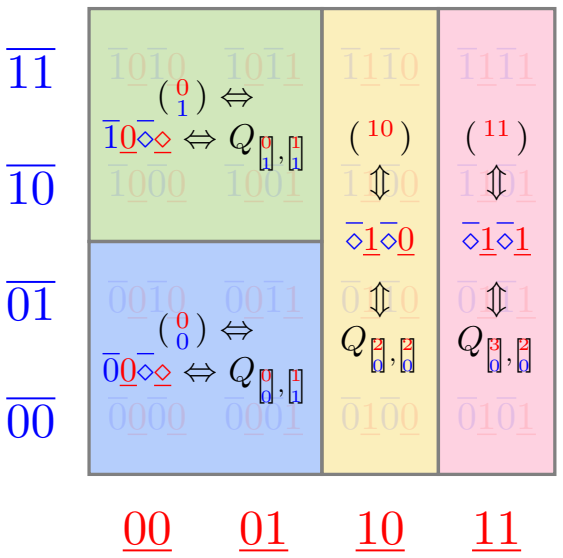
The carrying object is the per-node dimension subset $\sigma(v) \subseteq \{1,\dots,d\}$, encoded as a d-bit binary label $\vec b(v)$, together with the normalized-omnitree condition: a node keeps a 1 in any dimension in which all of its children split. Labels accumulated from the root give each rectangle its per-dimension level $\vec \ell$, so a node can be addressed by level-index notation and linearized in Z-order. This label/marker machinery does two jobs: it makes the tree storable as a compact depth-first bitstring of d bits per node, and it carries the convergence argument, since each one-dimensional bisection is counted directly while an octree pays for $2^{d-1}$ unproductive sibling
What would settle it
Take a function on $[0,1]^d$ that depends only on $x_1$ and has a known jump discontinuity, refine it by octree and omnitree to increasing cell counts, and measure L1 error on a log-log plot. If the omnitree log-log slope is about $d$ times the octree slope in the single-dimension regime, the compounding argument is confirmed; if the two slopes converge as $N \to \infty$, the claimed up-to-$d$ advantage does not materialize.
Extended reading notes
Core claim
Omnitrees are octrees with a per-node d-bit label that selects which dimensions get bisected: a node splitting $d'$ dimensions has $2^{d'}$ children, so one-dimensional refinement, two-dimensional refinement, and isotropic refinement all live in the same structure. A normalization condition forces each split as high in the tree as possible, making the representation unique and shallow. The paper's central theoretical result is Eq. (6): in the regime where after some resolution only one dimension per rectangle benefits from further refinement, every octree level creates $2^{d-1}$ extra cells that do not reduce error, and because this repeats at every level, the convergence-rate ratio satisfie
Load-bearing premise
The factor-d gain assumes the ideal refinement at every scale after some resolution bisects only one dimension per rectangle, with the octree's extra isotropic cells contributing nothing to error; if a problem needs simultaneous refinement in several dimensions, octrees lose little or nothing.
Editorial extensions
If this is right
- For any AMR problem with locally directional features, allowing per-dimension splits turns wasted isotropic siblings into usable resolution, so the same cell budget yields lower error and the same error needs fewer cells.
- Because the tree descriptor costs only d bits per node while data values dominate storage, the moderate overhead is quickly repaid once any anisotropy appears; for float-valued simulations the crossover is earlier than for the binary test case.
- The relative advantage grows with dimension because the octree's branching factor is $2^d$: the same structure that improves 3D shapes should make 4D space-time and higher-dimensional AMR feasible where octrees blow up.
- The compact bitstring plus Z-order traversal lets existing parallel AMR machinery be adapted to omnitrees once balancing and iteration are developed.
- In binary-valued problems, omnitree discretization also maximises the information density of stored leaf values faster than octrees, connecting error convergence to the entropy of the representation.
Reading between the lines
- The $d$-fold convergence bound is an upper envelope over problems that are locally one-dimensional at every scale; on real mixed-anisotropy problems the measured ratio should lie between 1 and $d$, so the practical win depends on how directional the target problem is.
- A cheaper, geometry-aware refinement criterion, such as signed-distance or intersection tests, may capture most of the omnitree benefit without the thousands of sensitivity samples per rectangle; the F25 wing-miss reported in the paper suggests sampling-based priorities can misallocate resolution.
- Combining omnitree labels with wavelet or multilinear bases, along the lines the paper notes for AMM, could let parent nodes carry approximation data and push compression and streaming benefits further.
- A direct extension would measure $r_{\mathrm{oct}}/r_{\mathrm{omni}}$ on synthetic functions with known anisotropic smoothness to map exactly where the factor $d$ is attained and where it decays toward 1.
Editorial analysis
A structured set of objections, weighed in public.
Referee Report
Summary. The paper introduces omnitrees, an anisotropic generalization of octrees/quadtrees for dyadic adaptive mesh refinement. An omnitree node may split in any subset of dimensions, with a normalized d-bit label encoding the split set, and the tree is stored as a linearized preorder bitstring. The paper defines a refinement algorithm based on refinement markers, analyzes storage costs, and derives a worst-case convergence-rate advantage in Section 4.1: under locally one-dimensional refinement, octrees spend a factor 2^{d-1} more cells per level than omnitrees for the same error reduction, giving an up-to-d factor rate ratio (Eq. 6). The empirical evaluation uses binary shape representation on 4,166 Thingi10K objects, reporting higher mean/median convergence rates for omnitrees (0.59 vs 0.39 mean; 0.76 vs 0.56 median) and a 10.1x lower median L1 error at N=8192. A 4-d time-rotation extension and an F25 aircraft showcase are also presented.
Significance. If the claims hold, omnitrees are a useful data-structural contribution for high-dimensional AMR: the factor-d rate bound is concrete, parameter-free, and independent of the underlying numerical method, and the compact bitstring representation plus accompanying open-source implementation make the proposal actionable. The theoretical worst-case argument is sound in the stated single-dimension-anisotropy regime. However, the empirical validation does not isolate the structural advantage from the refinement-criterion choice: the omnitree uses per-dimension Sobol indices while the octree uses total variance, so the measured gains conflate two independent changes. The paper is reproducible (code and data links provided) and the related work is thorough, but the central empirical claim needs a controlled comparison before it can be accepted as validation of Eq. (6).
major comments (2)
- [§5 and §6.1 (Fig. 6)] The headline empirical comparison is confounded. In §5, the omnitree refinement priority is the per-dimension variance-scaled first-order Sobol index S_j·Vol, while the octree uses only the total variance V·Vol. The octree therefore cannot distinguish which dimension carries the signal; on a dataset that the authors themselves describe as containing flat, long, axis-aligned objects (§6.3), this can waste much of the octree budget on constant dimensions. The observed 1.5x rate advantage and 10.1x median error gap therefore bundle the choice of refinement criterion with the anisotropic tree structure, and do not directly validate the structural factor-d bound of Eq. (6). I would need a control in which the octree receives the same per-dimension information (e.g., using max_j S_j·Vol as its priority, or comparing both trees under the same oracle), or a re-framed claim that the comparison is
- [§4.1, Eq. (6)] As printed, Eq. (6) is not correct: the antecedent e_oct^1 ≤ e_omni^1 and e_oct^2 ≤ e_omni^2 does not imply 1 ≥ r_oct/r_omni ≥ 1/d; simple counterexamples give ratio 1 when both octree errors are lower by the same factor. The intended statement follows directly from the scenario in the preceding paragraph: if one-dimensional refinement halves the error with N→2N while octree refinement halves the error with N→2^d N, then r_oct/r_omni = log(2)/log(2^d) = 1/d. Please replace the displayed inequality with a derivation along those lines and make the assumption “after a given resolution, refinement is only beneficial in a single dimension per rectangle” explicit in the statement. This is a central equation, so the fix should be made carefully.
minor comments (4)
- [§5] Typo: “Monte Calro L1 error” should be “Monte Carlo L1 error”.
- [§5, §6.1] The Monte Carlo parameters ns=512, ng=4096, ne=262144 are not accompanied by a sensitivity analysis or uncertainty quantification. Since the central empirical curves are Monte Carlo estimates, please state whether the reported rates are stable to these choices, or provide uncertainty bands for the aggregate curves.
- [§6.1] The text states that “in both measures, the convergence rate is increased by 0.20”. This is arithmetically true, but differences in log-log slopes are less interpretable than the ratio stated in the abstract (1.5x); please harmonize the presentation.
- [§4.1, Eq. (5)] The rate r is undefined when e=0, and Fig. 6 explicitly notes that zero-error cases occur. Please state how zero-error cases are handled in the aggregate convergence-rate calculations.
Circularity Check
No material circularity: Eq. (6) is a parameter-free consequence of explicit anisotropy assumptions, and the empirical section tests the derived ordering against an external benchmark.
full rationale
The central theoretical claim (Section 4.1, Eq. (6)) is not circular. The convergence-rate definition r=log(e1/e2)/log(N2/N1) is applied to the stated regime where, after some resolution, refinement is beneficial in only one dimension per rectangle. Under that premise, an omnitree doubles the cell count per resolved level while an octree multiplies it by 2^d, so the rate ratio log(2)/log(2^d)=1/d follows by arithmetic and not by assuming the target inequality. The premise does not include the conclusion; it is a structural assumption about the problem. No fitted constant is introduced, and no prior result by the authors is invoked to supply the factor-d bound. The empirical validation (Section 6, Thingi10K) is an external benchmark with stated sampling and sensitivity-analysis machinery; the reported convergence rates are descriptive measurements, not fitted parameters renamed as predictions. The only self-references are to the authors' own code repositories and data repository [39,40] plus the Zenodo entry, which are implementation artifacts and do not carry the argument. The paper explicitly acknowledges that its omnitree refinement uses per-dimension Sobol indices while the octree baseline uses total variance (Section 5), which is a potential confound for interpreting the magnitude of the empirical gap as purely structural; however, confounding a benchmark comparison is not circularity. Likewise, the stated F25 limitation (Section 6.4) that sensitivity-index sampling can miss parts of the geometry is an admitted weakness of the refinement criterion, not a circular step. The uniqueness assertion in Definition 2.2 is a definitional convention rather than a cited theorem, and it is not used to force Eq. (6). Therefore no circular step meeting the quoted-evidence standard is present.
Assumptions & free parameters
free parameters (4)
- Saltelli sample count ns per cuboid =
512
- Inner Monte Carlo samples ng per rectangle =
4,096 (3-d) / 8,192 (4-d)
- Outer Monte Carlo samples ne for the L1 error =
262,144 (3-d) / 16,777,216 (4-d)
- Discretization budgets (refine until N surpasses a power of two) =
powers of two from 16 up to 8,192 (3-d) and 32,768 (4-d)
assumptions (5)
- domain assumption Extreme local anisotropy: after some resolution, further refinement is beneficial in only a single dimension per rectangle, with error halving per such one-dimensional refinement and cost doubling per level.
- domain assumption Variance-scaled first-order Sobol indices, estimated by Saltelli sampling with ns=512, are a faithful per-dimension refinement priority for binary functions.
- domain assumption Monte Carlo L1 estimates with ne samples accurately rank approximation errors at the resolutions studied.
- domain assumption Piecewise-constant majority-vote recovery is a representative error model for AMR discretizations of binary fields.
- domain assumption Standard space-filling curve properties (Z order locality, nesting, parallelizability in the p4est/t8code style) carry over to the omnitree linearization.
invented entities (1)
-
Omnitree (anisotropic dyadic refinement with per-node dimension-subset labels, normalization, and d-bit preorder bitstring encoding)
independent evidence
Cite this review
Pith. "Pith review of The Beauty of Anisotropic Mesh Refinement: Omnitrees for Efficient Dyadic Discretizations." pith.science (2026). https://pith.science/paper/HJW5GSBA
@misc{pith2026250806316,
  author       = {Pith},
  title        = {Pith review of: The Beauty of Anisotropic Mesh Refinement: Omnitrees for Efficient Dyadic Discretizations},
  year         = {2026},
  howpublished = {\url{https://pith.science/paper/HJW5GSBA}},
  note         = {Machine review of arXiv:2508.06316}
}
read the original abstract
Structured adaptive mesh refinement (AMR), commonly implemented via quadtrees and octrees, underpins a wide range of applications including databases, computer graphics, physics simulations, and machine learning. However, octrees enforce isotropic refinement in regions of interest, which can be especially inefficient for problems that are intrinsically anisotropic--much resolution is spent where little information is gained. This paper presents omnitrees as an anisotropic generalization of octrees and related data structures. Omnitrees allow to refine only the locally most important dimensions, providing tree structures that are less deep than bintrees and less wide than octrees. As a result, the convergence of the AMR schemes can be increased by up to a factor of the dimensionality d for very anisotropic problems, quickly offsetting their modest increase in storage overhead. We validate this finding on the problem of binary shape representation across 4,166 three-dimensional objects: Omnitrees increase the mean convergence rate by 1.5x, require less storage to achieve equivalent error bounds, and maximize the information density of the stored function faster than octrees. These advantages are projected to be even stronger for higher-dimensional problems. We provide a first validation by introducing a time-dependent rotation to create four-dimensional representations, and discuss the properties of their 4-d octree and omnitree approximations. Overall, omnitree discretizations can make existing AMR approaches more efficient, and open up new possibilities for high-dimensional applications.
Figures


Figures from the paper (10 more)


Forward citations
Cited by 1 Pith paper
-
Towards Fully Dynamic Omnitrees: Moment-Conserving Anisotropic Compression With Wavelets
Wavelet-guided coarsening and downsplit make omnitrees fully dynamic, delivering superior anisotropic compression versus OpenVDB on 3D shapes and continuous volumes while conserving mass by design.
Reference graph
Works this paper leans on
-
[1]
The Fast Multipole Method for Gridless Particle Simulation
John Ambrosiano, Leslie Greengard, and Vladimir Rokhlin. “The Fast Multipole Method for Gridless Particle Simulation”. In:Computer Physics Communications 48.1 (Jan. 1, 1988), pp. 117–125. issn: 0010-4655. doi: 10.1016/0010-4655(88)90029-X . url: https://www.sciencedirect. com/science/article/pii/001046558890029X. 3https://zenodo.org/records/15909872?previ...
arXiv 1988
-
[2]
Michael Bader. Space-Filling Curves. Vol. 9. Texts in Computational Sci- ence and Engineering. Berlin, Heidelberg: Springer, 2013. isbn: 978-3- 642-31045-4. doi: 10.1007/978- 3- 642- 31046- 1. url: http://link. springer.com/10.1007/978-3-642-31046-1
doi:10.1007/978- 2013
-
[3]
Dan Baruzzini, Neal Domel, and Daniel Miller. “Fundamental Challenges of Micro-Vanes and Micro-Ramps for High-Speed Inlet Applications: A Computational Fluid Dynamics Investigation”. In:45th AIAA/ASME/SAE/ASEE Joint Propulsion Conference & Exhibit . American Institute of Aeronau- tics and Astronautics, 2009. doi: 10.2514/6.2009- 5074. url: https: //arc.ai...
doi:10.2514/6.2009- 2009
-
[4]
Multidimensional Binary Search Trees Used for As- sociative Searching
Jon Louis Bentley. “Multidimensional Binary Search Trees Used for As- sociative Searching”. In: Commun. ACM 18.9 (1975-09-01), pp. 509–517. issn: 0001-0782. doi: 10.1145/361002.361007 . url: https://dl.acm. org/doi/10.1145/361002.361007
arXiv 1975
-
[5]
AMM: Adaptive Multilinear Meshes
Harsh Bhatia et al. “AMM: Adaptive Multilinear Meshes”. In: IEEE Transactions on Visualization and Computer Graphics 28.6 (June 2022), pp. 2350–2363. issn: 1941-0506. doi: 10.1109/TVCG.2022.3165392. url: https://ieeexplore.ieee.org/document/9751449
-
[6]
A New Uncertainty Importance Measure
E. Borgonovo. “A New Uncertainty Importance Measure”. In: Reliabil- ity Engineering & System Safety 92.6 (June 1, 2007), pp. 771–784. issn: 0951-8320. doi: 10.1016/j.ress.2006.04.015 . url: https://www. sciencedirect.com/science/article/pii/S0951832006000883
-
[7]
Foundations of Nonlinear Gyrokinetic Theory
A. J. Brizard and T. S. Hahm. “Foundations of Nonlinear Gyrokinetic Theory”. In: Reviews of Modern Physics 79.2 (Apr. 2, 2007), pp. 421–468. doi: 10.1103/RevModPhys.79.421 . url: https://link.aps.org/doi/ 10.1103/RevModPhys.79.421
-
[8]
P4est: Scalable Algorithms for Parallel Adaptive Mesh Refinement on Forests of Octrees
Carsten Burstedde, Lucas C. Wilcox, and Omar Ghattas. “P4est: Scalable Algorithms for Parallel Adaptive Mesh Refinement on Forests of Octrees”. In: SIAM Journal on Scientific Computing 33.3 (Jan. 2011), pp. 1103–
work page 2011
Show all 59 references
-
[9]
ParallelNN: A Parallel Octree-based Nearest Neigh- bor Search Accelerator for 3D Point Clouds
Faquan Chen et al. “ParallelNN: A Parallel Octree-based Nearest Neigh- bor Search Accelerator for 3D Point Clouds”. In: 2023 IEEE International Symposium on High-Performance Computer Architecture (HPCA) . 2023 IEEE International Symposium on High-Performance Computer Architec-...
2023
-
[10]
Fast Construction of K-Nearest Neighbor Graphs for Point Clouds
Michael Connor and Piyush Kumar. “Fast Construction of K-Nearest Neighbor Graphs for Point Clouds”. In: IEEE Transactions on Visualiza- tion and Computer Graphics 16.4 (July 2010), pp. 599–608. issn: 1941-
2010
-
[11]
From Piz Daint to the Stars: Simulation of Stellar Mergers Using High-Level Abstractions
Gregor Daiß et al. “From Piz Daint to the Stars: Simulation of Stellar Mergers Using High-Level Abstractions”. In: Proceedings of the Interna- tional Conference for High Performance Computing, Networking, Stor- age and Analysis . SC ’19. New York, NY, USA: Association for Com-...
2019
-
[12]
Dawson-Haggerty et al. trimesh. Version 3.2.0. 2019. url: https : / / trimesh.org/
2019
-
[13]
Efficient Autoregressive Shape Generation via Octree- Based Adaptive Tokenization
Kangle Deng et al. Efficient Autoregressive Shape Generation via Octree- Based Adaptive Tokenization . Version 1. Apr. 3, 2025. doi: 10.48550/ arXiv.2504.02817. arXiv: 2504.02817 [cs]. url: http://arxiv.org/ abs/2504.02817. Pre-published
-
[14]
Deutsches Zentrum f¨ ur Luft- und Raumfahrt e.V. (DLR). DLR-F25. DLR Digital Hangar. url: https://www.digital- hangar.de/portfolio/ dlr-f25/
-
[15]
Time-Tensor for Rapid Convergence of CFD Solutions
Neal Domel. “Time-Tensor for Rapid Convergence of CFD Solutions”. In: 48th AIAA Aerospace Sciences Meeting Including the New Horizons Forum and Aerospace Exposition. American Institute of Aeronautics and Astronautics, 2010. doi: 10.2514/6.2010-120. url: https://arc.aiaa. org/d...
2010 doi
-
[16]
Splitflow - Progress in 3D CFD with Cartesian Omni-Tree Grids for Complex Geometries
Neal Domel and Steve Karman. “Splitflow - Progress in 3D CFD with Cartesian Omni-Tree Grids for Complex Geometries”. In: 38th Aerospace Sciences Meeting and Exhibit . American Institute of Aeronautics and As- tronautics, 2000. doi: 10.2514/6.2000-1006 . url: https://arc.aiaa. ...
-
[17]
Propulsion Aerodynamics Workshop IV Results for the Special Topic
Neal D. Domel. “Propulsion Aerodynamics Workshop IV Results for the Special Topic”. In: AIAA Propulsion and Energy 2019 Forum . American Institute of Aeronautics and Astronautics, 2019. doi: 10.2514/6.2019-
2019 doi
-
[18]
Low- and High-Frequency Nature of Oblique Filamentation Modes. II. Vlasov–Maxwell Simulations of Collisionless Heat- ing Process
A. Ghizzo and D. Del Sarto. “Low- and High-Frequency Nature of Oblique Filamentation Modes. II. Vlasov–Maxwell Simulations of Collisionless Heat- ing Process”. In: Physics of Plasmas 27.7 (July 21, 2020), p. 072104. issn: 1070-664X. doi: 10.1063/5.0003698. url: https://doi.org...
2020 doi
-
[19]
A Fast Algorithm for Particle Simulations
L Greengard and V Rokhlin. “A Fast Algorithm for Particle Simulations”. In: Journal of Computational Physics 73.2 (Dec. 1, 1987), pp. 325–348. issn: 0021-9991. doi: 10.1016/0021- 9991(87)90140- 9. url: https: //www.sciencedirect.com/science/article/pii/0021999187901409
1987
-
[20]
Sixteen Space-Filling Curves and Traversals for d- Dimensional Cubes and Simplices
Herman Haverkort. Sixteen Space-Filling Curves and Traversals for d- Dimensional Cubes and Simplices . Sept. 12, 2018. arXiv: 1711 . 04473 [cs]. url: http://arxiv.org/abs/1711.04473. Pre-published. 30
2018 arXiv
-
[21]
SALib: An open-source Python library for Sensitivity Analysis
Jon Herman and Will Usher. “SALib: An open-source Python library for Sensitivity Analysis”. In: The Journal of Open Source Software 2.9 (2017). doi: 10.21105/joss.00097 . url: https://doi.org/10.21105/joss. 00097
2017 doi
-
[22]
T8code - Modular Adaptive Mesh Refinement in the Exascale Era
Johannes Holke et al. “T8code - Modular Adaptive Mesh Refinement in the Exascale Era”. In: Journal of Open Source Software 10.106 (Feb. 6, 2025), p. 6887. issn: 2475-9066. doi: 10.21105/joss.06887. url: https: //joss.theoj.org/papers/10.21105/joss.06887
2025 doi
-
[23]
OctoMap: An Efficient Probabilistic 3D Map- ping Framework Based on Octrees
Armin Hornung et al. “OctoMap: An Efficient Probabilistic 3D Map- ping Framework Based on Octrees”. In: Autonomous Robots 34.3 (Apr. 1, 2013), pp. 189–206. issn: 1573-7527. doi: 10.1007/s10514-012-9321-0 . url: https://doi.org/10.1007/s10514-012-9321-0
2013 doi
-
[24]
Toward SALib 2.0: Advancing the accessibility and interpretability of global sensitiv- ity analyses
Takuya Iwanaga, William Usher, and Jonathan Herman. “Toward SALib 2.0: Advancing the accessibility and interpretability of global sensitiv- ity analyses”. In: Socio-Environmental Systems Modelling 4 (May 2022), p. 18155. doi: 10 . 18174 / sesmo . 18155. url: https : / / sesmo ...
2022
-
[25]
An Octree- Based, Cartesian Navier–Stokes Solver for Modern Cluster Architectures
Dylan Jude, Jayanarayanan Sitaraman, and Andrew Wissink. “An Octree- Based, Cartesian Navier–Stokes Solver for Modern Cluster Architectures”. In: The Journal of Supercomputing 78.9 (June 1, 2022), pp. 11409–11440. issn: 1573-0484. doi: 10 . 1007 / s11227 - 022 - 04324 - 7. url...
2022 doi
-
[26]
On a Method of Binary-Picture Rep- resentation and Its Application to Data Compression
Eiji Kawaguchi and Tsutomu Endo. “On a Method of Binary-Picture Rep- resentation and Its Application to Data Compression”. In: IEEE Trans- actions on Pattern Analysis and Machine Intelligence PAMI-2.1 (Jan. 1980), pp. 27–35. issn: 1939-3539. doi: 10.1109/TPAMI.1980.4766967 . u...
1980
-
[27]
Progressive Transmission of Grey-Scale and Binary Pic- tures by Simple, Efficient, and Lossless Encoding Schemes
K. Knowlton. “Progressive Transmission of Grey-Scale and Binary Pic- tures by Simple, Efficient, and Lossless Encoding Schemes”. In: Proceed- ings of the IEEE 68.7 (July 1980), pp. 885–896. issn: 1558-2256. doi: 10 . 1109 / PROC . 1980 . 11754. url: https : / / ieeexplore . ie...
1980
-
[28]
Spatially Adaptive Techniques for Level Set Methods and Incompressible Flow
Frank Losasso, Ronald Fedkiw, and Stanley Osher. “Spatially Adaptive Techniques for Level Set Methods and Incompressible Flow”. In: Comput- ers & Fluids 35.10 (Dec. 1, 2006), pp. 995–1010. issn: 0045-7930. doi: 10. 1016/j.compfluid.2005.01.006 . url: https://www.sciencedirect....
2006
-
[29]
Simulating Water and Smoke with an Octree Data Structure
Frank Losasso, Fr´ ed´ eric Gibou, and Ron Fedkiw. “Simulating Water and Smoke with an Octree Data Structure”. In: ACM SIGGRAPH 2004 Pa- pers. SIGGRAPH ’04. New York, NY, USA: Association for Comput- ing Machinery, Aug. 1, 2004, pp. 457–462. isbn: 978-1-4503-7823-9. doi: 10.11...
2004
-
[30]
Sierpinski’s Curve: A (Beautiful) Paradigm of Recur- sion
Paola Magrone. “Sierpinski’s Curve: A (Beautiful) Paradigm of Recur- sion”. In: Slov. ˇCasopis Pre Geom. Graf 17 (2020), pp. 17–28. url: http: //ssgg.sk/G/Abstrakty/G_cisla/G33.pdf#page=17
2020
-
[31]
Geometric Modeling Using Octree Encoding
Donald Meagher. “Geometric Modeling Using Octree Encoding”. In: Com- puter Graphics and Image Processing 19.2 (June 1, 1982), pp. 129–147. issn: 0146-664X. doi: 10.1016/0146- 664X(82)90104- 6. url: https: //www.sciencedirect.com/science/article/pii/0146664X82901046
1982
-
[32]
Octree Partitioning of Hybrid Grids for Parallel Adaptive Viscous Flow Simulations
T. Minyard and Y. Kallinderis. “Octree Partitioning of Hybrid Grids for Parallel Adaptive Viscous Flow Simulations”. In: International Journal for Numerical Methods in Fluids 26.1 (1998), pp. 57–78. issn: 1097-0363. doi: 10.1002/(SICI)1097-0363(19980115)26:1<57::AID-FLD625>3. ...
1998 doi
-
[33]
Interface-Capturing Methods for Two-Phase Flows: An Overview and Recent Developments
Shahab Mirjalili, Suhas S. Jain, and Micheal Dodd. “Interface-Capturing Methods for Two-Phase Flows: An Overview and Recent Developments”. In: Center for Turbulence Research Annual Research Briefs 2017.117–135 (2017), p. 13. url: https://doddm.com/publications/2017-ctr-sm- sj-md.pdf
2017
-
[34]
Parallel Level-Set Methods on Adaptive Tree-Based Grids
Mohammad Mirzadeh et al. “Parallel Level-Set Methods on Adaptive Tree-Based Grids”. In: Journal of Computational Physics 322 (Oct. 1, 2016), pp. 345–364. issn: 0021-9991. doi: 10 . 1016 / j . jcp . 2016 . 06
2016
-
[35]
Astrophysical Particle Simulations on Heteroge- neous CPU-GPU Systems
Naohito Nakasato et al. Astrophysical Particle Simulations on Heteroge- neous CPU-GPU Systems . June 6, 2012. doi: 10.48550/arXiv.1206
2012 doi
-
[36]
A Numerical Algorithm Based on a Tree Data for an Anisotropically Adaptive Cartesian Mesh
Takanobu Ogawa. “A Numerical Algorithm Based on a Tree Data for an Anisotropically Adaptive Cartesian Mesh”. In: ASME/JSME 2003 4th Joint Fluids Summer Engineering Conference. American Society of Me- chanical Engineers Digital Collection, 2009-02-04, pp. 2015–2021. doi: 10 . 1...
2003
-
[37]
An Adaptive Cartesian Mesh Flow Solver Based on the Tree-data with Anisotropic Mesh Refinement
Takanobu Ogawa. “An Adaptive Cartesian Mesh Flow Solver Based on the Tree-data with Anisotropic Mesh Refinement”. In: Computational Fluid Dynamics 2002 . Ed. by Steve W. Armfield, Patrick Morgan, and Karke- nahalli Srinivas. Berlin, Heidelberg: Springer, 2003, pp. 453–458. isb...
2002 doi
-
[38]
url: https://www.sciencedirect.com/science/article/pii/ S002199911630242X
-
[39]
freifrauvonbleifrei/DyAda
Theresa Pollinger. freifrauvonbleifrei/DyAda. version 0.0.5. June 12, 2025. url: https://github.com/freifrauvonbleifrei/DyAda
2025
-
[40]
freifrauvonbleifrei/thingies with omnitrees
Theresa Pollinger. freifrauvonbleifrei/thingies with omnitrees. June 12, 2025. url: https : / / github . com / freifrauvonbleifrei / thingies _ with _ omnitrees
2025
-
[41]
Making Best Use of Model Evaluations to Compute Sen- sitivity Indices
Andrea Saltelli. “Making Best Use of Model Evaluations to Compute Sen- sitivity Indices”. In: Computer Physics Communications 145.2 (May 15, 2002), pp. 280–297. issn: 0010-4655. doi: 10 . 1016 / S0010 - 4655(02 ) 00280- 1. url: https://www.sciencedirect.com/science/article/ pi...
2002
-
[42]
Global Sensitivity Analysis: The Primer
Andrea Saltelli et al. Global Sensitivity Analysis: The Primer . John Wiley & Sons, 2008
2008
-
[43]
Parallelization of an Adaptive Cartesian Mesh Flow Solver Based on the 2N -Tree Data Structure
Takanobu Ogawa. “Parallelization of an Adaptive Cartesian Mesh Flow Solver Based on the 2N -Tree Data Structure”. In: Parallel Computational Fluid Dynamics 2002 . Ed. by K. Matsuno et al. Amsterdam: North- Holland, 2003-01-01, pp. 441–448. isbn: 978-0-444-50680-1. doi: 10.1016...
2002
-
[44]
Omni-Tree and Adaptive Cartesian Hybrid Grid Method in Steady and Unsteady Flows
Wei Sang and Feng Li. “Omni-Tree and Adaptive Cartesian Hybrid Grid Method in Steady and Unsteady Flows”. In: 21st AIAA Applied Aerody- namics Conference. American Institute of Aeronautics and Astronautics,
-
[45]
Application of an Omni-tree Adaptive and Hybrid Cartesian Grid Method
Wei Sang, Feng Li, and Q. E. “Application of an Omni-tree Adaptive and Hybrid Cartesian Grid Method”. In: 41st Aerospace Sciences Meeting and Exhibit. American Institute of Aeronautics and Astronautics, 2003. doi: 10.2514/6.2003- 1239 . url: https://arc.aiaa.org/doi/abs/10. 25...
2003 doi
-
[46]
Comparison of Octree and Omni-Tree Carte- sian Grid for Civil-Plane High-Lift Model Simulations
Weimin Sang and Yu Shi. “Comparison of Octree and Omni-Tree Carte- sian Grid for Civil-Plane High-Lift Model Simulations”. In: Journal of Aircraft 50.4 (2013), pp. 1099–1105. issn: 0021-8669. doi: 10.2514/1. C032044. url: https://doi.org/10.2514/1.C032044
2013 doi
-
[47]
Numerically Analyzing More Efficiently High-Lift Aerodynamics of Wing/Body Model with Omni-Tree Cartesian Grids
Weimin Sang and Jiangang Yu. “Numerically Analyzing More Efficiently High-Lift Aerodynamics of Wing/Body Model with Omni-Tree Cartesian Grids”. In: Aerospace Science and Technology 15.5 (2011-07-01), pp. 375–
2011
-
[48]
The Quadtree and Related Hierarchical Data Structures
Hanan Samet. “The Quadtree and Related Hierarchical Data Structures”. In: ACM Computing Surveys (CSUR) 16.2 (1984), pp. 187–260. doi: 10. 1145/356924.356930
1984
-
[49]
Etree: A Database-Oriented Method for Generating Large Octree Meshes
T. Tu, D. R. O’Hallaron, and J. C. L´ opez. “Etree: A Database-Oriented Method for Generating Large Octree Meshes”. In: Engineering with Com- puters 20.2 (July 1, 2004), pp. 117–128. issn: 1435-5663. doi: 10.1007/ s00366- 004- 0283- 5. url: https://doi.org/10.1007/s00366- 004- 0283-5
2004 doi
-
[50]
Octree-R: An Adaptive Octree for Efficient Ray Tracing
Kyu-Young Whang et al. “Octree-R: An Adaptive Octree for Efficient Ray Tracing”. In: IEEE Transactions on Visualization and Computer Graph- ics 1.4 (Dec. 1995), pp. 343–349. issn: 1941-0506. doi: 10.1109/2945. 485621. url: https : / / ieeexplore . ieee . org / abstract / docum...
1995 doi
-
[51]
Establishing the DLR-F25 as a Research Baseline Aircraft for the Short-Medium Range Market in 2035
Sebastian W¨ ohler, Jannik H¨ aßy, and Vivian Kriewall. “Establishing the DLR-F25 as a Research Baseline Aircraft for the Short-Medium Range Market in 2035”. In: 34th Congress of the International Council of the Aeronautical Sciences, ICAS 2024. International Council of the Ae...
-
[52]
Adaptive Patching for High-resolution Image Segmen- tation with Transformers
Enzhi Zhang et al. “Adaptive Patching for High-resolution Image Segmen- tation with Transformers”. In: SC24: International Conference for High Performance Computing, Networking, Storage and Analysis . IEEE, 2024, pp. 1–16. url: https://ieeexplore.ieee.org/abstract/document/ 10793226/
2024
- [53]
-
[55]
Octree-Based Indexing for 3D Pointclouds within an Oracle Spatial DBMS
Bianca Sch¨ on et al. “Octree-Based Indexing for 3D Pointclouds within an Oracle Spatial DBMS”. In: Computers & Geosciences 51 (Feb. 1, 2013), pp. 430–438. issn: 0098-3004. doi: 10 . 1016 / j . cageo . 2012 . 08 . 021. url: https : / / www . sciencedirect . com / science / art...
2013
-
[380]
doi: 10.1016/j.ast.2010.09.001
issn: 1270-9638. doi: 10.1016/j.ast.2010.09.001. url: https:// www.sciencedirect.com/science/article/pii/S1270963810001161
2010 doi
-
[506]
url: https://ieeexplore.ieee
doi: 10.1109/TVCG.2010.9 . url: https://ieeexplore.ieee. org/abstract/document/5383353. 29
2010
-
[1133]
doi: 10.1137/100791634
issn: 1064-8275. doi: 10.1137/100791634 . url: https://epubs. siam.org/doi/abs/10.1137/100791634
-
[1199]
1199 [astro-ph]
arXiv: 1206 . 1199 [astro-ph]. url: http : / / arxiv . org / abs / 1206.1199. Pre-published
-
[4020]
url: https://arc.aiaa.org/doi/abs/10.2514/6.2019-4020
2019 doi
Reviewed August 5, 2026 · model on record in the stance chip above.
Discussion (0). Sign in to comment.