REVIEW 1 major objections 4 minor 99 references
Completing and Debugging Ontologies: state of the art and challenges
T0 review · 1 major / 4 minor · reviewed 2026-08-14 · deepseek-v4-flash
Pith's one-line read One repair definition unifies ontology completion and debugging.
desk verdict A solid survey whose CDP framework gives the field a common vocabulary; the oracle gap is a precision issue, not a fatal one. read the letter →
The pith
A machine-rendered reading of the paper's core claim, the machinery that carries it, and where it could break.
The reading
What carries the argument
The load-bearing object is the Complete-Debug-Problem (CDP) and its repair relation from Definition 1, together with the oracle $Or$ that answers true or false for each TBox axiom and represents the domain expert. The oracle is the only channel through which domain correctness enters; without it, 'missing' and 'wrong' are just syntactic labels. The framework's other machinery is a family of preference relations over repairs—more complete, less incorrect, and subset minimal—and their combinations, which let the survey classify algorithms by which kind of optimal repair they can produce, such as maximally complete, minimally incorrect, or skyline-optimal. The CDP carries the argument by turning every repair task into the same abductive schema, making the comparison of methods a matter of checking which conditions and preferences each method realizes.
What would settle it
Take a repair produced by an axiom-weakening tool and try to express it as a pair ($A$,$D$) of whole axioms under any oracle; if there is an ontology where the weakened axiom cannot be split into oracle-true additions and oracle-false deletions that keep all missing axioms derivable and all wrong axioms underivable, then Definition 1 does not cover every repair method it claims to unify.
Extended reading notes
Core claim
The central claim is Definition 1: for a TBox $T$, atomic concepts $C$, an oracle $Or$ returning true or false for every axiom, a finite set $M$ of missing axioms and a finite set $W$ of wrong axioms, a repair of CDP($T,C,Or,M,W$) is any pair ($A$,$D$) of finite axiom sets such that every axiom in $A$ is oracle-true, every axiom in $D$ is oracle-false, the TBox obtained by deleting $D$ from and adding $A$ to $T$ is consistent, every axiom in $M$ is derivable from the repaired TBox, and no axiom in $W$ is derivable from it. The author then reads the literature through this lens: correctness-only debugging is the special case with $M$ empty and $A$ empty, completeness-only completion is $W$ empty and $D$ empty, and work that does both at once is rare and mostly restricted to lightweight is-a structures. On this reading the field's main gap is not detection but the combined repair problem and the algorithmic guarantee of preferred repairs.
Load-bearing premise
The load-bearing premise is that a domain expert can serve as an oracle that returns the correct true or false judgment for every TBox axiom, because the definition of a repair lets axioms be added only on 'true' answers and deleted only on 'false' answers.
Editorial extensions
If this is right
- Every debugging-only or completion-only method discussed is a special case of CDP repair, which is why the framework can compare them uniformly.
- A repair for the combined problem cannot in general be obtained by doing a completion step and then a debugging step, or vice versa, since additions can re-enable wrong derivations and deletions can remove needed support.
- Preference relations distinguish good repairs: maximally complete, minimally incorrect, and subset-minimal are different goals, and existing systems often realize only some of them.
- The open problems follow directly: algorithms for combined repair with guarantees, complexity results for completion and preferred repairs, and extensions to oracles that answer 'unknown'.
- Ontology networks can be treated as single TBoxes by translating all mappings into axioms, so the same CDP definition applies there as well.
Reading between the lines
- If the CDP formalization became the standard interface for repair tools, benchmark evaluations could be built around a shared tuple ($T$,$M$,$W$,oracle answers), letting any proposed repair algorithm be scored against the same oracle judgments; current surveys compare systems only via their own benchmarks.
- The oracle dependence suggests a robustness program the paper only touches: repairs could be defined relative to probability-of-correctness estimates or to multiple experts, so that add and delete decisions are made under uncertainty rather than by an all-knowing judge.
- Axiom-level add/delete granularity may be the wrong cut for some real repairs, which weaken or rewrite axioms; the paper notes these can be encoded as delete-plus-add, but this encoding may hide a finer-grained repair problem worth formalizing separately.
Signed reviews
Editorial analysis
A structured set of objections, weighed in public.
Referee Report
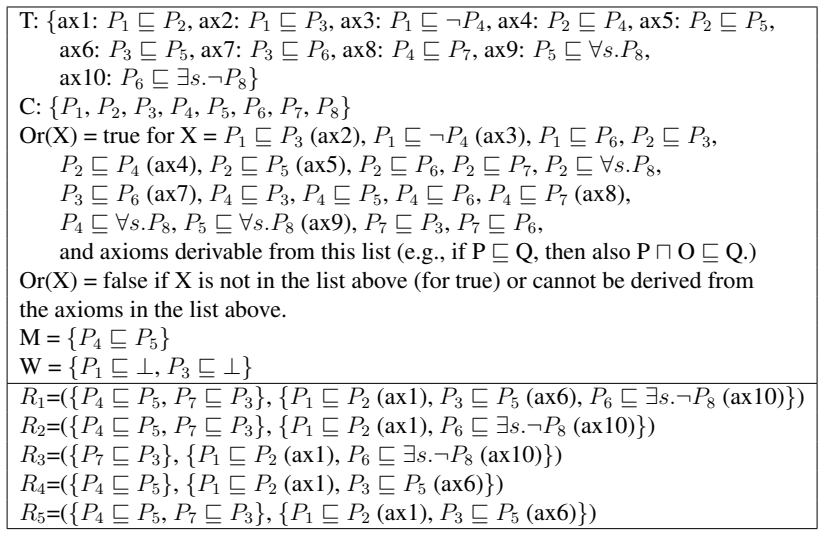
Summary. The paper presents a survey of ontology debugging and completion focused on the repair step. It introduces a formalization of a Complete-Debug-Problem CDP(T,C,Or,M,W), where a repair is a pair (A,D) of TBox axiom sets to add and delete such that: added axioms are declared true by an oracle Or, deleted axioms are declared false, the resulting TBox is consistent, all missing axioms M are entailed, and all wrong axioms W are not entailed (Definition 1). It then defines preference relations among repairs—more complete, less incorrect, subset minimality, and combined skyline optimality—and uses this framework to organize the state of the art for single ontologies and ontology networks, including correctness-only, completeness-only, and combined approaches. The paper concludes with open research problems in theory, algorithms, and user support, and an appendix works through a Galen-inspired EL example verifying several repairs against the five conditions.
Significance. The proposed framework is a useful unifying device: it makes explicit that repair involves both addition and deletion, it connects repair to abduction, and it provides preference notions that prior surveys lacked. The worked examples are careful, and the appendix verifies each candidate repair against Definition 1, which is a strength. The survey's descriptive claims are supported by references, and the separation of debugging and completion is convincingly documented. The paper does not claim machine-checked proofs or experimental results, which is appropriate for a survey; its value lies in the formalization and organization of the field.
major comments (1)
- [§4.1.1 (Definition 1) and §4.1.2] Definition 1 constrains the oracle only on the added set A and the deleted set D (conditions (i)–(ii)); conditions (iv)–(v) apply to M and W without any requirement that Or has classified these axioms. The 'all-knowing' case is introduced informally in §4.1.2, and the statement that one can 'without loss of generality' assume that M-axioms are really missing and W-axioms are really false is an external meta-assumption rather than a consequence of Definition 1. As written, therefore, a repair can satisfy (iv) by entailing an axiom that is in fact false according to the domain (if M contains a false positive), and can satisfy (v) by making a true entailment non-derivable (if W contains a false negative); the preference relations in Definitions 2–3 inherit this issue because they compare entailment sets using a possibly fallible Or. I recommend adding explicit conditions to the definition of CDP or to Definition 1 (e.g., ∀ψ∈M: Or(ψ)=true and ∀ψ∈W: Or(ψ)=false, possibly as a separate 'validated defects' assumption) and stating formally what 'all-knowing' means (e.g., Or(ψ)=true iff ψ holds in the intended domain).
minor comments (4)
- [§5.2] In the sentence 'Therefore, in Def. 1, ∀ψm∈M:Or(ψp)=true, W=∅ and D=∅', the variable ψp should be ψm.
- [§4.1.1 (Definition 1)] Definition 1 includes C in the problem signature, but C is never used in any of the conditions; either remove it or state explicitly that it is part of the signature for notational uniformity.
- [§4.1.1 (Definition 1) and §4.1.2] Definition 1 does not explicitly require D⊆T or A∩D=∅ in general; the examples and the identity (T∪A)\D=(T\D)∪A in §4.1.2 assume A∩D=∅. Please state the intended domain of A and D.
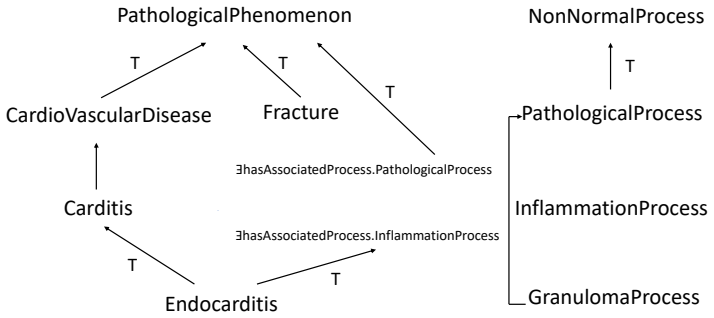
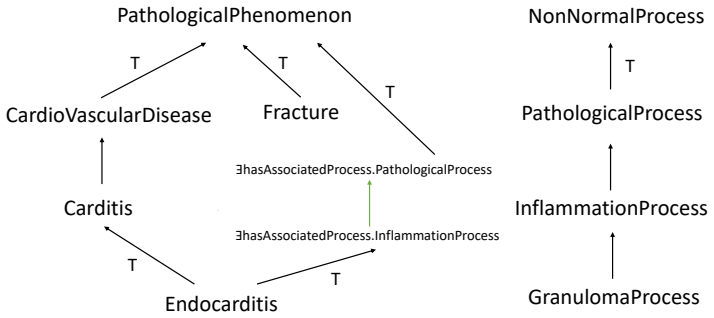
- [Figures 2 and 3] The color coding and the T/F labels are helpful, but the captions do not explain that blue marks missing axioms and red marks wrong axioms; making the captions self-contained would improve readability.
Circularity Check
No significant circularity: the CDP framework is a definitional formalization, and surveyed prior work is assessed against it rather than derived from it.
full rationale
The paper's central move is Definition 1, which explicitly defines a repair for a Complete-Debug-Problem as a pair (A,D) satisfying oracle-based conditions on additions/deletions, consistency, derivability of all M, and non-derivability of all W. This is a stated formalization, not a prediction derived from hidden inputs, nor a parameter fitted to data. The subsequent preference relations (Definitions 2-10) are also explicit definitions built on the oracle, and Section 4.1.2 openly discusses the all-knowing oracle assumption and the consequences of oracle fallibility; the skeptic's observation that Definition 1 does not itself require the oracle to have validated M and W is a precision limitation the paper acknowledges in prose, not a circular reduction. The survey's citations of the author's own systems (e.g., RepOSE [24,25], EL completion algorithms [56,58], and ALC repair [59]) are used as examples of the state of the art; those works contain independent algorithms and complexity results, and the paper does not invoke them as premises that force the framework's conclusions. No fitted-input-called-prediction, self-citation-load-bearing, or renamed-known-result pattern is present, so the derivation chain is self-contained as a formalization-and-survey contribution.
Assumptions & free parameters
assumptions (4)
- standard math Standard description logic semantics: interpretations, models, TBox consistency, and subsumption are well-defined.
- domain assumption Ontologies of interest are represented as TBoxes without instances.
- ad hoc to paper An oracle Or exists that can answer true or false for any TBox axiom.
- standard math EL TBoxes are always consistent.
Cite this review
Pith. "Pith review of Completing and Debugging Ontologies: state of the art and challenges." pith.science (2026). https://pith.science/paper/HK2HKMUD
@misc{pith2026190803171,
  author       = {Pith},
  title        = {Pith review of: Completing and Debugging Ontologies: state of the art and challenges},
  year         = {2026},
  howpublished = {\url{https://pith.science/paper/HK2HKMUD}},
  note         = {Machine review of arXiv:1908.03171}
}
read the original abstract
As semantically-enabled applications require high-quality ontologies, developing and maintaining ontologies that are as correct and complete as possible is an important although difficult task in ontology engineering. A key step is ontology debugging and completion. In general, there are two steps: detecting defects and repairing defects. In this paper we discuss the state of the art regarding the repairing step. We do this by formalizing the repairing step as an abduction problem and situating the state of the art with respect to this framework. We show that there are still many open research problems and show opportunities for further work and advancing the field.
Figures


Figures from the paper (10 more)



Reference graph
Works this paper leans on
-
[1]
S. Staab, R. Studer, Handbook on Ontologies, Springer-Verlag, 2009. doi: 10.1007/978-3-540-92673-3
-
[2]
M. D. Wilkinson, M. Dumontier, I. J. Aalbersberg, G. Appleton, M. Axton, A. Baak, N. Blomberg, J.-W. Boiten, L. B. da Silva Santos, P. E. Bourne, J. Bouwman, A. J. Brookes, T. Clark, M. Crosas, I. Dillo, O. Dumon, S. Ed- munds, C. T. Evelo, R. Finkers, A. Gonzalez-Beltran, A. J. Gray, P. Groth, C. Goble, J. S. Grethe, J. Heringa, P. A. t Hoen, R. Hooft, T...
2016
-
[3]
M. d’Aquin, N. F. Noy, Where to Publish and Find Ontologies? A Survey of Ontology Libraries, Journal of Web Semantics 11 (2012) 96–111. doi: 10.1016/j.websem.2011.08.005
-
[4]
Simperl, M
E. Simperl, M. Mochol, T. B ¨urger, Achieving maturity: the state of practice in ontology engineering in 2009, International Journal of Computer Science and Applications 7(1) (2010) 45–65
2010
-
[5]
Q. Liu, P. Lambrix, A System for Debugging Missing Is-a Structure in Networked Ontologies, in: P. Lambrix, G. Kemp (Eds.), Data Integration in the Life Sciences, 7th International Conference, DILS 2010, Gothen- burg, Sweden, August 25-27, 2010. Proceedings, V ol. 6254 of Lecture 29 Notes in Computer Science, Springer, 2010, pp. 50–57. doi:10.1007/ 978-3-6...
2010
-
[6]
Kalyanpur, B
A. Kalyanpur, B. Parsia, E. Sirin, J. Hendler, Debugging Unsatisfiable Classes in OWL Ontologies, Journal of Web Semantics 3 (4) (2005) 268–
2005
-
[7]
P. Lambrix, Q. Liu, H. Tan, Repairing the missing is-a structure of ontolo- gies, in: A. Gomez-Perez, Y . Yu, Y . Ding (Eds.), The Semantic Web, Fourth Asian Conference, ASWC 2009, Shanghai, China, December 6-9, 2009. Proceedings, V ol. 5926 of Lecture Notes in Computer Science, Springer, 2009, pp. 76–90. doi:10.1007/978-3-642-10871-6_6
-
[8]
Baader, D
F. Baader, D. Calvanese, D. L. McGuinness, D. Nardi, P. F. Patel-Schneider (Eds.), The Description Logic Handbook: Theory, Implementation, and Ap- plications, Cambridge University Press, 2003
2003
Show all 99 references
-
[9]
Baader, I
F. Baader, I. Horrocks, C. Lutz, U. Sattler (Eds.), An Introduction to De- scription Logic, Cambridge University Press, 2017
2017
-
[10]
Schlobach, R
S. Schlobach, R. Cornet, Non-Standard Reasoning Services for the De- bugging of Description Logic Terminologies, in: G. Gottlob, T. Walsh (Eds.), Proceedings of the 18th International Joint Conference on Artificial Intelligence, 2003, pp. 355–360. URL https://www.ijcai.org/Proc...
2003
-
[11]
Buitelaar, P
P. Buitelaar, P. Cimiano, B. Magnini, Ontology Learning from Text: Meth- ods, Evaluation and Applications, IOS Press, 2005
2005
-
[12]
Maedche, V
A. Maedche, V . Pekar, S. Staab, Ontology learning part one - on discovering taxonomic relations from the web, in: Zhong, Liu, Yao (Eds.), Web Intelligence, Springer, 2003, pp. 301–320. doi:10.1007/ 978-3-662-05320-1_14
2003
-
[13]
Maedche, S
A. Maedche, S. Staab, Discovering conceptual relations from text, in: W. Horn (Ed.), ECAI 2000, Proceedings of the 14th European Conference on Artificial Intelligence, Berlin, Germany, August 20-25, 2000, 2000, pp. 321–325. URL http://frontiersinai.com/ecai/ecai2000/pdf/ p0321.pdf 30
2000
-
[14]
Zavitsanos, G
E. Zavitsanos, G. Paliouras, G. A. V ouros, S. Petridis, Discovering subsump- tion hierarchies of ontology concepts from text corpora, in: IEEE / WIC / ACM International Conference on Web Intelligence, 2007, pp. 402–408. doi:10.1109/WI.2007.55
2007 doi
-
[15]
Spiliopoulos, G
V . Spiliopoulos, G. A. V ouros, V . Karkaletsis, On the discovery of subsump- tion relations for the alignment of ontologies, Journal of Web Semantics 8 (2010) 69–88. doi:10.1016/j.websem.2010.01.001
2010 doi
-
[16]
Cimiano, A
P. Cimiano, A. Hotho, S. Staab, Learning concept hierarchies from text cor- pora using formal concept analysis, Journal of Artificial Intelligence Re- search 24 (2005) 305–339. doi:10.1613/jair.1648
2005 doi
-
[17]
M. A. Hearst, Automatic Acquisition of Hyponyms from Large Text Cor- pora, in: Proceedings of the 14th International Conference on Computa- tional Linguistics, V ol. 2, 1992, pp. 539–545. doi:10.3115/992133. 992154
1992 doi
-
[18]
Corcho, C
O. Corcho, C. Roussey, L. M. Vilches Bl ´azquez, I. P ´erez, Pattern-based OWL ontology debugging guidelines, in: Workshop on Ontology Patterns, 2009, pp. 68–82. URL http://ceur-ws.org/Vol-516/pap02.pdf
2009
-
[19]
C. M. Keet, Detecting and revising flaws in OWL object property ex- pressions, in: A. ten Teije, J. V ¨olker, S. Handschuh, H. Stuckenschmidt, M. d’Aquin, A. Nikolov, N. Aussenac-Gilles, N. Hernandez (Eds.), Knowl- edge Engineering and Knowledge Management - 18th International ...
2012 doi
-
[20]
Roussey, O
C. Roussey, O. Zamazal, Antipattern detection: how to debug an ontology without a reasoner, in: P. Lambrix, G. Qi, M. Horridge, B. Parsia (Eds.), Proceedings of the Second International Workshop on Debugging Ontolo- gies and Ontology Mappings, Montpellier, France, May 27, 2013...
2013
-
[21]
Poveda-Villal ´on, A
M. Poveda-Villal ´on, A. G ´omez-P´erez, M. C. Su ´arez-Figueroa, Oops! (on- tology pitfall scanner!): An on-line tool for ontology evaluation, Interna- tional Journal on Semantic Web and Information Systems 10 (2) (2014) 7–
2014
-
[22]
P. Wang, B. Xu, Debugging ontology mappings: a static approach, Comput- ing and Informatics 27 (2008) 21–36. URL http://www.cai.sk/ojs/index.php/cai/article/ view/271/220
2008
-
[23]
Beisswanger, U
E. Beisswanger, U. Hahn, Towards valid and reusable reference alignments - ten basic quality checks for ontology alignments and their application to three different reference data sets, Journal of Biomedical Semantics 3 (Suppl
-
[24]
Ivanova, P
V . Ivanova, P. Lambrix, A unified approach for aligning taxonomies and debugging taxonomies and their alignments, in: P. Cimiano, ´O. Corcho, V . Presutti, L. Hollink, S. Rudolph (Eds.), The Semantic Web: Seman- tics and Big Data, 10th International Conference, ESWC 2013, Mont...
2013
-
[25]
Lambrix, V
P. Lambrix, V . Ivanova, A unified approach for debugging is-a structure and mappings in networked taxonomies, Journal of Biomedical Semantics 4 (2013) 10. doi:10.1186/2041-1480-4-10
2013 doi
- [26]
-
[27]
Euzenat, P
J. Euzenat, P. Shvaiko, Ontology Matching, Springer, 2007
2007
-
[28]
Pesquita, D
C. Pesquita, D. Faria, E. Santos, F. M. Couto, To repair or not to repair: reconciling correctness and coherence in ontology reference alignments, in: P. Shvaiko, J. Euzenat, K. Srinivas, M. Mao, E. Jim ´enez-Ruiz (Eds.), Pro- ceedings of the 8th International Workshop on Onto...
2013
-
[29]
M. Bada, L. Hunter, Identification of OBO Nonalignments and Its Impli- cations for OBO Enrichment, Bioinformatics 24 (12) (2008) 1448–1455. doi:10.1093/bioinformatics/btn194
2008 doi
-
[30]
Haase, G
P. Haase, G. Qi, An analysis of approaches to resolving inconsistencies in dl-based ontologies, in: G. Flouris, M. d Aquin (Eds.), International Workshop on Ontology Dynamics, 2007, pp. 97–109. URL http://kmi.open.ac.uk/events/iwod/papers/ paper-13.pdf
2007
-
[31]
Dragisic, V
Z. Dragisic, V . Ivanova, P. Lambrix, D. Faria, E. Jim´enez-Ruiz, C. Pesquita, User validation in ontology alignment, in: P. Groth, E. Simperl, A. Gray, M. Sabou, M. Kr ¨otzsch, F. Lecue, F. Fl ¨ock, Y . Gil (Eds.), The Semantic Web - ISWC 2016, 15th International Semantic Web...
2016
-
[32]
D. A. Bell, G. Qi, W. Liu, Approaches to inconsistency handling in description-logic based ontologies, in: R. Meersman, Z. Tari, P. Herrero (Eds.), On the Move to Meaningful Internet Systems 2007: OTM 2007 Workshops, OTM Confederated International Workshops and Posters, AWe- S...
2007
-
[33]
Kalyanpur, B
A. Kalyanpur, B. Parsia, M. Horridge, E. Sirin, Finding All Justifications of OWL DL Entailments, in: K. Aberer, K.-S. Choi, N. Noy, D. Alle- mang, K.-I. Lee, L. Nixon, J. Golbeck, P. Mika, D. Maynard, R. Mizoguchi, G. Schreiber, P. Cudre-Mauroux (Eds.), The Semantic Web - 6th ...
2007 doi
-
[34]
doi:10.4018/ijswis.2014040102. 31
-
[35]
Schlobach, Debugging and Semantic Clarification by Pinpointing, in: A
S. Schlobach, Debugging and Semantic Clarification by Pinpointing, in: A. Gomez-Perez, J. Euzenat (Eds.), The Semantic Web: Research and Appli- cations - Second European Semantic Web Conference, ESWC 2005, Herak- lion, Crete, Greece, May 29-June 1, 2005. Proceedings, 2005, pp. ...
2005 doi
-
[36]
Pe ˜naloza, B
R. Pe ˜naloza, B. Sertkaya, Understanding the complexity of axiom pinpoint- ing in lightweight description logics, Artificial Intelligence 250 (2017) 80–
2017
-
[37]
Pe ˜naloza, B
R. Pe ˜naloza, B. Sertkaya, On the complexity of axiom pinpointing in the EL family of description logics, in: F. Lin, U. Sattler, M. Truszczynski (Eds.), Principles of Knowledge Representation and Reasoning: Proceedings of the Twelfth International Conference, KR 2010, Toront...
2010
-
[38]
Pe ˜naloza, B
R. Pe ˜naloza, B. Sertkaya, Complexity of axiom pinpointing in the dl-lite family of description logics, in: H. Coelho, R. Studer, M. J. Wooldridge (Eds.), ECAI 2010 - 19th European Conference on Artificial Intelligence, Lisbon, Portugal, August 16-20, 2010, Proceedings, 2010, ...
2010 doi
-
[39]
Schlobach, Z
S. Schlobach, Z. Huang, R. Cornet, F. van Harmelen, Debugging Incoher- ent Terminologies, Journal of Automated Reasoning 39 (3) (2007) 317–349. doi:10.1007/s10817-007-9076-z
2007 doi
-
[40]
Meyer, K
T. Meyer, K. Lee, R. Booth, J. Pan, Finding maximally satisfiable termi- nologies for the description logic ALC, in: A. Cohn (Ed.), AAAI’06 - Proceedings of the 21st national conference on Artificial intelligence, AAAI Press, 2006, pp. 269–274. URL https://www.aaai.org/Papers/AA...
2006
-
[41]
Reiter, A theory of diagnosis from first principles, Artificial Intelligence 32(1) (1987) 57–95
R. Reiter, A theory of diagnosis from first principles, Artificial Intelligence 32(1) (1987) 57–95. doi:10.1016/0004-3702(87)90062-2
1987 doi
-
[42]
Baader, W
F. Baader, W. Nutt, Basic description logics, in: F. Baader, D. Calvanese, D. McGuinness, D. Nardi, P. Patel-Schneider (Eds.), The Description Logic Handbook, Cambridge University Press, 2003, Ch. 2, pp. 43–95
2003
-
[43]
Q. Ji, Z. Gao, Z. Huang, M. Zhua, Measuring effectiveness of ontology de- bugging systems, Knowledge-Based Systems 71 (2014) 169–186. doi: 10.1016/j.knosys.2014.07.023
2014 doi
-
[44]
Kalyanpur, B
A. Kalyanpur, B. Parsia, E. Sirin, B. Cuenca-Grau, Repairing Unsatisfiable Concepts in OWL Ontologies, in: Y . Sure, J. Domingue (Eds.), The Se- mantic Web: Research and Applications 3rd European Semantic Web Con- ference, ESWC 2006 Budva, Montenegro, June 11-14, 2006 Proceedin...
2006 doi
-
[45]
Horridge, B
M. Horridge, B. Parsia, U. Sattler, Explaining inconsistencies in OWL ontologies, in: L. Godo, A. Pugliese (Eds.), Scalable Uncertainty Man- agement, Third International Conference, SUM 2009, Washington, DC, USA, September 28-30, 2009. Proceedings, V ol. 5785 of Lecture Notes ...
2009
-
[46]
M. F. Arif, C. Menc ´ıa, A. Ignatiev, N. Manthey, R. Pe ˜naloza, J. Marques- Silva, BEACON: an efficient sat-based tool for debugging ELˆ+ ontologies, in: N. Creignou, D. L. Berre (Eds.), Theory and Applications of Satisfiability Testing - SAT 2016 - 19th International Conferenc...
2016 doi
-
[47]
Q. Ji, G. Qi, P. Haase, A relevance-directed algorithm for finding justifica- tions of DL entailments, in: A. G ´omez-P´erez, Y . Yu, Y . Ding (Eds.), The Semantic Web, Fourth Asian Conference, ASWC 2009, Shanghai, China, December 6-9, 2009. Proceedings, 2009, pp. 306–320. doi:1...
2009
-
[48]
Q. Ji, Z. Gao, Z. Huang, M. Zhu, An efficient approach to debugging on- tologies based on patterns, in: J. Z. Pan, H. Chen, H. Kim, J. Li, Z. Wu, I. Horrocks, R. Mizoguchi, Z. Wu (Eds.), The Semantic Web - Joint Inter- national Semantic Technology Conference, JIST 2011, Hangzho...
2011
-
[49]
Moodley, T
K. Moodley, T. Meyer, I. J. Varzinczak, Root justifications for ontology re- pair, in: S. Rudolph, C. Guti ´errez (Eds.), Web Reasoning and Rule Sys- tems - 5th International Conference, RR 2011, Galway, Ireland, August 29- 30, 2011. Proceedings, V ol. 6902 of Lecture Notes in ...
2011 doi
-
[50]
Lehmann, L
J. Lehmann, L. B ¨uhmann, ORE - A tool for repairing and enriching knowl- edge bases, in: P. F. Patel-Schneider, Y . Pan, P. Hitzler, P. Mika, L. Zhang, J. Z. Pan, I. Horrocks, B. Glimm (Eds.), The Semantic Web - ISWC 2010 - 9th International Semantic Web Conference, ISWC 2010...
2010 doi
-
[51]
Schekotihin, P
K. Schekotihin, P. Rodler, W. Schmid, Ontodebug: Interactive ontology de- bugging plug-in for prot ´eg´e, in: F. Ferrarotti, S. Woltran (Eds.), Founda- tions of Information and Knowledge Systems - 10th International Sympo- sium, FoIKS 2018, Budapest, Hungary, May 14-18, 2018, ...
2018 doi
-
[52]
Fleischhacker, C
D. Fleischhacker, C. Meilicke, J. V ¨olker, M. Niepert, Computing incoher- ence explanations for learned ontologies, in: W. Faber, D. Lembo (Eds.), Web Reasoning and Rule Systems - 7th International Conference, RR 2013, Mannheim, Germany, July 27-29, 2013. Proceedings, V ol. 7...
2013
-
[54]
Rodler, W
P. Rodler, W. Schmid, On the impact and proper use of heuristics in test- driven ontology debugging, in: C. Benzm ¨uller, F. Ricca, X. Parent, D. Ro- man (Eds.), Rules and Reasoning - Second International Joint Conference, RuleML+RR 2018, Luxembourg, September 18-21, 2018, Pro...
2018 doi
-
[55]
X. Fu, G. Qi, Y . Zhang, Z. Zhou, Graph-based approaches to debugging and revision of terminologies in dl-lite, Knowledge-Based Systems 100 (2016) 1–12. doi:10.1016/j.knosys.2016.01.039
2016 doi
-
[56]
Wei-Kleiner, Z
F. Wei-Kleiner, Z. Dragisic, P. Lambrix, Abduction framework for repairing incomplete el ontologies: Complexity results and algorithms, in: AAAI’14 - 36 Proceedings of the 28st national conference on Artificial intelligence, 2014, pp. 1120–1127. URL https://www.aaai.org/ocs/ind...
2014
-
[57]
M. M. Ribeiro, R. Wassermann, Base revision for ontology debugging, Jour- nal of Logic and Computation 19 (5) (2009) 721–743. doi:10.1093/ logcom/exn048
2009
-
[58]
Nikitina, S
N. Nikitina, S. Rudolph, B. Glimm, Interactive ontology revision, Journal of Web Semantics 12 (2012) 118–130. doi:10.1016/j.websem.2011. 12.002
2012 doi
-
[59]
Lambrix, Z
P. Lambrix, Z. Dragisic, V . Ivanova, Get my pizza right: Repairing missing is-a relations in alc ontologies, in: H. Takeda, Y . Qu, R. Mizoguchi, Y . Kita- mura (Eds.), Semantic Technology, Second Joint International Conference, JIST 2012, Nara, Japan, December 2-4, 2012. Pro...
2012 doi
-
[60]
J. Du, H. Wan, H. Ma, Practical tbox abduction based on justification patterns, in: S. P. Singh, S. Markovitch (Eds.), Proceedings of the Thirty- First AAAI Conference on Artificial Intelligence, February 4-9, 2017, San Francisco, California, USA., 2017, pp. 1100–1106. URL https...
2017
-
[61]
Lambrix, Q
P. Lambrix, Q. Liu, Debugging the missing is-a structure within taxonomies networked by partial reference alignments, Data and Knowledge Engineer- ing 86 (2013) 179–205. doi:10.1016/j.datak.2013.03.003
2013 doi
-
[62]
Lambrix, F
P. Lambrix, F. Wei-Kleiner, Z. Dragisic, Completing the is-a structure in light-weight ontologies, Journal of Biomedical Semantics 6 (2015) 12:1– 12:26. doi:10.1186/s13326-015-0002-8
2015 doi
-
[63]
Shvaiko, J
P. Shvaiko, J. Euzenat, A survey of schema-based matching approaches, Journal on Data Semantics IV (2005) 146–171. doi:10.1007/ 11603412_5
2005
-
[64]
Lambrix, L
P. Lambrix, L. Str ¨omb¨ack, H. Tan, Information integration in bioinformatics with ontologies and standards, in: F. Bry, J. Maluszynski (Eds.), Semantic 37 Techniques for the Web: The REWERSE perspective, V ol. 5500 of Lecture Notes in Computer Science, Springer, 2009, Ch. 8,...
2009 doi
-
[65]
Kalfoglou, M
Y . Kalfoglou, M. Schorlemmer, Ontology mapping: the state of the art, The Knowledge Engineering Review 18(1) (2003) 1–31. doi:10.1017/ S0269888903000651
2003
-
[66]
N. F. Noy, Semantic integration: A survey of ontology-based approaches, SIGMOD Record 33(4) (2004) 65–70. doi:10.1145/1041410. 1041421
2004 doi
-
[67]
Lambrix, R
P. Lambrix, R. Kaliyaperumal, A session-based ontology alignment ap- proach enabling user involvement, Semantic Web Journal 8 (2) (2017) 225–
2017
-
[68]
Meilicke, H
C. Meilicke, H. Stuckenschmidt, A. Tamilin, Repairing ontology mappings, in: R. C. Holte, A. Howe (Eds.), Proceedings of the Twenty-Second AAAI Conference on Artificial Intelligence, July 22-26, 2007, Vancouver, British Columbia, Canada, 2007, pp. 1408–1413. URL https://www.aaa...
2007
-
[69]
Shvaiko, J
P. Shvaiko, J. Euzenat, Ontology matching: state of the art and future challenges, IEEE Transactions on Knowledge and Data Engineering 25(1) (2013) 158–176. doi:10.1109/TKDE.2011.253
2013 doi
-
[70]
Dragisic, V
Z. Dragisic, V . Ivanova, H. Li, P. Lambrix, Experiences from the anatomy track in the ontology alignment evaluation initiative, Journal of Biomedical Semantics 8 (1) (2017) 56:1–56:28. doi:10.1186/ s13326-017-0166-5
2017
-
[71]
Jim ´enez-Ruiz, B
E. Jim ´enez-Ruiz, B. C. Grau, Logmap: Logic-based and scalable ontol- ogy matching, in: L. Aroyo, C. Welty, H. Alani, J. Taylor, A. Bernstein, L. Kagal, N. F. Noy, E. Blomqvist (Eds.), The Semantic Web - ISWC 2011 - 10th International Semantic Web Conference, Bonn, Germany, O...
2011
-
[72]
Jim ´enez-Ruiz, B
E. Jim ´enez-Ruiz, B. C. Grau, Y . Zhou, I. Horrocks, Large-scale interac- tive ontology matching: Algorithms and implementation, in: L. D. Raedt, 38 C. Bessi `ere, D. Dubois, P. Doherty, P. Frasconi, F. Heintz, P. J. F. Lucas (Eds.), ECAI 2012 - 20th European Conference on Ar...
2012 doi
-
[73]
Santos, D
E. Santos, D. Faria, C. Pesquita, F. M. Couto, Ontology alignment repair through modularization and confidence-based heuristics, PLoS ONE 10(12):e0144807) (2015) 1–19. doi:10.1371/journal.pone. 0144807
2015 doi
-
[74]
Q. Ji, P. Haase, G. Qi, P. Hitzler, S. Stadtm ¨uller, Radon - repair and diagnosis in ontology networks, in: The Semantic Web: Research and Applications. ESWC 2009., 2009, pp. 863–867. doi:10.1007/ 978-3-642-02121-3_71
2009
-
[75]
Meilicke, Alignment incoherence in ontology matching, Ph.D
C. Meilicke, Alignment incoherence in ontology matching, Ph.D. thesis, University of Mannheim (2011)
2011
-
[76]
Meilicke, H
C. Meilicke, H. Stuckenschmidt, A. Tamilin, Reasoning support for mapping revision, Journal of Logic and Computation 19 (5) (2009) 807–829. doi: 10.1093/logcom/exn047
2009 doi
-
[77]
G. Qi, Q. Ji, P. Haase, A conflict-based operator for mapping revision, in: A. Bernstein, D. R. Karger, T. Heath, L. Feigenbaum, D. Maynard, E. Motta, K. Thirunarayan (Eds.), The Semantic Web - ISWC 2009, 8th International Semantic Web Conference, ISWC 2009, Chantilly, V A, USA...
2009
-
[78]
Euzenat, Revision in networks of ontologies, Artificial Intelligence 228 (2015) 195–216
J. Euzenat, Revision in networks of ontologies, Artificial Intelligence 228 (2015) 195–216. doi:10.1016/j.artint.2015.07.007. 39
2015 doi
-
[79]
Solimando, E
A. Solimando, E. Jim ´enez-Ruiz, G. Guerrini, Detecting and correcting conservativity principle violations in ontology-to-ontology mappings, in: P. Mika, T. Tudorache, A. Bernstein, C. Welty, C. A. Knoblock, D. Vran- decic, P. T. Groth, N. F. Noy, K. Janowicz, C. A. Goble (Eds...
2014 doi
-
[80]
Jim ´enez-Ruiz, C
E. Jim ´enez-Ruiz, C. Meilicke, B. Cuenca Grau, I. Horrocks, Evaluating mapping repair systems with large biomedical ontologies, in: T. Eiter, B. Glimm, Y . Kazakov, M. Kr ¨otzsch (Eds.), Informal Proceedings of the 26th International Workshop on Description Logics, Ulm, Germa...
2013
-
[81]
J. S. C. Lam, D. H. Sleeman, J. Z. Pan, W. W. Vasconcelos, A fine-grained approach to resolving unsatisfiable ontologies, J. Data Semantics 10 (2008) 62–95. doi:10.1007/978-3-540-77688-8\_3
2008 doi
-
[82]
Baader, F
F. Baader, F. Kriegel, A. Nuradiansyah, R. Pe ˜naloza, Making repairs in description logics more gentle, in: M. Thielscher, F. Toni, F. Wolter (Eds.), Principles of Knowledge Representation and Reasoning: Proceedings of the Sixteenth International Conference, KR 2018, Tempe, A...
2018
-
[83]
Troquard, R
N. Troquard, R. Confalonieri, P. Galliani, R. Pe ˜naloza, D. Porello, O. Kutz, Repairing ontologies via axiom weakening, in: S. A. McIlraith, K. Q. Weinberger (Eds.), Proceedings of the Thirty-Second AAAI Conference on Artificial Intelligence, (AAAI-18), the 30th innovative App...
2018
-
[84]
Horridge, B
M. Horridge, B. Parsia, U. Sattler, Laconic and precise justifications in OWL, in: A. P. Sheth, S. Staab, M. Dean, M. Paolucci, D. Maynard, T. W. Finin, K. Thirunarayan (Eds.), The Semantic Web - ISWC 2008, 7th Interna- tional Semantic Web Conference, ISWC 2008, Karlsruhe, Germ...
2008 doi
-
[85]
J. Du, G. Qi, X. Fu, A practical fine-grained approach to resolving inco- herent OWL 2 DL terminologies, in: J. Li, X. S. Wang, M. N. Garofalakis, I. Soboroff, T. Suel, M. Wang (Eds.), Proceedings of the 23rd ACM Inter- national Conference on Conference on Information and Knowl...
2014
-
[86]
Euzenat, Interaction-based ontology alignment repair with expansion and relaxation, in: C
J. Euzenat, Interaction-based ontology alignment repair with expansion and relaxation, in: C. Sierra (Ed.), Proceedings of the Twenty-Sixth International Joint Conference on Artificial Intelligence, IJCAI 2017, Melbourne, Aus- tralia, August 19-25, 2017, 2017, pp. 185–191. doi:...
2017 doi
-
[87]
M. Vigo, S. Bail, C. Jay, R. D. Stevens, Overcoming the pitfalls of ontology authoring: Strategies and implications for tool design, International Journal of Human-Computer Studies 72 (12) (2014) 835–845. doi:10.1016/j. ijhcs.2014.07.005
2014 doi
-
[88]
S. M. Falconer, M. D. Storey, A cognitive support framework for ontology mapping, in: K. Aberer, K. Choi, N. F. Noy, D. Allemang, K. Lee, L. J. B. Nixon, J. Golbeck, P. Mika, D. Maynard, R. Mizoguchi, G. Schreiber, P. Cudr ´e-Mauroux (Eds.), The Semantic Web, 6th International...
2007 doi
-
[89]
Baader, B
F. Baader, B. Ganter, B. Sertkaya, U. Sattler, Completing description logic knowledge bases using formal concept analysis, in: M. M. Veloso (Ed.), IJ- 40 CAI 2007, Proceedings of the 20th International Joint Conference on Artifi- cial Intelligence, Hyderabad, India, January 6-1...
2007
-
[90]
T. Dong, C. L. Duc, M. Lamolle, Tableau-based revision for expressive de- scription logics with individuals, Journal of Web Semantics 45 (2017) 63–
2017
-
[91]
doi:10.1016/j.websem.2017.09.001
2017 doi
-
[92]
Rodler, D
P. Rodler, D. Jannach, K. Schekotihin, P. Fleiss, Are query-based ontology debuggers really helping knowledge engineers?, Knowledge Based Systems 179 (2019) 92–107. doi:10.1016/j.knosys.2019.05.006
2019 doi
-
[93]
Baader, B
F. Baader, B. Sertkaya, Usability issues in description logic knowledge base completion, in: S. Ferr ´e, S. Rudolph (Eds.), Formal Concept Analysis, 7th International Conference, ICFCA 2009, Darmstadt, Germany, May 21- 24, 2009, Proceedings, V ol. 5548 of Lecture Notes in Comp...
2009 doi
-
[94]
Dragisic, P
Z. Dragisic, P. Lambrix, E. Blomqvist, Integrating ontology debugging and matching into the extreme design methodology, in: E. Blomqvist, P. Hitzler, A. Krisnadhi, T. Narock, M. Solanki (Eds.), Proceedings of the 6th Workshop on Ontology and Semantic Web Patterns, V ol. 1461 o...
2015
-
[95]
Ivanova, P
V . Ivanova, P. Lambrix, J. ˚Aberg, Requirements for and evaluation of user support for large-scale ontology alignment, in: F. Gandon, M. Sabou, H. Sack, C. d’Amato, P. Cudr´e-Mauroux, A. Zimmermann (Eds.), The Se- mantic Web. Latest Advances and New Domains - 12th European Se...
2015 doi
-
[96]
H. Li, Z. Dragisic, D. Faria, V . Ivanova, E. Jim ´enez-Ruiz, P. Lambrix, C. Pesquita, User validation in ontology alignment: functional assessment and impact, Knowledge Engineering Review 34 (2019) e15. doi:10. 1017/S0269888919000080. 41
2019
-
[97]
Ivanova, P
V . Ivanova, P. Lambrix, S. Lohmann, C. Pesquita, Visualization and interac- tion for ontologies and linked data - editorial, Journal of Web Semantics 55 (2019) 145–149. doi:10.1016/j.websem.2018.10.001
2019 doi
-
[104]
doi:10.1016/j.artint.2017.06.002
2017 doi
-
[251]
doi:10.3233/SW-160243
-
[293]
doi:10.1016/j.websem.2005.09.005
2005 doi
Reviewed August 14, 2026 · model on record in the stance chip above.
Discussion (0). Continue with ORCID to comment.