REVIEW 4 major objections 5 minor 81 references
DreamComposer++: Empowering Diffusion Models with Multi-View Conditions for 3D Content Generation
T0 review · 4 major / 5 minor · reviewed 2026-08-06 · deepseek-v4-flash
Pith's one-line read The paper's central claim is that a trainable lifting-and-fusion front end can give a frozen, single-view diffusion model arbitrary multi-view conditioning without retraining the base model.
desk verdict A useful engineering extension of DreamComposer to video diffusion, but the evaluation never isolates the new modules from the extra input views, so the central claim is under-tested. read the letter →
The pith
A machine-rendered reading of the paper's core claim, the machinery that carries it, and where it could break.
The reading
What carries the argument
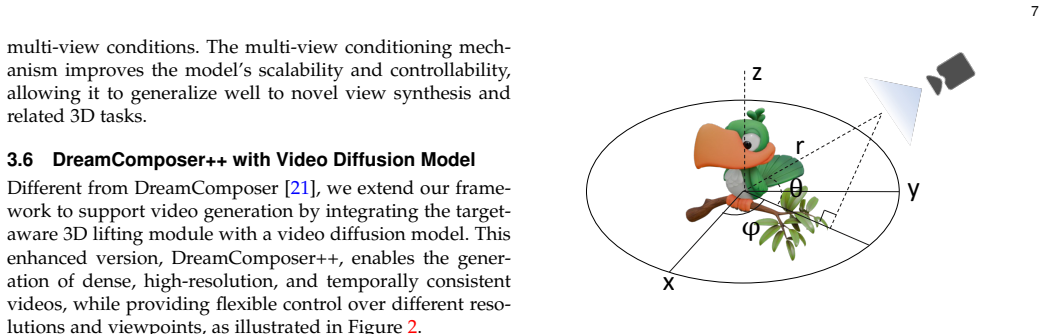
The central object is the lifted tri-plane latent: each input image is encoded into a 2D latent and projected into a tri-coordinate 3D tensor, with the projection conditioned on the relative rotation $\Delta\alpha_i$ to the target view. Multi-view feature fusion then samples points along target-view rays, transforms them into each input camera space, retrieves tri-plane features, weights them by $\lambda_i = (\cos(\Delta\gamma_i)+1)/2$ normalized across views, and volume-renders the fused features into a target-view latent feature that is injected into the frozen UNet. This lifted-and-fused latent is what carries the new controllability, because all multi-view information enters the base model through it.
What would settle it
A decisive test would be to run the trained model on held-out objects with large azimuth gaps between input views, such as 120 degrees or more, and compare against the single-view baseline; if perceptual quality and texture consistency do not improve, the claim that fused tri-plane latents encode target-view appearance fails for sparse wide-baseline inputs. A second check is to measure the quality gap when ground-truth target latents are swapped in for lifted ones, since the paper reports that this gap is visible and large enough to indicate how much of the final result depends on lifting quality.
Extended reading notes
Core claim
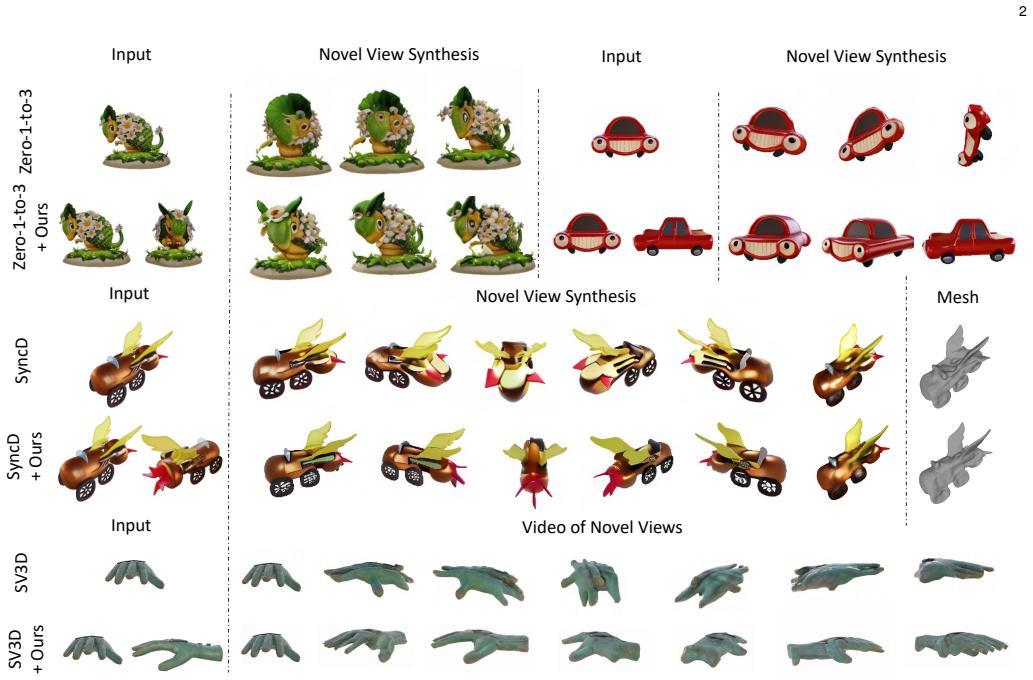
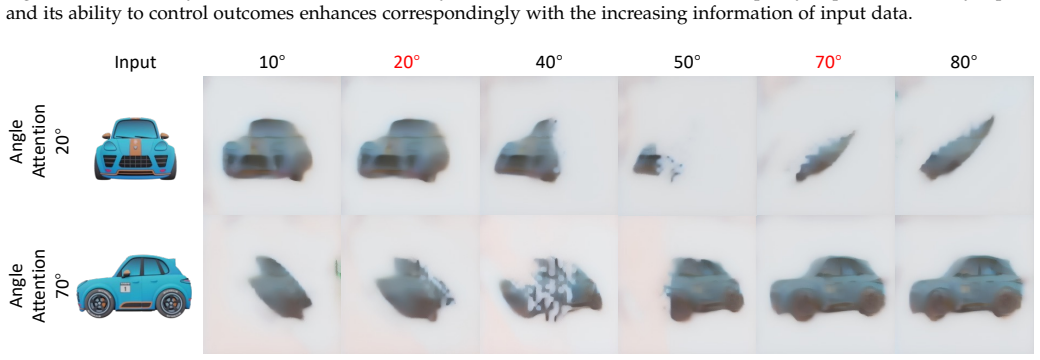
DreamComposer++ establishes that multi-view conditioning can be supplied as a target-view latent feature computed by a trainable front end, while the base diffusion model itself stays frozen. The new modules are a target-aware 3D lifting network that encodes each image latent into a tri-plane conditioned on the relative camera angle, a multi-view feature fusion module that projects target-view ray samples into each input camera space and volume-renders cosine-weighted retrieved features into the target latent, and a target-view feature injection module using concat-conv residual blocks. For video diffusion backbones, view-aware attention and shifted-window cross-attention are added. Experiments show that plugging these modules into Zero-1-to-3, SyncDreamer, and SV3D improves novel-view quality and controllability relative to the single-view baselines, with gains increasing as the number of input views increases.
Load-bearing premise
The load-bearing premise is that latent features lifted into tri-planes and fused by cosine-weighted volume rendering reliably represent what the target view of the object should look like; the paper's own Figure 17 shows that replacing lifted features with ground-truth latents substantially improves video quality, making the lifting module the fragile link.
Editorial extensions
If this is right
- A frozen single-view diffusion model can be upgraded to multi-view conditioning by training only the added modules, preserving the base model's generative behavior.
- Adding more input views improves the controllability of generated novel views for both image diffusion backbones and video diffusion backbones.
- The same lifted 3D latent representation can feed both image and video diffusion models, so the framework extends from multi-view image synthesis to temporally consistent videos of novel views.
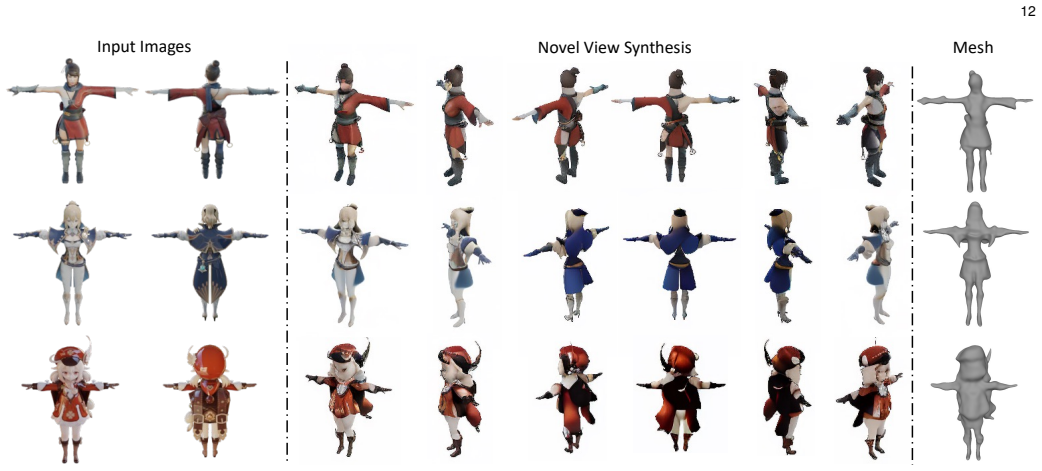
- Multi-view conditioning enables downstream applications such as controllable 3D object editing from a single modified view and 3D character modeling from a few 2D paintings.
Reading between the lines
- If the recipe holds, newer single-view diffusion novel-view-synthesis models could be upgraded by bolt-on multi-view conditioning rather than by redesigning or retraining them.
- The paper's bottleneck analysis suggests that future gains lie in improving the 3D lifting module itself, for example by adding depth or normal supervision, although the paper does not test this.
- The cosine weighting treats input views symmetrically and does not model occlusion, so a learned visibility weight would likely help when input views are far apart or partially occlude one another.
- Training uses Objaverse renders with white backgrounds, and in-the-wild CO3D results are shown qualitatively, so testing with real captured multi-view photograph sets would extend the claim beyond rendered objects.
Editorial analysis
A structured set of objections, weighed in public.
Referee Report
Summary. The paper proposes DreamComposer++, a framework that adds multi-view conditioning to pre-trained view-aware diffusion models by lifting input-view latents into tri-plane 3D features, fusing them via cosine-weighted volume rendering, and injecting the resulting target-view latents into a frozen diffusion U-Net. The claimed contribution is a plug-in module that improves controllability and fidelity of novel view synthesis and 3D reconstruction from multiple posed images, without retraining the base model. Experiments on GSO report PSNR/SSIM/LPIPS gains over single-view baselines for Zero-1-to-3, SyncDreamer, and SV3D, together with ablations, a bottleneck analysis, and applications such as editing and character modeling.
Significance. The work addresses a practical need: leveraging multiple input views to control diffusion-based novel view synthesis. The modular design (target-aware 3D lifting, multi-view feature fusion, target-view feature injection) is reasonable and the system is demonstrated on both image and video diffusion models. The manuscript is honest in reporting a bottleneck analysis that identifies the lifting module as the main limitation, and it provides ablations for several design choices. If the empirical isolation issues are fixed, the framework could be a useful add-on to existing models. However, the current evidence does not establish that the proposed modules, rather than the mere availability of more input views, are responsible for the reported gains.
major comments (4)
- [§4.3, Table 1; §4.5, Table 3] The headline comparisons give DreamComposer++ more input views than the baselines: Zero-1-to-3 and SV3D receive one image while DreamComposer++ receives 2-6 images (ground truth in Table 1, and 2-6 in Table 3). Since any method that makes use of additional pose-aligned views would be expected to beat a single-view baseline on object-centric renders, these tables do not isolate the contribution of the proposed 3D lifting and fusion modules. Please add a same-input-count baseline, e.g., a naive fusion of per-view latents or a multi-view-conditioned variant of the base model, and also report the single-view-input result for the same model (e.g., DC-Zero-1-to-3 with one input) to separate the number-of-views effect from the method effect.
- [§4.8, Figure 17] The bottleneck analysis explicitly states that replacing the lifted latents with ground-truth latents substantially improves video quality, and that 'the primary bottleneck in improving the entire framework lies in enhancing the Lift3D module.' This is an admission that the lifting module, which is the core novelty, produces inaccurate target-view latents. The paper should quantify this gap (e.g., report PSNR/LPIPS with GT latents vs. lifted latents on the same setting) and discuss how the central claim of the framework is affected. As written, this finding tempers the claim that the proposed 3D lifting is what enables the enhancement.
- [§4.6, Table 7] The only multi-view-input baseline, ViewFormer, is trained on CO3D and tested on GSO, an out-of-distribution setting; the 10+ dB PSNR gap is plausibly dominated by domain shift rather than method superiority. In-distribution quantitative results on CO3D are not provided. Please report quantitative CO3D results for both methods (or use an in-distribution baseline) before claiming superiority over sparse-view reconstruction methods.
- [Tables 1-5, §4.1] All quantitative claims are based on 30 GSO objects with no error bars, confidence intervals, or significance tests. Given the small evaluation set and the confound identified above, please report variance across objects and, if possible, results on a larger subset or on CO3D, or at least justify the statistical reliability of the conclusions.
minor comments (5)
- [§3.3, Eq. (7)] The parenthesization of the weighting formula is ambiguous; write λ_i = (cos(∆γ_i)+1)/2 explicitly.
- [§4.4 and Table 2] The additional condition-view for SyncDreamer is generated by Zero-1-to-3 rather than ground truth; this differs from the setting of Table 1 and should be stated clearly in the main text.
- [§4.8] 'Bottle Neck Analysis' should be 'Bottleneck Analysis'; also the phrase 'training DreamController' appears to be a leftover from another project and should be corrected to 'DreamComposer++.'
- [§4.1] The claim that the evaluation dataset is extended to GSO and CO3Dv2 is misleading because the quantitative GSO evaluation uses only 30 objects and CO3D is used only qualitatively; please clarify the scope.
- [§3.1 and §4.2] The notation for camera conditioning is inconsistent: Eq. (1) uses rotation R and translation T, while §4.2 uses spherical parameters [∆θ, sin(∆ϕ), cos(∆ϕ), ∆r]; please unify the notation.
Circularity Check
No circularity: all reported gains are empirical measurements from trained modules; the sole self-citation to prior DreamComposer is not load-bearing.
full rationale
DreamComposer++ is an empirical system, not a closed-form derivation, and its reported improvements are measurements from trained models rather than quantities forced by construction. The target-aware 3D lifting module is trained with an MSE loss against ground-truth target latents (Eq. 12) and then jointly optimized with the diffusion loss (Eq. 13); this is standard supervised training, and the evaluation on held-out GSO/CO3D objects is external to the fitted values. The cosine weighting in Eq. 7 is a hand-designed heuristic, but the final PSNR/SSIM/LPIPS numbers are not predetermined by that formula; they depend on the learned modules and the frozen base diffusion models. The only self-citation is to the authors' prior DreamComposer [21], used to contrast the residual-injection design with the new Concat-conv design and to describe extensions; it is not load-bearing, and no uniqueness theorem or ansatz is imported from that citation. The bottleneck analysis in Figure 17, which shows that ground-truth latents outperform lifted latents, is a limitation statement, not a circular step; it does not redefine the measured output as its input. The experimental design has a possible confound (baselines receive one image while DreamComposer++ receives multiple views), but a confound is an evaluation-validity concern, not a derivation that reduces to its inputs. Consequently, no circular step meeting the quoted-equation standard was found.
Assumptions & free parameters
free parameters (3)
- lambda_lift =
not reported
- triplane feature dimension =
32
- number of volume-rendering samples =
not reported
assumptions (5)
- domain assumption Pre-trained view-aware diffusion models have strong priors that can be augmented by injecting extra latent features without fine-tuning the base UNet.
- domain assumption Tri-plane latent representations are sufficient to capture target-view 3D structure from multiple views.
- ad hoc to paper Cosine-weighted averaging of features from different views is a valid fusion rule that handles occlusion and misalignment.
- domain assumption Volume rendering in latent space, following NeRF-style integration, produces coherent target-view features.
- domain assumption Evaluation on 30 Google Scanned Objects generalizes to in-the-wild objects.
Cite this review
Pith. "Pith review of DreamComposer++: Empowering Diffusion Models with Multi-View Conditions for 3D Content Generation." pith.science (2026). https://pith.science/paper/HKBBUDIZ
@misc{pith2026250702299,
  author       = {Pith},
  title        = {Pith review of: DreamComposer++: Empowering Diffusion Models with Multi-View Conditions for 3D Content Generation},
  year         = {2026},
  howpublished = {\url{https://pith.science/paper/HKBBUDIZ}},
  note         = {Machine review of arXiv:2507.02299}
}
read the original abstract
Recent advancements in leveraging pre-trained 2D diffusion models achieve the generation of high-quality novel views from a single in-the-wild image. However, existing works face challenges in producing controllable novel views due to the lack of information from multiple views. In this paper, we present DreamComposer++, a flexible and scalable framework designed to improve current view-aware diffusion models by incorporating multi-view conditions. Specifically, DreamComposer++ utilizes a view-aware 3D lifting module to extract 3D representations of an object from various views. These representations are then aggregated and rendered into the latent features of target view through the multi-view feature fusion module. Finally, the obtained features of target view are integrated into pre-trained image or video diffusion models for novel view synthesis. Experimental results demonstrate that DreamComposer++ seamlessly integrates with cutting-edge view-aware diffusion models and enhances their abilities to generate controllable novel views from multi-view conditions. This advancement facilitates controllable 3D object reconstruction and enables a wide range of applications.
Figures


Figures from the paper (14 more)







Reference graph
Works this paper leans on
-
[1]
Zero-1-to-3: Zero-shot one image to 3d object,
R. Liu, R. Wu, B. V . Hoorick, P . Tokmakov, S. Zakharov, and C. Vondrick, “Zero-1-to-3: Zero-shot one image to 3d object,” 2023
2023
-
[2]
Syncdreamer: Learning to generate multiview-consistent images from a single-view image,
Y. Liu, C. Lin, Z. Zeng, X. Long, L. Liu, T. Komura, and W. Wang, “Syncdreamer: Learning to generate multiview-consistent images from a single-view image,” arXiv preprint arXiv:2309.03453 , 2023
arXiv 2023
-
[3]
Sv3d: Novel multi-view synthesis and 3d generation from a single image using latent video diffusion,
V . Voleti, C.-H. Yao, M. Boss, A. Letts, D. Pankratz, D. Tochilkin, C. Laforte, R. Rombach, and V . Jampani, “Sv3d: Novel multi-view synthesis and 3d generation from a single image using latent video diffusion,” arXiv preprint arXiv:2403.12008 , 2024
arXiv 2024
-
[4]
Denoising diffusion probabilistic models,
J. Ho, A. Jain, and P . Abbeel, “Denoising diffusion probabilistic models,” Advances in neural information processing systems , vol. 33, pp. 6840–6851, 2020
2020
-
[5]
High-resolution image synthesis with latent diffusion models,
R. Rombach, A. Blattmann, D. Lorenz, P . Esser, and B. Ommer, “High-resolution image synthesis with latent diffusion models,” 2021
2021
-
[6]
Dreamfusion: Text-to-3d using 2d diffusion,
B. Poole, A. Jain, J. T. Barron, and B. Mildenhall, “Dreamfusion: Text-to-3d using 2d diffusion,” 2022
work page 2022
-
[7]
Score jacobian chaining: Lifting pretrained 2d diffusion models for 3d generation,
H. Wang, X. Du, J. Li, R. A. Yeh, and G. Shakhnarovich, “Score jacobian chaining: Lifting pretrained 2d diffusion models for 3d generation,” in Proceedings of the IEEE/CVF Conference on Computer Vision and Pattern Recognition , 2023, pp. 12 619–12 629
work page 2023
-
[8]
Dream- time: An improved optimization strategy for text-to-3d content creation,
Y. Huang, J. Wang, Y. Shi, X. Qi, Z.-J. Zha, and L. Zhang, “Dream- time: An improved optimization strategy for text-to-3d content creation,” arXiv preprint arXiv:2306.12422 , 2023
arXiv 2023
Show all 81 references
-
[9]
Prolificdreamer: High-fidelity and diverse text-to-3d generation with variational score distillation,
Z. Wang, C. Lu, Y. Wang, F. Bao, C. Li, H. Su, and J. Zhu, “Prolificdreamer: High-fidelity and diverse text-to-3d generation with variational score distillation,” arXiv preprint arXiv:2305.16213, 2023
2023 arXiv
-
[10]
Magic3d: High- resolution text-to-3d content creation,
C.-H. Lin, J. Gao, L. Tang, T. Takikawa, X. Zeng, X. Huang, K. Kreis, S. Fidler, M.-Y. Liu, and T.-Y. Lin, “Magic3d: High- resolution text-to-3d content creation,” in Proceedings of the IEEE/CVF Conference on Computer Vision and Pattern Recognition , 2023, pp. 300–309
2023
-
[11]
Fantasia3d: Disentangling geometry and appearance for high-quality text-to-3d content cre- ation,
R. Chen, Y. Chen, N. Jiao, and K. Jia, “Fantasia3d: Disentangling geometry and appearance for high-quality text-to-3d content cre- ation,” arXiv preprint arXiv:2303.13873 , 2023
2023 arXiv
-
[12]
Zero123++: a single image to consistent multi-view diffusion base model,
R. Shi, H. Chen, Z. Zhang, M. Liu, C. Xu, X. Wei, L. Chen, C. Zeng, and H. Su, “Zero123++: a single image to consistent multi-view diffusion base model,” 2023
2023
-
[13]
Consistent-1-to- 3: Consistent image to 3d view synthesis via geometry-aware diffusion models,
J. Ye, P . Wang, K. Li, Y. Shi, and H. Wang, “Consistent-1-to- 3: Consistent image to 3d view synthesis via geometry-aware diffusion models,” 2023
2023
-
[14]
Consistent123: Improve consistency for one image to 3d object synthesis,
H. Weng, T. Yang, J. Wang, Y. Li, T. Zhang, C. L. P . Chen, and L. Zhang, “Consistent123: Improve consistency for one image to 3d object synthesis,” 2023
2023
-
[15]
Wonder3d: Single image to 3d using cross-domain diffusion,
X. Long, Y.-C. Guo, C. Lin, Y. Liu, Z. Dou, L. Liu, Y. Ma, S.-H. Zhang, M. Habermann, C. Theobalt, and W. Wang, “Wonder3d: Single image to 3d using cross-domain diffusion,” 2023
2023
-
[16]
Sparse3d: Distilling multiview-consistent diffu- sion for object reconstruction from sparse views,
Z.-X. Zou, W. Cheng, Y.-P . Cao, S.-S. Huang, Y. Shan, and S.-H. Zhang, “Sparse3d: Distilling multiview-consistent diffu- sion for object reconstruction from sparse views,” arXiv preprint arXiv:2308.14078, 2023
2023 arXiv
-
[17]
pixelnerf: Neural radiance fields from one or few images,
A. Yu, V . Ye, M. Tancik, and A. Kanazawa, “pixelnerf: Neural radiance fields from one or few images,” in Proceedings of the IEEE/CVF conference on computer vision and pattern recognition , 2021, pp. 4578–4587
2021
-
[18]
Sparsefusion: Distilling view- conditioned diffusion for 3d reconstruction,
Z. Zhou and S. Tulsiani, “Sparsefusion: Distilling view- conditioned diffusion for 3d reconstruction,” in Proceedings of the IEEE/CVF Conference on Computer Vision and Pattern Recognition , 2023, pp. 12 588–12 597. 16
2023
-
[19]
Common objects in 3d: Large-scale learning and evaluation of real-life 3d category reconstruction,
J. Reizenstein, R. Shapovalov, P . Henzler, L. Sbordone, P . Labatut, and D. Novotny, “Common objects in 3d: Large-scale learning and evaluation of real-life 3d category reconstruction,” in Proceedings of the IEEE/CVF International Conference on Computer Vision , 2021, pp. 10 ...
2021
-
[20]
Efficient geometry-aware 3d generative adversarial networks,
E. R. Chan, C. Z. Lin, M. A. Chan, K. Nagano, B. Pan, S. De Mello, O. Gallo, L. J. Guibas, J. Tremblay, S. Khamis et al. , “Efficient geometry-aware 3d generative adversarial networks,” in Proceed- ings of the IEEE/CVF Conference on Computer Vision and Pattern Recognition, 202...
2022
-
[21]
DreamComposer: Controllable 3D Object Generation via Multi-View Conditions,
Y. Yang, Y. Huang, X. Wu, Y.-C. Guo, S.-H. Zhang, H. Zhao, T. He, and X. Liu, “DreamComposer: Controllable 3D Object Generation via Multi-View Conditions,” in Proceedings of the IEEE/CVF Con- ference on Computer Vision and Pattern Recognition , 2024, pp. 8111– 8120
2024
-
[22]
Nerf: Representing scenes as neural radiance fields for view synthesis,
B. Mildenhall, P . P . Srinivasan, M. Tancik, J. T. Barron, R. Ra- mamoorthi, and R. Ng, “Nerf: Representing scenes as neural radiance fields for view synthesis,” Communications of the ACM , vol. 65, no. 1, pp. 99–106, 2021
2021
-
[23]
Viewformer: Nerf-free neural rendering from few images using transformers,
J. Kulh ´anek, E. Derner, T. Sattler, and R. Babu ˇska, “Viewformer: Nerf-free neural rendering from few images using transformers,” in European Conference on Computer Vision . Springer, 2022, pp. 198–216
2022
-
[24]
Nerfdiff: Single-image view synthesis with nerf-guided distillation from 3d-aware diffusion,
J. Gu, A. Trevithick, K.-E. Lin, J. Susskind, C. Theobalt, L. Liu, and R. Ramamoorthi, “Nerfdiff: Single-image view synthesis with nerf-guided distillation from 3d-aware diffusion,” 2023
2023
-
[25]
Photorealistic text-to-image diffusion models with deep lan- guage understanding,
C. Saharia, W. Chan, S. Saxena, L. Li, J. Whang, E. L. Denton, K. Ghasemipour, R. Gontijo Lopes, B. Karagol Ayan, T. Salimans et al., “Photorealistic text-to-image diffusion models with deep lan- guage understanding,” Advances in Neural Information Processing Systems, vol. 35,...
2022
-
[26]
Objaverse: A universe of annotated 3d objects,
M. Deitke, D. Schwenk, J. Salvador, L. Weihs, O. Michel, E. Van- derBilt, L. Schmidt, K. Ehsani, A. Kembhavi, and A. Farhadi, “Objaverse: A universe of annotated 3d objects,” 2022
2022
-
[27]
One-2-3-45++: Fast single image to 3d objects with consistent multi-view generation and 3d diffusion,
M. Liu, R. Shi, L. Chen, Z. Zhang, C. Xu, X. Wei, H. Chen, C. Zeng, J. Gu, and H. Su, “One-2-3-45++: Fast single image to 3d objects with consistent multi-view generation and 3d diffusion,” 2023
2023
-
[28]
In- stantmesh: Efficient 3d mesh generation from a single image with sparse-view large reconstruction models,
J. Xu, W. Cheng, Y. Gao, X. Wang, S. Gao, and Y. Shan, “In- stantmesh: Efficient 3d mesh generation from a single image with sparse-view large reconstruction models,” arXiv preprint arXiv:2404.07191, 2024
2024 arXiv
-
[29]
Crm: Single image to 3d textured mesh with con- volutional reconstruction model,
Z. Wang, Y. Wang, Y. Chen, C. Xiang, S. Chen, D. Yu, C. Li, H. Su, and J. Zhu, “Crm: Single image to 3d textured mesh with con- volutional reconstruction model,” arXiv preprint arXiv:2403.05034 , 2024
2024 arXiv
-
[30]
One-2-3-45++: Fast single image to 3d objects with consistent multi-view generation and 3d diffusion,
M. Liu, R. Shi, L. Chen, Z. Zhang, C. Xu, X. Wei, H. Chen, C. Zeng, J. Gu, and H. Su, “One-2-3-45++: Fast single image to 3d objects with consistent multi-view generation and 3d diffusion,” arXiv preprint arXiv:2311.07885, 2023
2023 arXiv
-
[31]
Cat3d: Create anything in 3d with multi-view diffusion models,
R. Gao*, A. Holynski*, P . Henzler, A. Brussee, R. Martin-Brualla, P . P . Srinivasan, J. T. Barron, and B. Poole*, “Cat3d: Create anything in 3d with multi-view diffusion models,” arXiv, 2024
2024
-
[32]
Free3d: Consistent novel view synthe- sis without 3d representation,
C. Zheng and A. Vedaldi, “Free3d: Consistent novel view synthe- sis without 3d representation,” arXiv, 2023
2023
-
[33]
Imagedream: Image-prompt multi-view diffusion for 3d generation,
P . Wang and Y. Shi, “Imagedream: Image-prompt multi-view diffusion for 3d generation,” arXiv preprint arXiv:2312.02201, 2023
2023 arXiv
-
[34]
Toss: High-quality text- guided novel view synthesis from a single image,
Y. Shi, J. Wang, H. Cao, B. Tang, X. Qi, T. Yang, Y. Huang, S. Liu, L. Zhang, and H.-Y. Shum, “Toss: High-quality text- guided novel view synthesis from a single image,” arXiv preprint arXiv:2310.10644, 2023
2023 arXiv
-
[35]
Novel view synthesis with diffusion models,
D. Watson, W. Chan, R. Martin-Brualla, J. Ho, A. Tagliasacchi, and M. Norouzi, “Novel view synthesis with diffusion models,” arXiv preprint arXiv:2210.04628, 2022
2022 arXiv
-
[36]
Generative novel view synthesis with 3d-aware diffusion mod- els,
E. R. Chan, K. Nagano, M. A. Chan, A. W. Bergman, J. J. Park, A. Levy, M. Aittala, S. De Mello, T. Karras, and G. Wetzstein, “Generative novel view synthesis with 3d-aware diffusion mod- els,” arXiv preprint arXiv:2304.02602 , 2023
2023 arXiv
-
[37]
Ouroboros3d: Image-to-3d generation via 3d-aware recursive diffusion,
H. Wen, Z. Huang, Y. Wang, X. Chen, Y. Qiao, and L. Sheng, “Ouroboros3d: Image-to-3d generation via 3d-aware recursive diffusion,” arXiv preprint arXiv:2406.03184 , 2024
2024 arXiv
-
[38]
Dreamcontrol: Control-based text-to-3d generation with 3d self-prior,
T. Huang, Y. Zeng, Z. Zhang, W. Xu, H. Xu, S. Xu, R. W. Lau, and W. Zuo, “Dreamcontrol: Control-based text-to-3d generation with 3d self-prior,” in Proceedings of the IEEE/CVF Conference on Computer Vision and Pattern Recognition , 2024, pp. 5364–5373
2024
-
[39]
Sweetdreamer: Align- ing geometric priors in 2d diffusion for consistent text-to-3d,
W. Li, R. Chen, X. Chen, and P . Tan, “Sweetdreamer: Align- ing geometric priors in 2d diffusion for consistent text-to-3d,” arxiv:2310.02596, 2023
2023 arXiv
-
[40]
Dreampolisher: Towards high-quality text-to-3d generation via geometric diffusion,
Y. Lin, R. Clark, and P . Torr, “Dreampolisher: Towards high-quality text-to-3d generation via geometric diffusion,” 2024
2024
-
[41]
Shapenet: An information-rich 3d model repository,
A. X. Chang, T. Funkhouser, L. Guibas, P . Hanrahan, Q. Huang, Z. Li, S. Savarese, M. Savva, S. Song, H. Su et al. , “Shapenet: An information-rich 3d model repository,” arXiv preprint arXiv:1512.03012, 2015
2015 arXiv
-
[42]
Im-3d: Iterative multiview diffusion and reconstruction for high-quality 3d generation,
L. Melas-Kyriazi, I. Laina, C. Rupprecht, N. Neverova, A. Vedaldi, O. Gafni, and F. Kokkinos, “Im-3d: Iterative multiview diffusion and reconstruction for high-quality 3d generation,” arXiv preprint arXiv:2402.08682, 2024
2024 arXiv
-
[43]
Videomv: Consistent multi-view generation based on large video generative model,
Q. Zuo, X. Gu, L. Qiu, Y. Dong, Z. Zhao, W. Yuan, R. Peng, S. Zhu, Z. Dong, L. Bo et al. , “Videomv: Consistent multi-view generation based on large video generative model,” arXiv preprint arXiv:2403.12010, 2024
2024 arXiv
-
[44]
Viewcrafter: Taming video diffusion models for high-fidelity novel view synthesis,
W. Yu, J. Xing, L. Yuan, W. Hu, X. Li, Z. Huang, X. Gao, T.-T. Wong, Y. Shan, and Y. Tian, “Viewcrafter: Taming video diffusion models for high-fidelity novel view synthesis,” arXiv preprint arXiv:2409.02048, 2024
2024 arXiv
-
[45]
Hi3d: Pursuing high-resolution image-to-3d generation with video diffusion models,
H. Yang, Y. Chen, Y. Pan, T. Yao, Z. Chen, C.-W. Ngo, and T. Mei, “Hi3d: Pursuing high-resolution image-to-3d generation with video diffusion models,” arXiv preprint arXiv:2409.07452 , 2024
2024 arXiv
-
[46]
Nvs-solver: Video diffu- sion model as zero-shot novel view synthesizer,
M. You, Z. Zhu, H. Liu, and J. Hou, “Nvs-solver: Video diffu- sion model as zero-shot novel view synthesizer,” arXiv preprint arXiv:2405.15364, 2024
2024 arXiv
-
[47]
Shap-e: Generating conditional 3d implicit functions,
H. Jun and A. Nichol, “Shap-e: Generating conditional 3d implicit functions,” 2023
2023
-
[48]
Point-e: A system for generating 3d point clouds from complex prompts,
A. Nichol, H. Jun, P . Dhariwal, P . Mishkin, and M. Chen, “Point-e: A system for generating 3d point clouds from complex prompts,” 2022
2022
-
[49]
Rodin: A generative model for sculpting 3d digital avatars using diffusion,
T. Wang, B. Zhang, T. Zhang, S. Gu, J. Bao, T. Baltrusaitis, J. Shen, D. Chen, F. Wen, Q. Chen, and B. Guo, “Rodin: A generative model for sculpting 3d digital avatars using diffusion,” 2022
2022
-
[50]
Diffrf: Rendering-guided 3d radiance field diffu- sion,
N. M ¨uller, Y. Siddiqui, L. Porzi, S. R. Bul `o, P . Kontschieder, and M. Nießner, “Diffrf: Rendering-guided 3d radiance field diffu- sion,” 2023
2023
-
[51]
Latent-nerf for shape-guided generation of 3d shapes and textures,
G. Metzer, E. Richardson, O. Patashnik, R. Giryes, and D. Cohen- Or, “Latent-nerf for shape-guided generation of 3d shapes and textures,” 2022
2022
-
[52]
Gaussiandreamer: Fast generation from text to 3d gaussian splatting with point cloud priors,
T. Yi, J. Fang, G. Wu, L. Xie, X. Zhang, W. Liu, Q. Tian, and X. Wang, “Gaussiandreamer: Fast generation from text to 3d gaussian splatting with point cloud priors,” arXiv preprint arXiv:2310.08529, 2023
2023 arXiv
-
[53]
Consistent3d: Towards consistent high-fidelity text-to-3d generation with deter- ministic sampling prior,
Z. Wu, P . Zhou, X. Yi, X. Yuan, and H. Zhang, “Consistent3d: Towards consistent high-fidelity text-to-3d generation with deter- ministic sampling prior,” in Proceedings of the IEEE/CVF Conference on Computer Vision and Pattern Recognition , 2024, pp. 9892–9902
2024
-
[54]
Score distillation sampling with learned manifold corrective,
T. Alldieck, N. Kolotouros, and C. Sminchisescu, “Score distillation sampling with learned manifold corrective,” 2024
2024
-
[55]
Stable score distillation for high-quality 3d generation,
B. Tang, J. Wang, Z. Wu, and L. Zhang, “Stable score distillation for high-quality 3d generation,” 2023
2023
-
[56]
Dreamview: Injecting view-specific text guidance into text-to-3d generation,
J. Yan, Y. Gao, Q. Yang, X. Wei, X. Xie, A. Wu, and W.-S. Zheng, “Dreamview: Injecting view-specific text guidance into text-to-3d generation,” arXiv, 2024
2024
-
[57]
Real- fusion: 360deg reconstruction of any object from a single image,
L. Melas-Kyriazi, I. Laina, C. Rupprecht, and A. Vedaldi, “Real- fusion: 360deg reconstruction of any object from a single image,” in Proceedings of the IEEE/CVF Conference on Computer Vision and Pattern Recognition, 2023, pp. 8446–8455
2023
-
[58]
Make-it-3d: High-fidelity 3d creation from a single image with diffusion prior,
J. Tang, T. Wang, B. Zhang, T. Zhang, R. Yi, L. Ma, and D. Chen, “Make-it-3d: High-fidelity 3d creation from a single image with diffusion prior,” arXiv preprint arXiv:2303.14184 , 2023
2023 arXiv
-
[59]
Neurallift- 360: Lifting an in-the-wild 2d photo to a 3d object with 360deg views,
D. Xu, Y. Jiang, P . Wang, Z. Fan, Y. Wang, and Z. Wang, “Neurallift- 360: Lifting an in-the-wild 2d photo to a 3d object with 360deg views,” in Proceedings of the IEEE/CVF Conference on Computer Vision and Pattern Recognition , 2023, pp. 4479–4489
2023
-
[60]
Magic123: One image to high-quality 3d object generation using both 2d and 3d diffusion priors,
G. Qian, J. Mai, A. Hamdi, J. Ren, A. Siarohin, B. Li, H.-Y. Lee, I. Skorokhodov, P . Wonka, S. Tulyakov et al. , “Magic123: One image to high-quality 3d object generation using both 2d and 3d diffusion priors,” arXiv preprint arXiv:2306.17843 , 2023
2023 arXiv
-
[61]
Make-it-3d: High-fidelity 3d creation from a single image with diffusion prior,
J. Tang, T. Wang, B. Zhang, T. Zhang, R. Yi, L. Ma, and D. Chen, “Make-it-3d: High-fidelity 3d creation from a single image with diffusion prior,” 2023
2023
-
[62]
Neurallift- 360: Lifting an in-the-wild 2d photo to a 3d object with 360◦ views,
D. Xu, Y. Jiang, P . Wang, Z. Fan, Y. Wang, and Z. Wang, “Neurallift- 360: Lifting an in-the-wild 2d photo to a 3d object with 360◦ views,” 2023. 17
2023
-
[63]
Dreamcraft3d: Hierarchical 3d generation with bootstrapped dif- fusion prior,
J. Sun, B. Zhang, R. Shao, L. Wang, W. Liu, Z. Xie, and Y. Liu, “Dreamcraft3d: Hierarchical 3d generation with bootstrapped dif- fusion prior,” arXiv preprint arXiv:2310.16818 , 2023
2023 arXiv
-
[64]
Meshgpt: Generating triangle meshes with decoder-only transformers,
Y. Siddiqui, A. Alliegro, A. Artemov, T. Tommasi, D. Sirigatti, V . Rosov, A. Dai, and M. Nießner, “Meshgpt: Generating triangle meshes with decoder-only transformers,” in Proceedings of the IEEE/CVF conference on computer vision and pattern recognition , 2024, pp. 19 615–19 625
2024
-
[65]
Meshanything: Artist-created mesh generation with autoregressive transformers,
Y. Chen, T. He, D. Huang, W. Ye, S. Chen, J. Tang, X. Chen, Z. Cai, L. Yang, G. Yu et al. , “Meshanything: Artist-created mesh generation with autoregressive transformers,” arXiv preprint arXiv:2406.10163, 2024
2024 arXiv
-
[66]
Meshanything v2: Artist-created mesh generation with adjacent mesh tokenization,
Y. Chen, Y. Wang, Y. Luo, Z. Wang, Z. Chen, J. Zhu, C. Zhang, and G. Lin, “Meshanything v2: Artist-created mesh generation with adjacent mesh tokenization,” arXiv preprint arXiv:2408.02555, 2024
2024 arXiv
-
[67]
Meshxl: Neural coordinate field for generative 3d foundation models,
S. Chen, X. Chen, A. Pang, X. Zeng, W. Cheng, Y. Fu, F. Yin, B. Wang, J. Yu, G. Yu et al. , “Meshxl: Neural coordinate field for generative 3d foundation models,” Advances in Neural Information Processing Systems, vol. 37, pp. 97 141–97 166, 2024
2024
-
[68]
Scaling mesh generation via compressive tokenization,
H. Weng, Z. Zhao, B. Lei, X. Yang, J. Liu, Z. Lai, Z. Chen, Y. Liu, J. Jiang, C. Guo et al. , “Scaling mesh generation via compressive tokenization,” arXiv preprint arXiv:2411.07025 , 2024
2024 arXiv
-
[69]
Edgerunner: Auto-regressive auto-encoder for artistic mesh gen- eration,
J. Tang, Z. Li, Z. Hao, X. Liu, G. Zeng, M.-Y. Liu, and Q. Zhang, “Edgerunner: Auto-regressive auto-encoder for artistic mesh gen- eration,” arXiv preprint arXiv:2409.18114 , 2024
2024 arXiv
-
[70]
Meshtron: High- fidelity, artist-like 3d mesh generation at scale,
Z. Hao, D. W. Romero, T.-Y. Lin, and M.-Y. Liu, “Meshtron: High- fidelity, artist-like 3d mesh generation at scale,” arXiv preprint arXiv:2412.09548, 2024
2024 arXiv
-
[71]
Structured 3d latents for scalable and versatile 3d generation,
J. Xiang, Z. Lv, S. Xu, Y. Deng, R. Wang, B. Zhang, D. Chen, X. Tong, and J. Yang, “Structured 3d latents for scalable and versatile 3d generation,” arXiv preprint arXiv:2412.01506 , 2024
2024 arXiv
-
[72]
Lvsm: A large view synthesis model with minimal 3d inductive bias,
H. Jin, H. Jiang, H. Tan, K. Zhang, S. Bi, T. Zhang, F. Luan, N. Snavely, and Z. Xu, “Lvsm: A large view synthesis model with minimal 3d inductive bias,” arXiv preprint arXiv:2410.17242 , 2024
2024 arXiv
-
[73]
Instructpix2pix: Learning to follow image editing instructions,
T. Brooks, A. Holynski, and A. A. Efros, “Instructpix2pix: Learning to follow image editing instructions,” 2023
2023
-
[74]
Drag your gan: Interactive point-based manipulation on the generative image manifold,
X. Pan, A. Tewari, T. Leimk ¨uhler, L. Liu, A. Meka, and C. Theobalt, “Drag your gan: Interactive point-based manipulation on the generative image manifold,” 2023
2023
-
[75]
Dragdiffusion: Harnessing diffusion models for interactive point-based image editing,
Y. Shi, C. Xue, J. H. Liew, J. Pan, H. Yan, W. Zhang, V . Y. F. Tan, and S. Bai, “Dragdiffusion: Harnessing diffusion models for interactive point-based image editing,” 2023
2023
-
[76]
Google scanned objects: A high-quality dataset of 3d scanned household items,
L. Downs, A. Francis, N. Koenig, B. Kinman, R. Hickman, K. Rey- mann, T. B. McHugh, and V . Vanhoucke, “Google scanned objects: A high-quality dataset of 3d scanned household items,” in ICRA, 2022
2022
-
[77]
Image quality assessment: from error visibility to structural similarity,
Z. Wang, A. C. Bovik, H. R. Sheikh, and E. P . Simoncelli, “Image quality assessment: from error visibility to structural similarity,” TIP, 2004
2004
-
[78]
The unreasonable effectiveness of deep features as a perceptual metric,
R. Zhang, P . Isola, A. A. Efros, E. Shechtman, and O. Wang, “The unreasonable effectiveness of deep features as a perceptual metric,” in CVPR, 2018
2018
-
[79]
Neus: Learning neural implicit surfaces by volume rendering for multi-view reconstruction,
P . Wang, L. Liu, Y. Liu, C. Theobalt, T. Komura, and W. Wang, “Neus: Learning neural implicit surfaces by volume rendering for multi-view reconstruction,” 2023
2023
-
[80]
Adding conditional control to text-to-image diffusion models,
L. Zhang, A. Rao, and M. Agrawala, “Adding conditional control to text-to-image diffusion models,” in Proceedings of the IEEE/CVF International Conference on Computer Vision , 2023, pp. 3836–3847
2023
-
[81]
DreamWaltz: Make a Scene with Complex 3D Animatable Avatars,
Y. Huang, J. Wang, A. Zeng, H. Cao, X. Qi, Y. Shi, Z.-J. Zha, and L. Zhang, “DreamWaltz: Make a Scene with Complex 3D Animatable Avatars,” in Advances in Neural Information Processing Systems, 2023
2023
Reviewed August 6, 2026 · model on record in the stance chip above.
Discussion (0). Sign in to comment.