ChronoVAE-HOPE: Beyond Attention -- A Next-Generation VAE Foundation Model for Specialized Time Series Classification
Pith reviewed 2026-05-22 07:56 UTC · model grok-4.3
The pith
ChronoVAE-HOPE provides an efficient VAE-based alternative to attention mechanisms for time series classification by disentangling key structural components.
A machine-rendered reading of the paper's core claim, the machinery that carries it, and where it could break.
Core claim
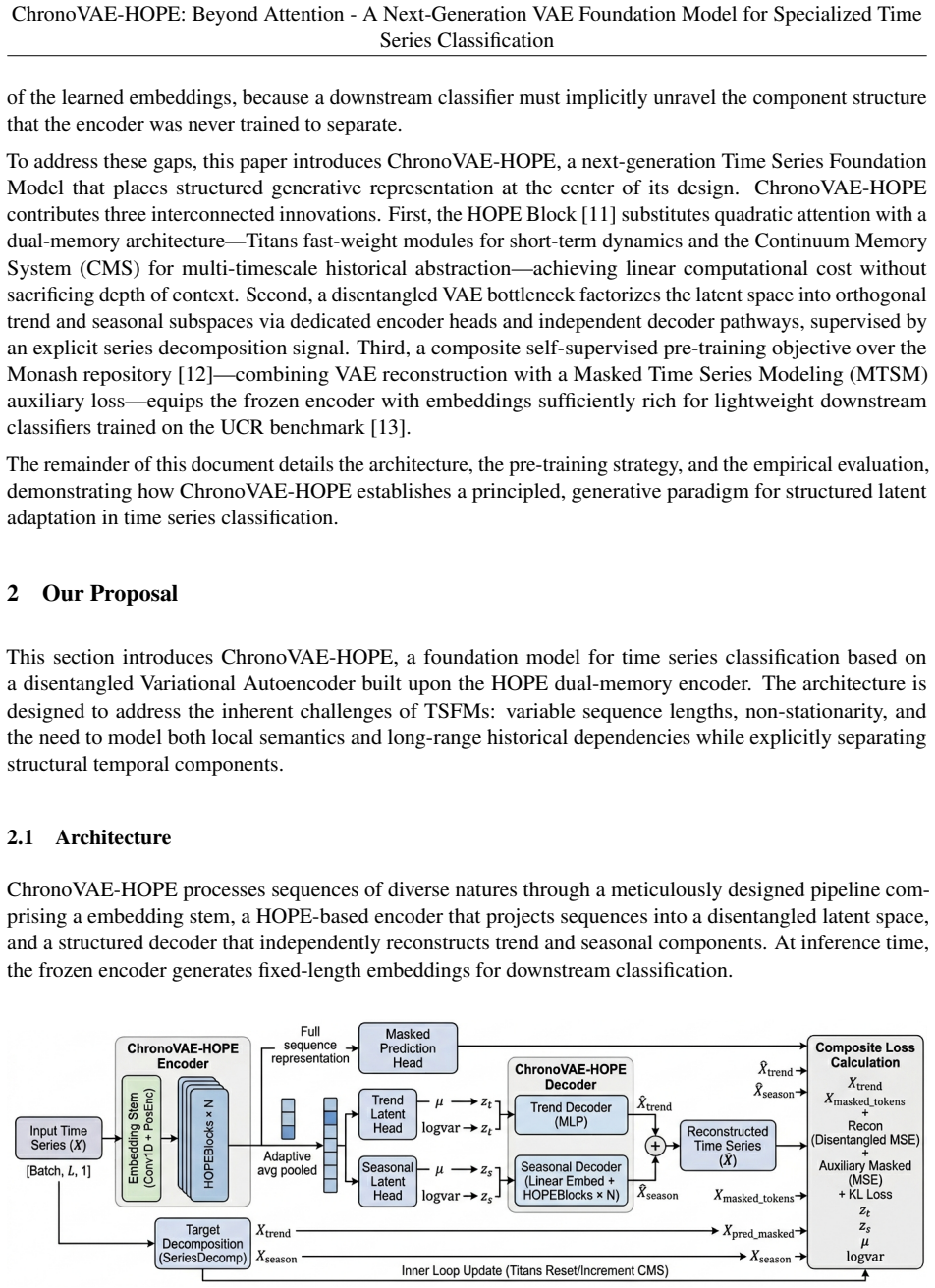
ChronoVAE-HOPE is a next-generation time series foundation model based on a variational autoencoder. It features the HOPE Block that substitutes standard attention with Titans modules for short-term dynamics and a Continuum Memory System for long-term context. A disentangled latent space allows independent modeling of trend and seasonal elements through specialized encoder heads and decoder paths. Pre-training combines masked modeling and reconstruction objectives on the Monash archive, after which the encoder is frozen to generate fixed-length embeddings for classification on UCR benchmark datasets, yielding strong results particularly where causal structures are prominent.
What carries the argument
HOPE Block dual-memory system (Titans for short-term retention and Continuum Memory System for long-term abstraction) combined with disentangled latent factorization into trend and seasonal components via dedicated encoder heads and separate decoder pathways.
If this is right
- Allows scaling to longer sequences by avoiding quadratic attention costs.
- Supports interpretable analysis by isolating trend and seasonal influences.
- Enables effective transfer of pre-trained knowledge to downstream classification without retraining the full model.
- Delivers competitive accuracy across varied time series domains with emphasis on causal ones.
Where Pith is reading between the lines
- The structured generative nature could support data augmentation or imputation tasks in time series.
- This disentanglement approach might reveal domain-specific patterns when applied to new datasets not in the UCR collection.
- Integrating the model with existing forecasting pipelines could benefit from the trend-seasonal separation for multi-step predictions.
Load-bearing premise
That the dedicated encoder heads and separate decoder pathways successfully factorize the time series representations into independent trend and seasonal components, and that the frozen pre-trained encoder produces fixed-length embeddings that transfer effectively to classification tasks.
What would settle it
Observing whether the classification accuracy on UCR datasets drops significantly when the disentanglement is removed or when compared to attention-based alternatives, particularly in datasets with clear causal structures.
Figures
read the original abstract
Time Series Foundation Models (TSFMs) have become a new component of the state-of-the-art in general time series forecasting. However, adapting them to specialized classification tasks remains constrained by two interconnected challenges: the quadratic cost of standard attention mechanisms and the inability to disentangle the structural components underlying time series variability. This technical report introduces ChronoVAE-HOPE, a next-generation TSFM that reconciles massive generalization with structured latent representation for time series classification. The core of the proposal is a Variational Autoencoder (VAE) framework built upon the HOPE Block, which replaces quadratic attention with a dual-memory system: Titans modules for dynamic short-term retention and a Continuum Memory System (CMS) for the abstraction of long-term historical context. A key architectural novelty is the disentangled latent space, which factorizes representations into independent trend and seasonal components via dedicated encoder heads and separate decoder pathways. ChronoVAE-HOPE undergoes self-supervised pre-training on the Monash archive, combining a Masked Time Series Modeling (MTSM) auxiliary objective with a disentangled VAE reconstruction loss. The pre-trained encoder is subsequently frozen and used to generate fixed-length embeddings for downstream classification on the UCR benchmark datasets. Empirical results demonstrate strong performance across diverse temporal domains, particularly in settings characterized by strict causal structure. ChronoVAE-HOPE establishes a robust and interpretable framework for the adaptation of foundation models to time series classification through structured generative representations.
Editorial analysis
A structured set of objections, weighed in public.
Referee Report
Summary. The paper introduces ChronoVAE-HOPE, a VAE-based time series foundation model for classification tasks. It replaces quadratic attention with a HOPE Block featuring Titans modules for short-term retention and a Continuum Memory System (CMS) for long-term context. A key novelty is a disentangled latent space that factorizes representations into independent trend and seasonal components using dedicated encoder heads and separate decoder pathways. The model is pre-trained self-supervised on the Monash archive via Masked Time Series Modeling (MTSM) combined with a disentangled VAE reconstruction loss; the encoder is then frozen to produce fixed-length embeddings for classification on UCR benchmarks, with reported strong performance especially under strict causal structure.
Significance. If the claimed performance and the effectiveness of the structured disentangled representations hold under rigorous validation, the work could meaningfully advance adaptation of foundation models to specialized time series classification by offering an efficient attention alternative and interpretable generative latents. It targets practical challenges in causal temporal domains and could support more robust transfer from large-scale pre-training.
major comments (2)
- [Abstract and pre-training objective] Abstract and pre-training description: the central claim that dedicated encoder heads and separate decoder pathways achieve independent factorization of trend and seasonal components lacks any described mechanism (e.g., per-component KL term, mutual-information penalty, or orthogonality regularizer) in the MTSM + disentangled VAE loss. Standard VAE objectives permit leakage between latents, so the asserted independence is not guaranteed and directly undermines the interpretability and structured-representation advantages for downstream UCR classification transfer.
- [Empirical evaluation] Empirical results section: the abstract asserts strong performance across diverse temporal domains and particularly in strict causal settings, yet supplies no quantitative metrics, baselines, ablation results, or experimental details on UCR datasets. Without these, the data cannot be assessed for support of the claims regarding the HOPE Block, CMS, or disentangled embeddings.
minor comments (1)
- [Model architecture] New architectural components (HOPE Block, Titans modules, Continuum Memory System) are introduced with acronyms but without immediate formal definitions or pointers to their precise equations or pseudocode, reducing clarity for readers.
Simulated Author's Rebuttal
We thank the referee for the detailed and constructive report. We address each major comment below and outline the revisions we will make to strengthen the manuscript.
read point-by-point responses
-
Referee: [Abstract and pre-training objective] Abstract and pre-training description: the central claim that dedicated encoder heads and separate decoder pathways achieve independent factorization of trend and seasonal components lacks any described mechanism (e.g., per-component KL term, mutual-information penalty, or orthogonality regularizer) in the MTSM + disentangled VAE loss. Standard VAE objectives permit leakage between latents, so the asserted independence is not guaranteed and directly undermines the interpretability and structured-representation advantages for downstream UCR classification transfer.
Authors: We agree that the current description relies primarily on architectural separation through dedicated encoder heads and separate decoder pathways without additional explicit regularization to enforce independence. While this structure encourages factorization in practice, it does not mathematically guarantee it against leakage. In the revised manuscript we will augment the disentangled VAE loss with per-component KL terms for the trend and seasonal latents together with an orthogonality regularizer (or mutual-information penalty) between the two latent groups. These additions will be specified in the pre-training objective section and their effect on downstream interpretability will be discussed. revision: yes
-
Referee: [Empirical evaluation] Empirical results section: the abstract asserts strong performance across diverse temporal domains and particularly in strict causal settings, yet supplies no quantitative metrics, baselines, ablation results, or experimental details on UCR datasets. Without these, the data cannot be assessed for support of the claims regarding the HOPE Block, CMS, or disentangled embeddings.
Authors: We acknowledge that the present technical report version summarizes empirical outcomes at a high level without providing the full quantitative tables, baseline comparisons, or ablation studies. To allow proper assessment of the HOPE Block, CMS, and disentangled embeddings, the revised manuscript will contain a dedicated Empirical Evaluation section. This section will report accuracy and F1 scores on the UCR archive, comparisons against relevant self-supervised and foundation-model baselines, ablations isolating the Titans modules, CMS, and disentanglement components, and details of the strict causal evaluation protocol used during transfer. revision: yes
Circularity Check
No significant circularity; derivation is self-contained architectural and empirical description
full rationale
The paper presents ChronoVAE-HOPE as a VAE framework using HOPE Block with Titans and CMS modules, pre-trained via MTSM auxiliary objective plus disentangled VAE reconstruction loss on the Monash archive, then frozen encoder for fixed-length embeddings on UCR classification. No equations, fitted parameters renamed as predictions, or self-citation chains are described that reduce the central claims to inputs by construction. The factorization into trend/seasonal components is asserted via dedicated heads and pathways, but this is an architectural choice whose validity is left to empirical verification rather than being tautological. The derivation chain relies on standard VAE pre-training followed by transfer, which is externally falsifiable on benchmarks and does not invoke uniqueness theorems or ansatzes from prior self-work.
Axiom & Free-Parameter Ledger
axioms (2)
- domain assumption The HOPE Block with Titans modules and Continuum Memory System can replace quadratic attention while capturing short-term and long-term dependencies.
- ad hoc to paper Dedicated encoder heads and separate decoder pathways achieve independent factorization of trend and seasonal components.
invented entities (3)
-
HOPE Block
no independent evidence
-
Titans modules
no independent evidence
-
Continuum Memory System (CMS)
no independent evidence
Lean theorems connected to this paper
-
IndisputableMonolith/Cost/FunctionalEquation.leanwashburn_uniqueness_aczel unclear?
unclearRelation between the paper passage and the cited Recognition theorem.
The core of the proposal is a Variational Autoencoder (VAE) framework built upon the HOPE Block, which replaces quadratic attention with a dual-memory system: Titans modules for dynamic short-term retention and a Continuum Memory System (CMS) for the abstraction of long-term historical context.
-
IndisputableMonolith/Foundation/ArithmeticFromLogic.leanLogicNat unclear?
unclearRelation between the paper passage and the cited Recognition theorem.
A key architectural novelty is the disentangled latent space, which factorizes representations into independent trend and seasonal components via dedicated encoder heads and separate decoder pathways.
What do these tags mean?
- matches
- The paper's claim is directly supported by a theorem in the formal canon.
- supports
- The theorem supports part of the paper's argument, but the paper may add assumptions or extra steps.
- extends
- The paper goes beyond the formal theorem; the theorem is a base layer rather than the whole result.
- uses
- The paper appears to rely on the theorem as machinery.
- contradicts
- The paper's claim conflicts with a theorem or certificate in the canon.
- unclear
- Pith found a possible connection, but the passage is too broad, indirect, or ambiguous to say the theorem truly supports the claim.
discussion (0)
Sign in with ORCID, Apple, or X to comment. Anyone can read and Pith papers without signing in.