Fully Unsupervised Detection of Physical Contacts on Subsea Cables via State-of-Polarization Monitoring
Pith reviewed 2026-07-03 18:12 UTC · model grok-4.3
The pith
An unsupervised detector trained only on raw polarization data can rank all confirmed physical contacts on a subsea cable among its top anomalies.
A machine-rendered reading of the paper's core claim, the machinery that carries it, and where it could break.
Core claim
We present a fully unsupervised Fast-Slow DSVDD detector for continuous State-of-Polarization monitoring on a deployed subsea cable. Trained without event labels, it ranks all five confirmed trawler contacts within the top 13 of 122,174 recordings and surfaces additional corroborated cable-contact events.
What carries the argument
The Fast-Slow DSVDD, a two-component deep support vector data description model that learns to describe normal polarization states from unlabeled data and flags deviations as potential contact events.
If this is right
- The detector requires no labeled examples of contacts or other events to operate effectively.
- All known trawler contacts appear in the highest-ranked anomalies, suggesting high recall for this class of events.
- Additional events flagged by the model have been corroborated as likely contacts, indicating it can discover new incidents.
- Continuous monitoring becomes feasible on operational cables since the training uses only the normal data stream.
Where Pith is reading between the lines
- Similar unsupervised methods might apply to detecting other rare events in optical fiber networks, such as earthquakes or equipment failures.
- Operators could use the ranked list to prioritize physical inspections or repairs on long cable routes.
- Extending the model to multiple cables or combining with location data could enable automated mapping of contact risks along the route.
Load-bearing premise
The polarization anomalies caused by physical contacts are distinct enough from normal variations and unrelated disturbances that an unsupervised model can separate them without any labeled examples.
What would settle it
Running the same detector on a new dataset from the same or similar cable where several confirmed contacts do not rank in the top 20 anomalies would falsify the claim.
Figures
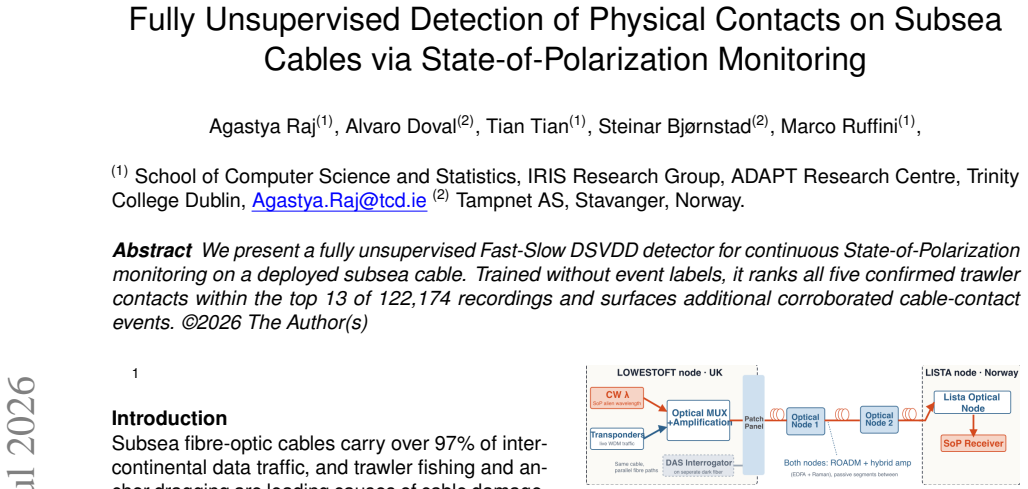


read the original abstract
We present a fully unsupervised Fast-Slow DSVDD detector for continuous State-of-Polarization monitoring on a deployed subsea cable. Trained without event labels, it ranks all five confirmed trawler contacts within the top 13 of 122,174 recordings and surfaces additional corroborated cable-contact events.
Editorial analysis
A structured set of objections, weighed in public.
Referee Report
Summary. The paper presents a fully unsupervised Fast-Slow DSVDD detector for continuous State-of-Polarization (SoP) monitoring on a deployed subsea cable. Trained without event labels on the unlabeled data stream, the detector ranks all five independently confirmed trawler contacts within the top 13 of 122,174 recordings and surfaces additional corroborated cable-contact events.
Significance. If the reported ranking holds, the work would provide empirical evidence that unsupervised anomaly detection on SoP streams can surface physical contact events at high rank in a real deployed system, offering a label-free approach to subsea cable monitoring with potential operational value. The use of a large real-world dataset and the concrete top-k ranking of known events are strengths that distinguish it from purely synthetic evaluations.
major comments (2)
- [Abstract] Abstract: the central empirical claim (all five confirmed contacts ranked in top 13 of 122174) is load-bearing for the paper's contribution, yet the abstract and available text supply no implementation details on the Fast-Slow DSVDD architecture, feature extraction from SoP time series, training procedure on the unlabeled stream, or anomaly-score threshold, preventing assessment of whether the ranking could arise from confounds such as diurnal variations or other polarization sources.
- [Abstract] Abstract: no data statistics (e.g., recording duration, sampling rate, number of independent cable segments) or verification procedure for the 'additional corroborated cable-contact events' are provided, making it impossible to judge whether the unsupervised detector's output is robust or sensitive to the specific choice of DSVDD hyperparameters.
Simulated Author's Rebuttal
Thank you for the opportunity to respond to the referee's report. We address the major comments point by point below. We believe the full manuscript provides the necessary details, but we will revise the abstract to make them more prominent as suggested.
read point-by-point responses
-
Referee: [Abstract] Abstract: the central empirical claim (all five confirmed contacts ranked in top 13 of 122174) is load-bearing for the paper's contribution, yet the abstract and available text supply no implementation details on the Fast-Slow DSVDD architecture, feature extraction from SoP time series, training procedure on the unlabeled stream, or anomaly-score threshold, preventing assessment of whether the ranking could arise from confounds such as diurnal variations or other polarization sources.
Authors: The full manuscript details the Fast-Slow DSVDD architecture in Section 3, feature extraction in Section 2.2, the training procedure in Section 4.1, and the anomaly scoring in Section 4.2. We acknowledge that the abstract is concise and will expand it to include a high-level description of these components to allow readers to better evaluate potential confounds. This revision will be made in the next version. revision: yes
-
Referee: [Abstract] Abstract: no data statistics (e.g., recording duration, sampling rate, number of independent cable segments) or verification procedure for the 'additional corroborated cable-contact events' are provided, making it impossible to judge whether the unsupervised detector's output is robust or sensitive to the specific choice of DSVDD hyperparameters.
Authors: Data statistics including recording duration, sampling rate, and cable segments are provided in Section 2.1 of the manuscript. The verification procedure for additional events is described in Section 5.2, where we discuss corroboration with external sources. Regarding sensitivity to hyperparameters, we include an ablation study in the appendix. We will update the abstract to summarize these aspects for completeness. revision: yes
Circularity Check
No significant circularity; empirical ranking result is self-contained
full rationale
The paper presents an empirical result from applying a fully unsupervised Fast-Slow DSVDD detector to an unlabeled State-of-Polarization stream. The central claim is that this detector ranks five externally confirmed trawler contacts within the top 13 of 122174 recordings. No derivation chain, mathematical prediction, or fitted parameter is shown to reduce to its own inputs by construction. The method trains on the data stream itself without event labels, and performance is evaluated against independent confirmation of contacts; this is a standard unsupervised anomaly detection benchmark with no self-definitional, self-citation load-bearing, or ansatz-smuggling steps visible in the provided abstract and claim description. The result stands or falls on whether polarization anomalies are empirically distinct, which is an external falsifiable question rather than an internal definitional loop.
Axiom & Free-Parameter Ledger
Reference graph
Works this paper leans on
-
[1]
Damage to submarine cables from dragged anchors
International Cable Protection Committee. “Damage to submarine cables from dragged anchors”. ICPC Viewpoints, updated 24 February 2025, accessed 21 April 2026, International Cable Protection Com- mittee. [Online]. Available: https : / / www . iscpc . org / publications / icpc - viewpoints / damage - to - submarine-cables-from-dragged-anchors/
work page 2025
-
[2]
First Im- pact Movement Characterization of Shallow Buried Live Subsea-Cable
S. Bjørnstad, K. S. Y amase Skarvang, D. Roar Hjelme, A. Tunheim, F . Fjermestad, and E. Østerli, “First Im- pact Movement Characterization of Shallow Buried Live Subsea-Cable”, in2024 Optical Fiber Communications Conference and Exhibition (OFC), Mar. 2024, pp. 1–3
work page 2024
-
[3]
Experience from Long-term Monitoring of Subsea Cables using Distributed Acoustic Sensing
O. H. Waagaard, J. P . Morten, E. Rønnekleiv, and S. Bjørnstad, “Experience from Long-term Monitoring of Subsea Cables using Distributed Acoustic Sensing”, en, in27th International Conference on Optical Fiber Sensors, Alexandria, Virginia: Optica Publishing Group, 2022, Th2.4.DOI:10.1364/OFS.2022.Th2.4
-
[4]
C.-R. Lin, S. von Specht, K.-F . Ma, M. Ohrnberger, and F . Cotton, “Analysis of saturation effects of distributed acoustic sensing and detection on signal clipping for strong motions”, en,Geophysical Journal International, vol. 241, no. 2, pp. 971–985, Mar. 2025.DOI: 10.1093/ gji/ggaf089
work page 2025
-
[5]
Multi-Modal Fiber Sensing for Offshore Environmental and Infrastructure Monitoring
K. Alexoudis, F . Azendorf, A. Doval, and S. Bjørnstad, “Multi-Modal Fiber Sensing for Offshore Environmental and Infrastructure Monitoring”, en, 2026
work page 2026
-
[6]
Sensing earthquakes in aerial single- and multi-core fiber optic networks
K. S. Vaskinn et al., “Sensing earthquakes in aerial single- and multi-core fiber optic networks”, en,Jour- nal of Optical Communications and Networking, vol. 18, no. 4, B119, Apr. 2026.DOI:10.1364/JOCN.584845
-
[7]
F . Usmani et al., “A Smart Sensing Grid for Road Traf- fic Detection Using Terrestrial Optical Networks and Attention-Enhanced Bi-LSTM”, en,Journal of Lightwave Technology, vol. 43, no. 10, pp. 4624–4634, May 2025. DOI:10.1109/JLT.2025.3543180
-
[8]
K. Abdelli, M. Lonardi, J. Gripp, S. Olsson, F . Boitier, and P . Layec, “Risky event classification leveraging transfer learning for very limited datasets in optical networks”, en,Journal of Optical Communications and Networking, vol. 16, no. 7, p. C51, Jul. 2024.DOI: 10.1364/JOCN. 517529
-
[9]
S. Bjørnstad, A. Doval, and A. Tysdal, “First observations of subsea cable physical contacts combining State of Polarization (SoP) and Distributed Acoustic Sensing (DAS)”, en, 2026
work page 2026
-
[10]
K. Abdelli et al., “Vision Transformers for Anomaly Clas- sification and Localization in Optical Networks Using SOP Spectrograms”, en,Journal of Lightwave Tech- nology, vol. 43, no. 4, pp. 1902–1914, Feb. 2025.DOI: 10.1109/JLT.2024.3519755
-
[11]
Deep Learning for Detection of Harmful Events in Real-World, Noisy Optical Fiber Deployments
L. Sadighi, S. Karlsson, C. Natalino, L. Wosinska, M. Ruffini, and M. Furdek, “Deep Learning for Detection of Harmful Events in Real-World, Noisy Optical Fiber Deployments”, en,Journal of Lightwave Technology, vol. 43, no. 13, pp. 6092–6101, Jul. 2025.DOI: 10.1109/ JLT.2025.3557748
-
[12]
B. Y ang et al., “Low-complexity SOP-based vibration broadband sensing and efficient recognition for stable IM/DD optical interconnects in data centers”, en,Jour- nal of Optical Communications and Networking, vol. 17, no. 8, p. 692, Aug. 2025.DOI:10.1364/JOCN.559810
-
[13]
W. Qin, X. Gong, W. Hou, L. Gan, and L. Guo, “Ex- perimental Demonstration of Bending Eavesdropping Detection in Optical Communications Using a Physics- Informed Convolutional Network”, en,Journal of Light- wave Technology, vol. 44, no. 5, pp. 1636–1646, Mar. 2026.DOI:10.1109/JLT.2025.3647694
-
[14]
ML- Based State of Polarization Analysis to Detect Emerging Threats to Optical Fiber Security
L. Sadighi, S. Karlsson, C. Natalino, and M. Furdek, “ML- Based State of Polarization Analysis to Detect Emerging Threats to Optical Fiber Security”,IEEE Transactions on Network and Service Management, vol. 23, pp. 432– 442, 2026.DOI:10.1109/TNSM.2025.3607022
-
[15]
S. Pellegrini et al., “Overview on the state of polarization sensing: Application scenarios and anomaly detection algorithms”, en,Journal of Optical Communications and Networking, vol. 17, no. 2, A196, Feb. 2025.DOI: 10. 1364/JOCN.537881
work page 2025
-
[16]
Prompt Once, Manage All: A Unified LLM Framework for Multi-Task Optical Link Management
K. Abdelli, “Prompt Once, Manage All: A Unified LLM Framework for Multi-Task Optical Link Management”, en, Journal of Lightwave Technology, pp. 1–12, 2026.DOI: 10.1109/JLT.2026.3660177
-
[17]
L. Ruff et al., “Deep one-class classification”, inProceed- ings of the 35th International Conference on Machine Learning, J. Dy and A. Krause, Eds., ser. Proceedings of Machine Learning Research, vol. 80, PMLR, Oct. 2018, pp. 4393–4402
work page 2018
-
[18]
C. J. Carver and X. Zhou, “Polarization sensing of network health and seismic activity over a live terres- trial fiber-optic cable”, en,Communications Engineering, vol. 3, no. 1, p. 91, Jul. 2024.DOI: 10.1038/s44172- 024-00237-w
discussion (0)
Sign in with ORCID, Apple, or X to comment. Anyone can read and Pith papers without signing in.