REVIEW 4 major objections 7 minor 1 cited by
Quantum Feature Optimization for Enhanced Clustering of Blockchain Transaction Data
T0 review · 4 major / 7 minor · reviewed 2026-08-07 · deepseek-v4-flash
Pith's one-line read Shallow quantum circuits—random or trained—sharpen clustering of blockchain transaction data.
desk verdict A reasonable question undercut by a missing control: no classical random-feature baseline, implausible metric values, and sloppy references make this a desk reject. read the letter →
The pith
A machine-rendered reading of the paper's core claim, the machinery that carries it, and where it could break.
The reading
What carries the argument
The central object is a variational quantum circuit $V(\Theta)$ built from single-qubit $R_y(\theta)$ rotations and CNOT entangling gates, which maps classical features into measurement probabilities over computational basis states. In the hybrid approach the circuit is random and fixed, producing additional features concatenated with classical ones. In the fully quantum approach the same architecture is trained end-to-end with a SwAV-style loss: $L_{\mathrm{SwAV}} = \mathrm{KL}(\log(\mathrm{Softmax}(Z_1/\tau)) \,\|\, P_2)$, where $P_2$ is a smoothed one-hot prototype assignment, and the resulting features are used for K-means.
What would settle it
Re-run the hybrid pipeline with a classical random feature map of the same output dimension—for instance, random Fourier features or a randomly initialized ReLU network—and compare the silhouette scores. If the classical map matches or exceeds the quantum feature results, the paper's quantum-specific advantage claim would collapse.
Extended reading notes
Core claim
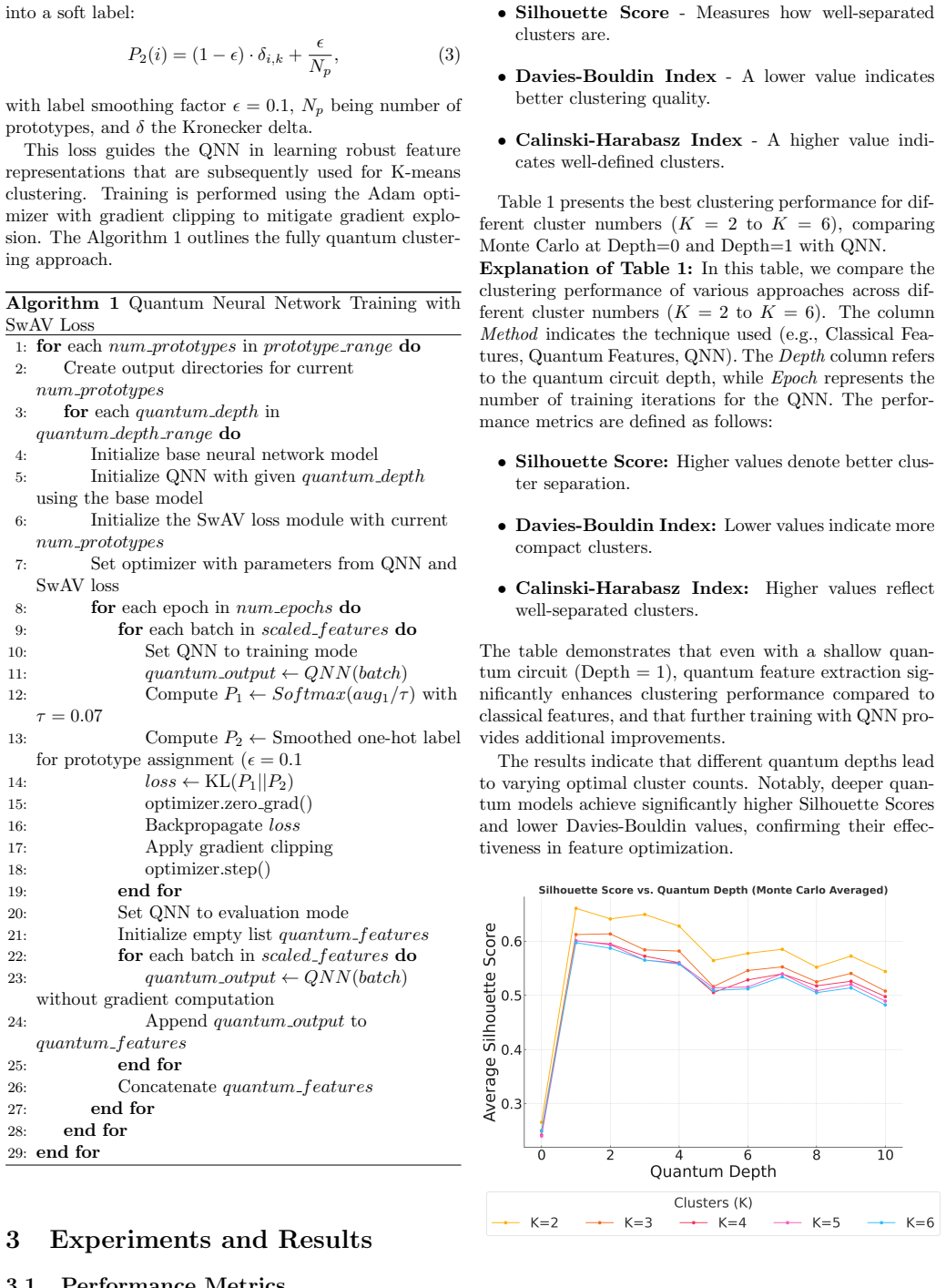
The paper's central claim is that quantum feature optimization—either as a fixed random feature map or as a trained feature extractor—materially improves K-means clustering of blockchain transaction data. On their dataset, classical K-means achieves silhouette scores around 0.24–0.27; augmenting with a single-layer random quantum circuit lifts the best-run silhouette to above 0.99, and the fully trained QNN reaches 0.999 with a Davies-Bouldin index near 1e-8. The authors present this as evidence that the nonlinear quantum feature mapping 'untangles' noisy, entangled transaction features and reveals cluster structure inaccessible to raw features.
Load-bearing premise
The reported gains are attributed to the quantum nature of the feature map, but the only baseline is classical K-means on raw features; a classical random feature map of similar capacity could plausibly produce the same gains, which would collapse the central quantum-advantage claim.
Editorial extensions
If this is right
- A single-layer, untrained quantum circuit can act as a training-free feature augmenter that substantially improves K-means clustering on high-dimensional transaction data.
- Training the same circuit with a SwAV self-supervised objective pushes clustering metrics close to perfect separation, showing that quantum feature spaces respond well to prototype-based learning.
- Because random quantum features nearly match the trained QNN, resource-constrained deployments can skip training and still get most of the benefit.
- If these results hold on other data, quantum feature extraction becomes a practical preprocessing step for unsupervised fraud and anomaly detection on ledger data.
- The paper's three-way comparison (classical, hybrid, fully quantum) provides a template for benchmarking quantum feature learning in unsupervised settings.
Reading between the lines
- The near-perfect silhouette scores suggest the test dataset has unusually strong cluster structure; on noisier real-world transaction graphs the margin between quantum and classical features may be far smaller.
- The paper never tests a classical random nonlinear feature map (e.g., random Fourier features or a random ReLU network), so the specific role of quantum entanglement vs. generic high-dimensional random projection remains an open question.
- A natural next experiment is to compare the quantum random features against random classical features of matched dimension on a public blockchain dataset with known ground-truth labels, to see whether the quantum map retains an advantage.
Editorial analysis
A structured set of objections, weighed in public.
Referee Report
Summary. The manuscript compares three clustering pipelines on blockchain transaction data: (1) classical K-means on pre-processed features; (2) hybrid clustering, where measurements from an untrained random quantum circuit are concatenated with classical features and fed to K-means; and (3) fully quantum clustering, where a parameterized circuit is trained with a prototype-based loss and its outputs are used as features for K-means. The paper claims that even a depth-1 untrained circuit yields significant improvements over classical K-means and that QNN training improves performance further. The empirical section reports one table of silhouette, Davies-Bouldin, and Calinski-Harabasz values and references three figures; the dataset is described in two sentences, and no code, data, error bars, seeds, or hyperparameter ranges are provided.
Significance. If the claims were established, the paper would provide a useful case study on whether shallow random quantum feature maps can improve K-means clustering for blockchain transaction data, and the explicit comparison of random versus trained quantum features is a sensible design. However, the current experiments do not establish a quantum-specific effect: the random QNN features are not compared with a classical random feature map of matched dimensionality, and the fully quantum pipeline optimizes features for cluster separation by construction. The absence of dataset details, code, and statistical reporting prevents verification of the numbers. The paper is therefore better viewed as a preliminary proposal than as a validated empirical contribution.
major comments (4)
- [§2.3.3 and Table 1] The central claim in Section 1 that even shallow quantum circuits (quantum depth = 1) yield significant improvements in clustering performance is not supported because no classical random-feature baseline is tested. The untrained QNN in §2.3.3 is one instance of a random nonlinear feature map; a matched classical counterpart (e.g., random Fourier features, a random ReLU network, or a random projection followed by a nonlinearity) is needed to determine whether the gains come from the quantum circuit or simply from lifting the data into a higher-dimensional space. Table 1 compares Quantum Features only against K-means on raw classical features, so the reported improvements cannot be attributed to quantum effects.
- [§2.3.4, Eq. (2)-(3), Algorithm 1] The fully quantum approach is confounded by its training objective. The loss in Eq. (2)-(3) trains the circuit to map each sample to a smoothed one-hot prototype assignment, so the resulting features are explicitly shaped for cluster separability; evaluating K-means on those features and comparing to untrained K-means on raw features does not isolate any quantum benefit. A classical network trained with the same objective would be expected to behave similarly. In addition, this loss is not SwAV: SwAV relies on swapped prediction between two augmentations, whereas Eq. (2) is a single-view KL divergence to a smoothed one-hot target, and Algorithm 1 never defines the augmentation variable used to compute P1. The method is therefore underspecified and mislabeled.
- [§2.1 and §3.1] The empirical results are not reproducible. Section 2.1 gives no dataset size, number of features, provenance, or preprocessing details beyond label encoding and RobustScaler; Table 1 reports single metric values with Worst/Average/Best Run labels but no number of runs, standard deviations, seeds, or hyperparameter ranges; and no code or data are provided. The phrase significant improvements in the abstract and introduction is therefore unsupported by statistical evidence.
- [Table 1] The reported Calinski-Harabasz values are implausibly large, ranging from 1,605 for classical features to 2.3e16 for the QNN. Values of order 1e13 to 1e16 imply near-zero within-cluster variance, which typically signals duplicated or collapsed feature vectors; the paper offers no diagnostic, such as the number of unique feature vectors, within-cluster variance, or cluster sizes, to rule out a degenerate feature representation. The reader cannot tell whether the clustering metrics are meaningful, and as written the numbers undermine confidence in the results.
minor comments (7)
- [Table 1 and §3.1] The text says the table compares Monte Carlo at Depth=0 and Depth=1 with QNN, but Monte Carlo is never defined and no Depth=0 rows are present in the table.
- [Algorithm 1] The base neural network model that is initialized together with the QNN is never described; its architecture and role in the pipeline are unclear.
- [§2.3.3] The sentence followed by CNOT gates implementing is incomplete; the circuit description is cut off.
- [References] The reference list is duplicated verbatim at the end of the manuscript.
- [General] The terms quantum depth and Monte Carlo are used without definitions; the manuscript should define circuit depth and the number or type of random runs.
- [Abstract and captions] The spelling SwA V with a space appears in the abstract and figure captions, while the body uses SwAV; this should be made consistent.
- [Figures 2 and 3] The captions describe the QNN as generating weights for feature transformation NN, which conflicts with the text in §2.3.3 and §2.3.4 that the circuit output distribution is used as features; the architecture needs clarification.
Circularity Check
Fully quantum clustering's near-perfect scores reduce to the SwAV one-hot prototype objective; hybrid random-feature result is not circular but lacks a classical random-feature control.
-
fitted input called prediction
[Section 2.3.4, Eqs. (2)-(3); Algorithm 1 lines 13-14; Table 1 QNN rows]
"LSwAV = KL (log(Softmax(Z1/τ)) ∥ P2) ... P2(i) = (1 − ϵ) · δi,k + ϵ/Np ... This loss guides the QNN in learning robust feature representations that are subsequently used for K-means clustering. [Algorithm 1:] Compute P2 ← Smoothed one-hot label for prototype assignment (ϵ = 0.1)."
The QNN is trained to minimize KL divergence to P2, a smoothed one-hot distribution over prototypes, so the extracted features are forced into near-one-hot discrete structure. K-means applied to these features then yields silhouette scores near 1 (e.g., 0.999777 for K=2 in Table 1) as a direct consequence of the training target, not as independent evidence that quantum features improve clustering. The raw classical baseline is not trained with any such objective, so the comparison measures the effect of optimizing a clustering objective rather than any quantum-specific effect. The hybrid random-feature approach (Approach 2) is not circular, but it is evaluated only against raw classical features, not a classical random projection baseline.
full rationale
Approach 2 (random QNN features) is not circular: it is an untrained random feature map evaluated independently of any training objective, and the absence of a classical random-feature control is a missing comparison, not a definitional reduction. The fully quantum approach, however, contains a circular step: the QNN is trained to minimize KL divergence to a smoothed one-hot prototype assignment P2, so the extracted features are forced into near-one-hot discrete structure; K-means then returns silhouette values near 1 because the objective already encoded hard cluster assignments. The classical baseline is not trained with this objective, so the comparison does not isolate a quantum effect. Self-citations to the Quantum-Train line [20-28] are motivating context only and are not load-bearing. The paper's central claim for shallow untrained circuits therefore retains independent content, but the 'fully quantum' column's reported gains partially reduce to the training objective; hence score 6.
Assumptions & free parameters
free parameters (6)
- Quantum circuit depth =
Depth per K: K=2 depth=2, K=3 depth=4, K=4 depth=9, K=5 depth=6, K=6 depth=6 (Table 1)
- Number of prototypes Np =
not stated
- Temperature tau =
0.07
- Label smoothing epsilon =
0.1
- Number of epochs =
1, 5, or 9 depending on K (Table 1)
- K (number of clusters) =
2 to 6
assumptions (4)
- domain assumption A randomly initialized quantum circuit provides a meaningful nonlinear feature map for clustering.
- domain assumption The blockchain dataset and its preprocessing (label encoding, RobustScaler) are adequate for clustering comparison.
- ad hoc to paper The single-view KL-to-smoothed-one-hot loss is a valid implementation of SwAV self-supervised clustering.
- standard math K-means convergence and Euclidean distance are appropriate for the hybrid feature space.
Cite this review
Pith. "Pith review of Quantum Feature Optimization for Enhanced Clustering of Blockchain Transaction Data." pith.science (2026). https://pith.science/paper/HM77RNZC
@misc{pith2026250516672,
  author       = {Pith},
  title        = {Pith review of: Quantum Feature Optimization for Enhanced Clustering of Blockchain Transaction Data},
  year         = {2026},
  howpublished = {\url{https://pith.science/paper/HM77RNZC}},
  note         = {Machine review of arXiv:2505.16672}
}
read the original abstract
Blockchain transaction data exhibits high dimensionality, noise, and intricate feature entanglement, presenting significant challenges for traditional clustering algorithms. In this study, we conduct a comparative analysis of three clustering approaches: (1) Classical K-Means Clustering, applied to pre-processed feature representations; (2) Hybrid Clustering, wherein classical features are enhanced with quantum random features extracted using randomly initialized quantum neural networks (QNNs); and (3) Fully Quantum Clustering, where a QNN is trained in a self-supervised manner leveraging a SwAV-based loss function to optimize the feature space for clustering directly. The proposed experimental framework systematically investigates the impact of quantum circuit depth and the number of learned prototypes, demonstrating that even shallow quantum circuits can effectively extract meaningful non-linear representations, significantly improving clustering performance.
Figures


Figures from the paper (1 more)

Forward citations
Cited by 1 Pith paper
-
Quantum-Enhanced Reinforcement Learning with LSTM Forecasting Signals for Optimizing Fintech Trading Decisions
A quantum-enhanced A3C agent with LSTM forecast features beat classical A3C in a single in-sample S&P 500 backtest.
Reference graph
Works this paper leans on
-
[1]
Survey of clustering al- gorithms,
R. Xu and D. Wunsch, “Survey of clustering al- gorithms,” IEEE Transactions on Neural Networks, vol. 16, no. 3, pp. 645–678, 2005
work page 2005
-
[2]
Blockchain data complexity and its implications for analytics,
X. Li, Y. Chen, and W. Zhang, “Blockchain data complexity and its implications for analytics,” Jour- nal of Blockchain Research, vol. 5, no. 2, pp. 123–138, 2020
work page 2020
-
[3]
Challenges in blockchain data analytics: A comprehensive survey,
A. Khan, S. Malik, and Z. Hussain, “Challenges in blockchain data analytics: A comprehensive survey,” IEEE Access, vol. 9, pp. 45 678–45 690, 2021
work page 2021
-
[4]
Challenges in clus- tering high-dimensional data: A blockchain perspec- tive,
Y. Liu, H. Zhang, and Y. Chen, “Challenges in clus- tering high-dimensional data: A blockchain perspec- tive,” IEEE Access, vol. 7, pp. 123 456–123 468, 2019. 7
work page 2019
-
[5]
Wittek, Quantum Machine Learning: What Quan- tum Computing Means to Data Mining
P. Wittek, Quantum Machine Learning: What Quan- tum Computing Means to Data Mining. Academic Press, 2014
work page 2014
-
[6]
J. Biamonte, P. Wittek, N. Pancotti, P. Rebentrost, N. Wiebe, and S. Lloyd, “Quantum machine learn- ing,” Nature, vol. 549, no. 7671, pp. 195–202, 2017
work page 2017
-
[7]
An in- troduction to quantum machine learning,
M. Schuld, I. Sinayskiy, and F. Petruccione, “An in- troduction to quantum machine learning,” Contem- porary Physics, vol. 56, no. 2, pp. 172–185, 2015
work page 2015
-
[8]
Quantum-assisted machine learning,
D. Aharon, J. Biamonte, M. Schuld, and N. Wiebe, “Quantum-assisted machine learning,” Quantum Sci- ence and Technology, vol. 5, no. 4, p. 043002, 2020
work page 2020
Show all 28 references
-
[9]
Variational quantum algorithms,
M. Cerezo, A. Arrasmund, Y. Cao, X. Yuan, L. Cin- cio, and P. Coles, “Variational quantum algorithms,” Nature Reviews Physics, vol. 3, pp. 625–644, 2021
2021
-
[10]
Supervised learning with quantum-enhanced feature spaces,
V. Havl ´ ıˇ cek, A. C´ orcoles, K. Temme, A. Harrow, A. Kandala, J. Chow, and J. Gambetta, “Supervised learning with quantum-enhanced feature spaces,”Na- ture, vol. 567, no. 7747, pp. 209–212, 2019
2019
-
[11]
Quantum circuits for dynamic learning,
J. Arrazola, T. Bromley, M. Schuld, and F. Petruc- cione, “Quantum circuits for dynamic learning,” Quantum Machine Intelligence, vol. 2, no. 3, pp. 1– 15, 2020
2020
-
[12]
Quantum- enhanced machine learning,
V. Dunjko, J. Taylor, and H. Briegel, “Quantum- enhanced machine learning,” Physical Review Letters, vol. 120, no. 4, p. 040501, 2018
2018
-
[13]
Quantum computing in the nisq era and beyond,
J. Preskill, “Quantum computing in the nisq era and beyond,” Quantum, vol. 2, p. 79, 2018
2018
-
[14]
Quantum machine learning: A classical perspective,
M. Schuld and F. Petruccione, “Quantum machine learning: A classical perspective,” npj Quantum In- formation, vol. 6, pp. 1–9, 2020
2020
-
[15]
Quantum circuit learning,
K. Mitarai, M. Negoro, M. Kitagawa, and K. Fu- jii, “Quantum circuit learning,” Physical Review A, vol. 98, no. 3, p. 032309, 2018
2018
-
[16]
Parameterized quantum circuits as machine learning models,
M. Benedetti, E. Lloyd, S. Sack, and M. Fiorentini, “Parameterized quantum circuits as machine learning models,” Quantum Science and Technology, vol. 4, no. 4, p. 043001, 2019
2019
-
[17]
Quantum algorithms for electronic structure calculations: Particle-hole hamiltonian and optimized wavefunction expansions,
P. Barkoutsos, M. Seri, J. Holtz, A. Sokolov, and S. Kais, “Quantum algorithms for electronic structure calculations: Particle-hole hamiltonian and optimized wavefunction expansions,” Physical Review Research, vol. 2, no. 3, p. 033034, 2020
2020
-
[18]
Enhancing machine learning models with quantum feature maps,
G. Wang, H. Fan, and X. Sun, “Enhancing machine learning models with quantum feature maps,” IEEE Transactions on Neural Networks and Learning Sys- tems, vol. 32, no. 7, pp. 2891–2903, 2021
2021
-
[19]
Unsupervised learning of visual features by contrasting cluster assign- ments,
M. Caron, I. Misra, J. Mairal, P. Goyal, P. Bo- janowski, and A. Joulin, “Unsupervised learning of visual features by contrasting cluster assign- ments,” in Advances in Neural Information Process- ing Systems (NeurIPS) , 2020. [Online]. Available: https://arxiv.org/abs/2006.09882
2020 arXiv
-
[20]
Quantum- train: Rethinking hybrid quantum-classical machine learning in the model compression perspective,
C.-Y. Liu, E.-J. Kuo, C.-H. A. Lin, J. G. Young, Y.- J. Chang, M.-H. Hsieh, and H.-S. Goan, “Quantum- train: Rethinking hybrid quantum-classical machine learning in the model compression perspective,” arXiv preprint arXiv:2405.11304, 2024
2024 arXiv
-
[21]
Quantum-train long short-term memory: Applica- tion on flood prediction problem,
C.-H. A. Lin, C.-Y. Liu, and K.-C. Chen, “Quantum-train long short-term memory: Applica- tion on flood prediction problem,” arXiv preprint arXiv:2407.08617, 2024
2024 arXiv
-
[22]
Qtrl: Toward practical quantum reinforcement learning via quantum-train,
C.-Y. Liu, C.-H. A. Lin, C.-H. H. Yang, K.-C. Chen, and M.-H. Hsieh, “Qtrl: Toward practical quantum reinforcement learning via quantum-train,” arXiv preprint arXiv:2407.06103, 2024
2024 arXiv
-
[23]
Federated quantum- train with batched parameter generation,
C.-Y. Liu and S. Y.-C. Chen, “Federated quantum- train with batched parameter generation,” arXiv preprint arXiv:2409.02763, 2024
2024 arXiv
-
[24]
Quantum-train with tensor network mapping model and distributed circuit ansatz,
C.-Y. Liu, C.-H. A. Lin, and K.-C. Chen, “Quantum-train with tensor network mapping model and distributed circuit ansatz,” arXiv preprint arXiv:2409.06992, 2024
2024 arXiv
-
[25]
Quantum-trained convolutional neural net- work for deepfake audio detection,
C.-H. A. Lin, C.-Y. Liu, S. Y.-C. Chen, and K.-C. Chen, “Quantum-trained convolutional neural net- work for deepfake audio detection,” arXiv preprint arXiv:2410.09250, 2024
2024 arXiv
-
[26]
A quantum circuit-based compression perspective for parameter-efficient learning,
C.-Y. Liu, C.-H. H. Yang, M.-H. Hsieh, and H.- S. Goan, “A quantum circuit-based compression perspective for parameter-efficient learning,” arXiv preprint arXiv:2410.09846, 2024
2024 arXiv
-
[27]
Quantum-train-based distributed multi-agent reinforcement learning,
K.-C. Chen, S. Y.-C. Chen, C.-Y. Liu, and K. K. Leung, “Quantum-train-based distributed multi-agent reinforcement learning,” arXiv preprint arXiv:2412.08845, 2024
2024 arXiv
-
[28]
Programming variational quantum circuits with quantum-train agent,
C.-Y. Liu, S. Y.-C. Chen, K.-C. Chen, W.-J. Huang, and Y.-J. Chang, “Programming variational quantum circuits with quantum-train agent,” arXiv preprint arXiv:2412.01173, 2024. 8
2024 arXiv
Reviewed August 7, 2026 · model on record in the stance chip above.
Discussion (0). Sign in to comment.