Vorticity Induced by Non-frontal Collisions of Quantum Droplets
Pith reviewed 2026-06-26 22:09 UTC · model grok-4.3
The pith
Non-frontal collisions of heteronuclear quantum droplets generate vortex rings and dislocation lines through dynamical instabilities.
A machine-rendered reading of the paper's core claim, the machinery that carries it, and where it could break.
Core claim
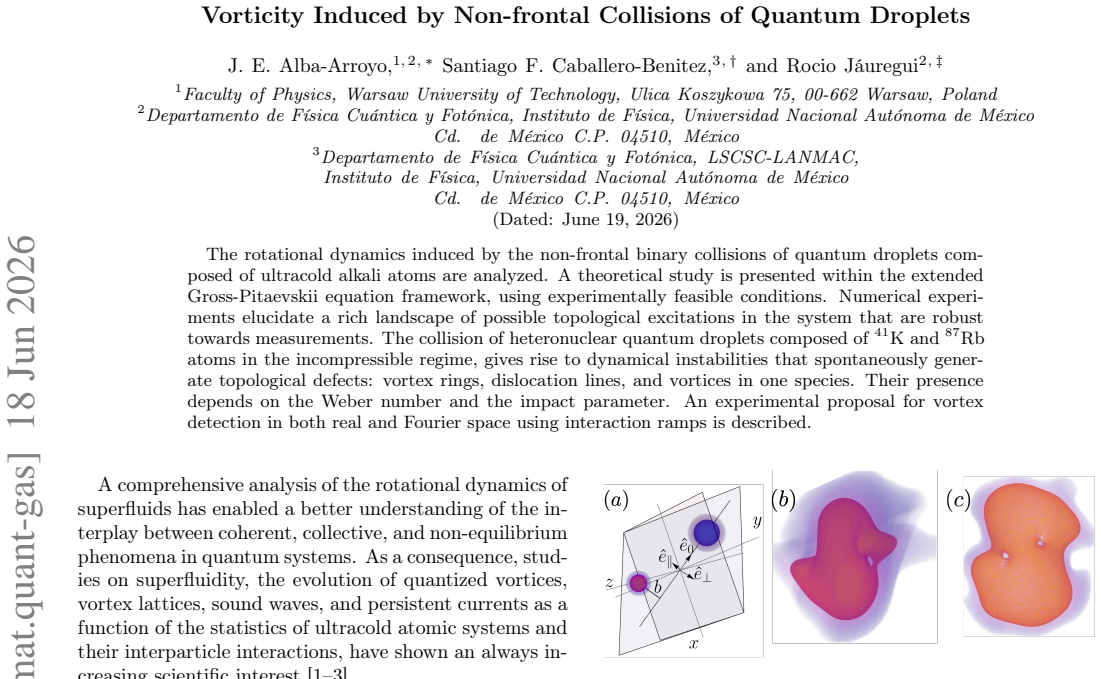
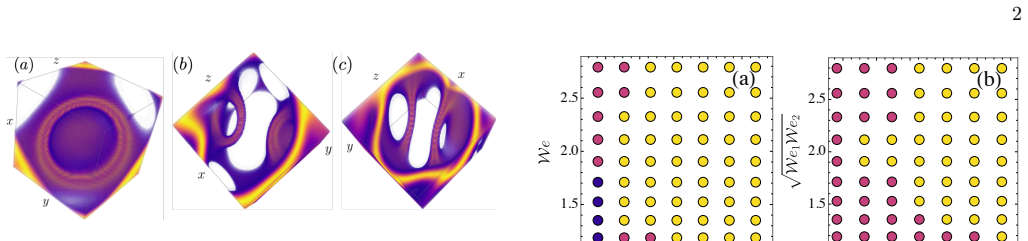
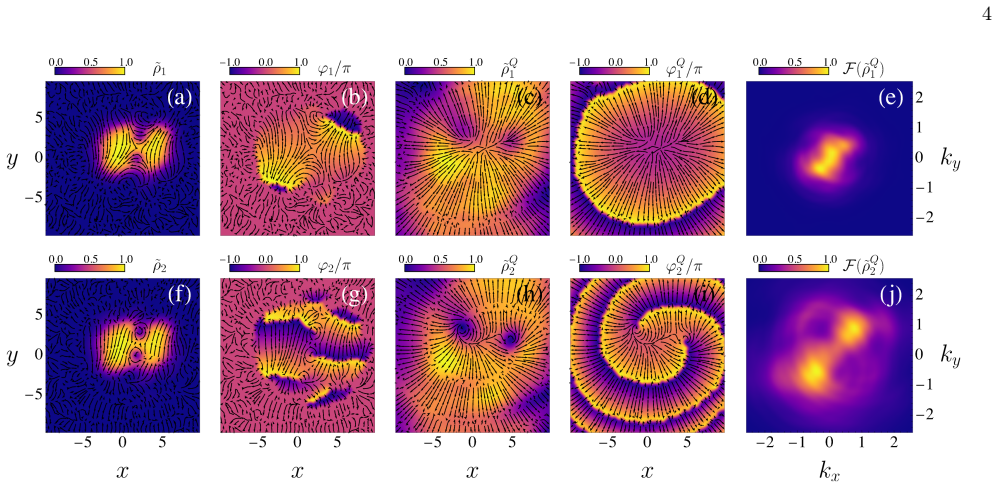
The collision of heteronuclear quantum droplets composed of ^{41}K and ^{87}Rb atoms in the incompressible regime gives rise to dynamical instabilities that spontaneously generate topological defects: vortex rings, dislocation lines, and vortices in one species. Their presence depends on the Weber number and the impact parameter. An experimental proposal for vortex detection in both real and Fourier space using interaction ramps is described.
What carries the argument
Dynamical instabilities in non-frontal collisions of heteronuclear quantum droplets, obtained from numerical solutions of the extended Gross-Pitaevskii equation and controlled by Weber number together with impact parameter.
If this is right
- Topological defects form robustly in non-frontal collisions under conditions reachable in current ultracold-atom setups.
- Vortices can be detected by suddenly changing the interaction strength and imaging both in position space and in momentum space.
- The specific defects that appear are selected by the Weber number of the collision and by the impact parameter.
- The process supplies a mechanism for creating vorticity in quantum droplets that begin with zero net angular momentum.
Where Pith is reading between the lines
- Varying the collision parameters could provide a tunable source of initial vorticity for studies of quantum turbulence in droplet systems.
- Analogous instabilities may arise in other attractive multicomponent Bose gases or in superfluid mixtures beyond the specific potassium-rubidium case.
- Including thermal fluctuations or three-body losses in future simulations would test whether the generated defects survive under more realistic conditions.
Load-bearing premise
The extended Gross-Pitaevskii equation framework provides an accurate description of these heteronuclear droplets under the incompressible regime and experimentally feasible conditions.
What would settle it
An experiment colliding ^{41}K and ^{87}Rb quantum droplets off-center that finds no vortex rings, dislocation lines, or single-species vortices after the interaction.
Figures
read the original abstract
The rotational dynamics induced by the non-frontal binary collisions of quantum droplets composed of ultracold alkali atoms are analyzed. A theoretical study is presented within the extended Gross-Pitaevskii equation framework, using experimentally feasible conditions. Numerical experiments elucidate a rich landscape of possible topological excitations in the system that are robust towards measurements. The collision of heteronuclear quantum droplets composed of $^{41}$K and $^{87}$Rb atoms in the incompressible regime, gives rise to dynamical instabilities that spontaneously generate topological defects: vortex rings, dislocation lines, and vortices in one species. Their presence depends on the Weber number and the impact parameter. An experimental proposal for vortex detection in both real and Fourier space using interaction ramps is described.
Editorial analysis
A structured set of objections, weighed in public.
Referee Report
Summary. The paper analyzes rotational dynamics in non-frontal binary collisions of heteronuclear quantum droplets (^{41}K and ^{87}Rb) within the extended Gross-Pitaevskii equation framework under experimentally feasible conditions. Numerical experiments show that in the incompressible regime, dynamical instabilities spontaneously generate topological defects including vortex rings, dislocation lines, and single-species vortices, with their occurrence depending on the Weber number and impact parameter; an experimental detection scheme via interaction ramps is proposed.
Significance. If the results hold under the stated model, the work would identify a collision-based mechanism for generating vorticity and topological excitations in quantum droplets, offering testable predictions via Weber number and impact parameter dependence that could be relevant for experiments with ultracold heteronuclear mixtures.
major comments (2)
- [Abstract] The abstract states that numerical experiments elucidate the generation of topological defects but provides no details on the numerical methods, discretization scheme, convergence checks, or validation against known limiting cases (e.g., frontal collisions or single-component droplets); this information is required to evaluate whether the reported instabilities are numerically robust.
- [Results (incompressible regime discussion)] The central claim that non-frontal collisions generate defects via dynamical instabilities in the incompressible regime rests on the extended GPE accurately capturing the physics for ^{41}K-^{87}Rb droplets; however, no quantitative assessment of the validity of the LHY correction or the incompressibility assumption (e.g., via comparison of density profiles or energy scales) is provided, which directly affects the reported dependence on Weber number and impact parameter.
minor comments (2)
- Clarify the definition and range of the Weber number used in the simulations, including how it is computed from the droplet parameters.
- Ensure that all simulation parameters (e.g., atom numbers, trap frequencies, scattering lengths) are explicitly listed in a table for reproducibility.
Simulated Author's Rebuttal
We thank the referee for their careful reading of our manuscript and the constructive comments provided. We respond to each major comment below.
read point-by-point responses
-
Referee: [Abstract] The abstract states that numerical experiments elucidate the generation of topological defects but provides no details on the numerical methods, discretization scheme, convergence checks, or validation against known limiting cases (e.g., frontal collisions or single-component droplets); this information is required to evaluate whether the reported instabilities are numerically robust.
Authors: The abstract is intended to be a high-level summary, and space constraints preclude inclusion of technical details there. We will expand the manuscript with a dedicated Numerical Methods section that specifies the discretization scheme (split-step Fourier method), grid parameters, convergence checks with respect to spatial and temporal resolution, and validation against frontal collisions (recovering the expected absence of vorticity) as well as single-component droplet cases. revision: yes
-
Referee: [Results (incompressible regime discussion)] The central claim that non-frontal collisions generate defects via dynamical instabilities in the incompressible regime rests on the extended GPE accurately capturing the physics for ^{41}K-^{87}Rb droplets; however, no quantitative assessment of the validity of the LHY correction or the incompressibility assumption (e.g., via comparison of density profiles or energy scales) is provided, which directly affects the reported dependence on Weber number and impact parameter.
Authors: We agree that a quantitative validation of the model assumptions would strengthen the presentation. We will add a paragraph in the results section that compares density profiles obtained with and without the LHY term, provides estimates of the relevant energy scales (kinetic versus interaction), and discusses the resulting Mach number to justify the incompressible regime, together with a brief analysis of how these choices influence the observed dependence on Weber number and impact parameter. revision: yes
Circularity Check
No circularity: results from direct numerical integration of eGPE
full rationale
The paper reports outcomes of numerical simulations solving the extended Gross-Pitaevskii equations for heteronuclear quantum droplet collisions under experimentally feasible parameters. Topological defects (vortex rings, dislocation lines, single-species vortices) emerge as dynamical instabilities in these integrations, with dependence on Weber number and impact parameter. No load-bearing steps reduce claims to self-definitions, fitted inputs renamed as predictions, or self-citation chains; the extended GPE framework is an established model whose LHY and interaction terms are external to the present numerics. The derivation chain is self-contained as forward simulation of the stated PDE system.
Axiom & Free-Parameter Ledger
axioms (1)
- domain assumption The extended Gross-Pitaevskii equation is suitable for modeling these quantum droplet collisions
Reference graph
Works this paper leans on
-
[1]
R. P. Feynman, Superfluidity and superconductivity, Rev. Mod. Phys.29, 205 (1957)
1957
-
[2]
C. F. Barenghi, R. J. Donnelly, and W. F. Vinen, Quantized Vortex Dynamics and Superfluid Turbulence (Springer, 2001)
2001
-
[3]
Leggett,Quantum Liquids(Oxford University Press, 2006)
A. Leggett,Quantum Liquids(Oxford University Press, 2006)
2006
-
[4]
R. L. Donnelly,Superfluid Vortices: Quantized Vortices In Helium II(Cambridge University Press, 1991)
1991
-
[5]
K. W. Madison, F. Chevy, W. Wohlleben, and J. Dal- ibard, Vortex formation in a stirred bose-einstein con- densate, Phys. Rev. Lett.84, 806 (2000)
2000
-
[6]
D. S. Petrov, Quantum mechanical stabilization of a col- lapsing bose-bose mixture, Phys. Rev. Lett.115, 155302 (2015)
2015
-
[7]
Schmitt, M
M. Schmitt, M. Wenzel, F. Böttcher, I. Ferrier-Barbut, and T. Pfau, Self-bound droplets of a dilute magnetic quantum liquid, Nature539, 259 (2016)
2016
-
[8]
C. R. Cabrera, L. Tanzi, J. Sanz, B. Naylor, P. Thomas, P. Cheiney, and L. Tarruell, Quantum liquid droplets in a mixture of bose-einstein condensates, Science359, 301 (2018)
2018
-
[9]
Semeghini, G
G. Semeghini, G. Ferioli, L. Masi, C. Mazzinghi, L. Wol- swijk, F. Minardi, M. Modugno, G. Modugno, M. In- guscio, and M. Fattori, Self-bound quantum droplets of atomic mixtures in free space, Phys. Rev. Lett.120, 235301 (2018)
2018
-
[10]
D’Errico, A
C. D’Errico, A. Burchianti, M. Prevedelli, L. Salasnich, F. Ancilotto, M. Modugno, F. Minardi, and C. Fort, Ob- servation of quantum droplets in a heteronuclear bosonic mixture, Phys. Rev. Res.1, 033155 (2019)
2019
-
[11]
Cikojević, L
V. Cikojević, L. V. Markić, M. Pi, M. Barranco, F. An- cilotto, and J. Boronat, Dynamics of equilibration and collisions in ultradilute quantum droplets, Phys. Rev. Res.3, 043139 (2021)
2021
-
[12]
J. E. Alba-Arroyo, S. F. Caballero-Benitez, and R. Jáuregui, Weber number and the outcome of binary collisions between quantum droplets, Sci. Rep.12(2022)
2022
-
[13]
Caldara and F
M. Caldara and F. Ancilotto, Vortices in quantum droplets of heteronuclear bose mixtures, Phys. Rev. A 105, 063328 (2022)
2022
-
[14]
L. F. Gomez, K. R. Ferguson, J. P. Cryan, C. Bacel- lar, R. M. P. Tanyag, C. Jones, S. Schorb, D. Anielski, A. Belkacem, C. Bernando,et al., Shapes and vortici- ties of superfluid helium nanodroplets, Science345, 906 (2014)
2014
-
[15]
T. A. Flynn, L. Parisi, T. P. Billam, and N. G. Parker, Quantum droplets in imbalanced atomic mixtures, Phys. Rev. Res.5, 033167 (2023)
2023
-
[16]
Ferioli, G
G. Ferioli, G. Semeghini, L. Masi, G. Giusti, G. Mod- ugno, M. Inguscio, A. Gallemí, A. Recati, and M. Fattori, Collisions of self-bound quantum droplets, Phys. Rev. Lett.122, 090401 (2019)
2019
-
[17]
In the reported data typical values of these quantities wered 0 = 3.79µm= 3.30ξ; b∈[0.98µm,8.86µm] = [0.86ξ,7.78ξ];k 0 ∈ [0.30µm−1,0.48µm] = [0.36ξ −1,0.42ξ −1]
-
[18]
See, Supplemental material: http
-
[19]
Van Loock, D
J. Van Loock, D. Ahmed-Braun, and J. Tempere, Frag- mentation temperature of 1d and 3d quantum droplets in a bec mixture, Journal of Low Temperature Physics 222, 73 (2026)
2026
-
[20]
J. E. Alba-Arroyo, S. F. Caballero-Benitez, and R. Jáuregui, Rotational dynamics induced by low-energy binary collisions of quantum droplets, Photonics10 (2023). [21]g Q αχ = 4 3π2 gααm3/5 α ℏ3 2/3 m3/5 χ gχχ
2023
-
[21]
N. R. Arnold Frohn,Dynamics of Droplets(Springer Berlin, Heidelberg, 2000)
2000
-
[22]
C. F. Barenghi and N. G. Parker,A Primer on Quantum Fluids, SpringerBriefs in Physics (Springer International Publishing, Cham, Switzerland, 2016)
2016
-
[23]
García-Alfonso, F
E. García-Alfonso, F. Ancilotto, M. Barranco, M. Pi, and N. Halberstadt, Quantized vortex nucleation in collisions of superfluid nanoscopic helium droplets at zero temper- ature, J. of Chem. Phys.159, 074305 (2023)
2023
-
[24]
Wlazłowski, K
G. Wlazłowski, K. Sekizawa, M. Marchwiany, and P. Magierski, Suppressed solitonic cascade in spin- imbalanced superfluid fermi gas, Phys. Rev. Lett.120, 253002 (2018)
2018
-
[25]
B. A. Malomed, Vortex solitons: Old results and new perspectives, Physica D: Nonlinear Phenomena399, 108 (2019)
2019
-
[26]
Strang, On the construction and comparison of dif- ference schemes, SIAM J
G. Strang, On the construction and comparison of dif- ference schemes, SIAM J. on Num. Anal.5, 506 (1968), https://doi.org/10.1137/0705041
-
[27]
W. Bao, D. Jaksch, and P. A. Markowich, Numerical so- lution of the gross–pitaevskii equation for bose–einstein condensation, J. of Comput. Phys.187, 318 (2003)
2003
-
[28]
W. H. Press, B. P. Flannery, S. A. Teukolsky, and W. T. Vetterling,Numerical Recipes in FORTRAN 77: The Art of Scientific Computing, 2nd ed. (Cambridge University Press, 1992). 6 END MA TTER Natural Units.DropletsthatsatifyN a/Nb = p gaa/gbb withN α the number of atoms of theαspecies in the mixture are considered. The healing lengthξα (natural unit of len...
1992
discussion (0)
Sign in with ORCID, Apple, or X to comment. Anyone can read and Pith papers without signing in.