Block algebra for morphing circuits
Pith reviewed 2026-06-27 09:13 UTC · model grok-4.3
The pith
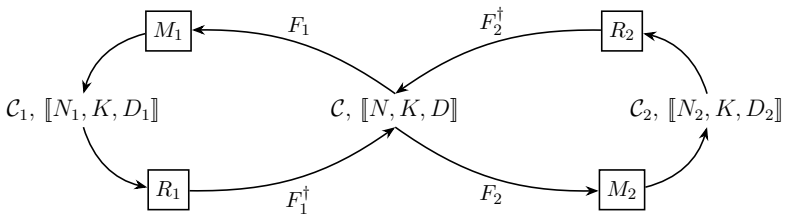
Block algebra notation produces four explicit constructions for CNOT-based CSS morphing circuits with defined qubit connectivities.
A machine-rendered reading of the paper's core claim, the machinery that carries it, and where it could break.
Core claim
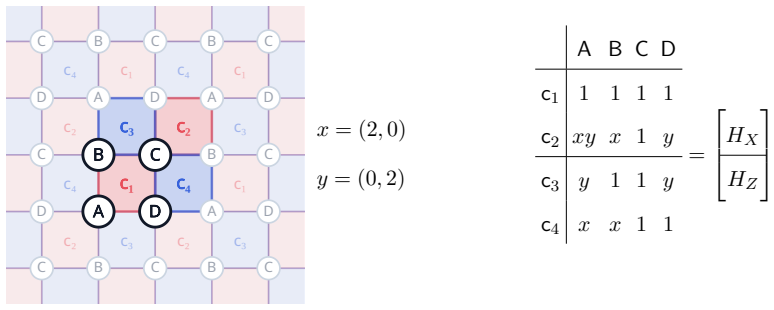
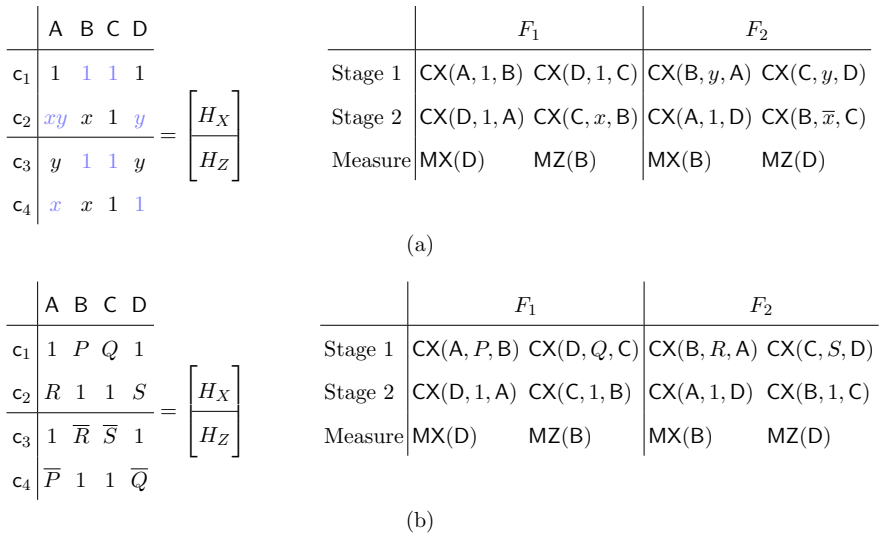
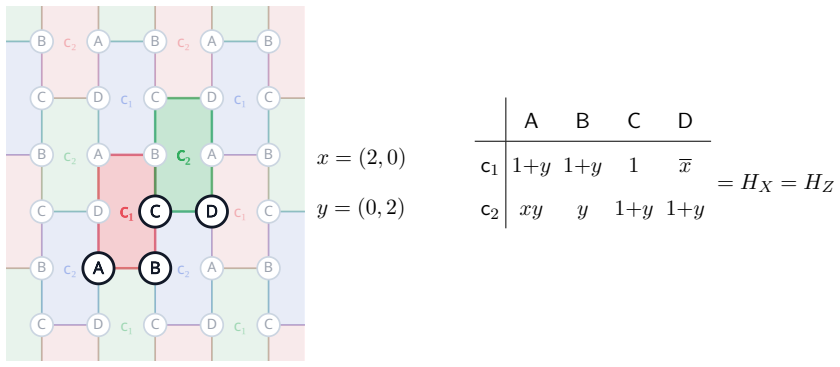
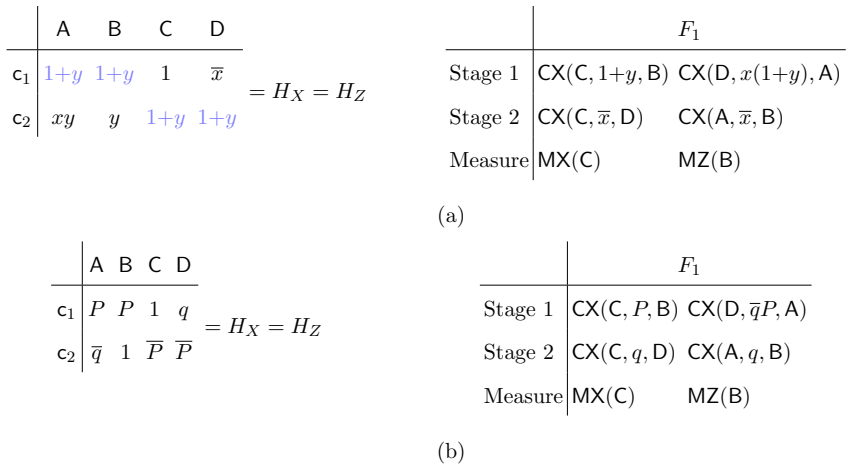
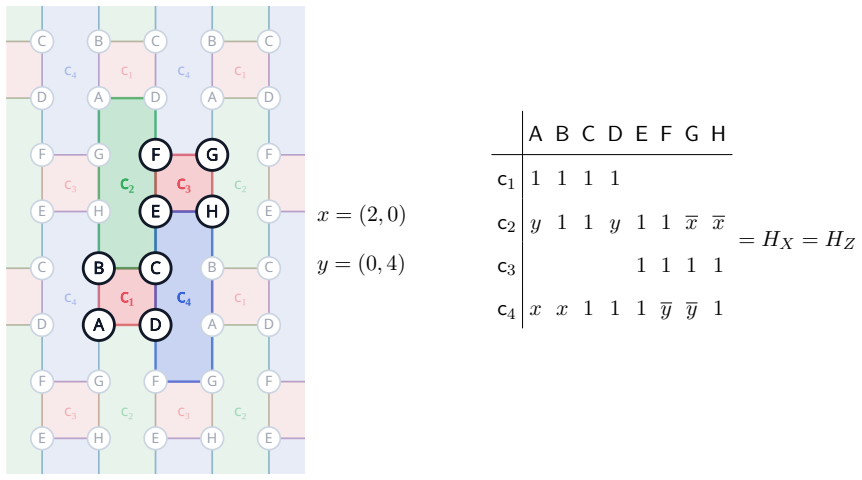
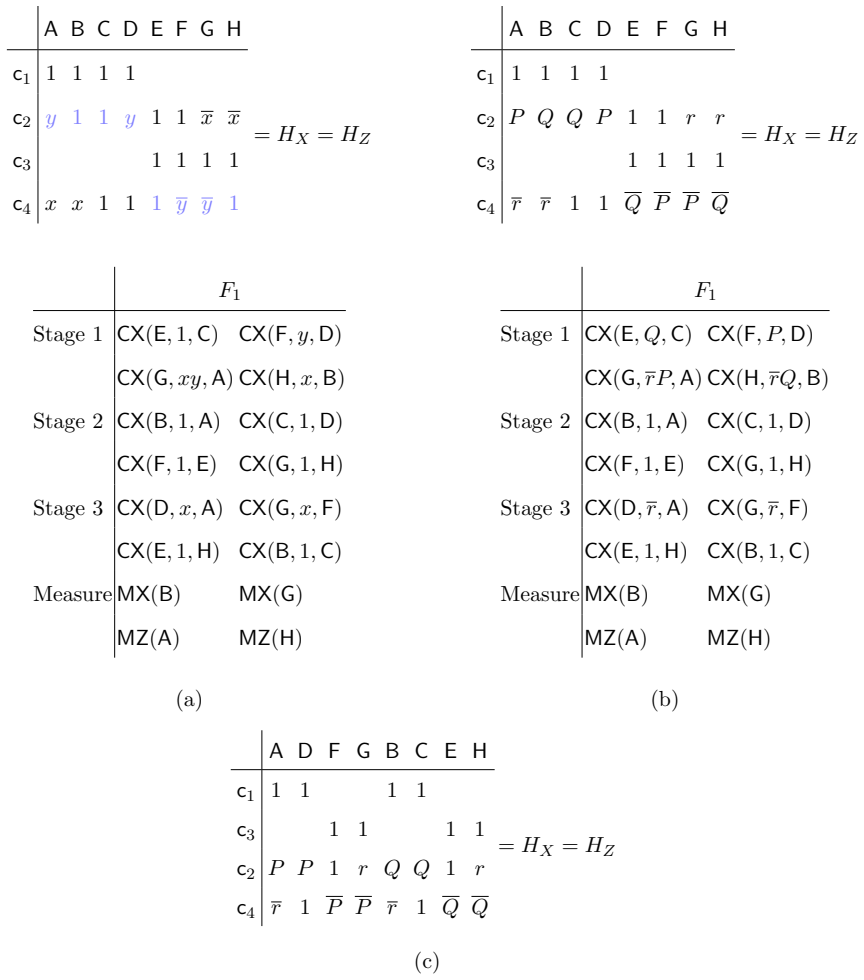
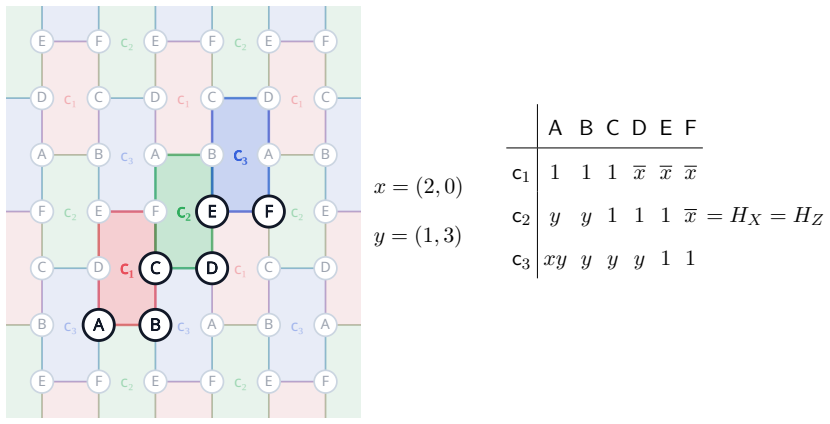
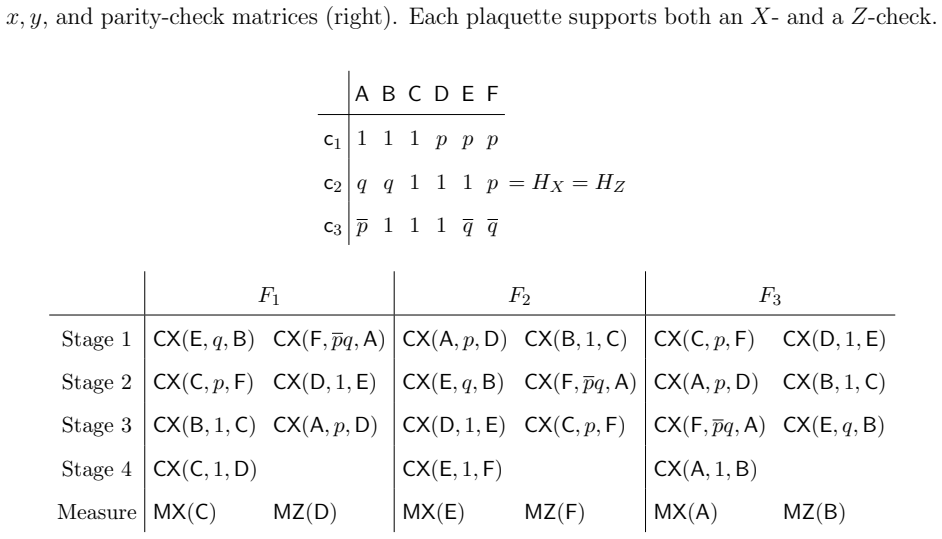
Four CNOT-based CSS morphing circuits are specified in block algebra notation with entries in algebras generated by permutation matrices. The first three arise by rewriting existing surface- and color-code morphing circuits; the fourth is a new three-round construction modeled on the 6.6.6 color code. The surface-code construction recovers the morphing circuit of Ref. [ST25] for two-block group algebra codes. Numerical search over regular representations of finite groups then instantiates the required permutation matrices.
What carries the argument
Block algebra notation whose entries are algebras generated by permutation matrices
If this is right
- The surface-code construction exactly recovers the morphing circuit of Ref. [ST25] for two-block group algebra codes.
- A new three-round construction modeled on the 6.6.6 color code is obtained in the same notation.
- Explicit qubit connectivity degrees are stated for each of the four constructions.
- The algebraic form separates the circuit specification from the concrete choice of permutation matrices.
Where Pith is reading between the lines
- The same block-algebra template could be applied to additional color-code or surface-code families beyond the four cases shown.
- If suitable group representations exist, the method offers a route to generate morphing circuits for codes whose connectivity graphs are not yet known.
- The separation of algebraic specification and numerical search may allow reuse of the same block-algebra skeleton with different groups or search heuristics.
Load-bearing premise
Numerical search over regular representations of finite groups will produce permutation matrices that satisfy the explicit qubit-connectivity degrees and CNOT-based CSS morphing properties required by the four constructions.
What would settle it
No finite group is found whose regular representation supplies permutation matrices meeting the degree and morphing conditions for any one of the four block-algebra constructions.
Figures
read the original abstract
Morphing circuits are a new paradigm for quantum error correction that relaxes hardware requirements. We present four constructions for CNOT-based CSS morphing circuits with explicit qubit connectivity degrees. All four constructions are specified in block algebra notation, with entries in algebras generated by permutation matrices. The first three are obtained by rewriting existing surface- and color-code morphing circuits; the fourth is a new three-round construction modeled on the 6.6.6 color code. The surface-code construction recovers the morphing circuit of Ref. [ST25] for two-block group algebra codes. Numerical search then instantiates these permutation matrices using regular representations of finite groups. [ST25] M. H. Shaw and B. M. Terhal, Phys. Rev. Lett. 134(9), 090602 (2025).
Editorial analysis
A structured set of objections, weighed in public.
Referee Report
Summary. The paper presents four constructions for CNOT-based CSS morphing circuits specified in block algebra notation with entries drawn from algebras generated by permutation matrices. The first three constructions are obtained by rewriting existing surface- and color-code morphing circuits; the fourth is a new three-round construction modeled on the 6.6.6 color code. The surface-code case recovers the morphing circuit of Ref. [ST25] for two-block group algebra codes. All constructions are claimed to be instantiated via numerical search over regular representations of finite groups.
Significance. If the numerical search is shown to succeed with explicit matrices satisfying the required connectivity degrees and morphing properties, the block-algebra framework would supply a systematic way to generate morphing circuits from group representations, extending prior work and potentially easing hardware constraints in quantum error correction. The recovery of the [ST25] result provides a useful consistency check.
major comments (1)
- [Abstract (and the section describing the numerical search)] The abstract states that numerical search instantiates the permutation matrices for all four constructions, but no explicit matrices, search algorithm details, success criteria, or verification that the resulting matrices obey the qubit-connectivity degrees and CNOT-based CSS morphing commutation relations are supplied. This is load-bearing because the block-algebra specifications are abstract and the claim of instantiability rests entirely on the unverified outcome of that search.
Simulated Author's Rebuttal
We thank the referee for their thoughtful review and for highlighting the importance of verifying the numerical search claims. We address the major comment below and will revise the manuscript accordingly to strengthen the presentation of the instantiability results.
read point-by-point responses
-
Referee: [Abstract (and the section describing the numerical search)] The abstract states that numerical search instantiates the permutation matrices for all four constructions, but no explicit matrices, search algorithm details, success criteria, or verification that the resulting matrices obey the qubit-connectivity degrees and CNOT-based CSS morphing commutation relations are supplied. This is load-bearing because the block-algebra specifications are abstract and the claim of instantiability rests entirely on the unverified outcome of that search.
Authors: We agree that the manuscript as submitted does not provide sufficient details on the numerical search or explicit verification. The block-algebra constructions are the primary contribution, but the claim that they are instantiated via regular representations requires supporting evidence. In revision we will add a new subsection (or expand the existing numerical-search section) that: (1) specifies the search procedure (exhaustive enumeration over small-order groups with regular representations, or a targeted heuristic if exhaustive search is infeasible), (2) states the success criteria (matrices must satisfy the exact block-algebra commutation relations, the prescribed connectivity degrees, and the CSS morphing conditions), and (3) supplies at least one explicit set of permutation matrices for each of the four constructions together with a short verification that they meet the connectivity and commutation requirements. This will make the instantiability claim directly verifiable while preserving the abstract's concise statement. revision: yes
Circularity Check
No significant circularity; constructions and instantiations are independent
full rationale
The paper specifies four CNOT-based CSS morphing circuit constructions explicitly in block algebra notation whose entries are permutation matrices drawn from regular representations of finite groups. The surface-code case is obtained by rewriting an existing construction to recover the morphing circuit of the independent Ref. [ST25]; the new three-round case is modeled on the 6.6.6 color code. Numerical search is then used only to locate concrete matrix realizations that obey the stated qubit-connectivity degrees and CNOT-based CSS morphing properties. This search is an external instantiation step, not a self-definitional loop, fitted-input prediction, or load-bearing self-citation; the abstract block-algebra framework itself does not presuppose the search outcome, and the recovery of [ST25] rests on rewriting rather than on any fitted parameter or self-referential definition. No step reduces the central claims to their own inputs by construction.
Axiom & Free-Parameter Ledger
axioms (1)
- domain assumption Regular representations of finite groups generate permutation matrices that can instantiate the required block-algebra entries for morphing circuits.
Reference graph
Works this paper leans on
-
[1]
Lowering Connectivity Requirements for Bivariate Bicycle Codes Using Morphing Circuits , author =. Phys. Rev. Lett. , volume =. 2025 , month =. doi:10.1103/PhysRevLett.134.090602 , eprint =
-
[2]
Quantum , issn =
Relaxing Hardware Requirements for Surface Code Circuits using Time-dynamics , author =. Quantum , issn =. 2023 , doi =
2023
-
[3]
New circuits and an open source decoder for the color code , author =. 2312.08813 , year =
-
[4]
Algebraic methods for quantum codes on lattices , author =. Rev. Colomb. Mat. , volume =. 2016 , doi =
2016
-
[5]
Generalized Toric Codes on Twisted Tori for Quantum Error Correction , author =. PRX Quantum , volume =. 2025 , month =. doi:10.1103/rmy6-9n89 , eprint =
-
[6]
Tile Codes: High-Efficiency Quantum Codes on a Lattice with Boundary , author =. Phys. Rev. Lett. , volume =. 2025 , month =. doi:10.1103/l4mx-l3xx , eprint =
-
[7]
Quantum two-block group algebra codes , author =. Phys. Rev. A , volume =. 2024 , month =. doi:10.1103/PhysRevA.109.022407 , eprint =
-
[8]
High-threshold and low-overhead fault-tolerant quantum memory , author =. Nature , volume =. 2024 , publisher =. 2308.07915 , doi =
arXiv 2024
-
[9]
2026 , eprint =
Distance-Finding Algorithms for Quantum Codes and Circuits , author =. 2026 , eprint =
2026
-
[10]
and Horn, Max , year =
Besche, Hans Ulrich and Eick, Bettina and O'Brien, Eamonn A. and Horn, Max , year =
-
[11]
Quantum , issn =
Stim: a fast stabilizer circuit simulator , author =. Quantum , issn =. 2021 , doi =
2021
-
[12]
Yoked surface codes , author =. Nat. Commun. , volume =. 2025 , doi =
2025
-
[13]
2025 , eprint =
Improved belief propagation is sufficient for real-time decoding of quantum memory , author =. 2025 , eprint =
2025
-
[14]
2026 , howpublished =
2026
-
[15]
2026 , eprint =
Optimising Quantum Error Correction Using Morphing Circuits , author =. 2026 , eprint =
2026
- [16]
-
[17]
Chen, Zi-Han and Chen, Ming-Cheng and Lu, Chao-Yang and Pan, Jian-Wei , journal =. Transversal Logical. 2026 , month =. doi:10.1103/m7tq-9v3g , eprint =
-
[18]
Breaking the Orthogonality Barrier in Quantum
Kasai, Kenta , year =. Breaking the Orthogonality Barrier in Quantum
discussion (0)
Sign in with ORCID, Apple, or X to comment. Anyone can read and Pith papers without signing in.