REVIEW 5 major objections 4 minor 28 references
Uniqueness of star central configurations in the $5$-body problem
T0 review · 5 major / 4 minor · reviewed 2026-08-07 · deepseek-v4-flash
Pith's one-line read This paper proves that the unique star central configuration for five equal masses in the planar Newtonian problem is the regular pentagon.
desk verdict A serious attempt at a human-checkable proof of a known result, but the proof is incomplete and contains a false numerical comparison in the only worked-out region. read the letter →
The pith
A machine-rendered reading of the paper's core claim, the machinery that carries it, and where it could break.
The reading
What carries the argument
The load-bearing object is the reduced system (4.2), obtained after fixing $q_1=(1,0)$ and equal angular positions $0,2\pi/5,\ldots$; it expresses the central-configuration multipliers as functions $\lambda_{ik}(r_3,r_5)$ and asks when all components agree, normalized by $\lambda_{12}=0$. The admissible domain is $\hat S=\{(r_3,r_5)\in\mathbb R^2: r_3>0,\ r_5>0,\ r_5>r_3-b/2,\ r_5>(ar_3-a)/2\}$ with $a=\sqrt5+1$, $b=\sqrt5-1$. The proof machinery is the split of $\hat S$ into sixteen regions $J_1,\dots,J_{16}$, together with auxiliary function families (written as $e_{i\eta}$ and $f_{i\eta}$) whose monotonicity, convexity, and crossing properties yield strict inequalities between distinct $\lambda$ components on each region.
What would settle it
Evaluate the reduced system (4.2) on a fine grid over $\hat S$; any point with $(r_3,r_5)\neq(1,1)$ where all required $\lambda$-components coincide would falsify uniqueness. More narrowly, checking the asserted bounds in Properties 5.4 to 5.9, such as $\max e_3 \le 1.0696$ or $r_5^*(0)=0.417957$, with an independent calculation would settle whether the $J_1$ argument and its deferred siblings are sound.
Extended reading notes
Core claim
The central claim is Theorem 5.2 combined with Theorem 5.1: for five equal masses, any star central configuration in the plane must have $r_3=r_5=1$, i.e. the bodies form a regular pentagon, and that configuration indeed minimizes the configuration measure $IU^2$. The proof writes positions in polar coordinates with $q_1=(1,0)$ and angular spacing $2\pi/5$, derives the reduced system (4.2) in the two variables $r_3,r_5$, and then partitions the domain $\hat S$ into sixteen regions. In each region the authors exhibit a pair of $\lambda$-components that cannot be equal; the region $J_1$ is shown in detail through monotonicity and convexity properties of auxiliary functions, while the other fifteen regions are said to follow from the same strategy with details in supplementary material.
Load-bearing premise
The conclusion depends on the correctness and completeness of the fifteen case analyses ($J_2$ through $J_{16}$) that are deferred to a supplementary file not included with the paper, together with the asserted numerical bounds used for region $J_1$; if any of those deferred estimates is wrong or missing, the uniqueness theorem is not established.
Editorial extensions
If this is right
- Every star central configuration of five equal masses in the plane is homothetic and rotationally equivalent to the regular pentagon.
- The uniqueness statement is an analytic counterpart to the earlier computer-assisted classification of equal-mass five-body central configurations, covering exactly the star subclass without interval-arithmetic computations.
- Combined with the known three- and four-body cases, the result completes the pattern that star configurations are regular polygons for $n\le 5$, whereas the same uniqueness is false for $n\ge 6$.
- The regular pentagon is a genuine solution (Theorem 5.1), so existence and uniqueness coincide for this constrained family.
Reading between the lines
- Because the text explicitly says that only region $J_1$ is worked out and that the rest is deferred, a careful reader should treat Theorem 5.2 as conditional on the promised supplementary case analyses; the uniqueness claim is not fully self-contained in the submitted text.
- The same two-variable reduction could be run for six equal masses with equal angular spacing, where known nested-triangle configurations suggest uniqueness will fail; a direct analogue of the $J_1$ inequality argument could locate where the pattern breaks.
- If the deferred regions are supplied and verified, the algebraic approach would give a template for proving uniqueness in other constrained families, such as equilateral pentagons or cyclic equal-edge chains, without computer assistance.
Editorial analysis
A structured set of objections, weighed in public.
Referee Report
Summary. The paper claims a fully analytical proof that, for five equal masses in the Newtonian planar five-body problem, the only star central configuration—five bodies at equal angular steps around the center of mass—is the regular pentagon. The authors reduce the governing equations to a two-variable system (4.2), split the domain into sixteen regions, and aim to show by case analysis that no non-pentagonal solution exists. Only region J1 is treated in detail in the submitted text; the remaining regions are deferred to supplementary material that is not present in the submission.
Significance. If the main theorem were established rigorously, it would be a valuable analytic complement to the computer-assisted classification of Moczurad and Zgliczynski and would strengthen the known result that for n≤5 the only star central configuration is the regular polygon. The intended result is plausible and consistent with existing literature. However, the submitted proof is not verifiable in its current form: the central reduction is not derived, the auxiliary functions are not defined, most of the sixteen-region case analysis is absent, and the one fully displayed argument contains a numerically contradictory comparison. As submitted, the paper does not meet the standard of a rigorous analytical proof.
major comments (5)
- [Section 4, Eq. (4.2)] The derivation of the reduced system (4.2) is not presented. The functions λik(r3,r5) are not defined explicitly, the condition λ12=0 is introduced without justification, and the equivalence between solutions of (4.2) and central configurations of the original five-body problem is not proved. The domain S-hat is declared with inequalities involving a=√5+1 and b=√5−1, but no derivation of these inequalities is given. Because all later estimates operate on this system and domain, the proof is not self-contained.
- [Section 5.1, definition before Properties 5.4] The parameterization λikη(r5):=λik(b/2+η, r5) with η∈(0,∞) does not cover the stated region J1={0<r3≤b/2, 0<r5≤b/2}; for η>0 one has r3=b/2+η>b/2. Throughout Section 5.1 the proofs use η∈[0,0.02] or η∈(0.02,∞), yet the propositions are asserted to hold for region J1. This mismatch means the displayed J1 analysis is not applicable to the region it claims to treat.
- [Section 1 and Section 5.2, Theorem 5.2] Theorem 5.2 requires excluding solutions in all sixteen regions J1–J16, but the text states that only J1 is shown and that the details for J2–J16 are in supplementary material; no such supplement is included in the submission. The abbreviated arguments for Propositions 5.17–5.29 contain unsupported assertions such as "We can verify" and "strictly positive" without explicit computations or derivations. The central uniqueness claim therefore rests on absent material and is not established as submitted.
- [Proposition 5.13, Part IIb] The printed numerical comparison contradicts the claimed inequality. For r5∈(0.5,0.54), the proof states that the maximum value of L166η(0.5) is L1660.037(0.5)=18.40326 and that (dηf20.037)''(0.54)=9.60098. Since 18.40326>9.60098, these numbers cannot support the asserted conclusion L166η(r5)<(dηf2η)''(r5). The subsequent sentence "In all cases, L166η(r5)<(dηf2η)''(r5)" is therefore unsupported. This proposition is used to establish convexity, which feeds into Propositions 5.14 and 5.16, so the J1 exclusion is not proved.
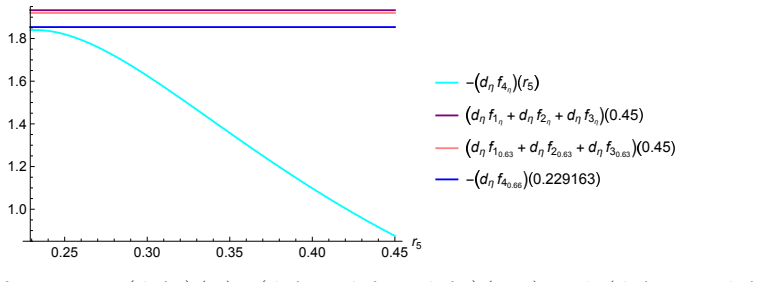
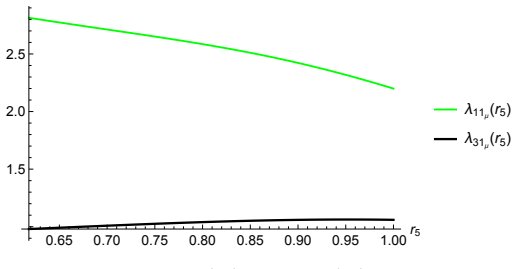
- [Properties 5.4–5.9] The properties are asserted "through straightforward computation" with decimal bounds such as e3η(r5η)≤1.0696, r*5(0)=0.417957, and r̂5(0)=0.156497, but no derivations or interval certificates are provided. The underlying functions e_iη and f_iη are never defined in the paper. Since the paper claims an entirely analytical proof but relies on these unverified decimal assertions, the rigor of the subsequent estimates cannot be assessed.
minor comments (4)
- [Introduction and Section 1] The phrase "can be consulted oin the supplementary material" contains a typo; it should read "in the supplementary material."
- [Section 6] The conclusion states that "The proof of Theorem 5.1 follows from the propositions discussed in Subsection 5.2," but the propositions in Subsection 5.2 concern the uniqueness assertion of Theorem 5.2, not the existence statement of Theorem 5.1.
- [References] The citation numbering is inconsistent: Euler's work is cited as [28] in the introduction, while [28] in the reference list is a 2015 paper by Zhao and Chen; the reference for Euler's paper should be corrected.
- [Abstract] The abstract states the approach is "entirely analytical, relying on algebraic techniques rather than numerical approximations," but the proof uses many decimal numerical bounds without rigorous interval arithmetic or rational-certified estimates; the wording should be clarified.
Circularity Check
No circularity: the uniqueness claim is derived from the Newtonian central-configuration equations, not from its own conclusion; deferred verifications and numerical gaps are correctness concerns, not circularity.
full rationale
The derivation is not circular in any of the relevant senses. Star central configurations are defined in Definition 2.2 by equal angular spacing 2π/n with variable radii, and the reduced system (4.2) is obtained by substituting the polar-coordinate ansatz (2.3) into the Newtonian equations (4.1); no parameter is fitted to the target result and no prediction is renamed from data. The regular pentagon is checked locally by an explicit Hessian computation in Theorem 5.1, and the uniqueness claim is benchmarked against the independent, external computer-assisted classification of Moczurad and Zgliczynski [15], which is cited for context rather than used as the load-bearing argument. The paper's genuine weaknesses are incompleteness and possible numerical error, not circularity: Section 1 states 'the details for the rest of the subregions can be consulted in the supplementary material' while only J1 is shown; Properties 5.4–5.9 are asserted 'through straightforward computation' without derivations or interval certificates; and Proposition 5.13 contains a suspicious comparison in which L1660.037(0.5) = 18.40326 is used to bound (dηf2 0.037)''(0.54) = 9.60098, with 18.40326 > 9.60098. These are gaps in rigor or possible errors, but they do not amount to the conclusion being assumed in the hypotheses. There are no self-citations, no imported uniqueness theorem from the authors' prior work, and no definition that encodes the regular pentagon by construction. Hence the circularity score is 0.
Assumptions & free parameters
free parameters (3)
- Monotonicity splitting points r*_5(eta) and r-hat_5(eta) =
r*_5(0)=0.417957, r*_5(0.02)=0.397798, r-hat_5(0)=0.156497, r-hat_5(0.02)=0.148828
- Decimal bound constants for auxiliary functions =
For example, max e3 <= 1.0696; 3.413203, 1.90132, 0.83961, 3.51384, 1.92656, 1.05376 in Proposition 5.10
- Lower bound constant in Proposition 5.28 =
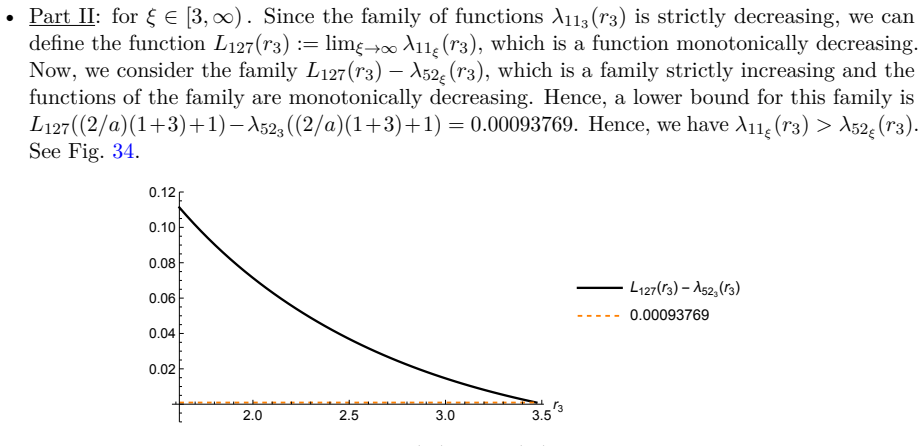
0.00093769
assumptions (4)
- standard math Newtonian gravitational equations and central configuration definitions (Eqs. 2.1-2.2)
- domain assumption Star ansatz: equal angular spacing theta_i = 2*pi*(i-1)/n with free radial distances
- domain assumption Center-of-mass reduction to two variables (r3, r5) and the domain S-hat with inequalities r5 > r3 - b/2 and r5 > (a/2)(r3 - 1)
- ad hoc to paper Correctness of Properties 5.4-5.9 and of the J2-J16 region verifications
Cite this review
Pith. "Pith review of Uniqueness of star central configurations in the $5$-body problem." pith.science (2026). https://pith.science/paper/HMKKEJ6A
@misc{pith2026250516101,
  author       = {Pith},
  title        = {Pith review of: Uniqueness of star central configurations in the $5$-body problem},
  year         = {2026},
  howpublished = {\url{https://pith.science/paper/HMKKEJ6A}},
  note         = {Machine review of arXiv:2505.16101}
}
read the original abstract
In this study, we present a rigorous analytical proof of the uniqueness of central configurations for the five-body problem, assuming that all five masses are equal and positioned at the vertices of a planar polygon. We consider configurations in which the bodies are equally spaced in angular position relative to the center of mass, and aim to determine whether a central configuration arises under these constraints. We prove that the only central configuration that satisfies these conditions occurs when the five bodies form a regular pentagon. Our approach is entirely analytical, relying on algebraic techniques rather than numerical approximations. By transforming the governing equations into a reduced system involving only two variables, we analyze the solution space over a significant and carefully bounded domain. This domain is divided into sixteen disjoint regions, within which we rule out additional solutions through explicit algebraic arguments. Our results confirm that the regular pentagonal configuration is the only central configuration in this symmetric five-body scenario.
Figures


Figures from the paper (26 more)







Reference graph
Works this paper leans on
-
[1]
A. Albouy. Sym´ etrie des configurations centrales de quatre corps.C. R. Acad. Sci. Paris S´ er. I Math., 320(2):217–220, 1995. 36
work page 1995
- [2]
-
[3]
Albouy and V
A. Albouy and V. Kaloshin. Finiteness of central configurations of five bodies in the plane. Ann. of Math. (2) , 176(1):535–588, 2012
2012
-
[4]
M. Alvarez-Ram´ ırez, A. Gasull, and J. Llibre. On the equilateral pentagonal central configura- tions. Commun. Nonlinear Sci. Numer. Simul. , 112:Paper No. 106511, 12, 2022
work page 2022
-
[5]
M. Alvarez-Ram´ ırez and J. Llibre. The symmetric central configurations of the 4-body problem with masses m1 =m2̸=m3 =m4. Appl. Math. Comput. , 219(11):5996–6001, 2013
work page 2013
-
[6]
A simpler proof of regular polygon solutions of the N-body problem
A. Chenciner. Comment on: “A simpler proof of regular polygon solutions of the N-body problem” [Phys. Lett. A 277 (2000), no. 3, 156–158; MR1808487 (2002b:70019)] by Z. Xie and S. Zhang. Phys. Lett. A , 300(1):101–102, 2002
work page 2000
-
[7]
A. Chenciner, R. Cushman, C. Robinson, and Z. J. Xia, editors. Celestial mechanics, volume 292 of Contemporary Mathematics. American Mathematical Society, Providence, RI, 2002. Dedicated to Donald Saari for his 60th birthday
work page 2002
-
[8]
Y. Deng and M. Hampton. Equilateral chains and cyclic central configurations of the planar five-body problem. J. Nonlinear Sci. , 33(1):Paper No. 4, 18, 2023
work page 2023
Show all 28 references
-
[9]
L. Euler. Considerationes de motu corporum coelestium. Novi commentarii academiae scien- tiarum Petropolitanae, 10:544–558, 1754
-
[10]
Hampton and R
M. Hampton and R. Moeckel. Finiteness of relative equilibria of the four-body problem. Invent. Math., 163(2):289–312, 2006
2006
-
[11]
Lagrange
J.-L. Lagrange. Essai sur le probl´ eme des trois corps. Prix de l’Acad´ emie Royale des Sciences de Paris, 9:229–331, 1772
-
[12]
Lei and M
J. Lei and M. Santoprete. Rosette central configurations, degenerate central configurations and bifurcations. Celestial Mech. Dynam. Astronom. , 94(3):271–287, 2006
2006
-
[13]
Llibre and L
J. Llibre and L. F. Mello. New central configurations for the planar 5-body problem. Celestial Mechanics and Dynamical Astronomy, 100(2):141–149, 2008
2008
-
[14]
Long and S
Y. Long and S. Sun. Four-body central configurations with some equal masses. Arch. Ration. Mech. Anal., 162(1):25–44, 2002
2002
-
[15]
M. g. Moczurad and P. Zgliczy´ nski. Central configurations in planarn-body problem with equal masses for n = 5, 6, 7. Celestial Mech. Dynam. Astronom. , 131(10):Paper No. 46, 28, 2019
2019
-
[16]
R. Moeckel. Central configurations. In Central configurations, periodic orbits, and Hamiltonian systems, Adv. Courses Math. CRM Barcelona, pages 105–167. Birkh¨ auser/Springer, Basel, 2015
2015
-
[17]
Moeckel and C
R. Moeckel and C. Sim´ o. Bifurcation of spatial central configurations from planar ones. SIAM J. Math. Anal. , 26(4):978–998, 1995
1995
-
[18]
F. R. Moulton. The straight line solutions of the problem of n bodies. Ann. of Math. (2) , 12(1):1–17, 1910. 37
1910
-
[19]
Perez-Chavela and M
E. Perez-Chavela and M. Santoprete. Convex four-body central configurations with some equal masses. Arch. Ration. Mech. Anal., 185(3):481–494, 2007
2007
-
[20]
L. M. Perko and E. L. Walter. Regular polygon solutions of the N-body problem. Proc. Amer. Math. Soc., 94(2):301–309, 1985
1985
-
[21]
C. Sim´ o. Dynamical properties of the figure eight solution of the three-body problem. In Celestial mechanics (Evanston, IL, 1999) , volume 292 of Contemp. Math., pages 209–228. Amer. Math. Soc., Providence, RI, 2002
1999
-
[22]
S. Smale. Mathematical problems for the next century. In Mathematics: frontiers and perspectives, pages 271–294. Amer. Math. Soc., Providence, RI, 2000
2000
-
[23]
Xie and S
Z. Xie and S. Zhang. A simpler proof of regular polygon solutions of the N-body problem. Phys. Lett. A , 277(3):156–158, 2000
2000
-
[24]
Yu and S
X. Yu and S. Zhang. Twisted angles for central configurations formed by two twisted regular polygons. J. Differential Equations , 253(7):2106–2122, 2012
2012
-
[25]
Yu and S
X. Yu and S. Zhang. Central configurations formed by two twisted regular polygons. Journal of Mathematical Analysis and Applications , 425(1):372–380, 2015
2015
-
[26]
Zhang and Q
S. Zhang and Q. Zhou. Nested regular polygon solutions for planar 2 N-body problems. Sci. China Ser. A , 45(8):1053–1058, 2002
2002
-
[27]
Zhang and Q
S. Zhang and Q. Zhou. Periodic solutions for planar 2 N-body problems. Proc. Amer. Math. Soc., 131(7):2161–2170, 2003
2003
-
[28]
Zhao and J
F. Zhao and J. Chen. Central configurations for ( pN +gN )-body problems. Celestial Mech. Dynam. Astronom., 121(1):101–106, 2015. 38
2015
Reviewed August 7, 2026 · model on record in the stance chip above.
Discussion (0). Continue with ORCID to comment.