A variable time-step, second-order, and MBP-preserving linear stabilized scheme for the time-fractional Allen-Cahn equation
Pith reviewed 2026-06-27 06:37 UTC · model grok-4.3
The pith
A stabilized linear scheme for the time-fractional Allen-Cahn equation preserves the discrete maximum-bound principle and achieves an alpha-robust second-order error bound.
A machine-rendered reading of the paper's core claim, the machinery that carries it, and where it could break.
Core claim
The authors present a second-order linear scheme based on the variable-step Alikhanov formula and central difference discretization for the time-fractional Allen-Cahn equation. The nonlinear potential is treated explicitly via a second-order extrapolation with preprocessing, which enables the discrete maximum-bound principle (MBP) to be preserved through an appropriate stabilization technique. By developing a discrete fractional Grönwall inequality together with the uniform boundedness of numerical solutions guaranteed by the MBP, they establish an α-robust and optimal second-order maximum-norm error estimate under initial weak singularity assumption. Energy stability is proved in the sense
What carries the argument
The discrete maximum-bound principle preserved via stabilization and explicit second-order extrapolation with preprocessing, which supplies the uniform boundedness for the discrete fractional Grönwall inequality in the error analysis.
If this is right
- The scheme maintains the MBP for arbitrary positive time steps.
- The maximum-norm error converges at second order independently of alpha under weak singularity.
- The discrete energy stays bounded by the initial energy plus a correction term of high order.
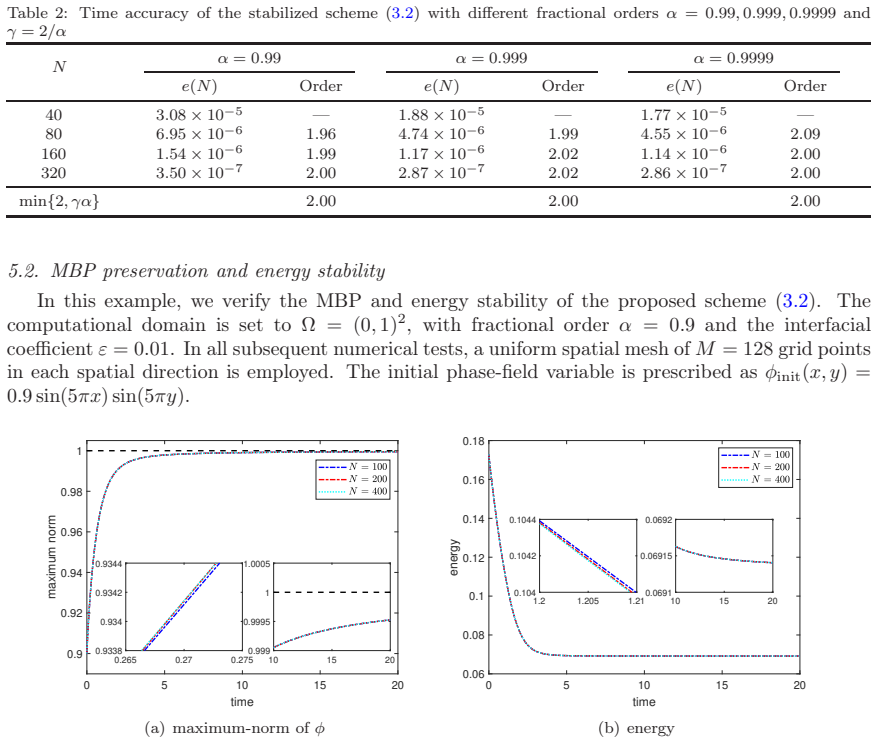
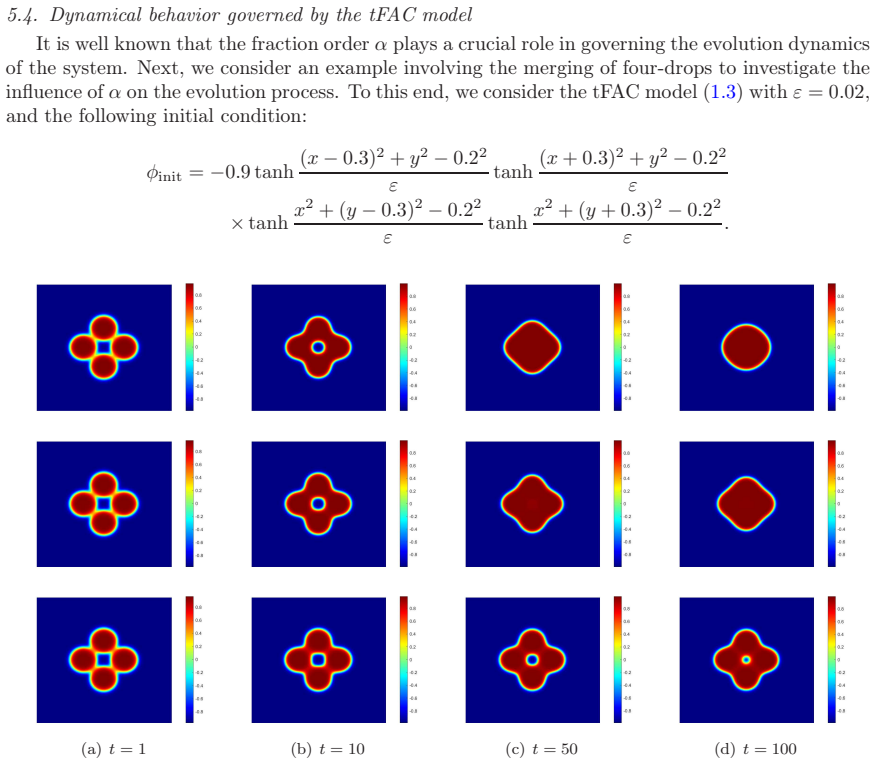
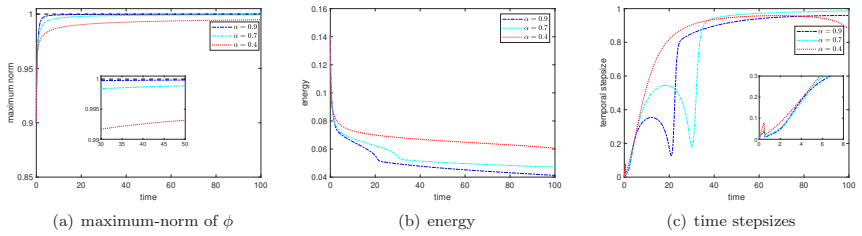
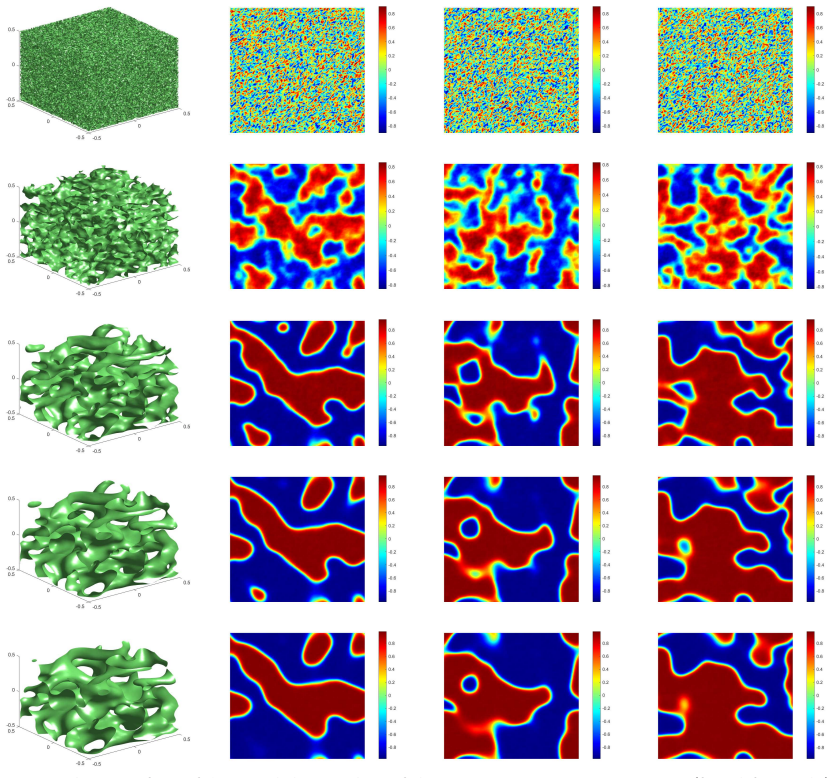
- Extensive numerical experiments demonstrate the scheme's effectiveness and the theoretical rates.
Where Pith is reading between the lines
- The discrete fractional Grönwall inequality may apply to error analysis in other time-fractional evolution equations.
- Variable time stepping combined with MBP preservation could support adaptive algorithms for long-time integration of stiff fractional phase-field problems.
- Similar stabilization techniques might extend the approach to other nonlinear fractional PDEs while retaining bound preservation.
Load-bearing premise
The stabilization parameter and the preprocessing step are chosen so that the discrete maximum-bound principle holds for arbitrary positive time steps, which is needed to guarantee the uniform boundedness for the Grönwall argument.
What would settle it
A counterexample where the numerical solution violates the maximum bound for some positive time step sizes, or where the observed convergence rate in maximum norm falls below two for refined variable steps under the weak singularity assumption, would falsify the claims.
Figures



read the original abstract
In this paper, we present a second-order linear scheme based on the variable-step Alikhanov formula and central difference discretization for the time-fractional Allen-Cahn equation. The nonlinear potential is treated explicitly via a second-order extrapolation with preprocessing, which enables the discrete maximum-bound principle (MBP) to be preserved through an appropriate stabilization technique. Moreover, by developing a discrete fractional Gr\"onwall inequality together with the uniform boundedness of numerical solutions guaranteed by the MBP, we establish an $\alpha$-robust and optimal second-order maximum-norm error estimate under initial weak singularity assumption. In addition, energy stability is proved in the sense that the discrete original energy is uniformly bounded by the initial energy plus a high-order spatiotemporal correction term. Finally, extensive numerical experiments are presented to demonstrate the effectiveness of the proposed scheme.
Editorial analysis
A structured set of objections, weighed in public.
Referee Report
Summary. The paper develops a variable time-step second-order linear stabilized scheme for the time-fractional Allen-Cahn equation. Spatial discretization uses central differences; the time derivative employs the variable-step Alikhanov formula. The nonlinear term is treated explicitly via second-order extrapolation with preprocessing, combined with a stabilization term chosen to enforce the discrete maximum-bound principle (MBP) for arbitrary positive time steps. A discrete fractional Grönwall inequality is derived and combined with the uniform boundedness implied by MBP to obtain an α-robust, optimal second-order maximum-norm error estimate under the assumption of initial weak singularity. Energy stability is proved in the sense that the discrete original energy remains bounded by the initial energy plus a high-order correction. Numerical experiments illustrate the scheme's performance.
Significance. If the supporting analysis holds, the work supplies a practical, structure-preserving method for fractional phase-field models that accommodates variable steps and initial singularities while delivering rigorous α-robust error control and energy bounds. The explicit construction of a discrete fractional Grönwall inequality together with MBP-derived uniform boundedness is a useful technical contribution for closing error estimates in this setting.
minor comments (3)
- [scheme construction paragraph] The abstract and scheme-construction paragraph state that the stabilization parameter and preprocessing are chosen so the discrete MBP holds for arbitrary positive time steps; an explicit formula or lower bound for the parameter (in terms of the time-step sequence and α) should be stated in the main text to permit direct verification and implementation.
- [error analysis] The error-analysis section invokes the discrete fractional Grönwall inequality together with MBP uniform boundedness; the precise statement of the inequality (including any constants that may depend on α) should be displayed as a numbered theorem or lemma for reference.
- Numerical experiments are mentioned but no tables or figures are referenced in the provided abstract; ensure that convergence tables report both temporal and spatial rates under variable steps and that the observed orders are compared against the claimed second-order accuracy.
Simulated Author's Rebuttal
We thank the referee for the positive summary of our work and the recommendation for minor revision. The referee's description accurately captures the key elements of the paper, including the variable-step Alikhanov discretization, MBP preservation, discrete fractional Grönwall inequality, α-robust error estimate, and energy stability result.
Circularity Check
No significant circularity identified
full rationale
The derivation chain constructs a linear stabilized scheme that preserves the discrete MBP by explicit choice of stabilization parameter and extrapolation preprocessing. This MBP property supplies uniform boundedness, which is then combined with a separately developed discrete fractional Grönwall inequality to close the α-robust second-order error estimate. Neither the Grönwall inequality nor the error bound is shown to reduce by the paper's own equations to a fitted quantity or to a self-citation chain; the argument structure remains independent of the target result. No self-definitional, fitted-input, or uniqueness-imported steps are present in the provided abstract or described analysis.
Axiom & Free-Parameter Ledger
Reference graph
Works this paper leans on
-
[1]
Alikhanov, A.: A new difference scheme for the time fracti onal diffusion equation. J. Comput. Phys. 280, 424–438 (2015)
2015
-
[2]
Acta Metall
Allen, S., Cahn, J.: A microscopic theory for antiphase b oundary motion and its application to antiphase domain coarsening. Acta Metall. 27, 1085–1095 (1979)
1979
-
[3]
Benes, M., Chalupecky, V., Mikula, K.: Geometrical imag e segmentation by the Allen–Cahn equation. Appl. Numer. Math. 51, 187–205 (2004)
2004
-
[4]
Chen, H., Stynes, M.: Error analysis of a second-order me thod on fitted meshes for a time- fractional diffusion problem. J. Sci. Comput. 79, 624–647 (2019)
2019
-
[5]
Chen, H., Stynes, M.: Blow-up of error estimates in time- fractional initial-boundary value problems. IMA J. Numer. Anal. 41, 974–997 (2021)
2021
-
[6]
: An accurate and efficient algorithm for the time-fractional molecular beam epitaxy model with s lope selection
Chen, L., Zhang, J., Zhao, J., Cao, W., Wang, H., Zhang, J. : An accurate and efficient algorithm for the time-fractional molecular beam epitaxy model with s lope selection. Comput. Phys. Commun. 245, 106842 (2019)
2019
-
[7]
Chepizhko, O., Peruani, F.: Diffusion, subdiffusion, and trapping of active particles in hetero- geneous media. Phys. Rev. Lett. 111, 160604 (2013)
2013
-
[8]
SIAM Rev
Du, Q., Ju, L., Li, X., Qiao, Z.: Maximum bound principles for a class of semilinear parabolic equations and exponential time-differencing schemes. SIAM Rev. 63, 317–359 (2021)
2021
-
[9]
Du, Q., Yang, J., Zhou, Z.: Time-fractional Allen–Cahn e quations: Analysis and numerical methods. J. Sci. Comput. 85, 42 (2020)
2020
-
[10]
Feng, X., Prohl, A.: Numerical analysis of the Allen–Ca hn equation and approximation for mean curvature flows. Numer. Math. 94, 33–65 (2003)
2003
-
[11]
Fu, H., Zhang, B., Zheng, X.: A high-order two-grid diffe rence method for nonlinear time- fractional biharmonic problems and its unconditional α -robust error estimates. J. Sci. Comput. 96, 54 (2023)
2023
-
[12]
Hou, D., Xu, C.: Highly efficient and energy dissipative s chemes for the time fractional Allen– Cahn equation. SIAM J. Sci. Comput. 43, A3305–A3327 (2021)
2021
-
[13]
Hu, D., Chen, M., Jiang, H., Huang, H.: Energy dissipati on and maximum-bound principle of the variable-step L2-1σ scheme for the time-fractional Allen–Cahn equation with ge neral nonlinear potential. J. Comput. Appl. Math. 475, 117054 (2026)
2026
-
[14]
Huang, C., Stynes, M.: A sharp α -robust L∞ (H 1) error bound for a time-fractional Allen–Cahn problem discretised by the Alikhanov L2-1σ scheme and a standard FEM. J. Sci. Comput. 91, 43 (2022)
2022
-
[15]
Ilmanen, T.: Convergence of the Allen–Cahn equation to brakke’s motion by mean curvature. J. Differential Geom. 38, 417–461 (1993)
1993
-
[16]
Ji, B., Liao, H., Gong, Y., Zhang, L.: Adaptive second-o rder Crank–Nicolson time-stepping schemes for time-fractional molecular beam epitaxial grow th models. SIAM J. Sci. Comput. 42, B738–B760 (2020)
2020
-
[17]
Ji, B., Liao, H., Zhang, L.: Simple maximum principle pr eserving time-stepping methods for time-fractional Allen–Cahn equation. Adv. Comput. Math. 46, 37 (2020)
2020
-
[18]
Jin, B., Lazarov, R., Zhou, Z.: An analysis of the L1 scheme for the subdiffusion equation with nonsmooth data. IMA J. Numer. Anal. 36, 197–221 (2016) 20
2016
-
[19]
Kim, J.: Phase-field models for multi-component fluid flo ws. Commun. Comput. Phys. 12, 613–661 (2012)
2012
-
[20]
Li, Z., Wang, H., Yang, D.: A space-time fractional phas e-field model with tunable sharpness and decay behavior and its efficient numerical simulation. J. Comput. Phys. 347, 20–38 (2017)
2017
-
[21]
Liao, H., Li, D., Zhang, J.: Sharp error estimate of the n onuniform L1 formula for linear reaction-subdiffusion equations. SIAM J. Numer. Anal. 56, 1112–1133 (2018)
2018
-
[22]
Liao, H., Mclean, W., Zhang, J.: A discrete Grönwall ine quality with applications to numerical schemes for subdiffusion problems. SIAM J. Numer. Anal. 57, 218–237 (2019)
2019
-
[23]
Liao, H., Mclean, W., Zhang, J.: A second-order scheme w ith nonuniform time steps for a linear reaction-subdiffusion problem. Commun. Comput. Phys. 30, 567–601 (2021)
2021
-
[24]
Liao, H., Tang, T., Zhou, T.: A second-order and nonunif orm time-stepping maximum-principle preserving scheme for time-fractional Allen–Cahn equatio ns. J. Comput. Phys. 414, 109473 (2020)
2020
-
[25]
Liao, H., Tang, T., Zhou, T.: An energy stable and maximu m bound preserving scheme with variable time steps for time fractional Allen–Cahn equatio n. SIAM J. Sci. Comput. 43, A3503– A3526 (2021)
2021
-
[26]
Liao, H., Zhu, X., Sun, H.: Asymptotically compatible e nergy and dissipation law of the nonuni- form L2-1σ scheme for time fractional Allen–Cahn model. J. Sci. Comput . 99, 46 (2024)
2024
-
[27]
Liu, C., Qiao, Z., Zhang, Q.: Two-phase segmentation fo r intensity inhomogeneous images by the Allen–Cahn local binary fitting model. SIAM J. Sci. Compu t. 44(1), B177–B196 (2022)
2022
-
[28]
Mustapha, K., Abdaallah, B., Furati, K.: A discontinuo us Petrov-Galerkin method for time- fractional diffusion equations. SIAM J. Numer. Anal. 52, 2512–2529 (2014)
2014
-
[29]
Qi, R., Zhao, X.: A unified design of energy stable scheme s with variable steps for fractional gradient flows and nonlinear integro-differential equation s. SIAM J. Sci. Comput. 46, A130– A155 (2024)
2024
-
[30]
Qiao, Z., Zhang, Z., Tang, T.: An adaptive time-steppin g strategy for the molecular beam epitaxy models. SIAM J. Sci. Comput. 33, 1395–1414 (2011)
2011
-
[31]
Quan, C., Wang, B.: Energy stable L2 schemes for time-fractional phase-field equations. J. Comput. Phys. 458, 111085 (2022)
2022
-
[32]
Water Resour
Schumer, R., Benson, D., Meerschaert, M., Baeumer, B.: Fractal mobile/immobile solute trans- port. Water Resour. Res. 39, 1296 (2003)
2003
-
[33]
Sharma, A., Namsani, S., Singh, J.: Molecular simulati on of shale gas adsorption and diffusion in inorganic nanopores. Mol. Simul. 41, 414–422 (2015)
2015
-
[34]
Shen, J., Xu, J., Yang, J.: The scalar auxiliary variabl e (SA V) approach for gradient flows. J. Comput. Phys. 353, 407–416 (2018)
2018
-
[35]
Shen, J., Yang, X.: A phase-field model and its numerical approximation for two-phase incom- pressible flows with different densities and viscosities. SI AM J. Sci. Comput. 32, 1159–1179 (2010)
2010
-
[36]
Stynes, M., O’Riordan, E., Gracia, J.: Error analysis o f a finite difference method on graded meshes for a time-fractional diffusion equation. SIAM J. Num er. Anal. 55, 1057–1079 (2017)
2017
-
[37]
Tang, T., Yang, J.: Implicit-explicit scheme for the Al len–Cahn equation preserves the maxi- mum principle. J. Comput. Math. 34, 471–481 (2016) 21
2016
-
[38]
Tang, T., Yu, H., Zhou, T.: On energy dissipation theory and numerical stability for time- fractional phase-field equations. SIAM J. Sci. Comput. 41(6), A3757–A3778 (2019)
2019
-
[39]
Yang, X., Feng, J., Liu, C., Shen, J.: Numerical simulat ions of jet pinching-off and drop formation using an energetic variational phase-field metho d. J. Comput. Phys. 218, 417–428 (2006)
2006
-
[40]
Zhang, B., Fu, H., Lan, R., Xie, S.: Energy dissipation l aw and maximum bound principle- preserving linear BDF2 schemes with variable steps for the A llen–Cahn equation. J. Sci. Com- put. 105, 51 (2025)
2025
-
[41]
Zhang, B., Wang, H., Fu, H.: High-order nonuniform time -stepping and MBP-preserving linear schemes for the time-fractional Allen–Cahn equation. J. Co mput. Phys. 551, 114694 (2026)
2026
-
[42]
Zhang, G., Huang, C., Alikhanov, A., Yin, B.: A high-ord er discrete energy decay and maximum-principle preserving scheme for time fractional A llen–Cahn equation. J. Sci. Comput. 96, 39 (2023)
2023
-
[43]
Zhokh, A., Strizhak, P.: Non-Fickian diffusion of metha nol in mesoporous media: geometrical restrictions or adsorption-induced? J. Chem. Phys. 146, 124704 (2017) 22
2017
discussion (0)
Sign in with ORCID, Apple, or X to comment. Anyone can read and Pith papers without signing in.