REVIEW 4 major objections 5 minor 31 references
Exploiting Scaling Laws for Polymeric Bottle Brushes: a Theoretical Coarse-Graining for Homopolymeric Branched Polymers
T0 review · 4 major / 5 minor · reviewed 2026-08-14 · deepseek-v4-flash
Pith's one-line read A bottle brush made of tens of thousands of monomers can be replaced by a short chain of spherical star-polymer beads whose interactions depend only on grafting density and side-chain length.
desk verdict Plausible coarse-graining with new analytic scaling forms, but the validation is circular and Eq (7) as printed appears inverted — needs a serious referee, not a desk reject. read the letter →
The pith
A machine-rendered reading of the paper's core claim, the machinery that carries it, and where it could break.
The reading
What carries the argument
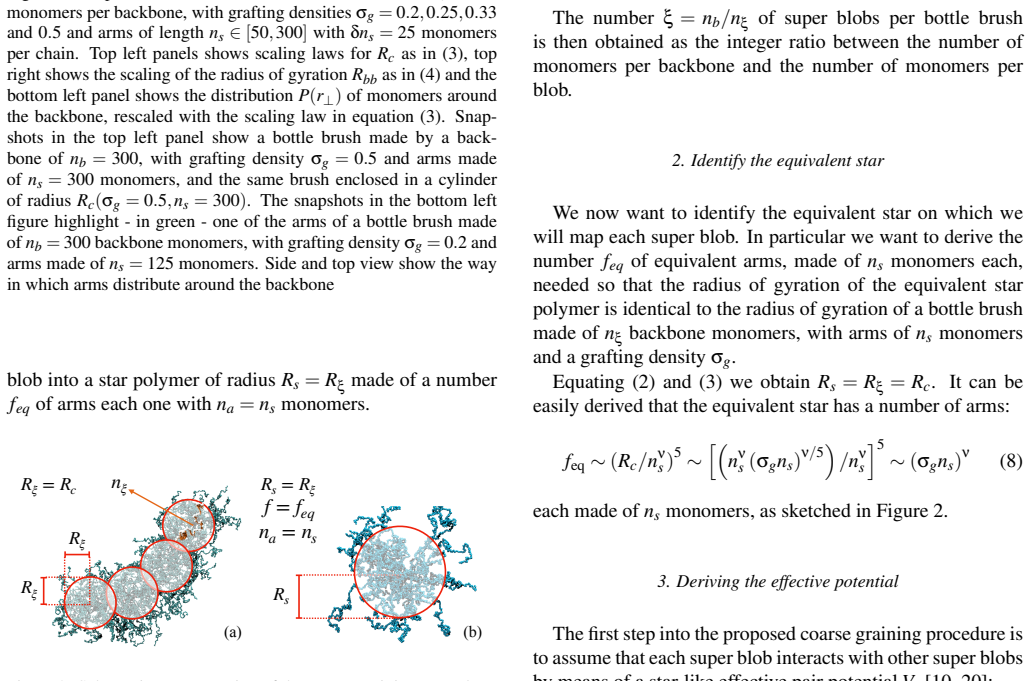
The machinery is the super-blob decomposition. A bottle brush is cut into $\xi$ identical spherical super blobs of radius $R_\xi = R_c$, where $R_c$ is the average distance of arm monomers from the backbone and scales as $R_c \sim n_s^\nu (\sigma_g n_s)^{\nu/5}$; imposing $R_\xi = R_c$ fixes the number $n_\xi$ of backbone monomers per blob, and matching each blob to a star of radius $R_c$ fixes $f_{\mathrm{eq}} = (\sigma_g n_s)^\nu$. The effective bead-bead potential is $V_\xi(r) = V_s(r) + k(r - r_0)^2$, with $V_s$ the star-star potential, $k = (5/18)\sigma_g^2 n_s$, and $r_0 = (4/3)R_c$. This single functional form carries the argument because it has no free fit parameters once the microscopic pair $(\sigma_g, n_s)$ is chosen.
What would settle it
Simulate isolated bottle-brush sub-segments of exactly $n_\xi$ backbone monomers, as defined by the scaling condition, for several $(\sigma_g, n_s)$ combinations and compare their measured radius of gyration $R_\xi$ to the cylinder radius $R_c$ used in the mapping; a systematic departure would mean the super-blob size and the equivalent star parameters are not well defined and the coarse-graining cannot be generalized.
Extended reading notes
Core claim
The paper's central claim is that a bottle brush, a linear backbone with densely grafted side chains, carries a hidden spherical substructure: sub-segments of the backbone of length $n_\xi$ have a radius of gyration $R_\xi$ equal to the brush's cylindrical radius $R_c$. Because of that equality, each sub-segment can be replaced by an equivalent star polymer with $f_{\mathrm{eq}} = (\sigma_g n_s)^\nu$ arms of length $n_s$, and the whole brush becomes a linear chain of $\xi = n_b/n_\xi$ beads. The effective interaction between two beads is the sum of the known star-star repulsive potential and a harmonic tether with spring constant $k = (5/18)\sigma_g^2 n_s$ and rest length $r_0 = (4/3)R_c$, so the coarse-grained force field depends only on grafting density $\sigma_g$ and side-chain length $n_s$. The authors show that this coarse-grained chain reproduces the bottle-brush radius of gyration $R_{bb} \sim n_b^\nu (1+\sigma_g n_s)^\nu (\sigma_g n_s)^{-2\nu/5}$ quantitatively, with all data collapsing onto the predicted master curve.
Load-bearing premise
The whole mapping rests on the assumption that a sub-segment of the brush only $n_\xi$ backbone monomers long obeys the same scaling law as the complete brush, so that its radius of gyration equals the cylinder radius; if short-segment scaling fails, the blob size and the equivalent star have no well-defined values.
Editorial extensions
If this is right
- For any homopolymeric bottle brush under good solvent conditions, the radius of gyration can be computed from a chain of a few effective beads rather than from all monomeric units, cutting the computational cost dramatically.
- The same effective potential can be applied to longer backbones by increasing the number $\xi$ of beads, so the method is transferable to molecular weights that would be prohibitive in full-monomer simulation.
- The extrapolation to a grafting density not included in the potential derivation still falls on the master curve, indicating predictive power for stiffer brushes.
- Because each bead's potential is controlled by the local $(\sigma_g, n_s)$, the coarse-graining can be generalized to polydisperse or blocky brushes by chaining stars with different radii and spring constants.
Reading between the lines
- If the mapping survives finite-density conditions, the same bead-chain model should make the study of bottle-brush solutions, adsorption, and self-assembly accessible, since those regimes are currently out of reach for monomer-resolved simulation.
- The explicit spring constant $k \propto \sigma_g^2 n_s$ implies that the effective backbone stiffness is set by the same two parameters; measuring the persistence length of the coarse-grained chain could give a direct test of how the flexible-to-rigid crossover of bottle brushes emerges from scaling.
- The super-blob logic may transfer to other cylindrical polymer assemblies, such as DNA-protein filaments or cylindrical micelles, whenever an equivalent cylinder radius can be defined by scaling, providing a ready-made coarse-graining in those contexts.
- A quantitative test of the potential at intermediate blob counts could reveal whether the super-blob scaling assumption, rather than the star potential, is the limiting factor in matching full-monomer data.
Signed reviews
Editorial analysis
A structured set of objections, weighed in public.
Referee Report
Summary. This manuscript proposes an analytical coarse-graining scheme for homopolymeric bottle brushes in good solvent. The backbone is divided into ξ super-blobs of nξ monomers chosen so that the sub-segment radius of gyration equals the cylinder radius Rc; each blob is mapped to a star polymer with feq=(σg ns)^ν arms of length ns; neighbouring blobs interact via a known star-star potential plus a fitted harmonic tether with k=(5/18)σ_g^2 n_s and r0=σc=(4/3)Rc. The authors run coarse-grained MD simulations of chains of ξ beads, convert ξ to nb via Eq. (12), and test the radius of gyration against the scaling relation Eq. (4) in Figure 4, claiming quantitative agreement with full-monomer MD and scaling predictions.
Significance. If the mapping were quantitatively validated, the scheme would be a useful transferable coarse-graining tool: it reduces a bottle brush of 10^3–10^5 monomers to a short chain of star-like beads whose interactions have a closed analytical form in terms of σg and ns. The manuscript is clearly written, and the scaling algebra leading to nξ and feq is elegant; the mastercurve collapse in Figure 4 is a useful internal consistency check. However, the validation currently rests on an identity, and the absolute comparison to full-monomer simulations is not shown directly. The paper is therefore promising but requires a substantially strengthened validation before the quantitative claims can be accepted.
major comments (4)
- [Results and Discussion, Eq. (7)] Equation (7) as printed does not follow from setting Rξ=Rc in Eq. (4). Solving nξ^ν (1+σg ns)^ν (σg ns)^{-2ν/5} = Rc gives nξ ∼ Rc^{1/ν} (1+σg ns)^{-1} (σg ns)^{2/5}; the exponents on the two (σg,ns) factors are inverted in the manuscript. Since Eq. (12) repeats this expression, the x-axis mapping in Figure 4 is inconsistent with Eq. (15) if the printed formula is used literally. The reported collapse in Figure 4 suggests that the corrected expression was actually used in the analysis, so the formulas in Eqs. (7) and (12) must be corrected and the analysis rerun or confirmed.
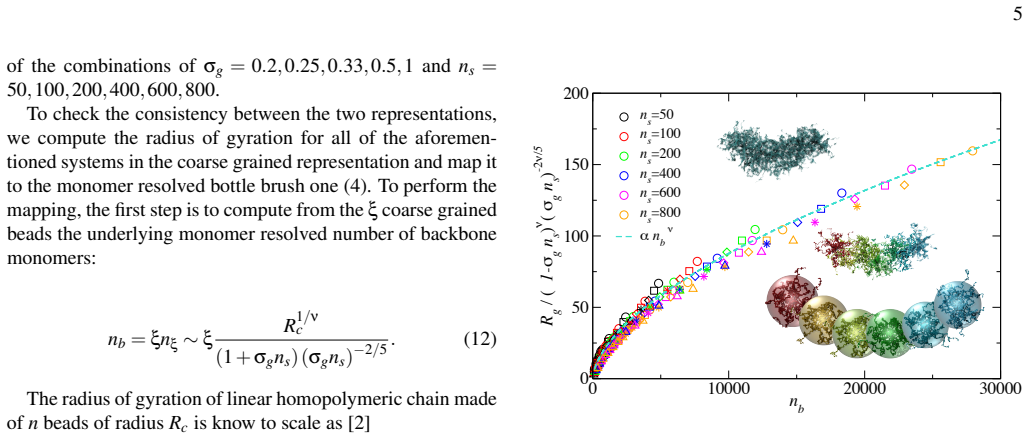
- [Testing the coarse graining procedure, Eqs. (13)–(15) and Fig. 4] The validation is circular with respect to the central claim. nξ is defined by imposing Rξ=Rc via Eq. (4), and feq is defined by equating the star radius to Rc; therefore any coarse-grained chain that obeys the generic polymer scaling Rg∼Rc ξ^ν (Eq. 13) satisfies Eq. (14) identically, independent of the specific forms of Vs (Eq. 9) and Φth (Eq. 11). Figure 4 thus tests the blob-counting algebra and the Flory exponent, not whether the effective potentials reproduce the absolute bottle-brush radius. Moreover, the line in Fig. 4 is α nb^ν with α a fitting constant, so the prefactor is not predicted. The full-monomer Rbb data from Figure 1(b) are never overlaid on Figure 4, so the abstract and conclusions claim of quantitative agreement with full-monomer MD is not directly evidenced. A direct overlay on the same reduced axes, with no fitted α or with α predicted from the model, is required.
- [Results and Discussion, 'Counting the number of super blobs'] The construction assumes that a sub-segment of only nξ backbone monomers obeys the asymptotic scaling law Eq. (4). With the corrected Eq. (7), nξ is of order 10–20 at the lower end of the parameter range (e.g., σg=0.5, ns=50 gives nξ≈13), so the use of the full-brush scaling law at this length scale is not self-evident. The authors do not test whether the radius of gyration of such truncated subsegments actually equals Rc in the full-monomer simulations. If Eq. (4) fails for short sub-chains, then nξ, ξ, and feq are not well defined and the mapping breaks down. A direct check of the sub-segment radius for the shortest nξ values is needed.
- [Results and Discussion, Eq. (11) and Fig. 4] The predictive content of the comparison is further weakened by the number of fitted quantities. The tether parameters k and r0 are obtained by fitting the same full-monomer simulations that later serve as the benchmark, and the collapse in Fig. 4 uses a fitted prefactor α. The claim of a general, transferable coarse-graining is therefore not supported by the current validation. At minimum the paper should state explicitly that α absorbs the unknown prefactor of Eq. (4), and it should perform a blind test in which α is fixed on a training subset (or predicted) and compared with the remaining data, including the σg=1 case.
minor comments (5)
- [Figure 4 and Eq. (15)] The y-axis label in Figure 4 and the surrounding text contain a minus sign, writing (1−σg ns)^ν, while Eq. (15) correctly has (1+σg ns)^ν; this typo should be corrected.
- [Eq. (11)] The notation "k = 5/18σ2 gns" is ambiguous; the intended expression is k=(5/18)σ_g^2 n_s, as confirmed by the fit in Figure 3(b), and it should be written with parentheses.
- [Results and Discussion, 'Identify the equivalent star'] The sentence "Equating (2) and (3) we obtain Rs = Rξ = Rc" is imprecise: Eq. (2) gives the star radius and Eq. (3) gives the cylinder radius, so Rs=Rc is a modelling choice, not a direct algebraic consequence of equating the two equations.
- [Testing the coarse graining procedure, Eq. (13)] The symbol n in Eq. (13) overloads the number of coarse-grained beads with the monomer number n used throughout the rest of the paper; using ξ for the bead number would avoid confusion.
- [Figures 1, 3, and 4] No error bars or statistical uncertainties are reported for the simulation data, which is important because the central claim is quantitative agreement; at least standard errors for Rc and Rg should be provided.
Circularity Check
The central validation is an identity: Eq. (14)/(15) reduce to the input scaling law (4) because the blob count nξ was defined by imposing Rξ=Rc; the star-star and tether potentials are not independently tested.
-
self definitional
[Results and Discussion, 'Testing the coarse graining procedure', Eqs. (7), (12), (13), (14), (15), and Fig. 4]
"To compare the radii of gyration obtained with the two models, we thus need to compare (13) and (4) for all of the measured systems: Rbb∼ nν b (1 + σgns)ν (σgns)−2ν/5∼ Rg. (14)"
The blob size nξ was defined in Eq. (7) by imposing Rξ=Rc, with Rξ given by the same scaling law (4). Consequently the intended inversion yields nξ^ν = Rc (1+σg ns)^{-ν}(σg ns)^{2ν/5}. The CG radius of gyration in Eq. (13) is Rg = α Rc ξ^ν, and Eq. (12) gives nb = ξ nξ. Substituting, Rg = α nb^ν (1+σg ns)^ν (σg ns)^{-2ν/5}, which is exactly Eq. (4). Thus Eq. (14) and the mastercurve in Fig. 4 are identities imposed by the construction: any CG chain satisfying Rg∼ξ^ν will collapse on that curve, independent of the star-star potential (9) and the tether (11). The plotted test therefore verifies only the Flory exponent ν and the blob-counting algebra, not that the effective potentials reproduce the absolute full-monomer Rbb.
-
fitted input called prediction
[Results and Discussion, 'Deriving the effective potential', Eqs. (10)-(11) and Fig. 3]
"The k and r0 values have been determined by analysing all of the (σg,ns) combinations that we defined earlier on in this section."
The harmonic tethering constant k=(5/18)σg^2 ns in Eq. (11) is fitted to probability distributions extracted from full-monomer bottle-brush simulations for the same (σg,ns) combinations that are later used as the CG validation set. Therefore the CG radii for those combinations are not parameter-free predictions: a fitted potential is being used to reproduce quantities derived from the same simulations that supplied the fit. Only the σg=1 extrapolation is genuinely out-of-sample, as the paper notes when it says this case 'had not been included in the derivation of the effective potential.'
full rationale
The paper's coarse-graining construction is internally consistent, and it uses an externally established star-star potential (Likos et al.) plus Flory scaling, so the work is not merely a self-citation chain. However, the primary validation in Figure 4 is circular in an algebraic sense: the blob count nξ is fixed by equating Rξ (computed with the input scaling law (4)) to Rc, and then Eq. (14)/(15) compare the CG radius Rg=αRcξ^ν with that same scaling law after converting ξ to nb via nb=ξnξ. The collapse therefore holds by construction for any chain of ξ self-avoiding beads of size Rc, regardless of the detailed effective potentials (9) and (11). Additionally, the tether constant k is fitted to the same full-monomer data used for the comparison, so for the fitted (σg,ns) set the agreement is not an independent prediction. The genuinely out-of-sample element is the σg=1 extrapolation, which is encouraging but is a single, partially qualitative test. On balance, the quantitative claim that the coarse graining reproduces the full-monomer radius of gyration is not independently established; the plotted scaling collapse is an identity, justifying a partial circularity score rather than a claim that the methodology is disproven.
Assumptions & free parameters
free parameters (4)
- k (tethering spring constant) =
k = (5/18) σg^2 ns
- r0 (equilibrium tether length) =
r0 = σc = (4/3) Rc
- Rc (cylinder radius / bead radius) =
measured per (σg, ns)
- α (mastercurve prefactor) =
not quoted
assumptions (5)
- domain assumption Bottle-brush scaling laws (3) and (4) hold for sub-segments of the brush, so Rξ = Rc determines nξ in equation (7).
- domain assumption Star polymer radius scales as Rs ~ na^ν f^(1/5) (equation (2), Daoud-Cotton), and this holds for effective arm numbers feq as low as roughly 4.
- domain assumption The effective star-star pair potential (9) (Likos et al.) describes interactions between non-bonded super blobs.
- ad hoc to paper The total potential between bonded beads is the sum of the star-star potential and a harmonic tether (10), with no three-body or orientation-dependent terms.
- domain assumption Good solvent conditions with ν = 0.588 hold throughout, and τ is constant.
Cite this review
Pith. "Pith review of Exploiting Scaling Laws for Polymeric Bottle Brushes: a Theoretical Coarse-Graining for Homopolymeric Branched Polymers." pith.science (2026). https://pith.science/paper/HMUXZQZX
@misc{pith2026190801183,
  author       = {Pith},
  title        = {Pith review of: Exploiting Scaling Laws for Polymeric Bottle Brushes: a Theoretical Coarse-Graining for Homopolymeric Branched Polymers},
  year         = {2026},
  howpublished = {\url{https://pith.science/paper/HMUXZQZX}},
  note         = {Machine review of arXiv:1908.01183}
}
read the original abstract
Bottle brushes are polymeric macromolecules made of a linear polymeric backbone grafted with side chains. The choice of the grafting density {\sigma}g, the length ns the grafted side chains and their chemical nature fully determines the properties of each macromolecule, such as its elasticity and its folding behaviour. Typically, experimental bottle brushes are systems made of tens of thousands of monomeric units, rendering a computational approach extremely expensive, especially in the case of bottle brush solutions. A proper coarse graining description of these macromolecules thus appears essential. We present here a theoretical approach able to develop a general, transferable and analytical multi-scale coarse graining of homopolymeric bottle brush polymers under good solvent conditions. Starting from scaling theories, each macromolecule is mapped onto a chain of tethered star polymers, whose effective potential is known from scaling predictions, computational and experimental validations and can be expressed as a function of the number of arms f, and the length na of each arm. Stars are then tethered to one another and the effective potential between them is shown to only depend on the key parameters of the original bottle brush polymer ({\sigma}g, ns). The generalised form of the effective potential is then used to reproduce properties of the macromolecules obtained both with scaling theories and with simulations. The general form of the effective potentials derived in the current study allows a theoretical and computational description of the properties of homopolymeric bottle brush polymers for all grafting densities and all lengths of both backbone and grafted arms, opening the path for a manifold of applications.
Figures


Figures from the paper (2 more)

Reference graph
Works this paper leans on
-
[1]
identification of the number ξ of super blobs that will be used to represent the macromolecule
-
[2]
mapping of each super blob onto an equivalent star polymer
-
[3]
derivation of a general form for the set of effective po- tentials acting between the coarse grained beads. We sketch the coarse graining scheme in Figure 2; panel (a) highlights the division of the bottle brush into super blobs of radius Rξ, while panel (b) shows the mapping of each super 3 0 100 200 300 n s 10 20 30 R c / σ g ν /5 0.5 n s 6/5 ν 2 4 6 (1...
-
[4]
Counting the number of super blobs To identify the number of blobs, we exploit the spherical symmetry that each bottle brush presents on sub-portions of the macromolecule of lengths comparable to the cylinder ra- dius. We therefore divide the brush in a number ξ of identi- cal sub-bottle brush segments, each one made of nξ backbone monomers, such that the...
-
[5]
Identify the equivalent star We now want to identify the equivalent star on which we will map each super blob. In particular we want to derive the number feq of equivalent arms, made of ns monomers each, needed so that the radius of gyration of the equivalent star polymer is identical to the radius of gyration of a bottle brush made of nξ backbone monomer...
-
[6]
Deriving the effective potential The first step into the proposed coarse graining procedure is to assume that each super blob interacts with other super blobs by means of a star-like effective pair potentialVs [10, 20]: Vs(r) kBT = 5 18 f 3/2 eq [ −ln ( r σc ) + ( 1 + √ feq 2 )−1] for r≤ σc 5 18 f 3/2 eq ( 1 + √ feq 2 )−1( σc r ) · ·exp [...
work page 2017
-
[7]
P. G. de Gennes, Scaling Concepts in Polymer Physics(Cornell University Press, 1980)
work page 1980
-
[8]
Flory, Principles of Polymer Chemistry (Cornell University Press, 1953)
P. Flory, Principles of Polymer Chemistry (Cornell University Press, 1953)
work page 1953
Show all 31 references
-
[9]
Alexander, J
S. Alexander, J. Phys. France 38, 983 (1977)
1977
-
[10]
Coluzza, B
I. Coluzza, B. Capone, and J.-P. Hansen, Soft Matter 7, 5255 (2011)
2011
-
[11]
S. T. Milner, T. A. Witten, and M. E. Cates, Macromolecules 21, 2610 (1988)
1988
-
[12]
C. M. Wijmans, J. M. H. M. Scheutjens, and Y . B. Zhulina, Macromolecules 25, 2657 (1992)
1992
-
[13]
R. R. Netz and M. Schick, Macromolecules 31, 5105 (1998)
1998
-
[14]
Daoud and J
M. Daoud and J. P. Cotton, J. Phys. France 43, 531 (1982)
1982
-
[15]
Watzlawek, C
M. Watzlawek, C. N. Likos, and H. L¨owen, Phys. Rev. Lett.82, 5289 (1999)
1999
-
[16]
C. N. Likos, H. L ¨owen, M. Watzlawek, B. Abbas, O. Juck- nischke, J. Allgaier, and D. Richter, Phys. Rev. Lett. 80, 4450 (1998)
1998
-
[17]
Marzi, C
D. Marzi, C. N. Likos, and B. Capone, The Journal of Chemical Physics 137, 014902 (2012)
2012
-
[18]
T. M. Birshtein, O. V . Borisov, Y . B. Zhulina, A. R. Khokhlov, and T. A. Yurasova, Polymer Science U.S.S.R. 29, 1293 (1987), ISSN 0032-3950
1987
-
[19]
Kremer, G
K. Kremer, G. S. Grest, J Chem. Phys. 94, 4103 (1990)
1990
-
[20]
Y . B. Zhulina, Polymer Science U.S.S.R.26, 885 (1984), ISSN 0032-3950
1984
-
[21]
Y . B. Zhulina and T. M. Birshtein, Polymer Science U.S.S.R. 27, 570 (1985), ISSN 0032-3950
1985
-
[22]
H.-P. Hsu, W. Paul, and K. Binder, Macromolecular Theory and Simulations 20, 510 (2011)
2011
-
[23]
H.-P. Hsu, W. Paul, and K. Binder, Polymer Science Series C 55, 39 (2013), ISSN 1555-614X
2013
-
[24]
H.-P. Hsu, W. Paul, and K. Binder, Europhysics Letters 92, 28003 (2010)
2010
-
[25]
Plimpton, Journal of Computational Physics 117, 1 (1995), ISSN 0021-9991
S. Plimpton, Journal of Computational Physics 117, 1 (1995), ISSN 0021-9991
1995
-
[26]
C. N. Likos, Physics Reports 348, 267 (2001), ISSN 0370- 1573
2001
-
[27]
X.-Y . Tu, C. Meng, X.-L. Zhang, M.-G. Jin, X.-S. Zhang, X.- Z. Zhao, Y .-F. Wang, L.-W. Ma, B.-Y . Wang, M.-Z. Liu, et al., Macromolecular Bioscience 18, 1800022 (2018)
2018
-
[28]
X.-Y . Tu, C. Meng, Y .-F. Wang, L.-W. Ma, B.-Y . Wang, J.-L. He, P.-H. Ni, X.-L. Ji, M.-Z. Liu, and H. Wei, Macromolecular Rapid Communications 39, 1870014 (2018)
2018
-
[29]
Verduzco, X
R. Verduzco, X. Li, S. L. Pesek, and G. E. Stein, Chem. Soc. Rev. 44, 2405 (2015)
2015
-
[30]
W. F. M. Daniel, J. Burdynska, M. Vatankhah-Varnoosfaderani, K. Matyjaszewski, J. Paturej, M. Rubinstein, A. V . Dobrynin, and S. S. Sheiko, Nature Materials 15, 183 (2016)
2016
-
[31]
Mayer, F
C. Mayer, F. Sciortino, C. N. Likos, P. Tartaglia, H. L¨owen, and E. Zaccarelli, Macromolecules 42, 423 (2009)
2009
Reviewed August 14, 2026 · model on record in the stance chip above.
Discussion (0). Continue with ORCID to comment.