Radial Oscillations of Neutron Stars with Vector-Induced Scalar Hair
Pith reviewed 2026-05-16 08:13 UTC · model grok-4.3
The pith
In a subclass of scalar-vector-tensor theories, the vector-curvature coupling changes neutron star mass-radius curves and radial oscillation spectra while keeping the onset of instability tied to the maximum-mass configuration.
A machine-rendered reading of the paper's core claim, the machinery that carries it, and where it could break.
Core claim
Within this subclass of gauge-invariant SVT theories, the vector-curvature coupling produces vector-induced scalar hair. The generalized equilibrium equations show that varying the modified-gravity parameter changes the mass-radius relation of neutron stars. The quadratic action for radial perturbations yields a spectrum of matter normal modes inside the star and scalar quasinormal modes outside it. Across the family of solutions, the first unstable radial mode still appears precisely at the maximum-mass configuration, preserving the same stability criterion that holds in general relativity.
What carries the argument
The vector-curvature coupling in the SVT action, which sources an extra propagating scalar degree of freedom and supplies the quadratic action whose eigenvalues determine both matter normal modes and scalar quasinormal modes.
If this is right
- Different values of the coupling parameter produce distinct mass-radius relations for neutron stars.
- The frequencies of radial oscillation modes shift measurably with the coupling strength.
- The stability boundary for radial perturbations continues to coincide with the maximum-mass star for any coupling value.
- Scalar quasinormal modes appear outside the star and carry information about the modified gravity parameter.
Where Pith is reading between the lines
- Future observations of neutron-star oscillation frequencies could place bounds on the allowed range of the vector-curvature coupling.
- The preserved stability rule may hold in a wider class of theories that add vector-induced scalar degrees of freedom.
- The same framework could be used to study non-radial modes or rotating configurations to test whether the stability coincidence survives.
Load-bearing premise
The quadratic action for perturbations fully captures the linear dynamics of the theory without higher-order corrections becoming important.
What would settle it
A measured neutron-star mass, radius, and radial oscillation frequency that, for every value of the coupling parameter, places the star beyond the calculated maximum-mass point while still showing only stable modes.
Figures



read the original abstract
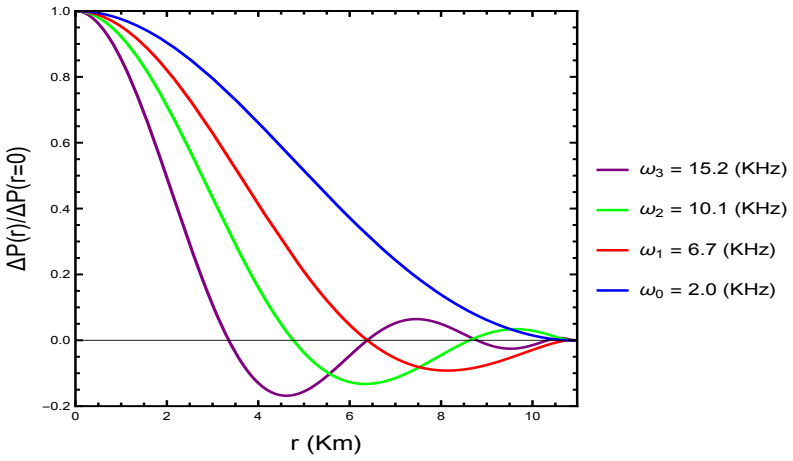
In this paper, we investigate the equilibrium configurations and radial perturbations of neutron stars within a subclass of gauge-invariant Scalar-Vector-Tensor (SVT) theories. By solving the generalized Tolman-Oppenheimer-Volkoff (TOV) equations for several values of the modified gravity parameter, we examine the impact of the vector-curvature coupling on the structure and properties of neutron stars. We then extend our analysis by deriving the quadratic action governing linear radial perturbations and computing both the normal modes associated with the matter sector and the scalar quasinormal modes arising from the additional propagating degree of freedom of the theory, which is able to propagate outside the neutron star. Our results show that the modified gravity parameter can significantly affect the mass-radius relation, the oscillation spectrum, and the stability properties of neutron stars, while preserving the coincidence between the onset of radial instability and the maximum-mass configuration, as in General Relativity.
Editorial analysis
A structured set of objections, weighed in public.
Referee Report
Summary. The paper investigates equilibrium configurations and radial perturbations of neutron stars in a subclass of gauge-invariant Scalar-Vector-Tensor (SVT) theories with vector-curvature coupling. By solving generalized Tolman-Oppenheimer-Volkoff (TOV) equations for multiple values of the modified gravity parameter, the authors obtain mass-radius relations and then derive the quadratic action for linear radial perturbations to compute matter normal modes and scalar quasinormal modes that propagate outside the star. The central claim is that the parameter significantly modifies the mass-radius curve, oscillation spectrum, and stability properties while preserving the coincidence between the onset of radial instability and the maximum-mass configuration, as in general relativity.
Significance. If the numerical results hold, the work shows that vector-induced scalar hair provides a controlled modification to neutron-star structure and dynamics without breaking the GR-like radial stability criterion. This is useful for placing bounds on SVT parameters from mass-radius observations and asteroseismology, and the explicit separation of matter and scalar modes clarifies the role of the extra degree of freedom.
minor comments (3)
- The manuscript should include a brief statement of the numerical methods used to integrate the generalized TOV equations and to solve the perturbation eigenvalue problem, together with convergence tests or error estimates for the reported frequencies and mass-radius points.
- Figure captions and axis labels should explicitly state the equation of state and the range of the modified gravity parameter used in each panel.
- A short paragraph comparing the obtained quasinormal-mode frequencies with the corresponding general-relativity limit would help readers assess the magnitude of the SVT correction.
Simulated Author's Rebuttal
We thank the referee for the careful reading of our manuscript and for the positive assessment of our results on neutron-star equilibria and radial perturbations in scalar-vector-tensor gravity. The referee's summary accurately captures the central findings, including the preservation of the maximum-mass–radial-instability coincidence. We will incorporate minor revisions to improve clarity and presentation as recommended.
Circularity Check
No significant circularity in the derivation chain
full rationale
The paper derives the generalized TOV equations and quadratic action for linear radial perturbations directly from the SVT theory action via standard variational procedures. Equilibrium configurations and normal modes are then obtained by numerical integration of these derived equations. The reported effects on mass-radius relations, oscillation spectra, and the preserved coincidence between radial instability onset and maximum mass are computed outputs, not inputs redefined by construction. No load-bearing self-citations, fitted parameters renamed as predictions, or smuggled ansatze appear in the central steps. The analysis remains self-contained against the theory's own field equations.
Axiom & Free-Parameter Ledger
free parameters (1)
- modified gravity parameter
axioms (1)
- domain assumption The theory belongs to a gauge-invariant subclass of scalar-vector-tensor theories
invented entities (1)
-
vector-induced scalar hair
no independent evidence
Lean theorems connected to this paper
-
IndisputableMonolith/Foundation/RealityFromDistinction.leanreality_from_one_distinction unclear?
unclearRelation between the paper passage and the cited Recognition theorem.
we choose G₃=0, G₄=κ/2 and K=X … f₄=β₄ … living us with a single parameter β₄
-
IndisputableMonolith/Cost/FunctionalEquation.leanwashburn_uniqueness_aczel unclear?
unclearRelation between the paper passage and the cited Recognition theorem.
the coincidence between the onset of radial instability and the maximum-mass configuration, as in General Relativity
What do these tags mean?
- matches
- The paper's claim is directly supported by a theorem in the formal canon.
- supports
- The theorem supports part of the paper's argument, but the paper may add assumptions or extra steps.
- extends
- The paper goes beyond the formal theorem; the theorem is a base layer rather than the whole result.
- uses
- The paper appears to rely on the theorem as machinery.
- contradicts
- The paper's claim conflicts with a theorem or certificate in the canon.
- unclear
- Pith found a possible connection, but the passage is too broad, indirect, or ambiguous to say the theorem truly supports the claim.
Reference graph
Works this paper leans on
-
[1]
GW150914: The Advanced LIGO Detectors in the Era of First Discoveries
S. Capozziello and V. Faraoni,Beyond Einstein gravity: A Survey of gravitational theories for cosmology and astrophysics, vol. 170. Springer Science & Business Media, 2010. [2]LIGO Scientific, VirgoCollaboration, B. Abbottet. al., “GW150914: The Advanced LIGO Detectors in the Era of First Discoveries,”Phys. Rev. Lett.116(2016), no. 13 131103, 1602.03838. ...
work page internal anchor Pith review Pith/arXiv arXiv 2010
-
[2]
Second-order scalar-tensor field equations in a four-dimensional space,
G. W. Horndeski, “Second-order scalar-tensor field equations in a four-dimensional space,” International Journal of Theoretical Physics10(1974), no. 6 363–384
work page 1974
-
[3]
Degenerate higher derivative theories beyond Horndeski: evading the Ostrogradski instability
D. Langlois and K. Noui, “Degenerate higher derivative theories beyond Horndeski: evading the Ostrogradski instability,”JCAP1602(2016), no. 02 034,1510.06930
work page internal anchor Pith review Pith/arXiv arXiv 2016
-
[4]
Generalization of the Proca Action,
L. Heisenberg, “Generalization of the Proca Action,”JCAP05(2014) 015,1402.7026
-
[5]
Scalar-Vector-Tensor Gravity Theories
L. Heisenberg, “Scalar-Vector-Tensor Gravity Theories,”JCAP10(2018) 054,1801.01523
work page internal anchor Pith review Pith/arXiv arXiv 2018
-
[6]
Odd-parity stability of hairy black holes in $U(1)$ gauge-invariant scalar-vector-tensor theories
L. Heisenberg, R. Kase, and S. Tsujikawa, “Odd-parity stability of hairy black holes inU(1) gauge-invariant scalar-vector-tensor theories,”Phys. Rev. D97(2018), no. 12 124043, 1804.00535. 15
work page internal anchor Pith review Pith/arXiv arXiv 2018
-
[7]
Black holes in vector-tensor theories
L. Heisenberg, R. Kase, M. Minamitsuji, and S. Tsujikawa, “Black holes in vector-tensor theories,”JCAP08(2017) 024,1706.05115
work page internal anchor Pith review Pith/arXiv arXiv 2017
-
[8]
Black holes and neutron stars in the generalized tensor-vector-scalar theory
P. D. Lasky, “Black holes and neutron stars in the generalized tensor-vector-scalar theory,” Phys. Rev. D80(2009) 081501,0910.0240
work page internal anchor Pith review Pith/arXiv arXiv 2009
-
[9]
Neutron stars with a generalized Proca hair and spontaneous vectorization,
R. Kase, M. Minamitsuji, and S. Tsujikawa, “Neutron stars with a generalized Proca hair and spontaneous vectorization,”Phys. Rev. D102(2020), no. 2 024067,2001.10701
-
[10]
Gauge-ready formulation of cosmological perturbations in scalar-vector-tensor theories
L. Heisenberg, R. Kase, and S. Tsujikawa, “Gauge-ready formulation of cosmological perturbations in scalar-vector-tensor theories,”Phys. Rev. D98(2018), no. 12 123504, 1807.07202
work page internal anchor Pith review Pith/arXiv arXiv 2018
-
[11]
Cosmology in scalar-vector-tensor theories
L. Heisenberg, R. Kase, and S. Tsujikawa, “Cosmology in scalar-vector-tensor theories,”Phys. Rev. D98(2018), no. 2 024038,1805.01066
work page internal anchor Pith review Pith/arXiv arXiv 2018
-
[12]
Dark energy in scalar-vector-tensor theories
R. Kase and S. Tsujikawa, “Dark energy in scalar-vector-tensor theories,”JCAP11(2018) 024, 1805.11919
work page internal anchor Pith review Pith/arXiv arXiv 2018
-
[13]
Cosmology in generalized Proca theories
A. De Felice, L. Heisenberg, R. Kase, S. Mukohyama, S. Tsujikawa, and Y.-l. Zhang, “Cosmology in generalized Proca theories,”JCAP06(2016) 048,1603.05806
work page internal anchor Pith review Pith/arXiv arXiv 2016
-
[14]
Stability of Horndeski vector-tensor interactions
J. Beltran Jimenez, R. Durrer, L. Heisenberg, and M. Thorsrud, “Stability of Horndeski vector-tensor interactions,”JCAP10(2013) 064,1308.1867
work page internal anchor Pith review Pith/arXiv arXiv 2013
-
[15]
Hairy black hole solutions in $U(1)$ gauge-invariant scalar-vector-tensor theories
L. Heisenberg and S. Tsujikawa, “Hairy black hole solutions inU(1) gauge-invariant scalar-vector-tensor theories,”Phys. Lett. B780(2018) 638–646,1802.07035
work page internal anchor Pith review Pith/arXiv arXiv 2018
-
[16]
Even-parity stability of hairy black holes in U(1) gauge-invariant scalar-vector-tensor theories,
C. Zhang and R. Kase, “Even-parity stability of hairy black holes in U(1) gauge-invariant scalar-vector-tensor theories,”Phys. Rev. D110(2024), no. 4 044047,2404.11910
-
[17]
Toroidal oscillations of slowly rotating relativistic star in tensor-vector-scalar theory
H. Sotani, “Toroidal oscillations of slowly rotating relativistic star in tensor-vector-scalar theory,”Phys. Rev. D82(2010) 124061,1012.2143
work page internal anchor Pith review Pith/arXiv arXiv 2010
-
[18]
Slowly Rotating Relativistic Stars in Tensor-Vector-Scalar Theory
H. Sotani, “Slowly Rotating Relativistic Stars in Tensor-Vector-Scalar Theory,”Phys. Rev. D81 (2010) 084006,1003.2575
work page internal anchor Pith review Pith/arXiv arXiv 2010
-
[19]
Relativistic stars in vector-tensor theories
R. Kase, M. Minamitsuji, and S. Tsujikawa, “Relativistic stars in vector-tensor theories,”Phys. Rev. D97(2018), no. 8 084009,1711.08713
work page internal anchor Pith review Pith/arXiv arXiv 2018
-
[20]
Black Holes and Neutron Stars in Vector Galileons
J. Chagoya, G. Niz, and G. Tasinato, “Black Holes and Neutron Stars in Vector Galileons,” Class. Quant. Grav.34(2017), no. 16 165002,1703.09555
work page internal anchor Pith review Pith/arXiv arXiv 2017
-
[21]
Structure of Neutron Stars in Tensor-Vector-Scalar Theory
P. D. Lasky, H. Sotani, and D. Giannios, “Structure of Neutron Stars in Tensor-Vector-Scalar Theory,”Phys. Rev. D78(2008) 104019,0811.2006
work page internal anchor Pith review Pith/arXiv arXiv 2008
-
[22]
Neutron stars in Scalar-Tensor-Vector Gravity
F. G. Lopez Armengol and G. E. Romero, “Neutron stars in Scalar-Tensor-Vector Gravity,” Gen. Rel. Grav.49(2017), no. 2 27,1611.05721
work page internal anchor Pith review Pith/arXiv arXiv 2017
-
[23]
Probing Tensor-Vector-Scalar Theory with Gravitational Wave Asteroseismology
H. Sotani, “Probing Tensor-Vector-Scalar Theory with Gravitational Wave Asteroseismology,” Phys. Rev. D80(2009) 064035,0909.2411
work page internal anchor Pith review Pith/arXiv arXiv 2009
-
[24]
Spontaneous scalarization of charged stars,
M. Minamitsuji and S. Tsujikawa, “Spontaneous scalarization of charged stars,”Phys. Lett. B 820(2021) 136509,2105.14661
-
[25]
Nonradial oscillations of stars,
W. Unno, Y. Osaki, H. Ando, and H. Shibahashi, “Nonradial oscillations of stars,”Tokyo: University of Tokyo Press(1979)
work page 1979
-
[26]
The radial oscillations of neutron stars,
E. N. Glass and L. Lindblom, “The radial oscillations of neutron stars,”Astrophysical Journal Supplement Series (ISSN 0067-0049), vol. 53, Sept. 1983, p. 93-103. Research supported by the Natural Sciences and Engineering Research Council of Canada.53(1983) 93–103
work page 1983
-
[27]
A NEW NUMERICAL APPROACH TO THE OSCILLATION MODES OF RELATIVISTIC STARS
N. Andersson, K. D. Kokkotas, and B. F. Schutz, “A New numerical approach to the oscillation modes of relativistic stars,”Mon. Not. Roy. Astron. Soc.274(1995) 1039,gr-qc/9503014
work page internal anchor Pith review Pith/arXiv arXiv 1995
-
[28]
Normal Modes of a Model Radiating System,
K. D. Kokkotas and B. F. Schutz, “Normal Modes of a Model Radiating System,”Gen. Rel. Grav.18(1986) 913
work page 1986
-
[29]
Oscillation dynamics of scalarized neutron stars,
C. J. Kr¨ uger and D. D. Doneva, “Oscillation dynamics of scalarized neutron stars,”Phys. Rev. D 103(2021), no. 12 124034,2102.11698
-
[30]
New class of quasinormal modes of neutron stars in scalar-tensor gravity
R. F. P. Mendes and N. Ortiz, “New class of quasinormal modes of neutron stars in scalar-tensor gravity,”Phys. Rev. Lett.120(2018), no. 20 201104,1802.07847. 16
work page internal anchor Pith review Pith/arXiv arXiv 2018
-
[31]
Probing Strong-Field Scalar-Tensor Gravity with Gravitational Wave Asteroseismology
H. Sotani and K. D. Kokkotas, “Probing strong-field scalar-tensor gravity with gravitational wave asteroseismology,”Phys. Rev. D70(2004) 084026,gr-qc/0409066
work page internal anchor Pith review Pith/arXiv arXiv 2004
-
[32]
ϕ-modes of neutron stars in a massless scalar–tensor theory,
J. L. Bl´ azquez-Salcedo, L. M. Gonz´ alez-Romero, F. S. Khoo, J. Kunz, and V. Preut, “ϕ-modes of neutron stars in a massless scalar–tensor theory,”Front. Astron. Space Sci.9(2022) 1005108, 2207.11370
-
[33]
Compact stars in alternative theories of gravity. Einstein-Dilaton-Gauss-Bonnet gravity
P. Pani, E. Berti, V. Cardoso, and J. Read, “Compact stars in alternative theories of gravity. Einstein-Dilaton-Gauss-Bonnet gravity,”Phys. Rev. D84(2011) 104035,1109.0928
work page internal anchor Pith review Pith/arXiv arXiv 2011
-
[34]
Rapidly Rotating Neutron Stars in Dilatonic Einstein-Gauss-Bonnet Theory
B. Kleihaus, J. Kunz, S. Mojica, and M. Zagermann, “Rapidly Rotating Neutron Stars in Dilatonic Einstein-Gauss-Bonnet Theory,”Phys. Rev. D93(2016), no. 6 064077,1601.05583
work page internal anchor Pith review Pith/arXiv arXiv 2016
-
[35]
S. DeDeo and D. Psaltis, “Towards New Tests of Strong-field Gravity with Measurements of Surface Atomic Line Redshifts from Neutron Stars,”Phys. Rev. Lett.90(2003) 141101, astro-ph/0302095
work page internal anchor Pith review Pith/arXiv arXiv 2003
-
[36]
Testing Strong-field Gravity with Quasi-Periodic Oscillations
S. DeDeo and D. Psaltis, “Testing strong-field gravity with quasiperiodic oscillations,” astro-ph/0405067
work page internal anchor Pith review Pith/arXiv arXiv
-
[37]
General Relativistic Variational Principle for Perfect Fluids,
A. H. Taub, “General Relativistic Variational Principle for Perfect Fluids,”Phys. Rev.94(1954) 1468–1470
work page 1954
-
[38]
Perfect fluids in general relativity: velocity potentials and a variational principle,
B. F. Schutz Jr, “Perfect fluids in general relativity: velocity potentials and a variational principle,”Physical Review D2(1970), no. 12 2762
work page 1970
-
[39]
Lagrangian density for perfect fluids in general relativity,
J. R. Ray, “Lagrangian density for perfect fluids in general relativity,”Journal of Mathematical Physics13(1972), no. 10 1451–1453
work page 1972
-
[40]
Variational aspects of relativistic field theories, with application to perfect fluids,
B. F. Schutz and R. Sorkin, “Variational aspects of relativistic field theories, with application to perfect fluids,”Annals of Physics107(1977), no. 1-2 1–43
work page 1977
-
[41]
B. Carter, A. Anile, and Y. Choquet-Bruhat, “Relativistic fluid dynamics,”Springer-Verlag (1989)
work page 1989
-
[42]
Action functionals for relativistic perfect fluids,
J. D. Brown, “Action functionals for relativistic perfect fluids,”Classical and Quantum Gravity 10(1993), no. 8 1579
work page 1993
-
[43]
Screening fifth forces in generalized Proca theories
A. De Felice, L. Heisenberg, R. Kase, S. Tsujikawa, Y.-l. Zhang, and G.-B. Zhao, “Screening fifth forces in generalized Proca theories,”Phys. Rev. D93(2016), no. 10 104016,1602.00371
work page internal anchor Pith review Pith/arXiv arXiv 2016
-
[44]
Analytical representations of unified equations of state of neutron-star matter
P. Haensel and A. Y. Potekhin, “Analytical representations of unified equations of state of neutron-star matter,”Astron. Astrophys.428(2004) 191–197,astro-ph/0408324
work page internal anchor Pith review Pith/arXiv arXiv 2004
-
[45]
Analytical representations of unified equations of state for neutron-star matter
A. Potekhin, A. Fantina, N. Chamel, J. Pearson, and S. Goriely, “Analytical representations of unified equations of state for neutron-star matter,”Astron. Astrophys.560(2013) A48, 1310.0049
work page internal anchor Pith review Pith/arXiv arXiv 2013
-
[46]
J. M. Pearson, N. Chamel, A. Y. Potekhin, A. F. Fantina, C. Ducoin, A. K. Dutta, and S. Goriely, “Unified equations of state for cold non-accreting neutron stars with Brussels–Montreal functionals – I. Role of symmetry energy,”Mon. Not. Roy. Astron. Soc.481 (2018), no. 3 2994–3026,1903.04981. [Erratum: Mon.Not.Roy.Astron.Soc. 486, 768 (2019)]
-
[47]
Shapiro delay measurement of a two solar mass neutron star
P. Demorest, T. Pennucci, S. Ransom, M. Roberts, and J. Hessels, “Shapiro Delay Measurement of A Two Solar Mass Neutron Star,”Nature467(2010) 1081–1083,1010.5788
work page internal anchor Pith review Pith/arXiv arXiv 2010
-
[48]
A new numerical approach to the oscillation modes of relativistic stars,
N. Andersson, K. D. Kokkotas, and B. F. Schutz, “A new numerical approach to the oscillation modes of relativistic stars,”Monthly Notices of the Royal Astronomical Society274(1995), no. 4 1039–1048
work page 1995
-
[49]
Abelian and non-Abelian mimetic black holes,
M. A. Gorji, S. Jana, and P. Petrov, “Abelian and non-Abelian mimetic black holes,” 2511.22062
-
[50]
Linear Higher-Order Maxwell-Einstein-Scalar Theories,
M. A. Gorji, S. Mukohyama, P. Petrov, and M. Yamaguchi, “Linear Higher-Order Maxwell-Einstein-Scalar Theories,”2509.16526. 17
discussion (0)
Sign in with ORCID, Apple, or X to comment. Anyone can read and Pith papers without signing in.