REVIEW 4 major objections 5 minor 2 cited by
kiloHertz gravitational waves from binary neutron star remnants: time-domain model and constraints on extreme matter
T0 review · 4 major / 5 minor · reviewed 2026-08-14 · deepseek-v4-flash
Pith's one-line read NRPM is the first phase-coherent time-domain model spanning inspiral, merger, and kiloHertz postmerger neutron-star waveforms, and it makes postmerger detection feasible at SNR about 8.5.
desk verdict The first phase-coherent time-domain postmerger model is a real advance and the paper is honestly reported, but the SNR-8.5 and kilometer-precision claims are self-consistency checks against non-converged NR waveforms, not validated predictions. read the letter →
The pith
A machine-rendered reading of the paper's core claim, the machinery that carries it, and where it could break.
The reading
What carries the argument
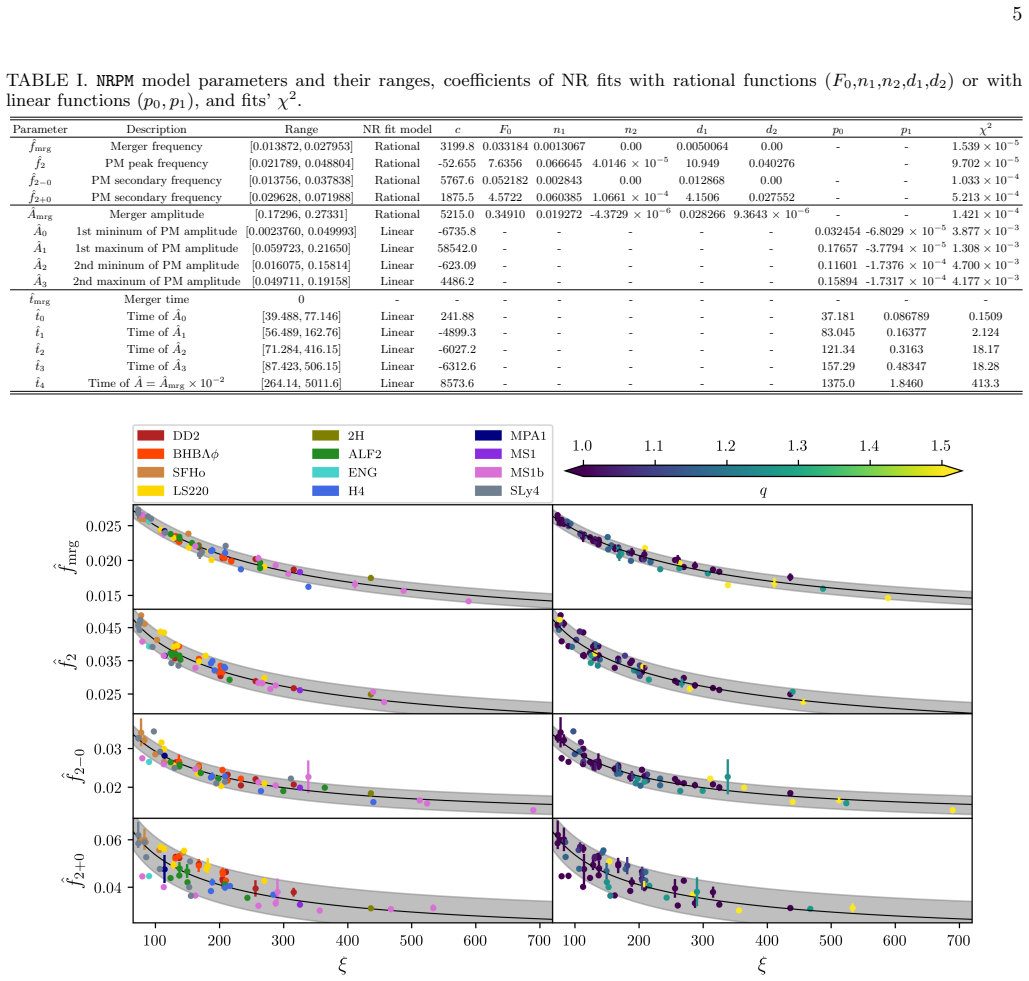
The central object is NRPM, a time-domain postmerger waveform model built from a C1 piecewise frequency and amplitude construction. The frequency is assembled from three characteristic spectral frequencies, the dominant $\hat{f}_2$ and sidebands $\hat{f}_{2\pm 0}$, with a cubic interpolation from the merger frequency and a sine-modulated oscillation; the amplitude interpolates between four extrema and then decays exponentially. All parameters are fitted to numerical-relativity data through quasiuniversal rational or linear relations in $\xi=\kappa^T_2+c(1-4\nu)$. The quasiuniversal relations are the load-bearing machinery: they convert the model's few physical parameters into concrete waveform morphology, and they are also the instrument by which the paper translates a measured peak frequency into the radius $R_{\rm TOV}^{\max}$ and into indications of equation-of-state softening.
What would settle it
A concrete test: run the same NRPM fits on a new set of error-controlled, higher-resolution postmerger simulations with microphysical equations of state and check whether the predicted $\hat{f}_2$ and the $\hat{R}_{\max}(\hat{f}_2)$ relation shift by more than the current fit uncertainties. A real detection with independently measured inspiral radius would also settle it: if the postmerger-inferred $R_{\rm TOV}^{\max}$ disagrees with the inspiral-based radius at high SNR, the quasiuniversal calibration is wrong or the postmerger remnant probes different physics.
Extended reading notes
Core claim
The central claim is that the kiloHertz gravitational-wave signal from a binary neutron star remnant can be captured by an analytical time-domain waveform whose parameters are determined, through quasiuniversal fits, by the binary's total mass, symmetric mass ratio, and tidal polarizability $\kappa^T_2$. When attached to an effective-one-body inspiral-merger waveform at the amplitude peak, the model keeps phase coherence across the full observed band and enables matched-filtering and Bayesian inference on the postmerger portion. The paper's validation shows mismatches averaging around 0.3 against numerical-relativity waveforms, with better fidelity for long-lived remnants and lower postmerger frequencies. From the recovered postmerger peak frequency, the paper derives a quasiuniversal mapping to $R_{\rm TOV}^{\max}$, the radius of the most compact nonrotating neutron star, and states that a single detection at minimal SNR constrains that radius to about one kilometer. It also reports that inconsistencies between inspiral and postmerger tidal-parameter posteriors can signal equation-of-state softening at extreme densities.
Load-bearing premise
The load-bearing premise is that the numerical-relativity postmerger waveforms used for fitting are accurate enough to anchor the quasiuniversal fits; the paper itself reports those waveforms are not yet in a convergence regime after the first few milliseconds, and it also relies on an ad hoc prompt-collapse criterion, $\kappa^T_2<80\pm40$, that may fail for hyperonic or phase-transition equations of state.
Editorial extensions
If this is right
- A template-based matched-filter search using NRPM can claim detection of postmerger signals at network SNR $\sim 8.5$, roughly the level expected for GW170817-like events with third-generation detectors.
- Bayesian model selection between inspiral-merger and inspiral-merger-postmerger hypotheses distinguishes prompt collapse to a black hole from a surviving neutron-star remnant, with decisive log Bayes factors in the two tested injections.
- For remnants that do not promptly collapse, the quasiuniversal relation $\hat{R}_{\max}(\hat{f}_2)$ converts the measured postmerger peak frequency into an estimate of the maximum-mass neutron star radius with uncertainty near one kilometer.
- The inspiral-postmerger consistency check can flag equation-of-state softening at densities of about 3 to 5 times nuclear saturation, as in the hyperon case studied, already at SNRs of about 11.
- The model's quasiuniversal fits are directly usable by other waveform construction strategies, extending earlier results on spectral peak relations.
Reading between the lines
- The quoted SNR threshold is a statement about how well NRPM matches the specific simulated waveforms used, not yet a guarantee about real sky signals; error-converged postmerger templates would be needed to confirm the threshold observationally.
- The same peak-frequency to radius machinery could be turned around: if a future high-SNR detection yields a postmerger-inferred radius that disagrees with the inspiral-derived radius, the discrepancy would point to new physics at postmerger densities, though the paper's hyperon example shows that breaking the quasiuniversal relation alone cannot identify the microphysical cause.
- Promoting the damping parameter $\alpha$ to a free inference parameter should remove the distance-estimation bias the paper notes and would make the model more agnostic; this is an immediate, testable extension.
- Using independent numerical-relativity catalogs to refit the quasiuniversal relations, as the paper begins to do for $\hat{f}_2$, would quantify how much of the validation mismatch is model bias versus numerical-relativity uncertainty.
Signed reviews
Editorial analysis
A structured set of objections, weighed in public.
Referee Report
Summary. The paper constructs NRPM, a time-domain analytical model of binary neutron star postmerger gravitational waveforms, calibrated to the CoRe numerical-relativity database and characterized by the parameters (mass ratio, total mass, and tidal polarizability kappa_T^2). NRPM is attached to TEOBResumS inspiral-merger waveforms to form a phase-coherent inspiral-merger-postmerger (IMPM) model. The authors validate NRPM against in-family and a small validation set of NR waveforms, report average mismatches of order 0.3, and perform zero-noise Bayesian injection studies to claim that postmerger signals can be detected at network SNR ~8.5, that prompt collapse versus remnant formation can be distinguished by model selection, that the radius of the maximum-mass nonrotating neutron star can be constrained to about 1 km via a recalibrated quasiuniversal relation Rmax(f2), and that inconsistencies between inspiral and postmerger inferences can indicate EOS softening at densities of ~3-5 rho_0.
Significance. If the central claims hold, this is a valuable contribution: it is the first phase-coherent time-domain inspiral-merger-postmerger model for BNS signals, it extends quasiuniversal relations to amplitudes and times, and it demonstrates a concrete Bayesian framework for postmerger parameter estimation and model selection. The authors are also commendably transparent about the limitations of the underlying NR waveforms, explicitly stating in Appendix C that postmerger phase convergence is not achieved on long timescales and that the amplitude is non-monotonic with resolution. The main quantitative results, however, are calibrated and tested on the same simulation family and therefore measure the model's self-consistency against its training data rather than its accuracy against true gravitational-wave signals; for this reason the stated SNR threshold and kilometer-level radius precision are not yet established as statements about real signals.
major comments (4)
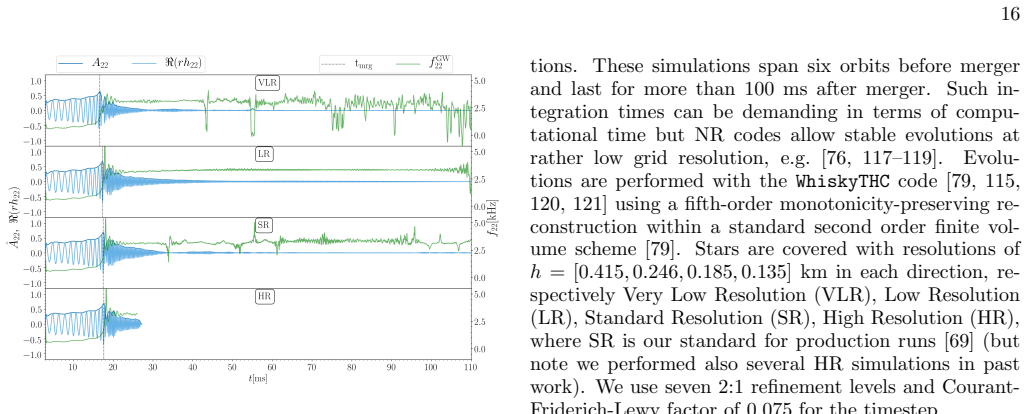
- [Sec. V A; Appendix C; Fig. 4] The abstract and Section V A claim that template-based detection is possible at SNR ~8.5 and that RTOV_max can be determined to about 1 km. These quantitative claims are supported only by zero-noise injections of CoRe NR waveforms, which are the same simulation family used to calibrate NRPM in Section II B, into a model fitted to those simulations. Appendix C states that the postmerger phase is monotonic with grid resolution only for a few milliseconds after merger and that the long-term data are not in a convergence regime, while Fig. 4 shows that NR resolution mismatches are often comparable to the model-NR mismatches. Under these conditions, the injection-recovery tests validate the model's self-consistency with its training data rather than its accuracy against true signals, and the quoted threshold and precision do not include the dominant systematic error. Please propagate NR resolution uncertainties into the injection studies (for example, by injecting waveforms at different resolutions and adding a resolution-based systematic error term) or explicitly restate the claims as self-consistency statements.
- [Sec. II B; Table II; Appendix A] The validation set of Table II is not independent of the calibration data: the fits in Section II B use 148 CoRe simulations plus 24 additional simulations, and the ten validation simulations are drawn from the same CoRe collaboration, often with the same microphysical EOS and evolution code, as the training set. The only external check in Appendix A compares the f2 quasiuniversal relation with SACRA data; it does not validate the full time-domain waveform model. As a result, the average mismatch ~0.3 and the injection results in Table II cannot be interpreted as a test of the model's ability to represent waveforms produced by other codes or EOS models. Please perform a full-waveform validation on independent NR data (for example, the SACRA catalog) or explicitly label the current validation as in-family.
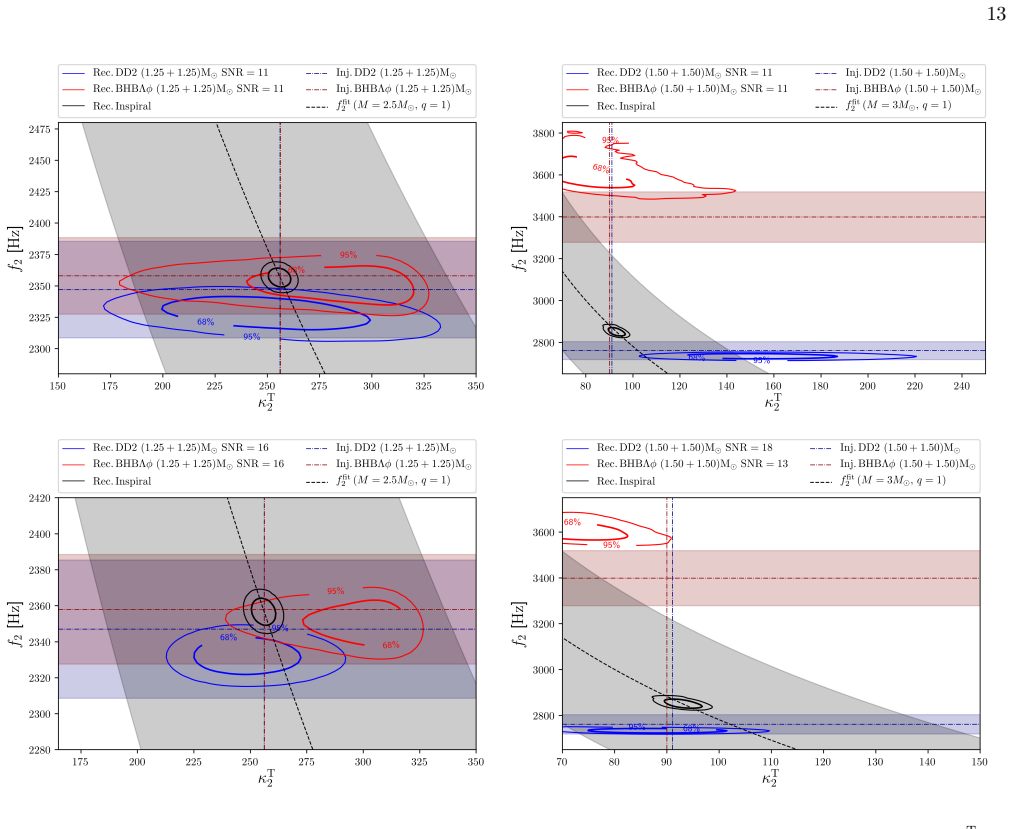
- [Sec. V A; Table II] Table II shows that several injections recover biased parameter values at or above the claimed detection threshold: for the SLy4 (1.364+1.364) injection the f2 posterior is bimodal with the dominant mode far from the injected value; for the DD2 (1.50+1.50) injection the recovered kappa_T^2 of 196^{+79}_{-68} is inconsistent with the injected value of 91.1 at more than one sigma; and for the H4 injection Rmax is overestimated. The text attributes these biases to NR fit inaccuracies and model systematics. Because these biases occur in exactly the injections used to support the detectability claim, the statement in Section V A that 'the posterior distributions of the physical parameters include the injected values within the 95% confidence regions' is misleading. Please quantify the fraction of injections that are unbiased and discuss how the SNR threshold and the Rmax precision claim change when these systematic biases are incorporated.
- [Sec. II B 2; Sec. V B; Eq. (16)] The prompt-collapse criterion kappa_T^2 < 80 +/- 40 in Eq. (16) is an empirical fit to hadronic EOS simulations and is explicitly acknowledged in the text to fail for hyperonic or phase-transition EOS. The paper nonetheless claims in the abstract and in Section V B that the model can infer whether the merger outcome is prompt collapse or a remnant star. The demonstration in Table III uses only the 2B and BHB Lambda-phi injections, both of which are consistent with the calibrated criterion. Since the model-selection argument depends on the template family rather than on Eq. (16) alone, please either demonstrate prompt-collapse inference for a case in which Eq. (16) is violated or restrict the claim to the class of EOS for which the criterion was calibrated.
minor comments (5)
- [Abstract and Conclusion] The abstract states a 'minimal signal-to-noise ratios (SNR) of 8' while the conclusion states SNR ~8.5; please reconcile these numbers and correct the singular/plural agreement in 'signal-to-noise ratios'.
- [Table I and Table II] There are typographical errors in the tables and text: 'mininum' and 'maxinum' in Table I should be 'minimum' and 'maximum', 'mantaining' in Section III should be 'maintaining', and 'quasinuniversal' should be 'quasiuniversal'.
- [Fig. 7 caption] The caption says the primary posterior peak at ~5.2 kHz is 'beyond the Nyquist limit, not in the plot', but the analysis band is stated as [1024, 4096] Hz, so the posterior maximum exceeds the analysis band rather than the Nyquist frequency; please clarify how a marginalized posterior can be produced outside the analyzed frequency band.
- [Sec. V C; Eq. (23)] Equation (23) is called an approximate relation but the reported chi^2 = 7.4e-5 is given without the number of degrees of freedom or the covariance of the fitted coefficients; please report the fit residuals and the coefficient covariance matrix so that the uncertainty on Rmax can be propagated correctly.
- [Sec. V A] The injections are performed in zero noise, so the quoted detectability threshold does not include false-alarm statistics, noise realization effects, or calibration uncertainties; at minimum this limitation should be stated in Section V A rather than only implicitly in the methodology.
Circularity Check
No circular derivation: NRPM is calibrated on NR simulations and validated on held-out waveforms plus independent SACRA data; the main caveats are non-converged postmerger NR waveforms and shared systematics, which are accuracy risks, not tautology.
full rationale
The paper's central derivation chain is not circular. NRPM is an empirical time-domain model whose frequencies, amplitudes, and times are fitted to CoRe NR simulations (Sec. II B, Table I), and the quasiuniversal relations are checked against the independent SACRA catalog in Appendix A. The validation set of 10 waveforms is explicitly held out from the fits (Sec. III), and the injection studies use these validation waveforms rather than the training waveforms, so the SNR 8.5 detectability claim is a genuine recovery test rather than a re-statement of the fit. The RTOV_max relation Eq. (23) is a recalibration of an existing quasiuniversal relation, and the paper itself reports biased Rmax recovery for DD2 and H4 cases, showing the inference is not tautologically forced. The prompt-collapse criterion Eq. (16) is imported from prior work by the same group, but it is a modeling input with acknowledged limitations (hyperons/phase transitions) and is not used in the model-selection test that establishes prompt-collapse inference. Appendix C's admission that postmerger NR phases are not in a convergence regime beyond a few milliseconds is an important external-validity and correctness caveat, not a circularity: it means the model inherits NR systematic errors, but the derivation does not reduce to its own inputs by construction. Overall, there are minor self-citations and shared-systematic concerns, but no load-bearing circular step.
Assumptions & free parameters
free parameters (4)
- Mass-ratio mixing parameter c in xi =
Varies per fit, e.g., 3199.8 for fmrg (Table I)
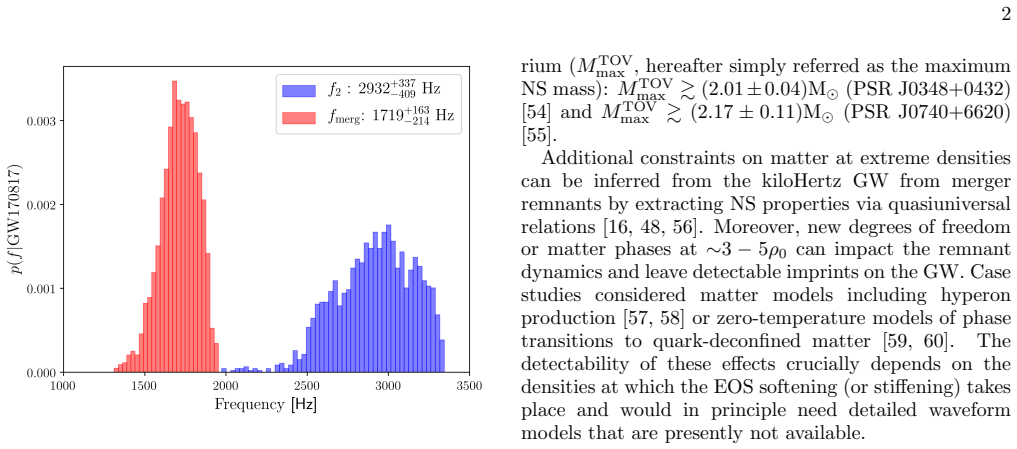
- Prompt collapse threshold kappa_T^thr =
80 +/- 40
- Damping time alpha (or t4, beta3) =
range roughly (3,70) ms
- Rmax(f2) quadratic coefficients =
5.81 +/- 0.13, -123.4 +/- 7.2, 1121 +/- 99
assumptions (5)
- domain assumption The gravitational-wave signal from a binary neutron star merger is dominated by the l=m=2 multipole, with nonspinning quasi-circular orbits.
- domain assumption Quasiuniversal relations express postmerger frequencies, amplitudes, and times as smooth functions of kappa_T^2 and nu (Eqs. 12-14), and these relations remain valid across the EOS parameter space.
- standard math The effective-one-body model TEOBResumS reproduces the inspiral-merger waveform including the merger peak amplitude.
- standard math Matched filtering is the optimal detection strategy under Gaussian noise, and the LALInference nested sampling implementation gives reliable evidences.
- ad hoc to paper Prompt collapse is determined by the empirical criterion kappa_T^2 < 80 +/- 40 (Eq. 16).
Cite this review
Pith. "Pith review of kiloHertz gravitational waves from binary neutron star remnants: time-domain model and constraints on extreme matter." pith.science (2026). https://pith.science/paper/HNZNITID
@misc{pith2026190811418,
  author       = {Pith},
  title        = {Pith review of: kiloHertz gravitational waves from binary neutron star remnants: time-domain model and constraints on extreme matter},
  year         = {2026},
  howpublished = {\url{https://pith.science/paper/HNZNITID}},
  note         = {Machine review of arXiv:1908.11418}
}
read the original abstract
The remnant star of a neutron star merger is an anticipated loud source of kiloHertz gravitational waves that conveys unique information on the equation of state of hot matter at extreme densities. Observations of such signals are hampered by the photon shot noise of ground-based interferometers and pose a challenge for gravitational-wave astronomy. We develop an analytical time-domain waveform model for postmerger signals informed by numerical relativity simulations. The model completes effective-one-body waveforms for quasi-circular nonspinning binaries in the kiloHertz regime. We show that a template-based analysis can detect postmerger signals with a minimal signal-to-noise ratios (SNR) of 8, corresponding to GW170817-like events for third-generation interferometers. Using Bayesian model selection and the complete inspiral-merger-postmerger waveform model it is possible to infer whether the merger outcome is a prompt collapse to a black hole or a remnant star. In the latter case, the radius of the maximum mass (most compact) nonrotating neutron star can be determined to kilometer precision. We demonstrate the feasibility of inferring the stiffness of the equation of state at extreme densities using the quasiuniversal relations deduced from numerical-relativity simulations.
Figures

Figures from the paper (10 more)




Forward citations
Cited by 2 Pith papers
-
From Multimessenger Inference to Simulations: A Ranked Ensemble of Finite-Temperature Equations of State
The paper constructs a 12-member ensemble of finite-temperature neutron star equations of state that spans the posterior from multimessenger and nuclear-physics constraints and releases simulation-ready tables.
-
Numerical Relativity Simulations of Dark Matter Admixed Binary Neutron Stars
First consistent numerical simulations of dark-matter-admixed neutron star mergers show that dark matter cores favor black hole collapse, halos form common envelopes, and standard tidal deformability calculations fail...
Reference graph
Works this paper leans on
-
[1]
Frequency and Phase We assume the GW frequency is composed of the three main characteristic frequencies ˆf2−0 < ˆf2 < ˆf2+0 and construct aC1 model for ˆω(t) as follows. The frequency model starts at ˆt = ˆtmrg = 0 with the value of the merger frequency ˆωmrg and its derivative ˙ˆωmrg taken either from NR fits or from an inspiral-merger time-domain approx-...
-
[2]
Amplitude We assume the postmerger amplitude has two minima, ˆAi with i = 0, 2, and two maxima, ˆAi with i = 1, 3, and that it decays exponentially after the second maximum. AC1 model for ˆA(t) is constructed assuming ˆA(ˆtmrg) = ˆAmrg (9a) ˆA(ˆti) = ˆAi (9b) ˆA(ˆt≥ ˆt3 + 5) = ˆA3 exp [ −α (ˆt− ˆt3 )] , (9c) and using sine waves to connect maxima and mini...
-
[3]
B. P. Abbott et al. (LIGO Scientific, Virgo), (2018), arXiv:1811.12907 [astro-ph.HE]
arXiv 2018
-
[4]
The distribution of f2 is cut at κT 2 < 70 to exclude binaries that undergo prompt collapse at merger
for the merger frequency; (ii) the relation proposed in [16] and further refined in this work for the postmerger peak fre- quency. The distribution of f2 is cut at κT 2 < 70 to exclude binaries that undergo prompt collapse at merger. The data analysis of (short duration) postmerger sig- nals can be performed with either morphology indepen- dent approaches ...
-
[5]
late-time
Frequencies, amplitudes and times The frequency information is extracted from the spec- tra by identifying the three dominant peak frequencies. Amplitudes ˆAi and the related times ˆti are extracted from the waveforms (Fig. 2). Specifically, we construct fit models using the variable [77] (see also Appendix A) ξ =κT 2 +c(1− 4ν) , (12) where the constant c i...
-
[6]
validation set
Prompt collapse NR simulations indicate that a NS binary merger will be followed by a prompt collapse to a BH, if the total gravitational mass M of the binary exceeds a threshold mass. The latter can be roughly estimated as [19, 20] Mthr =kthrMTOV max . (15) where MTOV max is the gravitational mass of the heaviest stable nonrotating NS. Both MTOV max and ...
- [7]
-
[8]
B. P. Abbott et al. (Virgo, LIGO Scientific), Phys. Rev. Lett. 119, 161101 (2017), arXiv:1710.05832 [gr-qc]
arXiv 2017
Show all 130 references
-
[9]
B. P. Abbott et al. (LIGO Scientific, Virgo), Phys. Rev. X9, 011001 (2019), arXiv:1805.11579 [gr-qc]
2019 arXiv
-
[10]
Dall’Osso, B
S. Dall’Osso, B. Giacomazzo, R. Perna, and L. Stella, Astrophys. J. 798, 25 (2015), arXiv:1408.0013 [astro- ph.HE]
2015 arXiv
-
[11]
Bernuzzi, A
S. Bernuzzi, A. Nagar, S. Balmelli, T. Dietrich, and M. Ujevic, Phys.Rev.Lett. 112, 201101 (2014), arXiv:1402.6244 [gr-qc]
2014 arXiv
-
[12]
B. P. Abbott et al. (Virgo, LIGO Scientific), Astrophys. J. 851, L16 (2017), arXiv:1710.09320 [astro-ph.HE]
2017 arXiv
-
[13]
B. P. Abbott et al. (LIGO Scientific, Virgo), (2018), 10.3847/1538-4357/ab0f3d, arXiv:1810.02581 [gr-qc]
2018 arXiv
-
[14]
Torres-Rivas, K
A. Torres-Rivas, K. Chatziioannou, A. Bauswein, and J. A. Clark, Phys. Rev. D99, 044014 (2019), arXiv:1811.08931 [gr-qc]
2019 arXiv
-
[15]
Cutler, Phys
C. Cutler, Phys. Rev. D66, 084025 (2002), arXiv:gr- qc/0206051 [gr-qc]
2002
-
[16]
Corsi and P
A. Corsi and P. Mszros, Astrophys. J. 702, 1171 (2009), arXiv:0907.2290 [astro-ph.CO]
2009 arXiv
- [17]
-
[18]
P. D. Lasky and K. Glampedakis, Mon. Not. Roy. As- tron. Soc. 458, 1660 (2016), arXiv:1512.05368 [astro- ph.HE]
2016 arXiv
-
[19]
Zappa, S
F. Zappa, S. Bernuzzi, D. Radice, A. Perego, and T. Dietrich, Phys. Rev. Lett. 120, 111101 (2018), arXiv:1712.04267 [gr-qc]
2018 arXiv
-
[20]
J. A. Clark, A. Bauswein, N. Stergioulas, and D. Shoemaker, Class. Quant. Grav. 33, 085003 (2016), arXiv:1509.08522 [astro-ph.HE]
2016 arXiv
-
[21]
Dietrich, M
T. Dietrich, M. Ujevic, W. Tichy, S. Bernuzzi, and B. Br¨ ugmann, Phys. Rev. D95, 024029 (2017), arXiv:1607.06636 [gr-qc]
2017 arXiv
-
[22]
Martynov et al., Phys
D. Martynov et al., Phys. Rev. D99, 102004 (2019), arXiv:1901.03885 [astro-ph.IM]
2019 arXiv
-
[23]
Bernuzzi, T
S. Bernuzzi, T. Dietrich, and A. Nagar, Phys. Rev. Lett. 115, 091101 (2015), arXiv:1504.01764 [gr-qc]
2015 arXiv
-
[24]
Stergioulas, A
N. Stergioulas, A. Bauswein, K. Zagkouris, and H.- T. Janka, Mon.Not.Roy.Astron.Soc. 418, 427 (2011), arXiv:1105.0368 [gr-qc]
2011 arXiv
-
[25]
Kiuchi, Y
K. Kiuchi, Y. Sekiguchi, M. Shibata, and K. Taniguchi, Phys. Rev. D80, 064037 (2009), arXiv:0904.4551 [gr- qc]
2009 arXiv
-
[26]
Hotokezaka, K
K. Hotokezaka, K. Kyutoku, H. Okawa, M. Shi- bata, and K. Kiuchi, Phys.Rev. D83, 124008 (2011), arXiv:1105.4370 [astro-ph.HE]
2011 arXiv
-
[27]
Bauswein, T
A. Bauswein, T. Baumgarte, and H. T. Janka, Phys.Rev.Lett. 111, 131101 (2013), arXiv:1307.5191 [astro-ph.SR]
2013 arXiv
-
[28]
Takami, L
K. Takami, L. Rezzolla, and L. Baiotti, Phys.Rev.Lett. 113, 091104 (2014), arXiv:1403.5672 [gr-qc]
2014 arXiv
-
[29]
Dietrich, S
T. Dietrich, S. Bernuzzi, M. Ujevic, and W. Tichy, Phys. Rev. D95, 044045 (2017), arXiv:1611.07367 [gr- qc]
2017 arXiv
-
[30]
Shibata and K
M. Shibata and K. Uryu, Prog. Theor. Phys. 107, 265 (2002), arXiv:gr-qc/0203037
2002 arXiv
-
[31]
Agathos, F
M. Agathos, F. Zappa, S. Bernuzzi, A. Perego, M. Breschi, and D. Radice, (2019), arXiv:1908.05442 [gr-qc]
2019 arXiv
-
[32]
Bauswein and H.-T
A. Bauswein and H.-T. Janka, Phys.Rev.Lett. 108, 011101 (2012), arXiv:1106.1616 [astro-ph.SR]
2012 arXiv
-
[33]
Bauswein, H
A. Bauswein, H. Janka, K. Hebeler, and A. Schwenk, Phys.Rev. D86, 063001 (2012), arXiv:1204.1888 [astro- ph.SR]
2012 arXiv
-
[34]
Hotokezaka, K
K. Hotokezaka, K. Kiuchi, K. Kyutoku, T. Muranushi, Y.-i. Sekiguchi, et al., Phys.Rev. D88, 044026 (2013), arXiv:1307.5888 [astro-ph.HE]
2013 arXiv
-
[35]
Radice, A
D. Radice, A. Perego, F. Zappa, and S. Bernuzzi, As- trophys. J. 852, L29 (2018), arXiv:1711.03647 [astro- ph.HE]
2018 arXiv
-
[36]
Radice, S
D. Radice, S. Bernuzzi, and C. D. Ott, Phys. Rev. D94, 064011 (2016), arXiv:1603.05726 [gr-qc]
2016 arXiv
-
[37]
Lehner, S
L. Lehner, S. L. Liebling, C. Palenzuela, O. L. Caballero, E. O’Connor, M. Anderson, and D. Neilsen, Class. Quant. Grav. 33, 184002 (2016), arXiv:1603.00501 [gr-qc]
2016 arXiv
-
[38]
S. Ai, H. Gao, Z.-G. Dai, X.-F. Wu, A. Li, B. Zhang, and M.-Z. Li, Astrophys. J. 860, 57 (2018), arXiv:1802.00571 [astro-ph.HE]
2018 arXiv
-
[39]
Margalit and B
B. Margalit and B. D. Metzger, Astrophys. J. 850, L19 (2017), arXiv:1710.05938 [astro-ph.HE]
2017 arXiv
-
[40]
Bauswein, O
A. Bauswein, O. Just, H.-T. Janka, and N. Stergioulas, Astrophys. J. 850, L34 (2017), arXiv:1710.06843 [astro- ph.HE]
2017 arXiv
-
[41]
Shibata, S
M. Shibata, S. Fujibayashi, K. Hotokezaka, K. Kiuchi, K. Kyutoku, Y. Sekiguchi, and M. Tanaka, Phys. Rev. D96, 123012 (2017), arXiv:1710.07579 [astro-ph.HE]
2017 arXiv
-
[42]
Chatziioannou, J
K. Chatziioannou, J. A. Clark, A. Bauswein, M. Mill- house, T. B. Littenberg, and N. Cornish, Phys. Rev. D96, 124035 (2017), arXiv:1711.00040 [gr-qc]
2017 arXiv
-
[43]
Rezzolla, E
L. Rezzolla, E. R. Most, and L. R. Weih, Astrophys. J. 852, L25 (2018), arXiv:1711.00314 [astro-ph.HE]
2018 arXiv
-
[44]
Yu, L.-D
Y.-W. Yu, L.-D. Liu, and Z.-G. Dai, Astrophys. J. 861, 114 (2018), arXiv:1711.01898 [astro-ph.HE]
2018 arXiv
-
[45]
Bauswein, N
A. Bauswein, N. Stergioulas, and H.-T. Janka, Eur. Phys. J. A52, 56 (2016), arXiv:1508.05493 [astro- ph.HE]
2016 arXiv
-
[46]
Li, L.-D
S.-Z. Li, L.-D. Liu, Y.-W. Yu, and B. Zhang, Astrophys. J. 861, L12 (2018), arXiv:1804.06597 [astro-ph.HE]
2018 arXiv
-
[47]
Lazzati, A
D. Lazzati, A. Deich, B. J. Morsony, and J. C. Work- man, Mon. Not. Roy. Astron. Soc. 471, 1652 (2017), arXiv:1610.01157 [astro-ph.HE]
2017 arXiv
-
[48]
Bromberg, A
O. Bromberg, A. Tchekhovskoy, O. Gottlieb, E. Nakar, and T. Piran, Mon. Not. Roy. Astron. Soc. 475, 2971 (2018), arXiv:1710.05897 [astro-ph.HE]
2018 arXiv
-
[49]
Lehner, S
L. Lehner, S. L. Liebling, C. Palenzuela, and P. M. Motl, Phys. Rev. D94, 043003 (2016), arXiv:1605.02369 [gr-qc]
2016 arXiv
-
[50]
Helstrom, Statistical theory of signal detection, In- ternational series of monographs on electronics and in- strumentation (Pergamon Press, 1968)
C. Helstrom, Statistical theory of signal detection, In- ternational series of monographs on electronics and in- strumentation (Pergamon Press, 1968)
1968
-
[51]
We give an euristic justification of the quasiuniveral relations (employed here and elsewhere to summarize NR information) and of the choice of the parametrization
and the CoRe data and fits. We give an euristic justification of the quasiuniveral relations (employed here and elsewhere to summarize NR information) and of the choice of the parametrization. The discussion follows from the original argument given in [82]. While the choice of t...
-
[52]
P. J. Easter, P. D. Lasky, A. R. Casey, L. Rezzolla, and K. Takami, (2018), arXiv:1811.11183 [gr-qc]
2018 arXiv
-
[53]
S. Bose, K. Chakravarti, L. Rezzolla, B. S. Sathyaprakash, and K. Takami, Phys. Rev. Lett. 120, 031102 (2018), arXiv:1705.10850 [gr-qc]
2018 arXiv
-
[54]
and MTOV max & (2.17± 0.11)M⊙ (PSR J0740+6620) [55]. Additional constraints on matter at extreme densities can be inferred from the kiloHertz GW from merger remnants by extracting NS properties via quasiuniversal relations [16, 48, 56]. Moreover, new degrees of freedom or matt...
2000
-
[55]
K. W. Tsang, T. Dietrich, and C. Van Den Broeck, (2019), arXiv:1907.02424 [gr-qc]
2019 arXiv
-
[56]
Bauswein, N
A. Bauswein, N. Stergioulas, and H.-T. Janka, Phys.Rev. D90, 023002 (2014), arXiv:1403.5301 [astro- ph.SR]
2014 arXiv
-
[57]
Rezzolla and K
L. Rezzolla and K. Takami, Phys. Rev. D93, 124051 (2016), arXiv:1604.00246 [gr-qc]
2016 arXiv
-
[58]
Kiuchi, K
K. Kiuchi, K. Kyohei, K. Kyutoku, Y. Sekiguchi, and M. Shibata, (2019), arXiv:1907.03790 [astro-ph.HE]
2019 arXiv
-
[59]
B. P. Abbott et al. (LIGO Scientific, Virgo), Phys. Rev. Lett. 121, 161101 (2018), arXiv:1805.11581 [gr-qc]
2018 arXiv
-
[60]
Perego, S
A. Perego, S. Bernuzzi, and D. Radice, Eur. Phys. J. A55, 124 (2019), arXiv:1903.07898 [gr-qc]
2019 arXiv
-
[61]
Antoniadis, P
J. Antoniadis, P. C. Freire, N. Wex, T. M. Tauris, R. S. Lynch, et al., Science 340, 6131 (2013), arXiv:1304.6875 [astro-ph.HE]
2013 arXiv
-
[62]
H. T. Cromartie et al., (2019), arXiv:1904.06759 [astro- ph.HE]
2019 arXiv
-
[63]
A. W. Steiner, J. M. Lattimer, and E. F. Brown, Eur. Phys. J. A52, 18 (2016), arXiv:1510.07515 [astro- 18 ph.HE]
2016 arXiv
-
[64]
Sekiguchi, K
Y. Sekiguchi, K. Kiuchi, K. Kyutoku, and M. Shibata, Phys.Rev.Lett. 107, 211101 (2011), arXiv:1110.4442 [astro-ph.HE]
2011 arXiv
-
[65]
Radice, S
D. Radice, S. Bernuzzi, W. Del Pozzo, L. F. Roberts, and C. D. Ott, Astrophys. J. 842, L10 (2017), arXiv:1612.06429 [astro-ph.HE]
2017 arXiv
-
[66]
Bauswein, N.-U
A. Bauswein, N.-U. F. Bastian, D. B. Blaschke, K. Chatziioannou, J. A. Clark, T. Fischer, and M. Oertel, Phys. Rev. Lett. 122, 061102 (2019), arXiv:1809.01116 [astro-ph.HE]
2019 arXiv
-
[67]
E. R. Most, L. J. Papenfort, V. Dexheimer, M. Hanauske, S. Schramm, H. Stcker, and L. Rezzolla, Phys. Rev. Lett. 122, 061101 (2019), arXiv:1807.03684 [astro-ph.HE]
2019 arXiv
-
[68]
Dietrich, D
T. Dietrich, D. Radice, S. Bernuzzi, F. Zappa, A. Perego, B. Brgmann, S. V. Chaurasia, R. Dudi, W. Tichy, and M. Ujevic, Class. Quant. Grav. 35, 24LT01 (2018), arXiv:1806.01625 [gr-qc]
2018 arXiv
-
[69]
Dietrich et al., Phys
T. Dietrich et al., Phys. Rev. D99, 024029 (2019), arXiv:1804.02235 [gr-qc]
2019 arXiv
-
[70]
E. E. Flanagan and T. Hinderer, Phys.Rev. D77, 021502 (2008), arXiv:0709.1915 [astro-ph]
2008 arXiv
-
[71]
Damour and A
T. Damour and A. Nagar, Phys. Rev. D81, 084016 (2010), arXiv:0911.5041 [gr-qc]
2010 arXiv
-
[72]
Damour, in Gravitational Radiation, edited by N
T. Damour, in Gravitational Radiation, edited by N. Deruelle and T. Piran (North-Holland, Amsterdam,
-
[73]
Hinderer, Astrophys.J
T. Hinderer, Astrophys.J. 677, 1216 (2008), arXiv:0711.2420 [astro-ph]
2008 arXiv
-
[74]
Damour and A
T. Damour and A. Nagar, Phys. Rev. D80, 084035 (2009), arXiv:0906.0096 [gr-qc]
2009 arXiv
-
[75]
Binnington and E
T. Binnington and E. Poisson, Phys. Rev. D80, 084018 (2009), arXiv:0906.1366 [gr-qc]
2009 arXiv
-
[76]
Radice, A
D. Radice, A. Perego, K. Hotokezaka, S. A. Fromm, S. Bernuzzi, and L. F. Roberts, Astrophys. J. 869, 130 (2018), arXiv:1809.11161 [astro-ph.HE]
2018 arXiv
-
[77]
Dimmelmeier, N
H. Dimmelmeier, N. Stergioulas, and J. A. Font, Mon. Not. Roy. Astron. Soc. 368, 1609 (2006), arXiv:astro- ph/0511394
2006
-
[78]
Passamonti, N
A. Passamonti, N. Stergioulas, and A. Nagar, Phys. Rev. D75, 084038 (2007), gr-qc/0702099
2007 arXiv
-
[79]
Baiotti, S
L. Baiotti, S. Bernuzzi, G. Corvino, R. De Pietri, and A. Nagar, Phys. Rev. D79, 024002 (2009), arXiv:0808.4002 [gr-qc]
2009 arXiv
-
[80]
Takami, L
K. Takami, L. Rezzolla, and L. Baiotti, Phys.Rev. D91, 064001 (2015), arXiv:1412.3240 [gr-qc]
2015 arXiv
-
[81]
Bauswein and N
A. Bauswein and N. Stergioulas, Phys. Rev. D91, 124056 (2015), arXiv:1502.03176 [astro-ph.SR]
2015 arXiv
-
[82]
Bernuzzi, D
S. Bernuzzi, D. Radice, C. D. Ott, L. F. Roberts, P. Moesta, and F. Galeazzi, Phys. Rev. D94, 024023 (2016), arXiv:1512.06397 [gr-qc]
2016 arXiv
-
[83]
Ciolfi, W
R. Ciolfi, W. Kastaun, J. V. Kalinani, and B. Giacomazzo, Phys. Rev. D100, 023005 (2019), arXiv:1904.10222 [astro-ph.HE]
2019 arXiv
-
[84]
Zappa, Master’s thesis, Parma U, Italy (2018)
F. Zappa, Master’s thesis, Parma U, Italy (2018)
2018
-
[85]
Bernuzzi, T
S. Bernuzzi, T. Dietrich, W. Tichy, and B. Br¨ ugmann, Phys.Rev. D89, 104021 (2014), arXiv:1311.4443 [gr-qc]
2014 arXiv
-
[86]
Radice, L
D. Radice, L. Rezzolla, and F. Galeazzi, Class.Quant.Grav. 31, 075012 (2014), arXiv:1312.5004 [gr-qc]
2014 arXiv
-
[87]
Bernuzzi and T
S. Bernuzzi and T. Dietrich, Phys. Rev. D94, 064062 (2016), arXiv:1604.07999 [gr-qc]
2016 arXiv
-
[88]
Banik, M
S. Banik, M. Hempel, and D. Bandyopadhyay, Astro- phys. J. Suppl. 214, 22 (2014), arXiv:1404.6173 [astro- ph.HE]
2014 arXiv
-
[89]
Bernuzzi, A
S. Bernuzzi, A. Nagar, T. Dietrich, and T. Damour, Phys.Rev.Lett. 114, 161103 (2015), arXiv:1412.4553 [gr-qc]
2015 arXiv
-
[90]
Dietrich, S
T. Dietrich, S. Bernuzzi, M. Ujevic, and B. Br¨ ugmann, Phys. Rev. D91, 124041 (2015), arXiv:1504.01266 [gr- qc]
2015 arXiv
-
[91]
Cutler and E
C. Cutler and E. E. Flanagan, Phys.Rev. D49, 2658 (1994), arXiv:gr-qc/9402014 [gr-qc]
1994 arXiv
-
[92]
Aasi et al
J. Aasi et al. (LIGO Scientific), Class. Quant. Grav. 32, 074001 (2015), arXiv:1411.4547 [gr-qc]
2015 arXiv
-
[93]
B. P. Abbott et al. (VIRGO, KAGRA, LIGO Sci- entific), Living Rev. Rel. 21, 3 (2018), [Living Rev. Rel.19,1(2016)], arXiv:1304.0670 [gr-qc]
2018 arXiv
-
[94]
G. M. Harry (LIGO Scientific Collaboration), Class.Quant.Grav. 27, 084006 (2010)
2010
-
[95]
Lindblom, B
L. Lindblom, B. J. Owen, and D. A. Brown, Phys.Rev. D78, 124020 (2008), arXiv:0809.3844 [gr-qc]
2008 arXiv
- [96]
-
[97]
Nagar et al., Phys
A. Nagar et al., Phys. Rev. D98, 104052 (2018), arXiv:1806.01772 [gr-qc]
2018 arXiv
-
[98]
Punturo, M
M. Punturo, M. Abernathy, F. Acernese, B. Allen, N. Andersson, et al., Class.Quant.Grav. 27, 194002 (2010)
2010
-
[99]
Hild et al., Class
S. Hild et al., Class. Quant. Grav. 28, 094013 (2011), arXiv:1012.0908 [gr-qc]
2011 arXiv
-
[100]
Akcay, S
S. Akcay, S. Bernuzzi, F. Messina, A. Nagar, N. Or- tiz, and P. Rettegno, Phys. Rev. D99, 044051 (2019), arXiv:1812.02744 [gr-qc]
2019 arXiv
-
[101]
Acernese et al
F. Acernese et al. (VIRGO), Class. Quant. Grav. 32, 024001 (2015), arXiv:1408.3978 [gr-qc]
2015 arXiv
-
[102]
Skilling, Bayesian Anal
J. Skilling, Bayesian Anal. 1, 833 (2006)
2006
-
[103]
Veitch and A
J. Veitch and A. Vecchio, Phys.Rev. D81, 062003 (2010), arXiv:0911.3820 [astro-ph.CO]
2010 arXiv
-
[104]
Veitch et al., Phys
J. Veitch et al., Phys. Rev. D91, 042003 (2015), arXiv:1409.7215 [gr-qc]
2015 arXiv
-
[105]
LIGO Algorithm Li- brary - LALSuite,
LIGO Scientific Collaboration, “LIGO Algorithm Li- brary - LALSuite,” free software (GPL) (2018)
2018
-
[106]
B. D. Lackey, S. Bernuzzi, C. R. Galley, J. Meidam, and C. Van Den Broeck, Phys. Rev. D95, 104036 (2017), arXiv:1610.04742 [gr-qc]
2017 arXiv
-
[107]
B. D. Lackey, K. Kyutoku, M. Shibata, P. R. Brady, and J. L. Friedman, Phys.Rev. D85, 044061 (2012), arXiv:1109.3402 [astro-ph.HE]
2012 arXiv
-
[108]
J. S. Read, L. Baiotti, J. D. E. Creighton, J. L. Fried- man, B. Giacomazzo, et al., Phys.Rev. D88, 044042 (2013), arXiv:1306.4065 [gr-qc]
2013 arXiv
-
[109]
Ghosh et al., Phys
A. Ghosh et al., Phys. Rev. D94, 021101 (2016), arXiv:1602.02453 [gr-qc]
2016 arXiv
-
[110]
B. P. Abbott et al. (LIGO Scientific, Virgo), Phys. Rev. Lett. 116, 221101 (2016), [Erratum: Phys. Rev. Lett.121,no.12,129902(2018)], arXiv:1602.03841 [gr-qc]
2016 arXiv
-
[111]
B. P. Abbott et al. (LIGO Scientific, Virgo), (2019), arXiv:1903.04467 [gr-qc]
2019 arXiv
-
[112]
Breschi, R
M. Breschi, R. O’Shaughnessy, J. Lange, and O. Birn- holtz, (2019), arXiv:1903.05982 [gr-qc]
2019 arXiv
-
[113]
Kiuchi, K
K. Kiuchi, K. Kawaguchi, K. Kyutoku, Y. Sekiguchi, M. Shibata, and K. Taniguchi, Phys. Rev. D96, 084060 (2017), arXiv:1708.08926 [astro-ph.HE]
2017 arXiv
-
[114]
Kawaguchi, K
K. Kawaguchi, K. Kiuchi, K. Kyutoku, Y. Sekiguchi, M. Shibata, and K. Taniguchi, Phys. Rev. D97, 044044 (2018), arXiv:1802.06518 [gr-qc]. 19
2018 arXiv
-
[115]
Foucart, T
F. Foucart, T. Hinderer, and S. Nissanke, Phys. Rev. D98, 081501 (2018), arXiv:1807.00011 [astro-ph.HE]
2018 arXiv
-
[116]
Zappa, S
F. Zappa, S. Bernuzzi, F. Pannarale, M. Mapelli, and N. Giacobbo, Phys. Rev. Lett. 123, 041102 (2019), arXiv:1903.11622 [gr-qc]
2019 arXiv
- [117]
-
[118]
B. D. Lackey and L. Wade, Phys.Rev. D91, 043002 (2015), arXiv:1410.8866 [gr-qc]
2015 arXiv
-
[119]
M. F. Carney, L. E. Wade, and B. S. Irwin, Phys. Rev. D98, 063004 (2018), arXiv:1805.11217 [gr-qc]
2018 arXiv
-
[120]
Bernuzzi, M
S. Bernuzzi, M. Thierfelder, and B. Br¨ ugmann, Phys.Rev. D85, 104030 (2012), arXiv:1109.3611 [gr-qc]
2012 arXiv
-
[121]
Bernuzzi, A
S. Bernuzzi, A. Nagar, M. Thierfelder, and B. Br¨ ugmann, Phys.Rev. D86, 044030 (2012), arXiv:1205.3403 [gr-qc]
2012 arXiv
-
[122]
Radice, L
D. Radice, L. Rezzolla, and F. Galeazzi, Mon.Not.Roy.Astron.Soc. 437, L46 (2014), arXiv:1306.6052 [gr-qc]
2014 arXiv
-
[123]
A. S. Schneider, L. F. Roberts, and C. D. Ott, Phys. Rev. C96, 065802 (2017), arXiv:1707.01527 [astro- ph.HE]
2017 arXiv
-
[124]
Andersson, J
N. Andersson, J. Baker, K. Belczynski, S. Bernuzzi, E. Berti, et al., Class.Quant.Grav. 30, 193002 (2013), arXiv:1305.0816 [gr-qc]
2013 arXiv
-
[125]
De Pietri, A
R. De Pietri, A. Feo, J. A. Font, F. Lffler, F. Maione, M. Pasquali, and N. Stergioulas, Phys. Rev. Lett. 120, 221101 (2018), arXiv:1802.03288 [gr-qc]
2018 arXiv
-
[126]
Nedora, S
V. Nedora, S. Bernuzzi, D. Radice, A. Perego, A. En- drizzi, and N. Ortiz, (2019), arXiv:1907.04872 [astro- ph.HE]
2019 arXiv
-
[127]
Radice and L
D. Radice and L. Rezzolla, Astron. Astrophys. 547, A26 (2012), arXiv:1206.6502 [astro-ph.IM]
2012 arXiv
-
[128]
Radice, A
D. Radice, A. Perego, S. Bernuzzi, and B. Zhang, Mon. Not. Roy. Astron. Soc. 481, 3670 (2018), arXiv:1803.10865 [astro-ph.HE]
2018 arXiv
-
[129]
Paschalidis, W
V. Paschalidis, W. E. East, F. Pretorius, and S. L. Shapiro, Phys. Rev. D92, 121502 (2015), arXiv:1510.03432 [astro-ph.HE]
2015 arXiv
-
[130]
W. E. East, V. Paschalidis, and F. Pretorius, Class. Quant. Grav. 33, 244004 (2016), arXiv:1609.00725 [astro-ph.HE]
2016 arXiv
Reviewed August 14, 2026 · model on record in the stance chip above.
Discussion (0). Continue with ORCID to comment.