Frequency Shift Physics-Informed Extreme Learning Machine for Solving High-Frequency Partial Differential Equations
Pith reviewed 2026-07-03 17:44 UTC · model grok-4.3
The pith
Translating the mean of Gaussian weights while fixing their variance at one overcomes spectral bias in extreme learning machines for high-frequency PDEs.
A machine-rendered reading of the paper's core claim, the machinery that carries it, and where it could break.
Core claim
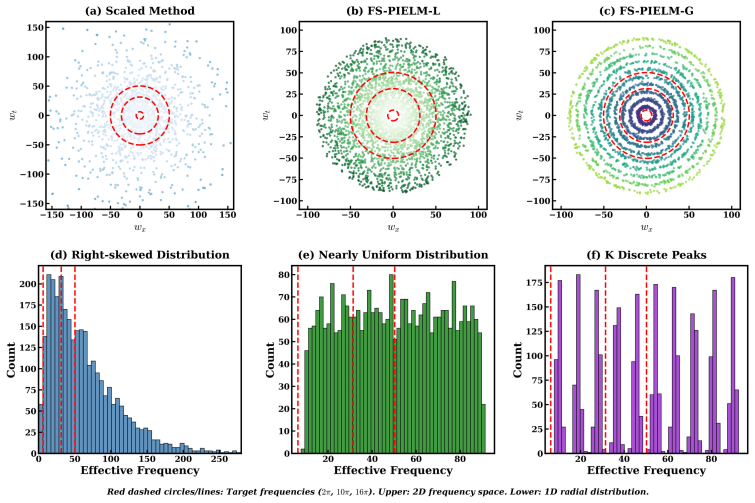
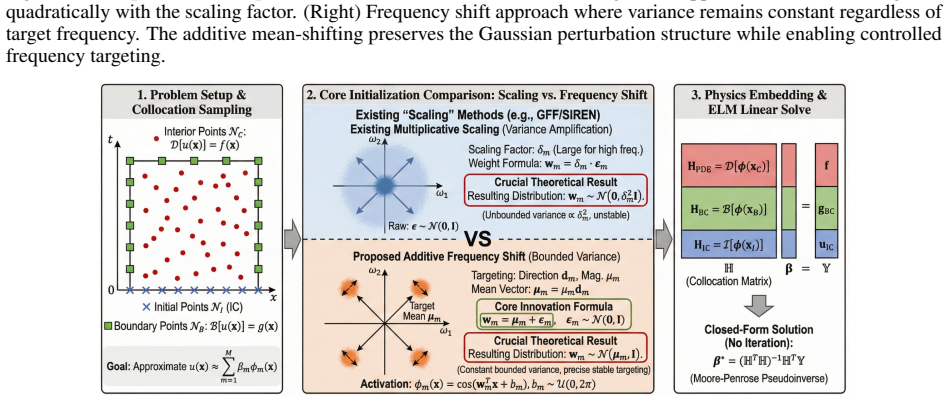
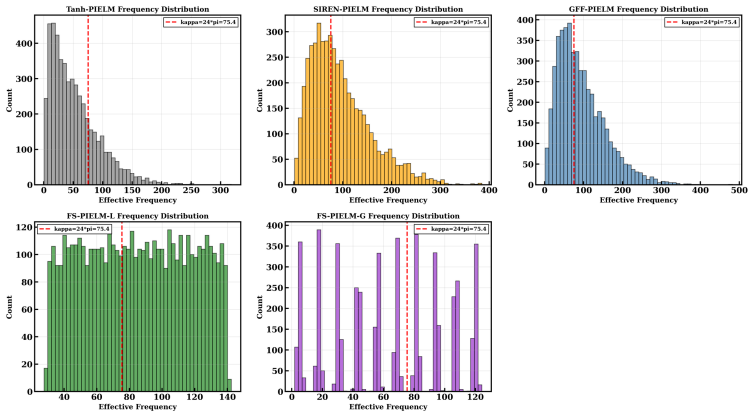
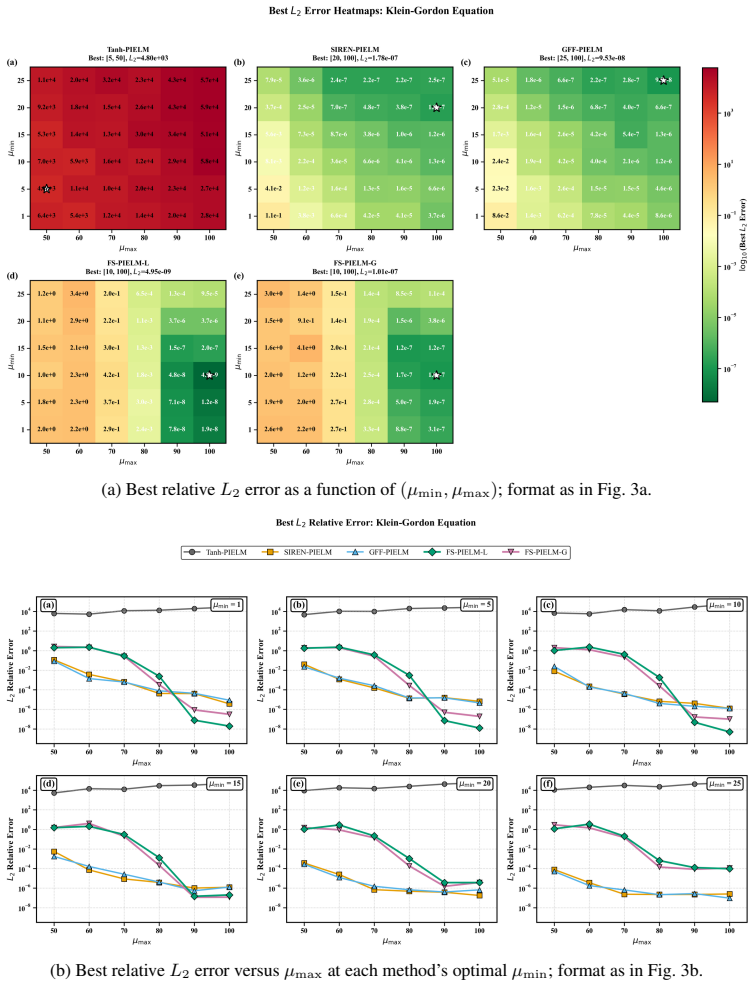
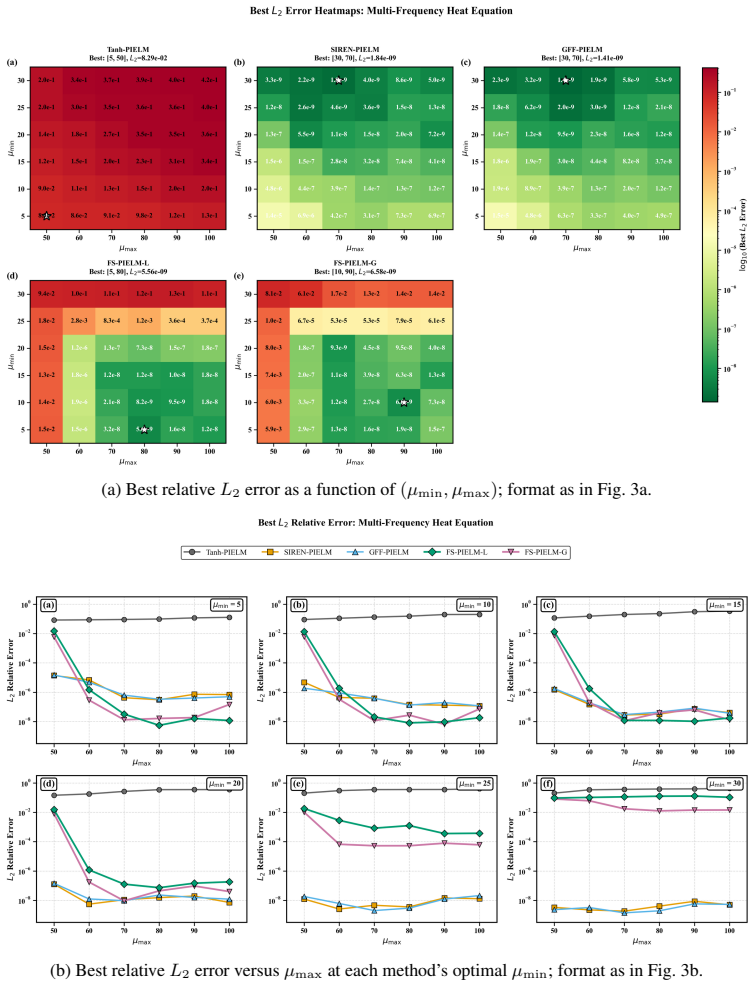
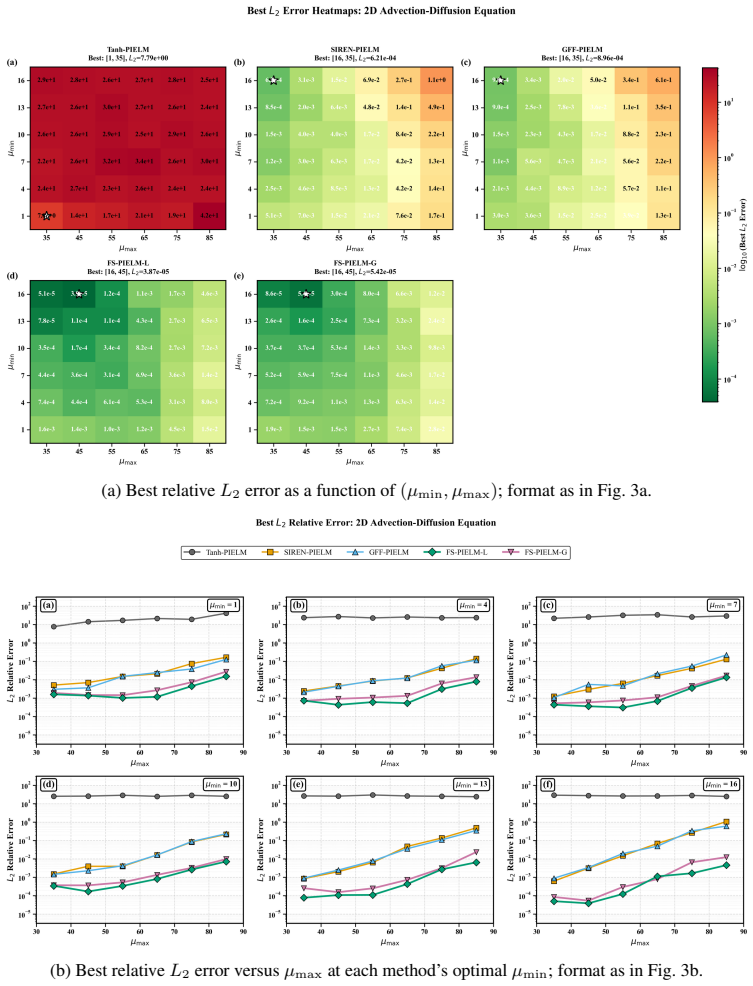
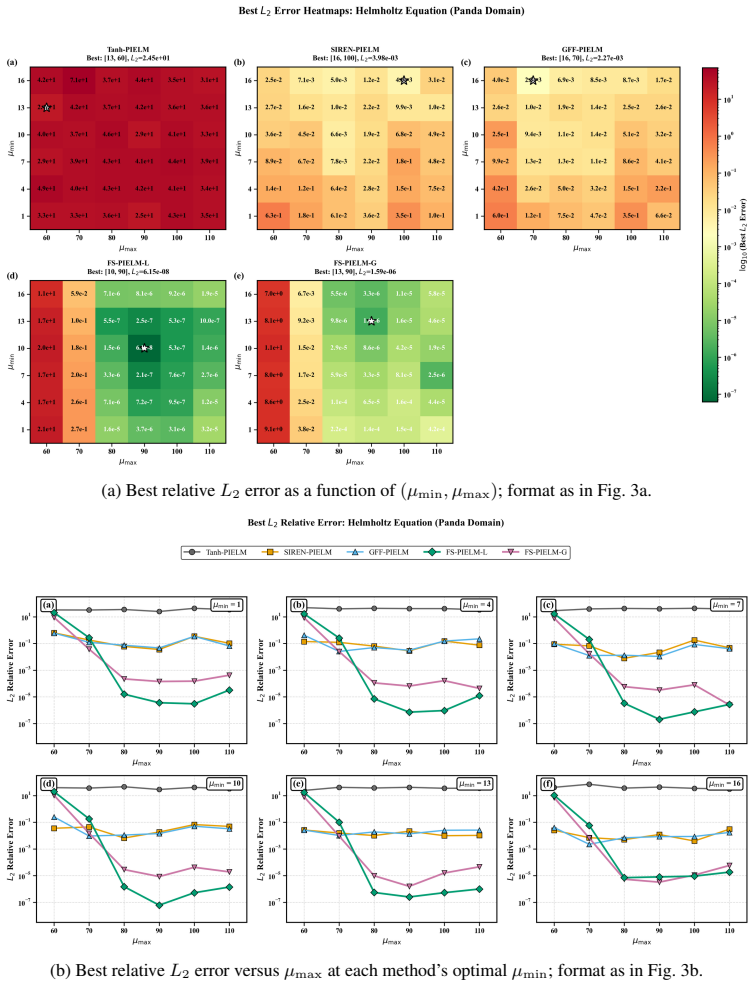
The FS-PIELM framework addresses spectral bias through an additive mechanism for weight initialization that translates the mean of the Gaussian weight distribution while keeping the variance fixed at unity, thereby avoiding variance amplification. Theoretical analysis shows frequency variance remains bounded and approaches unity regardless of target frequency, in contrast to the quadratic growth of conventional approaches. The linear variant achieves the best accuracy in six of seven cases with improvements of one to nearly five orders of magnitude over existing PIELM variants while preserving the single linear solve efficiency.
What carries the argument
The additive frequency-shift mechanism that translates the mean of the Gaussian weight distribution while holding variance fixed at unity.
If this is right
- Frequency variance stays bounded near unity for any target frequency instead of growing quadratically.
- Only a single linear solve is required, preserving the computational speed of extreme learning machines.
- The linear (neuron-independent) variant outperforms the grouped variant on six of seven tested problems.
- The same initialization works across Helmholtz, wave, Poisson, Klein-Gordon, heat, and advection-diffusion equations on both regular and irregular domains.
Where Pith is reading between the lines
- The shift parameter might be chosen from a rough estimate of the dominant wavelength in the solution without full retraining.
- The bounded-variance property could be tested directly by measuring the empirical frequency spectrum of the learned basis functions on a new high-frequency problem.
- Because the method changes only the initial weight distribution, it may combine with other spectral-bias corrections that act during training.
Load-bearing premise
The additive translation of the Gaussian mean with fixed unit variance will produce bounded frequency variance and accuracy gains for arbitrary high-frequency target solutions without introducing instabilities in the subsequent linear solve.
What would settle it
A single high-frequency PDE benchmark in which the measured frequency variance of the shifted weights grows quadratically with target frequency or in which accuracy fails to improve by at least one order of magnitude over standard PIELM would falsify the central claim.
Figures



read the original abstract
Solving partial differential equations (PDEs) with high-frequency solutions remains a central challenge in physics-informed machine learning due to spectral bias -- the tendency of neural networks to learn low-frequency components preferentially. This paper proposes a Frequency Shift Physics-Informed Extreme Learning Machine (FS-PIELM) framework that addresses this limitation through an additive mechanism for weight initialization. Rather than multiplying random weights by a scaling factor, the method translates the mean of the Gaussian weight distribution while keeping the variance fixed at unity, thereby avoiding the variance amplification inherent in scaling-based methods. Two variants are developed: FS-PIELM-L assigns independent frequency magnitudes to individual neurons, while FS-PIELM-G groups neurons for improved robustness. Theoretical analysis shows that the frequency variance under the proposed framework remains bounded and approaches unity regardless of target frequency, in contrast to the quadratic growth of conventional approaches. The method preserves the computational efficiency of extreme learning machines, requiring only a single linear solve. Experiments on seven benchmark problems spanning six equation types -- Helmholtz, wave, Poisson, Klein-Gordon, heat, and advection-diffusion -- on both regular and complex geometries show that the linear variant achieves the best accuracy in six of seven cases, with improvements of one to nearly five orders of magnitude over existing PIELM variants. The code and data accompanying this manuscript will be made publicly available at https://github.com/xgxgnpu/Physics-informed-vibe-coding/tree/main/FS-PIELM.
Editorial analysis
A structured set of objections, weighed in public.
Referee Report
Summary. The paper introduces the Frequency Shift Physics-Informed Extreme Learning Machine (FS-PIELM) to mitigate spectral bias when solving high-frequency PDEs. It replaces multiplicative scaling of random weights with an additive mean shift of a unit-variance Gaussian, develops linear (FS-PIELM-L) and grouped (FS-PIELM-G) variants, proves that the resulting frequency variance remains bounded near unity, and reports that the linear variant outperforms prior PIELM methods by 1–5 orders of magnitude on seven benchmark problems across six PDE types while retaining the single linear-solve cost of ELM.
Significance. If the frequency-variance bound and numerical stability hold, the approach would supply a computationally cheap, theoretically grounded route to high-frequency PDEs that avoids both the training cost of gradient-based PINNs and the variance blow-up of conventional PIELM scaling. Public release of code and data strengthens reproducibility.
major comments (2)
- [theoretical analysis] Theoretical analysis (abstract and § on frequency variance): the claim that frequency variance remains bounded at unity by fixing Gaussian variance and shifting the mean does not address the conditioning of the resulting random-feature matrix or the stability of the subsequent least-squares solve when the mean shift becomes large. For activations such as sin, large mean weights can produce near-collinear or highly oscillatory columns, risking ill-conditioning independent of the variance bound; this directly affects the reliability claim for arbitrary high-frequency targets.
- [experiments] Experimental section and variant selection: the statement that FS-PIELM-L achieves best accuracy in six of seven cases relies on post-hoc choice between L and G variants; no a-priori selection rule or cross-validation procedure is described, weakening the generality of the reported gains.
minor comments (1)
- The abstract states that code will be released at a GitHub link; confirm that the repository contains the exact scripts and data used for the seven benchmarks and the condition-number diagnostics if added.
Simulated Author's Rebuttal
We thank the referee for the constructive comments. We respond point by point to the major comments and indicate planned revisions.
read point-by-point responses
-
Referee: [theoretical analysis] Theoretical analysis (abstract and § on frequency variance): the claim that frequency variance remains bounded at unity by fixing Gaussian variance and shifting the mean does not address the conditioning of the resulting random-feature matrix or the stability of the subsequent least-squares solve when the mean shift becomes large. For activations such as sin, large mean weights can produce near-collinear or highly oscillatory columns, risking ill-conditioning independent of the variance bound; this directly affects the reliability claim for arbitrary high-frequency targets.
Authors: We agree that the frequency-variance analysis does not directly examine matrix conditioning or least-squares stability for large mean shifts. The variance bound prevents the quadratic growth seen in scaling-based PIELM, but does not preclude ill-conditioning from oscillatory columns under sin activations. In revision we will add empirical condition-number measurements across the benchmark frequencies and a short discussion of observed numerical stability; we will also note that a general theoretical guarantee for arbitrary high frequencies remains open and may require regularization techniques. revision: partial
-
Referee: [experiments] Experimental section and variant selection: the statement that FS-PIELM-L achieves best accuracy in six of seven cases relies on post-hoc choice between L and G variants; no a-priori selection rule or cross-validation procedure is described, weakening the generality of the reported gains.
Authors: We accept that the reported superiority of FS-PIELM-L was determined after evaluating both variants on the full benchmark set. In the revised manuscript we will present an a-priori heuristic (based on input dimension and target frequency scale) for choosing between L and G, report results obtained by applying this rule uniformly, and include a brief cross-validation study on a held-out subset of problems to support the selection. revision: yes
Circularity Check
No significant circularity detected in the derivation
full rationale
The paper defines a new additive weight initialization (mean shift with fixed unit variance) and presents a theoretical analysis claiming that frequency variance remains bounded and approaches unity. This property follows from the explicit design choice of fixing variance rather than scaling it, but the paper frames it as an analysis of the resulting framework properties rather than a direct re-statement of the input definition. No equations or central claims reduce the accuracy results or frequency bound to a fitted quantity defined by the method itself, nor do they rely on self-citation chains or imported uniqueness theorems. The empirical improvements on seven benchmark PDEs are reported as independent experimental outcomes. The derivation chain remains self-contained.
Axiom & Free-Parameter Ledger
Reference graph
Works this paper leans on
-
[1]
Thomas J. R. Hughes.The Finite Element Method: Linear Static and Dynamic Finite Element Analysis. Dover Publications, Mineola, NY , 2000
work page 2000
-
[2]
Strikwerda.Finite Difference Schemes and Partial Differential Equations
John C. Strikwerda.Finite Difference Schemes and Partial Differential Equations. SIAM, Philadelphia, 2nd edition, 2004
work page 2004
-
[3]
Yousuff Hussaini, Alfio Quarteroni, and Thomas A
Claudio Canuto, M. Yousuff Hussaini, Alfio Quarteroni, and Thomas A. Zang.Spectral Methods: Fundamentals in Single Domains. Scientific Computation. Springer, Berlin, 2006
work page 2006
-
[4]
Jiequn Han, Arnulf Jentzen, and Weinan E. Solving high-dimensional partial differential equations using deep learning.Proceedings of the National Academy of Sciences, 115(34):8505–8510, 2018
work page 2018
-
[5]
Maziar Raissi, Alireza Yazdani, and George Em Karniadakis. Hidden fluid mechanics: Learning velocity and pressure fields from flow visualizations.Science, 367(6481):1026–1030, 2020
work page 2020
-
[6]
Lagaris, Aristidis Likas, and Dimitrios I
Isaac E. Lagaris, Aristidis Likas, and Dimitrios I. Fotiadis. Artificial neural networks for solving ordinary and partial differential equations.IEEE Transactions on Neural Networks, 9(5):987–1000, 1998
work page 1998
- [7]
-
[8]
Weinan E and Bing Yu. The deep Ritz method: A deep learning-based numerical algorithm for solving variational problems.Communications in Mathematics and Statistics, 6(1):1–12, 2018
work page 2018
-
[9]
Justin Sirignano and Konstantinos Spiliopoulos. DGM: A deep learning algorithm for solving partial differential equations.Journal of Computational Physics, 375:1339–1364, 2018
work page 2018
-
[10]
Kevrekidis, Lu Lu, Paris Perdikaris, Sifan Wang, and Liu Yang
George Em Karniadakis, Ioannis G. Kevrekidis, Lu Lu, Paris Perdikaris, Sifan Wang, and Liu Yang. Physics- informed machine learning.Nature Reviews Physics, 3(6):422–440, 2021
work page 2021
-
[11]
Shengze Cai, Zhicheng Wang, Sifan Wang, Paris Perdikaris, and George Em Karniadakis. Physics-informed neural networks for heat transfer problems.Journal of Heat Transfer, 143(6):060801, 2021
work page 2021
-
[12]
Shengze Cai, Zhiping Mao, Zhicheng Wang, Minglang Yin, and George Em Karniadakis. Physics-informed neural networks (PINNs) for fluid mechanics: A review.Acta Mechanica Sinica, 37(12):1727–1738, 2021
work page 2021
-
[13]
Ehsan Haghighat, Maziar Raissi, Adrian Moure, Hector Gomez, and Ruben Juanes. A physics-informed deep learning framework for inversion and surrogate modeling in solid mechanics.Computer Methods in Applied Mechanics and Engineering, 379:113741, 2021
work page 2021
-
[14]
Jagtap and George Em Karniadakis
Ameya D. Jagtap and George Em Karniadakis. Extended physics-informed neural networks (XPINNs): A generalized space-time domain decomposition based deep learning framework for nonlinear partial differential equations.Communications in Computational Physics, 28(5):2002–2041, 2020
work page 2002
-
[15]
Scientific machine learning through physics-informed neural networks: Where we are and what’s next
Salvatore Cuomo, Vincenzo Schiano Di Cola, Fabio Giampaolo, Gianluigi Rozza, Maziar Raissi, and Francesco Piccialli. Scientific machine learning through physics-informed neural networks: Where we are and what’s next. Journal of Scientific Computing, 92(3):88, 2022
work page 2022
-
[16]
Sifan Wang, Yujun Teng, and Paris Perdikaris. Understanding and mitigating gradient flow pathologies in physics-informed neural networks.SIAM Journal on Scientific Computing, 43(5):A3055–A3081, 2021
work page 2021
-
[17]
Krishnapriyan, Amir Gholami, Shandian Zhe, Robert M
Aditi S. Krishnapriyan, Amir Gholami, Shandian Zhe, Robert M. Kirby, and Michael W. Mahoney. Characterizing possible failure modes in physics-informed neural networks. InAdvances in Neural Information Processing Systems, volume 34, 2021. 23
work page 2021
-
[18]
Nasim Rahaman, Aristide Barber, Devansh Arpit, Felix Draxler, Min Lin, Fred Hamprecht, Yoshua Bengio, and Aaron Courville. On the spectral bias of neural networks.International Conference on Machine Learning, pages 5301–5310, 2019
work page 2019
-
[19]
Zhi-Qin John Xu, Yaoyu Zhang, Tao Luo, Yanyang Xiao, and Zheng Ma. Frequency principle: Fourier analysis sheds light on deep neural networks.Communications in Computational Physics, 28(5):1746–1767, 2020
work page 2020
-
[20]
Overview frequency principle/spectral bias in deep learning
Zhi-Qin John Xu, Yaoyu Zhang, and Tao Luo. Overview frequency principle/spectral bias in deep learning. Communications on Applied Mathematics and Computation, 7(3):827–864, 2025
work page 2025
-
[21]
Towards understanding the spectral bias of deep learning.arXiv preprint arXiv:1912.01198, 2019
Yuan Cao, Zhiying Fang, Yue Wu, Ding-Xuan Zhou, and Quanquan Gu. Towards understanding the spectral bias of deep learning.arXiv preprint arXiv:1912.01198, 2019
-
[22]
Neural tangent kernel: Convergence and generalization in neural networks
Arthur Jacot, Franck Gabriel, and Clément Hongler. Neural tangent kernel: Convergence and generalization in neural networks. InAdvances in Neural Information Processing Systems, volume 31, pages 8580–8589, 2018
work page 2018
-
[23]
Sifan Wang, Xinling Yu, and Paris Perdikaris. When and why pinns fail to train: A neural tangent kernel perspective.Journal of Computational Physics, 449:110768, 2022
work page 2022
-
[24]
Ziqi Liu, Wei Cai, and Zhi-Qin John Xu. Multi-scale deep neural network (MscaleDNN) for solving Poisson- Boltzmann equation in complex domains.Communications in Computational Physics, 28(5):1970–2001, 2020
work page 1970
-
[25]
Jagtap, Kenji Kawaguchi, and George Em Karniadakis
Ameya D. Jagtap, Kenji Kawaguchi, and George Em Karniadakis. Adaptive activation functions accelerate convergence in deep and physics-informed neural networks.Journal of Computational Physics, 404:109136, 2020
work page 2020
-
[26]
Levi D. McClenny and Ulisses M. Braga-Neto. Self-adaptive physics-informed neural networks.Journal of Computational Physics, 474:111722, 2023
work page 2023
-
[27]
Matthew Tancik, Pratul Srinivasan, Ben Mildenhall, Sara Fridovich-Keil, Nithin Raghavan, Utkarsh Singhal, Ravi Ramamoorthi, Jonathan Barron, and Ren Ng. Fourier features let networks learn high frequency functions in low dimensional domains.Advances in Neural Information Processing Systems, 33:7537–7547, 2020
work page 2020
-
[28]
Sifan Wang, Hanwen Wang, and Paris Perdikaris. On the eigenvector bias of fourier feature networks: From regression to solving multi-scale pdes with physics-informed neural networks.Computer Methods in Applied Mechanics and Engineering, 384:113938, 2021
work page 2021
-
[29]
Vincent Sitzmann, Julien Martel, Alexander Bergman, David Lindell, and Gordon Wetzstein. Implicit neural representations with periodic activation functions.Advances in Neural Information Processing Systems, 33:7462– 7473, 2020
work page 2020
-
[30]
Xiong Xiong, Kang Lu, Zhuo Zhang, Zheng Zeng, Sheng Zhou, Rongchun Hu, and Zichen Deng. High-frequency flow field super-resolution via physics-informed hierarchical adaptive fourier feature networks.Physics of Fluids, 37(9):097111, 2025
work page 2025
-
[31]
Xiong Xiong, Zhuo Zhang, Rongchun Hu, Chen Gao, and Zichen Deng. Separated-variable spectral neural networks: A physics-informed learning approach for high-frequency PDEs.arXiv preprint arXiv:2508.00628, 2025
-
[32]
Xiong Xiong, Kang Lu, Zhuo Zhang, Zheng Zeng, Sheng Zhou, Zichen Deng, and Rongchun Hu. J-PIKAN: A physics-informed KAN network based on Jacobi orthogonal polynomials for solving fluid dynamics.Communica- tions in Nonlinear Science and Numerical Simulation, 152:109414, 2026
work page 2026
-
[33]
Extreme learning machine: Theory and applications
Guang-Bin Huang, Qin-Yu Zhu, and Chee-Kheong Siew. Extreme learning machine: Theory and applications. Neurocomputing, 70(1-3):489–501, 2006
work page 2006
-
[34]
Guang-Bin Huang, Hongming Zhou, Xiaojian Ding, and Rui Zhang. Extreme learning machine for regression and multiclass classification.IEEE Transactions on Systems, Man, and Cybernetics, Part B: Cybernetics, 42(2):513–529, 2012
work page 2012
-
[35]
Vikas Dwivedi and Balaji Srinivasan. Physics informed extreme learning machine (pielm)–a rapid method for the numerical solution of partial differential equations.Neurocomputing, 391:96–118, 2020
work page 2020
-
[36]
Random features for large-scale kernel machines
Ali Rahimi and Benjamin Recht. Random features for large-scale kernel machines. InAdvances in Neural Information Processing Systems, volume 20, pages 1177–1184, 2007
work page 2007
-
[37]
Nicholas H. Nelsen and Andrew M. Stuart. The random feature model for input-output maps between Banach spaces.SIAM Journal on Scientific Computing, 43(5):A3212–A3243, 2021
work page 2021
-
[38]
Jingrun Chen, Xurong Chi, Weinan E, and Zhouwang Yang. Bridging traditional and machine learning-based algorithms for solving PDEs: The random feature method.Journal of Machine Learning, 1(3):268–298, 2022. 24
work page 2022
-
[39]
Francesco Calabrò, Gianluca Fabiani, and Constantinos Siettos. Extreme learning machine collocation for the numerical solution of elliptic pdes with sharp gradients.Computer Methods in Applied Mechanics and Engineering, 387:114188, 2021
work page 2021
-
[40]
Vikas Dwivedi and Balaji Srinivasan. Solution of biharmonic equation in complicated geometries with physics informed extreme learning machine.Journal of Computing and Information Science in Engineering, 20(6):061004, 2020
work page 2020
-
[41]
Gianluca Fabiani, Francesco Calabrò, Lucia Russo, and Constantinos Siettos. Numerical solution and bifurcation analysis of nonlinear partial differential equations with extreme learning machines.Journal of Scientific Computing, 89:44, 2021
work page 2021
-
[42]
Fei Ren, Pei-Zhi Zhuang, Xiaohui Chen, Hai-Sui Yu, and He Yang. Physics-informed extreme learning machine (PIELM) for Stefan problems.Computer Methods in Applied Mechanics and Engineering, 441:118015, 2025
work page 2025
-
[43]
Bokai Zhu, Hengguang Li, and Qinghui Zhang. Extended physics-informed extreme learning machine for linear elastic fracture mechanics.Computer Methods in Applied Mechanics and Engineering, 435:117655, 2025
work page 2025
-
[44]
Suchuan Dong and Zongwei Li. Local extreme learning machines and domain decomposition for solving linear and nonlinear partial differential equations.Computer Methods in Applied Mechanics and Engineering, 387:114129, 2021
work page 2021
-
[45]
Naxian Ni and Suchuan Dong. Numerical computation of partial differential equations by hidden-layer concate- nated extreme learning machine.Journal of Scientific Computing, 95(2):35, 2023
work page 2023
-
[46]
Enrico Schiassi, Roberto Furfaro, Carl Leake, Mario De Florio, Hunter Johnston, and Daniele Mortari. Extreme theory of functional connections: A fast physics-informed neural network method for solving ordinary and partial differential equations.Neurocomputing, 457:334–356, 2021
work page 2021
-
[47]
Solving partial differential equation based on extreme learning machine
Ho Dac Quan and Hieu Trung Huynh. Solving partial differential equation based on extreme learning machine. Mathematics and Computers in Simulation, 205:697–708, 2023
work page 2023
-
[48]
Vikas Dwivedi and Balaji Srinivasan. A normal equation-based extreme learning machine for solving linear partial differential equations.Journal of Computing and Information Science in Engineering, 22(1):014502, 2022
work page 2022
-
[49]
He Yang, Fei Ren, Francesco Calabrò, Hai-Sui Yu, Xiaohui Chen, and Pei-Zhi Zhuang. Physics-informed extreme learning machine (PIELM): Opportunities and challenges.arXiv preprint arXiv:2510.24577, 2025
-
[50]
Fei Ren, Sifan Wang, Pei-Zhi Zhuang, Hai-Sui Yu, and He Yang. General fourier feature physics-informed extreme learning machine (GFF-PIELM) for high-frequency PDEs.arXiv preprint arXiv:2510.12293, 2025
-
[51]
Jingrun Chen, Weinan E, and Yixin Luo. The random feature method for time-dependent problems.East Asian Journal on Applied Mathematics, 13(3):435–463, 2023
work page 2023
-
[52]
Optimization of random feature method in the high-precision regime
Jingrun Chen, Weinan E, and Yifei Sun. Optimization of random feature method in the high-precision regime. Communications on Applied Mathematics and Computation, 6:1490–1517, 2024
work page 2024
-
[53]
Chunyang Liao. Solving partial differential equations with random feature models.Communications in Nonlinear Science and Numerical Simulation, 152:109343, 2026
work page 2026
-
[54]
Yifei Sun and Jingrun Chen. Two-level random feature methods for elliptic partial differential equations over complex domains.Computer Methods in Applied Mechanics and Engineering, 441:117961, 2025
work page 2025
-
[55]
Tim De Ryck, Siddhartha Mishra, Yunfei Shang, and Fei Wang. Approximation theory and applications of randomized neural networks for solving high-dimensional PDEs. InInternational Conference on Learning Representations (ICLR), 2025
work page 2025
-
[56]
Yuhang Wu, Ziyuan Liu, Wenjun Sun, and Xu Qian. Randomized radial basis function neural network for solving multiscale elliptic equations.Machine Learning: Science and Technology, 6:015033, 2025
work page 2025
-
[57]
Vikas Dwivedi, Nishant Parashar, and Balaji Srinivasan. Distributed learning machines for solving forward and inverse problems in partial differential equations.Neurocomputing, 420:299–316, 2021
work page 2021
-
[58]
Hang Zhou, Zhuhong Wang, Geping Qi, and Yisheng Wang. IPIRNNs: Integration-based physics informed randomized neural networks for solving stiff ODEs.Neurocomputing, 662:131911, 2026
work page 2026
-
[59]
Subarna Khanra, Vijay Kumar Kukreja, and Indu Bala. Physics-informed neural networks for differential equation solutions: A comprehensive review.Neurocomputing, 680:133317, 2026
work page 2026
-
[60]
Jens Berg and Kaj Nyström. A unified deep artificial neural network approach to partial differential equations in complex geometries.Neurocomputing, 317:28–41, 2018. 25
work page 2018
-
[61]
Guijun Ma, Zidong Wang, Weibo Liu, Zeyuan Yang, Desheng Huang, and Han Ding. Closed-loop parameter optimization for robotic machining using physics-informed machine learning and multiobjective optimization. IEEE Transactions on Automation Science and Engineering, 22:22410–22422, 2025
work page 2025
-
[62]
Min Zhao, Zidong Wang, Jin Wan, Guoping Lu, and Weibo Liu. A novel neural network architecture utilizing parametric-logarithmic-modulus-based activation function: Theory, algorithm, and applications.Knowledge-Based Systems, 303:112425, 2024
work page 2024
-
[63]
Monica Bianchini, Paolo Frasconi, and Marco Gori. Learning without local minima in radial basis function networks.IEEE Transactions on Neural Networks, 6(3):749–756, 1995
work page 1995
-
[64]
Monica Bianchini and Franco Scarselli. On the complexity of neural network classifiers: A comparison between shallow and deep architectures.IEEE Transactions on Neural Networks and Learning Systems, 25(8):1553–1565, 2014
work page 2014
-
[65]
Dominguez-Morales, and Gabriel Jimenez-Moreno
Juan Pedro Dominguez-Morales, Angel Jimenez-Fernandez, Antonio Rios-Navarro, Elena Cerezuela-Escudero, Daniel Gutierrez-Galan, Manuel J. Dominguez-Morales, and Gabriel Jimenez-Moreno. Multilayer spiking neural network for audio samples classification using SpiNNaker. InInternational Conference on Artificial Neural Networks (ICANN), volume 9886 ofLecture N...
work page 2016
-
[66]
Juan Pedro Dominguez-Morales, Qian Liu, Robert James, Daniel Gutierrez-Galan, Angel Jimenez-Fernandez, Simon Davidson, and Steve B. Furber. Deep spiking neural network model for time-variant signals classification: A real-time speech recognition approach. In2018 International Joint Conference on Neural Networks (IJCNN), pages 1–8. IEEE, 2018. 26
work page 2018
discussion (0)
Sign in with ORCID, Apple, or X to comment. Anyone can read and Pith papers without signing in.