REVIEW 4 major objections 5 minor 1 cited by
Agent-as-Tool: A Study on the Hierarchical Decision Making with Reinforcement Learning
T0 review · 4 major / 5 minor · reviewed 2026-08-06 · deepseek-v4-flash
Pith's one-line read The paper claims that separating a reasoning planner from a tool-calling agent improves multi-hop question answering, achieving state-of-the-art exact match on Bamboogle after reinforcement fine-tuning on only 180 samples.
desk verdict A sensible but confounded study: the pre/post RL gains are real, but the Bamboogle SOTA claim needs an ablation to hold. read the letter →
The pith
A machine-rendered reading of the paper's core claim, the machinery that carries it, and where it could break.
The reading
What carries the argument
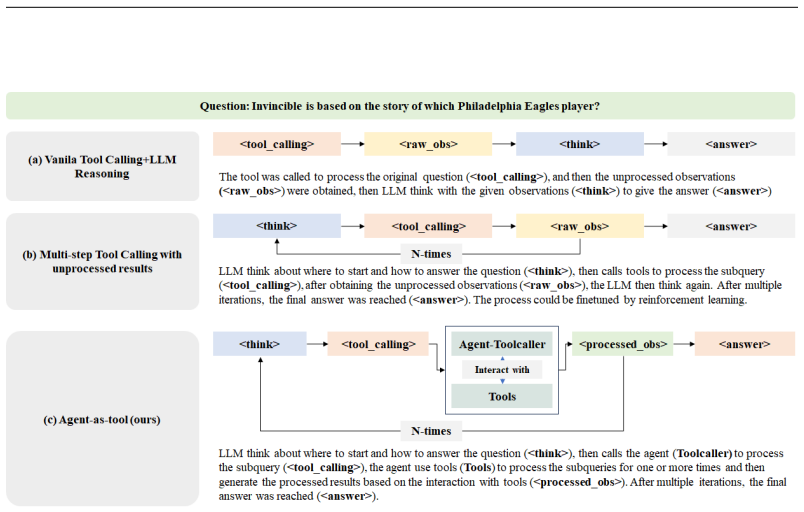
The load-bearing mechanism is the two-tier Planner/Toolcaller hierarchy plus observation masking. The Planner is the policy being trained: it reasons in <think>...</think> tags and issues sub-queries inside <tool calling>...</tool calling> tags. The Toolcaller is a separate, fixed chat agent that executes the search and returns processed observations in <obs>...</obs> blocks. In RL, those observation blocks are replaced by a zero-embedding <fim pad> token during reward modeling, so credit flows only to the Planner's reasoning and query-construction decisions. Training uses GRPO with 12 rollouts per prompt, a batch of 3, and 60 steps (180 samples total), with a reward of +F1 for correctly formatted answers and -2 for malformed ones.
What would settle it
Run the comparison with the tool-output variable held constant: give Search-R1 the same GPT-4o-mini-generated structured summaries that Agent-as-tool's Toolcaller produces, or replace the Toolcaller with Qwen-2.5-7B-Instruct. If Bamboogle exact match for Search-R1 rises from 58.4% toward Agent-as-tool's 63.2%, or if Agent-as-tool's score falls when its Toolcaller is weakened, the confound is confirmed and the hierarchical claim is not supported.
Extended reading notes
Core claim
On the paper's own terms, the discovery is that tool execution and verbal reasoning should be assigned to different agents in an RL-trained system. The Planner emits <think> reasoning and <tool calling> natural-language sub-queries; the Toolcaller, a CAMEL-style chat agent powered by GPT-4o-mini, retrieves top-k search results and returns them as structured <obs> observations. During GRPO fine-tuning the observation blocks are masked with a special token so the reward reaches only the Planner's outputs, preserving credit assignment. With 60 training steps on 180 samples (12 rollouts each), the fine-tuned Planner improves over its untuned base on all four benchmarks by an average of 2.5% in exact match and, on Bamboogle, beats the strongest compared baseline Search-R1.
Load-bearing premise
The load-bearing premise is that the measured gains come from the hierarchical split itself, yet Agent-as-tool and Search-R1 differ in a second respect: Agent-as-tool's planner receives pre-digested summaries from a stronger, fixed model (GPT-4o-mini), and that variable is never isolated.
Editorial extensions
If this is right
- If the hierarchical design is responsible for the gains, RL-based agents for search-heavy tasks should separate reasoning from tool execution instead of using a single coupled ReAct-style loop.
- Reinforcement fine-tuning on as few as 180 samples yields a consistent improvement across all four benchmarks, suggesting multi-hop search agents can be adapted cheaply.
- Reasoning over structured, summarized observations rather than raw search output produces clearer, more decomposable reasoning traces and avoids the model being misled by irrelevant symbols.
- The architecture is extensible: the Toolcaller can be swapped for calculators, code interpreters, or MCP-based tool servers, and the Planner can evolve into a tool orchestrator.
- Observation masking preserves credit assignment in the hierarchical setup and could support other multi-agent RL training schemes.
Reading between the lines
- The comparison with Search-R1 changes two variables at once: the hierarchical structure and the presence of a strong summarizer (GPT-4o-mini) that writes structured observations, so the isolated effect of the hierarchy is not identified by the reported numbers.
- A direct test would feed Search-R1 the same structured summaries or give Agent-as-tool raw search results, which would separate the benefit of structured observations from the benefit of hierarchical RL training.
- The design also implies a cheaper deployment pattern, where a fixed or small model handles tool-interface noise while the trained policy concentrates on reasoning.
- Observation masking may transfer to other hierarchical RL settings where a subordinate agent's outputs should not leak reward into the policy gradient.
Editorial analysis
A structured set of objections, weighed in public.
Referee Report
Summary. The paper proposes 'Agent-as-tool', a hierarchical framework that separates a reasoning Planner from a tool-calling Toolcaller. The Toolcaller, implemented as a CAMEL-style agent powered by GPT-4o-mini, summarizes web-search results into structured observations. The Planner is fine-tuned with GRPO on 180 samples from HotpotQA and 2WikiMultiHopQA, with observation masking to preserve credit assignment. The authors report state-of-the-art results on Bamboogle (63.2% EM, 75.2% CEM) over Search-R1, while acknowledging lower exact-match results on HotpotQA, 2WikiMultiHopQA, and MuSiQue.
Significance. The conceptual split of planning and tool execution is a sensible architectural proposal, and the claim that only 180 samples and 2160 rollouts are needed for a stable gain is interesting. The paper is transparent about its training protocol and includes qualitative examples. However, the headline empirical claim is not yet established: the head-to-head comparison with Search-R1 is confounded by the Toolcaller's use of GPT-4o-mini, and the reported numbers lack error bars. The framework and the pre/post-RL comparison are worth seeing with proper ablations, but in its current form the evidence is insufficient to support 'state-of-the-art'.
major comments (4)
- [§3.1.2, §4.1.4, Table 1] The headline claim of state-of-the-art Bamboogle performance rests on a comparison that changes two variables at once. §3.1.2 specifies that the Toolcaller is a CAMEL-style GPT-4o-mini agent returning structured summaries, while §4.1.4 states that for Search-R1, search results are 'directly returned as the answer' without such a Toolcaller. Table 1 shows that Agent-as-tool-Base (no GRPO) already reaches 60.0 EM on Bamboogle, above Search-R1's 58.4 EM. The reported 4.8-point gain of Agent-as-tool-Instruct over Search-R1 is therefore consistent with the GPT-4o-mini summarizer accounting for most or all of the improvement, rather than the hierarchical design or the RL fine-tuning. Please add an ablation that fixes the observation model—e.g., a Toolcaller implemented with Qwen-2.5-7B-Instruct, or Search-R1 fed GPT-4o-mini-generated summaries—and report the pre-RL version of that ablated setting.
- [§4.1.5, Table 1, Table 2] All quantitative results are single numbers with no error bars, no test-set sizes, and no significance tests. The differences that support the paper's conclusions (e.g., +3.2 EM on Bamboogle from RL in Table 2; +2.2 EM on HotpotQA; +4.8 EM over Search-R1 in Table 1) are a few percentage points on datasets that are known to be small; without variance estimates they cannot be distinguished from run-to-run noise. Please provide means and standard deviations over at least three independent RL runs/seeds, or bootstrap confidence intervals, and report the number of evaluation examples per dataset.
- [§3.2.2–§3.2.3, Eq. (2)] The causal story that 'hierarchical decoupling' produces the gains is underdetermined because the reward function (Eq. 2) combines F1 scoring with a −2 formatting penalty and the training procedure includes observation masking (§3.2.2). A non-hierarchical GRPO baseline trained with the same reward, prompt format, and 180-sample budget is needed to show that the architecture, rather than the reward shaping or the extra training signal, is responsible for the improvement. Without such a baseline, the paper's Section 4.2 claim that 'the Agent-as-tool ... is a more effective framework' is not supported.
- [§4.1.2, Figure 2] The report that training is 60 steps on 180 samples with 12 rollouts per prompt is transparent, but the loss curve in Figure 2 is unstable for the first 30 steps, and no validation accuracy is shown during training. It is therefore unclear whether the final checkpoint is representative, and whether the 180-sample selection (described only as 'same ratio as R1-searcher') matters. Please report the sample-selection procedure and show results for at least two different selections or seeds.
minor comments (5)
- [Abstract] The abstract contains grammatical errors ('had achieved exceptionally well performance', 'the chain of reasoning was solely relied on') that should be corrected.
- [Eq. (2)] The F1 score used for the reward is never defined for free-form answers (e.g., token-level, character-level, or based on a normalization step); please specify the exact computation.
- [§4.1.5] The CEM ('cover exact match') metric is not defined; please provide a definition or a citation to the original metric.
- [§4.1.4] There is a typo 'information retrival' (should be 'information retrieval'), and the text contains inconsistent spacing in 'T oolcaller', 'W eb Search', and 'Agent-as-tool-Base + W eb Search'.
- [§4.2] Cross-reference errors: 'The qualitative results are shown in 1' should read 'Table 1', and 'shown in 2' should read 'Table 2'.
Circularity Check
No significant circularity: the RL derivation and evaluation are self-contained; the SOTA comparison is confounded but not circular.
full rationale
The paper's central derivation is not circular. The GRPO objective (Eq. 1), the reward function (Eq. 2), and the observation-masking scheme are fixed independently of the evaluation outcome. Training data are drawn from HotpotQA and 2WikiMultiHopQA, while Bamboogle is used only for evaluation, so no fitted parameter is later renamed as a prediction. The framework's components (Planner and Toolcaller) are defined behaviorally, not in terms of the benchmark results, and the claimed efficiency (180 training samples) is an empirical outcome rather than a construction. The main weakness is a confound: the Toolcaller uses GPT-4o-mini to summarize search results while the Search-R1 baseline receives raw search outputs, so the Bamboogle gain over Search-R1 may be attributable to the summarizer rather than to hierarchical RL. A confound, however, is not circularity: it does not make the stated result equivalent to its inputs by definition. There are also no load-bearing self-citations, no imported uniqueness theorem, and no ansatz smuggled in via citation. The paper's claims are underdetermined by the experiments, not entailed by them, so the correct circularity score is 0.
Assumptions & free parameters
free parameters (4)
- Reward penalty for malformed output =
-2
- Number of GRPO training steps =
60
- Rollouts per prompt =
12
- Max tool-calling rounds per rollout =
10
assumptions (4)
- domain assumption The Toolcaller (GPT-4o-mini) returns accurate and sufficient summaries of web search results.
- ad hoc to paper Rewarding only the final answer with F1 and a formatting penalty is sufficient to improve multi-hop reasoning.
- domain assumption The evaluation metrics EM and CEM capture the intended reasoning ability.
- domain assumption The 180-sample training set, drawn from HotpotQA and 2WikiMultiHopQA, is representative enough to generalize to MuSiQue and Bamboogle.
Cite this review
Pith. "Pith review of Agent-as-Tool: A Study on the Hierarchical Decision Making with Reinforcement Learning." pith.science (2026). https://pith.science/paper/HOELECPD
@misc{pith2026250701489,
  author       = {Pith},
  title        = {Pith review of: Agent-as-Tool: A Study on the Hierarchical Decision Making with Reinforcement Learning},
  year         = {2026},
  howpublished = {\url{https://pith.science/paper/HOELECPD}},
  note         = {Machine review of arXiv:2507.01489}
}
read the original abstract
Large Language Models (LLMs) have emerged as one of the most significant technological advancements in artificial intelligence in recent years. Their ability to understand, generate, and reason with natural language has transformed how we interact with AI systems. With the development of LLM-based agents and reinforcement-learning-based reasoning models, the study of applying reinforcement learning in agent frameworks has become a new research focus. However, all previous studies face the challenge of deciding the tool calling process and the reasoning process simultaneously, and the chain of reasoning was solely relied on the unprocessed raw result with redundant information and symbols unrelated to the task from the tool, which impose a heavy burden on the model's capability to reason. Therefore, in our research, we proposed a hierarchical framework Agent-as-tool that detach the tool calling process and the reasoning process, which enables the model to focus on the verbally reasoning process while the tool calling process is handled by another agent. Our work had achieved comparable results with only a slight reinforcement fine-tuning on 180 samples, and had achieved exceptionally well performance in Bamboogle with 63.2% of exact match and 75.2% in cover exact match, exceeding Search-R1 by 4.8% in exact match and 3.2% in cover exact match.
Figures


Figures from the paper (1 more)

Forward citations
Cited by 1 Pith paper
-
OpenClaw and Ollama in Agentic AI: Toward Fully Autonomous and Scalable AI Agent Systems
A review-plus-demo claiming agentic capabilities emerge from system integration, backed by a 15-task benchmark whose C1→C3 performance gap is largely built into the test design.
Reference graph
Works this paper leans on
- [1]
- [3]
-
[6]
URL https://arxiv.org/abs/2503.09516. G. Li, H. Hammoud, H. Itani, D. Khizbullin, and B. Ghanem. Camel: Communicative agents for” mind” exploration of large language model society. Advances in Neural Information Processing Systems, 36:51991–52008, 2023a. M. Li, Y. Zhao, B. Yu, F. Song, H. Li, H. Yu, Z. Li, F. Huang, and Y. Li. Api-bank: A comprehensive be...
-
[7]
URL https://doi.org/10.5281/zenodo.15186407. B. Liu, X. Li, J. Zhang, J. Wang, T. He, S. Hong, H. Liu, S. Zhang, K. Song, K. Zhu, et al. Advances and challenges in foundation agents: From brain-inspired intelligence to evolutionary, collaborative, and safe systems. arXiv preprint arXiv:2504.01990,
-
[8]
URL https://arxiv.org/abs/2210.03350. C. Qian, E. C. Acikgoz, Q. He, H. Wang, X. Chen, D. Hakkani-T¨ ur, G. Tur, and H. Ji. Toolrl: Reward is all tool learning needs. arXiv preprint arXiv:2504.13958,
-
[9]
URL https://arxiv.org/abs/2412.15115. 9 Z. Shao, P. Wang, Q. Zhu, R. Xu, J. Song, X. Bi, H. Zhang, M. Zhang, Y. Li, Y. Wu, et al. Deepseekmath: Pushing the limits of mathematical reasoning in open language models. arXiv preprint arXiv:2402.03300,
-
[12]
Z. Yang, P. Qi, S. Zhang, Y. Bengio, W. W. Cohen, R. Salakhutdinov, and C. D. Manning. Hotpotqa: A dataset for diverse, explainable multi-hop question answering. arXiv preprint arXiv:1809.09600,
-
[13]
URL https://arxiv.org/abs/2210.03629. J. Zhang, J. Xiang, Z. Yu, F. Teng, X. Chen, J. Chen, M. Zhuge, X. Cheng, S. Hong, J. Wang, et al. Aflow: Automating agentic workflow generation. arXiv preprint arXiv:2410.10762,
Show all 15 references
-
[14]
Zheng, S
Y. Zheng, S. Sun, L. Qiu, D. Ru, C. Jiayang, X. Li, J. Lin, B. Wang, Y. Luo, R. Pan, et al. Openresearcher: Unleashing ai for accelerated scientific research. arXiv preprint arXiv:2408.06941,
-
[15]
Zheng, D
Y. Zheng, D. Fu, X. Hu, X. Cai, L. Ye, P. Lu, and P. Liu. Deepresearcher: Scaling deep research via reinforcement learning in real-world environments. arXiv preprint arXiv:2504.03160,
-
[2020]
S. Hong, X. Zheng, J. Chen, Y. Cheng, J. Wang, C. Zhang, Z. Wang, S. K. S. Yau, Z. Lin, L. Zhou, et al. Metagpt: Meta programming for multi-agent collaborative framework. arXiv preprint arXiv:2308.00352, 3(4):6,
-
[2022]
URL https://arxiv.org/abs/2108.00573. L. von Werra, Y. Belkada, L. Tunstall, E. Beeching, T. Thrush, N. Lambert, S. Huang, K. Rasul, and Q. Gallou´ edec. Trl: Transformer reinforcement learning. https://github.com/huggingface/trl,
-
[2023]
Hurst, A
A. Hurst, A. Lerer, A. P. Goucher, A. Perelman, A. Ramesh, A. Clark, A. Ostrow, A. Weli- hinda, A. Hayes, A. Radford, et al. Gpt-4o system card. arXiv preprint arXiv:2410.21276,
-
[2024]
H. Song, J. Jiang, Y. Min, J. Chen, Z. Chen, W. X. Zhao, L. Fang, and J.-R. Wen. R1- searcher: Incentivizing the search capability in llms via reinforcement learning. arXiv preprint arXiv:2503.05592,
-
[2025]
URL https://arxiv.org/abs/2504.04736. D. Guo, D. Yang, H. Zhang, J. Song, R. Zhang, R. Xu, Q. Zhu, S. Ma, P. Wang, X. Bi, et al. Deepseek-r1: Incentivizing reasoning capability in llms via reinforcement learning. arXiv preprint arXiv:2501.12948,
Reviewed August 6, 2026 · model on record in the stance chip above.
Discussion (0). Sign in to comment.