REVIEW 1 major objections 4 minor 66 references
A unified fluid model for nonthermal plasmas and reacting flows
T0 review · 1 major / 4 minor · reviewed 2026-08-07 · deepseek-v4-flash
Pith's one-line read A unified fluid solver, reactPlasFoam, simulates fully coupled plasma and combustion by recomputing the electron energy distribution at every cell, and reproduces reference streamers, flame behavior, and spark data.
desk verdict A genuinely useful solver integration with solid streamer and flame benchmarks, but the spark 'validation' is partly circular because Eq. (30) caps electron density with the measured power, and the code isn't released. read the letter →
The pith
A machine-rendered reading of the paper's core claim, the machinery that carries it, and where it could break.
The reading
What carries the argument
The argument is carried by three things. The first is the on-the-fly electron Boltzmann equation solve, done with a two-term expansion under the local-field approximation, at the cell level, which replaces tabulated transport and rate data. The second is the four-mode governing-equation structure that strips the full equations down to the dominant physics per stage. The third is the set of acceleration techniques: adaptive mesh refinement targeting the streamer length scale, dynamic load balancing that redistributes Boltzmann-solve tasks across processors, and sub-cycling that separates slow hydrodynamics from fast charge transport.
What would settle it
The paper states that no coupled plasma-combustion benchmark data yet exist, so full verification is open; a concrete test is to compare the per-electron ionization rate at a steep streamer head against a nonlocal kinetic (Monte Carlo) calculation at the same instantaneous field and density gradient, and to check whether any divergence grows as the gradient steepens.
Extended reading notes
Core claim
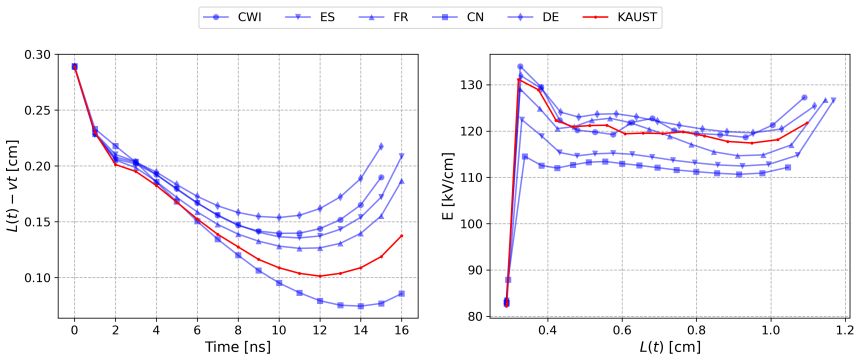
On the paper's own terms, the central claim is that a single unified fluid model can capture the whole life cycle of a plasma interacting with a flame — streamer, spark, reacting flow, and ionic wind — if the electron energy distribution function is treated as a local, composition-dependent field rather than a pre-tabulated function of the reduced field. The solver recomputes the EEDF on the fly from a two-term Boltzmann solution, so electron mobility, diffusion, reaction rates, and energy deposition adapt to local temperature and composition. The paper reports that this reproduces positive-streamer results in a standardized comparison, matches a one-dimensional hydrogen flame, captures nanosecond spark energy deposition and fast heating, and produces plausible flame-guided streamers and ionic-wind flame responses.
Load-bearing premise
The model assumes that at each point the electron energy distribution is determined entirely by the local reduced electric field, gas composition, and temperature (the stationary, spatially homogeneous local-field approximation); if electron transport from neighboring regions shapes the distribution, as can happen at steep streamer fronts, the computed rates and transport properties would be wrong.
Editorial extensions
If this is right
- Fully coupled plasma-combustion simulations in realistic two-dimensional geometries become feasible at moderate cost, opening systematic numerical studies of two-way plasma-flame coupling.
- Mixture-dependent electron properties such as mobility and ionization rate can be captured across a flame front without building high-dimensional lookup tables.
- Dynamic load balancing and sub-cycling give order-of-magnitude speedups — about sevenfold for flame-guided streamers and sixteenfold for ionic-wind mode — with acceptable accuracy loss.
- The spark-mode results reproduce measured gas temperature and atomic-oxygen density in a nanosecond air discharge, supporting predictions of fast heating and radical production.
Reading between the lines
- The on-the-fly Boltzmann solve is the main cost bottleneck; a data-driven surrogate for the electron energy distribution trained on local field and composition could remove most of that cost, a route the paper itself lists as future work.
- Because the local-field approximation is known to strain at steep streamer fronts, the four-mode architecture could be extended with a local-mean-energy closure or nonlocal correction without changing its overall structure.
- The four-mode switching pattern suggests a modular path to reduced-order models: each mode could be replaced by a cheaper surrogate independently while preserving the coupling interface.
- A decisive validation step would be a three-dimensional simulation with electrode-circuit coupling to test whether the spark-mode power cap in Eq. (30) holds beyond the single-pulse cases shown.
Editorial analysis
A structured set of objections, weighed in public.
Referee Report
Summary. The paper presents reactPlasFoam, a unified fluid-modeling framework for nonthermal plasmas coupled to reacting flows, built by embedding the ChemPlasKin 0D gas-plasma kinetics solver into OpenFOAM. The solver operates in four modes (streamer, spark, reacting flow, ionic wind) and solves the two-term electron Boltzmann equation on the fly to obtain composition- and temperature-dependent electron transport properties and reaction rates. The authors verify the streamer mode against six established streamer codes, benchmark the reacting-flow mode against Cantera for a 1D hydrogen flame, and demonstrate the framework on three applications: a nanosecond spark in airflow, streamer propagation through a premixed methane flame, and counterflow-flame response to DC/AC electric fields. They also report substantial computational savings from adaptive mesh refinement, dynamic load balancing, and time-step subcycling. The central claim is that this integrated solver makes fully coupled plasma-combustion simulation feasible and accurate at moderate cost.
Significance. If the central claims hold, the paper would be a valuable contribution: it provides a single code base for plasma-combustion interaction with local, composition-aware electron kinetics, going beyond pre-tabulated EEDF approaches that are limited to homogeneous mixtures. The streamer benchmarks against six codes and the Cantera flame comparison are clean, quantitative checks that support the solver's numerical infrastructure. The reported performance gains from dynamic load balancing and sub-cycling are concrete and relevant to the community. However, the load-bearing validation evidence for the plasma-chemistry capability in the spark application is weakened by the circular use of the experimental power in Eq. (30), as detailed below. The paper also contains explicit, honest statements of its main limitations (two-term local-field approximation, incomplete PAC mechanism, 2D axisymmetry), which is commendable. With the spark-validation issue addressed, the framework would be a strong basis for future plasma-assisted combustion studies.
major comments (1)
- [Sec. 4.1] The streamer verification in Sec. 4.1 does not exercise the paper's central novelty, namely the on-the-fly EBE closure. Equations (46) and (47) use analytically prescribed transport and ionization coefficients (¯α, µe, De) rather than values computed from the EBE, so the agreement with the six reference solvers validates the discretization, AMR, and parallel infrastructure, but not the composition- and temperature-dependent EBE update. The paper should state this explicitly and, ideally, add a verification of the EBE module itself (e.g., reproducing CppBOLOS/BOLSIG+ transport coefficients and rates for a multi-component mixture) to support the claim that the on-the-fly EBE approach is accurate in reacting mixtures.
minor comments (4)
- [Sec. 1] There is a grammatical error near the end of the second paragraph: 'it is either directly by solving the electron Boltzmann equation' should read 'it is obtained either by solving the electron Boltzmann equation...'.
- [Sec. 4.2, Fig. 8] The word 'prorogation' in '1D freely prorogation hydrogen flame' is a typo; it should be 'propagating'.
- [Sec. 5.2] In the sentence 'A 8 kV trapezoid pulse is applied', the article should be 'An 8 kV trapezoid pulse'.
- [Sec. 3.5.1, Eq. (45)] The EBE-update tolerances r_rel and r_abs are user-specified, but no sensitivity study is reported. A representative test showing the effect of these tolerances on the solution and on the computational cost would help users set them and would strengthen the performance claims.
Circularity Check
Spark validation is partly circular: measured power caps electron density and measured T/O seed initial conditions before being used as validation targets.
-
fitted input called prediction
[Sec. 2.2.2, Eq. (30); Sec. 5.1.2, Figs. 15 and 17]
"because the conduction current is limited by the external power supply (not modeled here), we enforce an upper bound on n e to prevent nonphysical growth: ne = min(n+ − n− − nc, n_old_e P_exp / ∫∫∫_V Ėp dV) (Eq. 30). Note that the external-power cap (Eq. 30) prevents excessive electron densities. The total deposited energy reaches 502 μJ at 24 ns, about 25% below the experimental 670±50 μJ [56]."
The validation target 670 μJ is the time-integrated power measured in the same Rusterholtz experiment whose P_exp is injected as an active constraint in Eq. (30). In spark mode, whenever the unconstrained plasma power would exceed P_exp, the electron density is reduced so that energy deposition cannot exceed the measured input. The 502 μJ result, and the post-breakdown gas heating and radical production that follow from it, are therefore not independent predictions: they are upper-bounded by the experimental power used as ground truth. The pre-spark streamer phase is less affected, but the post-breakdown phase dominates the total energy, so the Sec. 5.1.2 'major part of code validation' is not an independent test of the plasma model.
-
fitted input called prediction
[Sec. 5.1.2, initial conditions and Fig. 17]
"Experimental measurements in [56] show that, during the quasi-steady state before the next voltage pulse, the gas temperature and atomic-oxygen (O(3P)) number density at the electrode-gap center are 1500 K and 2×10^17 cm−3, respectively. ... we impose radial Gaussian profiles ... Atomic-oxygen also follows a Gaussian distribution ... Figure 17 compares simulated gas temperature and O(3P) density at the discharge center (x, r) = (0,0) with the experimental data from [56]. The agreement validates reactPlasFoam's ability to capture rapid gas heating and radical production in multiD simulations."
The same Rusterholtz dataset supplies both the target curves in Fig. 17 and the initial center values (1500 K and 2×10^17 cm−3 oxygen atoms) used to construct the Gaussian profiles of temperature, electron density, and atomic oxygen. The comparison therefore starts from the measured values that it is used to validate, so the peak and early-time portions of the simulated T and O(3P) curves are inherited from the experimental input rather than independently predicted. The post-pulse evolution is still informative, but the Fig. 17 agreement is partly by construction and cannot stand as a clean validation of fast-heating and radical-production predictions.
full rationale
The central, load-bearing claim—that reactPlasFoam can simulate fully coupled plasma-combustion systems with on-the-fly EBE updates—rests on genuinely independent external anchors. The positive-streamer cases reproduce the six-code envelope of Bagheri et al., and the reacting-flow mode is benchmarked against Cantera with an independent hydrogen mechanism and transport model. Those parts do not reduce to the paper's inputs and raise no circularity concern. The circularity burden is concentrated in the Sec. 5.1.2 spark validation, and it is real but partial. Eq. (30) actively caps the electron density using P_exp from the same Rusterholtz experiment whose 670 μJ energy is later quoted as the validation target, so the post-breakdown energy, heating, and radical production are not fully free predictions. Additionally, the T and O(3P) initial profiles are seeded from that same experiment before Fig. 17 compares against it, making the early-time agreement partly by construction. The one-sided nature of the power cap and the genuinely independent streamer and flame benchmarks keep the paper from being wholly circular, so a moderate score is appropriate. The acknowledged limitations of the stationary, homogeneous EBE solutions concern physical accuracy rather than circularity.
Assumptions & free parameters
free parameters (3)
- External power cap P_exp =
Measured electric power from Rusterholtz et al. [56], corresponding to 670±50 µJ per pulse
- Gaussian initial profiles for quasi-steady spark =
T_center = 1500 K, n_e,center = 1e17 m^-3, sigma_r = 400 µm, O atom gap-center mole fraction 0.04
- EBE update tolerances r_rel and r_abs =
Not specified
assumptions (5)
- domain assumption Two-term expansion of the electron Boltzmann equation under stationary, spatially homogeneous conditions yields a valid EEDF for all four operating modes.
- domain assumption Local-field approximation: electron properties are determined by the local reduced electric field and local mixture state, with no nonlocal or memory effects.
- domain assumption T+ ≈ T_e during the interpulse period, giving D_a ≈ 2D+.
- domain assumption Background fluid velocity and density are frozen during streamer propagation.
- ad hoc to paper The external power supply limits electron density through the cap in Eq. (30), without a circuit model.
Cite this review
Pith. "Pith review of A unified fluid model for nonthermal plasmas and reacting flows." pith.science (2026). https://pith.science/paper/HOVIG6YD
@misc{pith2026250607792,
  author       = {Pith},
  title        = {Pith review of: A unified fluid model for nonthermal plasmas and reacting flows},
  year         = {2026},
  howpublished = {\url{https://pith.science/paper/HOVIG6YD}},
  note         = {Machine review of arXiv:2506.07792}
}
read the original abstract
This work presents a unified fluid modeling framework for reacting flows coupled with nonthermal plasmas (NTPs). Building upon the gas-plasma kinetics solver, ChemPlasKin, and the CFD library, OpenFOAM, the integrated solver, reactPlasFOAM, allows simulation of fully coupled plasma-combustion systems with versatility and high performance. By simplifying the governing equations according to the dominant physical phenomena at each stage, the solver seamlessly switches between four operating modes: streamer, spark, reacting flow, and ionic wind, using coherent data structures. Unlike conventional streamer solvers that rely on pre-tabulated or fitted electron transport properties and reaction rates as functions of the reduced electric field or electron temperature, our approach solves the electron Boltzmann equation (EBE) on the fly to update the electron energy distribution function (EEDF) at the cell level. This enables a high-fidelity representation of evolving plasma chemistry and dynamics by capturing temporal and spatial variations in mixture composition and temperature. To improve computational efficiency for this multiscale, multiphysics system, we employ adaptive mesh refinement (AMR) in the plasma channel, dynamic load balancing for parallelization, and time-step subcycling for fast and slow transport processes. The solver is first verified against six established plasma codes for positive-streamer simulations and benchmarked against Cantera for a freely propagating hydrogen flame, then applied to three cases: (1) spark discharge in airflow; (2) streamer propagation in a premixed flame; and (3) flame dynamics under non-breakdown electric fields. These applications validate the model's ability to predict NTP properties such as fast heating and radical production and demonstrate its potential to reveal two-way coupling between plasma and combustion.
Figures


Figures from the paper (21 more)




Reference graph
Works this paper leans on
-
[1]
Nozomi Takeuchi and Koichi Yasuoka. Review of plasma-based water treatment technologies for the decomposition of persistent organic compounds.Japanese Journal of Applied Physics, 60(SA):SA0801, October 2020. Publisher: IOP Publishing
work page 2020
-
[2]
Thomas C. Corke, Martiqua L. Post, and Dmitriy M. Orlov. Single dielectric barrier discharge plasma enhanced aerodynamics: physics, modeling and applications.Experiments in Fluids, 46(1):1–26, January 2009
work page 2009
-
[3]
Plasma in cancer treatment.Clinical Plasma Medicine, 1(2):2–7, December 2013
J¨ urgen Schlegel, Julia K¨ oritzer, and Veronika Boxhammer. Plasma in cancer treatment.Clinical Plasma Medicine, 1(2):2–7, December 2013
work page 2013
-
[4]
Andrey Starikovskiy and Nickolay Aleksandrov. Plasma-assisted ignition and combustion.Progress in Energy and Combustion Science, 39(1):61–110, February 2013
work page 2013
-
[5]
Yiguang Ju and Wenting Sun. Plasma assisted combustion: Dynamics and chemistry.Progress in Energy and Combustion Science, 48:21–83, June 2015
work page 2015
-
[6]
Deanna A. Lacoste. Flames with plasmas.Proceedings of the Combustion Institute, 39(4):5405–5428, January 2023
work page 2023
-
[7]
Jinhoon Choe, Wenting Sun, Timothy Ombrello, and Campbell Carter. Plasma assisted ammonia combustion: Simultaneous NOx reduction and flame enhancement.Combustion and Flame, 228:430– 432, June 2021
work page 2021
-
[8]
Colin A. Pavan, Santosh J. Shanbhogue, Drew E. Weibel, Felipe Gomez del Campo, Ahmed F. Ghoniem, and Carmen Guerra-Garcia. Dynamic response of nanosecond repetitively pulsed dis- charges to combustion dynamics: regime transitions driven by flame oscillations.Plasma Sources Science and Technology, 33(2):025016, February 2024. Publisher: IOP Publishing
work page 2024
Show all 66 references
-
[9]
3D fluid modeling of positive streamer discharges in air with stochastic photoioniza- tion.Plasma Sources Science and Technology, 29(5):055007, May 2020
Robert Marskar. 3D fluid modeling of positive streamer discharges in air with stochastic photoioniza- tion.Plasma Sources Science and Technology, 29(5):055007, May 2020. Publisher: IOP Publishing
2020
-
[10]
Economou
Jiao Zhang, Yanhui Wang, Dezhen Wang, and Demetre J. Economou. Numerical simulation of streamer evolution in surface dielectric barrier discharge with electrode-array.Journal of Applied Physics, 128(9):093301, September 2020
2020
-
[11]
Chenhua Ren, Bangdou Huang, Cheng Zhang, Bo Qi, Weijiang Chen, and Tao Shao. The critical effect of electron acceleration under enhanced electric field near cathode on the formation of runaway electrons and diffuse discharge in atmosphere.Plasma Sources Science and Technology,...
2023
-
[12]
Quantitative modeling of streamer discharge branching in air.Plasma Sources Science and Technology, 32(8):085007, August 2023
Zhen Wang, Siebe Dijcks, Yihao Guo, Martijn van der Leegte, Anbang Sun, Ute Ebert, Sander Nijdam, and Jannis Teunissen. Quantitative modeling of streamer discharge branching in air.Plasma Sources Science and Technology, 32(8):085007, August 2023. Publisher: IOP Publishing
2023
-
[13]
A computational study on the energy efficiency of species production by single-pulse streamers in air.Plasma Sources Science and Technology, 32(2):025001, February 2023
Baohong Guo and Jannis Teunissen. A computational study on the energy efficiency of species production by single-pulse streamers in air.Plasma Sources Science and Technology, 32(2):025001, February 2023. Publisher: IOP Publishing
2023
-
[14]
Rousso, Timothy Y
Xingqian Mao, Qi Chen, Aric C. Rousso, Timothy Y. Chen, and Yiguang Ju. Effects of controlled non-equilibrium excitation on H2/O2/He ignition using a hybrid repetitive nanosecond and DC discharge.Combustion and Flame, 206:522–535, August 2019. 37
2019
-
[15]
Kinetic Study for Plasma Assisted Cracking of NH3: Approaches and Challenges.The Journal of Physical Chemistry A, 127(5):1271–1282, February 2023
Seunghwan Bang, Ramses Snoeckx, and Min Suk Cha. Kinetic Study for Plasma Assisted Cracking of NH3: Approaches and Challenges.The Journal of Physical Chemistry A, 127(5):1271–1282, February 2023. Publisher: American Chemical Society
2023
-
[16]
Lacoste, and Hong G
Xiao Shao, Deanna A. Lacoste, and Hong G. Im. ChemPlasKin: A general-purpose program for uni- fied gas and plasma kinetics simulations.Applications in Energy and Combustion Science, 19:100280, September 2024
2024
-
[17]
phdthesis, Universit´ e Paris-Saclay, May 2016
Maria Luis Gracio Bilro Castela.Direct Numerical Simulations of plasma-assisted ignition in quies- cent and turbulent flow conditions. phdthesis, Universit´ e Paris-Saclay, May 2016
2016
-
[18]
Casey, Jie Han, Memdouh Belhi, Paul G
Tiernan A. Casey, Jie Han, Memdouh Belhi, Paul G. Arias, Fabrizio Bisetti, Hong G. Im, and Jyh- Yuan Chen. Simulations of planar non-thermal plasma assisted ignition at atmospheric pressure. Proceedings of the Combustion Institute, 36(3):4155–4163, January 2017
2017
-
[19]
Yacine Bechane and Beno ˆ ıt Fiorina. Numerical investigations of turbulent premixed flame ignition by a series of Nanosecond Repetitively Pulsed discharges.Proceedings of the Combustion Institute, 38(4):6575–6582, January 2021
2021
-
[20]
Barl´ eon, B
N. Barl´ eon, B. Cuenot, and O. Vermorel. Large-Eddy Simulation of swirled flame stabilisation using NRP discharges at atmospheric pressure.Applications in Energy and Combustion Science, page 100163, June 2023
2023
-
[21]
Large eddy simulation of plasma assisted ignition: Effects of pulse repetition frequency, number of pulses, and pulse energy
Taaresh Sanjeev Taneja, Timothy Ombrello, Joseph Lefkowitz, and Suo Yang. Large eddy simulation of plasma assisted ignition: Effects of pulse repetition frequency, number of pulses, and pulse energy. Combustion and Flame, 267:113574, September 2024
2024
-
[22]
Lacoste, and Hong G
Xiao Shao, Narjisse Kabbaj, Deanna A. Lacoste, and Hong G. Im. A computational study of a laminar methane–air flame assisted by nanosecond repetitively pulsed discharges.Journal of Physics D: Applied Physics, 57(20):205201, February 2024. Publisher: IOP Publishing
2024
-
[23]
T Unfer and J-P Boeuf. Modeling and comparison of sinusoidal and nanosecond pulsed surface dielectric barrier discharges for flow control.Plasma Physics and Controlled Fusion, 52(12):124019, November 2010
2010
-
[24]
Nanosecond surface di- electric barrier discharge in atmospheric pressure air: I
Yifei Zhu, Sergey Shcherbanev, Brian Baron, and Svetlana Starikovskaia. Nanosecond surface di- electric barrier discharge in atmospheric pressure air: I. measurements and 2D modeling of mor- phology, propagation and hydrodynamic perturbations.Plasma Sources Science and Technol...
2017
-
[25]
Jiao Zhang, Weiwei Tang, Yanhui Wang, and Dezhen Wang. Numerical simulation of streamer, pressure wave, and vortex induced by nanosecond pulsed surface dielectric barrier discharges.Plasma Sources Science and Technology, 33(3):035004, March 2024. Publisher: IOP Publishing
2024
-
[26]
Chen, , and Y
Z. Chen, , and Y. Ju. Theoretical analysis of the evolution from ignition kernel to flame ball and planar flame.Combustion Theory and Modelling, 11(3):427–453, April 2007. Publisher: Taylor & Francis eprint: https://doi.org/10.1080/13647830600999850
2007 doi
-
[27]
Modeling of the effects of non-equilibrium excitation and electrode geometry on H2/air ignition in a nanosecond plasma discharge.Combustion and Flame, 240:112046, June 2022
Xingqian Mao, Hongtao Zhong, Tianhan Zhang, Andrey Starikovskiy, and Yiguang Ju. Modeling of the effects of non-equilibrium excitation and electrode geometry on H2/air ignition in a nanosecond plasma discharge.Combustion and Flame, 240:112046, June 2022
2022
-
[28]
A VIP: a low temperature plasma code, September 2022
Lionel Cheng, Nicolas Barleon, Olivier Vermorel, Benedicte Cuenot, and Anne Bourdon. A VIP: a low temperature plasma code, September 2022. arXiv:2201.01291 [physics]. 38
2022 arXiv
-
[29]
Steady and Unsteady Flow Simulations Using the Hy- brid Flow Solver A VBP.AIAA Journal, 37(11):1378–1385, November 1999
Thilo Schonfeld and Michael Rudgyard. Steady and Unsteady Flow Simulations Using the Hy- brid Flow Solver A VBP.AIAA Journal, 37(11):1378–1385, November 1999. Publisher: American Institute of Aeronautics and Astronautics
1999
-
[30]
Barleon, L
N. Barleon, L. Cheng, B. Cuenot, O. Vermorel, and A. Bourdon. Investigation of the impact of NRP discharge frequency on the ignition of a lean methane-air mixture using fully coupled plasma- combustion numerical simulations.Proceedings of the Combustion Institute, 39(4):5521–5...
2023
-
[31]
G. J. M. Hagelaar and L. C. Pitchford. Solving the Boltzmann equation to obtain electron transport coefficients and rate coefficients for fluid models.Plasma Sources Science and Technology, 14(4):722, October 2005
2005
-
[32]
G. K. Grubert, M. M. Becker, and D. Loffhagen. Why the local-mean-energy approximation should be used in hydrodynamic plasma descriptions instead of the local-field approximation.Physical Review E, 80(3):036405, September 2009. Publisher: American Physical Society
2009
-
[33]
Goodwin, Harry K
David G. Goodwin, Harry K. Moffat, Ingmar Schoegl, Raymond L. Speth, and Bryan W. Weber. Cantera: An Object-oriented Software Toolkit for Chemical Kinetics, Thermodynamics, and Trans- port Processes, 2022
2022
-
[34]
Pancheshnyi, S
S. Pancheshnyi, S. Biagi, M. Bordage, G. J. M. Hagelaar, W. Morgan, Arthur Phelps, and L. Pitch- ford. The LXCat project: Electron scattering cross sections and swarm parameters for low temper- ature plasma modeling.Chemical Physics, 398:148–153, April 2012
2012
-
[35]
L. L. Alves, A. Bogaerts, V. Guerra, and M. M. Turner. Foundations of modelling of nonequilibrium low-temperature plasmas.Plasma Sources Science and Technology, 27(2):023002, February 2018. Publisher: IOP Publishing
2018
-
[36]
H. G. Weller, G. Tabor, H. Jasak, and C. Fureby. A tensorial approach to computational continuum mechanics using object-oriented techniques.Computer in Physics, 12(6):620–631, November 1998
1998
-
[37]
phdthesis, Ecole Centrale Paris, December 2008
S´ ebastien Celestin.Study of the dynamics of streamers in air at atmospheric pressure. phdthesis, Ecole Centrale Paris, December 2008
2008
-
[38]
M. B. Zhelezniak, A. Kh. Mnatsakanian, and S. V. Sizykh. Photoionization of nitrogen and oxygen mixtures by radiation from a gas discharge.High Temperature Science, 20:357–362, November 1982. ADS Bibcode: 1982HTemS..20..357Z
1982
-
[39]
Bourdon, V
A. Bourdon, V. P. Pasko, N. Y. Liu, S. C´ elestin, P. S´ egur, and E. Marode. Efficient models for photoionization produced by non-thermal gas discharges in air based on radiative transfer and the Helmholtz equations.Plasma Sources Science and Technology, 16(3):656, August 2007
2007
-
[40]
phdthesis, Ecole Centrale Paris, De- cember 2012
Fabien Tholin.Numerical simulation of nanosecond repetitively pulsed discharges in air at atmo- spheric pressure : Application to plasma-assisted combustion. phdthesis, Ecole Centrale Paris, De- cember 2012
2012
-
[41]
J. L. Shohet. Plasma Science and Engineering. In Robert A. Meyers, editor,Encyclopedia of Physical Science and Technology (Third Edition), pages 401–423. Academic Press, New York, January 2003
2003
-
[42]
Compared ionic wind measurements on multi-tip corona and DBD plasma actuators.Journal of Electrostatics, 76:278–287, August 2015
Marco Belan and Federico Messanelli. Compared ionic wind measurements on multi-tip corona and DBD plasma actuators.Journal of Electrostatics, 76:278–287, August 2015. 39
2015
-
[43]
Direct numerical simulation of the effect of an electric field on flame stability.Combustion and Flame, 157(12):2286–2297, December 2010
Memdouh Belhi, Pascale Domingo, and Pierre Vervisch. Direct numerical simulation of the effect of an electric field on flame stability.Combustion and Flame, 157(12):2286–2297, December 2010
2010
-
[44]
S. H. Won, M. S. Cha, C. S. Park, and S. H. Chung. Effect of electric fields on reattachment and propagation speed of tribrachial flames in laminar coflow jets.Proceedings of the Combustion Institute, 31(1):963–970, January 2007
2007
-
[45]
A quasi-direct numerical simulation solver for compressible reacting flows.Computers & Fluids, 213:104718, December 2020
Tao Li, Jiaying Pan, Fanfu Kong, Baopeng Xu, and Xiaohan Wang. A quasi-direct numerical simulation solver for compressible reacting flows.Computers & Fluids, 213:104718, December 2020
2020
-
[46]
reactingFoam-SCI: An open source CFD platform for reacting flow simulation.Computers & Fluids, 190:114–127, August 2019
Qi Yang, Peng Zhao, and Haiwen Ge. reactingFoam-SCI: An open source CFD platform for reacting flow simulation.Computers & Fluids, 190:114–127, August 2019
2019
-
[47]
A Robust Reacting Flow Solver with Computational Diagnostics Based on OpenFOAM and Cantera.Aerospace, 9(2):102, February 2022
Dezhi Zhou, Hongyuan Zhang, and Suo Yang. A Robust Reacting Flow Solver with Computational Diagnostics Based on OpenFOAM and Cantera.Aerospace, 9(2):102, February 2022. Number: 2 Publisher: Multidisciplinary Digital Publishing Institute
2022
-
[48]
Hindmarsh, Peter N
Alan C. Hindmarsh, Peter N. Brown, Keith E. Grant, Steven L. Lee, Radu Serban, Dan E. Shumaker, and Carol S. Woodward. SUNDIALS: Suite of nonlinear and differential/algebraic equation solvers. ACM Transactions on Mathematical Software, 31(3):363–396, September 2005
2005
-
[49]
Gardner, Daniel R
David J. Gardner, Daniel R. Reynolds, Carol S. Woodward, and Cody J. Balos. Enabling New Flexibility in the SUNDIALS Suite of Nonlinear and Differential/Algebraic Equation Solvers.ACM Transactions on Mathematical Software, 48(3):31:1–31:24, September 2022
2022
-
[50]
Load balanced 2D and 3D adaptive mesh refinement in OpenFOAM.SoftwareX, 10:100317, July 2019
Daniel Rettenmaier, Daniel Deising, Yun Ouedraogo, Erion Gjonaj, Herbert De Gersem, Dieter Bothe, Cameron Tropea, and Holger Marschall. Load balanced 2D and 3D adaptive mesh refinement in OpenFOAM.SoftwareX, 10:100317, July 2019
2019
-
[51]
phd, Universit´ e de Toulouse, 2022
Nicolas Barleon.Detailed modeling and simulations of Nanosecond Repetitively Pulsed Discharges for Plasma-Assisted Combustion. phd, Universit´ e de Toulouse, 2022
2022
-
[52]
Eigen v3, 2010
Ga¨ el Guennebaud, Beno ˆ ıt Jacob, and others. Eigen v3, 2010
2010
-
[53]
Bagheri, J
B. Bagheri, J. Teunissen, U. Ebert, M. M. Becker, S. Chen, O. Ducasse, O. Eichwald, D. Loffhagen, A. Luque, D. Mihailova, J. M. Plewa, J. van Dijk, and M. Yousfi. Comparison of six simulation codes for positive streamers in air.Plasma Sources Science and Technology, 27(9):0950...
2018
-
[54]
Simulating streamer discharges in 3D with the parallel adaptive Afivo framework.Journal of Physics D: Applied Physics, 50(47):474001, October 2017
Jannis Teunissen and Ute Ebert. Simulating streamer discharges in 3D with the parallel adaptive Afivo framework.Journal of Physics D: Applied Physics, 50(47):474001, October 2017. Publisher: IOP Publishing
2017
-
[55]
Burke, Marcos Chaos, Yiguang Ju, Frederick L
Michael P. Burke, Marcos Chaos, Yiguang Ju, Frederick L. Dryer, and Stephen J. Klippenstein. Com- prehensive H2/O2 kinetic model for high-pressure combustion.International Journal of Chemical Kinetics, 44(7):444–474, 2012. eprint: https://onlinelibrary.wiley.com/doi/pdf/10.100...
2012 doi
-
[56]
D. L. Rusterholtz, D. A. Lacoste, G. D. Stancu, D. Z. Pai, and C. O. Laux. Ultrafast heating and oxygen dissociation in atmospheric pressure air by nanosecond repetitively pulsed discharges. Journal of Physics D: Applied Physics, 46(46):464010, October 2013. Publisher: IOP Publishing
2013
-
[57]
Lacoste, Jonas P
Deanna A. Lacoste, Jonas P. Moeck, William L. Roberts, Suk Ho Chung, and Min Suk Cha. Analysis of the step responses of laminar premixed flames to forcing by non-thermal plasma.Proceedings of the Combustion Institute, 36(3):4145–4153, January 2017. 40
2017
-
[58]
Dynamic responses of counterflow nonpremixed flames to AC electric field.Combustion and Flame, 198:240–248, December 2018
Dae Geun Park, Suk Ho Chung, and Min Suk Cha. Dynamic responses of counterflow nonpremixed flames to AC electric field.Combustion and Flame, 198:240–248, December 2018
2018
-
[59]
Cheng, N
L. Cheng, N. Barleon, B. Cuenot, O. Vermorel, and A. Bourdon. Plasma assisted combustion of methane-air mixtures: Validation and reduction.Combustion and Flame, 240:111990, June 2022
2022
-
[60]
Pancheshnyi, Deanna A
Sergey V. Pancheshnyi, Deanna A. Lacoste, Anne Bourdon, and Christophe O. Laux. Ignition of Propane–Air Mixtures by a Repetitively Pulsed Nanosecond Discharge.IEEE Transactions on Plasma Science, 34(6):2478–2487, December 2006
2006
-
[61]
Spontaneous Branching of Anode-Directed Streamers between Planar Electrodes.Physical Review Letters, 88(17):174502, April 2002
Manuel Array´ as, Ute Ebert, and Willem Hundsdorfer. Spontaneous Branching of Anode-Directed Streamers between Planar Electrodes.Physical Review Letters, 88(17):174502, April 2002. Publisher: American Physical Society
2002
-
[62]
Calculation and analysis of the mobility and diffusion coeffi- cient of thermal electrons in methane/air premixed flames.Combustion and Flame, 159(12):3518– 3521, December 2012
Fabrizio Bisetti and Mbark El Morsli. Calculation and analysis of the mobility and diffusion coeffi- cient of thermal electrons in methane/air premixed flames.Combustion and Flame, 159(12):3518– 3521, December 2012
2012
-
[63]
Bidirectional ionic wind in nonpremixed coun- terflow flames with DC electric fields.Combustion and Flame, 168:138–146, June 2016
Dae Geun Park, Suk Ho Chung, and Min Suk Cha. Bidirectional ionic wind in nonpremixed coun- terflow flames with DC electric fields.Combustion and Flame, 168:138–146, June 2016
2016
-
[64]
Modelling of the effect of DC and AC electric fields on the stability of a lifted diffusion methane/air flame.Combustion Theory and Modelling, 17(4):749–787, August 2013
Memdouh Belhi, Pascale Domingo, and Pierre Vervisch. Modelling of the effect of DC and AC electric fields on the stability of a lifted diffusion methane/air flame.Combustion Theory and Modelling, 17(4):749–787, August 2013. Publisher: Taylor & Francis eprint: https://doi.org/1...
2013
-
[65]
Memdouh Belhi, Bok Jik Lee, Fabrizio Bisetti, and Hong G. Im. A computational study of the effects of DC electric fields on non-premixed counterflow methane-air flames.Journal of Physics D: Applied Physics, 50(49):494005, November 2017. Publisher: IOP Publishing
2017
-
[66]
Narjisse Kabbaj, , and Hong G. Im. Response of one-dimensional ionised layer to oscillatory electric fields.Combustion Theory and Modelling, 27(2):267–289, February 2023. Publisher: Taylor & Francis eprint: https://doi.org/10.1080/13647830.2023.2165965. 41
2023
Reviewed August 7, 2026 · model on record in the stance chip above.
Discussion (0). Sign in to comment.