REVIEW 3 major objections 6 minor 1 cited by
Robust Communication Design in RIS-Assisted THz Channels
T0 review · 3 major / 6 minor · reviewed 2026-08-12 · deepseek-v4-flash
Pith's one-line read A THz downlink can keep critical data flowing whenever either the direct or the RIS-reflected path is up.
desk verdict Solid extension of the authors' SC-based criticality work; queueing/misalignment studies are new, claims hold up under the model, but the outage approximation needs scrutiny. read the letter →
The pith
A machine-rendered reading of the paper's core claim, the machinery that carries it, and where it could break.
The reading
What carries the argument
The load-bearing object is mixed-criticality superposition coding (MC-SC): the base station transmits $x_d=\sqrt{p_h^{(d)}}s_h+\sqrt{p_l^{(d)}}s_l$ toward the user and $x_r=\sqrt{p_h^{(r)}}s_h+\sqrt{p_l^{(r)}}s_l$ toward the RIS, with the HC stream carrying more power. The receiver applies successive decoding: HC first, treating LC as noise; after cancellation, LC is decoded from the residual. The optimization in (31) allocates the four powers so that HC rate constraints hold for every blockage state with at least one available path and LC rate constraints hold only for the unblocked direct path. Rates are evaluated at the half-power misalignment threshold $\rho=A/2$, which turns continuous pointing errors into per-link outage probabilities through the parameters $\gamma_d$ and $\gamma_r$. The non-convex problem is solved by successive convex approximation with a fractional-programming quadratic transform.
What would settle it
Recompute the outage and queue-stability results using the exact joint decoding condition: declare HC success whenever $\Gamma_h(\beta,\epsilon)\geq 2^{R_h/B}-1$ with continuous misalignment variables $\rho_d,\rho_r$, instead of the per-link half-power threshold and the independent-path product in (30). If the stability boundary and delay numbers barely move, the paper's conclusion stands; if the boundary moves substantially, the reported $\alpha\approx0.63$ is an artifact of the approximation.
Extended reading notes
Core claim
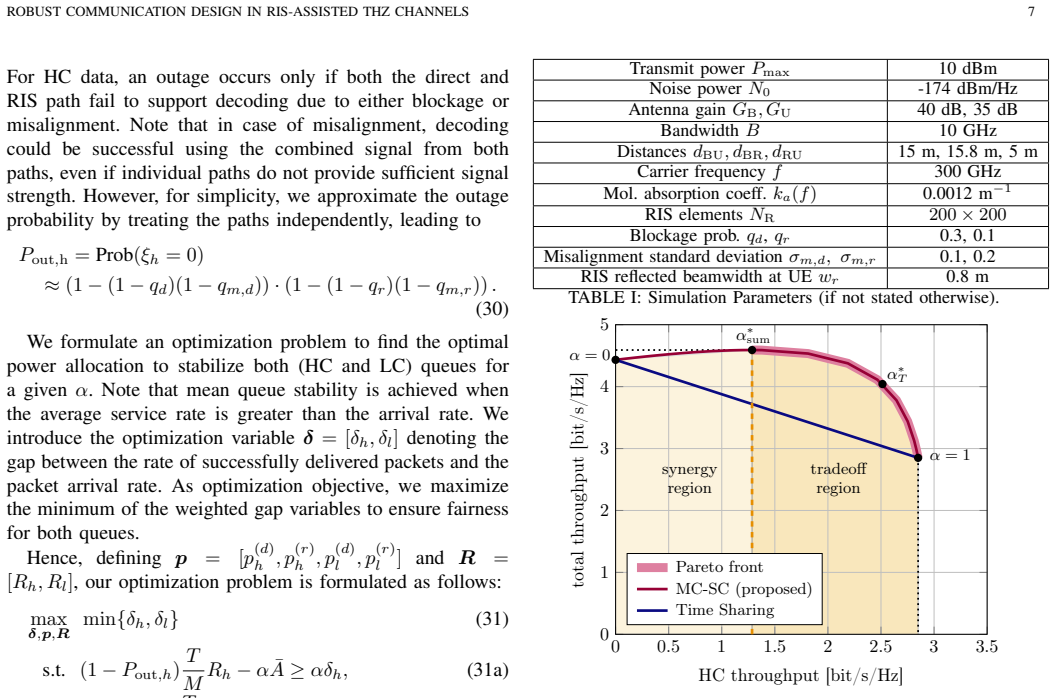
The central discovery is that mixed-criticality superposition coding turns THz link intermittency into a power-allocation problem with a much larger feasible region than time sharing. In the proposed scheme, the high-criticality message is superimposed with the low-criticality message at different powers on both the direct and RIS beams, and the user decodes the HC message first and cancels it. Because HC can be decoded from either link, its outage probability is the product of two per-path failure probabilities, and its rate constraints are enforced for every blockage state except the one where both links are blocked. The resulting feasible region supports HC fractions up to about α=0.63 with stable queues (versus 0.18 for time sharing), and at the recommended tradeoff point α≈0.62 the HC throughput nearly doubles while total throughput drops only about 12%.
Load-bearing premise
The results rest on treating a link as usable only when misalignment fading is at least half the perfectly aligned power (the half-power beamwidth heuristic), and on approximating HC outage as the product of two independent per-link failure events, even though the receiver could in principle combine two partially misaligned signals.
Editorial extensions
If this is right
- The HC stream is decodable whenever at least one of the two links is available, while LC is decodable only when the direct line-of-sight is up, so the optimal solution sets LC power on the RIS beam to zero.
- Queue stability holds for HC fractions up to about α=0.63, versus about 0.18 for time sharing, and HC average delay is roughly ten times lower for small α.
- Total throughput peaks at α=0.28, and the recommended tradeoff point α=0.62 nearly doubles HC throughput while losing only about 12% of total throughput.
- As direct-path blockage rises, total throughput drops from about 5 to 3.5 bit/s/Hz while HC throughput stays near 2.5 bit/s/Hz, and beam misalignment degrades both streams but HC remains relatively protected.
- Under strict HC reliability requirements, MC-SC outperforms time sharing by about 35% in throughput and nearly triples the throughput of treating all data as HC at high misalignment.
- HC outage probability is reduced by path diversity: the HC stream is disrupted only when both the direct and RIS paths fail, whereas LC is disrupted whenever the direct path fails.
Reading between the lines
- Beyond the paper: because the per-link half-power threshold treatment ignores that two partially misaligned beams add coherently at the receiver, the reported HC outage probability is likely an upper bound, so the stable-HC boundary could be above α≈0.63 under the paper's own channel model.
- Beyond the paper: the MC-SC structure transfers to other paired links with a strong-but-fragile and weak-but-stable profile, such as mmWave with a reflective surface or a satellite link with a terrestrial relay, wherever data can be split by criticality.
- Beyond the paper: the tradeoff parameter α is chosen offline by a one-dimensional search; an online estimator that tracks blockage and misalignment statistics from acknowledgments could adapt α per coherence block and approach the reported Pareto front without knowing those statistics in advance.
Signed reviews
Editorial analysis
A structured set of objections, weighed in public.
Referee Report
Summary. The paper studies a downlink RIS-assisted THz system with an intermittent direct line-of-sight path and a more reliable but weaker RIS path. It proposes a mixed-criticality superposition coding (MC-SC) scheme in which high-criticality (HC) and low-criticality (LC) packets are superimposed, with HC data always carried over both paths and LC data over the direct path only. A power allocation problem is formulated to maximize the minimum queue-stability gap subject to rate constraints evaluated at a half-power misalignment threshold and outage constraints, and is solved by an iterative SCA/fractional-programming algorithm in the appendix. Numerical simulations compare the feasible rate region, outage probabilities, and queuing delays against a time-sharing baseline, and show that MC-SC supports a substantially larger fraction of HC data with lower HC queueing delay.
Significance. If the physical-layer model is sound, the paper offers a useful way to trade rate for reliability in THz links by exploiting RIS path diversity for critical data. The paper is clearly written, the optimization is carefully formulated, the rate constraints are conservative with respect to misalignment, and the simulation study is extensive, including blockage, misalignment, and beamwidth adaptation. The main contribution is the combination of mixed-criticality superposition coding with a queue-stability formulation in a RIS-aided THz channel, which is not present in prior work. The central claims are falsifiable and the numerical setup is reproducible.
major comments (3)
- [Section II-B, Eqs. (17)–(18)] The HC SINR in (18) does not follow from the received signal model in (17). The same symbol s_h is sent over both beams, so the HC component before noise is (h√p_h^d + g√p_h^r)s_h; its power is |h|^2 p_h^d + |g|^2 p_h^r + 2Re{h g^*}√(p_h^d p_h^r). The cross term is omitted in (18). If h and g are understood as the real positive scalars defined in (1)–(2), the omitted cross term is positive and (18) is a lower bound; if the usual complex baseband model with a relative phase is intended, the cross term can be negative and (18) can be optimistic. The paper does not specify a phase or combining model, and this issue affects the rate constraint (31d) in the state β=(1,1) and the outage approximation (30). Consequently, the claim in Section I-B that HC data is reliably delivered whenever either the direct or the RIS path is available is not established for the both-paths-present state. Please state the assumed phase/combining model (e.g., coherent combining with known phase, or worst-case phase) and replace (18) accordingly, or argue explicitly why (18) is a valid bound.
- [Section III, Eq. (30)] The HC outage probability is introduced as an approximation, and the text notes that the combined signal could support decoding even when both individual paths fail the half-power threshold. The paper does not quantify the error of this approximation or demonstrate by simulation that it is accurate or a guaranteed bound. Since (1 − Pout,h) enters the stability constraint (31a), the feasible regions in Fig. 5 and the queueing results in Figs. 9–10 inherit this uncertainty. Please provide a numerical or analytical comparison of (30) with the empirical outage probability of the proposed scheme, and state whether (30) is an upper or lower bound.
- [Appendix, Algorithm 1] The appendix reformulates (31) into a sequence of convex problems and alternates between solving (38) and updating µ via (36)–(37), but no convergence proof, monotonicity argument, or stopping criterion is given. All numerical results in Section IV are generated by this algorithm. Please provide a convergence analysis (e.g., convergence to a stationary point of (31) under the standard assumptions of the FP framework in [38]) or an empirical convergence study, and specify the termination condition used in the simulations.
minor comments (6)
- [Appendix, Eq. (36)] In Eq. (36), the first terms in the numerator and denominator use η_r^2 where the direct-path term should be η_d^2, as in Eq. (34).
- [Section I-A] The phrase 'has beed studied' should read 'has been studied'.
- [Appendix, Algorithm 1] Replace 'until Convergence' with an explicit stopping criterion, such as a tolerance on the relative change of the objective.
- [Figures 9 and 10] The definition of 'normalized queue peak' appears only in the text; please add it to the figure captions.
- [Section II-B] The sentence 'with more power allocated to the HC stream and by leveraging path diversity, critical data experiences fewer outages caused by beam misalignment' is a claim that can be verified from the model; please clarify whether it is an observation from the simulations or a property of the constraints.
- [Notation, Eqs. (24)–(25)] The positive-part operator is defined as [x]^+ in the Notation paragraph, but Eqs. (24)–(25) use parentheses; please use one notation consistently.
Circularity Check
No significant circularity: the HC reliability guarantee is encoded as an optimization constraint, and the queueing/delay results follow from the stated outage model; self-citations are background, not load-bearing.
full rationale
The paper's central claims do not reduce to their inputs by construction. The HC reliability statement in Section I-B ('HC data is reliably delivered as long as either the direct link or the RIS-path is available') is deliberately imposed as constraint (31d), which requires Rh <= B log2(1+Gamma_h(beta, eps_th)) for every beta with at least one available path. This is a design constraint, not a fitted prediction or a discovered result. The outage probability in (30) is explicitly acknowledged as an approximation ('for simplicity, we approximate the outage probability by treating the paths independently'), and the queue-stability and delay results in Figs. 9-10 are computed from that stated model. No parameter is fitted to the target outputs and then renamed as a prediction; the feasibility region follows from the defined outage probabilities and rate constraints. The half-power beamwidth threshold (rho >= A/2) is a heuristic modeling choice, and the paper identifies it as such; whether it is accurate is a correctness concern, not a circularity one. The HC SINR in (18) is a modeling assumption for real-positive channel gains (phase alignment), not a reduction of the conclusion into the premise. Self-citations ([1], [23]-[25]) are present, but they are background/motivation references and are not invoked as uniqueness theorems or as external proof of the present results; no load-bearing argument reduces to a self-authored claim. The derivation chain is therefore self-contained under the stated assumptions, with only minor non-load-bearing self-citation.
Assumptions & free parameters
free parameters (1)
- Outage threshold factor for misalignment fading =
0.5 (rho >= A/2)
assumptions (5)
- domain assumption NLoS components are neglected; only the direct LoS path and one RIS-reflected path are modeled.
- domain assumption Blockage states are independent Bernoulli random variables with fixed probabilities qd and qr, and the BS knows only their statistics.
- domain assumption Misalignment fading on the direct and RIS paths are independent Rayleigh-pointing-error processes, modeled by [30].
- domain assumption The two beams are perfectly isolated (negligible sidelobes) and the received powers from the two paths add non-coherently as in (18)-(19).
- standard math The successive convex approximation with the quadratic transform of [38] converges to a solution of (31).
Cite this review
Pith. "Pith review of Robust Communication Design in RIS-Assisted THz Channels." pith.science (2026). https://pith.science/paper/HPB247GY
@misc{pith2026241110524,
  author       = {Pith},
  title        = {Pith review of: Robust Communication Design in RIS-Assisted THz Channels},
  year         = {2026},
  howpublished = {\url{https://pith.science/paper/HPB247GY}},
  note         = {Machine review of arXiv:2411.10524}
}
read the original abstract
Terahertz (THz) communication offers the necessary bandwidth to meet the high data rate demands of next-generation wireless systems. However, it faces significant challenges, including severe path loss, dynamic blockages, and beam misalignment, which jeopardize communication reliability. Given that many 6G use cases require both high data rates and strong reliability, robust transmission schemes that achieve high throughput under these challenging conditions are essential for the effective use of high-frequency bands. In this context, we propose a novel mixed-criticality superposition coding scheme for reconfigurable intelligent surface (RIS)-assisted THz systems. This scheme leverages both the strong but intermittent direct line-of-sight link and the more reliable, yet weaker, RIS path to ensure robust delivery of high-criticality data while maintaining high overall throughput. We model a mixed-criticality queuing system and optimize transmit power to meet reliability and queue stability constraints. Simulation results show that our approach significantly reduces queuing delays for critical data while sustaining high overall throughput, outperforming conventional time-sharing methods. Additionally, we examine the impact of blockage, beam misalignment, and beamwidth adaptation on system performance. These results demonstrate that our scheme effectively balances reliability and throughput under challenging conditions, while also underscoring the need for robust beamforming techniques to mitigate the impact of misalignment in RIS-assisted channels.
Figures


Figures from the paper (6 more)



Forward citations
Cited by 1 Pith paper
-
Resilience and Criticality: Brothers in Arms for 6G
A tutorial that integrates resilience and criticality into a unified framework for 6G network design, introducing a three-cycle resilience strategy and an A3RT resilience metric.
Reference graph
Works this paper leans on
-
[38]
Fractional programming for communication systems–Part I: Power control and beamforming,
K. Shen and W. Yu, “Fractional programming for communication systems–Part I: Power control and beamforming,” IEEE Trans. Signal Process., vol. 66, no. 10, pp. 2616–2630, 2018
2018
-
[1]
Intermittency Versus Path Loss in RIS-aided THz Communication: A Data Significance Approach,
Y . Karacora, A. Umra, and A. Sezgin, “Intermittency Versus Path Loss in RIS-aided THz Communication: A Data Significance Approach,” in Proc. IEEE Int. Conf. Commun. (ICC) , 2024, pp. 3414–3419
work page 2024
-
[2]
LOS and NLOS Channel Models for Indoor 300 GHz Communications,
J. Kokkoniemi, J. Lehtomäki, and M. Juntti, “LOS and NLOS Channel Models for Indoor 300 GHz Communications,” in 16th Int. Symp. Wireless Commun. Syst. (ISWCS) , 2019, pp. 441–445
work page 2019
-
[3]
C. Chaccour, M. N. Soorki, W. Saad, M. Bennis, P. Popovski, and M. Debbah, “Seven defining features of terahertz (THz) wireless sys- tems: A fellowship of communication and sensing,” IEEE Commun. Surveys Tuts., vol. 24, no. 2, pp. 967–993, Jan. 2022
work page 2022
-
[4]
Combating the distance problem in the millimeter wave and terahertz frequency bands,
I. F. Akyildiz, C. Han, and S. Nie, “Combating the distance problem in the millimeter wave and terahertz frequency bands,” IEEE Commun. Mag., vol. 56, no. 6, pp. 102–108, June 2018
2018
-
[5]
RIS-enhanced Resilience in Cell-Free MIMO,
K. Weinberger, R.-J. Reifert, A. Sezgin, and E. Basar, “RIS-enhanced Resilience in Cell-Free MIMO,” in 26th Int. Workshop Smart Antennas (WSA) and 13th Conf. Sys. Commun. Coding (SCC) , 2023, pp. 1–6
work page 2023
-
[6]
Risk-based optimization of virtual reality over terahertz reconfigurable intelligent surfaces,
C. Chaccour, M. N. Soorki, W. Saad, M. Bennis, and P. Popovski, “Risk-based optimization of virtual reality over terahertz reconfigurable intelligent surfaces,” in Proc. IEEE Int. Conf. Commun. (ICC) , Dublin, Ireland, June 2020, pp. 1–6
work page 2020
-
[7]
Resource Management for Multiplexing eMBB and URLLC Services Over RIS-Aided THz Communication,
H. Zarini, N. Gholipoor, M. R. Mili, M. Rasti, H. Tabassum, and E. Hos- sain, “Resource Management for Multiplexing eMBB and URLLC Services Over RIS-Aided THz Communication,” IEEE Trans. Commun., vol. 71, no. 2, pp. 1207–1225, 2023
work page 2023
Show all 39 references
-
[8]
On the Downlink Coverage Performance of RIS-Assisted THz Networks,
W. Aman, N. Kouzayha, M. M. U. Rahman, and T. Y . Al-Naffouri, “On the Downlink Coverage Performance of RIS-Assisted THz Networks,” IEEE Commun. Letters , vol. 28, no. 1, pp. 228–232, 2024
2024
-
[9]
Beam Training and Alignment for RIS-Assisted Millimeter-Wave Systems: State of the Art and Beyond,
P. Wang, J. Fang, W. Zhang, Z. Chen, H. Li, and W. Zhang, “Beam Training and Alignment for RIS-Assisted Millimeter-Wave Systems: State of the Art and Beyond,” IEEE Wireless Commun., vol. 29, no. 6, pp. 64–71, 2022
2022
-
[10]
Far- versus Near-Field RIS Modeling and Beam Design,
M. Delbari, G. C. Alexandropoulos, R. Schober, and V . Jamali, “Far- versus Near-Field RIS Modeling and Beam Design,” arXiv preprint arXiv:2401.08237, 2024
2024 arXiv
-
[11]
Variable Beamwidth Near Field Codebook Design for Communications Aided by A Large Scale RIS,
X. Tian, N. Gonzalez-Prelcic, and R. W. Heath, “Variable Beamwidth Near Field Codebook Design for Communications Aided by A Large Scale RIS,” in IEEE Global Commun. Conf. (GLOBECOM) , Kuala Lumpur, Malaysia, Dec. 2023, pp. 2021–2026
2023
-
[12]
Reconfigurable Intelligent Surfaces: Principles and Opportu- nities,
Y . Liu, X. Liu, X. Mu, T. Hou, J. Xu, M. Di Renzo, and N. Al- Dhahir, “Reconfigurable Intelligent Surfaces: Principles and Opportu- nities,” IEEE Commun. Surveys Tuts. , vol. 23, no. 3, pp. 1546–1577, 2021
2021
-
[13]
Preparing for the Inevitable: Preventing Outages Using Resilient RIS- Assisted JCAS,
S. Sivadevuni, F. Lotfi, B. Ahmad, K. Weinberger, and A. Sezgin, “Preparing for the Inevitable: Preventing Outages Using Resilient RIS- Assisted JCAS,” in IEEE 9th Int. Workshop Comp. Adv. Multi-Sensor Adapt. Proc. (CAMSAP) , 2023, pp. 241–245
2023
-
[14]
Reconfigurable Intelligent Surfaces for THz: Hardware Design and Signal Processing Challenges,
G. C. Alexandropoulos, A. Clemente, S. Matos, R. Husbands, S. Ahearne, Q. Luo, V . Lain-Rubio, T. Kürner, and L. M. Pessoa, “Reconfigurable Intelligent Surfaces for THz: Hardware Design and Signal Processing Challenges,” in 18th European Conf. Antennas Prop. (EuCAP). IEEE, 202...
2024
-
[15]
Active Control of THz Waves in Wireless Environments Using Graphene-Based RIS,
S. Dash, C. Psomas, I. Krikidis, I. F. Akyildiz, and A. Pitsillides, “Active Control of THz Waves in Wireless Environments Using Graphene-Based RIS,” IEEE Trans. Antennas Prop., vol. 70, no. 10, pp. 8785–8797, 2022
2022
-
[16]
The Mobile Blockers Impact on RISs Aided mmWave/THz Communication Systems,
A. M. Nor, O. Fratu, and S. Halunga, “The Mobile Blockers Impact on RISs Aided mmWave/THz Communication Systems,” IEEE Open J. Commun. Soc., vol. 5, pp. 3151–3169, 2024
2024
-
[17]
On the Impact of Beam Misalignment in Reconfigurable Intelligent Surface Assisted THz Systems,
E. N. Papasotiriou, A.-A. A. Boulogeorgos, and A. Alexiou, “On the Impact of Beam Misalignment in Reconfigurable Intelligent Surface Assisted THz Systems,” in 22nd Int. Workshop Signal Proc. Adv. Wireless Commun. (SPAWC), 2021, pp. 121–125
2021
-
[18]
Performance and Optimization of Reconfigurable Intelligent Surface Aided THz Communications,
H. Du, J. Zhang, K. Guan, D. Niyato, H. Jiao, Z. Wang, and T. Kürner, “Performance and Optimization of Reconfigurable Intelligent Surface Aided THz Communications,” IEEE Trans. Commun. , vol. 70, no. 5, pp. 3575–3593, 2022
2022
-
[19]
Performance Analysis of LOS THz Systems Under Misalignment and Deterministic Fading,
R. Abdalla and A. B. Cooper, “Performance Analysis of LOS THz Systems Under Misalignment and Deterministic Fading,” in 57th Ann. Conf. Inf. Sci. Syst. (CISS) , 2023, pp. 1–5
2023
-
[20]
Impact of beam misalignment on THz wireless systems,
J. Kokkoniemi, A.-A. A. Boulogeorgos, M. Aminu, J. Lehtomäki, A. Alexiou, and M. Juntti, “Impact of beam misalignment on THz wireless systems,” Nano Commun. Netw. , vol. 24, p. 100302, 2020
2020
-
[21]
Can terahertz provide high-rate reliable low latency communications for wireless VR?
C. Chaccour, M. N. Soorki, W. Saad, M. Bennis, and P. Popovski, “Can terahertz provide high-rate reliable low latency communications for wireless VR?” IEEE Internet Things J. , Jan. 2022
2022
-
[22]
Directional Terahertz Communication Systems for 6G: Fact Check,
A.-A. A. Boulogeorgos, J. M. Jornet, and A. Alexiou, “Directional Terahertz Communication Systems for 6G: Fact Check,” IEEE Veh. Technol. Mag., vol. 16, no. 4, pp. 68–77, 2021
2021
-
[23]
Event-Based Beam Tracking With Dynamic Beamwidth Adaptation in Terahertz (THz) ROBUST COMMUNICATION DESIGN IN RIS-ASSISTED THZ CHANNELS 12 Communications,
Y . Karacora, C. Chaccour, A. Sezgin, and W. Saad, “Event-Based Beam Tracking With Dynamic Beamwidth Adaptation in Terahertz (THz) ROBUST COMMUNICATION DESIGN IN RIS-ASSISTED THZ CHANNELS 12 Communications,” IEEE Trans. Commun. , vol. 71, no. 10, pp. 6195– 6210, 2023
2023
-
[24]
Comeback Kid: Resilience for Mixed-Critical Wireless Network Resource Management,
R.-J. Reifert, S. Roth, A. A. Ahmad, and A. Sezgin, “Comeback Kid: Resilience for Mixed-Critical Wireless Network Resource Management,” IEEE Trans. Veh. Technol., pp. 1–17, 2023
2023
-
[25]
Rate-splitting enabled multi-connectivity in mixed-criticality systems,
Y . Karacora and A. Sezgin, “Rate-splitting enabled multi-connectivity in mixed-criticality systems,” in Proc. IEEE Int. Conf. Commun. (ICC) , Rome, Italy, June 2023, pp. 5340–5345
2023
-
[26]
Terahertz-band MIMO-NOMA: Adaptive superposition coding and subspace detection,
H. Sarieddeen, A. Abdallah, M. M. Mansour, M.-S. Alouini, and T. Y . Al-Naffouri, “Terahertz-band MIMO-NOMA: Adaptive superposition coding and subspace detection,” IEEE Open J. Commun. Soc. , vol. 2, pp. 2628–2644, 2021
2021
-
[27]
Minimum Power Multicast Beamforming With Superposition Coding for Multiresolution Broadcast and Application to NOMA Sys- tems,
J. Choi, “Minimum Power Multicast Beamforming With Superposition Coding for Multiresolution Broadcast and Application to NOMA Sys- tems,” IEEE Trans. Commun. , vol. 63, no. 3, pp. 791–800, 2015
2015
-
[28]
Coded Hierarchical Modulation for Wireless Progressive Image Transmission,
S. S. Arslan, P. C. Cosman, and L. B. Milstein, “Coded Hierarchical Modulation for Wireless Progressive Image Transmission,” IEEE Trans. Veh. Technol., vol. 60, no. 9, pp. 4299–4313, 2011
2011
-
[29]
A line-of-sight channel model for the 100–450 gigahertz frequency band,
J. Kokkoniemi, J. Lehtomäki, and M. Juntti, “A line-of-sight channel model for the 100–450 gigahertz frequency band,” EURASIP J. Wireless Commun. Netw., vol. 2021, no. 1, pp. 1–15, Apr. 2021
2021
-
[30]
Outage Capacity Optimization for Free-Space Optical Links With Pointing Errors,
A. A. Farid and S. Hranilovic, “Outage Capacity Optimization for Free-Space Optical Links With Pointing Errors,” J. Lightwave Technol., vol. 25, no. 7, pp. 1702–1710, 2007
2007
-
[31]
Analytical Performance Assessment of THz Wireless Systems,
A.-A. A. Boulogeorgos, E. N. Papasotiriou, and A. Alexiou, “Analytical Performance Assessment of THz Wireless Systems,” IEEE Access , vol. 7, pp. 11 436–11 453, 2019
2019
-
[32]
Perfor- mance Analysis of THz Wireless Systems in the Presence of Antenna Misalignment and Phase Noise,
E. N. Papasotiriou, A.-A. A. Boulogeorgos, and A. Alexiou, “Perfor- mance Analysis of THz Wireless Systems in the Presence of Antenna Misalignment and Phase Noise,” IEEE Commun. Letters, vol. 24, no. 6, pp. 1211–1215, 2020
2020
-
[33]
On the Joint Effect of Rain and Beam Misalignment in Terahertz Wireless Systems,
A.-A. A. Boulogeorgos, J. M. Riera, and A. Alexiou, “On the Joint Effect of Rain and Beam Misalignment in Terahertz Wireless Systems,” IEEE Access, vol. 10, pp. 58 997–59 012, 2022
2022
-
[34]
Analytical Performance Assessment of Beamforming Efficiency in Reconfigurable Intelligent Surface-Aided Links,
G. Stratidakis, S. Droulias, and A. Alexiou, “Analytical Performance Assessment of Beamforming Efficiency in Reconfigurable Intelligent Surface-Aided Links,” IEEE Access, vol. 9, pp. 115 922–115 931, 2021
2021
-
[35]
Power- Domain Non-Orthogonal Multiple Access (NOMA) in 5G Systems: Potentials and Challenges,
S. M. R. Islam, N. Avazov, O. A. Dobre, and K.-s. Kwak, “Power- Domain Non-Orthogonal Multiple Access (NOMA) in 5G Systems: Potentials and Challenges,” IEEE Commun. Surveys Tuts., vol. 19, no. 2, pp. 721–742, 2017
2017
-
[36]
Introduction to Queues,
M. J. Neely, “Introduction to Queues,” in Stochastic Network Opti- mization with Application to Communication and Queueing Systems . Springer, 2010, pp. 15–28
2010
-
[37]
A Proof for the Queuing Formula: L = λW ,
J. D. C. Little, “A Proof for the Queuing Formula: L = λW ,” Operations Research, vol. 9, no. 3, pp. 383–387, 1961
1961
-
[39]
CVX: Matlab software for disciplined convex programming, version 2.1,
M. Grant and S. Boyd, “CVX: Matlab software for disciplined convex programming, version 2.1,” http://cvxr.com/cvx, Mar. 2014. YASEMIN KARACORA (Graduate Student Mem- ber, IEEE) received the B.Sc. and M.Sc. degrees in electrical engineering and information technology from Ruhr ...
2014
Reviewed August 12, 2026 · model on record in the stance chip above.
Discussion (0). Continue with ORCID to comment.