REVIEW 3 major objections 5 minor 48 references
Distill Knowledge from NRSfM for Weakly Supervised 3D Pose Learning
T0 review · 3 major / 5 minor · reviewed 2026-08-14 · deepseek-v4-flash
Pith's one-line read A pose estimator trained only on 2D landmarks can learn depth by distilling the NRSfM cost function instead of the teacher's depth output.
desk verdict A genuinely new distillation loss for weakly supervised 3D pose, with a clean convex derivation, but the unvalidated 'oracle camera' assumption and missing reproducibility details keep it just short of fully convincing. read the letter →
The pith
A machine-rendered reading of the paper's core claim, the machinery that carries it, and where it could break.
The reading
What carries the argument
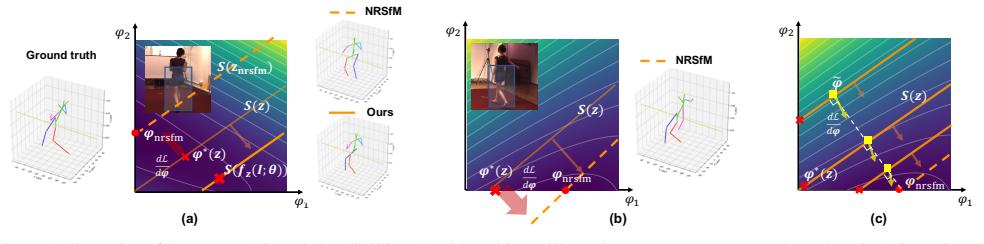
The load-bearing construction is the split of the camera-rotated dictionary into $B_{xy}^{(i)}$ (2D projection) and $B_z^{(i)}$ (depth), together with the subspace $\mathcal{S}^{(i)}(z') = \{\phi : B_z^{(i)}\phi = z'\}$ of codes consistent with a predicted depth $z'$. The loss is $\tilde{L}^{(i)}(z') = \|B_{xy}^{(i)}\tilde{\phi}(z') - w^{(i)}\| + h(\tilde{\phi}(z'))$, where $\tilde{\phi}(z') = \phi_{\mathrm{nrsfm}}^{(i)} + (B_z^{(i)})^{\dagger}(z' - B_z^{(i)}\phi_{\mathrm{nrsfm}}^{(i)})$ projects the NRSfM solution onto that subspace. This closed-form differentiable operator maps any predicted depth to the nearest code in the teacher's dictionary, so gradients from the teacher's cost reach the depth branch while the student remains free to choose depths supported by image features.
What would settle it
Keep the same training pipeline but perturb or randomize the teacher's camera matrices while holding the dictionary fixed; if the student's pose-aligned mean per-joint error on Human3.6M validation stays near 62.8 mm, the camera-fixity assumption is not load-bearing, while a large degradation would confirm it is.
Extended reading notes
Core claim
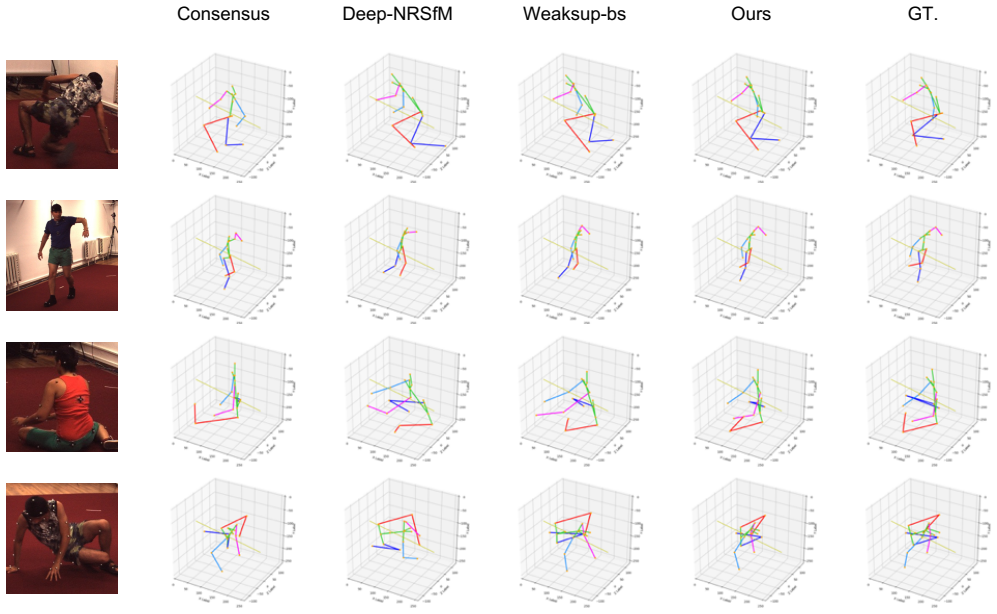
The central claim is that the obstacle to using NRSfM as a teacher is the teacher's raw depth output, so the paper replaces hard depth regression with a loss that evaluates depth through the NRSfM objective itself. Given a network depth prediction $z'$, all dictionary codes reproducing that depth form a subspace $\mathcal{S}^{(i)}(z')$, and the quality of a depth hypothesis is the minimum of reprojection error plus sparsity regularizer over that subspace. Because solving that constrained problem at every SGD step is impractical, the paper projects the NRSfM solution onto the subspace, obtaining a closed-form differentiable operator and a convex upper bound that still reflects 2D projection ambiguity. Training the integral-regression network with a 2D landmark loss for $(x,y)$ and this distilled loss for $z$ yields a student that reconstructs the training set more accurately than its NRSfM teacher (pose-aligned mean per-joint error 56.4 mm vs 73.2 mm; depth error 71.2 vs 76.5 mm), outperforms other weakly supervised methods, and matches the fully supervised baseline on validation mean per-joint position error (86.4 mm).
Load-bearing premise
Everything rests on assuming the NRSfM camera matrices are accurate and fixed, because the subspace and the distilled loss are built on them; if a camera is wrong, the loss evaluates depth against a misplaced projection.
Editorial extensions
If this is right
- The method needs only 2D landmark annotations, so it removes the 3D-data bottleneck for training pose estimators on new object categories.
- On Human3.6M, the distilled student reaches the same validation mean per-joint position error as a fully supervised network using the same pose-estimation architecture, while using no 3D labels.
- The student improves on the teacher's training-set depth error, showing that the soft loss transfers NRSfM knowledge without copying its mistakes.
- Because the loss is defined at the level of the NRSfM cost, the distillation recipe applies to any dictionary-learning NRSfM method and to any student network that outputs landmark depth.
Reading between the lines
- The method's reliance on fixed camera matrices suggests a natural extension the paper does not test: refining or marginalizing uncertain cameras instead of treating them as oracle.
- If the deep image prior is the active ingredient, the advantage over the teacher should grow with image texture; ablating on textureless silhouettes would isolate that effect.
- The same subspace-projection idea should transfer to other geometric self-supervised losses where a teacher is defined by an optimization cost rather than by network outputs.
- The absence of object-specific priors implies transfer to non-human keypoint categories such as quadrupeds and hands, which the paper states as a motivation but does not demonstrate.
Signed reviews
Editorial analysis
A structured set of objections, weighed in public.
Referee Report
Summary. This paper proposes a weakly supervised 3D human pose estimation method that, given images and 2D landmark annotations only, trains a pose regression network without 3D ground truth, multi-view footage, or object-specific priors. The authors fit a modified Deep-NRSfM teacher on the 2D training set, obtaining a dictionary D, per-image camera matrices M^(i), and codes φ_(nrsfm)^(i). Treating D and M^(i) as fixed, they define, for a predicted depth z′, the affine subspace of codes whose reconstructed depth equals z′ (Eq. 8), define the distillation loss as the minimum NRSfM cost within that subspace (Eq. 10), and approximate it by the cost at the projection of the teacher code onto the subspace (Eqs. 12–14), claiming a convex upper bound. The student, an integral regression network, is trained with a 2D reprojection loss plus this distillation loss (Eq. 15). On Human3.6M, the method is reported to improve depth and pose error over the Deep-NRSfM teacher and over a weak supervision baseline, to outperform other weakly supervised methods while using less supervision, and to match a fully supervised baseline in MPJPE.
Significance. If the results hold, this is a useful contribution: it converts an NRSfM-style cost into a soft, differentiable supervisory signal for a CNN without hard depth labels, while retaining a geometric objective. The derivation of the subspace projection and the convex upper bound (Eqs. 8–14) is mathematically clean, and the comparison against the Weaksup-bs baseline isolates the effect of the proposed loss from the teacher and student architectures. The claim to use less supervision than prior weakly supervised methods is explicit and falsifiable. The main caveats are that the method's correctness depends on the teacher camera matrices being accurate, a premise that is asserted but not tested, and that the reported margins lack error bars and use a validation-set-selected hyperparameter. These issues are addressable and do not invalidate the core idea.
major comments (3)
- [Sec. 4.1, Eqs. (6)–(8), (13)–(14)] The premise that the Deep-NRSfM camera matrices are "oracle and fixed" is load-bearing but unvalidated. Because B_z^(i) is formed by rotating the dictionary with the teacher's M^(i) (Eq. 6), and the subspace S^(i)(z′) is defined as {φ : B_z^(i) φ = z′} (Eq. 8), any error in M^(i) changes which depth values are deemed consistent with a code. The projection in Eq. (13) and the distillation loss in Eq. (14) then evaluate depth hypotheses against the teacher's camera geometry rather than against true image depth. The paper's central evidence—that the student improves over the teacher (Tables 1 and 2)—cannot be read as the student correcting teacher depth unless camera accuracy is established. H3.6M provides ground-truth camera parameters; please report per-camera errors of the modified Deep-NRSfM against them, and add an ablation in which the loss is computed with ground-truth cameras (or with cameras from an alternative NRSfM method) to test sensitivity to this assumption.
- [Sec. 5.4, Tables 2 and 4] The headline numbers are single runs with the regularizer weight (0.3) selected on the same validation set used for reporting. Table 4 shows that the choice of weight matters for depth error: 0.01 gives 79.0 mm and 0.5 gives 76.7 mm, versus 73.1 mm for 0.3, against a 78.0 mm Weaksup-bs baseline. Thus the reported improvement is not fully robust to this selection for all metrics. Please report mean and standard deviation over multiple training runs, and either fix hyperparameters on a separate split or demonstrate that the conclusions hold across the reasonable range for depth error and MPJPE as well as PA-MPJPE.
- [Sec. 5.3 and supplementary] The teacher is described as a "modified" Deep-NRSfM with "significant difference" from the original (Table 1 footnote), and the camera and code estimation networks q_M and q_φ are deferred to the supplementary material. As the teacher defines the entire distillation target, this prevents the reader from assessing whether the reported gains are tied to the specific teacher modifications or to the proposed loss. Please include a precise description (or release code) of the modified Deep-NRSfM, and clarify how the teacher's hyperparameters (dictionary sizes, sparsity weight λ) were chosen. Without this, the comparison against other NRSfM methods in Table 1 is difficult to interpret.
minor comments (5)
- [Eq. (2)] There is a typo: "vecorized" should be "vectorized". Also, the norm in Eq. (9) is left unspecified, but Section 4.4 states that L2 is used for the reprojection error; please make this consistent earlier.
- [Sec. 5.3, references] The acronym "MUS" is used in the text, but the cited reference [1] is titled "Image collection pop-up"; please provide the correct citation for MUS or remove the acronym.
- [Tables 1, 2, and 4] Table 1 is evaluated on the training set, Table 2 on the validation set, and Table 4 also reports validation-set numbers; the text should state this explicitly near each table to avoid confusion, especially because the regularizer weight is selected on the same validation set.
- [Sec. 4.2] The side note that an unlimited-capacity network would converge to the same depth as NRSfM is important: the method's improvement relies on the network's inductive bias. Please state this caveat more prominently, since it frames the interpretation of the experimental gains.
- [Fig. 2] Figure 2 is informative, but the caption and labels are dense; consider enlarging the figure or adding a legend for the orange lines, red dots, and yellow squares to make the geometry easier to follow.
Circularity Check
No significant circularity: the distillation loss is anchored to the NRSfM teacher's cost, but the reported depth gains are validated against ground-truth 3D pose, so the result is not forced by construction.
full rationale
The derivation chain in Sections 3 and 4 is not circular. The teacher's dictionary D, camera matrices M^(i), and codes phi_nrsfm are inputs obtained from the authors' modified Deep-NRSfM, and the distillation loss Eq. 14 is literally the NRSfM cost evaluated at the projection Eq. 13 of the teacher's code onto the subspace Eq. 8 defined by the student's depth hypothesis. This makes the loss anchored to the teacher's own fitted quantities, but it does not force the student to reproduce the teacher's depth: z' is a free output of f_z(I;theta), and minimizing Eq. 15 can move the network away from phi_nrsfm. The paper's central quantitative claims (training-set depth error 71.2 mm vs. the teacher's 76.5 mm in Table 1; validation P-MPJPE 62.8 mm in Table 2) are measured against ground-truth 3D pose, which is external to the teacher's cost function. The self-citation to Kong and Lucey [21] is real, but it functions as the choice of teacher and baseline, and the comparison with external NRSfM methods and with ground-truth labels means the result does not reduce to that citation. The 'oracle and fixed' camera-matrix assumption in Section 4.1 is a load-bearing empirical fragility: if the cameras are biased, the subspace B_z and the projection in Eq. 13 evaluate a distorted depth geometry, so the loss would reward or penalize depth hypotheses based on camera error rather than true depth quality. That is a correctness risk, not a circular step, because it concerns the accuracy of an input rather than the equivalence of a prediction to an input by definition. No circular step satisfying the quoted-evidence standard was found.
Assumptions & free parameters
free parameters (3)
- L1 regularizer weight in distillation loss (Eq. 14) =
0.3
- Sparsity weight lambda in teacher's dictionary learning (Eq. 2) =
0.01
- Hierarchical dictionary sizes and number of levels for Deep-NRSfM teacher =
6 levels: 256, 128, 64, 32, 16, 8
assumptions (6)
- domain assumption Weak perspective camera model W = S M with orthonormal M (Eq. 1)
- domain assumption Teacher camera matrices M(i) are accurate and treated as fixed oracle
- domain assumption The dictionary is overcomplete, so the depth subspace S(z') is non-empty and B_z has full row rank
- domain assumption The CNN's limited capacity acts as a 'deep image prior' that can disambiguate ambiguous 2D projections
- domain assumption The NRSfM solution phi_nrsfm approximates the unconstrained minimizer of the cost C
- domain assumption Multi-layer sparse coding is an adequate shape prior for human poses
Cite this review
Pith. "Pith review of Distill Knowledge from NRSfM for Weakly Supervised 3D Pose Learning." pith.science (2026). https://pith.science/paper/HPDGVPJW
@misc{pith2026190806377,
  author       = {Pith},
  title        = {Pith review of: Distill Knowledge from NRSfM for Weakly Supervised 3D Pose Learning},
  year         = {2026},
  howpublished = {\url{https://pith.science/paper/HPDGVPJW}},
  note         = {Machine review of arXiv:1908.06377}
}
read the original abstract
We propose to learn a 3D pose estimator by distilling knowledge from Non-Rigid Structure from Motion (NRSfM). Our method uses solely 2D landmark annotations. No 3D data, multi-view/temporal footage, or object specific prior is required. This alleviates the data bottleneck, which is one of the major concern for supervised methods. The challenge for using NRSfM as teacher is that they often make poor depth reconstruction when the 2D projections have strong ambiguity. Directly using those wrong depth as hard target would negatively impact the student. Instead, we propose a novel loss that ties depth prediction to the cost function used in NRSfM. This gives the student pose estimator freedom to reduce depth error by associating with image features. Validated on H3.6M dataset, our learned 3D pose estimation network achieves more accurate reconstruction compared to NRSfM methods. It also outperforms other weakly supervised methods, in spite of using significantly less supervision.
Figures

Figures from the paper (1 more)

Reference graph
Works this paper leans on
-
[1]
Image collection pop-up: 3d reconstruction and clustering of rigid and non-rigid categories
Antonio Agudo, Melcior Pijoan, and Francesc Moreno- Noguer. Image collection pop-up: 3d reconstruction and clustering of rigid and non-rigid categories. In Proceed- ings of the IEEE Conference on Computer Vision and Pattern Recognition, pages 2607–2615, 2018. 2, 8
work page 2018
-
[2]
Trajectory space: A dual representation for nonrigid struc- ture from motion
Ijaz Akhter, Yaser Sheikh, Sohaib Khan, and Takeo Kanade. Trajectory space: A dual representation for nonrigid struc- ture from motion. Pattern Analysis and Machine Intelli- gence, IEEE Transactions on, 33(7):1442–1456, 2011. 2
work page 2011
-
[3]
2d human pose estimation: New benchmark and state of the art analysis
Mykhaylo Andriluka, Leonid Pishchulin, Peter Gehler, and Bernt Schiele. 2d human pose estimation: New benchmark and state of the art analysis. In IEEE Conference on Com- puter Vision and Pattern Recognition (CVPR), June 2014. 7
work page 2014
-
[4]
Amir Beck and Marc Teboulle. A fast iterative shrinkage- thresholding algorithm with application to wavelet-based im- age deblurring. 2009. 3
work page 2009
-
[5]
Recovering non-rigid 3d shape from image streams
Christoph Bregler, Aaron Hertzmann, and Henning Bier- mann. Recovering non-rigid 3d shape from image streams. In Computer Vision and Pattern Recognition, 2000. Proceed- ings. IEEE Conference on, volume 2, pages 690–696. IEEE,
work page 2000
-
[6]
3d human pose es- timation = 2d pose estimation + matching
Ching-Hang Chen and Deva Ramanan. 3d human pose es- timation = 2d pose estimation + matching. In The IEEE Conference on Computer Vision and Pattern Recognition (CVPR), July 2017. 2
work page 2017
-
[7]
Synthesizing training images for boosting human 3d pose estimation
Wenzheng Chen, Huan Wang, Yangyan Li, Hao Su, Zhen- hua Wang, Changhe Tu, Dani Lischinski, Daniel Cohen- Or, and Baoquan Chen. Synthesizing training images for boosting human 3d pose estimation. In 2016 Fourth Inter- national Conference on 3D Vision (3DV) , pages 479–488. IEEE, 2016. 2
work page 2016
-
[8]
Learning 3d hu- man pose from structure and motion
Rishabh Dabral, Anurag Mundhada, Uday Kusupati, Safeer Afaque, Abhishek Sharma, and Arjun Jain. Learning 3d hu- man pose from structure and motion. In The European Con- ference on Computer Vision (ECCV), September 2018. 2
work page 2018
Show all 48 references
-
[9]
A simple prior- free method for non-rigid structure-from-motion factoriza- tion
Yuchao Dai, Hongdong Li, and Mingyi He. A simple prior- free method for non-rigid structure-from-motion factoriza- tion. International Journal of Computer Vision, 107(2):101– 122, 2014. 2, 3, 6
2014
-
[10]
An iterative thresholding algorithm for linear inverse prob- lems with a sparsity constraint
Ingrid Daubechies, Michel Defrise, and Christine De Mol. An iterative thresholding algorithm for linear inverse prob- lems with a sparsity constraint. Communications on Pure and Applied Mathematics: A Journal Issued by the Courant Institute of Mathematical Sciences , 57(11):14...
2004
-
[11]
Non-rigid structure from motion using ranklet-based track- ing and non-linear optimization
Alessio Del Bue, Fabrizio Smeraldi, and Lourdes Agapito. Non-rigid structure from motion using ranklet-based track- ing and non-linear optimization. Image and Vision Comput- ing, 25(3):297–310, 2007. 6
2007
-
[12]
Can 3d pose be learned from 2d projections alone? In Proceedings of the European Conference on Computer Vision (ECCV) , pages 0–0, 2018
Dylan Drover, Rohith MV , Ching-Hang Chen, Amit Agrawal, Ambrish Tyagi, and Cong Phuoc Huynh. Can 3d pose be learned from 2d projections alone? In Proceedings of the European Conference on Computer Vision (ECCV) , pages 0–0, 2018. 1, 2, 6, 7
2018
-
[13]
Harley, William Seto, and Katerina Fragkiadaki
Hsiao-Yu Fish Tung, Adam W. Harley, William Seto, and Katerina Fragkiadaki. Adversarial inverse graphics net- works: Learning 2d-to-3d lifting and image-to-image trans- lation from unpaired supervision. In The IEEE International Conference on Computer Vision (ICCV), Oct 2017. 2, 6, 7
2017
-
[14]
Unsupervised monocular depth estimation with left- right consistency
Cl ´ement Godard, Oisin Mac Aodha, and Gabriel J Bros- tow. Unsupervised monocular depth estimation with left- right consistency. In Proceedings of the IEEE Conference on Computer Vision and Pattern Recognition , pages 270–279,
-
[15]
Computing smooth time trajectories for camera and deformable shape in structure from motion with occlusion
Paulo FU Gotardo and Aleix M Martinez. Computing smooth time trajectories for camera and deformable shape in structure from motion with occlusion. Pattern Analysis and Machine Intelligence, IEEE Transactions on , 33(10):2051– 2065, 2011. 2
2011
-
[16]
Kernel non-rigid structure from motion
Paulo FU Gotardo and Aleix M Martinez. Kernel non-rigid structure from motion. In Computer Vision (ICCV), 2011 IEEE International Conference on , pages 802–809. IEEE,
2011
-
[17]
Learning spatially-smooth mappings in non-rigid structure from motion
Onur C Hamsici, Paulo FU Gotardo, and Aleix M Martinez. Learning spatially-smooth mappings in non-rigid structure from motion. In European Conference on Computer Vision, pages 260–273. Springer, 2012. 6
2012
-
[18]
Human3.6m: Large scale datasets and predic- tive methods for 3d human sensing in natural environments
Catalin Ionescu, Dragos Papava, Vlad Olaru, and Cristian Sminchisescu. Human3.6m: Large scale datasets and predic- tive methods for 3d human sensing in natural environments. IEEE Transactions on Pattern Analysis and Machine Intelli- gence, 36(7):1325–1339, jul 2014. 1, 2, 7
2014
-
[19]
Panoptic studio: A massively multiview system for social motion capture
Hanbyul Joo, Hao Liu, Lei Tan, Lin Gui, Bart Nabbe, Iain Matthews, Takeo Kanade, Shohei Nobuhara, and Yaser Sheikh. Panoptic studio: A massively multiview system for social motion capture. In Proceedings of the IEEE Inter- national Conference on Computer Vision, pages 3334–3342,
-
[20]
Prior-less compressible struc- ture from motion
Chen Kong and Simon Lucey. Prior-less compressible struc- ture from motion. In Proceedings of the IEEE Conference on Computer Vision and Pattern Recognition , pages 4123– 4131, 2016. 2, 3, 6
2016
-
[21]
Deep interpretable non-rigid structure from motion
Chen Kong and Simon Lucey. Deep interpretable non-rigid structure from motion. arXiv preprint arXiv:1902.10840 ,
1902 arXiv
-
[22]
Structure from category: a generic and prior-less approach
Chen Kong, Rui Zhu, Hamed Kiani, and Simon Lucey. Structure from category: a generic and prior-less approach. International Conference on 3DVision (3DV), 2016. 2, 6
2016
-
[23]
Scalable dense non-rigid structure-from-motion: A grassmannian perspective
Suryansh Kumar, Anoop Cherian, Yuchao Dai, and Hong- dong Li. Scalable dense non-rigid structure-from-motion: A grassmannian perspective. arXiv preprint arXiv:1803.00233,
-
[24]
Multi- body non-rigid structure-from-motion
Suryansh Kumar, Yuchao Dai, and Hongdong Li. Multi- body non-rigid structure-from-motion. In 3D Vision (3DV), 2016 Fourth International Conference on , pages 148–156. IEEE, 2016. 2
2016
-
[25]
Consensus of non-rigid reconstructions
Minsik Lee, Jungchan Cho, and Songhwai Oh. Consensus of non-rigid reconstructions. In Proceedings of the IEEE Con- ference on Computer Vision and Pattern Recognition, pages 4670–4678, 2016. 6
2016
-
[26]
A simple yet effective baseline for 3d human pose es- timation
Julieta Martinez, Rayat Hossain, Javier Romero, and James J Little. A simple yet effective baseline for 3d human pose es- timation. In Proceedings of the IEEE International Confer- ence on Computer Vision, pages 2640–2649, 2017. 2
2017
-
[27]
Convo- lutional neural networks analyzed via convolutional sparse coding
Vardan Papyan, Yaniv Romano, and Michael Elad. Convo- lutional neural networks analyzed via convolutional sparse coding. The Journal of Machine Learning Research , 18(1):2887–2938, 2017. 3
2017
-
[28]
Ordinal depth supervision for 3d human pose estimation
Georgios Pavlakos, Xiaowei Zhou, and Kostas Daniilidis. Ordinal depth supervision for 3d human pose estimation. In The IEEE Conference on Computer Vision and Pattern Recognition (CVPR), June 2018. 2
2018
-
[29]
Coarse-to-fine volumetric predic- tion for single-image 3d human pose
Georgios Pavlakos, Xiaowei Zhou, Konstantinos G Derpa- nis, and Kostas Daniilidis. Coarse-to-fine volumetric predic- tion for single-image 3d human pose. In Proceedings of the IEEE Conference on Computer Vision and Pattern Recogni- tion, pages 7025–7034, 2017. 2
2017
-
[30]
Harvesting multiple views for marker-less 3d human pose annotations
Georgios Pavlakos, Xiaowei Zhou, Konstantinos G Derpa- nis, and Kostas Daniilidis. Harvesting multiple views for marker-less 3d human pose annotations. In Proceedings of the IEEE conference on computer vision and pattern recog- nition, pages 6988–6997, 2017. 2
2017
-
[31]
Re- constructing 3d human pose from 2d image landmarks
Varun Ramakrishna, Takeo Kanade, and Yaser Sheikh. Re- constructing 3d human pose from 2d image landmarks. In European Conference on Computer Vision, pages 573–586. Springer, 2012. 2
2012
-
[32]
Unsu- pervised geometry-aware representation for 3d human pose estimation
Helge Rhodin, Mathieu Salzmann, and Pascal Fua. Unsu- pervised geometry-aware representation for 3d human pose estimation. In The European Conference on Computer Vision (ECCV), September 2018. 1, 2, 6
2018
-
[33]
Learning monocular 3d human pose estimation from multi-view images
Helge Rhodin, Jrg Sprri, Isinsu Katircioglu, Victor Con- stantin, Frdric Meyer, Erich Mller, Mathieu Salzmann, and Pascal Fua. Learning monocular 3d human pose estimation from multi-view images. In The IEEE Conference on Com- puter Vision and Pattern Recognition (CVPR), June 2...
2018
-
[34]
Sparse coding via thresholding and local competition in neural circuits
Christopher J Rozell, Don H Johnson, Richard G Baraniuk, and Bruno A Olshausen. Sparse coding via thresholding and local competition in neural circuits. Neural computation , 20(10):2526–2563, 2008. 3
2008
-
[35]
Apollocar3d: A large 3d car instance understanding benchmark for autonomous driving, 2018
Xibin Song, Peng Wang, Dingfu Zhou, Rui Zhu, Chenye Guan, Yuchao Dai, Hao Su, Hongdong Li, and Ruigang Yang. Apollocar3d: A large 3d car instance understanding benchmark for autonomous driving, 2018. 1
2018
-
[36]
Integral human pose regression
Xiao Sun, Bin Xiao, Fangyin Wei, Shuang Liang, and Yichen Wei. Integral human pose regression. In Proceedings of the European Conference on Computer Vision (ECCV) , pages 529–545, 2018. 2, 5, 6, 7, 8
2018
-
[37]
Lifting from the deep: Convolutional 3d pose estimation from a sin- gle image
Denis Tome, Chris Russell, and Lourdes Agapito. Lifting from the deep: Convolutional 3d pose estimation from a sin- gle image. In The IEEE Conference on Computer Vision and Pattern Recognition (CVPR), July 2017. 1, 2, 6
2017
-
[38]
Self-supervised learning of motion capture
Hsiao-Yu Tung, Hsiao-Wei Tung, Ersin Yumer, and Katerina Fragkiadaki. Self-supervised learning of motion capture. In Advances in Neural Information Processing Systems , pages 5236–5246, 2017. 1, 2, 6
2017
-
[39]
Deep image prior
Dmitry Ulyanov, Andrea Vedaldi, and Victor Lempitsky. Deep image prior. In Proceedings of the IEEE Conference on Computer Vision and Pattern Recognition , pages 9446– 9454, 2018. 5
2018
-
[40]
Learning from synthetic humans
Gul Varol, Javier Romero, Xavier Martin, Naureen Mah- mood, Michael J Black, Ivan Laptev, and Cordelia Schmid. Learning from synthetic humans. InProceedings of the IEEE Conference on Computer Vision and Pattern Recognition , pages 109–117, 2017. 2
2017
-
[41]
Repnet: Weakly su- pervised training of an adversarial reprojection network for 3d human pose estimation
Bastian Wandt and Bodo Rosenhahn. Repnet: Weakly su- pervised training of an adversarial reprojection network for 3d human pose estimation. CoRR, abs/1902.09868, 2019. 2
1902 arXiv
-
[42]
Learning depth from monocular videos us- ing direct methods
Chaoyang Wang, Jos ´e Miguel Buenaposada, Rui Zhu, and Simon Lucey. Learning depth from monocular videos us- ing direct methods. In Proceedings of the IEEE Conference on Computer Vision and Pattern Recognition , pages 2022– 2030, 2018. 4
2022
-
[43]
Single image 3d interpreter network
Jiajun Wu, Tianfan Xue, Joseph J Lim, Yuandong Tian, Joshua B Tenenbaum, Antonio Torralba, and William T Freeman. Single image 3d interpreter network. In European Conference on Computer Vision , pages 365–382. Springer,
-
[44]
3d human pose estima- tion in the wild by adversarial learning
Wei Yang, Wanli Ouyang, Xiaolong Wang, Jimmy Ren, Hongsheng Li, and Xiaogang Wang. 3d human pose estima- tion in the wild by adversarial learning. InThe IEEE Confer- ence on Computer Vision and Pattern Recognition (CVPR) , June 2018. 2
2018
-
[45]
Monocular 3d pose and shape estimation of multiple people in natural scenes - the importance of multiple scene constraints
Andrei Zanfir, Elisabeta Marinoiu, and Cristian Sminchis- escu. Monocular 3d pose and shape estimation of multiple people in natural scenes - the importance of multiple scene constraints. In The IEEE Conference on Computer Vision and Pattern Recognition (CVPR), June 2018. 2
2018
-
[46]
Unsupervised learning of depth and ego-motion from video
Tinghui Zhou, Matthew Brown, Noah Snavely, and David G Lowe. Unsupervised learning of depth and ego-motion from video. In Proceedings of the IEEE Conference on Computer Vision and Pattern Recognition, pages 1851–1858, 2017. 4
2017
-
[47]
Towards 3d human pose estimation in the wild: a weakly-supervised approach
Xingyi Zhou, Qixing Huang, Xiao Sun, Xiangyang Xue, and Yichen Wei. Towards 3d human pose estimation in the wild: a weakly-supervised approach. In Proceedings of the IEEE International Conference on Computer Vision , pages 398– 407, 2017. 1, 2, 7
2017
-
[48]
Complex non-rigid motion 3d reconstruction by union of subspaces
Yingying Zhu, Dong Huang, Fernando De La Torre, and Si- mon Lucey. Complex non-rigid motion 3d reconstruction by union of subspaces. In Computer Vision and Pattern Recog- nition (CVPR), 2014 IEEE Conference on, pages 1542–1549. IEEE, 2014. 2
2014
Reviewed August 14, 2026 · model on record in the stance chip above.
Discussion (0). Continue with ORCID to comment.