REVIEW 2 major objections 4 minor 79 references
Lattice Boltzmann Methods for Navier-Stokes Equations in General Orthogonal Coordinates for Efficient Flow Simulations using Nonuniform Clustered Grids
T0 review · 2 major / 4 minor · reviewed 2026-08-01 · deepseek-v4-flash
Pith's one-line read This paper claims that the standard collide-and-stream lattice Boltzmann method can be extended to continuously varying orthogonal clustered and curvilinear grids by adding metric-factor-dependent moment equilibria corrections and source te
desk verdict A genuine extension of collide-and-stream LBM to nonuniform orthogonal grids, with strong benchmark agreement, but the key cancellation of E3/E4 is asserted rather than shown, and the benchmarks don't isolate the correction terms. read the letter →
The pith
A machine-rendered reading of the paper's core claim, the machinery that carries it, and where it could break.
The reading
What carries the argument
The central object is the moment equilibria correction, parameterized by the metric factors h1, h2 and the curvature coefficient matrix θij, added to the second-order diagonal moment equilibria. These corrections are derived via a Chapman-Enskog expansion and take the form of coefficients D3,k, D4,k and C3, C4 multiplying normal velocity and density gradients. They are what recover the normal stress components and cancel the non-Galilean cubic-velocity errors; without them the scheme would reduce to an inconsistent viscous-flux representation on nonuniform meshes.
What would settle it
Implement the GOC-LBM on a nontrivial orthogonal clustered grid and directly measure the recovered normal viscous stress components τ11 and τ22 against a finite-difference solution of the GOC Navier-Stokes equations; alternatively, use a computer algebra system to verify symbolically that substituting the correction coefficients eliminates E3 and E4 in the Chapman-Enskog closure.
Extended reading notes
Core claim
The central claim is that the GOC-LBM, built on the D2Q9 lattice with raw moments, central moments, or a single relaxation time, solves the 2D Navier-Stokes equations on orthogonally clustered or curved grids. The key technical step is a Chapman-Enskog analysis that identifies deviation terms E3 and E4 in the second-order non-equilibrium moments; these are then eliminated by introducing corrections to the moment equilibria—Eqs. (76)-(78)—so that the recovered viscous stress tensor matches the GOC constitutive relations. The analysis also shows that shear stresses emerge exactly from a non-equilibrium moment without extra corrections, and that the formulation is Galilean invariant to third or
Load-bearing premise
The load-bearing premise is the algebraic identity that the deviation terms E3 and E4 are exactly cancelled by the correction coefficients in Eqs. (76)-(78), a step the paper states after 'considerable algebraic manipulations' without displaying all details.
Editorial extensions
If this is right
- Lattice Boltzmann simulations can use continuously clustered orthogonal grids to resolve thin boundary layers without interpolation or multi-block refinement while retaining the usual collide-and-stream implementation.
- The scheme reduces exactly to standard lattice Boltzmann when all metric factors are unity, making it a modular extension that can be inserted into existing codes using any collision model.
- Shear stresses and normal stresses can be computed locally from moments, extending the standard uniform-grid strain-rate extraction to curvilinear coordinates.
- The same GOC construction applies to the magnetic induction equation for magnetohydrodynamics, enabling efficient simulation of thin Hartmann layers at high Hartmann numbers.
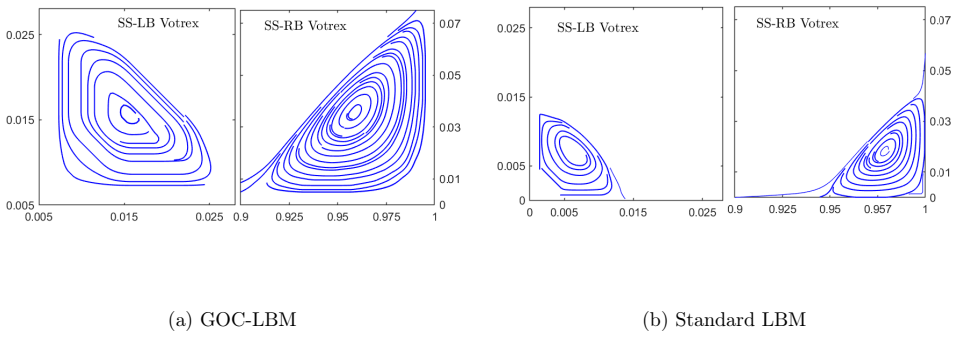
- Numerical benchmarks—Poiseuille, Couette, lid-driven cavity, Taylor-Couette, and Hartmann flow—show agreement with analytical/reference solutions and substantial grid savings compared to uniform-grid lattice Boltzmann.
Reading between the lines
- If the correction-term cancellation is exact, the main practical bottleneck shifts to generating orthogonal body-fitted grids for arbitrary geometries, which the paper itself identifies as an area for future work.
- The formulation points toward a systematic extension to three dimensions and to thermal or multiphase flows by adding analogous metric-factor corrections, although those extensions are not part of the paper's proofs.
- One could test the method on a problem where the mixed curvature terms θ12 and θ21 are nonzero while h1 and h2 vary strongly, since the benchmarks primarily exercise diagonal curvature.
- The local shear-stress formula suggests that the method could be coupled with turbulence models or used for wall-modeled large-eddy simulation on nonuniform grids, where accurate near-wall stresses are essential.
Editorial analysis
A structured set of objections, weighed in public.
Referee Report
Summary. The paper constructs two-dimensional lattice Boltzmann models in general orthogonal coordinates (GOC-LBM) that retain the standard collide-and-stream structure on a uniform computational lattice while allowing continuously clustered or body-fitted orthogonal grids in the physical domain. The construction is top-down: Sec. 2 derives a conservative form of the Navier-Stokes equations in GOC; Sec. 3 performs a Chapman-Enskog analysis of a raw-moment MRT-D2Q9 model and identifies deviation terms E3 and E4 in the normal-stress recovery; Sec. 4 introduces second-order moment-equilibria corrections, Eqs. (75)-(78), which are claimed to cancel these deviations and recover the GOC Navier-Stokes equations, including normal stresses, without non-Galilean cubic-velocity artifacts. Implementations for raw-moment MRT, central-moment MRT, and SRT are given in Appendices A-G, together with coordinate stretching functions. The method is validated against Poiseuille, transient Couette, lid-driven cavity, Hartmann MHD, and Taylor-Couette benchmarks, and a grid-savings study is presented for Hartmann layers.
Significance. If the central algebraic identity of Sec. 4 is correct, this is a significant contribution: it would give a systematic way to use standard D2Q9 collide-and-stream LBM on nonuniform orthogonal grids through metric-dependent equilibria, forcing, and correction terms, reducing to the standard scheme when all metric factors are unity. The modular treatment across collision models (raw moments, central moments, SRT) and the explicit algorithmic appendices are strengths, as is the demonstration of practical grid savings in a thin-boundary-layer MHD problem. However, the paper does not ship machine-checked derivations or code, and its central claim rests on an algebraic cancellation whose derivation is explicitly omitted. The benchmark agreement is encouraging but does not isolate individual correction coefficients. The contribution is therefore promising but not yet verifiable from the manuscript in its current form.
major comments (2)
- [Sec. 3.3 and Sec. 4 (Eqs. 54-57, 72-78)] The central result of the paper is the set of correction coefficients D3,k, D4,k, C3, C4 in Eqs. (76)-(78), which are claimed to cancel the deviation terms E3 and E4 exactly. The manuscript explicitly states 'we omit the details of such lengthy algebraic manipulations' before Eqs. (54) and (56), and the step from Eqs. (74a)-(74b) to Eqs. (75)-(78) is also not shown. This is not a peripheral detail: a sign or prefactor error in any one coefficient would introduce spurious viscous or cubic-velocity terms into the recovered momentum equation. The numerical tests do not isolate the coefficients: Poiseuille and transient Couette flows have ∂ξ1 U1 = ∂ξ2 U2 = 0; the lid-driven cavity on straight clustered grids has θ12 = θ21 = 0; and Taylor-Couette flow does not exercise the full normal-stress correction. I ask the authors to provide the complete derivation of E3, E4 and of Eqs. (75)-(78), or,
- [Appendix E, Eq. (124)] The matrix F displayed in Eq. (124) does not appear to be the transformation from the bare raw-moment vector m of Eq. (80) to the bare central-moment vector mc of Eq. (122). For example, row 4 of the displayed matrix contains U1^2+U2^2 and -2U2 terms, which would be appropriate for a combined k20+k02 moment, whereas the expanded formulas in Step 2 of the same appendix correctly give k20 = k20' - 2U1 k10' + U1^2 k00'. If F is intended for a different moment ordering (e.g., combined diagonal moments), that ordering should be stated explicitly. As printed, a reader implementing Eq. (130) with the displayed F would obtain incorrect central moments. Please correct the matrix or clarify the ordering, and verify that the matrix is consistent with the step-by-step implementation.
minor comments (4)
- [Eq. (44a)] In the O(epsilon) moment system, the second spatial derivative of neq2 appears as ∂ξ1 neq2; from the subsequent Eq. (45a) it should be ∂ξ2 neq2. Please correct the typo.
- [Eq. (158) and Eq. (159)] The stated constraint 'sum_alpha W_alpha = 0' is inconsistent with the requirement that the zeroth moment of g^{eq} equals h1h2 Bi. The subsequent W0 + 4W1 = 1 and W1 = cs_m^2/2 imply sum_alpha W_alpha = 1. The first line of Eq. (158) should read '= 1'.
- [Secs. 7.1-7.3 and 8.2] The validation figures show good qualitative agreement, but quantitative error norms or grid-convergence data are provided only for the MHD/Hartmann study (Table 3). Please add L2 or maximum errors for the Poiseuille, Couette, cavity, and Taylor-Couette cases, and state the grid resolutions / clustering parameters used for each reported curve.
- [Eqs. (68) and (71)] The shear viscosity ν is defined through omega5 in Eq. (68) and through omega4 in Eq. (71). In the implementations the authors set omega4 = omega5, but the text should state explicitly that both definitions coincide only under this choice, and that the proofs/implementations assume omega4 = omega5.
Circularity Check
No significant circularity: the GOC-LBM construction is a top-down Chapman-Enskog derivation with externally validated benchmarks; the omitted algebraic cancellations are a completeness risk, not a circular step.
full rationale
The derivation chain is self-contained rather than circular. The paper starts from target NSE in GOC (Sec. 2), proposes raw-moment equilibria and source terms parameterized by metric factors (Sec. 3.2), performs a Chapman-Enskog expansion to identify the residual deviation terms E3 and E4 (Eqs. 55 and 57), and then constructs moment-equilibria corrections (Eqs. 75-78) whose coefficients are determined by constraints (Eqs. 69-73) that enforce recovery of the target normal stresses. This is a standard top-down LBE construction: the target equations are a design specification, not a fitted parameter, and the scheme's correctness is checked against analytic solutions (Poiseuille, Couette, Hartmann, Taylor-Couette) and published benchmark data (Ghia et al. 1982; Erturk et al. 2005) that were not used to set any coefficients. The admitted omission of the lengthy algebra leading from Eqs. (74a/b) to (76)-(78) is an unverified lemma and a correctness/completeness risk, but an omitted proof is not circularity. Self-citations to prior rectangular/cuboid LB work [28-30] and uniform-grid non-GI corrections [50,51] are not load-bearing: the GOC corrections are rederived here via C-E analysis, and the central-moments version transfers the raw-moment non-equilibrium results rather than importing an unsupported ansatz. The limit h1=h2=1 making the corrections vanish is an internal consistency check rather than a definitional identity. No step equivocates a predicted quantity with an input, and no result reduces to a self-citation chain.
Assumptions & free parameters
free parameters (4)
- global speed of sound cs =
cs = q/sqrt(3), q = min over the domain of min(h1, h2)
- grid stretching/clustering parameters beta (hyperbolic tangent) and gamma (Roberts) =
beta=1.2 (cavity), beta=1.1 (Fig. 11), gamma=1.06 (channel tests), gamma=1.05 (Hartmann cases)
- free relaxation rates omega0, omega1, omega2, omega6, omega7, omega8 =
1.0
- fourth-order equilibrium moment k_eq'22 =
rho cs^4 + rho cs^2 (U1^2 + U2^2) + rho U1^2 U2^2
assumptions (6)
- domain assumption GOC calculus identities for gradient, divergence, curl, vector and tensor divergence (Eqs. (5)-(9)) are adopted wholesale from the recent reference [44].
- domain assumption The target equations are the conservative-form NSE with compressible effects and independently adjustable bulk viscosity (Eqs. (11)-(15)), not the strict incompressible NSE (Eq. (1)).
- standard math Chapman-Enskog multiscale expansion: distribution and time-derivative expansions (Eqs. (42), (61), (167)) truncated at O(epsilon^2) with the standard equilibrium/non-equilibrium split.
- domain assumption The coordinate system is restricted to orthogonal coordinates (metric factors only, no cross terms in the mapping).
- standard math In the magnetic induction equation analysis, the unsteady term partial_t0 Lambda^{eq(0)} ~ O(Ma^3) is neglected.
- domain assumption The D2Q9 lattice plus the proposed moment corrections is a sufficient basis to represent the GOC-NSE (sufficiency of the chosen nine moments).
Cite this review
Pith. "Pith review of Lattice Boltzmann Methods for Navier-Stokes Equations in General Orthogonal Coordinates for Efficient Flow Simulations using Nonuniform Clustered Grids." pith.science (2026). https://pith.science/paper/HPNAOYHZ
@misc{pith2026260715362,
  author       = {Pith},
  title        = {Pith review of: Lattice Boltzmann Methods for Navier-Stokes Equations in General Orthogonal Coordinates for Efficient Flow Simulations using Nonuniform Clustered Grids},
  year         = {2026},
  howpublished = {\url{https://pith.science/paper/HPNAOYHZ}},
  note         = {Machine review of arXiv:2607.15362}
}
read the original abstract
Resolving multiscale fluid flows or boundary layers effectively requires the use of nonuniform meshes with local grid clustering. The standard lattice Boltzmann method (LBM), a kinetic theory-based approach for computational fluid dynamics, however, is restricted to the use of uniform Cartesian grids. We present new and improved formulations of the LBM that accommodate continuously varying spatial grids via coordinate transformations to simulate the Navier-Stokes equations (NSE) in the general orthogonal coordinates (GOC). They are constructed using a Chapman-Enskog analysis to specify the equilibrium moments of the distribution functions and the geometric force terms used in the collision step to be dependent on the local metric factors and their spatial derivatives, along with the density, momentum and their fluxes, and some correction terms related to the normal velocity gradients so as to accurately represent the NSE in the GOC. The resulting GOC-LBM importantly maintains the simplicity of the collide-and-stream approach and is Galilean invariant that is free of the cubic velocity artifacts. Our GOC-LBM is general and modular in that it can be used with any collision model with appropriate modifications to the equilibria and forcing terms. We present its implementation details for a variety of collision models while the central moments-based model using multiple relaxation times was found to be the most robust in practical implementations. We validate the GOC-LBM through numerical simulations for various benchmark flow problems. Moreover, we demonstrate significant computational advantages of our approach for a case study on simulating boundary layer flows efficiently that involves coupling the GOC-LBM for the NSE with a new GOC-LB scheme for solving the magnetic induction equation for magnetohydrodynamics (MHD), and for another case study involving orthogonal curvilinear grids.
Figures


Figures from the paper (17 more)




Reference graph
Works this paper leans on
-
[1]
Use of the Boltzmann equation to simulate lattice-gas automata.Physical review letters, 61(20):2332, 1988
Guy R McNamara and Gianluigi Zanetti. Use of the Boltzmann equation to simulate lattice-gas automata.Physical review letters, 61(20):2332, 1988
1988
-
[2]
Boltzmann approach to lattice gas simulations.EPL (Euro- physics Letters), 9(7):663, 1989
FJ Higuera and Javier Jiménez. Boltzmann approach to lattice gas simulations.EPL (Euro- physics Letters), 9(7):663, 1989
1989
-
[3]
Lattice BGK models for navier- stokes equation.EPL (Europhysics Letters), 17(6):479, 1992
Yue-Hong Qian, Dominique d’Humières, and Pierre Lallemand. Lattice BGK models for navier- stokes equation.EPL (Europhysics Letters), 17(6):479, 1992
1992
-
[4]
The lattice Boltzmann equation: theory and applications.Physics Reports, 222(3):145–197, 1992
Roberto Benzi, Sauro Succi, and Massimo Vergassola. The lattice Boltzmann equation: theory and applications.Physics Reports, 222(3):145–197, 1992
1992
-
[5]
Theory of the lattice Boltzmann method: From the Boltzmann equation to the lattice Boltzmann equation.Physical Review E, 56(6):6811, 1997
Xiaoyi He and Li-Shi Luo. Theory of the lattice Boltzmann method: From the Boltzmann equation to the lattice Boltzmann equation.Physical Review E, 56(6):6811, 1997
1997
-
[6]
Lattice Boltzmann method for fluid flows.Annual review of fluid mechanics, 30(1):329–364, 1998
Shiyi Chen and Gary D Doolen. Lattice Boltzmann method for fluid flows.Annual review of fluid mechanics, 30(1):329–364, 1998
1998
-
[7]
The lattice Boltzmann method for nearly incompressible flows.Journal of Computational Physics, 431:109713, 2021
Pierre Lallemand, Li-Shi Luo, Manfred Krafczyk, and Wen-An Yong. The lattice Boltzmann method for nearly incompressible flows.Journal of Computational Physics, 431:109713, 2021
2021
-
[8]
Multiple–relaxation–time lattice Boltzmann models in three dimen- sions.Philosophical Transactions of the Royal Society of London
Dominique d’Humieres. Multiple–relaxation–time lattice Boltzmann models in three dimen- sions.Philosophical Transactions of the Royal Society of London. Series A: Mathematical, Physical and Engineering Sciences, 360(1792):437–451, 2002
2002
Show all 79 references
-
[9]
Cascaded digital lattice Boltzmann au- tomata for high Reynolds number flow.Physical Review E, 73(6):066705, 2006
Martin Geier, Andreas Greiner, and Jan G Korvink. Cascaded digital lattice Boltzmann au- tomata for high Reynolds number flow.Physical Review E, 73(6):066705, 2006
2006
-
[10]
The cumulant lattice Boltzmann equation in three dimensions: Theory and validation.Computers & Mathematics with Applications, 70(4):507–547, 2015
Martin Geier, Martin Schönherr, Andrea Pasquali, and Manfred Krafczyk. The cumulant lattice Boltzmann equation in three dimensions: Theory and validation.Computers & Mathematics with Applications, 70(4):507–547, 2015
2015
-
[11]
Entropic lattice Boltzmann methods: A review.Computers & Fluids, 259:105884, 2023
Seyed Ali Hosseini, Mohammad Atif, Santosh Ansumali, and Iliya V Karlin. Entropic lattice Boltzmann methods: A review.Computers & Fluids, 259:105884, 2023. 81
2023
-
[12]
Fokker-Planck central moment lattice Boltzmann method for effective simulations of fluid dynamics.Fluids, 9(11):255, 2024
William Schupbach and Kannan Premnath. Fokker-Planck central moment lattice Boltzmann method for effective simulations of fluid dynamics.Fluids, 9(11):255, 2024
2024
-
[13]
Physical symmetry and lattice symmetry in the lattice Boltzmann method.Physical review E, 55(1):R21, 1997
Nianzheng Cao, Shiyi Chen, Shi Jin, and Daniel Martinez. Physical symmetry and lattice symmetry in the lattice Boltzmann method.Physical review E, 55(1):R21, 1997
1997
-
[14]
Some progress in lattice Boltzmann method
Xiaoyi He, Li-Shi Luo, and Micah Dembo. Some progress in lattice Boltzmann method. part i. nonuniform mesh grids.Journal of computational Physics, 129(2):357–363, 1996
1996
-
[15]
Large eddy simulations of a stirred tank using the lattice Boltzmann method on a nonuniform grid
Zhenyu Lu, Ying Liao, Dongying Qian, JB McLaughlin, JJ Derksen, and K Kontomaris. Large eddy simulations of a stirred tank using the lattice Boltzmann method on a nonuniform grid. Journal of Computational Physics, 181(2):675–704, 2002
2002
-
[16]
Accuracy of discrete-velocity BGK models for the simu- lation of the incompressible Navier-Stokes equations.Computers & fluids, 24(4):459–467, 1995
Marc B Reider and James D Sterling. Accuracy of discrete-velocity BGK models for the simu- lation of the incompressible Navier-Stokes equations.Computers & fluids, 24(4):459–467, 1995
1995
-
[17]
Lattice Boltzmann method on irregular meshes.Physical Review E, 58(4):R4124, 1998
Gongwen Peng, Haowen Xi, Comer Duncan, and So-Hsiang Chou. Lattice Boltzmann method on irregular meshes.Physical Review E, 58(4):R4124, 1998
1998
-
[18]
Least-squares finite-element lattice Boltzmann method.Physical Review E, 69(6):065701, 2004
Yusong Li, Eugene J LeBoeuf, and PK Basu. Least-squares finite-element lattice Boltzmann method.Physical Review E, 69(6):065701, 2004
2004
-
[19]
Theory of the lattice Boltzmann method: Dispersion, dissi- pation, isotropy, galilean invariance, and stability.Physical Review E, 61(6):6546, 2000
Pierre Lallemand and Li-Shi Luo. Theory of the lattice Boltzmann method: Dispersion, dissi- pation, isotropy, galilean invariance, and stability.Physical Review E, 61(6):6546, 2000
2000
-
[20]
Grid refinement for lattice-BGK models.Journal of Compu- tational physics, 147(1):219–228, 1998
Olga Filippova and Dieter Hänel. Grid refinement for lattice-BGK models.Journal of Compu- tational physics, 147(1):219–228, 1998
1998
-
[21]
A multi-block lattice Boltzmann method for viscous fluid flows.International journal for numerical methods in fluids, 39(2):99–120, 2002
Dazhi Yu, Renwei Mei, and Wei Shyy. A multi-block lattice Boltzmann method for viscous fluid flows.International journal for numerical methods in fluids, 39(2):99–120, 2002
2002
-
[22]
A generic, mass conservative local grid refinement technique for lattice-Boltzmann schemes.International journal for numerical methods in fluids, 51(4):439–468, 2006
Martin Rohde, Drona Kandhai, Jos J Derksen, and Harry EA Van den Akker. A generic, mass conservative local grid refinement technique for lattice-Boltzmann schemes.International journal for numerical methods in fluids, 51(4):439–468, 2006
2006
-
[23]
Rectangular lattice-Boltzmann schemes with BGK-collision operator.Journal of Scientific Computing, 56(2):230–242, 2013
Luiz Adolfo Hegele Jr, Keijo Mattila, and Paulo Cesar Philippi. Rectangular lattice-Boltzmann schemes with BGK-collision operator.Journal of Scientific Computing, 56(2):230–242, 2013
2013
-
[24]
Lattice Boltz- mann equation on a two-dimensional rectangular grid.Journal of Computational Physics, 172(2):704–717, 2001
M’hamed Bouzidi, Dominique d’Humières, Pierre Lallemand, and Li-Shi Luo. Lattice Boltz- mann equation on a two-dimensional rectangular grid.Journal of Computational Physics, 172(2):704–717, 2001
2001
-
[25]
MRT rectangular lattice Boltzmann method.International Journal of Modern Physics C, 23(05):1250040, 2012
Jian Guo Zhou. MRT rectangular lattice Boltzmann method.International Journal of Modern Physics C, 23(05):1250040, 2012
2012
-
[26]
Designingcorrectfluidhydrodynam- ics on a rectangular grid using MRT lattice Boltzmann approach.Computers & Mathematics with Applications, 72(2):288–310, 2016
YuanZong, ChengPeng, ZhaoliGuo, andLian-PingWang. Designingcorrectfluidhydrodynam- ics on a rectangular grid using MRT lattice Boltzmann approach.Computers & Mathematics with Applications, 72(2):288–310, 2016
2016
-
[27]
A hydrodynamically-consistent MRT lattice Boltzmann model on a 2d rectangular grid.Journal of Computational Physics, 326:893–912, 2016
Cheng Peng, Haoda Min, Zhaoli Guo, and Lian-Ping Wang. A hydrodynamically-consistent MRT lattice Boltzmann model on a 2d rectangular grid.Journal of Computational Physics, 326:893–912, 2016. 82
2016
-
[28]
Central moment lattice Boltzmann method on a rect- angular lattice.Physics of Fluids, 33(5):057110, 2021
Eman Yahia and Kannan N Premnath. Central moment lattice Boltzmann method on a rect- angular lattice.Physics of Fluids, 33(5):057110, 2021
2021
-
[29]
Three-dimensional central moment lattice Boltzmann method on a cuboid lattice for anisotropic and inhomogeneous flows.Fluids, 6(9):326, 2021
Eman Yahia, William Schupbach, and Kannan N Premnath. Three-dimensional central moment lattice Boltzmann method on a cuboid lattice for anisotropic and inhomogeneous flows.Fluids, 6(9):326, 2021
2021
-
[30]
Preconditioned central moment lattice Boltzmann method on a rectangular lattice grid for accelerated computations of inhomogeneous flows
Eman Yahia and Kannan N Premnath. Preconditioned central moment lattice Boltzmann method on a rectangular lattice grid for accelerated computations of inhomogeneous flows. Journal of Computational Science, 63:101821, 2022
2022
-
[31]
On the finite difference-based lattice Boltzmann method in curvi- linear coordinates.Journal of Computational Physics, 143(2):426–448, 1998
Renwei Mei and Wei Shyy. On the finite difference-based lattice Boltzmann method in curvi- linear coordinates.Journal of Computational Physics, 143(2):426–448, 1998
1998
-
[32]
Explicit finite-difference lattice Boltzmann method for curvi- linear coordinates.Physical review E, 67(6):066709, 2003
Zhaoli Guo and Tian-Shou Zhao. Explicit finite-difference lattice Boltzmann method for curvi- linear coordinates.Physical review E, 67(6):066709, 2003
2003
-
[33]
MRT lattice Boltzmann method for 2D flows in curvilinear coordinates
Ljubomir Budinski. MRT lattice Boltzmann method for 2D flows in curvilinear coordinates. Computers & Fluids, 96:288–301, 2014
2014
-
[34]
Implementation of a high-order compact finite- difference lattice Boltzmann method in generalized curvilinear coordinates.Journal of Compu- tational Physics, 267:28–49, 2014
Kazem Hejranfar and Eslam Ezzatneshan. Implementation of a high-order compact finite- difference lattice Boltzmann method in generalized curvilinear coordinates.Journal of Compu- tational Physics, 267:28–49, 2014
2014
-
[35]
Lattice kinetic scheme for generalized coordinates and curved spaces.International Journal of Modern Physics C, 25(12):1441001, 2014
M Mendoza, J-D Debus, S Succi, and HJ Herrmann. Lattice kinetic scheme for generalized coordinates and curved spaces.International Journal of Modern Physics C, 25(12):1441001, 2014
2014
-
[36]
Towards a generalised lattice Boltzmann method for aerodynamic simulations.Journal of Computational Science, 45:101182, 2020
Juan Antonio Reyes Barraza and Ralf Deiterding. Towards a generalised lattice Boltzmann method for aerodynamic simulations.Journal of Computational Science, 45:101182, 2020
2020
-
[37]
Volumetric lattice Boltzmann models in general curvilinear coordinates: theo- retical formulation.Frontiers in Applied Mathematics and Statistics, 7:691582, 2021
Hudong Chen. Volumetric lattice Boltzmann models in general curvilinear coordinates: theo- retical formulation.Frontiers in Applied Mathematics and Statistics, 7:691582, 2021
2021
-
[38]
Lattice Boltzmann model in general curvilinear coordinates applied to exactly solvable 2d flow problems.Frontiers in Applied Mathematics and Statistics, 8:1066522, 2023
Alexei Chekhlov, Ilya Staroselsky, Raoyang Zhang, and Hudong Chen. Lattice Boltzmann model in general curvilinear coordinates applied to exactly solvable 2d flow problems.Frontiers in Applied Mathematics and Statistics, 8:1066522, 2023
2023
-
[39]
Lattice Boltzmann method for the convection–diffusion equation in curvilinear coordinate systems.Journal of Computational Physics, 257:884–900, 2014
Hiroaki Yoshida and Makoto Nagaoka. Lattice Boltzmann method for the convection–diffusion equation in curvilinear coordinate systems.Journal of Computational Physics, 257:884–900, 2014
2014
-
[40]
Technology Press, 1946
Philip McCord Morse and Herman Feshbach.Methods of theoretical physics. Technology Press, 1946
1946
-
[41]
Courier Corporation, 2012
Francis B Hildebrand.Methods of applied mathematics. Courier Corporation, 2012
2012
-
[42]
Prentice-Hall, Inc., 1969
Lawrence E Malvern.Introduction to the Mechanics of a Continuous Medium. Prentice-Hall, Inc., 1969
1969
-
[43]
IoP publishing, 2017
Richard Fitzpatrick.Theoretical fluid mechanics. IoP publishing, 2017. 83
2017
-
[44]
Boundary layer formulations in orthogonal curvilinear coordinates for flow over wind-generated surface waves.Journal of Fluid Mechanics, 888:A11, 2020
Kianoosh Yousefi and Fabrice Veron. Boundary layer formulations in orthogonal curvilinear coordinates for flow over wind-generated surface waves.Journal of Fluid Mechanics, 888:A11, 2020
2020
-
[45]
Onone-dimensionalstretchingfunctionsforfinite-differencecalculations.Jour- nal of Computational Physics, 50(2):215–234, 1983
MarcelVinokur. Onone-dimensionalstretchingfunctionsforfinite-differencecalculations.Jour- nal of Computational Physics, 50(2):215–234, 1983
1983
-
[46]
CRC press, 1998
Joe F Thompson, Bharat K Soni, and Nigel P Weatherill.Handbook of grid generation. CRC press, 1998
1998
-
[47]
Springer, 1999
Vladimir D Liseikin.Grid generation methods, volume 1. Springer, 1999
1999
-
[48]
CRC press, 2020
Dale Anderson, John C Tannehill, Richard H Pletcher, Ramakanth Munipalli, and Vijaya Shankar.Computational fluid mechanics and heat transfer. CRC press, 2020
2020
-
[49]
Conservation equations of gasdynamics in curvilinear coordinate systems
Marcel Vinokur. Conservation equations of gasdynamics in curvilinear coordinate systems. Journal of Computational Physics, 14(2):105–125, 1974
1974
-
[50]
Lattice Boltzmann algorithms without cubic defects in Galilean invariance on standard lattices.Journal of Computational Physics, 259:270–283, 2014
Paul J Dellar. Lattice Boltzmann algorithms without cubic defects in Galilean invariance on standard lattices.Journal of Computational Physics, 259:270–283, 2014
2014
-
[51]
Farzaneh Hajabdollahi and Kannan N Premnath. Galilean-invariant preconditioned central- moment lattice Boltzmann method without cubic velocity errors for efficient steady flow simu- lations.Physical Review E, 97(5):053303, 2018
2018
-
[52]
Lattice kinetic schemes for magnetohydrodynamics.Journal of Computational Physics, 179(1):95–126, 2002
Paul J Dellar. Lattice kinetic schemes for magnetohydrodynamics.Journal of Computational Physics, 179(1):95–126, 2002
2002
-
[53]
Mallet- Bachelier, 1859
Gabriel Lamé.Leçons sur les coordonnées curvilignes et leurs diverses applications. Mallet- Bachelier, 1859
-
[54]
Conservation equations of a viscous, heat-conducting fluid in curvilinear orthogonal coordinates
LH Black. Conservation equations of a viscous, heat-conducting fluid in curvilinear orthogonal coordinates. Technical report, NASA Jet Propulsion Laboratory, Technical Report 32-1332, 1968
1968
-
[55]
An implicit finite-difference method for solving the Navier-Stokes equation using orthogonal curvilinear coordinates.Journal of Computational Physics, 23(4):343–363, 1977
Tin-Kan Hung and Thomas D Brown. An implicit finite-difference method for solving the Navier-Stokes equation using orthogonal curvilinear coordinates.Journal of Computational Physics, 23(4):343–363, 1977
1977
-
[56]
Prediction of heat and fluid flow in complex ge- ometries using general orthogonal coordinates.Numerical Heat Transfer, Part A: Applications, 9(2):125–142, 1986
GD Raithby, PF Galpin, and JP Van Doormaal. Prediction of heat and fluid flow in complex ge- ometries using general orthogonal coordinates.Numerical Heat Transfer, Part A: Applications, 9(2):125–142, 1986
1986
-
[57]
Finite-difference method for incompressible Navier–Stokes equations in arbi- trary orthogonal curvilinear coordinates.Journal of Computational Physics, 217(2):759–781, 2006
Nikolay Nikitin. Finite-difference method for incompressible Navier–Stokes equations in arbi- trary orthogonal curvilinear coordinates.Journal of Computational Physics, 217(2):759–781, 2006
2006
-
[58]
A novel thermal model for the lattice Boltzmann method in incompressible limit.Journal of computational physics, 146(1):282–300, 1998
Xiaoyi He, Shiyi Chen, and Gary D Doolen. A novel thermal model for the lattice Boltzmann method in incompressible limit.Journal of computational physics, 146(1):282–300, 1998
1998
-
[59]
On the partial difference equations of math- ematical physics.IBM Journal of Research and Development, 11(2):215–234, 1967
Richard Courant, Kurt Friedrichs, and Hans Lewy. On the partial difference equations of math- ematical physics.IBM Journal of Research and Development, 11(2):215–234, 1967. Republished from a paper in the Mathematische Annalen journal that appeared in 1928. 84
1967
-
[60]
Cambridge university press, 1990
Sydney Chapman, Thomas George Cowling, and David Burnett.The mathematical theory of non-uniform gases: an account of the kinetic theory of viscosity, thermal conduction and diffusion in gases. Cambridge university press, 1990
1990
-
[61]
Computational meshes for boundary layer problems
Glyn O Roberts. Computational meshes for boundary layer problems. InProceedings of the Second International Conference on Numerical Methods in Fluid Dynamics: September 15–19, 1970 University of California, Berkeley, pages 171–177. Springer, 1971
1970
-
[62]
Joe F Thompson, Frank C Thames, and C Wayne Mastin. Automatic numerical generation of body-fitted curvilinear coordinate system for field containing any number of arbitrary two- dimensional bodies.Journal of computational physics, 15(3):299–319, 1974
1974
-
[63]
The calculation of turbulent recirculating flows in general orthogonal coordinates
SB Pope. The calculation of turbulent recirculating flows in general orthogonal coordinates. Journal of Computational Physics, 26(2):197–217, 1978
1978
-
[64]
On the numerical generation of boundary-fitted or- thogonal curvilinear coordinate systems.Journal of Computational Physics, 34(1):124–135, 1980
Curtis D Mobley and Robert J Stewart. On the numerical generation of boundary-fitted or- thogonal curvilinear coordinate systems.Journal of Computational Physics, 34(1):124–135, 1980
1980
-
[65]
Orthogonal mapping.Journal of Computational Physics, 50(1):71–100, 1983
G Ryskin and LG Leal. Orthogonal mapping.Journal of Computational Physics, 50(1):71–100, 1983
1983
-
[66]
Orthogonal mapping in two dimensions.Journal of Computational Physics, 98(2):254–268, 1992
Ramani Duraiswami and Andrea Prosperetti. Orthogonal mapping in two dimensions.Journal of Computational Physics, 98(2):254–268, 1992
1992
-
[67]
2d orthogonal grid generation with boundary point distribution control.Journal of Computational Physics, 125(2):440–453, 1996
Luis Eça. 2d orthogonal grid generation with boundary point distribution control.Journal of Computational Physics, 125(2):440–453, 1996
1996
-
[68]
Nearly orthogonal two-dimensional grid generation with aspect ratio control.Journal of Computational Physics, 171(2):805–821, 2001
Volkan Akcelik, Branislav Jaramaz, and Omar Ghattas. Nearly orthogonal two-dimensional grid generation with aspect ratio control.Journal of Computational Physics, 171(2):805–821, 2001
2001
-
[69]
Numerical study of the properties of the central moment lattice Boltzmann method.International Journal for Numerical Methods in Fluids, 82(2):59–90, 2016
Yang Ning, Kannan N Premnath, and Dhiraj V Patil. Numerical study of the properties of the central moment lattice Boltzmann method.International Journal for Numerical Methods in Fluids, 82(2):59–90, 2016
2016
-
[70]
High-Re solutions for incompressible flow using the navier-stokes equations and a multigrid method.Journal of computational physics, 48(3):387– 411, 1982
UKNG Ghia, Kirti N Ghia, and CT Shin. High-Re solutions for incompressible flow using the navier-stokes equations and a multigrid method.Journal of computational physics, 48(3):387– 411, 1982
1982
-
[71]
Numerical solutions of 2-d steady in- compressible driven cavity flow at high reynolds numbers.International journal for Numerical Methods in fluids, 48(7):747–774, 2005
Ercan Erturk, Thomas C Corke, and Cihan Gökçöl. Numerical solutions of 2-d steady in- compressible driven cavity flow at high reynolds numbers.International journal for Numerical Methods in fluids, 48(7):747–774, 2005
2005
-
[72]
Duct flow in magnetohydrodynamics.Zeitschrift für angewandte Mathematik und Physik ZAMP, 12(2):100–114, 1961
Chieh C Chang and Thomas S Lundgren. Duct flow in magnetohydrodynamics.Zeitschrift für angewandte Mathematik und Physik ZAMP, 12(2):100–114, 1961
1961
-
[73]
Springer Science & Business Media, 2013
Ulrich Müller and Leo Bühler.Magnetofluiddynamics in channels and containers. Springer Science & Business Media, 2013
2013
-
[74]
On the use of composite grid schemes in computational aerodynamics.Computer Methods in Applied Mechanics and Engineering, 64(1-3):301–320, 1987
Joseph L Steger and John A Benek. On the use of composite grid schemes in computational aerodynamics.Computer Methods in Applied Mechanics and Engineering, 64(1-3):301–320, 1987. 85
1987
-
[75]
Composite overlapping meshes for the solution of partial differential equations.Journal of Computational Physics, 90(1):1–64, 1990
G Chesshire and William D Henshaw. Composite overlapping meshes for the solution of partial differential equations.Journal of Computational Physics, 90(1):1–64, 1990
1990
-
[76]
An algorithm for assembling overlapping grid systems.SIAM Journal on Scientific Computing, 20(6):1995–2022, 1999
N Anders Petersson. An algorithm for assembling overlapping grid systems.SIAM Journal on Scientific Computing, 20(6):1995–2022, 1999
1995
-
[77]
Composite overset structured grids.Handbook of Grid Generation, pages 1–20, 1999
Robert L Meakin. Composite overset structured grids.Handbook of Grid Generation, pages 1–20, 1999
1999
-
[78]
Chávez-Modena, E
M. Chávez-Modena, E. Ferrer, and G. Rubio. Improving the stability of multiple-relaxation lattice Boltzmann methods with central moments.Computers and Fluids, 172:397–409, 2018
2018
-
[79]
The lattice Boltzmann method.Springer International Publishing, 10:978–3, 2017
Timm Krüger, Halim Kusumaatmaja, Alexandr Kuzmin, Orest Shardt, Goncalo Silva, and Erlend Magnus Viggen. The lattice Boltzmann method.Springer International Publishing, 10:978–3, 2017. 86
2017
Reviewed August 1, 2026 · model on record in the stance chip above.
Discussion (0). Continue with ORCID to comment.