REVIEW 4 major objections 4 minor 73 references
SAMBLE: Shape-Specific Point Cloud Sampling for an Optimal Trade-Off Between Local Detail and Global Uniformity
T0 review · 4 major / 4 minor · reviewed 2026-08-16 · deepseek-v4-flash
Pith's one-line read SAMBLE samples point clouds to keep edge detail and global uniformity, and reports gains over prior samplers.
desk verdict Genuine extension of APES with strong few-point results, but test-set-selected hyperparameters and a missing k make the headline numbers hard to check independently. read the letter →
The pith
A machine-rendered reading of the paper's core claim, the machinery that carries it, and where it could break.
The reading
What carries the argument
The load-bearing mechanism is the sparse attention map (SAM) plus a bin-based sampling policy. SAM takes an N×N global attention map and, for each row, carves out only the cells corresponding to that point's k nearest neighbors, setting the rest to zero; the per-column count no and the column sums of these carved cells become the raw material for point-wise sampling scores. The preferred indexing mode, sparse column square-divided, divides each column sum by $no^{2}$, which softens the edge over-emphasis seen in row-standard-deviation modes. The bin policy then divides the score range into nb bins using boundaries updated with momentum over the training set, and nb learnable bin tokens, concatenated to keys and values, produce per-bin sampling weights through a masked point-to-token attention sub-map; within each bin, points are drawn by a softmax over scores with temperature τ. This combination is what turns a fixed top-M rule into a shape-specific strategy.
What would settle it
Run SAMBLE on a real scan with visibly non-uniform point density and compare its top-score points against manually labeled true edges; if dense flat regions are scored as high as genuine sharp edges, the kNN-frequency signal is density, not geometry.
Extended reading notes
Core claim
The central claim is that the asymmetry of k-nearest-neighbor relations — point pi can be among pj's neighbors without the reverse holding — is an easily computed point property that separates edge points, close-to-edge points, and non-edge points, and that a sparse attention map exposes this property. Starting from a global attention map, SAMBLE keeps only the k selected cells per row; because each point is chosen as a neighbor a different number of times, column variables like the selected-cell count no carry the geometric signal. Among seven indexing modes, the 'sparse column square-divided' mode (column sum divided by $no^{2}$) is chosen as the default because it samples edge points without over-emphasizing them. On top of those per-point scores, bin-based sampling partitions each shape's points into bins with momentum-updated score boundaries and learns one sampling weight per bin through extra bin tokens appended to the keys and values of the attention computation. The paper reports that this yields a better edge/global balance than APES in qualitative comparisons and better numbers on classification, part segmentation, and few-point sampling.
Load-bearing premise
The kNN asymmetry frequency is assumed to reflect local geometry (edge-ness) rather than local point density; that holds on the uniformly sampled CAD meshes of ModelNet40 and ShapeNet-Part, but on real scans with irregular density the sampling scores could be confounded by density.
Editorial extensions
If this is right
- Interpolation-based upsampling becomes usable: SAMBLE's uniformly spread samples let standard neighbor interpolation replace the cross-attention upsampler that APES required, without the accuracy drop APES shows under interpolation.
- Few-point sampling works directly from the raw input: SAMBLE reports 90.18% overall accuracy at M=256 and 89.45% at M=32 on ModelNet40 classification without FPS pre-processing, outperforming APES that uses FPS to reduce the input first.
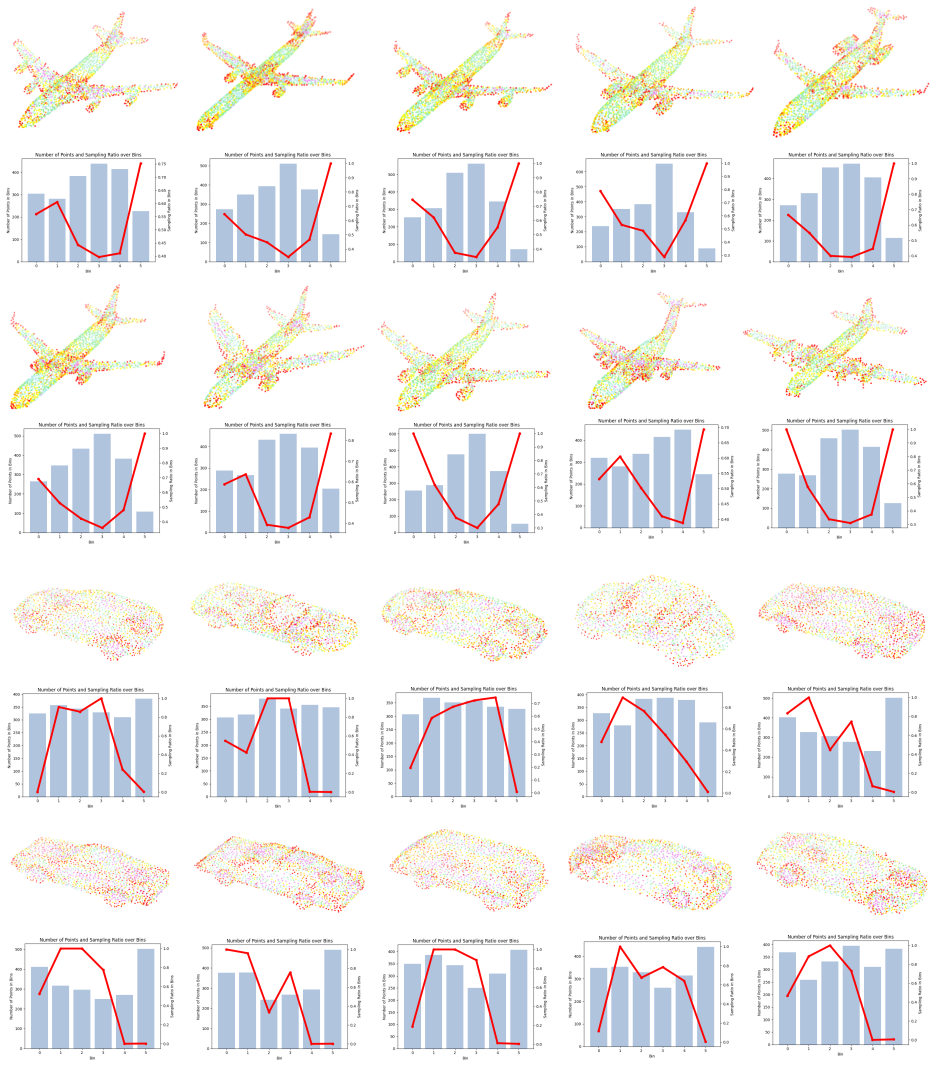
- Sampling strategies are shape-specific and category-consistent: visualization shows similar bin histograms within a category and different strategies across categories, implying the sampler learns meaningful per-shape importance profiles.
- The sampled sub-point clouds themselves carry more task signal: SAMBLE beats PointNeXt's FPS-based downsampling on intermediate downsampled sub-point clouds, suggesting the learned points, not the upsampling layer, drive the performance.
- The method scales to any target sample size M through the bin-quota redistribution algorithm, so the same trained strategy can serve multiple sampling budgets.
Reading between the lines
- On real-world scans with non-uniform density, the kNN asymmetry signal would conflate edge-ness with density; a density-normalized variant of the sparse column count is a natural extension that could be tested on scanned-object benchmarks.
- The learned bin boundaries essentially define a shape-specific importance quantile function; they could be exported as a compact descriptor of a shape class and used for rule-based sampling without neural inference.
- The same sparse-attention plus bin-token design should transfer to other permutation-invariant operators, such as downsampling for point cloud registration or scene understanding, where edge preservation and coverage both matter.
- The temperature τ in in-bin sampling interpolates between top-M and uniform sampling; per-bin or per-shape temperature schedules might improve the trade-off further.
Signed reviews
Editorial analysis
A structured set of objections, weighed in public.
Referee Report
Summary. The paper proposes SAMBLE, a learning-based point cloud sampling method that computes point-wise sampling scores from a sparse attention map (SAM) combining local and global information, and then samples points using a shape-specific bin-based strategy. The sparse attention map is built by masking a global attention map with kNN neighbor indices, and seven indexing modes are proposed for deriving sampling scores. Points are partitioned into bins with momentum-updated boundaries, and bin sampling weights are learned with additional bin tokens. The method is evaluated on ModelNet40 classification, ShapeNet-Part segmentation, few-point sampling on ModelNet40, and intermediate sub-point cloud segmentation, reporting state-of-the-art or competitive results against APES and other baselines. The paper includes extensive ablations over indexing modes, number of bins, momentum factor, temperature, and upsampling layers, plus supplementary material on network architecture, training details, and additional visualizations.
Significance. If the reported results are reliable, SAMBLE makes a useful contribution to task-oriented point cloud sampling by offering a more balanced local-global trade-off than APES, with particularly strong few-point sampling performance. The paper's systematic exploration of multiple indexing modes, the bin-based shape-specific sampling mechanism, the qualitative score heatmaps, and the runtime/complexity analysis are strengths. The central claim is empirical, however, and its validity depends on the evaluation methodology; the selection of design hyperparameters on the test benchmarks and the lack of statistical variance reporting are serious concerns. The method is also not independently reproducible as reported because the kNN neighborhood size k is never specified and no code is provided.
major comments (4)
- [Sec. 4.4 and supplementary Tables 11-12] The main results in Tables 2-4 are produced with hyperparameters that appear to be selected on the same test benchmarks used for the headline numbers. Specifically, the indexing mode is chosen from Table 5, the number of bins from Table 6 (and the corresponding main-text sentences), the momentum factor from Table 11 in the supplementary, and the temperature from Table 12 in the supplementary. No held-out validation split is described anywhere; the paper only mentions the official train-test splits for ModelNet40 and ShapeNet-Part. This is a form of test-set selection that can inflate reported accuracy, and it undermines the claim of 'superior performance' over APES, whose margins are only 0.3-0.4 accuracy points in Table 2. The authors should re-run the ablation selection on a validation split and report the final results on the test set only once, or otherwise demonstrate that the selected configuration is not an artifact of test-set tuning.
- [Sec. 3.1 and Table 1] The kNN neighborhood size k is a central free parameter of the proposed sparse attention map and of every indexing mode in Table 1 (e.g., the number of selected cells per row, and the column counts n_o used in modes v-vii). Throughout the paper and the supplementary material, k is never given a numeric value, and no ablation over k is reported. Without this value, the method cannot be reproduced or compared against other sampling methods. This missing specification is load-bearing for the empirical claim and must be added, along with an ablation or at least the chosen value for each experiment.
- [Table 3] Table 3 reports intermediate sub-point cloud segmentation results where SAMBLE's category mIoU increases as the number of points decreases (84.51 at 2048 points, 84.84 at 1024, 85.04 at 512). This is counterintuitive: a smaller sampled subset would generally not be expected to improve accuracy on a downstream task unless the evaluation protocol differs from what is described. The paper states that 'the learned sampled points contribute more to the overall performance' and that 'the upsampling layer cannot fully reconstruct the features of the discarded points,' but this does not explain why fewer points should yield higher mIoU. The authors should clarify the evaluation protocol for the intermediate sub-point clouds and explain this trend, as it currently undermines the interpretability of a key comparison.
- [Tables 2 and 4] All reported accuracy values appear to come from a single run with no seed variance or statistical significance testing. In Table 2, the gap between SAMBLE and APES (global) is 0.4% overall accuracy on ModelNet40 and 0.8% category mIoU on ShapeNet-Part; on a test set of 2,468 shapes, a 0.4% difference corresponds to roughly 10 shapes and may be within run-to-run variation. The few-point sampling gains in Table 4 are large and more convincing, but the classification and segmentation claims should be supported by mean±std over multiple seeds or, at minimum, a statement of the number of runs and the observed variance.
minor comments (4)
- [Sec. 3.2] The notation in the indexing-mode formulas is inconsistent: 'oth row' and 'oth column' should be 'o-th row' and 'o-th column', and the definition of S_o is only given in prose rather than in the table. Please align the notation between Table 1 and the surrounding text.
- [Sec. 1, Fig. 2] The phrase 'quantum-entangled twin point pair' is informal and not defined; the phenomenon is simply that two points can each be the other's kNN under ties or boundary conditions. Please replace this with a precise geometric description.
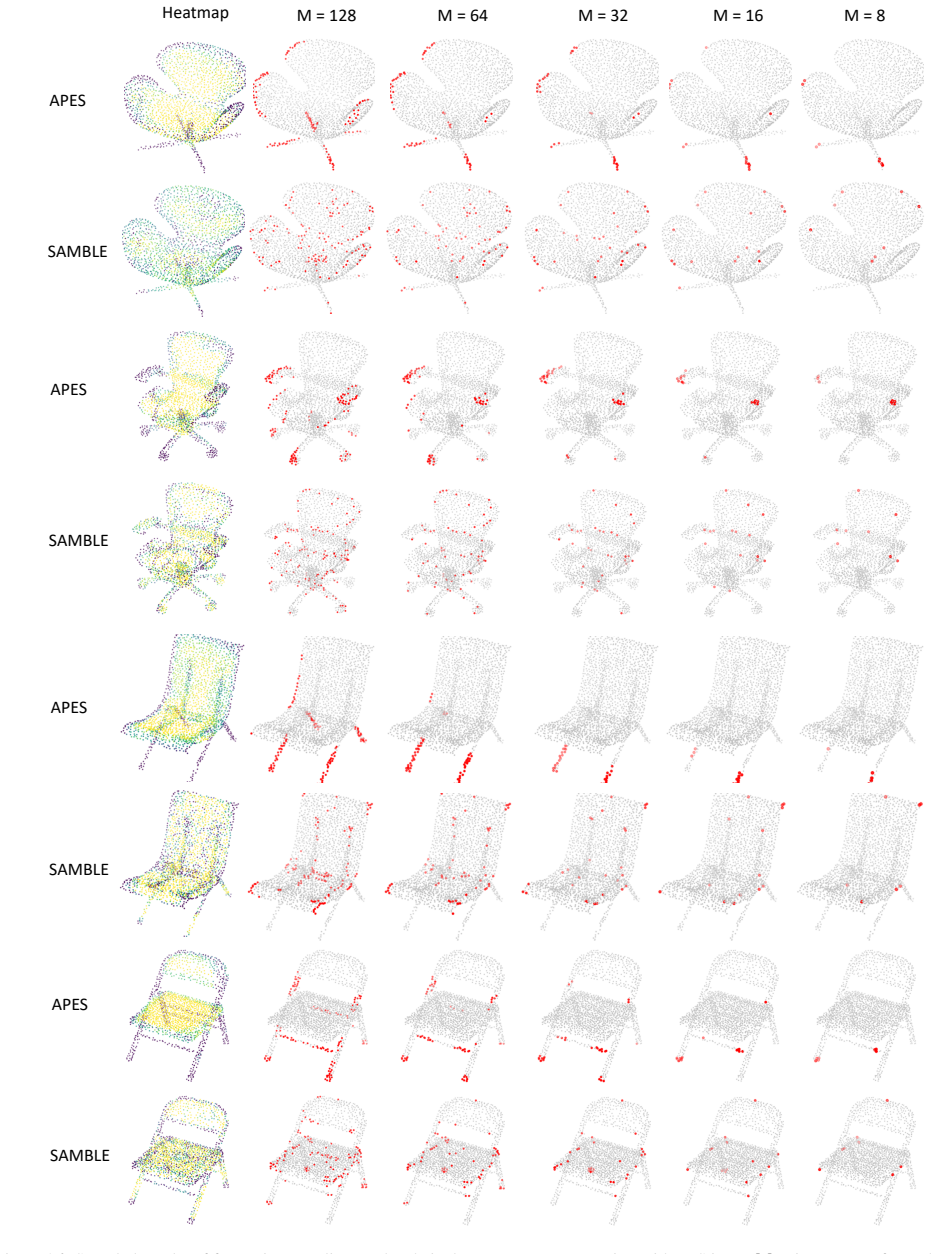
- [Fig. 5] The figure caption states scores are normalized to N(0.5,1) for visualization, but no colorbar or explicit scale is provided. Adding a colorbar and explaining what '1.0 (or higher)' means would improve interpretability.
- [Sec. 3.3, Eq. (5)] The temperature parameter tau is introduced in Eq. (5) for within-bin softmax sampling, and the supplementary extends it to global prior-based sampling in Eq. (10). The relationship between these two uses is clear but should be stated in the main text for completeness.
Circularity Check
The method's equations are self-contained, but the headline superiority is partly a test-set-selected configuration rather than an independent prediction.
-
fitted input called prediction
[Sec. 4.4 (Tables 5 and 6) and Supplementary Sec. 13 (Tables 11 and 12); final settings reused in Sec. 4.1-4.2 and Table 2]
"From it, we can observe that indexing modes vi and vii achieve best performances. ... In our case,n b = 6and4yield the best performance for the classification and segmentation tasks respectively, and we use it for the corresponding experiments. ... From it, we can see thatγ= 0.99yields the best performance. ... Numerical results are reported in Tab. 12, whereτ= 0.1achieves the best performance."
Tables 5, 6, 11, and 12 report accuracy/MIoU on the same ModelNet40 and ShapeNet-Part benchmarks used for the headline numbers in Table 2, and no held-out validation split is described. The paper then chooses the indexing mode, number of bins, momentum factor, and temperature that give the best values on those tables, and the main experiments reuse those configurations. The reported 'superior performance' is therefore the maximum over a benchmark hyperparameter search rather than an independent prediction for a fixed method; the headline result is partly a selection artifact, not a test of the sampling strategy alone.
full rationale
There is no equation-level circularity in the derivation chain: the kNN-asymmetry observation is an external geometric fact, the sparse attention map and all seven indexing modes are explicit functions of attention values and neighbor sets (Sec. 3.1-3.2), and bin boundaries and weights are learned from training data through Eqs. 3-5. APES is cited as the baseline architecture and as prior work, but the self-citation is not load-bearing: SAMBLE's components are defined independently and evaluated against external benchmarks. The one substantive circularity-type concern is evaluation: the final configuration was selected by ablating on the same benchmarks whose test numbers are then offered as evidence of 'superior performance', with no validation split, code, or seed variance reported. That makes the headline numbers partly selected rather than independently predicted, but it does not make the method's derivation self-referential. Score 4 reflects this partial selection burden, not a collapsed derivation.
Assumptions & free parameters
free parameters (5)
- kNN neighborhood size k =
not reported
- Number of bins n_b =
6 for classification, 4 for segmentation
- Momentum update factor gamma =
0.99
- Temperature tau =
0.1
- Indexing mode =
mode vii (sparse column square-divided)
assumptions (4)
- domain assumption The frequency with which a point is selected as a kNN neighbor reflects local geometric detail, with edge points selected less often.
- ad hoc to paper Pre-softmax attention values are a usable signal for bin sampling weights.
- domain assumption Bin boundaries learned from training score distributions generalize to test shapes.
- domain assumption The APES base network and training scheme constitute a valid testbed for comparing sampling methods.
invented entities (2)
-
Sparse Attention Map (SAM)
-
Bin tokens
Cite this review
Pith. "Pith review of SAMBLE: Shape-Specific Point Cloud Sampling for an Optimal Trade-Off Between Local Detail and Global Uniformity." pith.science (2026). https://pith.science/paper/HQAVIA62
@misc{pith2026250419581,
  author       = {Pith},
  title        = {Pith review of: SAMBLE: Shape-Specific Point Cloud Sampling for an Optimal Trade-Off Between Local Detail and Global Uniformity},
  year         = {2026},
  howpublished = {\url{https://pith.science/paper/HQAVIA62}},
  note         = {Machine review of arXiv:2504.19581}
}
read the original abstract
Driven by the increasing demand for accurate and efficient representation of 3D data in various domains, point cloud sampling has emerged as a pivotal research topic in 3D computer vision. Recently, learning-to-sample methods have garnered growing interest from the community, particularly for their ability to be jointly trained with downstream tasks. However, previous learning-based sampling methods either lead to unrecognizable sampling patterns by generating a new point cloud or biased sampled results by focusing excessively on sharp edge details. Moreover, they all overlook the natural variations in point distribution across different shapes, applying a similar sampling strategy to all point clouds. In this paper, we propose a Sparse Attention Map and Bin-based Learning method (termed SAMBLE) to learn shape-specific sampling strategies for point cloud shapes. SAMBLE effectively achieves an improved balance between sampling edge points for local details and preserving uniformity in the global shape, resulting in superior performance across multiple common point cloud downstream tasks, even in scenarios with few-point sampling.
Figures


Figures from the paper (21 more)





Reference graph
Works this paper leans on
-
[1]
Pyunghwan Ahn, Juyoung Yang, Eojindl Yi, Chanho Lee, and Junmo Kim. Projection-based point convolution for ef- ficient point cloud segmentation.IEEE Access, 10:15348– 15358, 2022. 2
work page 2022
-
[2]
Semantic segmentation of earth observation data using mul- timodal and multi-scale deep networks
Nicolas Audebert, Bertrand Le Saux, and S ´ebastien Lef`evre. Semantic segmentation of earth observation data using mul- timodal and multi-scale deep networks. InAsian Conference on Computer Vision, pages 180–196. Springer, 2016. 2
work page 2016
-
[3]
Alexandre Boulch, Bertrand Le Saux, and Nicolas Audebert. Unstructured point cloud semantic labeling using deep seg- mentation networks.3DOR@ Eurographics, 3, 2017. 2
work page 2017
-
[4]
Can Chen, Luca Zanotti Fragonara, and Antonios Tsourdos. GAPointNet: Graph attention based point neural network for exploiting local feature of point cloud.Neurocomputing, 438:122–132, 2021. 2
work page 2021
-
[5]
Silin Cheng, Xiwu Chen, Xinwei He, Zhe Liu, and Xiang Bai. PRA-Net: Point relation-aware network for 3d point cloud analysis.IEEE Transactions on Image Processing, 30: 4436–4448, 2021. 6
work page 2021
-
[6]
Alexey Dosovitskiy, Lucas Beyer, Alexander Kolesnikov, Dirk Weissenborn, Xiaohua Zhai, Thomas Unterthiner, Mostafa Dehghani, Matthias Minderer, Georg Heigold, Syl- vain Gelly, et al. An image is worth 16x16 words: Trans- formers for image recognition at scale.arXiv preprint arXiv:2010.11929, 2020. 5
arXiv 2010
-
[7]
Oren Dovrat, Itai Lang, and Shai Avidan. Learning to sam- ple. InProceedings of the IEEE/CVF Conference on Com- puter Vision and Pattern Recognition (CVPR), pages 2760– 2769, 2019. 1, 2, 6, 7, 8
work page 2019
-
[8]
Yuval Eldar, Michael Lindenbaum, Moshe Porat, and Yehoshua Y Zeevi. The farthest point strategy for progres- sive image sampling.IEEE Transactions on Image Process- ing, 6(9):1305–1315, 1997. 2, 8
work page 1997
Show all 73 references
-
[9]
Point transformer.IEEE Access, 9:134826–134840, 2021
Nico Engel, Vasileios Belagiannis, and Klaus Dietmayer. Point transformer.IEEE Access, 9:134826–134840, 2021. 3, 6
2021
-
[10]
Flex-convolution: Million-scale point-cloud learning be- yond grid-worlds
Fabian Groh, Patrick Wieschollek, and Hendrik PA Lensch. Flex-convolution: Million-scale point-cloud learning be- yond grid-worlds. InAsian Conference on Computer Vision (ACCV), pages 105–122. Springer, 2018. 2
2018
-
[11]
PCT: Point cloud transformer.Computational Visual Media, 7:187–199, 2021
Meng-Hao Guo, Jun-Xiong Cai, Zheng-Ning Liu, Tai-Jiang Mu, Ralph R Martin, and Shi-Min Hu. PCT: Point cloud transformer.Computational Visual Media, 7:187–199, 2021. 3, 6
2021
-
[12]
PointSift: A sift-like network module for 3d point cloud semantic segmentation.arXiv preprint arXiv:1807.00652, 2018
Mingyang Jiang, Yiran Wu, Tianqi Zhao, Zelin Zhao, and Cewu Lu. PointSift: A sift-like network module for 3d point cloud semantic segmentation.arXiv preprint arXiv:1807.00652, 2018. 2
2018 arXiv
-
[13]
Vilt: Vision- and-language transformer without convolution or region su- pervision
Wonjae Kim, Bokyung Son, and Ildoo Kim. Vilt: Vision- and-language transformer without convolution or region su- pervision. InInternational Conference on Machine Learn- ing, pages 5583–5594. PMLR, 2021. 5
2021
-
[14]
SampleNet: Dif- ferentiable point cloud sampling
Itai Lang, Asaf Manor, and Shai Avidan. SampleNet: Dif- ferentiable point cloud sampling. InProceedings of the IEEE/CVF Conference on Computer Vision and Pattern Recognition (CVPR), pages 7578–7588, 2020. 1, 2, 6, 8
2020
-
[15]
DPC: Unsupervised deep point correspondence via cross and self construction
Itai Lang, Dvir Ginzburg, Shai Avidan, and Dan Raviv. DPC: Unsupervised deep point correspondence via cross and self construction. In2021 International Conference on 3D Vision (3DV), pages 1442–1451. IEEE, 2021. 2
2021
-
[16]
Deep projective 3d semantic segmentation
Felix J ¨aremo Lawin, Martin Danelljan, Patrik Tosteberg, Goutam Bhat, Fahad Shahbaz Khan, and Michael Felsberg. Deep projective 3d semantic segmentation. InInternational Conference on Computer Analysis of Images and Patterns, pages 95–107. Springer, 2017. 2
2017
-
[17]
PointGrid: A deep network for 3d shape understanding
Truc Le and Ye Duan. PointGrid: A deep network for 3d shape understanding. InProceedings of the IEEE/CVF Conference on Computer Vision and Pattern Recognition (CVPR), pages 9204–9214, 2018. 2
2018
-
[18]
PointCNN: Convolution on x- transformed points.Advances in Neural Information Pro- cessing Systems (NeurIPS), 31, 2018
Yangyan Li, Rui Bu, Mingchao Sun, Wei Wu, Xinhan Di, and Baoquan Chen. PointCNN: Convolution on x- transformed points.Advances in Neural Information Pro- cessing Systems (NeurIPS), 31, 2018. 2
2018
-
[19]
Meta architecture for point cloud analysis
Haojia Lin, Xiawu Zheng, Lijiang Li, Fei Chao, Shanshan Wang, Yan Wang, Yonghong Tian, and Rongrong Ji. Meta architecture for point cloud analysis. InProceedings of the IEEE/CVF Conference on Computer Vision and Pattern Recognition (CVPR), pages 17682–17691, 2023. 2, 6
2023
-
[20]
FPConv: Learn- ing local flattening for point convolution
Yiqun Lin, Zizheng Yan, Haibin Huang, Dong Du, Ligang Liu, Shuguang Cui, and Xiaoguang Han. FPConv: Learn- ing local flattening for point convolution. InProceedings of the IEEE/CVF Conference on Computer Vision and Pattern Recognition (CVPR), pages 4293–4302, 2020. 2
2020
-
[21]
DA-Net: Density-adaptive down- sampling network for point cloud classification via end-to- end learning
Yanan Lin, Yan Huang, Shihao Zhou, Mengxi Jiang, Tian- long Wang, and Yunqi Lei. DA-Net: Density-adaptive down- sampling network for point cloud classification via end-to- end learning. In2021 4th International Conference on Pat- tern Recognition and Artificial Intelligence (P...
2021
-
[22]
Convolution in the cloud: Learning deformable kernels in 3d graph convolution networks for point cloud analysis
Zhi-Hao Lin, Sheng-Yu Huang, and Yu-Chiang Frank Wang. Convolution in the cloud: Learning deformable kernels in 3d graph convolution networks for point cloud analysis. InPro- ceedings of the IEEE/CVF Conference on Computer Vision and Pattern Recognition (CVPR), pages 1800–1809...
2020
-
[23]
Masked discrim- ination for self-supervised learning on point clouds
Haotian Liu, Mu Cai, and Yong Jae Lee. Masked discrim- ination for self-supervised learning on point clouds. InEu- ropean Conference on Computer Vision (ECCV), pages 657–
-
[24]
Relation-shape convolutional neural network for point cloud analysis
Yongcheng Liu, Bin Fan, Shiming Xiang, and Chunhong Pan. Relation-shape convolutional neural network for point cloud analysis. InProceedings of the IEEE/CVF Conference on Computer Vision and Pattern Recognition (CVPR), pages 8895–8904, 2019. 2
2019
-
[25]
V oxNet: A 3d con- volutional neural network for real-time object recognition
Daniel Maturana and Sebastian Scherer. V oxNet: A 3d con- volutional neural network for real-time object recognition. In2015 IEEE/RSJ International Conference on Intelligent Robots and Systems (IROS), pages 922–928. IEEE, 2015. 2
2015
-
[26]
Fast marching far- thest point sampling
Carsten Moenning and Neil A Dodgson. Fast marching far- thest point sampling. Technical report, University of Cam- bridge, Computer Laboratory, 2003. 2
2003
-
[27]
CurveNet: Curvature-based multitask learning deep networks for 3d object recognition.IEEE/CAA Journal of Automatica Sinica, 8(6):1177–1187, 2020
AAM Muzahid, Wanggen Wan, Ferdous Sohel, Lianyao Wu, and Li Hou. CurveNet: Curvature-based multitask learning deep networks for 3d object recognition.IEEE/CAA Journal of Automatica Sinica, 8(6):1177–1187, 2020. 6
2020
-
[28]
Adaptive hierarchical down-sampling for point cloud classification
Ehsan Nezhadarya, Ehsan Taghavi, Ryan Razani, Bingbing Liu, and Jun Luo. Adaptive hierarchical down-sampling for point cloud classification. InProceedings of the IEEE/CVF Conference on Computer Vision and Pattern Recognition (CVPR), pages 12956–12964, 2020. 2
2020
-
[29]
Masked autoencoders for point cloud self-supervised learning
Yatian Pang, Wenxiao Wang, Francis EH Tay, Wei Liu, Yonghong Tian, and Li Yuan. Masked autoencoders for point cloud self-supervised learning. InEuropean Conference on Computer Vision (ECCV), pages 604–621. Springer, 2022. 3
2022
-
[30]
PointNet: Deep learning on point sets for 3d classification and segmentation
Charles R Qi, Hao Su, Kaichun Mo, and Leonidas J Guibas. PointNet: Deep learning on point sets for 3d classification and segmentation. InProceedings of the IEEE/CVF Confer- ence on Computer Vision and Pattern Recognition (CVPR), pages 652–660, 2017. 2, 6, 7
2017
-
[31]
PointNet++: Deep hierarchical feature learning on point sets in a metric space.Advances in Neural Information Processing Systems (NeurIPS), 30, 2017
Charles Ruizhongtai Qi, Li Yi, Hao Su, and Leonidas J Guibas. PointNet++: Deep hierarchical feature learning on point sets in a metric space.Advances in Neural Information Processing Systems (NeurIPS), 30, 2017. 2, 6, 8
2017
-
[32]
P2B: Point-to-box network for 3d object tracking in point clouds
Haozhe Qi, Chen Feng, Zhiguo Cao, Feng Zhao, and Yang Xiao. P2B: Point-to-box network for 3d object tracking in point clouds. InProceedings of the IEEE/CVF Conference on Computer Vision and Pattern Recognition (CVPR), pages 6329–6338, 2020. 2
2020
-
[33]
PointNext: Revisiting pointnet++ with improved training and scaling strategies.Advances in Neural Informa- tion Processing Systems (NeurIPS), 35:23192–23204, 2022
Guocheng Qian, Yuchen Li, Houwen Peng, Jinjie Mai, Hasan Hammoud, Mohamed Elhoseiny, and Bernard Ghanem. PointNext: Revisiting pointnet++ with improved training and scaling strategies.Advances in Neural Informa- tion Processing Systems (NeurIPS), 35:23192–23204, 2022. 2, 6, 7, 8
2022
-
[34]
MOPS-Net: A matrix optimization-driven network fortask-oriented 3d point cloud downsampling.ArXiv, abs/2005.00383, 2020
Yu Qian, Junhui Hou, Yiming Zeng, Qijian Zhang, Sam Tak Wu Kwong, and Ying He. MOPS-Net: A matrix optimization-driven network fortask-oriented 3d point cloud downsampling.ArXiv, abs/2005.00383, 2020. 1, 2, 8
2005 arXiv
-
[35]
Mask3d: Mask trans- former for 3d semantic instance segmentation
Jonas Schult, Francis Engelmann, Alexander Hermans, Or Litany, Siyu Tang, and Bastian Leibe. Mask3d: Mask trans- former for 3d semantic instance segmentation. In2023 IEEE International Conference on Robotics and Automation (ICRA), pages 8216–8223. IEEE, 2023. 5
2023
-
[36]
Dynamic edge- conditioned filters in convolutional neural networks on graphs
Martin Simonovsky and Nikos Komodakis. Dynamic edge- conditioned filters in convolutional neural networks on graphs. InProceedings of the IEEE/CVF Conference on Computer Vision and Pattern Recognition (CVPR), pages 3693–3702, 2017. 2
2017
-
[37]
Tangent convolutions for dense prediction in 3d
Maxim Tatarchenko, Jaesik Park, Vladlen Koltun, and Qian- Yi Zhou. Tangent convolutions for dense prediction in 3d. InProceedings of the IEEE/CVF Conference on Computer Vision and Pattern Recognition (CVPR), pages 3887–3896,
-
[38]
KPConv: Flexible and deformable convolution for point clouds
Hugues Thomas, Charles R Qi, Jean-Emmanuel Deschaud, Beatriz Marcotegui, Franc ¸ois Goulette, and Leonidas J Guibas. KPConv: Flexible and deformable convolution for point clouds. InProceedings of the IEEE/CVF International Conference on Computer Vision (ICCV), pages 6411–6420,
-
[39]
Attention is all you need.Advances in Neural Information Processing Systems (NeurIPS), 30, 2017
Ashish Vaswani, Noam Shazeer, Niki Parmar, Jakob Uszko- reit, Llion Jones, Aidan N Gomez, Łukasz Kaiser, and Illia Polosukhin. Attention is all you need.Advances in Neural Information Processing Systems (NeurIPS), 30, 2017. 3
2017
-
[40]
PST-Net: Point cloud sampling via point-based trans- former
Xu Wang, Yi Jin, Yigang Cen, Congyan Lang, and Yidong Li. PST-Net: Point cloud sampling via point-based trans- former. In11th International Conference on Image and Graphics (ICIG), pages 57–69. Springer, 2021. 2, 8
2021
-
[41]
LighTN: Light-weight transformer network for performance-overhead tradeoff in point cloud downsam- pling.IEEE Transactions on Multimedia, 2023
Xu Wang, Yi Jin, Yigang Cen, Tao Wang, Bowen Tang, and Yidong Li. LighTN: Light-weight transformer network for performance-overhead tradeoff in point cloud downsam- pling.IEEE Transactions on Multimedia, 2023. 2, 7, 8
2023
-
[42]
Dynamic graph CNN for learning on point clouds.ACM Transactions on Graphics (TOG), 38(5):1–12, 2019
Yue Wang, Yongbin Sun, Ziwei Liu, Sanjay E Sarma, Michael M Bronstein, and Justin M Solomon. Dynamic graph CNN for learning on point clouds.ACM Transactions on Graphics (TOG), 38(5):1–12, 2019. 2, 6
2019
-
[43]
Learnable skeleton-aware 3d point cloud sampling
Cheng Wen, Baosheng Yu, and Dacheng Tao. Learnable skeleton-aware 3d point cloud sampling. InProceedings of the IEEE/CVF Conference on Computer Vision and Pattern Recognition (CVPR), pages 17671–17681, 2023. 3
2023
-
[44]
DeltaConv: anisotropic operators for ge- ometric deep learning on point clouds.ACM Transactions on Graphics (TOG), 41(4):1–10, 2022
Ruben Wiersma, Ahmad Nasikun, Elmar Eisemann, and Klaus Hildebrandt. DeltaConv: anisotropic operators for ge- ometric deep learning on point clouds.ACM Transactions on Graphics (TOG), 41(4):1–10, 2022. 6
2022
-
[45]
Sim2real trans- fer learning for point cloud segmentation: An industrial ap- plication case on autonomous disassembly
Chengzhi Wu, Xuelei Bi, Julius Pfrommer, Alexander Ce- bulla, Simon Mangold, and J ¨urgen Beyerer. Sim2real trans- fer learning for point cloud segmentation: An industrial ap- plication case on autonomous disassembly. InProceedings of the IEEE/CVF Winter Conference on Applicat...
2023
-
[46]
Attention-based point cloud edge sampling
Chengzhi Wu, Junwei Zheng, Julius Pfrommer, and J ¨urgen Beyerer. Attention-based point cloud edge sampling. InPro- ceedings of the IEEE/CVF Conference on Computer Vision and Pattern Recognition (CVPR), pages 5333–5343, 2023. 1, 2, 6, 7, 8
2023
-
[47]
A cross branch fusion-based contrastive learning framework for point cloud self-supervised learning
Chengzhi Wu, Qianliang Huang, Kun Jin, Julius Pfrommer, and J¨urgen Beyerer. A cross branch fusion-based contrastive learning framework for point cloud self-supervised learning. In2024 International Conference on 3D Vision (3DV), pages 528–538. IEEE, 2024. 3
2024
-
[48]
Rethinking attention module design for point cloud analysis
Chengzhi Wu, Kaige Wang, Zeyun Zhong, Hao Fu, Junwei Zheng, Jiaming Zhang, Julius Pfrommer, and J ¨urgen Bey- erer. Rethinking attention module design for point cloud analysis. InInternational Conference on Pattern Recogni- tion (ICPR), 2024. 3
2024
-
[49]
PointConv: Deep convolutional networks on 3d point clouds
Wenxuan Wu, Zhongang Qi, and Li Fuxin. PointConv: Deep convolutional networks on 3d point clouds. InProceedings of the IEEE/CVF Conference on Computer Vision and Pat- tern Recognition (CVPR), pages 9621–9630, 2019. 2, 6
2019
-
[50]
PointConvFormer: Revenge of the point-based convolution
Wenxuan Wu, Li Fuxin, and Qi Shan. PointConvFormer: Revenge of the point-based convolution. InProceedings of the IEEE/CVF Conference on Computer Vision and Pattern Recognition (CVPR), pages 21802–21813, 2023. 2
2023
-
[51]
Point transformer v2: Grouped vector atten- tion and partition-based pooling.Advances in Neural In- formation Processing Systems (NeurIPS), 35:33330–33342,
Xiaoyang Wu, Yixing Lao, Li Jiang, Xihui Liu, and Heng- shuang Zhao. Point transformer v2: Grouped vector atten- tion and partition-based pooling.Advances in Neural In- formation Processing Systems (NeurIPS), 35:33330–33342,
-
[52]
Point transformer v3: Simpler faster stronger
Xiaoyang Wu, Li Jiang, Peng-Shuai Wang, Zhijian Liu, Xi- hui Liu, Yu Qiao, Wanli Ouyang, Tong He, and Hengshuang Zhao. Point transformer v3: Simpler faster stronger. InPro- ceedings of the IEEE/CVF Conference on Computer Vision and Pattern Recognition (CVPR), pages 4840–4851, 2024. 3
2024
-
[53]
3D ShapeNets: A deep representation for volumetric shapes
Zhirong Wu, Shuran Song, Aditya Khosla, Fisher Yu, Lin- guang Zhang, Xiaoou Tang, and Jianxiong Xiao. 3D ShapeNets: A deep representation for volumetric shapes. InProceedings of the IEEE/CVF Conference on Computer Vision and Pattern Recognition (CVPR), pages 1912–1920,
1912
-
[54]
Grid-GCN for fast and scalable point cloud learning
Qiangeng Xu, Xudong Sun, Cho-Ying Wu, Panqu Wang, and Ulrich Neumann. Grid-GCN for fast and scalable point cloud learning. InProceedings of the IEEE/CVF Conference on Computer Vision and Pattern Recognition (CVPR), pages 5661–5670, 2020. 2
2020
-
[55]
SpiderCNN: Deep learning on point sets with parameterized convolutional filters
Yifan Xu, Tianqi Fan, Mingye Xu, Long Zeng, and Yu Qiao. SpiderCNN: Deep learning on point sets with parameterized convolutional filters. InProceedings of the European Con- ference on Computer Vision (ECCV), pages 87–102, 2018. 6
2018
-
[56]
A scalable active framework for region annotation in 3d shape collections.ACM Transactions on Graphics (TOG), 35(6):1–12, 2016
Li Yi, Vladimir G Kim, Duygu Ceylan, I-Chao Shen, Mengyan Yan, Hao Su, Cewu Lu, Qixing Huang, Alla Shef- fer, and Leonidas Guibas. A scalable active framework for region annotation in 3d shape collections.ACM Transactions on Graphics (TOG), 35(6):1–12, 2016. 7
2016
-
[57]
Point-BERT: Pre-training 3d point cloud transformers with masked point modeling
Xumin Yu, Lulu Tang, Yongming Rao, Tiejun Huang, Jie Zhou, and Jiwen Lu. Point-BERT: Pre-training 3d point cloud transformers with masked point modeling. InProceed- ings of the IEEE/CVF Conference on Computer Vision and Pattern Recognition (CVPR), pages 19313–19322, 2022. 3
2022
-
[58]
Linked dynamic graph cnn: Learning through point cloud by linking hierarchical features
Kuangen Zhang, Ming Hao, Jing Wang, Xinxing Chen, Yuquan Leng, Clarence W de Silva, and Chenglong Fu. Linked dynamic graph cnn: Learning through point cloud by linking hierarchical features. In2021 27th International Conference on Mechatronics and Machine Vision in Practice (M...
2021
-
[59]
Point- M2AE: multi-scale masked autoencoders for hierarchical point cloud pre-training.Advances in Neural Information Processing Systems (NeurIPS), 35:27061–27074, 2022
Renrui Zhang, Ziyu Guo, Peng Gao, Rongyao Fang, Bin Zhao, Dong Wang, Yu Qiao, and Hongsheng Li. Point- M2AE: multi-scale masked autoencoders for hierarchical point cloud pre-training.Advances in Neural Information Processing Systems (NeurIPS), 35:27061–27074, 2022. 3
2022
-
[60]
Point transformer
Hengshuang Zhao, Li Jiang, Jiaya Jia, Philip HS Torr, and Vladlen Koltun. Point transformer. InProceedings of the IEEE/CVF International Conference on Computer Vision (ICCV), pages 16259–16268, 2021. 2, 3, 6, 8
2021
-
[61]
V oxelNet: End-to-end learning for point cloud based 3d object detection
Yin Zhou and Oncel Tuzel. V oxelNet: End-to-end learning for point cloud based 3d object detection. InProceedings of the IEEE/CVF Conference on Computer Vision and Pattern Recognition (CVPR), pages 4490–4499, 2018. 2
2018
-
[62]
Point cloud registration network based on convolution fusion and attention mechanism.Neural Processing Letters, pages 1–21, 2023
Wei Zhu, Yue Ying, Jin Zhang, Xiuli Wang, and Yayu Zheng. Point cloud registration network based on convolution fusion and attention mechanism.Neural Processing Letters, pages 1–21, 2023. 2 SAMBLE: Shape-Specific Point Cloud Sampling for an Optimal Trade-Off Between Local Deta...
2023
-
[63]
In the main paper, we used global in- formation as the basis and introduced carve-based SAM
Carve-based SAM and Insert-based SAM Based on different information basis, we propose two dif- ferent sparse attention maps (SAM), carve-based SAM and insert-based SAM. In the main paper, we used global in- formation as the basis and introduced carve-based SAM. Using local inf...
-
[64]
Determining Number of Sampled Points for Each Bin For each shape, by considering the number of points con- tained within binsβ= (β 1,β 2,...,β nb )alongside the de- termined bin sampling weightsω= (ω 1,ω 2,...,ω nb ), the specific numbers of points to be sampled from each bin ...
-
[65]
We further provide the full version of the histogram, in which the number of points and the sampling ratio in each bin are given
Relationship between Bin Sampling Weights and Bin Sampling Ratios For the sake of brevity and improved visual clarity, in the paper, the axis labels of the histograms have been omit- ted. We further provide the full version of the histogram, in which the number of points and t...
-
[66]
Network Architecture For a fair comparison, the same basic network architectures from APES are used in our experiments, as illustrated in Fig. 14. The downsampling layers are replaced with our proposed ones, and the upsampling layers are replaced with the classical interpolati...
-
[67]
The learning rate starts from1×10 −4 and decays to1×10 −8 with a cosine annealing schedule
More Training Details Classification Tasks.AdamW is used as the optimizer. The learning rate starts from1×10 −4 and decays to1×10 −8 with a cosine annealing schedule. The weight decay hyper- parameter for network weights is set as1. Dropout with a probability of0.5is used in t...
-
[68]
13 and Fig
Sampling Results in Comparison with APES Additional qualitative results in comparison with APES are provided in Fig. 13 and Fig. 15. Both figures indicate that APES focuses excessively on edge points, while SAMBLE successfully achieves a much better trade-off between sam- plin...
-
[69]
Adding Bin Tokens to Q or K/V?A critical point in the idea of bin tokens lies in determining the specific branches to which the tokens should be concatenated
Design Justifications of the Bin Token Idea - Devil Is in the Details. Adding Bin Tokens to Q or K/V?A critical point in the idea of bin tokens lies in determining the specific branches to which the tokens should be concatenated. In order to match the tensor dimension for late...
-
[70]
In our case, we aim to derive the bin boundary valuesνfrom the entirety of shapes within the training dataset
Additional Ablation Studies Momentum Update Factor.The momentum update strat- egy is widely used within contrastive learning frameworks in self-supervised learning. In our case, we aim to derive the bin boundary valuesνfrom the entirety of shapes within the training dataset. T...
-
[71]
21, including Top-M sampling, prior-based sampling, and bin- based sampling
Sampling Policy Comparison Three different sampling policies are illustrated in Fig. 21, including Top-M sampling, prior-based sampling, and bin- based sampling. The Top-M sampling policy is the simplest one and it samples the points with larger sampling scores directly. The p...
-
[72]
Model Complexity and Runtime Efficiency To evaluate SAMBLE’s efficiency, we assess its model complexity in comparison with APES and report the results in Tab. 13. Results from the traditional FPS and SAM- BLE’s variations are also reported. For a more direct and detailed compa...
-
[73]
More Visualization Results Learned Shape-Specific Sampling Strategies.We present additional extensive results in Fig. 22, Fig. 23, Fig. 24, and Fig. 25 with various categories. From them, we can observe that shape edge points are mostly partitioned into the first two bins. Fur...
Reviewed August 16, 2026 · model on record in the stance chip above.
Discussion (0). Continue with ORCID to comment.