Exponential Observation Error in Boundary Region
Pith reviewed 2026-05-25 09:40 UTC · model grok-4.3
The pith
For parabolic distributed parameter systems, exponential observation in the boundary region reduces state reconstruction error.
A machine-rendered reading of the paper's core claim, the machinery that carries it, and where it could break.
Core claim
For distributed parameter systems of parabolic type, the error of state reconstruction can be diminished by exponential observation in the boundary region.
What carries the argument
Exponential observation performed in the boundary region, which produces exponential decay of the reconstruction error.
If this is right
- The reconstruction error decays exponentially rather than at a slower rate.
- State estimation becomes more reliable for parabolic PDE systems.
- Boundary observation is sufficient for this exponential improvement.
Where Pith is reading between the lines
- This could extend to designing observers for other boundary-controlled systems.
- Applications might include improving feedback control in engineering systems modeled by parabolic equations.
Load-bearing premise
The systems are of parabolic type and boundary region observation enables exponential decay of the reconstruction error.
What would settle it
A numerical simulation of the heat equation with boundary observation showing whether the state error decays exponentially or not.
Figures
read the original abstract
In this paper the (exponential) perception blunder idea on account of limit locale has been discussed and broke down. For disseminated parameter frameworks of explanatory sort, we demonstrate that, the blunder of state reproduction can be diminishes by exponentially perception.
Editorial analysis
A structured set of objections, weighed in public.
Referee Report
Summary. The manuscript asserts that for distributed-parameter systems of parabolic type, boundary-region observation yields exponential decay of the state-reconstruction error. The abstract (and apparently the full text) supplies neither the precise PDE class, boundary conditions, observer equations, nor any derivation or citation establishing the required observability inequality.
Significance. If a rigorous proof of uniform exponential decay were supplied via a verifiable observability inequality for boundary observations on parabolic systems, the result would be of interest to the infinite-dimensional control community. As written, however, the claim is an unsupported assertion rather than a demonstrated theorem.
major comments (2)
- [Abstract] Abstract (and entire manuscript): the central claim that 'the blunder of state reproduction can be diminishes by exponentially perception' is stated without any system equations, observer gain, observability inequality, or proof. This is load-bearing because the paper's sole contribution is the asserted demonstration of exponential decay.
- No section or equation: the required observability inequality (or spectral condition) that would produce a uniform exponential rate for the error system is neither stated nor proved, contrary to standard requirements in parabolic observer theory.
minor comments (1)
- [Abstract] Abstract contains multiple spelling and grammatical errors that obscure meaning (e.g., 'perception blunder' for 'observation error', 'limit locale' for 'boundary region', 'disseminated parameter frameworks of explanatory sort' for 'distributed parameter systems of parabolic type').
Simulated Author's Rebuttal
We thank the referee for the thorough review and for highlighting the need for explicit technical details. We agree that the submitted manuscript is missing the required system description, observer equations, and observability analysis, and we will revise it to supply these elements.
read point-by-point responses
-
Referee: [Abstract] Abstract (and entire manuscript): the central claim that 'the blunder of state reproduction can be diminishes by exponentially perception' is stated without any system equations, observer gain, observability inequality, or proof. This is load-bearing because the paper's sole contribution is the asserted demonstration of exponential decay.
Authors: We concur that the current abstract and manuscript text do not contain the parabolic PDE class, boundary conditions, observer equations, or the supporting observability inequality. This omission weakens the presentation of the claimed result. In the revised manuscript we will replace the existing abstract with a precise statement of the system and will add the full derivation of the boundary observability inequality that yields the uniform exponential decay rate for the error system. revision: yes
-
Referee: [—] No section or equation: the required observability inequality (or spectral condition) that would produce a uniform exponential rate for the error system is neither stated nor proved, contrary to standard requirements in parabolic observer theory.
Authors: The referee correctly notes the absence of any stated or proved observability inequality. We will insert a new section that formulates the parabolic system with boundary-region observation, constructs the observer, and derives the observability inequality (via standard Carleman-estimate or spectral methods for parabolic operators) that guarantees the exponential convergence of the reconstruction error. revision: yes
Circularity Check
No derivation chain present; claim asserted without equations or proof
full rationale
The provided manuscript consists solely of a brief, grammatically flawed abstract asserting that exponential observation diminishes state reconstruction error for parabolic distributed-parameter systems under boundary-region observation. No equations, observer construction, observability inequality, spectral analysis, or derivation steps appear anywhere in the text. Because no derivation chain exists to inspect, none of the enumerated circularity patterns (self-definitional, fitted-input prediction, self-citation load-bearing, etc.) can be exhibited by quoting paper content. The central claim is therefore not shown to reduce to its own inputs by construction; it is simply declared.
Axiom & Free-Parameter Ledger
Reference graph
Works this paper leans on
-
[1]
Thought of provincial discernibleness (r eached out by El Jai et al
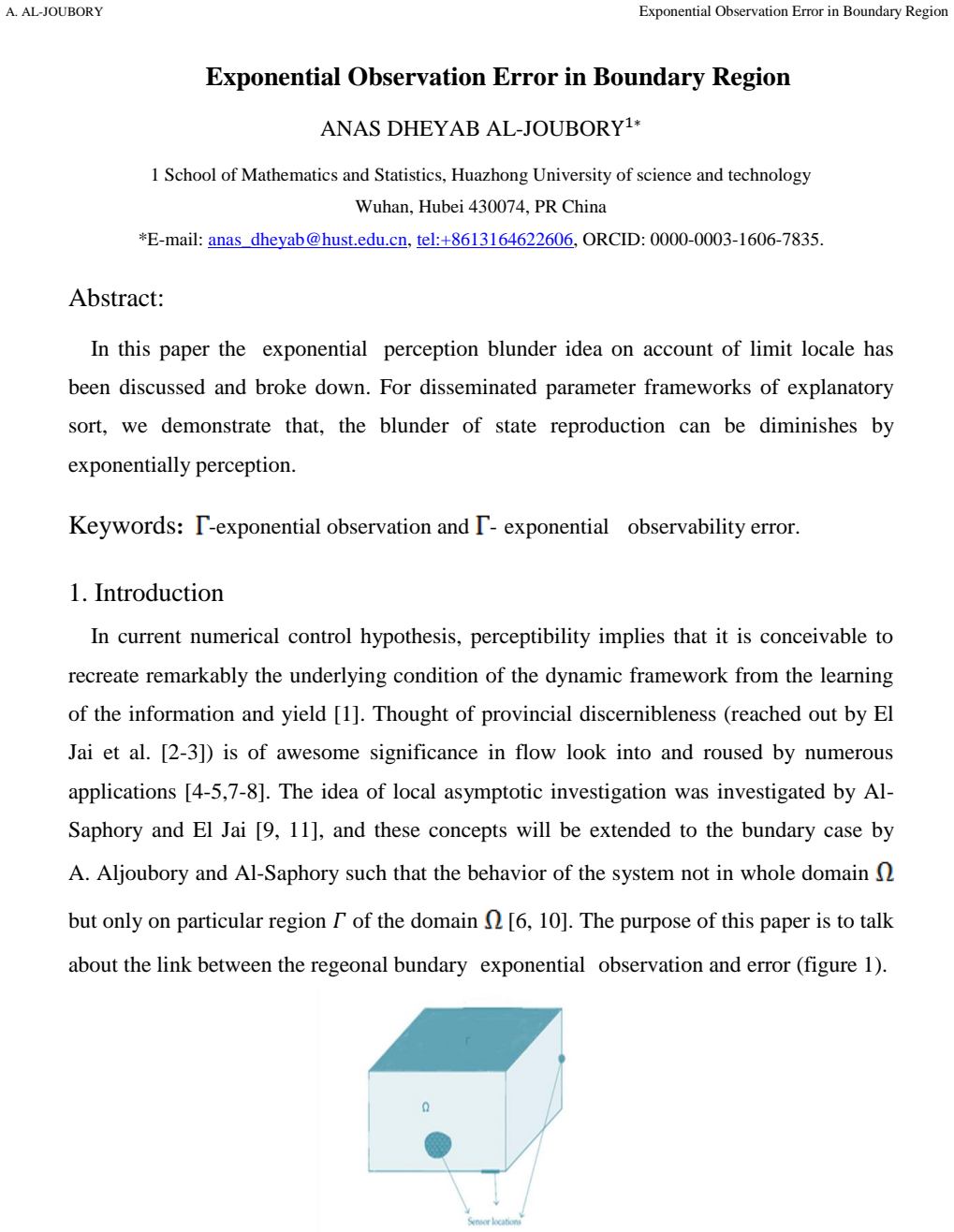
Introduction In current numerical control hypothesis, perceptibility implies that it is conceivable to recreate remarkably the underlying condition of the dynamic framework from the learning of the information and yield [1]. Thought of provincial discernibleness (r eached out by El Jai et al. [2 -3]) is of awesome significance in flow look into and roused...
-
[2]
Regional boundary (exponential) observation In this segment we give initially, the announcement of the issue with the speculation of consdered system, and afterward the idea of provincial limit (exponential) perceptibility is clarified, and we give a hypothesis which gives the approach watched the present state 𝑧(𝜇, 𝑡)of the original system (1) (exponenti...
-
[3]
Regional boundary (exponentially observation error The general observation problem in deciding whether the knowledge of the output together with the system dynamics makes the state reconstruction possible. When the system is (exponentially observable, the state reconstruction leads necessarily to an (exponentially reconstruction error, also called the (ex...
-
[4]
Conclusion The ideas created in this paper is identified with the (exponentially) (perception) error in limit locale. By presenting the thought of ((exponential) recognizability, we demonstrated a natural outcome which stipulates that the (exponentially perception mistake in limit locale is lower than in the entire space. Many inquiries still opened. This...
-
[5]
A. ElJai and A.J. Pritchard, Sensors and ac tuators in distributed systems, International Journal of Control, vol.46, no.4, pp. 1139–1153, 1987
work page 1987
-
[6]
A. ElJai and H.Hamzoui, Regional observation and sensors, International Journal of Applied Mathematics and Computer Science, vol. 19, no. 1, pp. 5 –14, 2009
work page 2009
-
[7]
A. ElJai, M.C.Simon, and E.Zerrik, Regional observability and sensor structures, Sensors and Actuators A, vol. 39, no. 2, pp. 95–102, 1993
work page 1993
-
[8]
ElJai, M.C.Simon, E.Zerrik, and M
A. ElJai, M.C.Simon, E.Zerrik, and M. Amouroux, Regional observability of a thermal process, IEEE Transactions on Automatic Control, vol.40, no.3, pp.518–521, 1995
work page 1995
-
[9]
A. ElJai, Guisset, E. Trombe, and A. Suleiman, Application of boundary observation to a thermal systems. Confernce of MTNS 2000, Perpgnan, France, June 19-23, 2000
work page 2000
-
[10]
State Reconstruction in Sobolev Space
A. Al -Joubory and N. Al -Shareef, "State Reconstruction in Sobolev Space " Journal of Al-qadisya for Pure Sciences , Alqadisya University, Iraq, pp. 1-9 no.154/ 2, 2016
work page 2016
-
[11]
Y.Quan, and A. Moore, Diffusion boundary det rmination and zon e control via ,mobile actuators&sensors networks (MAS -net)-challenge and opportunities, SCOIS, Utah state universty, Logan, UT84322, USA, 2004. A. AL-JOUBORY Exponential Observation Error in Boundary Region 11
work page 2004
-
[12]
J.Burns, J.Jorggaard, M.Cliff, and L. Zeietman, A PDE approach to opt mization and control of high performance buildings, workshop Numerical Techniques for Opt mization Problems with PDE Constraints, No. 04/2009, DOI: 10.4171/OWR/2009/04, 25-31 January, Houston, Denmark, 2009
-
[13]
Sensor structur s and regional (exponential) observability,
R.Al -Saphoory, “Sensor structur s and regional (exponential) observability,”International Scholarly Resear ch NetworkISRN Applied Mathemat cs, Volume 2011, Article ID 673052, doi:10.5402/2011/673052,14 pages,2011
-
[14]
Strategic sensors and regional boundary (exponential) observation
R.Al-Saphoory and A.Al-Joubory, "Strategic sensors and regional boundary (exponential) observation", Seventh Scientific Conference of Women Education College, Tikrit University, Iraq, 9-11 April, 2013
work page 2013
-
[15]
R.Al-Saphoory and A.El Jai, Sensor structures and regional detecta bility of parabolic distributes systems, Sensors and Actuators A, vol. 90, no. 3, pp. 163–171, 2001
work page 2001
-
[16]
R.Al-Saphory and A.El Jai,, Sensors characterzations for reg onal bundary det ctability in distributed parameter systems, Sensrs & Actutors A, vol.94, no.1-2, pp.1–10,2001
work page 2001
-
[17]
strategic Sensrs and reg onal (exponntial) obsrvability,
R. Al-Saphory, “strategic Sensrs and reg onal (exponntial) obsrvability,” Interntional Schlarly Research Network, vol. 2011, Article ID.673052, 2011
work page 2011
-
[18]
E.Zerrik, L.Badraui, and A.El Jai , sensors and r egional boun dary state reconstruction of parabolic systems, Sensors & Actuators A, vol.75, no.7, pp.102-117, 1999
work page 1999
-
[19]
E .Zerik, H.Bouray, and A.Bout ulout, Regional boundary observability: a numerical approach, International Journal of Ap lied Mathematics & Computer Sc ence, vol.12, no.2, pp.143–151, 2002
work page 2002
discussion (0)
Sign in with ORCID, Apple, or X to comment. Anyone can read and Pith papers without signing in.