The Quiet-Sun DEM Under Kappa: Diagnostic Degeneracy and the Failure of the Conductive Closure
Pith reviewed 2026-06-26 19:31 UTC · model grok-4.3
The pith
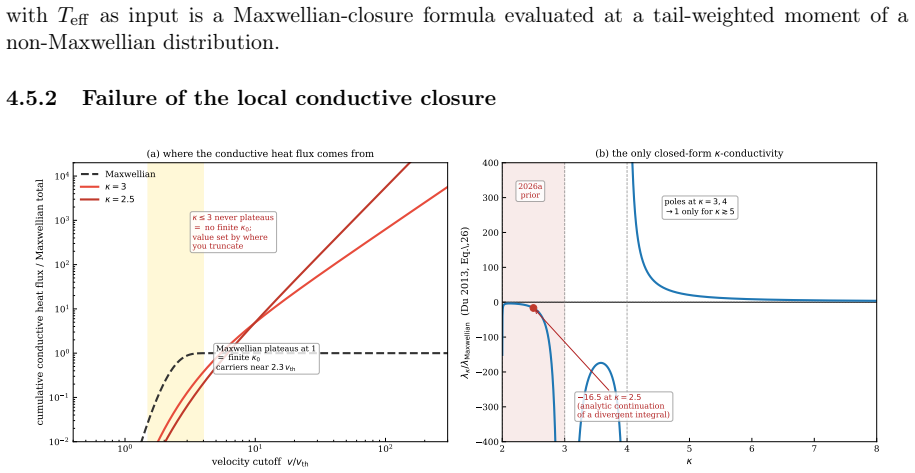
For kappa approximately 2.5 the Spitzer-Harm conductive closure fails to exist because its defining integral diverges.
A machine-rendered reading of the paper's core claim, the machinery that carries it, and where it could break.
Core claim
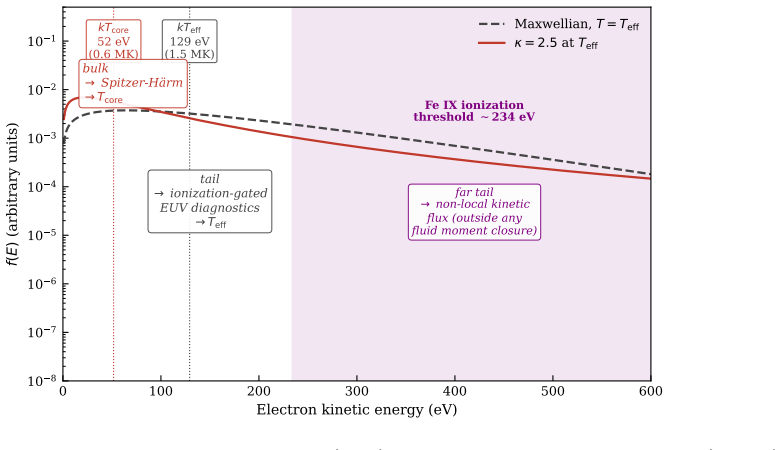
For a plasma whose electrons carry a kappa approximately 2.5 suprathermal tail the conductive flux is the tail-carried third velocity moment and the local conductivity integral diverges across the entire kappa interval from 2 to 3. The finite value returned by the closed-form kappa-conductivity expression at kappa equals 2.5 is an analytic continuation of a divergent integral and therefore not a physical conductivity. When this premise is applied to the quiet solar corona the standard EUV-DEM diagnostic cannot resolve the plasma and the conductive term of the energy budget has no valid form.
What carries the argument
The divergence of the conductivity integral for the third velocity moment in kappa distributions across the interval 2 to 3, which eliminates any finite Fourier-law closure.
If this is right
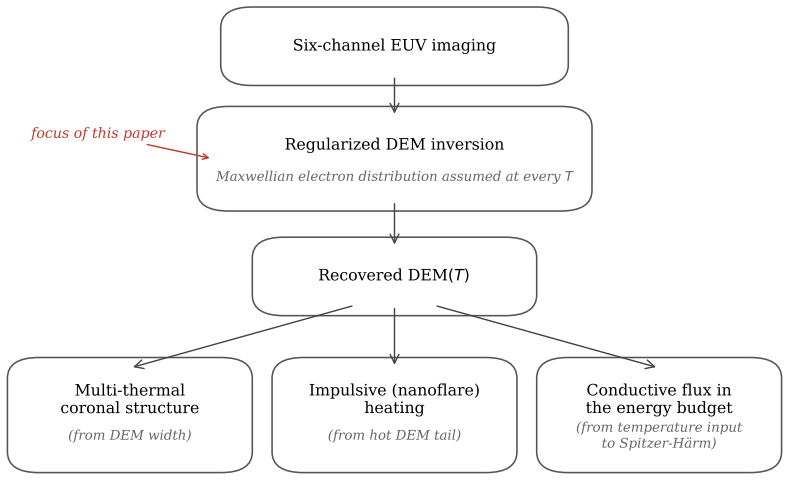
- The DEM inversion pipeline returns log T widths inside the same FWHM distribution for kappa equals 2.5 probes and for Maxwellian sources.
- Ionization-gated diagnostics return the tail-weighted effective temperature while any conduction term would be evaluated at the lower core temperature.
- The conductive term in the energy budget lacks a convergent form so the budget question moves to non-local kinetic transport.
- DEM-width multi-thermality and the conductive-budget gap lose their structural assumptions as pillars for impulsive heating.
Where Pith is reading between the lines
- Quiet-Sun heating calculations may need to move to full kinetic treatments rather than any fluid closure.
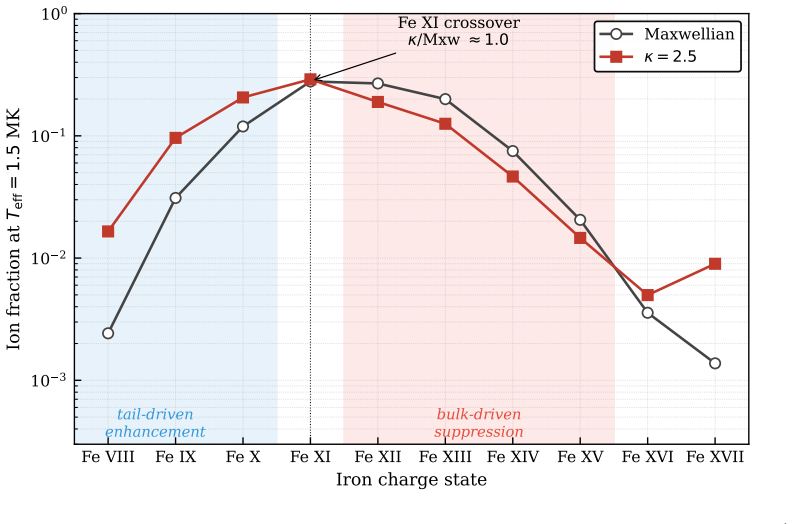
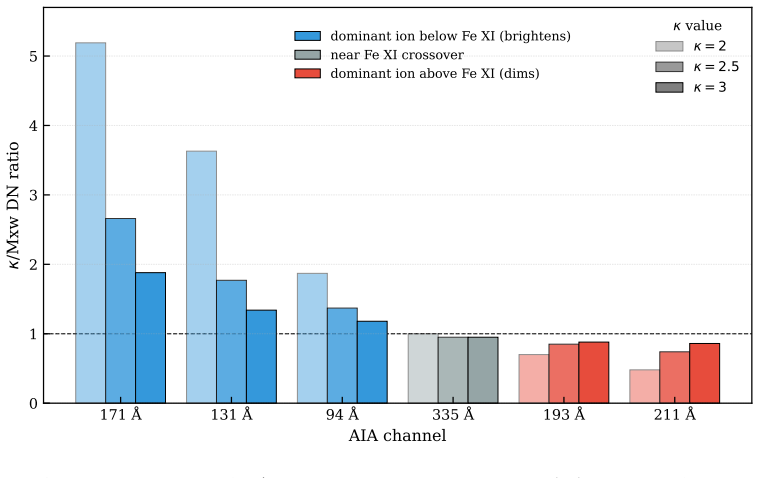
- The reported Fe XI charge-state crossover and EUV continuum reversal could be searched for as independent observational tests of the kappa premise.
- The same integral divergence may affect other transport coefficients derived from higher velocity moments in any kappa plasma near 2.5.
Load-bearing premise
The quiet solar corona maintains a kappa distribution with index near 2.5 throughout.
What would settle it
A direct measurement of the electron velocity distribution function in the quiet corona that determines whether the third-moment conductivity integral converges or diverges at the observed kappa value.
Figures
read the original abstract
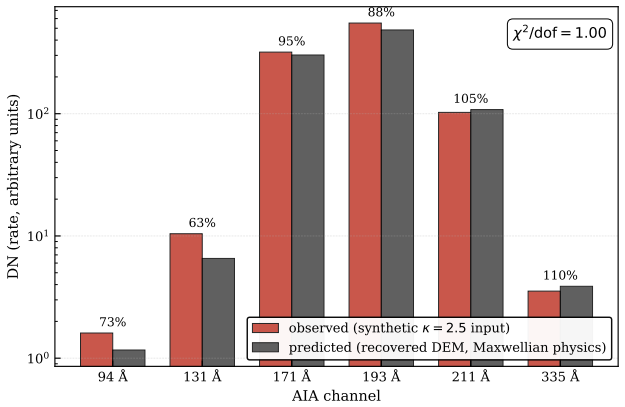
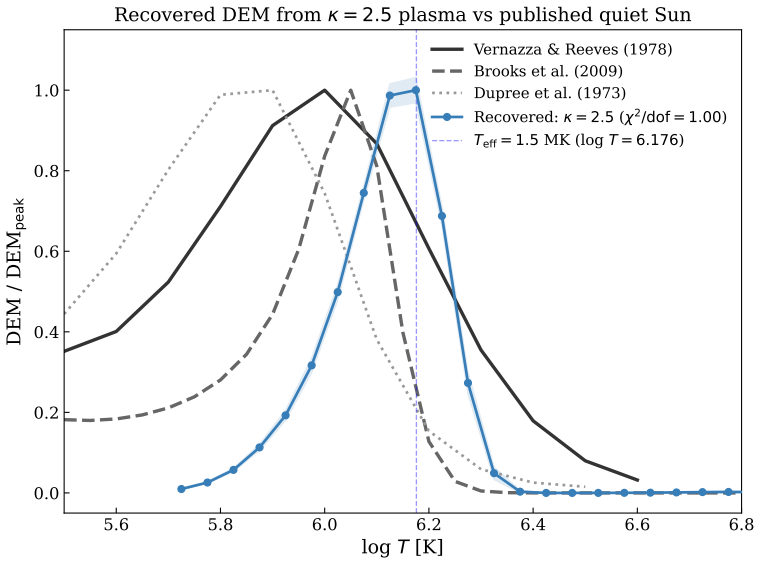
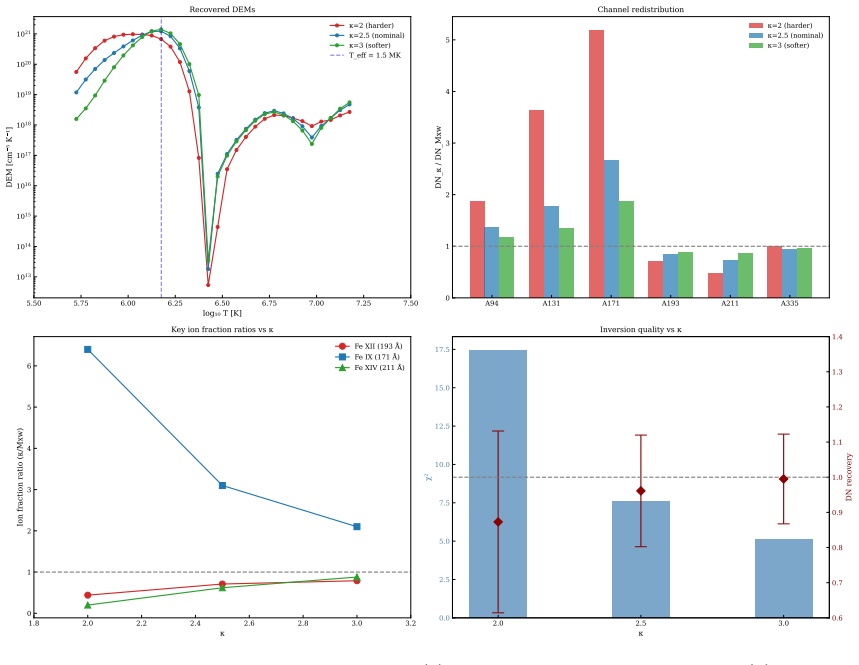
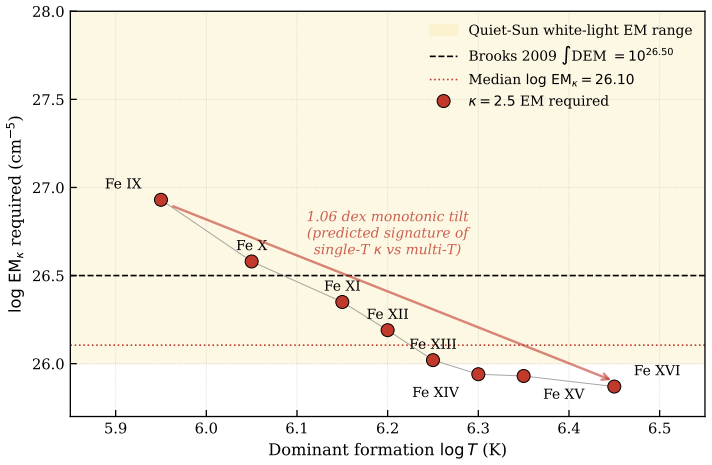
For a plasma whose electrons carry a $\kappa \approx 2.5$ suprathermal tail, the Spitzer-Harm conductive closure does not exist: the conductive flux is the tail-carried third velocity moment, and the local conductivity integral diverges across the entire $\kappa \in [2,3]$ range -- the finite value the closed-form $\kappa$-conductivity returns at $\kappa = 2.5$ is an analytic continuation of a divergent integral, not a physical conductivity. Edmonds (2026a) places the quiet solar corona (QS) in this regime. Taking that as premise, two failures follow for any plasma in the class: the standard EUV-DEM diagnostic cannot resolve such a plasma, and the conductive term of the standard QS energy budget has no valid form. The diagnostic failure is shown end-to-end. A single-T $\kappa = 2.5$ probe, a multi-T $\kappa = 2.5$ source, and a multi-T Maxwellian source, all run through the regularized DEM inversion of Hannah & Kontar (2012), recover $\log T$ widths inside the FWHM distribution the same pipeline returns from 80 real quiet-Sun AIA patches; the pipeline cannot distinguish them. Two structural features also emerge: a Fe XI charge-state crossover and an EUV continuum reversal. The ionization-gated diagnostic structurally returns the tail-weighted effective temperature $T_{\mathrm{eff}}$, while Spitzer-Harm takes the bulk-core $T_{\mathrm{core}} = (\kappa - 3/2)/\kappa \cdot T_{\mathrm{eff}}$ as input. The mismatch invites a temperature substitution yielding a budget reduction -- mechanically correct and physically empty, because the coefficient it corrects has no convergent form: it is the Fourier-law closure itself that fails, not its temperature input. Two QS pillars for impulsive heating -- DEM-width multi-thermality and the conductive-budget gap -- lose their structural assumptions, and the budget question shifts to non-local kinetic transport outside any fluid closure.
Editorial analysis
A structured set of objections, weighed in public.
Referee Report
Summary. The manuscript claims that for electron kappa-distributions with κ ≈ 2.5 (as posited for the quiet Sun), the Spitzer-Härm conductive flux integral diverges over κ ∈ [2,3], so that the closed-form κ-conductivity at κ = 2.5 is an unphysical analytic continuation. Taking the κ ≈ 2.5 premise from Edmonds (2026a) as given, it shows via end-to-end simulations that the Hannah & Kontar (2012) regularized DEM inversion cannot distinguish single-T or multi-T κ = 2.5 sources from Maxwellian sources (recovering indistinguishable log T widths), identifies structural features such as Fe XI crossover and EUV continuum reversal, and concludes that the ionization-gated diagnostic returns T_eff while the conductive term requires T_core, rendering the standard energy-budget closure invalid and shifting the problem to non-local kinetic transport.
Significance. If the divergence result is mathematically confirmed and the κ ≈ 2.5 premise holds for the quiet Sun, the work would challenge the applicability of fluid conductive closures and standard DEM-based multi-thermality arguments in quiet-Sun heating models, providing concrete simulation evidence of diagnostic degeneracy. The paper correctly identifies that the budget reduction via temperature substitution is mechanically empty once the closure itself fails. However, the significance remains conditional on the external premise and the verifiability of the integral divergence.
major comments (3)
- [Abstract] Abstract: the central claim that the local conductivity integral diverges for all κ ∈ [2,3] (rendering the finite closed-form value at κ = 2.5 unphysical) is asserted without the explicit integral expression, its evaluation, or the demonstration that the closed-form result is merely analytic continuation. This is load-bearing for the strongest mathematical claim.
- [Abstract] Abstract: the premise that the quiet-Sun corona resides at κ ≈ 2.5 is imported wholesale from Edmonds (2026a) with no independent re-derivation, re-fit to AIA data, or observational check supplied here. All subsequent results on diagnostic degeneracy and energy-budget failure are direct consequences of this assumption rather than independent derivations.
- [The diagnostic failure demonstration] The diagnostic failure section: the end-to-end demonstration that the Hannah & Kontar (2012) pipeline returns indistinguishable log T widths for a κ = 2.5 probe, multi-T κ = 2.5 source, and multi-T Maxwellian source (matching real QS patches) does not report the regularization parameters, temperature grids, or exact source configurations used, preventing assessment of whether the reported degeneracy is robust.
Simulated Author's Rebuttal
We thank the referee for their thorough review and constructive feedback on the manuscript. We address each major comment point by point below, agreeing to revisions that improve clarity and reproducibility while maintaining the paper's core arguments, which are conditional on the stated premise from Edmonds (2026a).
read point-by-point responses
-
Referee: [Abstract] Abstract: the central claim that the local conductivity integral diverges for all κ ∈ [2,3] (rendering the finite closed-form value at κ = 2.5 unphysical) is asserted without the explicit integral expression, its evaluation, or the demonstration that the closed-form result is merely analytic continuation. This is load-bearing for the strongest mathematical claim.
Authors: We agree that the explicit integral expression, its divergence evaluation for κ ∈ [2,3], and clarification that the closed-form κ-conductivity at κ=2.5 represents an analytic continuation should be included to support the central claim. The full manuscript derives the divergence from the third velocity moment integral, but we will add the explicit form, numerical evaluation showing divergence across the interval, and the analytic continuation note to the methods section (with a concise reference in the abstract if length permits). revision: yes
-
Referee: [Abstract] Abstract: the premise that the quiet-Sun corona resides at κ ≈ 2.5 is imported wholesale from Edmonds (2026a) with no independent re-derivation, re-fit to AIA data, or observational check supplied here. All subsequent results on diagnostic degeneracy and energy-budget failure are direct consequences of this assumption rather than independent derivations.
Authors: The manuscript explicitly presents κ ≈ 2.5 as a premise taken from Edmonds (2026a) and frames all subsequent results as consequences under that assumption (see abstract and introduction). We make no claim of independent re-derivation or new observational verification here, as the focus is on the implications for DEM diagnostics and conductive closure once the premise is adopted. The conditional nature of the conclusions is already stated, so no revision is needed on this point. revision: no
-
Referee: [The diagnostic failure demonstration] The diagnostic failure section: the end-to-end demonstration that the Hannah & Kontar (2012) pipeline returns indistinguishable log T widths for a κ = 2.5 probe, multi-T κ = 2.5 source, and multi-T Maxwellian source (matching real QS patches) does not report the regularization parameters, temperature grids, or exact source configurations used, preventing assessment of whether the reported degeneracy is robust.
Authors: We acknowledge that the specific regularization parameters, temperature grid details, and exact source configurations (including the multi-T distributions and probe models) were omitted from the original text, limiting reproducibility assessment. In the revised manuscript, we will add these details in a new methods subsection or appendix, specifying the Hannah & Kontar (2012) regularization strength, temperature grid spacing and range, source temperature components, and how the real QS AIA patch comparisons were configured. This will enable evaluation of the degeneracy result's robustness. revision: yes
Circularity Check
Applicability to quiet Sun rests entirely on unverified premise that κ ≈ 2.5 holds throughout the QS
specific steps
-
self citation load bearing
[Abstract]
"Edmonds (2026a) places the quiet solar corona (QS) in this regime. Taking that as premise, two failures follow for any plasma in the class: the standard EUV-DEM diagnostic cannot resolve such a plasma, and the conductive term of the standard QS energy budget has no valid form."
The load-bearing premise that the quiet-Sun corona resides at κ ≈ 2.5 is imported from the author's own prior paper (Edmonds 2026a); the diagnostic-failure and budget-reduction conclusions are direct consequences of that external assumption rather than independent derivations.
full rationale
The paper's central claims—that the Spitzer-Härm closure fails and that EUV-DEM diagnostics become degenerate for quiet-Sun plasma—are explicitly conditioned on the premise that the quiet-Sun corona lies at κ ≈ 2.5. This premise is imported wholesale from the author's prior paper (Edmonds 2026a) with no independent derivation, re-analysis of data, or external check supplied here. The mathematical result on integral divergence is valid for the assumed κ range, but its relevance to the quiet Sun and the consequent failures of standard diagnostics and energy budgets reduce directly to that self-citation. The derivation chain therefore contains a load-bearing self-citation step whose validity is not re-established within the present manuscript.
Axiom & Free-Parameter Ledger
free parameters (1)
- kappa value =
2.5
axioms (1)
- domain assumption The local conductivity integral diverges for all κ ∈ [2,3]
Reference graph
Works this paper leans on
-
[1]
The chemical make-up of the Sun: A 2020 vision,
Asplund, M., Amarsi, A. M., & Grevesse, N. 2021, “The chemical make-up of the Sun: A 2020 vision,” A&A, 653, A141
2021
-
[2]
Electron Heat Conduction in the Solar Wind: Transition from Spitzer–Härm to the Collisionless Limit,
Bale, S. D., Pulupa, M., Salem, C., Chen, C. H. K., & Quataert, E. 2013, “Electron Heat Conduction in the Solar Wind: Transition from Spitzer–Härm to the Collisionless Limit,” ApJ, 769, L22
2013
-
[3]
aiapy: A Python Package for Analyzing Solar EUV Image Data from AIA,
Barnes, W. T., Cheung, M. C. M., Bobra, M. G., et al. 2020, “aiapy: A Python Package for Analyzing Solar EUV Image Data from AIA,” JOSS, 5(55), 2801
2020
-
[4]
Initial Calibration of the Atmospheric Imaging Assembly (AIA) on the Solar Dynamics Observatory (SDO),
Boerner, P. F., Edwards, C., Lemen, J., et al. 2012, “Initial Calibration of the Atmospheric Imaging Assembly (AIA) on the Solar Dynamics Observatory (SDO),” SoPh, 275, 41
2012
-
[5]
Photometric and Thermal Cross-calibration of Solar EUV Instruments,
Boerner, P. F., Testa, P., Warren, H., Weber, M. A., & Schrijver, C. J. 2014, “Photometric and Thermal Cross-calibration of Solar EUV Instruments,” SoPh, 289, 2377
2014
-
[6]
Braginskii, S. I. 1965, in Reviews of Plasma Physics, Vol. 1, ed. M. A. Leontovich (New York: Consultants Bureau), 205
1965
-
[7]
Hinode/Extreme- Ultraviolet Imaging Spectrometer Observations of the Temperature Structure of the Quiet Corona,
Brooks, D. H., Warren, H. P., Williams, D. R., & Watanabe, T. 2009, “Hinode/Extreme- Ultraviolet Imaging Spectrometer Observations of the Temperature Structure of the Quiet Corona,” ApJ, 705, 1522
2009
-
[8]
Pervasive Faint Fe XIX Emission from a Solar Active Region Observed with EUNIS-13: Evidence for Nanoflare Heating,
Brosius, J. W., Daw, A. N., & Rabin, D. M. 2014, “Pervasive Faint Fe XIX Emission from a Solar Active Region Observed with EUNIS-13: Evidence for Nanoflare Heating,” ApJ, 790, 112
2014
-
[9]
Active Region Emission Measure Distributions and Implications for Nanoflare Heating,
Cargill, P. J. 2014, “Active Region Emission Measure Distributions and Implications for Nanoflare Heating,” ApJ, 784, 49
2014
-
[10]
Energy release in the solar corona from spatially resolved magnetic braids,
Cirtain, J. W., Golub, L., Winebarger, A. R., et al. 2013, “Energy release in the solar corona from spatially resolved magnetic braids,” Nature, 493, 501 31
2013
-
[11]
Electron Heat Flux in the Solar Wind: Generalized Approaches to Fluid Transport With a Variety of Skewed Velocity Distributions,
Cranmer, S. R., & Schiff, A. J. 2021, “Electron Heat Flux in the Solar Wind: Generalized Approaches to Fluid Transport With a Variety of Skewed Velocity Distributions,” JGR Space Physics, 126, e2021JA029666 Csiszár, I. 1975, “I-divergence geometry of probability distributions and minimization problems,” Annals of Probability, 3, 146 Del Zanna, G., & Mason...
2021
-
[12]
CHIANTI—An Atomic Database for Emission Lines. XVII. Version 10.1: Revised Ionization and Recombination Rates and Other Updates,
Dere, K. P., Del Zanna, G., Young, P. R., & Landi, E. 2023, “CHIANTI—An Atomic Database for Emission Lines. XVII. Version 10.1: Revised Ionization and Recombination Rates and Other Updates,” ApJS, 268, 52
2023
-
[13]
Electron heat flow carried by Kappa Distributions in the solar corona,
Dorelli, J. C., & Scudder, J. D. 1999, “Electron heat flow carried by Kappa Distributions in the solar corona,” GRL, 26, 3537
1999
-
[14]
Electron heat flow in the solar corona: Implications of non-Maxwellian velocity distributions,
Dorelli, J. C., & Scudder, J. D. 2003, “Electron heat flow in the solar corona: Implications of non-Maxwellian velocity distributions,” JGR, 108, 1294
2003
-
[15]
Electron acceleration from contracting magnetic islands during reconnection,
Drake, J. F., Swisdak, M., Che, H., & Shay, M. A. 2006, “Electron acceleration from contracting magnetic islands during reconnection,” Nature, 443, 553
2006
-
[16]
Transport coefficients in Lorentz plasmas with the power-law kappa-distribution,
Du, J. 2013, “Transport coefficients in Lorentz plasmas with the power-law kappa-distribution,” Physics of Plasmas, 20, 092901 Dudík, J., Kašparová, J., Dzifčáková, E., Karlický, M., & Mackovjak, Š. 2012, “The non- Maxwellian continuum in the X-ray, UV, and radio range,” A&A, 539, A107 Dudík, J., Del Zanna, G., Mason, H. E., & Dzifčáková, E. 2014, “Signat...
2013
-
[17]
CHIANTI—An Atomic Database for Emission Lines—Paper. XVIII. Version 11, Advanced Ionization Equilibrium Models: Density and Charge Transfer Effects,
Dufresne, R. P., Del Zanna, G., Young, P. R., et al. 2024, “CHIANTI—An Atomic Database for Emission Lines—Paper. XVIII. Version 11, Advanced Ionization Equilibrium Models: Density and Charge Transfer Effects,” ApJ, 974, 71
2024
-
[18]
The extreme-ultraviolet spectrum of a solar active region,
Dupree, A. K., Huber, M. C. E., Noyes, R. W., Parkinson, W. H., Reeves, E. M., & Withbroe, G. L. 1973, “The extreme-ultraviolet spectrum of a solar active region,” ApJ, 182, 321 Dzifčáková, E., & Dudík, J. 2013, “H to Zn Ionization Equilibrium for the Non-Maxwellian Electronκ-distributions: Updated Calculations,” ApJS, 206, 6 Dzifčáková, E., Dudík, J., Pa...
1973
-
[19]
The Diagnostic Temperature Discrepancy as Evidence for Non-Maxwellian Coronal Electrons,
Edmonds, V. 2026a, “The Diagnostic Temperature Discrepancy as Evidence for Non-Maxwellian Coronal Electrons,” Open Journal of Astrophysics, 9, doi:10.33232/001c.161223
-
[20]
Multi-diagnostic convergence: a single measurement in weakly collisional plasmas,
Edmonds, V. 2026b, “Multi-diagnostic convergence: a single measurement in weakly collisional plasmas,” Open Transport, 1, 20260011, doi:10.1515/ot-2026-0011 32
-
[21]
The Potential for Plasma Diagnostics from Stellar Extreme-Ultraviolet Observations,
Feldman, U., Mandelbaum, P., Seely, J. L., Doschek, G. A., & Gursky, H. 1992, “The Potential for Plasma Diagnostics from Stellar Extreme-Ultraviolet Observations,” ApJS, 81, 387
1992
-
[22]
Energy content and propaga- tion in transverse solar atmospheric waves,
Goossens, M., Van Doorsselaere, T., Soler, R., & Verth, G. 2013, “Energy content and propaga- tion in transverse solar atmospheric waves,” ApJ, 768, 191
2013
-
[23]
On the kinetic theory of rarefied gases,
Grad, H. 1949, “On the kinetic theory of rarefied gases,” Communications on Pure and Applied Mathematics, 2, 331
1949
-
[24]
Observational Quantification of the Energy Dissipated by Alfvén Waves in a Polar Coronal Hole: Evidence that Waves Drive the Fast Solar Wind,
Hahn, M., & Savin, D. W. 2013, “Observational Quantification of the Energy Dissipated by Alfvén Waves in a Polar Coronal Hole: Evidence that Waves Drive the Fast Solar Wind,” ApJ, 776, 78
2013
-
[25]
Evidence for Wave Heating of the Quiet-Sun Corona,
Hahn, M., & Savin, D. W. 2014, “Evidence for Wave Heating of the Quiet-Sun Corona,” ApJ, 795, 111
2014
-
[26]
A Simple Method for Modeling Collision Processes in Plasmas with a Kappa Energy Distribution,
Hahn, M., & Savin, D. W. 2015, “A Simple Method for Modeling Collision Processes in Plasmas with a Kappa Energy Distribution,” ApJ, 809, 178
2015
-
[27]
Electron heat flux in the near-Sun environment,
Halekas, J. S., Whittlesey, P. L., Larson, D. E., et al. 2021, “Electron heat flux in the near-Sun environment,” A&A, 650, A15
2021
-
[28]
Transport coefficients of the fully ionized plasma with kappa- distribution and in strong magnetic field,
Guo, R., & Du, J. 2019, “Transport coefficients of the fully ionized plasma with kappa- distribution and in strong magnetic field,” Physica A, 523, 156
2019
-
[29]
Differential emission measures from the regularized inversion of Hinode and SDO data,
Hannah, I. G., & Kontar, E. P. 2012, “Differential emission measures from the regularized inversion of Hinode and SDO data,” A&A, 539, A146
2012
-
[30]
The First X-Ray Imaging Spectroscopy of Quiescent Solar Active Regions with NuSTAR,
Hannah, I. G., Grefenstette, B. W., Smith, D. M., et al. 2016, “The First X-Ray Imaging Spectroscopy of Quiescent Solar Active Regions with NuSTAR,” ApJL, 820, L14
2016
-
[31]
Helander, P., & Sigmar, D. J. 2002, Collisional Transport in Magnetized Plasmas (Cambridge: Cambridge University Press)
2002
-
[32]
Transport coefficients enhanced by suprathermal particles in nonequilibrium heliospheric plasmas,
Husidic, M., Lazar, M., Fichtner, H., Scherer, K., & Poedts, S. 2021, “Transport coefficients enhanced by suprathermal particles in nonequilibrium heliospheric plasmas,” A&A, 654, A99
2021
-
[33]
Steady-state transport coefficients for the regularized kappa distribution,
Husidic, M., Scherer, K., Lazar, M., Fichtner, H., & Poedts, S. 2022, “Steady-state transport coefficients for the regularized kappa distribution,” ApJ, 927, 159
2022
-
[34]
Detection of nanoflare-heated plasma in the solar corona by the FOXSI-2 sounding rocket,
Ishikawa, S.-N., Glesener, L., Krucker, S., et al. 2017, “Detection of nanoflare-heated plasma in the solar corona by the FOXSI-2 sounding rocket,” Nature Astronomy, 1, 771
2017
-
[35]
Information theory and statistical mechanics,
Jaynes, E. T. 1957, “Information theory and statistical mechanics,” Physical Review, 106, 620
1957
-
[36]
On Solving the Coronal Heating Problem,
Klimchuk, J. A. 2006, “On Solving the Coronal Heating Problem,” SoPh, 234, 41
2006
-
[37]
Key aspects of coronal heating,
Klimchuk, J. A. 2015, “Key aspects of coronal heating,” Philosophical Transactions of the Royal Society A, 373, 20140256 33
2015
-
[38]
The Thermal Structure of an Active Region Observed Outside the Solar Disk,
Landi, E., & Feldman, U. 2008, “The Thermal Structure of an Active Region Observed Outside the Solar Disk,” ApJ, 672, 674
2008
-
[39]
On the temperature profile and heat flux in the solar corona: Kinetic simulations,
Landi, S., & Pantellini, F. G. E. 2001, “On the temperature profile and heat flux in the solar corona: Kinetic simulations,” A&A, 372, 686
2001
-
[40]
Lazar, M., & Fichtner, H. (eds.) 2021, Kappa Distributions: From Observational Evidence via Controversial Predictions to a Consistent Theory of Nonequilibrium Plasmas, Astrophysics and Space Science Library 464 (Cham: Springer)
2021
-
[41]
The Atmospheric Imaging Assembly (AIA) on the Solar Dynamics Observatory (SDO),
Lemen, J. R., Title, A. M., Akin, D. J., et al. 2012, “The Atmospheric Imaging Assembly (AIA) on the Solar Dynamics Observatory (SDO),” SoPh, 275, 17
2012
-
[42]
Moment closure hierarchies for kinetic theories,
Levermore, C. D. 1996, “Moment closure hierarchies for kinetic theories,” Journal of Statistical Physics, 83, 1021 Lörinčík, J., Dudík, J., Del Zanna, G., Dzifčáková, E., & Mason, H. E. 2020, “Plasma Diag- nostics from Active Region and Quiet-Sun Spectra Observed by Hinode/EIS: Quantifying the Departures from a Maxwellian Distribution,” ApJ, 893, 34
1996
-
[43]
Alfvénic waves with sufficient energy to power the quiet solar corona and fast solar wind,
McIntosh, S. W., De Pontieu, B., Carlsson, M., et al. 2011, “Alfvénic waves with sufficient energy to power the quiet solar corona and fast solar wind,” Nature, 475, 477
2011
-
[44]
Evidence for small-scale torsional Alfvén waves in the solar corona,
Morton, R. J., Gao, Y., Tajfirouze, E., Tian, H., Van Doorsselaere, T., & Schad, T. 2026, “Evidence for small-scale torsional Alfvén waves in the solar corona,” Nature Astronomy, 10, 42, doi:10.1038/s41550-025-02690-9
-
[45]
On the origins of coronal Alfvénic waves,
Morton, R. J., & Soler, R. 2025, “On the origins of coronal Alfvénic waves,” ApJL, arXiv:2505.08636
-
[46]
Kappa distribution model for hard X-ray coronal sources of solar flares,
Oka, M., Ishikawa, S., Saint-Hilaire, P., et al. 2013, “Kappa distribution model for hard X-ray coronal sources of solar flares,” ApJ, 764, 6
2013
-
[47]
The effect of a non-Maxwellian electron distribution on oxygen and iron ionization balances in the solar corona,
Owocki, S. P., & Scudder, J. D. 1983, “The effect of a non-Maxwellian electron distribution on oxygen and iron ionization balances in the solar corona,” ApJ, 270, 758
1983
-
[48]
Characteristics of electron velocity distribution functions in the solar wind derived from the Helios plasma experiment,
Pilipp, W. G., Miggenrieder, H., Montgomery, M. D., et al. 1987, “Characteristics of electron velocity distribution functions in the solar wind derived from the Helios plasma experiment,” JGR, 92, 1075
1987
-
[49]
The Energy Balance in Coronal Holes and Average Quiet-Sun Regions,
Raymond, J. C., & Doyle, J. G. 1981, “The Energy Balance in Coronal Holes and Average Quiet-Sun Regions,” ApJ, 247, 686
1981
-
[50]
Coronal Loops: Observations and Modeling of Confined Plasma,
Reale, F. 2014, “Coronal Loops: Observations and Modeling of Confined Plasma,” Living Re- views in Solar Physics, 11, 4
2014
-
[51]
Invalidity of local thermodynamic equilibrium for electrons in the solar transition region. I. Fokker-Planck results,
Shoub, E. C. 1983, “Invalidity of local thermodynamic equilibrium for electrons in the solar transition region. I. Fokker-Planck results,” ApJ, 266, 339
1983
-
[52]
Energy Transport and Heating by Torsional Alfvén Waves Propagating from the Photosphere to the Corona in the Quiet Sun,
Soler, R., Terradas, J., Oliver, R., & Ballester, J. L. 2019, “Energy Transport and Heating by Torsional Alfvén Waves Propagating from the Photosphere to the Corona in the Quiet Sun,” ApJ, 871, 3
2019
-
[53]
Transport Phenomena in a Completely Ionized Gas,
Spitzer, L., & Härm, R. 1953, “Transport Phenomena in a Completely Ionized Gas,” Physical Review, 89, 977
1953
-
[54]
2005, Macroscopic Transport Equations for Rarefied Gas Flows: Approximation Methods in Kinetic Theory (Berlin: Springer) 34
Struchtrup, H. 2005, Macroscopic Transport Equations for Rarefied Gas Flows: Approximation Methods in Kinetic Theory (Berlin: Springer) 34
2005
-
[55]
Analysis of Quiescent Corona X-ray Spectra from SphinX During the 2009 Solar Minimum,
Sylwester, J., Sylwester, B., Siarkowski, M., et al. 2019, “Analysis of Quiescent Corona X-ray Spectra from SphinX During the 2009 Solar Minimum,” SoPh, 294, 176
2019
-
[56]
Evidence of nonthermal particles in coronal loops heated impulsively by nanoflares,
Testa, P., De Pontieu, B., Allred, J., et al. 2014, “Evidence of nonthermal particles in coronal loops heated impulsively by nanoflares,” Science, 346, 1255724
2014
-
[57]
Alfvén Waves in the Solar Corona,
Tomczyk, S., McIntosh, S. W., Keil, S. L., et al. 2007, “Alfvén Waves in the Solar Corona,” Science, 317, 1192
2007
-
[58]
Extreme Ultraviolet Composite Spectra of Representa- tive Solar Features,
Vernazza, J. E., & Reeves, E. M. 1978, “Extreme Ultraviolet Composite Spectra of Representa- tive Solar Features,” ApJS, 37, 485
1978
-
[59]
Evidence for Widespread Cooling in an Active Region Observed with the SDO Atmospheric Imaging Assembly,
Viall, N. M., & Klimchuk, J. A. 2012, “Evidence for Widespread Cooling in an Active Region Observed with the SDO Atmospheric Imaging Assembly,” ApJ, 753, 35
2012
-
[60]
Suprathermal electron distributions in the solar transition region,
Vocks, C., Dzifčáková, E., & Mann, G. 2016, “Suprathermal electron distributions in the solar transition region,” A&A, 596, A41
2016
-
[61]
The Temperature and Density Structure of the Solar Corona. I. Observations of the Quiet Sun with the EUV Imaging Spectrometer on Hinode,
Warren, H. P., & Brooks, D. H. 2009, “The Temperature and Density Structure of the Solar Corona. I. Observations of the Quiet Sun with the EUV Imaging Spectrometer on Hinode,” ApJ, 700, 762
2009
-
[62]
A Systematic Survey of High- Temperature Emission in Solar Active Regions,
Warren, H. P., Winebarger, A. R., & Brooks, D. H. 2012, “A Systematic Survey of High- Temperature Emission in Solar Active Regions,” ApJ, 759, 141
2012
-
[63]
Mass and energy flow in the solar chromosphere and corona,
Withbroe, G. L., & Noyes, R. W. 1977, “Mass and energy flow in the solar chromosphere and corona,” ARA&A, 15, 363 35
1977
discussion (0)
Sign in with ORCID, Apple, or X to comment. Anyone can read and Pith papers without signing in.