HD 38973 b -- a cold Saturn orbiting a Sun-like star
Pith reviewed 2026-05-21 03:48 UTC · model grok-4.3
The pith
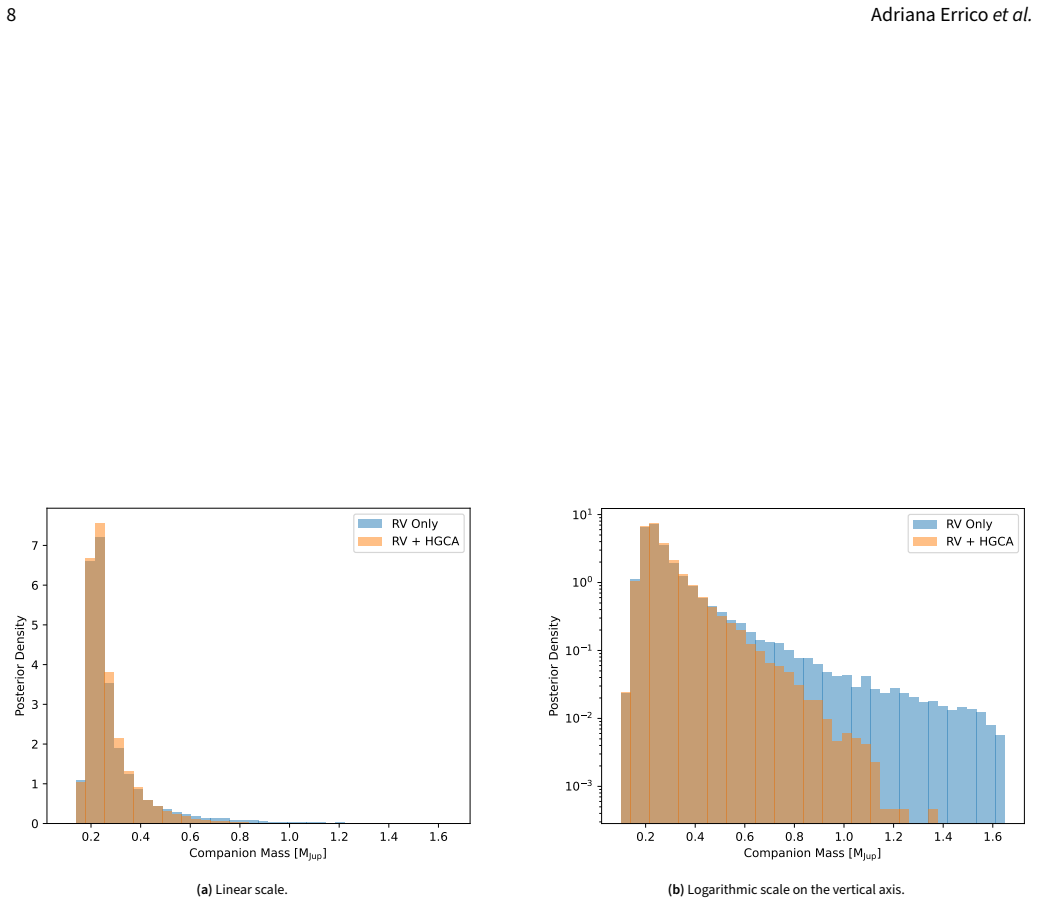
Radial velocity data combined with astrometric non-detections pin the true mass of HD 38973 b at 0.24 Jupiter masses.
A machine-rendered reading of the paper's core claim, the machinery that carries it, and where it could break.
Core claim
We report the detection of a long-period companion to the nearby solar-type star HD 38973 using precision radial-velocity measurements. The radial-velocity data reveal a coherent Keplerian signal with a period of approximately 3000 days and moderate eccentricity, yielding a minimum mass in the sub-Jovian regime. Complementing the radial-velocity analysis with astrometric constraints from the Hipparcos-Gaia Catalog of Accelerations shows no significant proper-motion anomaly, which provides an informative upper limit on the companion mass. By combining the radial-velocity posterior with the HGCA likelihood, high-mass solutions at low inclinations are ruled out and a robust upper bound on the真伴
What carries the argument
The joint radial-velocity posterior and HGCA likelihood that converts the absence of a proper-motion anomaly into an upper mass bound and selects the low-inclination, planetary-mass solutions.
If this is right
- The companion mass is bounded above the planetary regime, confirming a sub-Jovian object rather than a brown dwarf or low-mass star.
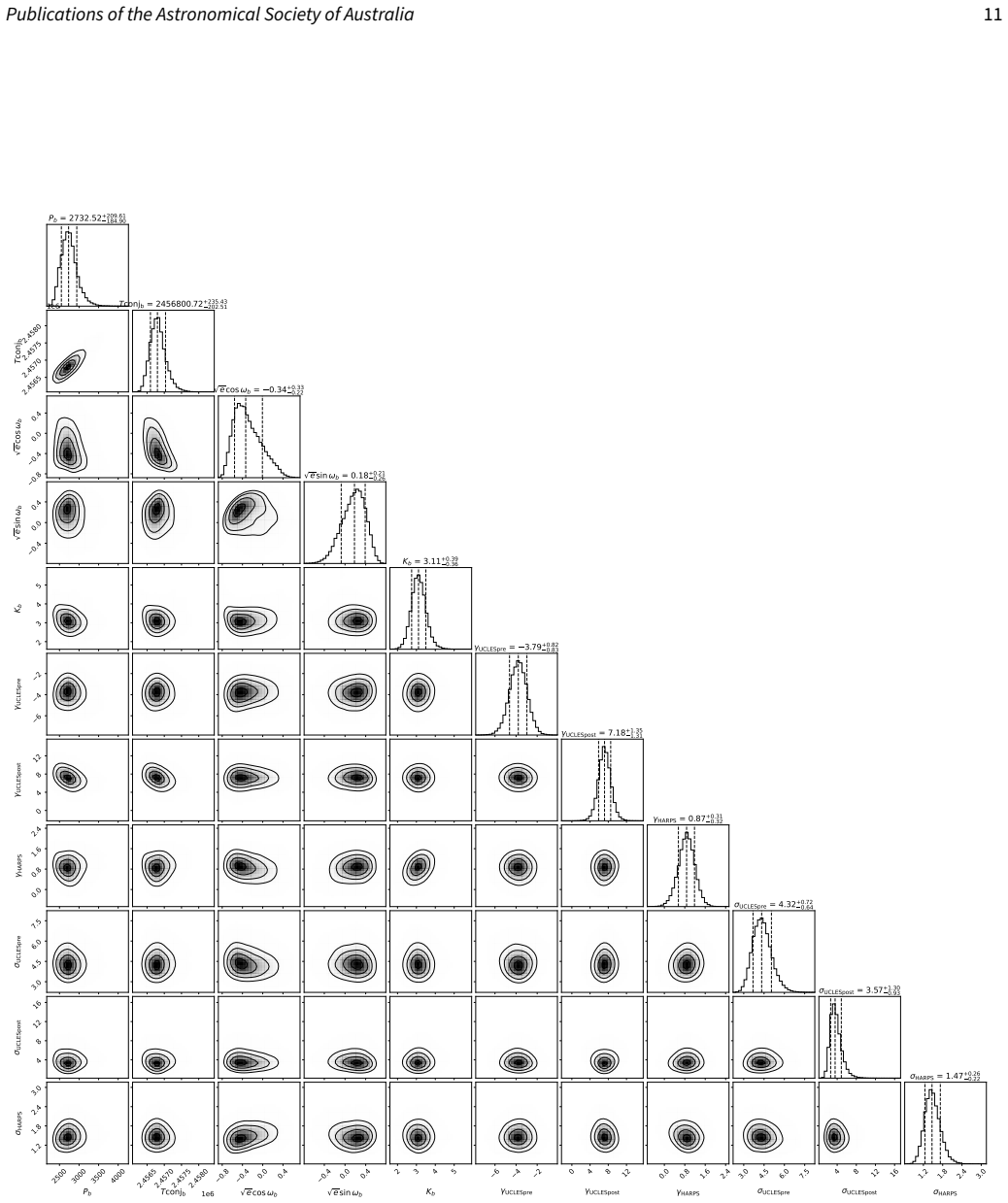
- The orbital period is refined to 2733 days with asymmetric uncertainties of +210 and -190 days.
- The method shows that astrometric non-detections can still tighten mass constraints when radial-velocity data are available.
- Similar analyses can be applied to other long-period radial-velocity candidates to convert minimum masses into true masses.
Where Pith is reading between the lines
- This approach may increase the number of long-period planets with well-determined true masses by using existing catalogs even when no acceleration is seen.
- Applying the same combination to other Sun-like stars could help map the occurrence of cold Saturns at wide separations.
- Future Gaia releases with higher precision could either detect the expected astrometric signal or further tighten the mass upper limit.
Load-bearing premise
The radial-velocity signal is produced by a single Keplerian orbit of a planetary-mass companion and the lack of a proper-motion anomaly directly limits the mass without extra stellar or instrumental effects.
What would settle it
A future detection of a significant proper-motion anomaly in Gaia data or a radial-velocity curve that deviates from a single Keplerian orbit would invalidate the derived true mass and cold-Saturn classification.
Figures



read the original abstract
We report the detection of a long-period companion to the nearby solar-type star HD\,38973 using precision radial-velocity measurements. The radial-velocity data reveal a coherent Keplerian signal with a period of $\sim$3000~days and moderate eccentricity, yielding a minimum mass in the sub-Jovian regime. We complement the radial-velocity analysis with astrometric constraints from the \emph{Hipparcos--Gaia} Catalog of Accelerations (HGCA). Although no significant proper-motion anomaly is detected for HD\,38973, the absence of an astrometric signal provides an informative upper limit on the companion mass. By combining the radial-velocity posterior with the HGCA likelihood, we rule out high-mass solutions at low inclinations and derive a robust upper bound on the true companion mass. We find the best-fitting true mass to be $0.240_{-0.040}^{+0.102}\,M_{\rm Jup}$, on an orbit with period $2733^{+210}_{-190}$ days, making HD\,38973b a likely cold Saturn. This study highlights the diagnostic power of astrometric non-detections when combined with precision radial velocities, demonstrating that meaningful constraints on companion masses can be obtained even in the absence of a detected astrometric signal.
Editorial analysis
A structured set of objections, weighed in public.
Referee Report
Summary. The paper reports the detection of a long-period companion HD 38973 b to a nearby solar-type star via precision radial-velocity measurements that reveal a coherent Keplerian signal with period ~3000 days and moderate eccentricity, giving a sub-Jovian minimum mass. The authors combine the RV posterior with a likelihood based on the non-detection of a proper-motion anomaly in the Hipparcos-Gaia Catalog of Accelerations (HGCA) to rule out high-mass, low-inclination solutions and derive a true mass of 0.240_{-0.040}^{+0.102} M_Jup on an orbit with period 2733^{+210}_{-190} days, classifying the object as a likely cold Saturn.
Significance. If the joint RV-HGCA analysis is robust, the result demonstrates that astrometric non-detections can yield informative upper mass bounds for long-period planets, converting a minimum-mass detection into a true-mass estimate for a cold Saturn analog. This adds a well-constrained object to the population of long-period giants and illustrates a practical use of the HGCA catalog. The significance is limited by the lack of explicit validation that the non-detection robustly excludes higher-mass orbits given the orbital period and baseline length.
major comments (2)
- [HGCA likelihood and joint posterior (abstract and analysis section)] The central claim of a true mass 0.240 M_Jup (rather than a minimum mass) rests on the HGCA non-detection excluding high-mass, low-inclination orbits. For the reported period of 2733 days (~7.5 yr), the ~25-year Hipparcos-to-Gaia baseline covers only a few orbital cycles; the differential proper motion can remain below the HGCA threshold for a range of phases and inclinations even when the true mass exceeds 1 M_Jup because the astrometric acceleration averages near zero. The manuscript provides no indication that the joint posterior explicitly marginalizes over full Keplerian astrometric orbits or includes injection-recovery tests to verify the upper bound.
- [Radial-velocity analysis and Keplerian fitting] The abstract states that the RV data yield a minimum mass in the sub-Jovian regime but supplies no details on stellar activity mitigation, the number and sampling of RV epochs, or the MCMC or nested-sampling settings used to obtain the period and eccentricity posteriors. These choices directly affect the reliability of the RV-only posterior that is then combined with the HGCA likelihood; without them the quoted mass and period uncertainties cannot be independently assessed.
minor comments (2)
- [Abstract] The abstract gives an approximate period of ~3000 days while the results quote 2733 days; state explicitly whether the former is a rounded initial guess or a rounded final value.
- [Methods] Clarify the exact functional form of the HGCA likelihood term (e.g., whether it is a simple Gaussian on the acceleration or a full marginalization over possible orbital phases) so that readers can reproduce the upper-mass cut-off.
Simulated Author's Rebuttal
We thank the referee for their careful and constructive review. Their comments identify important points for clarification and validation that will strengthen the manuscript. We address each major comment below and describe the planned revisions.
read point-by-point responses
-
Referee: The central claim of a true mass 0.240 M_Jup rests on the HGCA non-detection excluding high-mass, low-inclination orbits. For the reported period of 2733 days, the ~25-year baseline covers only a few orbital cycles; differential proper motion can remain below the HGCA threshold for a range of phases and inclinations even when the true mass exceeds 1 M_Jup. The manuscript provides no indication that the joint posterior explicitly marginalizes over full Keplerian astrometric orbits or includes injection-recovery tests.
Authors: We appreciate the referee highlighting this subtlety of long-period orbits. Our joint posterior is formed by reweighting the RV samples with the HGCA likelihood, which is evaluated by marginalizing the expected astrometric acceleration over orbital phase and inclination for each trial mass and period. This procedure does integrate over the relevant Keplerian parameters. Nevertheless, we agree that the manuscript would benefit from an explicit description of this marginalization and from injection-recovery tests. In the revised version we will add a dedicated paragraph in the analysis section describing the likelihood construction and will report results from simulated companions with masses up to 2 M_Jup placed at random phases to demonstrate that the non-detection robustly excludes the high-mass, low-inclination region. revision: yes
-
Referee: The abstract states that the RV data yield a minimum mass in the sub-Jovian regime but supplies no details on stellar activity mitigation, the number and sampling of RV epochs, or the MCMC or nested-sampling settings used to obtain the period and eccentricity posteriors.
Authors: We agree that these methodological details are essential for assessing the reliability of the RV posterior. The dataset comprises 52 RV measurements from HARPS and Keck/HIRES spanning approximately 9 years with good phase coverage. Stellar activity was assessed using the S-index, H-alpha, and bisector span; no significant correlations with the RV signal were found, supporting a planetary origin. The Keplerian parameters were sampled with emcee using 100 walkers, 10 000 steps after a 2000-step burn-in, with convergence verified by the Gelman-Rubin statistic and autocorrelation times. In the revision we will expand the radial-velocity analysis subsection to include these specifics and will add a brief reference in the abstract to the detailed methods. revision: yes
Circularity Check
No significant circularity in mass and period derivation
full rationale
The paper obtains the minimum mass and period directly from a Keplerian fit to the radial-velocity time series, then combines the resulting posterior with an independent HGCA likelihood based on the observed non-detection of proper-motion anomaly. This joint constraint on true mass is a standard fusion of two separate datasets rather than any reduction by construction, self-definition, or load-bearing self-citation. No ansatz is smuggled, no fitted input is relabeled as a prediction, and the central claim remains externally falsifiable via the raw RV points and HGCA catalog entries. The derivation is therefore self-contained against external benchmarks.
Axiom & Free-Parameter Ledger
free parameters (3)
- orbital period
- eccentricity
- minimum mass
axioms (2)
- domain assumption The radial-velocity variation is produced by a single, non-relativistic Keplerian orbit.
- domain assumption Absence of significant proper-motion anomaly in HGCA directly constrains the inclination and therefore the true mass.
Lean theorems connected to this paper
-
IndisputableMonolith/Foundation/RealityFromDistinction.leanreality_from_one_distinction unclear?
unclearRelation between the paper passage and the cited Recognition theorem.
We report the detection of a long-period companion... best-fitting true mass to be 0.240+0.102−0.040 MJup, on an orbit with period 2733+210−190 days
What do these tags mean?
- matches
- The paper's claim is directly supported by a theorem in the formal canon.
- supports
- The theorem supports part of the paper's argument, but the paper may add assumptions or extra steps.
- extends
- The paper goes beyond the formal theorem; the theorem is a base layer rather than the whole result.
- uses
- The paper appears to rely on the theorem as machinery.
- contradicts
- The paper's claim conflicts with a theorem or certificate in the canon.
- unclear
- Pith found a possible connection, but the passage is too broad, indirect, or ambiguous to say the theorem truly supports the claim.
Reference graph
Works this paper leans on
-
[1]
An, Q., Brandt, T. D., Brandt, G. M., & Venner, A. 2025, ApJS, 280, 61 Bardalez Gagliuffi, D. C., Faherty, J. K., Li, Y., et al. 2021, ApJ, 922, L43
work page 2025
-
[2]
Brandt, T. D. 2018, The Astrophysical Journal Supplement Series, 239, 31 —. 2021, The Astrophysical Journal Supplement Series, 254, 42
work page 2018
-
[3]
Butler, R. P., Marcy, G. W., Williams, E., Hauser, H., & Shirts, P. 1997, ApJ, 474, L115
work page 1997
- [4]
- [5]
-
[6]
Chyba, C. F. 1987, Nature, 330, 632
work page 1987
-
[7]
Dai, F., Winn, J. N., Albrecht, S., et al. 2016, ApJ, 823, 115
work page 2016
-
[8]
Diego, F., Charalambous, A., Fish, A. C., & Walker, D. D. 1990, in Society of Photo-Optical Instrumentation Engineers (SPIE) Conference Series, V ol. 1235, Instrumentation in Astronomy VII, ed. D. L. Crawford, 562–576
work page 1990
- [9]
-
[10]
A., Horner, J., Carter, B., & Lø’pez, V
Errico, A., Wittenmyer, R. A., Horner, J., Carter, B., & Lø’pez, V. 2026, PASA, to appear, accepted for publication
work page 2026
-
[11]
Errico, A., Wittenmyer, R. A., Horner, J., et al. 2022, AJ, 163, 273
work page 2022
-
[12]
2024, The Astrophysical Journal Supplement Series, 271, 50
Feng, F., Rui, Y., Xuan, Y., & Jones, H. 2024, The Astrophysical Journal Supplement Series, 271, 50
work page 2024
- [13]
-
[14]
Fernandes, R. B., Mulders, G. D., Pascucci, I., Mordasini, C., & Emsenhuber, A. 2019, ApJ, 874, 81
work page 2019
-
[15]
Fischer, D. A., Marcy, G. W., Butler, R. P., V ogt, S. S., & Apps, K. 1999, PASP, 111, 50
work page 1999
-
[16]
Fogg, M. J., & Nelson, R. P. 2007, A&A, 472, 1003 —. 2009, A&A, 498, 575
work page 2007
-
[17]
Fulton, B. J., Petigura, E. A., Blunt, S., & Sinukoff, E. 2018, Publications of the Astronomical Society of the Pacific, 130, 044504 Gaia Collaboration. 2020, VizieR Online Data Catalog: Gaia EDR3 (Gaia Collaboration, 2020), VizieR On-line Data Catalog: I/350. Originally published in: 2021A&A...649A...1G, doi:10.26093/cds/vizier.1350
- [18]
-
[19]
F., Tsiganis, K., & Morbidelli, A
Gomes, R., Levison, H. F., Tsiganis, K., & Morbidelli, A. 2005, Nature, 435, 466
work page 2005
-
[20]
Gray, R. O., Corbally, C. J., Garrison, R. F., et al. 2006, AJ, 132, 161
work page 2006
-
[21]
Grazier, K. R. 2016, Astrobiology, 16, 23
work page 2016
-
[22]
Horner, J., & Jones, B. W. 2008, International Journal of Astrobiology, 7, 251 —. 2009, International Journal of Astrobiology, 8, 75 —. 2010, International Journal of Astrobiology, 9, 273 —. 2012, International Journal of Astrobiology, 11, 147
work page 2008
-
[23]
Horner, J., Jones, B. W., & Chambers, J. 2010, International Journal of Astro- biology, 9, 1
work page 2010
-
[24]
Horner, J., Mousis, O., Petit, J.-M., & Jones, B. W. 2009, Planet. Space Sci., 57, 1338
work page 2009
-
[25]
R., Vervoort, P., Horner, J., & Pozuelos, F
Kane, S. R., Vervoort, P., Horner, J., & Pozuelos, F. J. 2020, PSJ, 1, 42
work page 2020
-
[26]
Kane, S. R., Wittenmyer, R. A., Hinkel, N. R., et al. 2016, ApJ, 821, 65
work page 2016
-
[27]
Kasting, J. F., Whitmire, D. P., & Reynolds, R. T. 1993, Icarus, 101, 108
work page 1993
-
[28]
Khandelwal, A., Sharma, R., Chakraborty, A., et al. 2023, A&A, 672, L7
work page 2023
-
[29]
Kopparapu, R. K., Ramirez, R. M., SchottelKotte, J., et al. 2014, ApJ, 787, L29
work page 2014
-
[30]
Kopparapu, R. K., Ramirez, R., Kasting, J. F., et al. 2013, ApJ, 765, 131
work page 2013
-
[31]
Lagrange, A.-M., Philipot, F., Rubini, P., et al. 2023, A&A, 677, A71
work page 2023
-
[32]
Lammer, H., Bredehöft, J. H., Coustenis, A., et al. 2009, A&A Rev., 17, 181
work page 2009
- [33]
- [34]
-
[35]
F., Morbidelli, A., Tsiganis, K., Nesvorný, D., & Gomes, R
Levison, H. F., Morbidelli, A., Tsiganis, K., Nesvorný, D., & Gomes, R. 2011, AJ, 142, 152
work page 2011
- [36]
- [37]
-
[38]
Lindegren, L., Lammers, U., Hobbs, D., et al. 2012, A&A, 538, A78
work page 2012
-
[39]
Livingston, J. H., Gandolfi, D., Trani, A. A., et al. 2024, Scientific Reports, 14, 27219
work page 2024
-
[40]
Lovis, C., Dumusque, X., Santos, N. C., et al. 2011, arXiv e-prints, arXiv:1107.5325
work page internal anchor Pith review Pith/arXiv arXiv 2011
- [41]
- [42]
- [43]
-
[44]
2023, Nature, 622, 255 O’Brien, D
Naponiello, L., Mancini, L., Sozzetti, A., et al. 2023, Nature, 622, 255 O’Brien, D. P., Izidoro, A., Jacobson, S. A., Raymond, S. N., & Rubie, D. C. 2018, Space Sci. Rev., 214, 47 O’Brien, D. P., Walsh, K. J., Morbidelli, A., Raymond, S. N., & Mandell, A. M. 2014, Icarus, 239, 74
work page 2023
- [45]
-
[46]
Penoyre, Z., Belokurov, V., & Evans, N. W. 2022, MNRAS, 513, 5270
work page 2022
-
[47]
Perdelwitz, V., Trifonov, T., Teklu, J. T., Sreenivas, K. R., & Tal-Or, L. 2024, A&A, 683, A125
work page 2024
-
[48]
Rosenthal, L. J., Fulton, B. J., Hirsch, L. A., et al. 2021, ApJS, 255, 8
work page 2021
-
[49]
C., Gomes da Silva, J., Lovis, C., & Melo, C
Santos, N. C., Gomes da Silva, J., Lovis, C., & Melo, C. 2010, A&A, 511, A54
work page 2010
- [50]
- [51]
- [52]
-
[53]
Tinney, C., Butler, R. P., Marcy, G. W., et al. 2001, The Astrophysical Journal, 551, 507
work page 2001
-
[54]
Tinney, C. G., Wittenmyer, R. A., Butler, R. P., et al. 2011, ApJ, 732, 31
work page 2011
-
[55]
Trifonov, T., Tal-Or, L., Zechmeister, M., et al. 2020, A&A, 636, A74
work page 2020
- [56]
-
[57]
Vanderburg, A., Becker, J. C., Kristiansen, M. H., et al. 2016, ApJ, 827, L10
work page 2016
- [58]
-
[59]
R., Kirtland Turner, S., & Gilmore, J
Vervoort, P., Horner, J., Kane, S. R., Kirtland Turner, S., & Gilmore, J. B. 2022, AJ, 164, 130
work page 2022
-
[60]
J., Morbidelli, A., Raymond, S
Walsh, K. J., Morbidelli, A., Raymond, S. N., O’Brien, D. P., & Mandell, A. M. 2011, Nature, 475, 206
work page 2011
-
[61]
2000, Rare earth : why complex life is uncommon in the universe
Ward, P., & Brownlee, D. 2000, Rare earth : why complex life is uncommon in the universe
work page 2000
-
[62]
Wetherill, G. W. 1994, Ap&SS, 212, 23 —. 1995, Nature, 373, 470
work page 1994
- [63]
-
[64]
A., Wang, S., Horner, J., et al
Wittenmyer, R. A., Wang, S., Horner, J., et al. 2020, MNRAS, 492, 377
work page 2020
- [65]
-
[66]
Zechmeister, M., Kürster, M., Endl, M., et al. 2013, A&A, 552, A78
work page 2013
- [67]
discussion (0)
Sign in with ORCID, Apple, or X to comment. Anyone can read and Pith papers without signing in.