REVIEW 3 major objections 4 minor 113 references
Generalized Entropic Quantum Speed Limits
T0 review · 3 major / 4 minor · reviewed 2026-08-10 · deepseek-v4-flash
Pith's one-line read This paper derives a two-parameter family of entropic quantum speed limits from the α-z-Rényi relative entropy, claimed to hold for arbitrary finite-dimensional unitary and nonunitary dynamics.
desk verdict The central inequality (4) is invalid as stated—Eq. (B3) inverts a lower bound that can be negative, and the paper's own depolarizing example violates the bound—so the QSL family is unsupported, despite a sensible construction and useful examples. read the letter →
The pith
A machine-rendered reading of the paper's core claim, the machinery that carries it, and where it could break.
The reading
What carries the argument
The load-bearing object is the α-z-relative purity $g_{\alpha,z}(\rho,\varrho)=\mathrm{Tr}\big[(\varrho^{(1-\alpha)/2z}\rho^{\alpha/z}\varrho^{(1-\alpha)/2z})^z\big]$, whose logarithm defines the α-z-Rényi relative entropy. The proof bounds the time derivative of this purity using the Araki-Lieb-Thirring inequality, a trace lower bound $\mathrm{Tr}(\rho_t^\alpha\rho_0^{1-\alpha})\ge 1+(1-\alpha)\ln[k_{\min}(\rho_0)]$, and Hölder and operator-norm estimates, producing the prefactor $h_{\alpha,z}(\rho_0)$ and a weighted time integral of the Schatten speed $\|d\rho_t/dt\|_1$. The speed-limit time is then obtained by inverting that weighted average.
What would settle it
Evaluate the right-hand side of Eq. (4) for a single-qubit initial state with $r=3/4$ and $\alpha=1/2$, where $k_{\min}(\rho_0)=1/8$ and $1+(1-\alpha)\ln[k_{\min}(\rho_0)]\approx -0.0397$: the prefactor $h_{\alpha,z}$ becomes negative while the left-hand side is nonnegative, so the claimed bound cannot hold as written unless the inversion step is repaired.
Extended reading notes
Core claim
The central claim is Eq. (4): for $0<\alpha<1$ and $1\ge z\ge \max\{\alpha,1-\alpha\}$, the α-z-Rényi relative entropy is bounded by $D_{\alpha,z}(\rho_\tau\|\rho_0) \le \frac{\alpha\,h_{\alpha,z}(\rho_0)}{|1-\alpha|}\int_0^\tau [k_{\min}(\rho_t)]^{\alpha-1}\|d\rho_t/dt\|_1\,dt$, with $h_{\alpha,z}(\rho_0)$ given by a closed expression in the extreme eigenvalues of the initial state. From this bound, its swapped version, and the symmetrized version, the paper derives a generalized speed-limit time $\tau^{\mathrm{QSL}}_{\alpha,z}$ in Eq. (11) that is claimed to lower-bound the actual evolution time. The family is two-parameter, is symmetric under $\alpha\to 1-\alpha$, and specializes to Petz-Rényi speed limits at $z=1$ and to fidelity- and affinity-based bounds at $\alpha=1/2$. The authors claim validity for pure or mixed, separable or entangled states, and for unitary and nonunitary dynamics.
Load-bearing premise
The whole chain assumes that the factor $1+(1-\alpha)\ln[k_{\min}(\rho_0)]$ is positive so its reciprocal can be used to invert the lower bound on the relative purity, but this positivity is never stated and fails for sufficiently mixed states, including the paper's own $r=3/4$, $\alpha=1/2$ example.
Editorial extensions
If this is right
- For closed-system dynamics, the entropic speed limit scales with the inverse of the energy variance, placing it in the Mandelstam-Tamm class of bounds.
- For open-system dynamics, the speed limit is expressed through the Schatten $1$-norm of the rate of change of the Kraus operators, so it can be evaluated from a quantum-channel description without diagonalizing the full Liouvillian.
- At $z=1$ the family reduces to Petz-Rényi speed limits, and at $\alpha=1/2$ it produces fidelity- and affinity-based speed limits, recovering several known results as particular choices of parameters.
- The symmetry $\tau^{\mathrm{QSL}}_{\alpha,z}=\tau^{\mathrm{QSL}}_{1-\alpha,z}$ means every bound below $\alpha=1/2$ has a matching bound above it.
- If valid for higher-dimensional systems, the bounds provide a low-cost estimate of how fast distinguishability changes, requiring only extreme eigenvalues and the generator of the dynamics.
Reading between the lines
- The claimed coverage of pure states is not directly supported by the proof as written, because $k_{\min}(\rho_0)=0$ makes the logarithmic factor in $h_{\alpha,z}$ singular; a separate limiting argument or full-rank regularization would be needed.
- The positivity of $1+(1-\alpha)\ln[k_{\min}(\rho_0)]$ is required for the inversion step in Eq. (B3), and it fails for sufficiently mixed states, including the paper's own example $r=3/4$, $\alpha=1/2$; a repaired version would need either a restriction on $k_{\min}(\rho_0)$ or a different inversion bound.
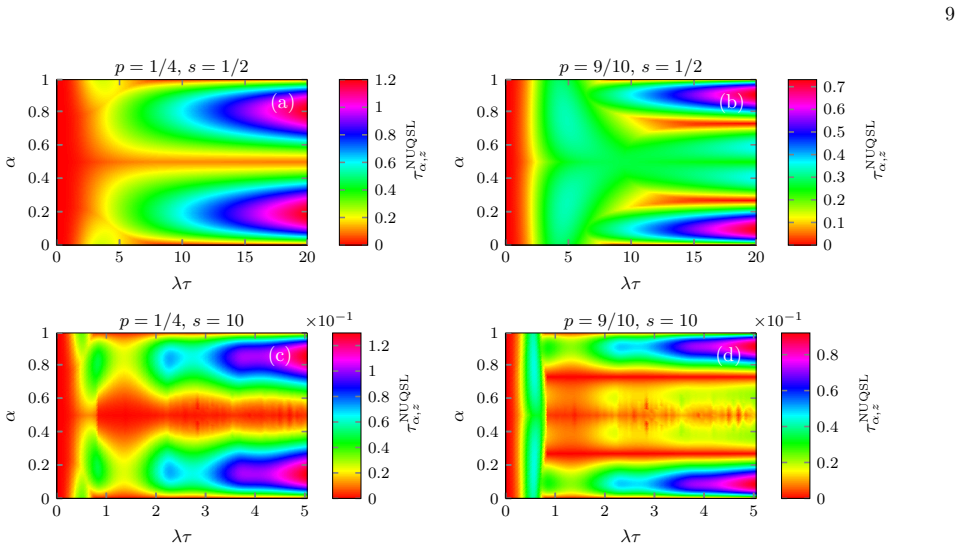
- In the depolarizing-channel example the speed limit nearly vanishes near $\alpha=1/2$, suggesting that the practically useful regime of this family may lie away from the symmetric relative-entropy branch.
- A natural testable extension is to check whether the same bounding strategy can be pushed beyond the data-processing-inequality region in the $(\alpha,z)$ plane, which the paper leaves open.
Signed reviews
Editorial analysis
A structured set of objections, weighed in public.
Referee Report
Summary. The manuscript proposes a two-parameter family of quantum speed limits based on α-z-Rényi relative entropies. The central result is Eq. (4), an upper bound on D_{α,z}(ρ_τ∥ρ_0) in terms of the time-averaged Schatten speed weighted by extremal-eigenvalue factors; from it the authors derive QSL times in Eqs. (11)–(13), specialize them to unitary and nonunitary dynamics in Eqs. (16)–(23), and illustrate them for single- and two-qubit systems. The paper claims validity for arbitrary finite-dimensional dynamics, including pure, mixed, separable, and entangled states.
Significance. If correct, the result would unify several entropic speed limits and extend the Petz-Rényi bounds of Ref. [56] to open systems using only minimal spectral information. The exposition is clear, and the analytical examples are explicit enough that the derivations can be checked directly. Unfortunately, the central inequality is false, and the proposed family of QSLs is therefore unsupported.
major comments (3)
- [Appendix B.1, Eq. (B3)] The derivation of the key bound inverts the lower bound (B5), Tr(ρ_t^α ρ_0^{1−α}) ≥ 1+(1−α) ln k_min(ρ_0). This inversion is valid only when the right-hand side is strictly positive. For any state with k_min(ρ_0) < exp(−1/(1−α)), the right-hand side is negative, so [g_{α,z}(ρ_t,ρ_0)]^{−1}, which is positive, cannot be bounded above by a negative number; for exact equality the bound is singular. This unstated positivity condition is not included in the theorem statements, and it is precisely the regime that the absolute value in Eq. (5) is meant to handle.
- [Eq. (4) and Sec. V.A.2] Equation (4) fails numerically for the paper's own depolarizing example. Take α=1/2, z=1, and r=3/4, for which k_min(ρ_0)=1/8 < e^{−2}. Using Eq. (31), D_{1/2,1}(ρ_∞∥ρ_0) = −2 ln[(√(1−r)+√(1+r))/2] ≈ 0.1855, while the right-hand side of Eq. (4) evaluates to h_{1/2,1}(ρ_0) ∫_0^∞ [k_min(ρ_t)]^{−1/2} ∥dρ_t/dt∥_1 dt ≈ 0.0525. Thus Eq. (4) asserts that a positive divergence is bounded above by a smaller positive number. Since Eqs. (6), (7), and the QSL times (11)–(13), (16)–(23) are all derived from Eq. (4) or from the same inversion step, the main results of the paper collapse.
- [Appendix B and Sec. IV] Appendix B begins by assuming that ρ_0 and ρ_t are full-rank, invertible density matrices, but the abstract and Sec. IV claim the speed limits hold for pure states and for arbitrary finite-dimensional dynamics. For pure states k_min=0, the factor [k_min(ρ_t)]^{α−1} diverges and the bound (B5) is not defined; no limiting argument is supplied. The domain of validity of the results is therefore narrower than claimed, independently of the algebraic error above.
minor comments (4)
- [Sec. V.A.2, discussion of Fig. 2] The text states that D_{1/2,z}(ρ_τ∥ρ_0) ≈ 0 for all τ ≥ 0, but Eq. (31) gives a finite asymptotic value, e.g., ≈ 0.185 for r=3/4; the numerical statement should be corrected.
- [Eq. (8)] Equation (8) restricts the result to 1/2 < z ≤ 1, while the stated data-processing-inequality region for α=1/2 includes z=1/2; please clarify whether the bound holds at the endpoint.
- [Eq. (B4)] The use of the Araki-Lieb-Thirring inequality would be easier to verify if the text explicitly listed the operators and parameters; as written, it is not immediately obvious that the choice A=ρ_0^{(1−α)/2}, B=ρ_t^α, q=z, r=1/z satisfies the hypotheses of the inequality for all z in the stated range.
- [References] Reference [107] contains a typo: 'Bathia' should be 'Bhatia'.
Circularity Check
No circularity: the QSL bound is derived analytically from contractivity and standard inequalities; the cited lemma [56] is a parameter-free prior result, not a redefinition of the target.
full rationale
The derivation chain is analytic and self-contained given standard inequalities and one parameter-free lemma from the authors' prior work. Eq. (4) follows from bounding |dD/dt| by the Schatten speed using Hölder and Araki–Lieb–Thirring inequalities; Eq. (11) is obtained by rearranging Eq. (4), so the QSL time is a mathematical consequence, not an independently fitted quantity. The cited lemma (B5) from Ref. [56] is a general lower bound on Tr(ρ_t^α ρ_0^{1−α}) that does not assume or encode Eq. (4), so invoking it is legitimate support even though an author overlaps. No parameter is fitted and no definition is chosen to force the bound. Separately, the inversion in Eq. (B3) requires positivity of 1+(1−α) ln kmin(ρ0), which is not stated; that is a correctness gap, not circularity, and therefore does not raise the circularity score.
Assumptions & free parameters
assumptions (5)
- standard math Integral representation of matrix powers ρ^s = sin(πs)/π ∫0∞ dx x^{s-1} ρ(ρ+xI)^{-1} for 0<s<1.
- standard math Araki-Lieb-Thirring inequality Tr[(A^r B^r A^r)^q] ≥ Tr[(A B A)^{r q}] for q≥0, r≥1.
- domain assumption Trace inequality Tr(ρ^α σ^{1-α}) ≥ 1 + (1-α) ln[kmin(σ)] for α∈(0,1), taken from Ref. [56].
- ad hoc to paper Positivity of 1+(1-α)ln[kmin(ρ0)].
- domain assumption α-z-RRE satisfies the data processing inequality for 0<α<1, 1≥z≥max{α,1-α}.
Cite this review
Pith. "Pith review of Generalized Entropic Quantum Speed Limits." pith.science (2026). https://pith.science/paper/HRGB53LC
@misc{pith2026250111049,
  author       = {Pith},
  title        = {Pith review of: Generalized Entropic Quantum Speed Limits},
  year         = {2026},
  howpublished = {\url{https://pith.science/paper/HRGB53LC}},
  note         = {Machine review of arXiv:2501.11049}
}
abstract
We present a class of generalized entropic quantum speed limits based on $\alpha$-$z$-R\'{e}nyi relative entropy, a real-valued, contractive, two-parameter family of distinguishability measures. The quantum speed limit (QSL) falls into the class of Mandelstam-Tamm bounds, and applies to finite-dimensional quantum systems that undergo a general physical process, i.e., their effective dynamics can be modeled by unitary or nonunitary evolutions. The results cover pure or mixed, separable, and entangled probe quantum states. The QSL time depends on the smallest and largest eigenvalues of the probe and instantaneous states of the system, and its evaluation requires low computational cost. In addition, it is inversely proportional to the time-average of the Schatten speed of the instantaneous state, which in turn is fully characterized by the considered dynamics. We specialize our results to the case of unitary and nonunitary evolutions. In the former case, the QSL scales with the inverse of the energy fluctuations, while the latter depends on the Schatten $1$-norm of the rate of change of the quantum channel Kraus operators. We illustrate our findings for single-qubit and two-qubit states, and unitary and nonunitary evolutions. Our results may find applications in the study of entropic uncertainty relations, quantum metrology, and also entanglement entropies signaled by generalized entropies.
Figures


Figures from the paper (3 more)


Reference graph
Works this paper leans on
-
[56]
Speed limits on correlations in bipartite quantum systems,
V. Pandey, D. Shrimali, B. Mohan, S. Das, and A. K. Pati, “Speed limits on correlations in bipartite quantum systems,” Phys. Rev. A 107, 052419 (2023)
work page 2023
-
[1]
Unitary evolution Let H = ⃗ n· ⃗ σbe the time-independent Hamiltonian of the two-level system, where ⃗ n= ( nx, ny, nz) is a three- dimensional vector. The unitary evolution is governed by the operator Ut = e−itH = cos(∥⃗ n∥t)I − i sin(∥⃗ n∥t)(ˆn · ⃗ σ), where ∥⃗ n∥2 = P l=x,y,z n2 l is the Euclidean norm, with ˆn = ⃗ n/∥⃗ n∥ and ∥ˆn∥ = 1. The instantaneo...
-
[2]
Here, I is the 2 × 2 identity matrix, σj is the jth Pauli matrix, and Γ defines the characteristic damping rate of the Markovian nonunitary process
Nonunitary evolution We consider the single-qubit state evolving under a depolarizing channel described by the time-dependent Kraus operators K0 = (1/2) √ 1 + 3e−Γt I, and K1,2,3 = (1/2) √ 1 − e−Γt σx,y,z , with P jK † j Kj = P jKjK † j = I [99]. Here, I is the 2 × 2 identity matrix, σj is the jth Pauli matrix, and Γ defines the characteristic damping rat...
-
[3]
Here {|0⟩, |1⟩} define the computational basis states in the complex two-dimensional vector space C2
(|0, 0⟩ + |1, 1⟩) is the Greenberger-Horne-Zeilinger (GHZ) state. Here {|0⟩, |1⟩} define the computational basis states in the complex two-dimensional vector space C2. The noisy processes of energy dissipation and decoherence are mod- eled by the amplitude-damping channel [102]. The in- stantaneous state of the two-qubits system is given by ρt = Et(ρ0) = ...
-
[4]
Quantum speed limits–primer, perspectives, and potential future directions,
M. R. Frey, “Quantum speed limits–primer, perspectives, and potential future directions,” Quantum Inf. Process. 15, 3919 (2016)
2016
-
[5]
Quantum speed limits: from Heisenberg’s uncertainty principle to optimal quan- tum control,
S. Deffner and S. Campbell, “Quantum speed limits: from Heisenberg’s uncertainty principle to optimal quan- tum control,” J. Phys. A: Math. Theor. 50, 453001 (2017)
2017
-
[6]
Bounds in nonequilibrium quantum dynamics,
Z. Gong and R. Hamazaki, “Bounds in nonequilibrium quantum dynamics,” Int. J. Mod. Phys. B 36, 2230007 (2022)
2022
-
[7]
Generalized Clausius Inequal- ity for Nonequilibrium Quantum Processes,
S. Deffner and E. Lutz, “Generalized Clausius Inequal- ity for Nonequilibrium Quantum Processes,” Phys. Rev. Lett. 105, 170402 (2010)
2010
Show all 113 references
-
[8]
Unifying speed limit, thermodynamic un- certainty relation and Heisenberg principle via bulk- boundary correspondence,
Y. Hasegawa, “Unifying speed limit, thermodynamic un- certainty relation and Heisenberg principle via bulk- boundary correspondence,” Nat. Commun. 14, 2828 (2023)
2023
-
[9]
Thermodynamic speed lim- its for mechanical work,
E. Aghion and J. R. Green, “Thermodynamic speed lim- its for mechanical work,” J. Phys. A: Math. Theor. 56, 05LT01 (2023)
2023
-
[10]
Geometric Speed Limit of Accessible Many-Body State Prepara- tion,
M. Bukov, D. Sels, and A. Polkovnikov, “Geometric Speed Limit of Accessible Many-Body State Prepara- tion,” Phys. Rev. X 9, 011034 (2019)
2019
-
[11]
Or- thogonality Catastrophe as a Consequence of the Quan- tum Speed Limit,
T. Fogarty, S. Deffner, T. Busch, and S. Campbell, “Or- thogonality Catastrophe as a Consequence of the Quan- tum Speed Limit,” Phys. Rev. Lett. 124, 110601 (2020)
2020
-
[12]
Oper- ational definition of a quantum speed limit,
Y. Shao, B. Liu, M. Zhang, H. Yuan, and J. Liu, “Oper- ational definition of a quantum speed limit,” Phys. Rev. Res. 2, 023299 (2020)
2020
-
[13]
Probing Quantum Speed Limits with Ultracold Gases,
A. del Campo, “Probing Quantum Speed Limits with Ultracold Gases,” Phys. Rev. Lett. 126, 180603 (2021)
2021
-
[14]
Demonstration of Quantum Brachis- tochrones between Distant States of an Atom,
M. R. Lam, N. Peter, T. Groh, W. Alt, C. Robens, D. Meschede, A. Negretti, S. Montangero, T. Calarco, and A. Alberti, “Demonstration of Quantum Brachis- tochrones between Distant States of an Atom,” Phys. Rev. X 11, 011035 (2021)
2021
-
[15]
Kibble-Zurek scaling in quantum speed limits for shortcuts to adia- baticity,
R. Puebla, S. Deffner, and S. Campbell, “Kibble-Zurek scaling in quantum speed limits for shortcuts to adia- baticity,” Phys. Rev. Res. 2, 032020 (2020)
2020
-
[16]
Advances in quantum metrology,
V. Giovannetti, S. Lloyd, and L. Maccone, “Advances in quantum metrology,” Nat. Photonics 5, 222 (2011)
2011
-
[17]
Reverse quantum speed limit: How slowly a quantum battery can discharge,
B. Mohan and A. K. Pati, “Reverse quantum speed limit: How slowly a quantum battery can discharge,” Phys. Rev. A 104, 042209 (2021)
2021
-
[18]
Minimal time required to charge a quantum system,
J.-Y. Gyhm, D. Rosa, and D. ˇSafr´ anek, “Minimal time required to charge a quantum system,” Phys. Rev. A 109, 022607 (2024)
2024
-
[19]
Connection between entanglement and the speed of quantum evolution,
J. Batle, M. Casas, A. Plastino, and A. R. Plastino, “Connection between entanglement and the speed of quantum evolution,” Phys. Rev. A 72, 032337 (2005)
2005
-
[20]
Breaking local quantum speed limits with steering,
Federico Centrone and Manuel Gessner, “Breaking local quantum speed limits with steering,” Phys. Rev. Res. 6, L042067 (2024)
2024
-
[21]
Quantum Speed Limits across the Quantum- to-Classical Transition,
B. Shanahan, A. Chenu, N. Margolus, and A. del Campo, “Quantum Speed Limits across the Quantum- to-Classical Transition,” Phys. Rev. Lett. 120, 070401 (2018)
2018
-
[22]
Quantum Speed Limit is Not Quantum,
M. Okuyama and M. Ohzeki, “Quantum Speed Limit is Not Quantum,” Phys. Rev. Lett. 120, 070402 (2018)
2018
-
[23]
Speed Limits for Macroscopic Transi- tions,
R. Hamazaki, “Speed Limits for Macroscopic Transi- tions,” PRX Quantum 3, 020319 (2022)
2022
-
[24]
Optimal Control at the Quantum Speed Limit,
T. Caneva, M. Murphy, T. Calarco, R. Fazio, S. Mon- tangero, V. Giovannetti, and G. E. Santoro, “Optimal Control at the Quantum Speed Limit,” Phys. Rev. Lett. 103, 240501 (2009)
2009
-
[25]
Quantum speed limit for robust state characterization and engineering,
K. Kobayashi and N. Yamamoto, “Quantum speed limit for robust state characterization and engineering,” Phys. Rev. A 102, 042606 (2020)
2020
-
[26]
Quantum speed limits in open systems: Non-Markovian dynamics with- out rotating-wave approximation,
Z. Sun, J. Liu, J. Ma, and X. Wang, “Quantum speed limits in open systems: Non-Markovian dynamics with- out rotating-wave approximation,” Sci. Rep. 5, 8444 (2015)
2015
-
[27]
Minimal evolution time and quantum speed limit of non-Markovian open sys- tems,
X. Meng, C. Wu, and H. Guo, “Minimal evolution time and quantum speed limit of non-Markovian open sys- tems,” Sci. Rep. 5, 16357 (2015)
2015
-
[28]
Quantum- speed-limit bounds in an open quantum evolution,
N. Mirkin, F. Toscano, and D. A. Wisniacki, “Quantum- speed-limit bounds in an open quantum evolution,” Phys. Rev. A 94, 052125 (2016)
2016
-
[29]
Role of non-Markovianity and backflow of information in the speed of quantum evolution,
M. Cianciaruso, S. Maniscalco, and G. Adesso, “Role of non-Markovianity and backflow of information in the speed of quantum evolution,” Phys. Rev. A 96, 012105 (2017)
2017
-
[30]
There is no general connection between the quantum speed limit and non-Markovianity,
J. Teittinen, H. Lyyra, and S. Maniscalco, “There is no general connection between the quantum speed limit and non-Markovianity,” New J. Phys. 21, 123041 (2019)
2019
-
[31]
Quantum Speed Limit and Divisibility of the Dynamical Map,
J. Teittinen and S. Maniscalco, “Quantum Speed Limit and Divisibility of the Dynamical Map,” Entropy23, 331 (2021)
2021
-
[32]
Quantum speed limit time of a non-hermitian two-level system,
Y.-Y. Wang and M.-F. Fang, “Quantum speed limit time of a non-hermitian two-level system,” Chin. Phys. B 29, 030304 (2020)
2020
-
[33]
Time scaling and quantum speed limit in non-Hermitian Hamiltonians,
F. Impens, F. M. D’Angelis, F. A. Pinheiro, and D. Gu´ ery-Odelin, “Time scaling and quantum speed limit in non-Hermitian Hamiltonians,” Phys. Rev. A 104, 052620 (2021)
2021
-
[34]
Generalised quantum speed limit for ar- bitrary time-continuous evolution,
D. Thakuria, A. Srivastav, B. Mohan, A. Kumari, and A. K. Pati, “Generalised quantum speed limit for ar- bitrary time-continuous evolution,” J. Phys. A: Math. Theor. 57, 025302 (2023)
2023
-
[35]
Speed limits and thermodynamic uncertainty relations for quantum systems governed by non-Hermitian Hamiltonian,
T. Nishiyama and Y. Hasegawa, “Speed limits and thermodynamic uncertainty relations for quantum systems governed by non-Hermitian Hamiltonian,” arXiv:2404.16392 (2024)
2024
-
[36]
Estimating the time evolution of NMR sys- tems via a quantum-speed-limit-like expression,
D. V. Villamizar, E. I. Duzzioni, A. C. S. Leal, and R. Auccaise, “Estimating the time evolution of NMR sys- tems via a quantum-speed-limit-like expression,” Phys. Rev. A 97, 052125 (2018)
2018
-
[37]
Experimental inves- tigation of geometric quantum speed limits in an open quantum system,
D. P. Pires, E. R. deAzevedo, D. O. Soares-Pinto, F. Brito, and J. G. Filgueiras, “Experimental inves- tigation of geometric quantum speed limits in an open quantum system,” Commun. Phys. 7, 142 (2024)
2024
-
[38]
Observing crossover between quantum speed limits,
G. Ness, M. R. Lam, W. Alt, D. Meschede, Y. Sagi, and A. Alberti, “Observing crossover between quantum speed limits,” Sci. Adv. 7, eabj9119 (2021). 17
2021
-
[39]
The uncertainty relation between energy and time in nonrelativistic quantum me- chanics,
L. Mandelstam and I. Tamm, “The uncertainty relation between energy and time in nonrelativistic quantum me- chanics,” in Selected papers (Springer, Berlin, Heidel- berg, 1991) pp. 115–123
1991
-
[40]
The maximum speed of dynamical evolution,
N. Margolus and L. B. Levitin, “The maximum speed of dynamical evolution,” Phys. D: Nonlinear Phenom. 120, 188 (1998)
1998
-
[41]
The role of entanglement in dynamical evolution,
V. Giovannetti, S. Lloyd, and L. Maccone, “The role of entanglement in dynamical evolution,” EPL 62, 615 (2003)
2003
-
[42]
Quantum limits to dynamical evolution,
V. Giovannetti, S. Lloyd, and L. Maccone, “Quantum limits to dynamical evolution,” Phys. Rev. A 67, 052109 (2003)
2003
-
[43]
Fundamental Limit on the Rate of Quantum Dynamics: The Unified Bound Is Tight,
L. B. Levitin and T. Toffoli, “Fundamental Limit on the Rate of Quantum Dynamics: The Unified Bound Is Tight,” Phys. Rev. Lett. 103, 160502 (2009)
2009
-
[44]
Geometry of quantum evolution,
J. Anandan and Y. Aharonov, “Geometry of quantum evolution,” Phys. Rev. Lett. 65, 1697 (1990)
1990
-
[45]
Quantum Speed Limit for States with a Bounded Energy Spectrum,
G. Ness, A. Alberti, and Y. Sagi, “Quantum Speed Limit for States with a Bounded Energy Spectrum,” Phys. Rev. Lett. 129, 140403 (2022)
2022
-
[46]
Quantum Speed Limit for Physical Pro- cesses,
M. M. Taddei, B. M. Escher, L. Davidovich, and R. L. de Matos Filho, “Quantum Speed Limit for Physical Pro- cesses,” Phys. Rev. Lett. 110, 050402 (2013)
2013
-
[47]
Quantum Speed Limits in Open System Dy- namics,
A. del Campo, I. L. Egusquiza, M. B. Plenio, and S. F. Huelga, “Quantum Speed Limits in Open System Dy- namics,” Phys. Rev. Lett. 110, 050403 (2013)
2013
-
[48]
Quantum Speed Limit for Non- Markovian Dynamics,
S. Deffner and E. Lutz, “Quantum Speed Limit for Non- Markovian Dynamics,” Phys. Rev. Lett. 111, 010402 (2013)
2013
-
[49]
Generalized Geometric Quantum Speed Limits,
D. P. Pires, M. Cianciaruso, L. C. C´ eleri, G. Adesso, and D. O. Soares-Pinto, “Generalized Geometric Quantum Speed Limits,” Phys. Rev. X 6, 021031 (2016)
2016
-
[50]
Ac- tion quantum speed limits,
E. O’Connor, G. Guarnieri, and S. Campbell, “Ac- tion quantum speed limits,” Phys. Rev. A 103, 022210 (2021)
2021
-
[51]
Geometric quantum speed limits for Markovian dynamics in open quantum sys- tems,
K. Lan, S. Xie, and X. Cai, “Geometric quantum speed limits for Markovian dynamics in open quantum sys- tems,” New J. Phys. 24, 055003 (2022)
2022
-
[52]
Tight and attainable quantum speed limit for open systems,
Z.-Y. Mai and C.-S. Yu, “Tight and attainable quantum speed limit for open systems,” Phys. Rev. A 108, 052207 (2023)
2023
-
[53]
Quantum speed limits for information and coherence,
B. Mohan, S. Das, and A. K. Pati, “Quantum speed limits for information and coherence,” New J. Phys. 24, 065003 (2022)
2022
-
[54]
Resource speed limits: maximal rate of resource varia- tion,
F. Campaioli, C.-S. Yu, F. A. Pollock, and K. Modi, “Resource speed limits: maximal rate of resource varia- tion,” New J. Phys. 24, 065001 (2022)
2022
-
[55]
Fundamental speed limits on entanglement dynamics of bipartite quantum systems,
V. Pandey, S. Bhowmick, B. Mohan, Sohail, and U. Sen, “Fundamental speed limits on entanglement dynamics of bipartite quantum systems,” arXiv:2303.07415 (2023)
2023
-
[57]
Relative purity, speed of fluctuations, and bounds on equilibration times,
D. P. Pires and T. R. de Oliveira, “Relative purity, speed of fluctuations, and bounds on equilibration times,” Phys. Rev. A 104, 052223 (2021)
2021
-
[58]
Unified entropies and quantum speed lim- its for nonunitary dynamics,
D. P. Pires, “Unified entropies and quantum speed lim- its for nonunitary dynamics,” Phys. Rev. A 106, 012403 (2022)
2022
-
[59]
Bounding gener- alized relative entropies: Nonasymptotic quantum speed limits,
D. P. Pires, K. Modi, and L. C. C´ eleri, “Bounding gener- alized relative entropies: Nonasymptotic quantum speed limits,” Phys. Rev. E 103, 032105 (2021)
2021
-
[60]
Symmetric Petz-R´ enyi relative entropy uncertainty relation,
D. S. P. Salazar, “Symmetric Petz-R´ enyi relative entropy uncertainty relation,” arXiv:2402.01390 (2024)
2024 arXiv
-
[61]
Entropic Energy-Time Uncertainty Re- lation,
P. J. Coles, V. Katariya, S. Lloyd, I. Marvian, and M. M. Wilde, “Entropic Energy-Time Uncertainty Re- lation,” Phys. Rev. Lett. 122, 100401 (2019)
2019
-
[62]
α-z-R´ enyi relative entropies,
K. M. R. Audenaert and N. Datta, “ α-z-R´ enyi relative entropies,” J. Math. Phys. 56, 022202 (2015)
2015
-
[63]
Equality conditions of data processing in- equality for α-z R´ enyi relative entropies,
H. Zhang, “Equality conditions of data processing in- equality for α-z R´ enyi relative entropies,” J. Math. Phys. 61, 102201 (2020)
2020
-
[64]
Inequal- ities for quantum divergences and the Audenaert-Datta conjecture,
E. A. Carlen, R. L. Frank, and E. H. Lieb, “Inequal- ities for quantum divergences and the Audenaert-Datta conjecture,” J. Phys. A: Math. Theor. 51, 483001 (2018)
2018
-
[65]
Family of coherence measures and duality between quantum coherence and path distinguishability,
C. Xiong, A. Kumar, and J. Wu, “Family of coherence measures and duality between quantum coherence and path distinguishability,” Phys. Rev. A98, 032324 (2018)
2018
-
[66]
Comparison of Quantum Channels by Super- channels,
G. Gour, “Comparison of Quantum Channels by Super- channels,” IEEE Trans. Inf. Theory 65, 5880 (2019)
2019
-
[67]
Dis- tinguishing Random and Black Hole Microstates,
J. Kudler-Flam, V. Narovlansky, and S. Ryu, “Dis- tinguishing Random and Black Hole Microstates,” PRX Quantum 2, 040340 (2021)
2021
-
[68]
From Wigner-Yanase-Dyson conjecture to Carlen-Frank-Lieb conjecture,
H. Zhang, “From Wigner-Yanase-Dyson conjecture to Carlen-Frank-Lieb conjecture,” Adv. Math. 365, 107053 (2020)
2020
-
[69]
Strong con- verse theorems using R´ enyi entropies,
F. Leditzky, M. M. Wilde, and N. Datta, “Strong con- verse theorems using R´ enyi entropies,” J. Math. Phys. 57, 082202 (2016)
2016
-
[70]
The second laws of quantum thermodynam- ics,
F. Brand˜ ao, M. Horodecki, N. Ng, J. Oppenheim, and S. Wehner, “The second laws of quantum thermodynam- ics,” Proc. Natl. Acad. Sci. 112, 3275 (2015)
2015
-
[71]
Quantum work statistics and resource theories: Bridging the gap through R´ enyi diver- gences,
G. Guarnieri, N. H. Y. Ng, K. Modi, J. Eisert, M. Pa- ternostro, and J. Goold, “Quantum work statistics and resource theories: Bridging the gap through R´ enyi diver- gences,” Phys. Rev. E 99, 050101 (2019)
2019
-
[72]
Critical Examination of Incoherent Operations and a Physically Consistent Re- source Theory of Quantum Coherence,
E. Chitambar and G. Gour, “Critical Examination of Incoherent Operations and a Physically Consistent Re- source Theory of Quantum Coherence,” Phys. Rev. Lett. 117, 030401 (2016)
2016
-
[73]
Maximal coherence and the resource theory of purity,
A. Streltsov, H. Kampermann, S. W¨ olk, M. Gessner, and D. Bruß, “Maximal coherence and the resource theory of purity,” New J. Phys. 20, 053058 (2018)
2018
-
[74]
Relating rela- tive R´ enyi entropies and Wigner-Yanase-Dyson skew in- formation to generalized multiple quantum coherences,
D. P. Pires, A. Smerzi, and T. Macr ` ı, “Relating rela- tive R´ enyi entropies and Wigner-Yanase-Dyson skew in- formation to generalized multiple quantum coherences,” Phys. Rev. A 102, 012429 (2020)
2020
-
[75]
Quasi-entropies for finite quantum systems,
D. Petz, “Quasi-entropies for finite quantum systems,” Rep. Math. Phys. 23, 57 (1986)
1986
-
[76]
On the Quantum R´ enyi Rel- ative Entropies and Related Capacity Formulas,
M. Mosonyi and F. Hiai, “On the Quantum R´ enyi Rel- ative Entropies and Related Capacity Formulas,” IEEE Trans. Inf. Theory 57, 2474 (2011)
2011
-
[77]
On quantum R´ enyi entropies: A new generalization and some properties,
M. M¨ uller-Lennert, F. Dupuis, O. Szehr, S. Fehr, and M. Tomamichel, “On quantum R´ enyi entropies: A new generalization and some properties,” J. Math. Phys. 54, 122203 (2013)
2013
-
[78]
Strong con- verse for the classical capacity of entanglement-breaking and Hadamard channels via a sandwiched R´ enyi relative entropy,
M. M. Wilde, A. Winter, and D. Yang, “Strong con- verse for the classical capacity of entanglement-breaking and Hadamard channels via a sandwiched R´ enyi relative entropy,” Commun. Math. Phys. 331, 593 (2014)
2014
-
[79]
Monotonicity of a relative R´ enyi entropy,
R. L. Frank and E. H. Lieb, “Monotonicity of a relative R´ enyi entropy,” J. Math. Phys.54, 122201 (2013)
2013
-
[80]
A limit of the quantum R´ enyi divergence,
N. Datta and F. Leditzky, “A limit of the quantum R´ enyi divergence,” J. Phys. A: Math. Theor.47, 045304 (2014)
2014
-
[81]
Min- and Max-Relative Entropies and a New Entanglement Monotone,
N. Datta, “Min- and Max-Relative Entropies and a New Entanglement Monotone,” IEEE Trans. Inf. Theory 55, 18 2816 (2009)
2009
-
[82]
R´ enyi Divergence and Kullback-Leibler Divergence,
T. van Erven and P. Harremos, “R´ enyi Divergence and Kullback-Leibler Divergence,” IEEE Trans. Inf. Theory 60, 3797 (2014)
2014
-
[83]
Maximum Relative Entropy of Coherence: An Opera- tional Coherence Measure,
K. Bu, U. Singh, S.-M. Fei, A. K. Pati, and J. Wu, “Maximum Relative Entropy of Coherence: An Opera- tional Coherence Measure,” Phys. Rev. Lett.119, 150405 (2017)
2017
-
[84]
Quan- tum Coherence Quantifiers Based on R´ enyi α-Relative Entropy,
L.-H. Shao, Y.-M. Li, Y. Luo, and Z.-J. Xi, “Quan- tum Coherence Quantifiers Based on R´ enyi α-Relative Entropy,” Commun. Theor. Phys. 67, 631 (2017)
2017
-
[85]
Quantifying Entanglement,
V. Vedral, M. B. Plenio, M. A. Rippin, and P. L. Knight, “Quantifying Entanglement,” Phys. Rev. Lett. 78, 2275 (1997)
1997
-
[86]
Information-Theoretical Bound of the Irreversibility in Thermal Relaxation Pro- cesses,
N. Shiraishi and K. Saito, “Information-Theoretical Bound of the Irreversibility in Thermal Relaxation Pro- cesses,” Phys. Rev. Lett. 123, 110603 (2019)
2019
-
[87]
Quantum work statistics close to equilibrium,
M. Scandi, H. J. D. Miller, J. Anders, and M. Perarnau- Llobet, “Quantum work statistics close to equilibrium,” Phys. Rev. Res. 2, 023377 (2020)
2020
-
[88]
Work, Entropy Pro- duction, and Thermodynamics of Information under Pro- tocol Constraints,
A. Kolchinsky and D. H. Wolpert, “Work, Entropy Pro- duction, and Thermodynamics of Information under Pro- tocol Constraints,” Phys. Rev. X 11, 041024 (2021)
2021
-
[89]
Extending Noether’s theorem by quantifying the asymmetry of quantum states,
I. Marvian and R. W. Spekkens, “Extending Noether’s theorem by quantifying the asymmetry of quantum states,” Nat. Commun. 5, 3821 (2014)
2014
-
[90]
Bengtsson and K
I. Bengtsson and K. ˙Zyczkowski, Geometry of Quan- tum States: An Introduction to Quantum Entanglement (Cambridge University Press, Cambridge, 2006)
2006
-
[91]
Statistical speed of quan- tum states: Generalized quantum Fisher information and Schatten speed,
M. Gessner and A. Smerzi, “Statistical speed of quan- tum states: Generalized quantum Fisher information and Schatten speed,” Phys. Rev. A 97, 022109 (2018)
2018
-
[92]
Geometric quantum speed limits: a case for Wigner phase space,
S. Deffner, “Geometric quantum speed limits: a case for Wigner phase space,” New. J. Phys. 19, 103018 (2017)
2017
-
[93]
Speed limit for open quantum systems,
K. Funo, N. Shiraishi, and K. Saito, “Speed limit for open quantum systems,” New J. Phys.21, 013006 (2019)
2019
-
[94]
Geometrical Bounds of the Irreversibility in Markovian Systems,
T. Van Vu and Y. Hasegawa, “Geometrical Bounds of the Irreversibility in Markovian Systems,” Phys. Rev. Lett. 126, 010601 (2021)
2021
-
[95]
Speed limits of the trace distance for open quantum system,
S. Nakajima and Y. Utsumi, “Speed limits of the trace distance for open quantum system,” New J. Phys. 24, 095004 (2022)
2022
-
[96]
Quantum speed limits based on Schatten norms: Uni- versality and tightness,
A. J. B. Rosal, D. O. Soares-Pinto, and D. P. Pires, “Quantum speed limits based on Schatten norms: Uni- versality and tightness,” Phys. Lett. A 534, 130250 (2025)
2025
-
[97]
Generalized Coherent Quantum Speed Limits,
H. Wang and X. Qiu, “Generalized Coherent Quantum Speed Limits,” arXiv:2401.01746 (2024)
2024
-
[98]
Random Bosonic States for Robust Quantum Metrology,
M. Oszmaniec, R. Augusiak, C. Gogolin, J. Ko lody´ nski, A. Ac ´ ın, and M. Lewenstein, “Random Bosonic States for Robust Quantum Metrology,” Phys. Rev. X6, 041044 (2016)
2016
-
[99]
Quantum Fisher Information as the Convex Roof of Variance,
S. Yu, “Quantum Fisher Information as the Convex Roof of Variance,” arXiv:1302.5311
-
[100]
Extremal properties of the vari- ance and the quantum Fisher information,
G. T´ oth and D. Petz, “Extremal properties of the vari- ance and the quantum Fisher information,” Phys. Rev. A 87, 032324 (2013)
2013
-
[101]
Lower bounds on the quantum Fisher infor- mation based on the variance and various types of en- tropies,
G. T´ oth, “Lower bounds on the quantum Fisher infor- mation based on the variance and various types of en- tropies,” arXiv:1701.07461
-
[102]
M. A. Nielsen and I. L. Chuang, Quantum Computation and Quantum Information: 10th Anniversary Edition (Cambridge University Press, 2010)
2010
-
[103]
Observable Measure of Quantum Coher- ence in Finite Dimensional Systems,
D. Girolami, “Observable Measure of Quantum Coher- ence in Finite Dimensional Systems,” Phys. Rev. Lett. 113, 170401 (2014)
2014
-
[104]
Quan- tum computers and dissipation,
G. M. Palma, K.-A. Suominen, and A. Ekert, “Quan- tum computers and dissipation,” Proc. R. Soc. Lond. A: Math. Phys. Eng. Sci. 452, 567 (1996)
1996
-
[105]
Deco- herence of quantum registers,
J. H. Reina, L. Quiroga, and N. F. Johnson, “Deco- herence of quantum registers,” Phys. Rev. A 65, 032326 (2002)
2002
-
[106]
Breuer and F
H.-P. Breuer and F. Petruccione, The Theory of Open Quantum Systems (Oxford University Press, 2007)
2007
-
[107]
Quantifying, characterizing, and controlling information flow in ultracold atomic gases,
P. Haikka, S. McEndoo, G. De Chiara, G. M. Palma, and S. Maniscalco, “Quantifying, characterizing, and controlling information flow in ultracold atomic gases,” Phys. Rev. A 84, 031602 (2011)
2011
-
[108]
Unified ( r, s)- Relative Entropy,
J. Wang, J. Wu, and C Minhyung, “Unified ( r, s)- Relative Entropy,” Int. J. Theor. Phys. 50, 1282 (2010)
2010
-
[109]
Thermodynamic uncertainty rela- tion for quantum entropy production,
D. S. P. Salazar, “Thermodynamic uncertainty rela- tion for quantum entropy production,” arXiv:2404.18163 (2024)
2024 arXiv
-
[110]
Bathia, Matrix Analysis (Springer-Verlag, New York, 1997)
R. Bathia, Matrix Analysis (Springer-Verlag, New York, 1997)
1997
-
[111]
On an inequality of Lieb and Thirring,
H. Araki, “On an inequality of Lieb and Thirring,” Lett. in Math. Phys. 19, 167–170 (1990)
1990
-
[112]
Inequalities for the Mo- ments of the Eigenvalues of the Schr¨ odinger Hamiltonian and their Relation to Sobolev Inequalities,
E. H. Lieb and W. E. Thirring, “Inequalities for the Mo- ments of the Eigenvalues of the Schr¨ odinger Hamiltonian and their Relation to Sobolev Inequalities,” in Inequal- ities: Selecta of Elliott H. Lieb , edited by M. Loss and M. B. Ruskai (Springer, Berlin, 2002) pp. 203–237
2002
-
[113]
Watrous, The theory of quantum information (Cam- bridge University Press, Oxford, 2018)
J. Watrous, The theory of quantum information (Cam- bridge University Press, Oxford, 2018)
2018
Reviewed August 10, 2026 · model on record in the stance chip above.
Discussion (0). Continue with ORCID to comment.