Pulsar Wind Nebulae (PWNe) -- A Review
Pith reviewed 2026-06-27 12:17 UTC · model grok-4.3
The pith
Recent theoretical progress explains the spectral and spatial features of several pulsar wind nebulae.
A machine-rendered reading of the paper's core claim, the machinery that carries it, and where it could break.
Core claim
The paper states that recent progress in theoretical studies has provided the capability to explain broadband observations of several PWNe including their spectral and spatial features, while the particle acceleration processes at the termination shock and elsewhere within the PWN remain to be understood.
What carries the argument
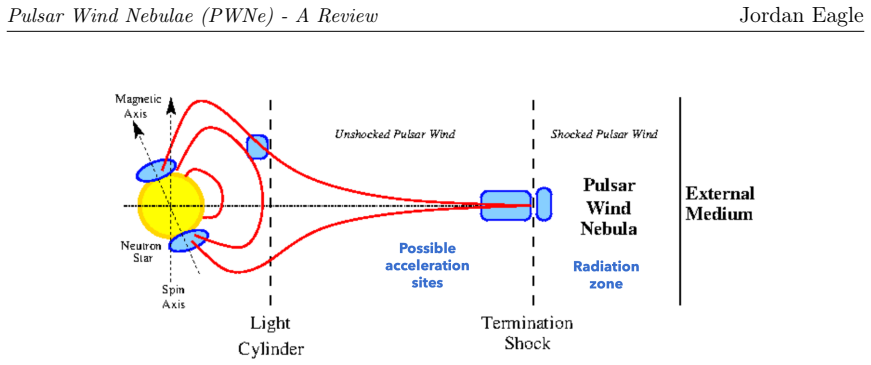
The termination shock, the site where the relativistic pulsar wind is decelerated and particles receive their energy before they radiate via synchrotron emission in the nebular magnetic field and inverse Compton scattering on ambient photon fields.
If this is right
- Theoretical models now account for both the energy spectra and the spatial distributions observed in multiple PWNe across radio, X-ray, and gamma-ray bands.
- Synchrotron emission from radio to X-rays and inverse Compton emission from MeV to TeV can be jointly explained for several objects.
- The main open problem is the detailed physics of particle acceleration at the termination shock.
- Future gamma-ray instruments are expected to provide the measurements that will distinguish among competing acceleration scenarios.
Where Pith is reading between the lines
- Better PWN models could improve estimates of the energy transferred from pulsars to their surroundings and the contribution of such nebulae to Galactic cosmic rays.
- If gamma-ray data reveal acceleration sites away from the termination shock, models will need to incorporate additional processes such as turbulence or magnetic reconnection inside the nebula.
- Successful modeling of individual PWNe may allow observers to use nebular properties to infer otherwise hidden parameters of the central pulsar.
Load-bearing premise
The reviewed recent literature accurately and representatively captures the current state of PWN modeling, and gamma-ray astronomy will supply the key data needed to resolve remaining questions on particle acceleration.
What would settle it
A high-resolution gamma-ray spectrum or image of a well-studied PWN that cannot be reproduced by any current theoretical model that already matches its radio-to-X-ray data.
Figures
read the original abstract
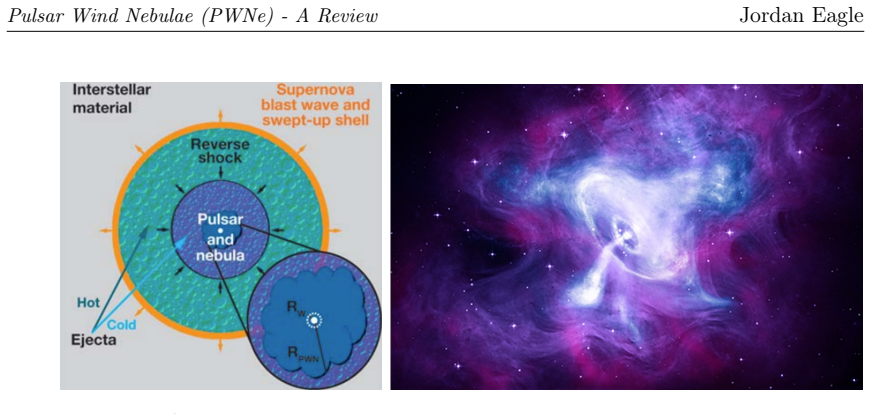
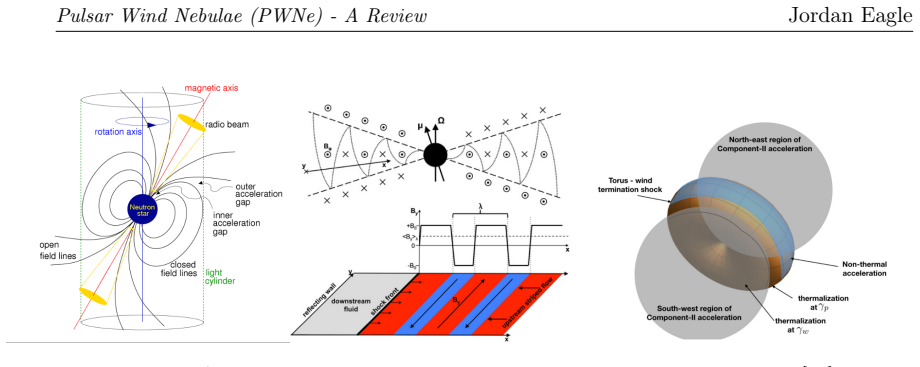
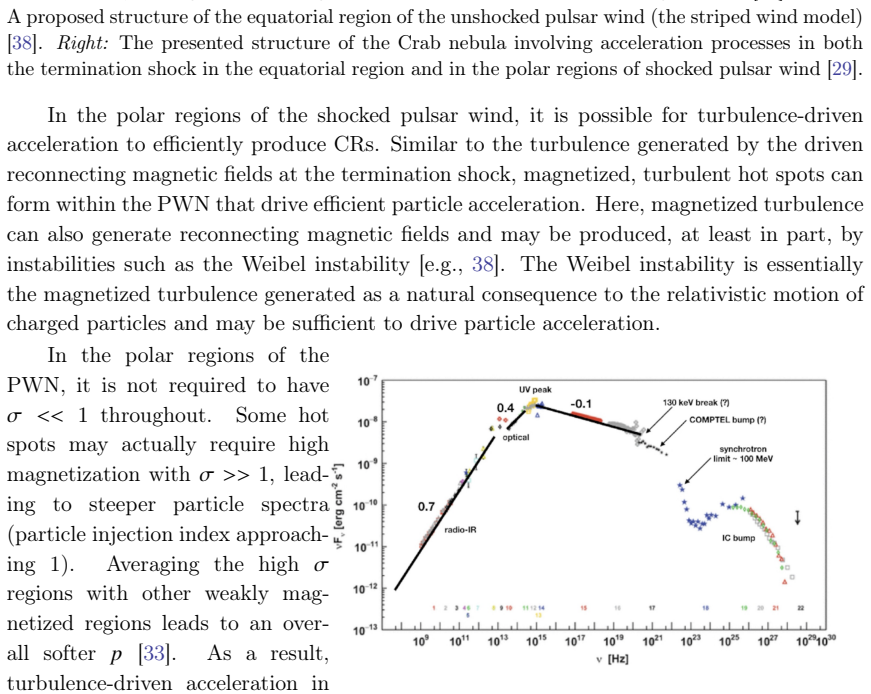
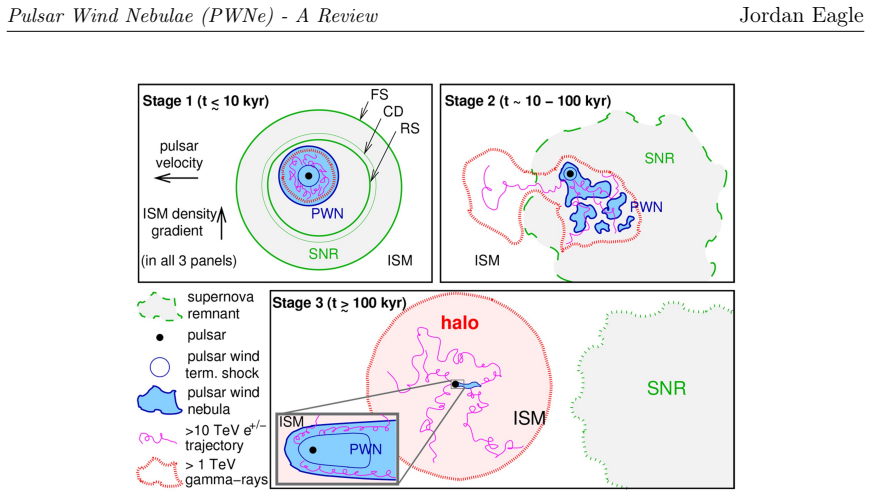
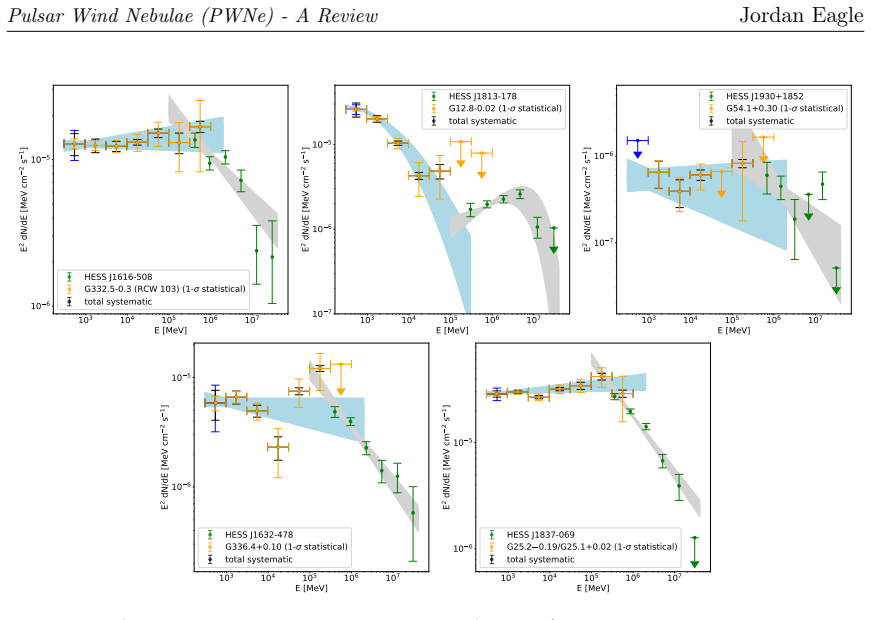
Pulsar Wind Nebulae (PWNe) are relativistic, magnetic winds comprised of radiating electrons and positrons, powered by an energetic pulsar. The pulsar continuously injects particles into the PWN that are accelerated at the termination shock. As the relativistic particles enter the PWN, they radiate away the energy received at the shock as they interact with the PWN environment, generating synchrotron emission from interactions with the magnetic field of the PWN and Inverse Compton Scattering (ICS) from interactions with the local photon fields. Synchrotron emission is observed from the majority of known PWNe from radio to X-ray energies, and the ICS is observed in the $\gamma$-ray bands, from MeV to TeV energies. The particle acceleration processes at the termination shock and elsewhere within the PWN remain to be understood. Recent progress in theoretical studies have provided the capability to explain broadband observations of several PWNe including their spectral and spatial features. This work reviews some of the most compelling outcomes of recent literature, outlining the outstanding questions that remain to be answered, and how the future prospects of $\gamma$-ray astronomy will be instrumental in advancing the current understanding of PWNe.
Editorial analysis
A structured set of objections, weighed in public.
Referee Report
Summary. This manuscript is a review of Pulsar Wind Nebulae (PWNe), which are relativistic magnetic winds powered by pulsars. It describes particle injection and acceleration at the termination shock, subsequent radiation via synchrotron emission (radio to X-ray) and inverse Compton scattering (MeV to TeV gamma rays), and states that recent theoretical progress now accounts for the broadband spectral and spatial features observed in several PWNe. The review outlines remaining open questions on acceleration mechanisms and argues that future gamma-ray astronomy will be key to further advances.
Significance. If the review faithfully and representatively summarizes the cited literature, it would provide a useful synthesis for the high-energy astrophysics community by consolidating recent modeling advances and highlighting testable open problems. The forward-looking emphasis on gamma-ray instruments aligns with ongoing observational developments.
minor comments (1)
- [Abstract] Abstract: The sentence beginning 'Recent progress in theoretical studies have provided...' contains a subject-verb agreement error ('progress' is singular and requires 'has provided').
Simulated Author's Rebuttal
We thank the referee for their positive assessment of the manuscript, the recognition of its potential utility to the high-energy astrophysics community, and the recommendation for minor revision. No specific major comments were provided in the report.
Circularity Check
No significant circularity; review summarizes external literature without derivations
full rationale
This is a review paper with no original derivations, equations, predictions, or load-bearing claims derived from self-citations. The central statements are literature summaries (e.g., 'Recent progress in theoretical studies have provided the capability to explain broadband observations'), not self-contained results that reduce to inputs by construction. No self-definitional steps, fitted predictions, or ansatz smuggling occur. The paper is self-contained as an external survey and receives the default non-finding.
Axiom & Free-Parameter Ledger
Reference graph
Works this paper leans on
-
[1]
A., Ajello, M., Allafort, A., et al
Abdo, A. A., Ajello, M., Allafort, A., et al. 2013, ApJS, 208, 17, doi:10.1088/ 0067-0049/208/2/17
2013
-
[2]
2013, ApJ, 773, 77, doi:10.1088/ 0004-637X/773/1/77
Acero, F., Ackermann, M., Ajello, M., et al. 2013, ApJ, 773, 77, doi:10.1088/ 0004-637X/773/1/77
2013
-
[3]
B., Bangale, P., et al
Acharyya, A., Adams, C. B., Bangale, P., et al. 2024, ApJ, 974, 61, doi:10.3847/ 1538-4357/ad698d
2024
-
[4]
2011, ApJ, 726, 35, doi:10.1088/ 0004-637X/726/1/35
Ackermann, M., Ajello, M., Baldini, L., et al. 2011, ApJ, 726, 35, doi:10.1088/ 0004-637X/726/1/35
2011
-
[5]
2020, ApJ, 897, 33, doi:10.3847/1538-4357/ab9368
Arakawa, M., Hayashida, M., Khangulyan, D., & Uchiyama, Y. 2020, ApJ, 897, 33, doi:10.3847/1538-4357/ab9368
-
[6]
Fermi Large Area Telescope Fourth Source Catalog Data Release 4 (4FGL-DR4)
Ballet, J., Bruel, P., Burnett, T. H., Lott, B., & The Fermi-LAT collaboration. 2023, arXiv e-prints, arXiv:2307.12546, doi:10.48550/arXiv.2307.12546
work page internal anchor Pith review Pith/arXiv arXiv doi:10.48550/arxiv.2307.12546 2023
-
[7]
Cao, Z., Aharonian, F., An, Q., et al. 2024, ApJS, 271, 25, doi:10.3847/1538-4365/ acfd29
-
[8]
C., Slane, P
de Jager, O. C., Slane, P. O., & LaMassa, S. 2008, ApJL, 689, L125, doi:10.1086/ 595959
2008
-
[9]
2018, A&A, 617, A5, doi:10.1051/ 0004-6361/201833008
Devin, J., Acero, F., Ballet, J., & Schmid, J. 2018, A&A, 617, A5, doi:10.1051/ 0004-6361/201833008
2018
-
[12]
2024, in Multifrequency Behaviour of High Energy Cosmic Sources XIV, 42 14 Pulsar Wind Nebulae (PWNe) - A ReviewJordan Eagle
Eagle, J., Castro, D., Mahhov, P., et al. 2024, in Multifrequency Behaviour of High Energy Cosmic Sources XIV, 42 14 Pulsar Wind Nebulae (PWNe) - A ReviewJordan Eagle
2024
-
[13]
Eagle, J., Hare, J., Hays, E., et al. 2024, ApJ, 975, 247, doi:10.3847/1538-4357/ ad85ca
-
[14]
2025, ApJ, 989, 110, doi:10.3847/1538-4357/ade8f0
Fermi-LAT Collaboration, Acharyya, A., Adelfio, A., et al. 2025, ApJ, 989, 110, doi:10.3847/1538-4357/ade8f0
-
[15]
Fiori, M., Olmi, B., Amato, E., et al. 2022, MNRAS, 511, 1439, doi:10.1093/mnras/ stac019
-
[16]
Measuring Average Treatment Effect from Heavy-tailed Data
Gaensler, B. M., & Slane, P. O. 2006, ARAA, 44, 17, doi:10.1146/annurev.astro. 44.051905.092528
work page internal anchor Pith review Pith/arXiv arXiv doi:10.1146/annurev.astro 2006
-
[17]
2019, BAAS, 51, 513
Gelfand, J., Wadiasingh, Z., Kargaltsev, O., et al. 2019, BAAS, 51, 513
2019
-
[18]
D., Slane, P
Gelfand, J. D., Slane, P. O., & Zhang, W. 2009, ApJ, 703, 2051, doi:10.1088/ 0004-637X/703/2/2051
2009
-
[19]
Giacinti, G., Mitchell, A. M. W., López-Coto, R., et al. 2020, A&A, 636, A113, doi:10. 1051/0004-6361/201936505
2020
-
[20]
H. E. S. S. Collaboration, Abramowski, A., Acero, F., et al. 2012, A&A, 548, A46, doi:10.1051/0004-6361/201219814
-
[21]
2012, A&A, 545, L2, doi:10.1051/0004-6361/201219906
—. 2012, A&A, 545, L2, doi:10.1051/0004-6361/201219906
-
[22]
H. E. S. S. Collaboration, Abdalla, H., Abramowski, A., et al. 2018, A&A, 612, A1, doi:10.1051/0004-6361/201732098
-
[23]
A., Funk, S., Parsons, R
Hinton, J. A., Funk, S., Parsons, R. D., & Ohm, S. 2011, ApJL, 743, L7, doi:10.1088/ 2041-8205/743/1/L7
2011
-
[24]
2023, arXiv e-prints, arXiv:2305.12888, doi:10.48550/ arXiv.2305.12888
Hofmann, W., & Zanin, R. 2023, arXiv e-prints, arXiv:2305.12888, doi:10.48550/ arXiv.2305.12888
arXiv 2023
-
[25]
Huentemeyer, P., BenZvi, S., Dingus, B., et al. 2019, in Bulletin of the American Astronomical Society, Vol. 51, 109, doi:10.48550/arXiv.1907.07737
work page internal anchor Pith review Pith/arXiv arXiv doi:10.48550/arxiv.1907.07737 2019
-
[26]
2025, ApJ, 988, 200, doi:10.3847/1538-4357/ade713
Lange, A., Eagle, J., Kargaltsev, O., Kuiper, L., & Hare, J. 2025, ApJ, 988, 200, doi:10.3847/1538-4357/ade713
-
[27]
R., & Kramer, M
Lorimer, D. R., & Kramer, M. 2012, Handbook of Pulsar Astronomy
2012
-
[28]
1088/1475-7516/2022/08/013
Lucchetta, G., Ackermann, M., Berge, D., &Bühler, R.2022, JCAP,2022, 013, doi:10. 1088/1475-7516/2022/08/013
2022
-
[29]
2019, MNRAS, 489, 2403, doi:10
Lyutikov, M., Temim, T., Komissarov, S., et al. 2019, MNRAS, 489, 2403, doi:10. 1093/mnras/stz2023
2019
-
[30]
2009, PRD, 80, 063005, doi:10.1103/ PhysRevD.80.063005 15 Pulsar Wind Nebulae (PWNe) - A ReviewJordan Eagle
Malyshev, D., Cholis, I., & Gelfand, J. 2009, PRD, 80, 063005, doi:10.1103/ PhysRevD.80.063005 15 Pulsar Wind Nebulae (PWNe) - A ReviewJordan Eagle
2009
-
[31]
Mitchell, A. M. W., & Gelfand, J. 2022, in Handbook of X-ray and Gamma-ray Astro- physics, ed. C. Bambi & A. Sangangelo, 61, doi:10.1007/978-981-16-4544-0_157-1
-
[32]
L., Abdo, A
Nolan, P. L., Abdo, A. A., Ackermann, M., et al. 2012, ApJS, 199, 31, doi:10.1088/ 0067-0049/199/2/31
2012
-
[33]
S., & Keppens, R
Porth, O., Komissarov, S. S., & Keppens, R. 2014, MNRAS, 438, 278, doi:10.1093/ mnras/stt2176
2014
-
[34]
Principe, G., Mitchell, A. M. W., Caroff, S., et al. 2020, A&A, 640, A76, doi:10.1051/ 0004-6361/202038375
2020
-
[35]
P., Pavlov, G
Reynolds, S. P., Pavlov, G. G., Kargaltsev, O., et al. 2017, SSR, 207, 175, doi:10. 1007/s11214-017-0356-6
2017
-
[36]
2017, in American Institute of Physics Conference Series, Vol
Saito, S., Khangulyan, D., Hagiwara, K., & Uchiyama, Y. 2017, in American Institute of Physics Conference Series, Vol. 1792, 6th International Symposium on High Energy Gamma-Ray Astronomy, 040013, doi:10.1063/1.4968917
-
[37]
2017, Particle Acceleration in Pulsar Wind Nebulae: PIC Modelling, ed
Sironi, L., & Cerutti, B. 2017, Particle Acceleration in Pulsar Wind Nebulae: PIC Modelling, ed. D. F. Torres, Vol. 446, 247, doi:10.1007/978-3-319-63031-1_11
-
[38]
2011, ApJ, 741, 39, doi: 10.1088/0004-637X/741/1/39
Sironi, L., & Spitkovsky, A. 2011, ApJ, 741, 39, doi:10.1088/0004-637X/741/1/39
-
[39]
Handbook of Supernovae , year = 2017, editor =
Slane, P. 2017, in Handbook of Supernovae, ed. A. W. Alsabti & P. Murdin, 2159, doi:10.1007/978-3-319-21846-5_95
-
[40]
2008, ApJL, 682, L5, doi:10.1086/590248
Spitkovsky, A. 2008, ApJL, 682, L5, doi:10.1086/590248
-
[41]
Temim, T., Slane, P., Kolb, C., et al. 2015, ApJ, 808, 100, doi:10.1088/0004-637X/ 808/1/100
-
[42]
F., Cillis, A., Mart´ ın, J., & de O˜ na Wilhelmi, E
Torres, D. F., Cillis, A., Martín, J., & de Oña Wilhelmi, E. 2014, Journal of High Energy Astrophysics, 1, 31, doi:10.1016/j.jheap.2014.02.001
-
[43]
P., & Horan, D
Wakely, S. P., & Horan, D. 2008, International Cosmic Ray Conference, 3, 1341 DISCUSSION BIRENDRA CHHOTARAY:Are PWNe found in X-ray binaries? If yes, how does the PWN affect the companion? JORDAN EAGLE:Here, we do not discuss PWNe that are part of binary systems, but in general, yes, there are PWNe in binary systems including X-ray binaries. In these syst...
2008
discussion (0)
Sign in with ORCID, Apple, or X to comment. Anyone can read and Pith papers without signing in.