REVIEW 3 major objections 5 minor 24 references
Novel highest-Tc superconductivity in two-dimensional Nb2C MXene
T0 review · 3 major / 5 minor · reviewed 2026-08-14 · deepseek-v4-flash
Pith's one-line read The paper reports that a two-dimensional Nb2C MXene becomes superconducting at 12.5 K, the highest transition temperature yet measured in an MXene.
desk verdict First claim of superconductivity in Nb2C MXene at 12.5 K, but the evidence is a tiny magnetization signal with no shielding fraction; worth peer review, not yet convincing. read the letter →
The pith
A machine-rendered reading of the paper's core claim, the machinery that carries it, and where it could break.
The reading
What carries the argument
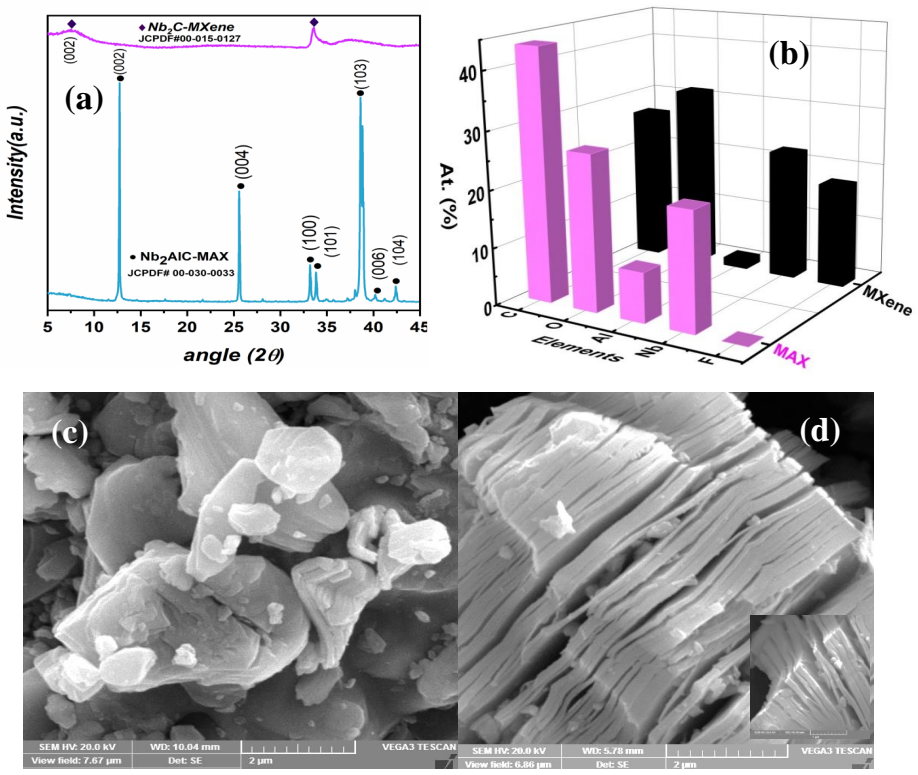
The central object is the two-dimensional Nb2C MXene sheet obtained by selective HF etching of the Nb2AlC MAX phase; its identity as a 2D phase is carried by the c-lattice expansion from 13.83 Å to 22.72 Å seen in XRD. The argument for superconductivity is carried by the magnetic response: a clear diamagnetic Meissner transition in ZFC and FC magnetization at 12.5 K, and magnetization loops whose lower and upper critical fields follow the Ginzburg-Landau form Hc(T) = Hc(0)[1-(T/Tc)2]. That fit is the load-bearing quantitative check that the transition is bulk superconducting rather than a spurious magnetic feature, and it yields the 25 nm coherence length quoted in the paper.
What would settle it
Measure the low-temperature specific heat of the same powder: an intrinsic bulk superconductor at 12.5 K should show a clear specific-heat anomaly at Tc, while a magnetization signal from a minority phase would show little or no anomaly; alternatively, extract the superconducting volume fraction from the zero-field-cooled shielding signal, where a bulk superconductor should give a large diamagnetic fraction.
Extended reading notes
Core claim
The authors claim that Nb2C MXene synthesized by HF etching of Nb2AlC MAX is an intrinsic superconductor with onset Tc = 12.5 K. They identify the superconducting phase as two-dimensional by the disappearance of the Al-related XRD peak and by the expansion of the c-lattice parameter from 13.83 Å to 22.72 Å, which indicates delamination into sheets. Below Tc, both zero-field-cooled and field-cooled magnetization turn diamagnetic, and the M-H loops show the hysteresis and vortex behavior of a type-II superconductor. The critical fields Hc1(T) and Hc2(T) fit the standard Ginzburg-Landau form, and the upper-critical-field extrapolation gives a coherence length of about 25 nm. The authors argue that the absence of XRD peaks from Nb, NbC, NbAlC, Al, or bulk 3D Nb2C, together with a Tc higher than any of those known phases, makes a minority impurity explanation unlikely and points to the intrinsic 2D MXene structure as the source of the high transition temperature.
Load-bearing premise
The result depends on the measured diamagnetic signal coming from the two-dimensional Nb2C MXene itself, not from a minor impurity or unetched phase that XRD cannot detect.
Editorial extensions
If this is right
- If the 12.5 K transition is intrinsic, Nb2C MXene becomes the highest-Tc MXene superconductor known, surpassing the 2D α-Mo2C values of about 3.6–8 K.
- The near-agreement with the 13 K predicted for Mo2C suggests that the same electron-phonon mechanism can raise Tc in n=1 MXene carbides, a generalization the paper explicitly proposes.
- A powder superconductor with Tc = 12.5 K and a critical current density extracted from Bean-model analysis is directly relevant for applications that want superconducting properties in a solution-processable 2D material.
- The type-II character, with upper critical field extrapolated from Ginzburg-Landau fits and a coherence length around 25 nm, sets a concrete magnetic phase diagram for future device-oriented studies.
Reading between the lines
- If confirmed, this result would make the etched powder a test bed for whether surface termination groups such as F, O, and OH left by HF etching enhance or suppress Tc; comparing samples with different terminations would separate surface chemistry from the intrinsic 2D structure.
- A decisive check of the intrinsic claim would be to measure the same Nb2C MXene as a continuous film: a much lower Tc there would suggest the powder's value comes from surface or grain-boundary effects rather than from the bare sheet.
- Because the paper infers strong electron-phonon coupling from the high Tc without direct transport data, a tunable test would be isotope substitution of carbon or pressure dependence to confirm the phonon mechanism.
- The broadening of the magnetic transition could reflect a distribution of Tc across sheets rather than vortex pinning alone; AC susceptibility measurements at different frequencies would separate dynamic pinning from static spread in Tc.
Signed reviews
Editorial analysis
A structured set of objections, weighed in public.
Referee Report
Summary. The manuscript reports the observation of superconductivity in two-dimensional Nb2C MXene powder synthesized by HF etching of Nb2AlC MAX phase. The claims are based on magnetization measurements: M(T) under ZFC/FC conditions shows a diamagnetic transition with onset Tc ≈ 12.5 K, M(H) loops exhibit hysteresis characteristic of a type-II superconductor, and the temperature dependences of the lower and upper critical fields are fitted with Ginzburg-Landau expressions. The authors argue that this is the highest superconducting transition temperature reported for any MXene so far, and they attribute it to the intrinsic 2D structure of Nb2C, supported by the proximity of the observed Tc to a DFT-predicted value of 13 K for Mo2C.
Significance. If the observation is correct, the paper would establish a new record transition temperature in MXenes and provide a strong candidate for intrinsic 2D superconductivity in a transition-metal carbide. The paper also reports a coherence length of about 25 nm and critical current densities estimated from Bean's model. However, the evidence rests entirely on magnetization data with a very small diamagnetic signal, no transport or specific-heat confirmation, and no quantification of the superconducting volume fraction. The claimed record is therefore not securely established, and the paper's significance is conditional on additional supporting evidence.
major comments (3)
- [Fig. 3a and the paragraph beginning 'Since our Nb2C MXene samples are in powder form...'] The ZFC magnetization below Tc at 10 mT is approximately -1.2×10^-3 emu/g. For a fully diamagnetic Nb2C powder (density ~5-6 g/cm³), the ideal Meissner response is M ≈ -H/(4πρ) ≈ -1.5 to -2 emu/g, so the measured value corresponds to a shielding fraction of order 0.1% (a few percent at most after demagnetization corrections). The manuscript does not report a Meissner or shielding fraction, and XRD-based impurity exclusion has a detection limit of a few percent. Since the starting Nb2AlC powder is only 90-95% pure, a trace superconducting impurity phase could produce exactly the observed small signal. This leaves the central claim—that the 12.5 K transition is intrinsic to the Nb2C MXene phase—unsubstantiated.
- [Paragraph beginning 'It can be seen that the width of M-H loop...' and the description of Mp = GH subtraction] The paramagnetic background subtraction is described only as removing a linear increase at high fields with Mp = GH, where G is the gradient of the high-field data. The manuscript does not specify the field range over which G is determined, whether G varies with temperature, or whether the subtracted component might include a reversible mixed-state response. This procedure directly determines the Hc1 and Hc2 values that are then fitted to Ginzburg-Landau theory, so the resulting parameters may be artifacts of the subtraction rather than intrinsic superconducting properties.
- [Section beginning 'Now, we discuss the relatively higher Tc...'] The argument that the observed Tc ≈ 12.5 K is intrinsic because it is close to the DFT-predicted 13 K for Mo2C is not a valid proof. The theoretical prediction was made for a different material (Mo2C), and no first-principles calculations are performed here for Nb2C. The proximity of the experimental Tc to this prediction does not exclude impurity phases and cannot serve as evidence that the 2D structure of Nb2C is responsible for the observed superconductivity. Similarly, the claim that 'the DOS above the Fermi level will be much higher compared to all other 2D MXenes' is speculative and not supported by any calculation.
minor comments (5)
- [Throughout the text] There are numerous typographical errors: 'pramagnetic' should be 'paramagnetic', 'yeilds' should be 'yields', 'relativly' should be 'relatively', 'imurity' should be 'impurity', 'supercondutivity' should be 'superconductivity', 'occurence' should be 'occurrence', and 'It is well know' should be 'It is well known'.
- [References] The reference list contains a duplicate number: [22] is used for both Awana et al. (Solid State Comm. 2006) and Farhadi et al. (J. Nanostruct. Chem. 2013). The references should be renumbered and checked for completeness.
- [Fig. 3d caption and axis labels] The text states that the fits use Hc1(T) = Hc1(0)[1 - (T/Tc)²] and similarly for Hc2, but the figure axis label reads 'T (K)' rather than 'T/Tc'. The figure should be clarified so the reader can distinguish the temperature axis from the normalized axis used in the fit.
- [Conclusion] The sentence 'this is the first study on the superconductivity of as-prepared MXene (Nb2C-powder in present case)' is misleading because the introduction discusses previous superconductivity studies on Mo2C MXenes; the statement should be rephrased to claim the first observation of superconductivity in Nb2C MXene specifically.
- [Abstract] The abstract states that 'strong-electron phonon interaction and the large density-of-states at Fermi level may cause the emergence of superconductivity', but this is presented as a speculation without supporting evidence; it should be explicitly labeled as a hypothesis.
Circularity Check
No significant circularity: Tc is read directly from magnetization data, the GL and Bean analyses are standard fits to measured quantities, and self-citations are contextual rather than load-bearing.
full rationale
The paper's central claim is an experimental observation: Tc ≈ 12.5 K is read directly from the ZFC/FC magnetization curves (Fig. 3a), not derived from a model that already contains that value. The lower and upper critical fields are extracted from measured M(H) isotherms and then fitted to the standard Ginzburg-Landau temperature dependence; this is a consistency check and parametrization, not a prediction forced by construction. The coherence length and critical current density follow from standard GL and Bean formulas applied to the measured Hc2(0) and M(H) loop widths, respectively. The self-citations (refs. 2, 3, 21) support general MXene magnetism/spintronics context and Bean-model methodology; none supplies the superconducting claim. The Mo2C DFT prediction of 13 K (ref. 9) is an external calculation used as an analogy, not as an input that determines the measured Tc. No equation in the paper reduces to its own input, and no fitted parameter is renamed as a prediction. The manuscript's main weakness is whether the very small diamagnetic signal is intrinsic to the Nb2C MXene phase rather than a trace impurity — an experimental attribution and validity concern, not a circularity concern.
Assumptions & free parameters
free parameters (4)
- Hc1(0) =
Not reported numerically; from GL fit to Hc1(T)
- Hc2(0) =
Not reported numerically; extrapolated from GL fit
- G =
Not reported
- d =
Not reported
assumptions (5)
- standard math Ginzburg-Landau theory with Hc(T)=Hc(0)[1-(T/Tc)^2]
- standard math Bean critical-state model for a cylinder
- domain assumption The paramagnetic high-field magnetization is linear in field and can be subtracted without residual bias
- domain assumption Powder grains are sufficiently connected to be treated as a single cylindrical superconductor for the Bean model
- domain assumption The HF-etched product is phase-pure Nb2C MXene with no superconductivity-relevant impurity phase
Cite this review
Pith. "Pith review of Novel highest-Tc superconductivity in two-dimensional Nb2C MXene." pith.science (2026). https://pith.science/paper/HT4REI5G
@misc{pith2026190803987,
  author       = {Pith},
  title        = {Pith review of: Novel highest-Tc superconductivity in two-dimensional Nb2C MXene},
  year         = {2026},
  howpublished = {\url{https://pith.science/paper/HT4REI5G}},
  note         = {Machine review of arXiv:1908.03987}
}
read the original abstract
Currently, superconductivity in two-dimensional (2D) materials is a hot topic of research owing to their potential technological applications. Here, we report observation of superconductivity in a 2D Nb2C MXene with transition temperature of 12.5 K, which is the highest transition temperature in MXene attained till now. We systematically optimized the chemical etching process to synthesize the Nb2C MXene from its Nb2AlC MAX phase. The X-ray diffraction (XRD) shows a clear (002) peak indicating the successful formation of MXene as well as a significant increase in the c-lattice parameter from 13.83{\AA} to 22.72{\AA} that indicates the delamination of Nb2C MXene sheets as revealed by morphological study using scanning electron microscope. The Meissner effect is detected using superconducting quantum interference device (SQUID: Quantum design). Lower and upper critical fields as a function of temperature follow the Ginzburg-Landau (GL) theory indicating the superconducting nature of the Nb2C MXene. Strong-electron phonon interaction and the large density-of-states at Fermi level may cause the emergence of superconductivity at such a higher transition temperature which has theoretically been predicted for Mo2C MXene. Our work is a significant advancement in the field of research and potential applications of 2D MXene.
Figures


Figures from the paper (2 more)


Reference graph
Works this paper leans on
-
[1]
Naguib, M.; Kurtoglu, M.; Presser, V.; Lu, J.; Niu, J.; Heon, M.; Hultman, L.; Gogotsi, Y.; Barsoum, M.W. Adv. Mater. 2011, 23, 4248
work page 2011
-
[2]
Co-existence of Novel Ferromagnetic/Anti-ferromagnetic Phases in Two-dimensional Ti3C2 MXene
M. Iqbal, J. Fatheema, M. Rani, R.-K. Zheng, S. A. Khan, Syed Rizwan , 2019, preprint: arXiv:1907.12588 [cond-mat.mes-hall]
work page Pith review arXiv 2019
-
[3]
Irfan Ali, Deji Akinwande, Syed Rizwan, ACS Omega 2018, 3, 13828
Ayesha Tariq, S . Irfan Ali, Deji Akinwande, Syed Rizwan, ACS Omega 2018, 3, 13828
work page 2018
-
[4]
Naguib, M., Mashtalir, O., Carle, J., Presser, V., Lu, J., Hultman, L., Gogotsi, Y., Barsoum, M.W. ACS Nano 2012, 6, 1322
work page 2012
-
[5]
The chemistry of transition metal carbides and nitrides , Springer, Dordrecht
Oyama, S.T. The chemistry of transition metal carbides and nitrides , Springer, Dordrecht. 1996
work page 1996
-
[6]
Xu, C., Wang, L., Liu, Z., Chen, L., Guo, J., Kang, N., Ma, X.L., Cheng, H.M. Ren, W. Nature Mater. 2015, 14, 1135
work page 2015
-
[7]
Wang, L., Xu, C., Liu, Z., Chen, L., Ma, X., Cheng, H.M., Ren, W., Kang, N. ACS Nano, 2016, 10, 4504
work page 2016
-
[8]
Zhang, Z., Gedeon, H., Cheng, Z., Xu, C., Shao, Z., Sun, H., Li, S., Cao, Y., Zhang, X., Bian, Q. Liu, L. Nano Lett. 2019, 19, 53327
work page 2019
Show all 24 references
-
[9]
Lei, J., Kutana, A., Yakobson, B.I. J. Mater. Chem. C, 2017, 5, 3438
2017
-
[10]
Peng, C., Wei, P., Chen, X., Zhang, Y., Zhu, F., Cao, Y., Wang, H., Yu, H., Peng, F. Cer. Intl. 2018, 44, 18886
2018
-
[11]
Sun, Z., Music, D., Ahuja, R., Li, S., Schneider J.M. Phys. Rev. B, 2004, 70, 092102
2004
-
[12]
M., Marsoum M
Naguib, M., Mochalin V. M., Marsoum M. W., Gogotsi Y. Adv. Mater. 2014, 26, 992
2014
-
[13]
Viculis, L.M., Mack, J.J., Mayer, O.M., Ha hn, H.T., Kaner, R.B., J. Mater. Chem. 2005, 15, 974
2005
-
[14]
Ihara, H
Takano, Y., Takeya, H., Fujii, H., Kumakura, H., Hatano, T., Togano, K., Kito, H. Ihara, H. Appl. Phys. Lett. 2001, 78, 2914
2001
-
[15]
Solid State Comm
Joshi, A.G., Pillai, C.G.S., Raj, P., Malik, S.K. Solid State Comm. 2001, 118, 445. 11
2001
-
[16]
and Awana, V.P.S., Superconductor Sci
Tiwari, B., Goyal, R., Jha, R., Dixit, A. and Awana, V.P.S., Superconductor Sci. Tech. 2015, 28, 055008
2015
-
[17]
Loh, K.P
Geng, D., Zhao, X., Li, L., Song, P., Tian, B., Liu, W., Chen, J., Shi, D., Lin, M., Zhou, W. Loh, K.P. 2D Mater,2017, (011012), 2053
2017
-
[18]
Hulm, J.K
Hardy, G.F. Hulm, J.K. Phys. Rev. 1954, 93, 1004
1954
-
[19]
Kirat, O
G. Kirat, O. Kizilaslan, M.A. Aksan, Ceram.Intl. 2016, 42, 15072
2016
-
[20]
Bean, Phys
C.P. Bean, Phys. Rev. Lett. 1962, 8, 250
1962
-
[21]
Mumtaz, Mirza Hassan Baig, M
M. Mumtaz, Mirza Hassan Baig, M. Waqee-ur-Rehman, M. Nasir Khan, Physica B 2018, 537, 283
2018
-
[22]
Awana, Rajeev Rawat, Anurag Gupta, M
V.P.S. Awana, Rajeev Rawat, Anurag Gupta, M. Isobe, K.P. Singh, Arpita Vajpayee, H. Kishan, E. Takayama-Muromachi, A.V. Narlikar, Solid State Comm. 2006, 139, 306
2006
-
[23]
Farhadi, K
S. Farhadi, K. Pourzare, S. Sadeghinejad, J. Nanostruct. Chem. 2013, 3, 16
2013
-
[24]
Naguib, M.; Halim, J.; Lu, J.; Cook, K.M.; Hultman, L.; Gogotsi, Y.; Barsoum, M.W. J. Am. Chem. Soc. 2013, 135, 15966. Table of Content (TOC) – Art File 12 Figure 1. (a) Summary of superconducting transition temperature of various MAX (3D) and MXene (2D ) super conductors repo...
2013
Reviewed August 14, 2026 · model on record in the stance chip above.
Discussion (0). Continue with ORCID to comment.