REVIEW 1 major objections 4 minor 26 references
Sound source detection, localization and classification using consecutive ensemble of CRNN models
T0 review · 1 major / 4 minor · reviewed 2026-08-14 · deepseek-v4-flash
Pith's one-line read This paper claims that sound-event localization decomposes into four sequential single-output CRNN subtasks, and that the resulting consecutive ensemble ranked first in the 2019 challenge: error rate 0.08, F-score 94.7, DOA error 3.7…
desk verdict A rank-1 DCASE 2019 system with a genuine decomposition idea, undermined only by an STFT hop-length typo that blocks exact replication. read the letter →
The pith
A machine-rendered reading of the paper's core claim, the machinery that carries it, and where it could break.
The reading
What carries the argument
The load-bearing mechanism is the consecutive ensemble: four single-output CRNN models chained so that each stage's prediction becomes the next stage's conditioning. The noas model emits a per-frame source count from 256-frame amplitude spectrograms; a postprocessor forces legitimate count trajectories (start and end at zero, step size at most one), and event onsets and offset candidates are derived from count transitions. The doa1 and doa2 models predict Cartesian xyz directions, with doa2 receiving the associated event's direction as an extra input; the class model uses soft voting across frames and, for fully overlapping events, picks the most probable class different from the associated event's class. Direction outputs are rounded to a 10-degree grid, which the algorithm exploits to decide whether two consecutive single-source chunks belong to the same event.
What would settle it
Feed a one-minute recording through an STFT with a 0.4-second Hann window and a 0.2-second hop and count the output frames: the result is about 300, not the 3000 vectors the architecture expects, which settles whether the printed description can reproduce the reported scores.
Extended reading notes
Core claim
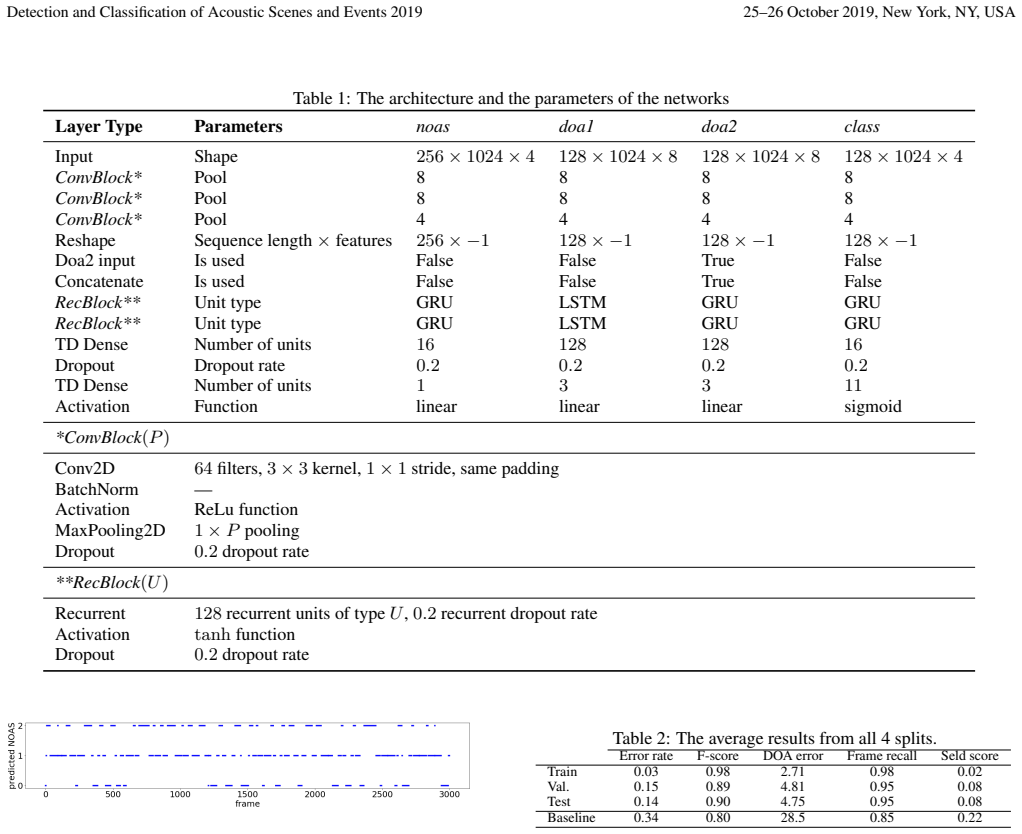
The authors propose that sound-event localization and detection should be solved by decomposition rather than by one monolithic network. Their system consists of four SELDnet-like CRNNs, each with a single output, arranged as a consecutive ensemble: the first predicts the number of active sources in each frame; the second predicts the direction of arrival of a lone source; the third predicts the direction of a second source conditioned on the associated event's direction; the fourth performs multi-label classification. The counting output is postprocessed so that each recording starts and ends silent and the count changes by at most one per frame; onsets and candidate offsets are read from count transitions, then disambiguated by comparing averaged direction estimates across chunks of constant count. On the official evaluation set, the system achieves error rate 0.08, F-score 94.7, DOA error 3.7 degrees, and frame recall 96.8, the best overall score among the submitted systems.
Load-bearing premise
The load-bearing premise is that the printed feature-extraction settings match the submitted runs, but they do not as written: a 0.2-second STFT hop on a one-minute recording yields about 300 frames, not the 3000-frame inputs the ensemble is described to consume.
Editorial extensions
If this is right
- Systems that adopt this decomposition can treat source-count estimation as an explicit first stage, and the official numbers suggest that stage is accurate enough to support competitive localization.
- Because the system uses only first-order ambisonic input, the results indicate that the four-channel microphone format is not necessary for top performance on this benchmark.
- The gap between single-source and overlapping-source results (DOA error 1.28 degrees versus 7.96 degrees, error rate 0.07 versus 0.18) implies the method's strength lies in single-source frames, and overlapping cases remain the harder regime.
- The pipeline's sequential nature means count errors propagate: a misclassified source-count frame can shift onset and offset assignments and corrupt both direction and class predictions for that segment.
Reading between the lines
- If the 3000-frame statement reflects the real configuration, the implied STFT hop is close to 0.02 seconds, so correcting the printed 0.2-second value would be the first step toward reproducing the result from the paper alone.
- The same decompose-and-chain scheme could be extended to three or more simultaneous sources by adding a doa3 network conditioned on two associated directions; the paper's stated at-most-two assumption marks exactly where that extension begins.
- Rounding predicted directions to the nearest 10 degrees means the reported 3.7-degree DOA error partly reflects the grid rather than raw model accuracy, and an off-grid or finer-grid evaluation would separate quantization from estimation error.
- A soft version of the source-count stage—for example, a probability distribution over 0, 1, or 2 instead of a hard pick—might reduce cascade failures when the count is ambiguous, at the cost of losing the simple event-segmentation rule.
Signed reviews
Editorial analysis
A structured set of objections, weighed in public.
Referee Report
Summary. The paper describes a system for DCASE 2019 Task 3 (Sound Event Localization and Detection) on first-order ambisonic recordings. The SELD task is decomposed into four subtasks: estimating the number of active sources (NOAS), estimating the direction of arrival of a single source (doa1), estimating the direction of arrival of a second source given an associated event (doa2), and multi-label classification of sound events. Each subtask is handled by a separate CRNN, and the outputs are combined by a hand-crafted consecutive ensemble that predicts event onsets, offsets, DOAs, and class labels. The system is evaluated on the TAU Spatial Sound Events 2019 Ambisonic dataset, reporting official test scores of error rate 0.08, F-score 94.7, DOA error 3.7 degrees, and frame recall 96.8, ranked first among challenge submissions and outperforming the official baseline.
Significance. If the reported results are taken at face value, the paper demonstrates a successful alternative to monolithic SELDnet: decomposing the task into specialized models and combining them with deterministic rules yields top-ranked performance on a public challenge. The paper's strengths include the externally evaluated official challenge results (not self-reported), per-fold development metrics with comparisons to baseline and other submissions, a detailed architecture table, and an explicit statement of limitations (more than two overlapping sources, coarse DOA grid, error cascading). The paper does not release code, so reproducibility relies entirely on the written specification; the STFT hop-length inconsistency described below is a genuine obstacle to exact replication.
major comments (1)
- [Section 2 and Section 4.1] The STFT configuration is internally inconsistent and blocks replication. Section 2 states a hop length of 0.2 s with a 0.4 s Hann window, while Section 2 and Section 4.1 both state that each recording yields exactly 3000 frames. For a 60 s recording, a 0.2 s hop gives about 299 frames, and a 0.02 s hop gives 2981 frames, neither of which equals 3000 without an additional, unspecified truncation or padding step. Because the input shapes in Table 1 (256- and 128-frame subsequences) and the entire consecutive ensemble algorithm in Section 4 operate on frame indices, the actual STFT hop length and the frame-count normalization must be specified for the system to be reproducible. I request that the authors provide the correct hop length and an explicit statement of how every recording is converted to exactly 3000 frames.
minor comments (4)
- [Section 5.1] The description of the development protocol is ambiguous: 'we used 2 splits out of 4 for training for every fold' could mean that two of the four splits are training, one is validation, and one is test, but the standard DCASE 2019 task 3 setup uses three training splits per fold. Please state explicitly the split assignment for each fold and clarify the role of the validation split.
- [Section 2] Minor language issues: 'If audio is longer than 1 minute' should be 'If an audio recording is longer than 1 minute', and 'If an audio is shorter than 1 minute' should be 'If an audio recording is shorter than 1 minute'.
- [Reference [3]] The reference title contains a typo: 'uetection' should be 'detection'.
- [Table 1] Consider clarifying the 'Doa2 input' row: the boolean values indicate per-model usage, but the row label is easy to misread as a layer type.
Circularity Check
No significant circularity: the reported results are genuine external challenge evaluations, and the system's components are not defined in terms of the quantities they predict.
full rationale
The paper reports results from the DCASE 2019 Task 3 evaluation, comparing against other submissions and the challenge baseline. Development-fold results (Table 3) and official evaluation results (Table 5) are measured on held-out data using the challenge's scoring software, so the reported error rate, F-score, DOA error, and frame recall are genuine predictions rather than fitted or renamed inputs. The four CRNN models are described as independent sub-task predictors (NOAS, DOA1, DOA2, class), and the consecutive ensemble is an explicit inference procedure that combines their outputs; it is not equivalent to any single training target or to the input features by construction. The architecture is based on external SELDnet work [2,3], not on a self-citation chain, and no uniqueness claim or ansatz is imported from the authors' prior work. There is a reproducibility issue in the feature description: the 0.2 s STFT hop would yield roughly 300 frames for a one-minute recording, while Sections 2 and 4.1 state exactly 3000 frames, implying a factor-of-ten inconsistency or a need for truncation/padding. That is an implementation and replication concern, not a circularity concern, because it does not make any predicted quantity equivalent to an input or fitted parameter. The paper also acknowledges limitations (more than two sources, grid resolution), which further indicates the claims are empirically contingent rather than definitionally forced.
Assumptions & free parameters
free parameters (9)
- STFT hop length =
0.2 s (text) / likely 0.02 s (consistent with 3000 frames)
- Input sequence length =
256 frames (noas), 128 frames (doa1/doa2/class)
- Convolutional filter count =
64
- Recurrent units =
128
- Number of training epochs =
500 (noas, class), 1000 (doa1, doa2)
- Learning rate schedule =
Adam default, decay 0.95 every 5 epochs for noas/class; constant for doa1/doa2
- DOA grid resolution =
10 degrees
- NOAS smoothing constraint =
max difference of 1 between consecutive frames
- Class disambiguation rule =
if overlapping event class equals associated class, choose second most probable class
assumptions (4)
- domain assumption The TAU Spatial Sound Events 2019 dataset and its official evaluation metrics provide a valid benchmark for SELD performance.
- domain assumption At most two active sound sources occur simultaneously, and all directions lie on a 10-degree grid.
- ad hoc to paper The SELD task can be decomposed into independent subtasks: source counting, single-source DOA, conditional two-source DOA, and classification.
- ad hoc to paper The consecutive postprocessing rules (NOAS smoothing, chunk matching, offset inference) correctly reconstruct event boundaries from frame-level predictions.
Cite this review
Pith. "Pith review of Sound source detection, localization and classification using consecutive ensemble of CRNN models." pith.science (2026). https://pith.science/paper/HT5PTUK3
@misc{pith2026190800766,
  author       = {Pith},
  title        = {Pith review of: Sound source detection, localization and classification using consecutive ensemble of CRNN models},
  year         = {2026},
  howpublished = {\url{https://pith.science/paper/HT5PTUK3}},
  note         = {Machine review of arXiv:1908.00766}
}
read the original abstract
In this paper, we describe our method for DCASE2019 task3: Sound Event Localization and Detection (SELD). We use four CRNN SELDnet-like single output models which run in a consecutive manner to recover all possible information of occurring events. We decompose the SELD task into estimating number of active sources, estimating direction of arrival of a single source, estimating direction of arrival of the second source where the direction of the first one is known and a multi-label classification task. We use custom consecutive ensemble to predict events' onset, offset, direction of arrival and class. The proposed approach is evaluated on the TAU Spatial Sound Events 2019 - Ambisonic and it is compared with other participants' submissions.
Figures


Reference graph
Works this paper leans on
-
[1]
INTRODUCTION Sound Event Localization and Detection (SELD) is a complex task which naturally appears when one wants to develop a sys- tem that possesses spatial awareness of the surrounding world us- ing multi-channel audio signals. This year, the task 3 from the IEEE AASP Challenge on Detection and Classification of Acoustic Scenes and Events (DCASE 2019)...
work page 2019
-
[2]
Sound source detection, localization and classification using consecutive ensemble of CRNN models
FEATURES The DCASE 2019 task 3 provides two formats of the TAU Spa- tial Sound Events 2019 dataset: first order ambisonic ( foa) and 4 channels from a microphone array (mic) [3]. In our method we only use the ambisonic format. arXiv:1908.00766v2 [eess.AS] 5 Sep 2019 Detection and Classification of Acoustic Scenes and Events 2019 25–26 October 2019, New York...
work page Pith review arXiv 2019
-
[3]
ARCHITECTURE As mentioned in the introduction, each of the subtasks ( noas, doa1, doa2 and class) has its own SELDnet-like CRNN. Each of these models is a copy of a single SELDnet node with just minor adjustments so that it fits to the specific subtask and for the regular- ization purpose. Each of these models takes as an input a fixed length subse- quence o...
-
[4]
CONSECUTIVE ENSEMBLE In this section, we introduce and describe the idea of the con- secutive ensemble which is the core of our approach. This custom binding of our four models allows us to predict the events’ onset, offset, direction of arrival and class. 4.1. The algorithm We assume that recordings have at most 2 active sound sources at once and the sou...
-
[5]
We feed the features to the noas network to predict the num- ber of active sources (NOAS) in each frame
-
[6]
We transform the predicted NOAS so that each recording starts and ends with no sound sources and the difference of NOAS between each frames is no greater than 1
-
[7]
From the predicted NOAS we deduce the number of events, their onsets and the list of possible offsets for each event. If NOAS in two consecutive frames increases, then we predict that a new event happened at the second frame. If in two consecutive frames NOAS decreases, then we append the first frame to all events since last time NOAS was 0 as a possible offset
-
[8]
In order to determine which offset corresponds to which event we use the doa1 network. We extract chunks (intervals of equal NOAS) of audio where the predicted NOAS equals 1 and we feed it to doa1 network. For each chunk where NOAS was 1 we predict the average azimuth and elevation, and we round it to the closest multiple of 10. If two consecutive chunks ...
Show all 26 references
-
[9]
We feed the chunks where NOAS is 2 to the doa2 network with the second input being DOA of the associated event in cartesian xyz coordinates
To determine the remaining information about angles we need to predict the direction of arrival (DOA) of events that start and end while the associated event is happening. We feed the chunks where NOAS is 2 to the doa2 network with the second input being DOA of the associated ...
-
[10]
Lastly, we predict the events’ classes. If an event has chunks where the event is happening in an isolation (NOAS = 1), then all such chunks are feed to the class network and the most probable class (using soft voting among frames) is taken as a predicted class. If an event ha...
2019
-
[11]
This dataset constitutes of two parts: the devel- opment and evaluation sets
RESULTS We evaluate our results on TAU Spatial Sound Events 2019 - Ambisonic dataset. This dataset constitutes of two parts: the devel- opment and evaluation sets. The development part consists of 400 recordings with predefined 4-fold cross-validation and the evalua- tion part ...
2019
-
[12]
Table 5: The comparison of the selected submissions
SUBMISSIONS Overall, we created 4 submissions for the competition: • ConseqFOA (Kapka_SRPOL_task3_2), • ConseqFOA1 (Kapka_SRPOL_task3_3), • ConseqFOAb (Kapka_SRPOL_task3_4), • MLDcT32019 (Lewandowski_SRPOL_task3_1). Table 5: The comparison of the selected submissions. Rank Sub...
-
[13]
However, we are aware that our solution has some serious limitations and it fails when one wants to consider a more general setup
CONCLUSION We conclude that decomposing the SELD problem into simpler tasks is instinctive and efficient. However, we are aware that our solution has some serious limitations and it fails when one wants to consider a more general setup. For example when there are more than 2 ac...
-
[14]
Detection and Classification of Acoustic Scenes and Events 2019 25–26 October 2019, New York, NY , USA
ACKNOWLEDGEMENT We are most grateful to Zuzanna Kwiatkowska for spending her time on careful reading with a deep understanding the final draft of this paper. Detection and Classification of Acoustic Scenes and Events 2019 25–26 October 2019, New York, NY , USA
2019
-
[15]
http://dcase.community/challenge2019/ task-sound-event-localization-and-detection
-
[16]
Sound event localization and detection of overlapping sources using convolutional recurrent neural networks,
S. Adavanne, A. Politis, J. Nikunen, and T. Virtanen, “Sound event localization and detection of overlapping sources using convolutional recurrent neural networks,”IEEE Journal of Se- lected Topics in Signal Processing, pp. 1–1, 2018
2018
-
[17]
A multi- room reverberant dataset for sound event localization and uetection,
S. Adavanne, A. Politis, and T. Virtanen, “A multi- room reverberant dataset for sound event localization and uetection,” in Submitted to Detection and Classification of Acoustic Scenes and Events 2019 Workshop (DCASE2019) ,
2019
-
[19]
Adam: A method for stochastic optimization,
D. P. Kingma and J. Ba, “Adam: A method for stochastic optimization,” 2014. [Online]. Available: https: //arxiv.org/abs/1412.6980
2014 arXiv
-
[20]
Polyphonic sound event detection and localization using a two-stage strategy,
Y . Cao, Q. Kong, T. Iqbal, F. An, W. Wang, and M. D. Plumbley, “Polyphonic sound event detection and localization using a two-stage strategy,” 2019. [Online]. Available: https://arxiv.org/abs/1905.00268
2019 arXiv
-
[21]
Two-stage sound event local- ization and detection using intensity vector and generalized cross-correlation,
Y . Cao, T. Iqbal, Q. Kong, M. Galindo, W. Wang, and M. Plumbley, “Two-stage sound event local- ization and detection using intensity vector and generalized cross-correlation,” 2019. [Online]. Avail- able: http://dcase.community/documents/challenge2019/ technical reports/DCASE...
2019
-
[22]
Data augmenta- tion and prior knowledge-based regularization for sound event localization and detection,
J. Zhang, W. Ding, and L. He, “Data augmenta- tion and prior knowledge-based regularization for sound event localization and detection,” 2019. [Online]. Avail- able: http://dcase.community/documents/challenge2019/ technical reports/DCASE2019 He 97.pdf
2019
-
[23]
Three-stage approach for sound event lo- calization and detection,
K. Noh, C. Jeong-Hwan, J. Dongyeop, and C. Joon- Hyuk, “Three-stage approach for sound event lo- calization and detection,” 2019. [Online]. Avail- able: http://dcase.community/documents/challenge2019/ technical reports/DCASE2019 Chang 81.pdf
2019
-
[24]
Squeeze-and-excitation net- works,
J. Hu, L. Shen, and G. Sun, “Squeeze-and-excitation net- works,” inThe IEEE Conference on Computer Vision and Pat- tern Recognition (CVPR), June 2018, pp. 7132–7141
2018
-
[25]
Specaugment: A simple data augmentation method for automatic speech recognition,
D. S. Park, W. Chan, Y . Zhang, C.-C. Chiu, B. Zoph, E. D. Cubuk, and Q. V . Le, “Specaugment: A simple data augmentation method for automatic speech recognition,”
-
[26]
Available: https://arxiv.org/abs/1904.08779
[Online]. Available: https://arxiv.org/abs/1904.08779
1904 arXiv
-
[2019]
Available: https://arxiv.org/abs/1905.08546
[Online]. Available: https://arxiv.org/abs/1905.08546
1905 arXiv
Reviewed August 14, 2026 · model on record in the stance chip above.
Discussion (0). Continue with ORCID to comment.