REVIEW 4 major objections 5 minor 2 cited by
VinTAGe: Joint Video and Text Conditioning for Holistic Audio Generation
T0 review · 4 major / 5 minor · reviewed 2026-08-11 · deepseek-v4-flash
Pith's one-line read VinTAGe's claim: to hear a scene completely — on-screen foley and off-screen ambience — audio generation must be grounded in both the video and a text prompt.
desk verdict Useful joint video-text audio model and a transparent benchmark, but the 'necessity' claim is weaker than the paper's own Table 5 suggests. read the letter →
The pith
A machine-rendered reading of the paper's core claim, the machinery that carries it, and where it could break.
The reading
What carries the argument
The engine is a flow-matching transformer: following flow matching, the model learns a velocity field $v_\theta(x_t, t, c_v, c_t)$ that linearly interpolates Gaussian noise into a compressed audio latent, and at inference an ODE solver integrates the field backwards. The backbone is SiT, the Scalable Interpolant Transformer, extended into a Joint VT-SiT whose blocks interleave self-attention with two cross-attention layers, one over text tokens and one over video tokens, fused by a learned per-layer weight $\omega_l$. The conditioning signal comes from the Visual-Text Encoder, which cross-attends CLIP frame embeddings (concatenated with sinusoidal encodings of mean optical-flow energy and frame indices) to FLAN-T5 text embeddings through zero-initialized tanh gates, and pools both modalities into a global vector applied by adaptive layer normalization. The decisive training mechanism is teacher-student alignment: batches alternate joint, text-only, and video-only inputs, and on the single-modality entries the joint model must reproduce the velocity predicted by frozen uni-modal teachers through the losses $L_t$ and $L_v$, which stops either modality from dominating. At inference, two classifier-free guidance scales $s_{\text{vis}}$ and $s_{\text{txt}}$ let the operator fade the output between visual and textual priorities.
What would settle it
Take uncurated real-world clips with natural multi-source soundscapes — several off-screen sounds at once, overlapping frequency bands, and multiple moving on-screen objects, the regime the paper's own limitations section flags — and compare VinTAGe against a strong text-to-audio model fed a detailed caption of the video. If the text-only model matches the joint model on semantic completeness and the temporal-synchronization advantage disappears on these clips, the claim that joint video-text conditioning is necessary for holistic audio would be falsified; running the same test on the benchmark's excluded hard cases (similar-frequency or busy mixtures) would show whether the filtering drove the result.
Extended reading notes
Core claim
The central claim is that joint text and visual interaction is necessary for holistic audio generation, and that a flow-based transformer can carry it out without drifting into one modality. The paper argues that each single-condition family is structurally incomplete: text-to-audio has no access to timing, and video-to-audio has no access to what lies off-screen, so neither can produce the full sound of a scene. Prior joint models assume the text and video describe the same content, which breeds a visual bias that suppresses off-screen sounds. VinTAGe counters this with three coordinated moves: a Visual-Text Encoder whose gated cross-attention lets video and text inform each other without forcing them to agree; a Joint VT-SiT transformer in which each block learns a weight $\omega_l$ balancing the two modalities' cross-attention; and a teacher-student scheme in which pretrained text-only and video-only generators supply velocity targets for single-modality inputs, so the joint model learns to match both teachers. On VinTAGe-Bench the model posts the best generation quality (FAD 3.05, FID 16.43) and the best mean audio-text/audio-visual alignment (16.06), and it is the joint model whose on-screen and off-screen concept accuracies stay closest together (57.7% and 43.6%), where the strongest joint rival splits 64.9% against 21.7%. The same model posts the best FID (6.65) and MKL (4.12) on VGGSound among the compared methods.
Load-bearing premise
The load-bearing premise is that VinTAGe-Bench's recipes — one on-screen sound mixed with one randomly chosen off-screen sound, with hard cases filtered out — stand in for real holistic audio, so the paper's conclusion that joint conditioning is necessary inherits everything from that curated two-source mix; if genuine off-screen soundscapes are messier than the benchmark, the necessity claim is not established.
Editorial extensions
If this is right
- Post-production sound for a silent clip reduces to a single pass: feed the video and a written description, and receive one mixed track containing both foley and off-screen ambience, with no manual mixing of separate stems.
- Joint conditioning beats both uni-modal families: on VinTAGe-Bench, VinTAGe's FAD (3.05) and FID (16.43) are the best in the table, and its mean audio-text/audio-visual alignment (16.06) is the highest.
- Modality bias is measurable and curable: joint baselines that assume aligned text and video (ReWaS, FoleyCrafter) generate on-screen sounds well but drop off-screen sounds, while teacher-guided training keeps VinTAGe's two accuracies close (57.7% versus 43.6%).
- The two guidance scales make the text-video trade-off controllable at inference: raising $s_{\text{vis}}$ shifts the output toward visual-only sounds, raising $s_{\text{txt}}$ adds off-screen content, and balanced values produce both.
- Because the same model is evaluated directly on VGGSound, the architecture doubles as a video-to-audio system, posting the best FID (6.65) and MKL (4.12) among the compared methods.
Reading between the lines
- The necessity claim is only as strong as the benchmark: VinTAGe-Bench mixes exactly one on-screen source with one off-screen source drawn from VGGSound and deletes hard cases (spectrally overlapping sounds, busy on-screen audio, poorly visible objects), so a real-world soundscape with several overlapping off-screen sources is an untested regime in which the conclusion could weaken.
- The paper's own limitations section (Appendix F) concedes that mean optical-flow magnitude is a coarse temporal guide that may fail when several moving objects each carry their own sound; an object-wise temporal-energy variant is the natural next test of whether fine-grained synchronization survives in complex scenes.
- The two guidance scales suggest an interactive application the authors do not build: a two-knob foley-versus-ambience fader that a sound editor could adjust per shot, exploiting the classifier-free guidance the model already learns.
- Because on-screen temporal alignment is measured only by subjective listening (existing metrics assume single-source audio), scoring the model's own output with a neural audio separator would give an objective, scalable test of the synchronization claim.
Editorial analysis
A structured set of objections, weighed in public.
Referee Report
Summary. VinTAGe addresses holistic audio generation: given a silent video and a text prompt, it aims to synthesize both onscreen and offscreen sounds that are temporally synchronized with the video and semantically aligned with the text. The proposed model comprises a Visual-Text Encoder (CLIP visual features, optical-flow energy, frame indices, and FLAN-T5 text embeddings with gated cross-attention), a flow-matching SiT transformer with per-layer text/video cross-attention weights, and teacher-student alignment losses from pretrained text-only and video-only audio generators. The paper also introduces VinTAGe-Bench, a 636-pair benchmark built from 212 VGGSound test videos by mixing each original audio track with one randomly selected offscreen sound and filtering out mixtures that are hard to distinguish. Experiments compare against V2A, T2A, and joint text-video baselines on VinTAGe-Bench and on VGGSound, reporting state-of-the-art FAD/FID numbers and a small subjective study. The central claim is that joint text and visual interaction is necessary for holistic audio generation.
Significance. The paper is useful in several respects. It formulates a timely task, contributes a new benchmark (VinTAGe-Bench) that the community can reuse, and proposes a sensible architecture with teacher-guided modality balancing; the comparison set is broad, and the limitations section is candid about the difficulty of temporal alignment metrics for mixed audio. The paper also ships a demo and promises code and pretrained models. However, the central conceptual claim—that joint conditioning is necessary for holistic audio generation—is not supported by the evidence. The benchmark construction makes single-modality models fail by design on one of the two subtasks, and the paper's own controlled comparison (Table 5) shows text-only conditioning achieving higher concept accuracy than the joint model. The VGGSound state-of-the-art claim also needs qualification because VinTAGe receives text captions that the pure V2A baselines do not. The contribution would remain valuable if the claims were reframed around what is actually demonstrated: joint conditioning improves distribution-level quality and alignment on curated two-source mixtures and mitigates modality bias.
major comments (4)
- [Abstract, §4, Table 5] The claim that 'joint text and visual interaction is necessary for holistic audio generation' is not established by the experiments. VinTAGe-Bench is constructed so that the offscreen sound is invisible in the video and appears only in the text caption, while mixtures with similar frequencies or 'busy' onscreen sounds are removed (§4, Dataset paragraph). Single-modality models are therefore guaranteed to fail on one of the two subtasks by construction, and the ambiguous cases where joint disambiguation would be most informative are filtered out. More importantly, the paper's own controlled comparison in Table 5 shows that text-only conditioning (svis=0.0, stxt=5.0) achieves higher mean concept accuracy than the joint model (54.32 vs. 50.66), and the visual-only teacher is competitive in mean alignment. The data support a weaker conclusion: joint conditioning improves FID/FAD and mean alignment on this curated benchmark. The necessity claim should be removed or substantially qualified.
- [§4, Table 2] The VGGSound state-of-the-art claim is not supported as stated. VinTAGe is conditioned on Auto-ACD text captions, which include the sound class label, while SpecVQGAN, Im2Wav, and Diff-Foley receive no text. Since VGGSound audio is largely determined by the class label, giving the model this text is an information advantage unrelated to joint video-text modeling. The authors update only the text+video baselines (FoleyCrafter and ReWaS) with Auto-ACD captions; the V2A baselines are not given an analogous captioning channel. The claim should be limited to joint text-video models with equalized inputs, or the comparison should include text-only and video-text variants of all baselines.
- [§4, Subjective Evaluation; Appendix D] The subjective evaluation is too small and too poorly characterized to support the temporal-alignment and faithfulness claims. Ten listeners rated 35 samples on VinTAGe-Bench, with no confidence intervals, significance tests, or inter-rater agreement reported. The MOS gaps (for example, MOS-T 3.36 vs. 2.96 for FoleyCrafter) may be meaningful, but with this sample size and no statistics they are not load-bearing. This matters because the paper explicitly declines to use objective temporal metrics (Appendix F) and relies on subjective scores for the temporal-synchronization claim. The authors should report per-item variance, confidence intervals, and a statistical test, or weaken the corresponding conclusions.
- [§3.3, Appendix B.3] The classifier-free guidance scales svis and stxt are tuned empirically to 2.5 and used for all main results, but no validation protocol is described. Appendix B.3 sweeps one scale while fixing the other, yet the paper does not state whether these sweeps were performed on the test benchmark or a held-out set. With only 636 test pairs and no error bars, the reported improvements could reflect guidance-scale selection rather than the model's joint-conditioning design. The authors should describe the scale-selection procedure and, ideally, report results across a range of scales.
minor comments (5)
- [§3.3, Eq. (7)] The sentence introducing Eq. (7) says 'stxt and svis represent the weights of visual and text guidance,' but stxt is the text weight and svis is the visual weight; the assignment is swapped.
- [§4, Table 1] The caption states 'Top-2 results are highlighted,' but in the typeset table only one row appears highlighted; please check the formatting so the intended highlighting is visible.
- [Appendix C] The phrase 'for each video, we selected two off-screen categories and one no off-screen scenario from the offscreen categories' is confusing; clarify that the no-offscreen scenario is a caption-only condition without a mixed offscreen audio track.
- [§3.2, Gated Cross-Attention] The dimensions of cv and ct are not fully specified: ct has length L (token count), cv has length N (frame count), and the final MLP projection size is given only in Appendix A.1. Stating these dimensions in the main text would improve readability.
- [References] References [9] and [10] appear to be the same Lumina-T2X paper, and the author list in [10] contains an empty entry ('Chris Liu, ,'); these should be merged and corrected.
Circularity Check
The claim that joint text and video conditioning is 'necessary' is built into the construction of VinTAGe-Bench, though the VGGSound results are independent.
-
self definitional
[Abstract; Section 4, VinTAGe-Bench construction paragraph]
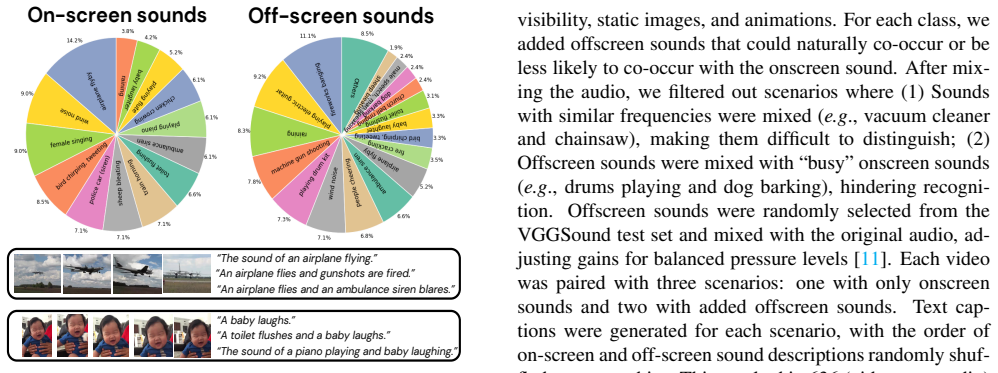
"Offscreen sounds were randomly selected from the VGGSound test set and mixed with the original audio, adjusting gains for balanced pressure levels [11]. ... Text captions were generated for each scenario, with the order of on-screen and off-screen sound descriptions randomly shuffled to prevent bias. ... Our comprehensive experiments on VinTAGe-Bench demonstrate that joint text and visual interaction is necessary for holistic audio generation."
VinTAGe-Bench defines holistic audio as a mixture of an onscreen sound and a randomly added offscreen sound. By construction, the offscreen clip is chosen from VGGSound test audio and mixed into the track, so it is not present in the video; its identity is available only through the caption, which names both sounds. The onscreen sound's temporal envelope, meanwhile, is available only through the video. Thus a video-only model cannot produce the offscreen component and a text-only model cannot lock the onscreen timing: the failure of single-modality models on this benchmark is guaranteed by dataset assembly rather than discovered by experiment.
full rationale
VinTAGe is an empirical system, and most of its engineering machinery — flow matching, the VT-Encoder, teacher-guided losses — is not circular: the VGGSound test set is an external benchmark, and the reported FAD/FID/MKL and MOS improvements there are independent evidence. The construction-bound step is the paper's headline conclusion that joint conditioning is 'necessary' for holistic audio generation. That conclusion is inferred from VinTAGe-Bench, which is built by taking VGGSound test videos, mixing each with one randomly chosen offscreen VGGSound test audio, and writing captions that name both sounds. The offscreen audio is therefore absent from the video by construction and present only in the text, while precise onscreen timing lives only in the video, so single-modality baselines fail on the corresponding sub-task for that reason, not because the experiments revealed an emergent necessity. The claim is further weakened by the paper's own Table 5, where text-only VinTAGe achieves higher Mean-Acc (54.32) than joint VinTAGe (50.66), so the 'necessary' claim is not even supported by the paper's controlled comparison. Because the VGGSound SOTA result and the architecture ablations rest on external or internally consistent evidence, the circularity is partial rather than total.
Assumptions & free parameters
free parameters (2)
- Classifier-free guidance scales svis and stxt =
2.5, 2.5
- Teacher alignment loss weights lambda_v, lambda_t =
1, 1
assumptions (4)
- standard math Flow matching linearly interpolates between noise and data with a constant velocity field
- domain assumption CLIP visual features and FLAN-T5 text features provide sufficiently aligned semantic representations of video and text
- domain assumption Pretrained T2A and V2A teacher models provide reliable velocity targets for student distillation
- ad hoc to paper The VinTAGe-Bench mixture of one onscreen audio and one randomly selected offscreen audio, after filtering hard cases, is representative of holistic audio scenes
Cite this review
Pith. "Pith review of VinTAGe: Joint Video and Text Conditioning for Holistic Audio Generation." pith.science (2026). https://pith.science/paper/HTF4WOLN
@misc{pith2026241210768,
  author       = {Pith},
  title        = {Pith review of: VinTAGe: Joint Video and Text Conditioning for Holistic Audio Generation},
  year         = {2026},
  howpublished = {\url{https://pith.science/paper/HTF4WOLN}},
  note         = {Machine review of arXiv:2412.10768}
}
read the original abstract
Recent advances in audio generation have focused on text-to-audio (T2A) and video-to-audio (V2A) tasks. However, T2A or V2A methods cannot generate holistic sounds (onscreen and off-screen). This is because T2A cannot generate sounds aligning with onscreen objects, while V2A cannot generate semantically complete (offscreen sounds missing). In this work, we address the task of holistic audio generation: given a video and a text prompt, we aim to generate both onscreen and offscreen sounds that are temporally synchronized with the video and semantically aligned with text and video. Previous approaches for joint text and video-to-audio generation often suffer from modality bias, favoring one modality over the other. To overcome this limitation, we introduce VinTAGe, a flow-based transformer model that jointly considers text and video to guide audio generation. Our framework comprises two key components: a Visual-Text Encoder and a Joint VT-SiT model. To reduce modality bias and improve generation quality, we employ pretrained uni-modal text-to-audio and video-to-audio generation models for additional guidance. Due to the lack of appropriate benchmarks, we also introduce VinTAGe-Bench, a dataset of 636 video-text-audio pairs containing both onscreen and offscreen sounds. Our comprehensive experiments on VinTAGe-Bench demonstrate that joint text and visual interaction is necessary for holistic audio generation. Furthermore, VinTAGe achieves state-of-the-art results on the VGGSound benchmark. Our source code and pre-trained models will be released. Demo is available at: https://www.youtube.com/watch?v=QmqWhUjPkJI.
Figures


Figures from the paper (14 more)


Forward citations
Cited by 2 Pith papers
-
AV-Link: Temporally-Aligned Diffusion Features for Cross-Modal Audio-Video Generation
AV-Link unifies video-to-audio and audio-to-video generation by aligning frozen diffusion-model activations with temporally matched rotary position embeddings in a shared Fusion Block.
-
Sound Scene Synthesis at the DCASE 2024 Challenge
Four text-to-audio systems were evaluated against a human reference in the DCASE 2024 Task 7 challenge, with a 36% quality gap and strong but small-sample FAD-to-human correlation.
Reference graph
Works this paper leans on
-
[1]
The Foley grail: The art of perform- ing sound for film, games, and animation
Vanessa Theme Ament. The Foley grail: The art of perform- ing sound for film, games, and animation . Routledge, 2014. 1
work page 2014
-
[2]
In- structpix2pix: Learning to follow image editing instructions
Tim Brooks, Aleksander Holynski, and Alexei A Efros. In- structpix2pix: Learning to follow image editing instructions. In Proceedings of the IEEE/CVF Conference on Computer Vision and Pattern Recognition, pages 18392–18402, 2023. 6
work page 2023
-
[3]
Video generation models as world simulators
Tim Brooks, Bill Peebles, Connor Holmes, Will DePue, Yufei Guo, Li Jing, David Schnurr, Joe Taylor, Troy Luh- man, Eric Luhman, Clarence Ng, Ricky Wang, and Aditya Ramesh. Video generation models as world simulators
-
[4]
Vggsound: A large-scale audio-visual dataset
Honglie Chen, Weidi Xie, Andrea Vedaldi, and Andrew Zis- serman. Vggsound: A large-scale audio-visual dataset. In International Conference on Acoustics, Speech, and Signal Processing (ICASSP), 2020. 2, 6, 8, 12
work page 2020
-
[5]
Gentron: Diffusion trans- formers for image and video generation
Shoufa Chen, Mengmeng Xu, Jiawei Ren, Yuren Cong, Sen He, Yanping Xie, Animesh Sinha, Ping Luo, Tao Xiang, and Juan-Manuel Perez-Rua. Gentron: Diffusion trans- formers for image and video generation. In Proceedings of the IEEE/CVF Conference on Computer Vision and Pattern Recognition, pages 6441–6451, 2024. 6
work page 2024
-
[6]
Michel Chion. Audio-vision: sound on screen . Columbia University Press, 2019. 1
work page 2019
-
[7]
Scaling instruction- finetuned language models
Hyung Won Chung, Le Hou, Shayne Longpre, Barret Zoph, Yi Tay, William Fedus, Yunxuan Li, Xuezhi Wang, Mostafa Dehghani, Siddhartha Brahma, et al. Scaling instruction- finetuned language models. Journal of Machine Learning Research, 25(70):1–53, 2024. 2, 11
work page 2024
-
[8]
An image is worth 16x16 words: Transformers for image recognition at scale
Alexey Dosovitskiy. An image is worth 16x16 words: Transformers for image recognition at scale. arXiv preprint arXiv:2010.11929, 2020. 11
arXiv 2010
Show all 56 references
-
[10]
Lumina-t2x: Trans- forming text into any modality, resolution, and duration via flow-based large diffusion transformers
Peng Gao, Le Zhuo, Chris Liu, , Ruoyi Du, Xu Luo, Longtian Qiu, Yuhang Zhang, et al. Lumina-t2x: Trans- forming text into any modality, resolution, and duration via flow-based large diffusion transformers. arXiv preprint arXiv:2405.05945, 2024. 3
2024 arXiv
-
[11]
Text-to-audio generation using instruc- tion tuned llm and latent diffusion model
Deepanway Ghosal, Navonil Majumder, Ambuj Mehrish, and Soujanya Poria. Text-to-audio generation using instruc- tion tuned llm and latent diffusion model. arXiv preprint arXiv:2304.13731, 2023. 1, 2, 3, 5, 6, 12, 14
2023 arXiv
-
[12]
Imagebind: One embedding space to bind them all
Rohit Girdhar, Alaaeldin El-Nouby, Zhuang Liu, Mannat Singh, Kalyan Vasudev Alwala, Armand Joulin, and Ishan Misra. Imagebind: One embedding space to bind them all. In CVPR, 2023. 3
2023
-
[13]
Determining op- tical flow
Berthold KP Horn and Brian G Schunck. Determining op- tical flow. Artificial intelligence, 17(1-3):185–203, 1981. 3, 11
1981
-
[14]
Make-an-audio: Text-to-audio gen- eration with prompt-enhanced diffusion models
Rongjie Huang, Jiawei Huang, Dongchao Yang, Yi Ren, Luping Liu, Mingze Li, Zhenhui Ye, Jinglin Liu, Xiang Yin, and Zhou Zhao. Make-an-audio: Text-to-audio gen- eration with prompt-enhanced diffusion models. In Inter- national Conference on Machine Learning , pages 13916– 13932...
2023
-
[15]
Captivating sound
Sander Huiberts. Captivating sound. Utrecht School of the Arts, 2010. 1
2010
-
[16]
Taming visually guided sound generation
Vladimir Iashin and Esa Rahtu. Taming visually guided sound generation. In British Machine Vision Conference (BMVC), 2021. 2, 6, 7, 8
2021
-
[17]
Mixing audio: concepts, practices, and tools
Roey Izhaki. Mixing audio: concepts, practices, and tools . Routledge, 2017. 1
2017
-
[18]
Read, watch and scream! sound generation from text and video
Yujin Jeong, Yunji Kim, Sanghyuk Chun, and Jiyoung Lee. Read, watch and scream! sound generation from text and video. 2024. 1, 2, 3, 4, 6, 7, 8, 12
2024
-
[19]
Fr \’echet audio distance: A metric for evaluating music enhancement algorithms
Kevin Kilgour, Mauricio Zuluaga, Dominik Roblek, and Matthew Sharifi. Fr \’echet audio distance: A metric for evaluating music enhancement algorithms. arXiv preprint arXiv:1812.08466, 2018. 6
2018 arXiv
-
[20]
Hifi-gan: Generative adversarial networks for efficient and high fi- delity speech synthesis
Jungil Kong, Jaehyeon Kim, and Jaekyoung Bae. Hifi-gan: Generative adversarial networks for efficient and high fi- delity speech synthesis. Advances in neural information pro- cessing systems, 33:17022–17033, 2020. 3, 12
2020
-
[21]
Audiogen: Textually guided audio gen- eration
Felix Kreuk, Gabriel Synnaeve, Adam Polyak, Uriel Singer, Alexandre D ´efossez, Jade Copet, Devi Parikh, Yaniv Taig- man, and Yossi Adi. Audiogen: Textually guided audio gen- eration. arXiv preprint arXiv:2209.15352, 2022. 2
2022 arXiv
-
[22]
Diff-sage: End-to-end spa- tial audio generation using diffusion models
Saksham Singh Kushwaha, Jianbo Ma, Mark RP Thomas, Yapeng Tian, and Avery Bruni. Diff-sage: End-to-end spa- tial audio generation using diffusion models. arXiv preprint arXiv:2410.11299, 2024. 3
2024 arXiv
-
[23]
V oice- box: Text-guided multilingual universal speech generation at scale, 2023
Matthew Le, Apoorv Vyas, Bowen Shi, Brian Karrer, Leda Sari, Rashel Moritz, Mary Williamson, Vimal Manohar, Yossi Adi, Jay Mahadeokar, and Wei-Ning Hsu. V oice- box: Text-guided multilingual universal speech generation at scale, 2023. 3
2023
-
[24]
Flow matching for generative mod- eling
Yaron Lipman, Ricky TQ Chen, Heli Ben-Hamu, Maximil- ian Nickel, and Matt Le. Flow matching for generative mod- eling. arXiv preprint arXiv:2210.02747, 2022. 3
2022 arXiv
-
[25]
Audi- oLDM: Text-to-audio generation with latent diffusion mod- els
Haohe Liu, Zehua Chen, Yi Yuan, Xinhao Mei, Xubo Liu, Danilo Mandic, Wenwu Wang, and Mark D Plumbley. Audi- oLDM: Text-to-audio generation with latent diffusion mod- els. Proceedings of the International Conference on Machine Learning, pages 21450–21474, 2023. 1, 2, 3, 12
2023
-
[26]
Flashaudio: Rectified flows for fast and high-fidelity text-to-audio generation
Huadai Liu, Jialei Wang, Rongjie Huang, Yang Liu, Heng Lu, Wei Xue, and Zhou Zhao. Flashaudio: Rectified flows for fast and high-fidelity text-to-audio generation. arXiv preprint arXiv:2410.12266, 2024. 3
2024 arXiv
-
[27]
Plumbley
Haohe Liu, Yi Yuan, Xubo Liu, Xinhao Mei, Qiuqiang Kong, Qiao Tian, Yuping Wang, Wenwu Wang, Yuxuan Wang, and Mark D. Plumbley. Audioldm 2: Learning holistic au- dio generation with self-supervised pretraining. IEEE/ACM Transactions on Audio, Speech, and Language Processing , ...
2024
-
[28]
Flow straight and fast: Learning to generate and transfer data with rectified flow
Xingchao Liu, Chengyue Gong, and Qiang Liu. Flow straight and fast: Learning to generate and transfer data with rectified flow. arXiv preprint arXiv:2209.03003, 2022. 3 9
2022 arXiv
-
[29]
Separate anything you describe
Xubo Liu, Qiuqiang Kong, Yan Zhao, Haohe Liu, Yi Yuan, Yuzhuo Liu, Rui Xia, Yuxuan Wang, Mark D Plumbley, and Wenwu Wang. Separate anything you describe. arXiv preprint arXiv:2308.05037, 2023. 6, 15
2023 arXiv
-
[30]
Diff-foley: Synchronized video-to-audio synthesis with la- tent diffusion models, 2023
Simian Luo, Chuanhao Yan, Chenxu Hu, and Hang Zhao. Diff-foley: Synchronized video-to-audio synthesis with la- tent diffusion models, 2023. 1, 2, 4, 6, 7, 8, 14
2023
-
[31]
Albergo, Nicholas M
Nanye Ma, Mark Goldstein, Michael S. Albergo, Nicholas M. Boffi, Eric Vanden-Eijnden, and Saining Xie. Sit: Exploring flow and diffusion-based generative models with scalable interpolant transformers. 2024. 2, 3, 4, 12
2024
-
[32]
Tango 2: Aligning diffusion-based text-to-audio generations through direct preference optimization, 2024
Navonil Majumder, Chia-Yu Hung, Deepanway Ghosal, Wei-Ning Hsu, Rada Mihalcea, and Soujanya Poria. Tango 2: Aligning diffusion-based text-to-audio generations through direct preference optimization, 2024. 1, 2, 6, 7, 13
2024
-
[33]
Samplernn: An unconditional end- to-end neural audio generation model
Soroush Mehri, Kundan Kumar, Ishaan Gulrajani, Rithesh Kumar, Shubham Jain, Jose Sotelo, Aaron Courville, and Yoshua Bengio. Samplernn: An unconditional end- to-end neural audio generation model. arXiv preprint arXiv:1612.07837, 2016. 2
2016 arXiv
-
[34]
Text-to- audio generation synchronized with videos
Shentong Mo, Jing Shi, and Yapeng Tian. Text-to- audio generation synchronized with videos. arXiv preprint arXiv:2403.07938, 2024. 3
2024 arXiv
-
[35]
Bal- ancing act: Distribution-guided debiasing in diffusion mod- els
Rishubh Parihar, Abhijnya Bhat, Abhipsa Basu, Saswat Mallick, Jogendra Nath Kundu, and R Venkatesh Babu. Bal- ancing act: Distribution-guided debiasing in diffusion mod- els. In Proceedings of the IEEE/CVF Conference on Com- puter Vision and Pattern Recognition , pages 6668–6678,
-
[36]
Scalable diffusion models with transformers, 2023
William Peebles and Saining Xie. Scalable diffusion models with transformers, 2023. 3, 4, 12
2023
-
[37]
Film: Visual reasoning with a general conditioning layer
Ethan Perez, Florian Strub, Harm De Vries, Vincent Du- moulin, and Aaron Courville. Film: Visual reasoning with a general conditioning layer. In Proceedings of the AAAI con- ference on artificial intelligence, 2018. 4
2018
-
[38]
Learning transferable visual models from natural language supervi- sion
Alec Radford, Jong Wook Kim, Chris Hallacy, Aditya Ramesh, Gabriel Goh, Sandhini Agarwal, Girish Sastry, Amanda Askell, Pamela Mishkin, Jack Clark, et al. Learning transferable visual models from natural language supervi- sion. In International conference on machine learning, ...
2021
-
[39]
Exploring the limits of transfer learning with a unified text-to-text transformer
Colin Raffel, Noam Shazeer, Adam Roberts, Katherine Lee, Sharan Narang, Michael Matena, Yanqi Zhou, Wei Li, and Peter J Liu. Exploring the limits of transfer learning with a unified text-to-text transformer. Journal of machine learning research, 21(140):1–67, 2020. 3
2020
-
[40]
High-resolution image synthesis with latent diffusion models
Robin Rombach, Andreas Blattmann, Dominik Lorenz, Patrick Esser, and Bj ¨orn Ommer. High-resolution image synthesis with latent diffusion models. In Proceedings of the IEEE/CVF conference on computer vision and pattern recognition, pages 10684–10695, 2022. 2
2022
-
[41]
I hear your true colors: Image guided audio generation, 2022
Roy Sheffer and Yossi Adi. I hear your true colors: Image guided audio generation, 2022. 2, 6, 8
2022
-
[42]
Auto- acd: A large-scale dataset for audio-language representation learning
Luoyi Sun, Xuenan Xu, Mengyue Wu, and Weidi Xie. Auto- acd: A large-scale dataset for audio-language representation learning. In ACM Multimedia, 2024. 6, 8
2024
-
[43]
Learning from between-class examples for deep sound recognition
Yuji Tokozume, Yoshitaka Ushiku, and Tatsuya Harada. Learning from between-class examples for deep sound recognition. arXiv preprint arXiv:1711.10282 , 2017. 12, 14
2017 arXiv
-
[44]
Attention is all you need
A Vaswani. Attention is all you need. Advances in Neural Information Processing Systems, 2017. 4
2017
-
[45]
Audiobox: Unified audio generation with natural language prompts, 2023
Apoorv Vyas, Bowen Shi, Matthew Le, Andros Tjandra, Yi-Chiao Wu, Baishan Guo, Jiemin Zhang, Xinyue Zhang, Robert Adkins, William Ngan, Jeff Wang, Ivan Cruz, Bapi Akula, Akinniyi Akinyemi, Brian Ellis, Rashel Moritz, Yael Yungster, Alice Rakotoarison, Liang Tan, Chris Summers, ...
2023
-
[46]
V2a-mapper: A lightweight solution for vision-to-audio generation by connecting foun- dation models
Heng Wang, Jianbo Ma, Santiago Pascual, Richard Cartwright, and Weidong Cai. V2a-mapper: A lightweight solution for vision-to-audio generation by connecting foun- dation models. In Proceedings of the AAAI Conference on Artificial Intelligence, 2024. 1, 3, 6
2024
-
[47]
One-peace: Exploring one general representa- tion model toward unlimited modalities
Peng Wang, Shijie Wang, Junyang Lin, Shuai Bai, Xi- aohuan Zhou, Jingren Zhou, Xinggang Wang, and Chang Zhou. One-peace: Exploring one general representa- tion model toward unlimited modalities. arXiv preprint arXiv:2305.11172, 2023. 6
2023 arXiv
-
[48]
Wav2clip: Learning robust audio repre- sentations from clip
Ho-Hsiang Wu, Prem Seetharaman, Kundan Kumar, and Juan Pablo Bello. Wav2clip: Learning robust audio repre- sentations from clip. In ICASSP 2022 - 2022 IEEE Interna- tional Conference on Acoustics, Speech and Signal Process- ing (ICASSP), 2022. 6
2022
-
[49]
Large-scale con- trastive language-audio pretraining with feature fusion and keyword-to-caption augmentation
Yusong Wu, Ke Chen, Tianyu Zhang, Yuchen Hui, Taylor Berg-Kirkpatrick, and Shlomo Dubnov. Large-scale con- trastive language-audio pretraining with feature fusion and keyword-to-caption augmentation. In ICASSP 2023-2023 IEEE International Conference on Acoustics, Speech and Si...
2023
-
[50]
Son- icvisionlm: Playing sound with vision language models
Zhifeng Xie, Shengye Yu, Qile He, and Mengtian Li. Son- icvisionlm: Playing sound with vision language models. In Proceedings of the IEEE/CVF Conference on Computer Vi- sion and Pattern Recognition, pages 26866–26875, 2024. 2, 3, 4
2024
-
[51]
Seeing and hearing: Open-domain visual- audio generation with diffusion latent aligners
Yazhou Xing, Yingqing He, Zeyue Tian, Xintao Wang, and Qifeng Chen. Seeing and hearing: Open-domain visual- audio generation with diffusion latent aligners. In CVPR,
-
[52]
Diffsound: Discrete diffusion model for text-to-sound generation
Dongchao Yang, Jianwei Yu, Helin Wang, Wen Wang, Chao Weng, Yuexian Zou, and Dong Yu. Diffsound: Discrete diffusion model for text-to-sound generation. IEEE/ACM Transactions on Audio, Speech, and Language Processing , 31:1720–1733, 2023. 2
2023
-
[53]
Diverse and aligned audio-to-video genera- tion via text-to-video model adaptation
Guy Yariv, Itai Gat, Sagie Benaim, Lior Wolf, Idan Schwartz, and Yossi Adi. Diverse and aligned audio-to-video genera- tion via text-to-video model adaptation. In Proceedings of the AAAI Conference on Artificial Intelligence, pages 6639– 6647, 2024. 3, 7, 11, 14
2024
-
[54]
Foley- crafter: Bring silent videos to life with lifelike and synchro- nized sounds, 2024
Yiming Zhang, Yicheng Gu, Yanhong Zeng, Zhening Xing, Yuancheng Wang, Zhizheng Wu, and Kai Chen. Foley- crafter: Bring silent videos to life with lifelike and synchro- nized sounds, 2024. 1, 2, 3, 4, 6, 7, 8 10
2024
-
[55]
Llava- next: A strong zero-shot video understanding model, 2024
Yuanhan Zhang, Bo Li, haotian Liu, Yong jae Lee, Liangke Gui, Di Fu, Jiashi Feng, Ziwei Liu, and Chunyuan Li. Llava- next: A strong zero-shot video understanding model, 2024. 6, 7, 12
2024
-
[56]
Yipin Zhou, Zhaowen Wang, Chen Fang, Trung Bui, and Tamara L. Berg. Visual to sound: Generating natural sound for videos in the wild. In Proceedings of the IEEE Confer- ence on Computer Vision and Pattern Recognition (CVPR) ,
-
[57]
Wind blows
Le Zhuo, Ruoyi Du, Xiao Han, Yangguang Li, Dongyang Liu, Rongjie Huang, Wenze Liu, et al. Lumina-next: Making lumina-t2x stronger and faster with next-dit. arXiv preprint arXiv:2406.18583, 2024. 3 Appendix A. Implementation details Video energy Video energy sampled at 0.25 s F...
2024 arXiv
Reviewed August 11, 2026 · model on record in the stance chip above.
Discussion (0). Continue with ORCID to comment.