REVIEW 2 major objections 4 minor 102 references
A robust neural determination of the source-count distribution of the Fermi-LAT sky at high latitudes
T0 review · 2 major / 4 minor · reviewed 2026-08-16 · deepseek-v4-flash
Pith's one-line read Using simulation-based inference with a Gaussian-random-field-perturbed foreground, this paper shows that 14 years of Fermi-LAT sky maps can be reduced to a calibrated source-count distribution and a nearly complete source list.
desk verdict Careful, useful SBI pipeline for Fermi-LAT dN/dS, but the simulator-realism test is too weak to support the paper's central robustness claim. read the letter →
The pith
A machine-rendered reading of the paper's core claim, the machinery that carries it, and where it could break.
The reading
What carries the argument
The machine that carries the argument is a fast, GPU-based forward simulator of binned all-sky photon-count maps at HEALPix resolution Nside = 128. It draws point sources from a parametric dN/dS given by a triple-broken power law, scatters their photons through an energy-averaged Fermi-LAT PSF by direct Monte Carlo, and adds PSF-smoothed templates for the Galactic diffuse emission, isotropic background, and the Magellanic Clouds. In the robust variant, the diffuse template is multiplied by the exponential of a Gaussian random field with power spectrum P(k) = (k/2.5)^(-gamma), so the network learns to marginalize over foreground uncertainty; this is the ingredient that reduces non-catalog candidates from 685 to 387. Inference is done by neural ratio estimation, in which a classifier learns the likelihood-to-evidence ratio, with a U-Net on a spherical graph for pixel-wise source detection and autoregressive ratio estimators for the dN/dS parameters.
What would settle it
Take the pipeline and run it on a simulated sky where the faint source population below about S~1e-11 $cm^{-2}$ $s^{-1}$ is spatially clustered on degree scales instead of isotropic; if the Deep SVDD anomaly score still accepts the map while the inferred dN/dS or the candidate list moves outside the quoted credible intervals, the model-space assumption fails.
Extended reading notes
Core claim
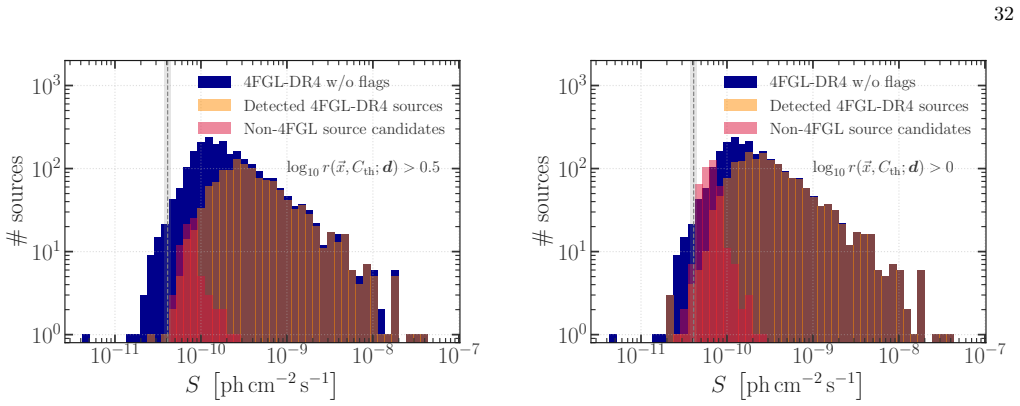
The paper's central claim, stated on its own terms, is that a neural simulator trained on a realistically perturbed forward model closes the reality gap for high-latitude gamma-ray inference. Applied to 14 years of Fermi-LAT data with |b| >= 30 degrees in the 1-10 GeV band, the pipeline detects point sources through a pixel-wise neural ratio and recovers about 98% of all unflagged 4FGL-DR4 sources above S=3e-10 $cm^{-2}$ $s^{-1}$, roughly 70% over the full flux range, while keeping the number of non-catalog candidates to a few hundred and none above that flux. The same framework infers the source-count distribution in a triple-broken-power-law form and in 20 independent flux bins; the two reconstructions agree at the 1-$\sigma$ level, overlap the catalog's implied distribution, and match the 1p-PDF results of earlier likelihood analyses more closely when the diffuse Milky Way foreground is distorted by Gaussian random fields during training. The paper declares the non-parametric, GRF-trained dN/dS profile to be its best estimate for the high-latitude source-count distribution.
Load-bearing premise
The load-bearing premise is that the simulator's model space contains the real high-latitude Fermi-LAT sky, so a network trained only on simulated maps generalizes to the actual data; the anomaly test only shows the real map is not a statistical outlier, not that the model space is complete.
Editorial extensions
If this is right
- Above S=3e-10 cm^-2 s^-1, the SBI detector reaches about 98% completeness relative to the 4FGL-DR4 catalog, and no non-catalog candidate appears at that flux, so the bright end of the dN/dS is consistent with the catalog.
- The inferred parametric and non-parametric dN/dS agree with each other at the 1-sigma level and with the 1p-PDF results from the literature across the full flux range when GRFs are included, supporting a downturn in the number of faint sources below S~1e-10 cm^-2 s^-1.
- Because the method yields amortized and well-calibrated posteriors, it can be extended to multiple energy bins, source spectra, and source classification without changing the inference principle.
- Training with GRF-perturbed foregrounds reduces the non-catalog candidate population from 685 to 387, implying that part of the candidate excess in the no-GRF analysis was foreground fluctuation rather than genuine point sources.
- The pipeline recovers about 70% of all unflagged 4FGL-DR4 sources over the full flux range, so it does not yet reach catalog-level sensitivity for faint sources; the paper attributes part of this gap to the catalog's own multi-step analysis pipeline.
Reading between the lines
- If the central claim is right, the unresolved point-source fraction of the isotropic gamma-ray background below S~1e-10 cm^-2 s^-1 would be smaller than the original 1p-PDF estimates, a difference that could be tested with a blazar luminosity-function decomposition.
- A testable extension the paper leaves implicit: the same GRF machinery could be replaced by a physically motivated gas-template alternative, and the inferred GRF parameters would then become measurements of missing or dark gas rather than effective distortions.
- The Deep SVDD anomaly test is necessary but not sufficient; injecting a spatially clustered faint-source population into the simulator and checking whether the anomaly score still accepts the real map would settle whether the model space is wide enough.
- Because the pipeline is amortized, rerunning it on independent early Fermi-LAT data selections or with a different PSF realization would provide a public, reproducible check of the 98% recovery claim.
Signed reviews
Editorial analysis
A structured set of objections, weighed in public.
Referee Report
Summary. The paper develops a simulation-based inference (SBI) pipeline based on neural ratio estimation with spherical (DeepSphere) convolutional networks, and applies it to 14 years of Fermi-LAT high-latitude (|b|>30°) data in the 1–10 GeV band. The forward simulator comprises a triple-broken-power-law point-source population with uniform sky positions, Galactic diffuse, isotropic, LMC, and SMC backgrounds, energy-averaged exposure and PSF treatments, and optional Gaussian-random-field (GRF) distortions of the Galactic diffuse template applied after PSF convolution. Three inference tasks are performed: pixel-wise point-source detection with a U-Net; parametric inference of the TBPL and background parameters via autoregressive NRE with nested sampling; and non-parametric inference of the binned S^2 dN/dS. The main claims are: recovery of ~98% of un-flagged 4FGL-DR4 sources above S=3×10^-10 cm^-2 s^-1 with no non-4FGL candidate above that flux (for the GRF-trained detector); parametric and non-parametric dN/dS profiles consistent with each other and with the 1p-PDF literature results [13,17]; validated reconstruction on simulated data including the dim-flux regime; coverage tests showing generally well-calibrated posteriors; and a Deep SVDD anomaly test indicating that the real sky lies inside the simulator's model space. The non-parametric GRF-inclusive dN/dS is declared the best estimate (Sec. VII).
Significance. If correct, this is a substantial methodological advance: it is among the first applications of ML-based source detection and SBI parameter inference to a large ROI of genuine Fermi-LAT data rather than simulations, it reaches fluxes about a factor of three below the 4FGL completeness limit without producing bright spurious detections, and the reconstructed dN/dS agrees with independent likelihood-based 1p-PDF analyses. The paper is unusually thorough in its validation: simulated-data recovery with known ground truth (App. D), posterior calibration via coverage tests on 1000 samples (App. E1), explicit mis-modeling tests (App. F), and a fast simulator built on public Fermi Science Tools. The headline claims are falsifiable: the candidate source list and the absence of bright non-4FGL candidates can be checked by dedicated follow-up observations, and the declared "best estimate" dN/dS can be compared against future catalog-based measurements. These strengths make the paper a likely reference point for SBI in gamma-ray astrophysics, provided the reality-gap validation is strengthened as detailed in the major comments.
major comments (2)
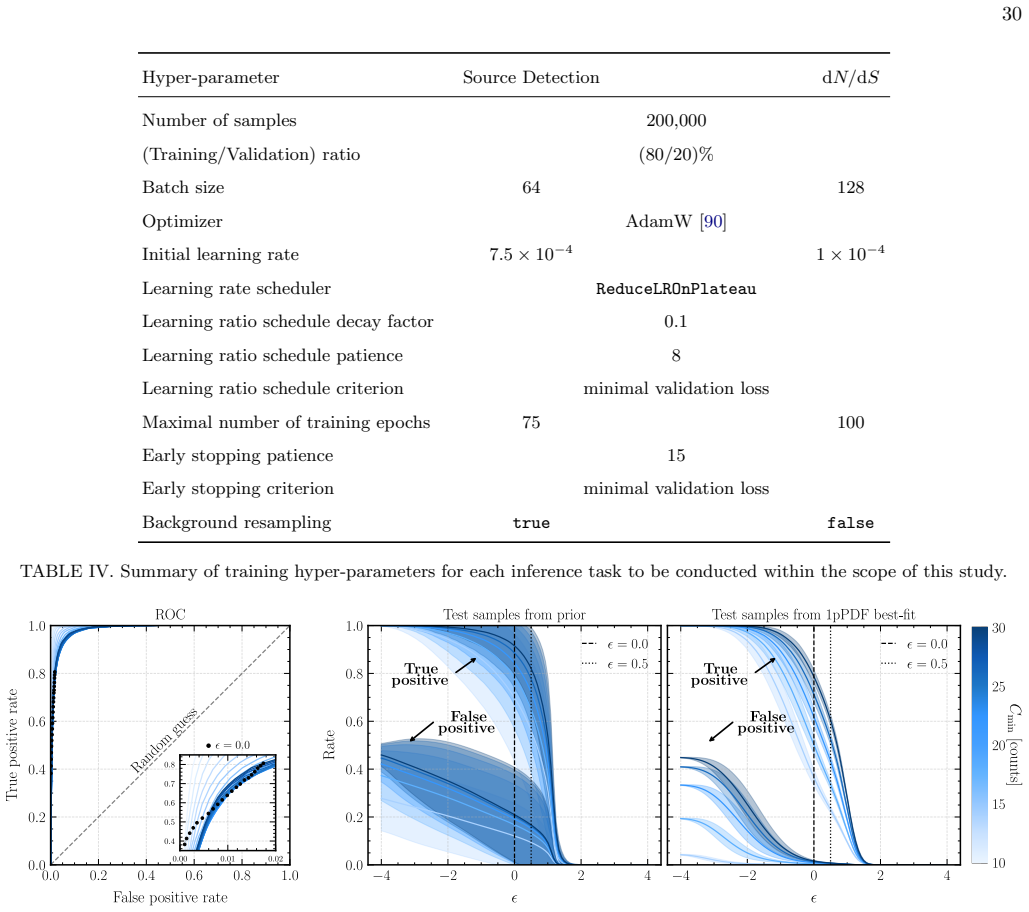
- [Sec. III D, App. E2, App. F1, Sec. VII] The paper's central robustness claim — that training with GRF-augmented backgrounds protects the dN/dS and source-list inference against diffuse mis-modeling, culminating in the declaration of the non-parametric GRF-inclusive dN/dS as the best estimate (Sec. VII) — is not established for the small-scale regime by the validation actually presented. Sec. III D states that the GRF is multiplied into the Galactic diffuse template after PSF convolution, so the simulator can only produce unsmeared small-scale diffuse fluctuations, whereas the physical mis-modeling it is meant to absorb (gas clumps, template errors, dark gas) would be smoothed by the LAT PSF before appearing in the count maps. The two quantitative checks do not close this gap: the Deep SVDD anomaly test (App. E2) places the real 14-year data inside the simulated score distribution, but it equally places a sky generated with the FGMA diffuse template inside that distribution, and in the GRF-trained case even a pure Poisson noise map moves closer to the simulated distribution; both observations indicate that the SVDD score is insensitive to the specific kind of mis-modeling that would bias dN/dS, because the GRFs inflate the variance of the model space at all scales. App. F1's mis-modeling test only replaces the diffuse template by a large-scale variant missing the Fermi Bubbles and Loop I; it does not exercise the small-scale, pre-PSF regime. I recommend adding a closed-loop stress test in which diffuse mis-modeling is injected before PSF convolution (e.g., GRF perturbations applied to the unsmoothed template, or compact unresolved structures outside the GRF family), followed by verification that the GRF-trained parametric and non-parametric networks recover the injected dN/dS without bias; this test is feasible within the existing simulator framework and directly targets the weakest assumption flagged by the authors themselves.
- [App. E1 (Fig. 20), Sec. VII] The abstract and Sec. VII present "well-calibrated posterior distributions" as a headline achievement, but the coverage tests behind the declared best estimate show systematic overconfidence. In App. E1, Fig. 20 (non-parametric inference with GRFs) gives empirical 1σ coverages of 58–62% against the nominal 68% for the bright flux bins θS,18–θS,20, similarly reduced coverage for several dim bins (θS,15–17), and slight overconfidence for Aiso (63.5% at nominal 68%). Because the non-parametric GRF profile is the result the paper recommends for further use, the quoted credible intervals for that profile are narrower than their stated calibration; this should be either fixed (e.g., by increasing the training sample, as the authors suggest in App. E1) or explicitly disclosed wherever the profile is presented, including in the abstract's calibration claim.
minor comments (4)
- [Sec. III B a, Tab. II] The TBPL prior ranges are explicitly motivated by the 4FGL catalog values (Sec. III B a), so the agreement between the inferred dN/dS and the 4FGL histogram (Figs. 7–9) is partly by construction; the decisive independent cross-checks are the 1p-PDF results [13,17], and this asymmetry should be stated where the 4FGL agreement is invoked.
- [Sec. V A, Figs. 5, 11] The fluxes of non-4FGL candidates are computed as pixel counts minus best-fit background divided by exposure, with no uncertainty or systematic caveat attached; since these fluxes control the headline statement that no candidate exceeds 3×10^-10 cm^-2 s^-1, a one-sentence caveat on the uncertainty of this estimate would prevent over-interpretation.
- [Data Availability] The data availability statement promises only figure products "upon reasonable request"; given that the paper's core contribution is a validated SBI pipeline, releasing the trained networks, simulator code, or posterior samples would substantially strengthen reproducibility.
- [Sec. VI] The attribution of the dim-regime discrepancy with [28] to their fixed Galactic diffuse normalization is plausible, but it would be more persuasive if accompanied by the closed-loop test proposed in major comment 1, since the present analysis's own sensitivity to diffuse mis-modeling is precisely the point at issue.
Circularity Check
No significant circularity: the dN/dS inference is data-driven, trained on simulated maps without 4FGL labels, and validated against external literature and catalogs.
full rationale
The central inference is genuinely simulation-based: in every training sample, point-source fluxes and positions are drawn from the TBPL priors, and the neural networks learn ratios from simulated photon-count maps without any use of 4FGL labels. The real-data dN/dS posteriors come from applying those trained networks to the LAT map, not from re-inserting the catalog. Priors are wide and only loosely anchored to 4FGL values, and the non-parametric analysis explicitly drops the TBPL functional form, so the agreement with the catalog and with the independent 1p-PDF results of Refs. [13,17] is an empirical cross-check rather than a construction. The source-detection claim is a recovery/completeness statement against 4FGL, with the paper explicitly noting that 4FGL is assumed as ground truth only for evaluation; the detection network itself was trained on simulated sources only. The robustness of the GRF-enhanced simulator is supported by closed-loop recovery tests on simulated data with known ground truth, Bayesian coverage tests, explicit mis-modeling stress tests in App. F, and a Deep SVDD anomaly check that treats the real LAT map as a held-out sample relative to the simulator-trained network. The acknowledged approximation of applying GRFs after PSF convolution (Sec. III.D) is a modeling limitation that the authors disclose and motivate, but it does not identify any inferred quantity with an input by construction. No load-bearing step reduces to a fitted parameter renamed as a prediction, and no uniqueness or validity claim is imported solely from the authors' own prior work. The paper therefore exhibits no circular derivation chain.
Assumptions & free parameters
free parameters (14)
- AS (dN/dS normalization) =
2.5 (posterior median, GRF case)
- n1 (first slope) =
3.0
- n2 (second slope) =
1.9
- n3 (third slope) =
1.8
- n4 (last slope) =
0.0
- Sb1 (first break flux) =
1.3e-8 cm^-2 s^-1
- Sb2 (second break flux) =
3.8e-10 cm^-2 s^-1
- Sb3 (third break flux) =
4.2e-12 cm^-2 s^-1
- Adiff (Galactic diffuse normalization) =
0.81
- Aiso (isotropic background normalization) =
0.9
- ALMC (LMC normalization) =
0.85
- ASMC (SMC normalization) =
0.56
- AGRF (GRF amplitude) =
2.0
- gamma (GRF power-spectrum slope) =
2.4
assumptions (8)
- domain assumption The high-latitude source-count distribution is well described by a triple-broken power law with parameters in the chosen prior ranges.
- domain assumption Point-like gamma-ray sources are uniformly distributed on the sky at |b|>30 degrees.
- domain assumption The combination of the Fermi diffuse model (gll_iem_v078), isotropic template, LMC/SMC templates, global normalizations, and GRF modulations spans the real high-latitude sky.
- ad hoc to paper Gaussian random field distortions with power-law power spectrum, gamma in [1.5,3] and AGRF in [0,5], can absorb unresolved diffuse mis-modeling without biasing the source-count inference.
- domain assumption Energy dispersion can be neglected in the single 1-10 GeV energy bin, affecting only a global rescaling of component fluxes.
- domain assumption The energy-averaged PSF computed at (l,b)=(90,40) is representative for the whole ROI and is radially symmetric.
- domain assumption Source fluxes are simulated only down to 1e-13 cm^-2 s^-1, with a single power-law extrapolation below; fainter sources are neglected.
- standard math Neural ratio estimation with the chosen architectures and training set sizes converges to the true likelihood ratio.
Cite this review
Pith. "Pith review of A robust neural determination of the source-count distribution of the Fermi-LAT sky at high latitudes." pith.science (2026). https://pith.science/paper/HTK75BXE
@misc{pith2026250502906,
  author       = {Pith},
  title        = {Pith review of: A robust neural determination of the source-count distribution of the Fermi-LAT sky at high latitudes},
  year         = {2026},
  howpublished = {\url{https://pith.science/paper/HTK75BXE}},
  note         = {Machine review of arXiv:2505.02906}
}
abstract
Over the past 16 years, the Fermi Large Area Telescope (LAT) has significantly advanced our view of the GeV gamma-ray sky, yet several key questions remain - such as the composition of the isotropic gamma-ray background, the origin of the Fermi Bubbles or the potential presence of signatures from exotic physics like dark matter. Addressing these challenges requires sophisticated astrophysical modeling and robust statistical methods capable of handling high-dimensional parameter spaces. In this work, we analyze 14 years of high-latitude ($|b|\geq30^{\circ}$) Fermi-LAT data in the range from 1 to 10 GeV using simulation-based inference (SBI) via neural ratio estimation. This approach allows us to detect individual gamma-ray sources and derive a list of significant gamma-ray emitters containing more than 98\% of all sources listed in the Fermi-LAT Fourth Source Catalog (4FGL) with a flux $S>3\times10^{-10}\;\mathrm{cm}^{-2}\,\mathrm{s}^{-1}$ (about a factor of three larger than the flux above which 4FGL is nearly complete), without any non-4FGL source detected in that flux range. Additionally, we reconstruct the source-count distribution in both parametric and non-parametric forms, achieving large agreement with previous literature results as well as those sources detected by our SBI pipeline. We also quantitatively validate our gamma-ray emission simulator via an anomaly detection technique, demonstrating that the synthetic data closely reproduces the complexity of the real observations.
Figures


Figures from the paper (24 more)




Reference graph
Works this paper leans on
-
[1]
Recovery of the 1p-PDF best-fit dN/dS In the main text’s Fig. 7, we confronted the para- metric and non-parametric d N/dS inference results on real data with similar findings obtained with the 1p-PDF technique. A common observation between our two SBI inference methods was a reduced number of dim sources in comparison with the 1p-PDF best-fit TBPL (which ...
-
[2]
In this section, we showcase the obtained inference results for the large variety of dN/dS profiles allowed by the prior distribu- tions defined in Tab
Performance on simulated sky maps In the previous section, we focused on a single dN/dS parameter realization and explored the perfor- mance of our parametric and non-parametric SBI ap- proach to recover these injected values. In this section, we showcase the obtained inference results for the large variety of dN/dS profiles allowed by the prior distribu-...
-
[3]
In the main text, we did not elaborate on all the information that we can extract from the autoregressive NRE approach and the paramet- ric dN/dS inference
Parameter correlations in the parametric dN/dS inference approach Results without GRFs. In the main text, we did not elaborate on all the information that we can extract from the autoregressive NRE approach and the paramet- ric dN/dS inference. It provides us with the full joint posterior distributions and, thus, we can inspect the cor- relations among di...
-
[4]
Bayesian coverage of the trained networks In Bayesian statistics, it is possible to check the cali- bration of the method and of the posterior distributions it yields via so-called coverage tests. With coverage tests, we aim to verify that the obtained α% credible inter- vals Θˆp(ζ|d)(α) of the posteriors ˆp(ζ|d) 21 cover the true value of the respective ...
-
[5]
III that our gamma-ray simulator was designed in the spirit of generating realistic sam- ples of gamma-ray emission at high latitudes
Assessing the simulator’s realism with anomaly detection We stressed in Sec. III that our gamma-ray simulator was designed in the spirit of generating realistic sam- ples of gamma-ray emission at high latitudes. While the results reported in Sec. V align well with previous litera- ture results – hence, they do not cast striking doubts on the accuracy of t...
-
[6]
The average SVDD is based on these re-normalized values. In the case w/o GRFs, we find that the real data is well within the variation expected from the simulator output, while the noise map is clearly an outlier that cannot be generated from the simulator. Interestingly, the sample featuring an alternative MW diffuse foreground model performs equally wel...
-
[7]
The un- certainties on these quantities will propagate into the predictions of the expected gamma-ray emission
Alternative description of the Galactic diffuse emission As stressed in different places, the Galactic diffuse emission originates in high-energy charged cosmic rays colliding with the interstellar medium, thus tracing the structure and distribution of gas and ISRFs. The un- certainties on these quantities will propagate into the predictions of the expect...
-
[8]
J.-Q. Xia, A. Cuoco, E. Branchini and M. Viel, Tomography of the Fermi-lat γ-ray Diffuse Extragalactic Signal via Cross Correlations With Galaxy Catalogs , Astrophys. J. Suppl. 217 (2015) 15 [ 1503.05918]
work page Pith review arXiv 2015
Show all 102 references
-
[9]
As noted in [13], there is no evidence for the necessity of even three breaks of the d N/dS
Shape of the source-count distribution Throughout this study, we worked with a simulator that generates high-latitude source populations follow- ing a TBPL source-count distribution. As noted in [13], there is no evidence for the necessity of even three breaks of the d N/dS. Y...
-
[10]
Fornasa and M
M. Fornasa and M. A. S´ anchez-Conde,The nature of the Diffuse Gamma-Ray Background , Physics Reports 598 (2015) 1 [ 1502.02866]
2015 arXiv
-
[11]
Ackermann et al., Fermi Large Area Telescope Detection of Extended Gamma-Ray Emission from the Radio Galaxy Fornax A, Astrophys
Fermi-LAT Collaboration, M. Ackermann et al., Fermi Large Area Telescope Detection of Extended Gamma-Ray Emission from the Radio Galaxy Fornax A, Astrophys. J. 826 (2016) 1 [ 1606.04905]
2016 arXiv
-
[12]
Ackermann et al., Anisotropies in the diffuse gamma-ray background measured by the Fermi LAT , Phys
M. Ackermann et al., Anisotropies in the diffuse gamma-ray background measured by the Fermi LAT , Phys. Rev. D 85 (2012) 083007 [ 1202.2856]
2012 arXiv
-
[13]
Fornasa et al., Angular power spectrum of the diffuse gamma-ray emission as measured by the Fermi Large Area Telescope and constraints on its dark matter interpretation, Phys
M. Fornasa et al., Angular power spectrum of the diffuse gamma-ray emission as measured by the Fermi Large Area Telescope and constraints on its dark matter interpretation, Phys. Rev. D 94 (2016) 123005 [1608.07289]
2016 arXiv
-
[14]
S. Ando, M. Fornasa, N. Fornengo, M. Regis and H.-S. Zechlin, Astrophysical interpretation of the anisotropies in the unresolved gamma-ray background , Phys. Rev. D 95 (2017) 123006 [ 1701.06988]
2017 arXiv
-
[15]
Ackermann et al., Unresolved Gamma-Ray Sky through its Angular Power Spectrum, Phys
Fermi-LAT Collaboration, M. Ackermann et al., Unresolved Gamma-Ray Sky through its Angular Power Spectrum, Phys. Rev. Lett. 121 (2018) 241101 [1812.02079]
2018 arXiv
-
[16]
J.-Q. Xia, A. Cuoco, E. Branchini, M. Fornasa and M. Viel, A cross-correlation study of the Fermi-LAT γ-ray diffuse extragalactic signal , Mon. Not. Roy. Astron. Soc. 416 (2011) 2247 [ 1103.4861]
2011 arXiv
-
[17]
Manconi, M
S. Manconi, M. Korsmeier, F. Donato, N. Fornengo, M. Regis and H. Zechlin, Testing gamma-ray models of blazars in the extragalactic sky , Phys. Rev. D 101 (2020) 103026 [ 1912.01622]
2020 arXiv
-
[18]
Branchini, S
E. Branchini, S. Camera, A. Cuoco, N. Fornengo, M. Regis, M. Viel and J.-Q. Xia, Cross-correlating the γ-ray sky with Catalogs of Galaxy Clusters , Astrophys. J. Suppl. 228 (2017) 8 [ 1612.05788]
2017 arXiv
-
[19]
Cuoco, M
A. Cuoco, M. Bilicki, J.-Q. Xia and E. Branchini, Tomographic imaging of the Fermi-LAT gamma-ray sky through cross-correlations: A wider and deeper look , Astrophys. J. Suppl. 232 (2017) 10 [ 1709.01940]
2017 arXiv
-
[20]
Ammazzalorso, N
S. Ammazzalorso, N. Fornengo, S. Horiuchi and M. Regis, Characterizing the local gamma-ray Universe via angular cross-correlations, Phys. Rev. D 98 (2018) 103007 [1808.09225]
2018 arXiv
-
[21]
Ballet, P
Fermi-LAT Collaboration, J. Ballet, P. Bruel, T. H. Burnett and B. Lott, Fermi Large Area Telescope Fourth Source Catalog Data Release 4 (4FGL-DR4) , 2307.12546
-
[22]
Zechlin, A
H.-S. Zechlin, A. Cuoco, F. Donato, N. Fornengo and A. Vittino, Unveiling the Gamma-ray Source Count Distribution Below the Fermi Detection Limit with Photon Statistics, Astrophys. J. Suppl. 225 (2016) 18 [1512.07190]
2016 arXiv
-
[23]
Zechlin, A
H.-S. Zechlin, A. Cuoco, F. Donato, N. Fornengo and M. Regis, Statistical Measurement of the Gamma-ray Source-count Distribution as a Function of Energy , Astrophys. J. Lett. 826 (2016) L31 [ 1605.04256]
2016 arXiv
-
[24]
S. K. Lee, M. Lisanti and B. R. Safdi, Distinguishing Dark Matter from Unresolved Point Sources in the Inner Galaxy with Photon Statistics , JCAP 05 (2015) 056 [1412.6099]
2015 arXiv
-
[25]
Malyshev and D
D. Malyshev and D. W. Hogg, Statistics of gamma-ray point sources below the Fermi detection limit , Astrophysical Journal 738 (2011) 1
2011
-
[26]
Manconi, F
S. Manconi, F. Calore and F. Donato, Galactic Center excess at the highest energies: Morphology and photon-count statistics, Phys. Rev. D 109 (2024) 123042 [2402.04733]
2024 arXiv
-
[27]
Lisanti, S
M. Lisanti, S. Mishra-Sharma, L. Necib and B. R. Safdi, Deciphering Contributions to the Extragalactic Gamma-Ray Background from 2 GeV to 2 TeV , Astrophys. J. 832 (2016) 117 [ 1606.04101]
2016 arXiv
-
[28]
J. J. Somalwar, L. J. Chang, S. Mishra-Sharma and M. Lisanti, Harnessing the Population Statistics of Subhalos to Search for Annihilating Dark Matter , Astrophys. J. 906 (2021) 57 [ 2009.00021]
2021 arXiv
-
[29]
Zechlin, S
H.-S. Zechlin, S. Manconi and F. Donato, Constraining Galactic dark matter with gamma-ray pixel counts statistics, Phys. Rev. D 98 (2018) 083022 [ 1710.01506]
2018 arXiv
-
[30]
R. K. Leane and T. R. Slatyer, Revival of the Dark Matter Hypothesis for the Galactic Center Gamma-Ray Excess, Phys. Rev. Lett. 123 (2019) 241101 [1904.08430]
2019 arXiv
-
[31]
L. J. Chang, S. Mishra-Sharma, M. Lisanti, M. Buschmann, N. L. Rodd and B. R. Safdi, Characterizing the nature of the unresolved point sources in the Galactic Center: An assessment of systematic uncertainties, Phys. Rev. D 101 (2020) 023014 [1908.10874]
2020 arXiv
-
[32]
Buschmann, N
M. Buschmann, N. L. Rodd, B. R. Safdi, L. J. Chang, S. Mishra-Sharma, M. Lisanti and O. Macias, Foreground Mismodeling and the Point Source Explanation of the Fermi Galactic Center Excess , Phys. Rev. D 102 (2020) 023023 [ 2002.12373]
2020 arXiv
-
[33]
R. K. Leane and T. R. Slatyer, The enigmatic Galactic Center excess: Spurious point sources and signal mismodeling, Phys. Rev. D 102 (2020) 063019 [2002.12371]
2020 arXiv
-
[34]
Calore, F
F. Calore, F. Donato and S. Manconi, Dissecting the Inner Galaxy with γ-Ray Pixel Count Statistics , Phys. Rev. Lett. 127 (2021) 161102 [ 2102.12497]
2021 arXiv
-
[35]
Caron, C
S. Caron, C. Eckner, L. Hendriks, G. J´ ohannesson, R. Ruiz de Austri and G. Zaharijas, Mind the gap: the discrepancy between simulation and reality drives interpretations of the Galactic Center Excess , JCAP 06 (2023) 013 [ 2211.09796]
2023 arXiv
-
[36]
Cranmer, J
K. Cranmer, J. Brehmer and G. Louppe, The frontier of simulation-based inference, Proc. Nat. Acad. Sci. 117 (2020) 30055 [ 1911.01429]
2020 arXiv
-
[37]
Amerio, A
A. Amerio, A. Cuoco and N. Fornengo, Extracting the gamma-ray source-count distribution below the Fermi-LAT detection limit with deep learning , JCAP 09 (2023) 029 [ 2302.01947]
2023 arXiv
-
[38]
Mishra-Sharma and K
S. Mishra-Sharma and K. Cranmer, Neural simulation-based inference approach for characterizing the Galactic Center γ-ray excess, Phys. Rev. D 105 (2022) 063017 [ 2110.06931]
2022 arXiv
-
[39]
F. List, N. L. Rodd and G. F. Lewis, Extracting the Galactic Center excess’ source-count distribution with neural nets, Phys. Rev. D 104 (2021) 123022 [2107.09070]
2021 arXiv
-
[40]
Mishra-Sharma and K
S. Mishra-Sharma and K. Cranmer, Semi-parametric γ-ray modeling with Gaussian processes and variational inference, in 34th Conference on Neural Information 54 Processing Systems, 10, 2020, 2010.10450
2020 arXiv
-
[41]
Christy, E
K. Christy, E. J. Baxter and J. Kumar, Applying simulation-based inference to spectral and spatial information from the Galactic Center gamma-ray excess, JCAP 07 (2024) 066 [ 2402.04549]
2024 arXiv
-
[42]
Goodenough and D
L. Goodenough and D. Hooper, Possible Evidence For Dark Matter Annihilation In The Inner Milky Way From The Fermi Gamma Ray Space Telescope, 0910.2998
-
[43]
Hooper and L
D. Hooper and L. Goodenough, Dark Matter Annihilation in The Galactic Center As Seen by the Fermi Gamma Ray Space Telescope, Phys. Lett. B 697 (2011) 412 [ 1010.2752]
2011 arXiv
-
[44]
Mishra-Sharma, N
S. Mishra-Sharma, N. L. Rodd and B. R. Safdi, NPTFit: A code package for Non-Poissonian Template Fitting, Astron. J. 153 (2017) 253 [ 1612.03173]
2017 arXiv
-
[45]
Hermans, V
J. Hermans, V. Begy and G. Louppe, Likelihood-free MCMC with Amortized Approximate Ratio Estimators , 1903.04057
1903 arXiv
-
[46]
B. K. Miller, A. Cole, G. Louppe and C. Weniger, Simulation-efficient marginal posterior estimation with swyft: stop wasting your precious time , in 36th Conference on Neural Information Processing Systems , 11, 2020, 2011.13951
2020 arXiv
-
[47]
Fermi Science Support Development Team, Fermitools: Fermi Science Tools, Astrophysics Source Code Library, record ascl:1905.011, May, 2019
1905
-
[48]
K. M. G´ orski, E. Hivon, A. J. Banday, B. D. Wand elt, F. K. Hansen, M. Reinecke and M. Bartelmann, HEALPix: A Framework for High-Resolution Discretization and Fast Analysis of Data Distributed on the Sphere, ApJ 622 (2005) 759 [ astro-ph/0409513]
2005 arXiv
-
[49]
Cowan, K
G. Cowan, K. Cranmer, E. Gross and O. Vitells, Asymptotic formulae for likelihood-based tests of new physics, Eur. Phys. J. C 71 (2011) 1554 [ 1007.1727]. [Erratum: Eur.Phys.J.C 73, 2501 (2013)]
2011 arXiv
-
[50]
Linden, N
T. Linden, N. L. Rodd, B. R. Safdi and T. R. Slatyer, High-energy tail of the Galactic Center gamma-ray excess, Phys. Rev. D 94 (2016) 103013 [ 1604.01026]
2016 arXiv
-
[51]
Fermi-LAT Collaboration, D. A. Smith et al., The Third Fermi Large Area Telescope Catalog of Gamma-Ray Pulsars, Astrophys. J. 958 (2023) 191 [2307.11132]
2023 arXiv
-
[52]
D. J. Bartlett, A. Kosti´ c, H. Desmond, J. Jasche and G. Lavaux, Constraints on dark matter annihilation and decay from the large-scale structure of the nearby Universe, Phys. Rev. D 106 (2022) 103526 [2205.12916]
2022 arXiv
-
[53]
T. A. Porter, G. Johannesson and I. V. Moskalenko, High-Energy Gamma Rays from the Milky Way: Three-Dimensional Spatial Models for the Cosmic-Ray and Radiation Field Densities in the Interstellar Medium, Astrophys. J. 846 (2017) 67 [ 1708.00816]
2017 arXiv
-
[54]
F. List, N. L. Rodd, G. F. Lewis and I. Bhat, The GCE in a New Light: Disentangling the γ-ray Sky with Bayesian Graph Convolutional Neural Networks , Phys. Rev. Lett. 125 (2020) 241102 [ 2006.12504]
2020 arXiv
-
[55]
M. Su, T. R. Slatyer and D. P. Finkbeiner, Giant Gamma-ray Bubbles from Fermi-LAT: AGN Activity or Bipolar Galactic Wind? , Astrophys. J. 724 (2010) 1044 [1005.5480]
2010 arXiv
-
[56]
Wolleben, A New Model For The Loop-I (The North Polar Spur) Region, Astrophys
M. Wolleben, A New Model For The Loop-I (The North Polar Spur) Region, Astrophys. J. 664 (2007) 349 [0704.0276]
2007 arXiv
-
[57]
Fermi-LAT Collaboration, A. A. Abdo et al., Fermi Large Area Telescope Observations of Two Gamma-Ray Emission Components from the Quiescent Sun , ApJ 734 (2011) 116 [ 1104.2093]
2011 arXiv
-
[58]
Fermi-LAT Collaboration, A. A. Abdo et al., Fermi Observations of γ-Ray Emission from the Moon , ApJ 758 (2012) 140
2012
-
[59]
Acero et al., Development of the Model of Galactic Interstellar Emission for Standard Point-Source Analysis of Fermi Large Area Telescope Data, Astrophys
Fermi-LAT Collaboration, F. Acero et al., Development of the Model of Galactic Interstellar Emission for Standard Point-Source Analysis of Fermi Large Area Telescope Data, Astrophys. J. Suppl. 223 (2016) 26 [ 1602.07246]
2016 arXiv
-
[60]
Fermi-LAT Collaboration, A. A. Abdo et al., Detection of the Small Magellanic Cloud in gamma-rays with Fermi/LAT, Astrophys. J. 523 (2010) A46 [ 1008.2127]
2010 arXiv
-
[61]
Ackermann et al., Deep view of the Large Magellanic Cloud with six years of Fermi-LAT observations, Astron
Fermi-LAT Collaboration, M. Ackermann et al., Deep view of the Large Magellanic Cloud with six years of Fermi-LAT observations, Astron. Astrophys. 586 (2016) A71 [1509.06903]
2016 arXiv
-
[62]
R. K. Leane and T. R. Slatyer, Spurious point source signals in the galactic center excess , Physical Review Letters 125 (2020) 121105
2020
-
[63]
N. M. McClure-Griffiths, S. Stanimirovi´ c and D. R. Rybarczyk, Atomic Hydrogen in the Milky Way: A Stepping Stone in the Evolution of Galaxies , Annual Reviews of Astronomy and Astrophysics 61 (2023) 19 [2307.08464]
2023 arXiv
-
[64]
Mertsch and A
P. Mertsch and A. Vittino, Bayesian inference of three-dimensional gas maps: I. Galactic CO , 2012.15770
2012 arXiv
-
[65]
S. C. Madden, D. Cormier, S. Hony, V. Lebouteiller, N. Abel, M. Galametz, I. De Looze, M. Chevance, F. L. Polles, M. Y. Lee, F. Galliano, A. Lambert-Huyghe, D. Hu and L. Ramambason, Tracing the total molecular gas in galaxies: [CII] and the CO-dark gas , Astron. Astrophys. 643...
2020 arXiv
-
[66]
D. J. Schlegel, D. P. Finkbeiner and M. Davis, Maps of dust IR emission for use in estimation of reddening and CMBR foregrounds, Astrophys. J. 500 (1998) 525 [astro-ph/9710327]
1998 arXiv
-
[67]
I. A. Grenier, J.-M. Casandjian and R. Terrier, Unveiling Extensive Clouds of Dark Gas in the Solar Neighborhood, Science 307 (2005) 1292
2005
-
[68]
Dimitriou, C
A. Dimitriou, C. Weniger and C. A. Correa, Towards reconstructing the halo clustering and halo mass function of N-body simulations using neural ratio estimation, 2206.11312
-
[69]
Donath et al., Gammapy: A python package for gamma-ray astronomy, A&A 678 (2023) A157
A. Donath et al., Gammapy: A python package for gamma-ray astronomy, A&A 678 (2023) A157
2023
-
[70]
G. H. Collin, N. L. Rodd, T. Erjavec and K. Perez, A Compound Poisson Generator Approach to Point-source Inference in Astrophysics, The Astrophysical Journal Supplement Series 260 (2022) 29
2022
-
[71]
B. K. Miller, A. Cole, C. Weniger, F. Nattino, O. Ku and M. W. Grootes, swyft: Truncated Marginal Neural Ratio Estimation in Python , J. Open Source Softw. 7 (2022) 4205
2022
-
[72]
R. K. Leane and T. R. Slatyer, The enigmatic Galactic Center excess: Spurious point sources and signal mismodeling, Physical Review D 102 (2020) 63019
2020
-
[73]
Lueckmann, J
J.-M. Lueckmann, J. Boelts, D. S. Greenberg, P. J. Gon¸ calves and J. H. Macke,Benchmarking simulation-based inference, 2101.04653. 55
-
[74]
Cranmer, J
K. Cranmer, J. Pavez and G. Louppe, Approximating likelihood ratios with calibrated discriminative classifiers, 1506.02169
-
[75]
Papamakarios, E
G. Papamakarios, E. Nalisnick, D. J. Rezende, S. Mohamed and B. Lakshminarayanan, Normalizing flows for probabilistic modeling and inference , Journal of Machine Learning Research 22 (2021) 1
2021
-
[76]
Devroye, L
L. Devroye, L. Gy¨ orfi and G. Lugosi,A Probabilistic Theory of Pattern Recognition, vol. 31 of Stochastic Modelling and Applied Probability . Springer, 1996, 10.1007/978-1-4612-0711-5
1996 doi
-
[77]
K. P. Murphy, Probabilistic Machine Learning: An introduction. MIT Press, 2022
2022
-
[78]
A. Mao, M. Mohri and Y. Zhong, Cross-entropy loss functions: Theoretical analysis and applications , in International conference on Machine learning , pp. 23803–23828, PMLR, 2023, 2304.07288
2023 arXiv
-
[79]
B. K. Miller, A. Cole, P. Forr´ e, G. Louppe and C. Weniger, Truncated marginal neural ratio estimation, in 37th Conference on Neural Information Processing Systems, 07, 2021, 2107.01214, DOI
2021 arXiv
-
[80]
Defferrard, M
M. Defferrard, M. Milani, F. Gusset and N. Perraudin, DeepSphere: a graph-based spherical CNN , in International Conference on Learning Representations, 2020, https://openreview.net/forum?id=B1e3OlStPB
2020
-
[81]
Falcon and The PyTorch Lightning team, PyTorch Lightning, Mar., 2019
W. Falcon and The PyTorch Lightning team, PyTorch Lightning, Mar., 2019. 10.5281/zenodo.3828935
2019 doi
-
[82]
Anau Montel, J
N. Anau Montel, J. Alvey and C. Weniger, Scalable inference with autoregressive neural ratio estimation , Mon. Not. Roy. Astron. Soc. 530 (2024) 4107 [2308.08597]
2024 arXiv
-
[83]
Anau Montel and C
N. Anau Montel and C. Weniger, Detection is truncation: studying source populations with truncated marginal neural ratio estimation , in 36th Conference on Neural Information Processing Systems: Workshop on Machine Learning and the Physical Sciences , 11, 2022, 2211.04291
2022 arXiv
-
[84]
Huang, D
C.-W. Huang, D. Krueger, A. Lacoste and A. Courville, Neural autoregressive flows, 2018
2018
-
[85]
Ronneberger, P
O. Ronneberger, P. Fischer and T. Brox, U-net: Convolutional networks for biomedical image segmentation, in Medical image computing and computer-assisted intervention–MICCAI 2015: 18th international conference, Munich, Germany, October 5-9, 2015, proceedings, part III 18 , pp....
2015
-
[86]
Esteves, C
C. Esteves, C. Allen-Blanchette, A. Makadia and K. Daniilidis, Learning so (3) equivariant representations with spherical cnns , in Proceedings of the european conference on computer vision (ECCV) , pp. 52–68, 2018
2018
-
[87]
T. S. Cohen, M. Geiger, J. K¨ ohler and M. Welling, Spherical cnns, preprint (2018) [ 1801.10130]
2018 arXiv
-
[88]
Perraudin, M
N. Perraudin, M. Defferrard, T. Kacprzak and R. Sgier, Deepsphere: Efficient spherical convolutional neural network with healpix sampling for cosmological applications, Astronomy and Computing 27 (2019) 130–146
2019
-
[89]
Abdollahi et al., Fermi Large Area Telescope Fourth Source Catalog, Astrophys
Fermi-LAT Collaboration, S. Abdollahi et al., Fermi Large Area Telescope Fourth Source Catalog, Astrophys. J. Suppl. 247 (2020) 33 [ 1902.10045]
2020 arXiv
-
[90]
K. He, X. Zhang, S. Ren and J. Sun, Deep Residual Learning for Image Recognition, 1512.03385
-
[91]
L. Ruff, R. Vandermeulen, N. Goernitz, L. Deecke, S. A. Siddiqui, A. Binder, E. M¨ uller and M. Kloft,Deep one-class classification, in Proceedings of the 35th International Conference on Machine Learning (J. Dy and A. Krause, eds.), vol. 80 of Proceedings of Machine Learning ...
2018
-
[92]
Caron, L
S. Caron, L. Hendriks and R. Verheyen, Rare and Different: Anomaly Scores from a combination of likelihood and out-of-distribution models to detect new physics at the LHC , SciPost Phys. 12 (2022) 077 [2106.10164]
2022 arXiv
-
[93]
with a lower angular resolution. Large-scale differ- ences will also be present since FGMA does not encom- pass any description of the FBs or Loop I, which are present in the 4FGL background model via re-injected fit residuals. These large-scale variations are easy to rec- ogn...
-
[94]
Ackermann et al., The spectrum of isotropic diffuse gamma-ray emission between 100 MeV and 820 GeV , Astrophys
Fermi-LAT Collaboration, M. Ackermann et al., The spectrum of isotropic diffuse gamma-ray emission between 100 MeV and 820 GeV , Astrophys. J. 799 (2015) 86 [ 1410.3696]
2015 arXiv
-
[95]
CTA Consortium Collaboration, B. S. Acharya et al., Science with the Cherenkov Telescope Array . WSP, 11, 2018, 10.1142/10986, [ 1709.07997]
2018 arXiv
-
[96]
Panes, C
B. Panes, C. Eckner, L. Hendriks, S. Caron, K. Dijkstra, G. J´ ohannesson, R. R. de Austri and G. Zaharijas, Identification of point sources in gamma rays using U-shaped convolutional neural networks and a data challenge , Astron. Astrophys. 656 (2021) A62 [2103.11068]
2021 arXiv
-
[97]
van den Oetelaar, S
C. van den Oetelaar, S. Bhattacharyya, B. Panes, S. Caron, G. Zaharijas, R. R. de Austri and G. J´ ohannesson,Localisation and classification of gamma ray sources using neural networks , PoS ICRC2021 (2021) 663
2021
-
[98]
M. Long, Z. Yu, W. Zoujian, W. Xiaotian and X. Jiarong, SiamVIT: A patchwise network for γ-ray point source detection, Astronomy & Astrophysics 692 (2024) A38
2024
-
[99]
Loshchilov and F
I. Loshchilov and F. Hutter, Decoupled Weight Decay Regularization, arXiv e-prints (2017) arXiv:1711.05101 [1711.05101]
2017 arXiv
-
[100]
A. Cole, B. K. Miller, S. J. Witte, M. X. Cai, M. W. Grootes, F. Nattino and C. Weniger, Fast and credible likelihood-free cosmology with truncated marginal neural ratio estimation, JCAP 09 (2022) 004 [ 2111.08030]
2022 arXiv
-
[101]
Ben Bekhti et al., HI4PI: A full-sky H I survey based on EBHIS and GASS , Astron
HI4PI Collaboration, N. Ben Bekhti et al., HI4PI: A full-sky H I survey based on EBHIS and GASS , Astron. Astrophys. 594 (2016) A116 [ 1610.06175]
2016 arXiv
-
[102]
P. M. W. Kalberla, W. B. Burton, D. Hartmann, E. M. Arnal, E. Bajaja, R. Morras and W. G. L. Poppel, The Leiden/Argentine/Bonn (LAB) survey of Galactic HI: Final data release of the combined LDS and IAR surveys with improved stray-radiation corrections, Astron. Astrophys. 440 ...
2005 arXiv
Reviewed August 16, 2026 · model on record in the stance chip above.
Discussion (0). Continue with ORCID to comment.