REVIEW 4 major objections 6 minor 54 references
Guiding Time-Varying Generative Models with Natural Gradients on Exponential Family Manifold
T0 review · 4 major / 6 minor · reviewed 2026-08-08 · deepseek-v4-flash
Pith's one-line read Time-varying generative models can be trained by projecting their evolution onto an exponential-family manifold and matching the projected change to the natural gradient of the KL divergence, avoiding MCMC and likelihood evaluation.
desk verdict A genuinely new idea with useful closed-form particle updates, but the central projection-gap assumption is unproven and the proof has fixable typos; it deserves peer review. read the letter →
The pith
A machine-rendered reading of the paper's core claim, the machinery that carries it, and where it could break.
The reading
What carries the argument
The load-bearing object is the time-score projection $\delta_{t_0}(w)$: the natural-parameter velocity of the exponential-family curve that best matches the instantaneous change of the generative distribution in the time-score-matching sense. For drift models the machine reduces to the identity $\lim_{\sigma\to 0}\delta_{t_0}(w)=F_{t_0}^{-1}E[\nabla T(X_{t_0})h(X_{t_0};w)]$, which turns natural-gradient matching into a least-squares problem over drift functions. The optimal RKHS drift (Theorem 4.3) and its neural-tangent analogue provide closed-form particle update rules. The exponential-family manifold $\mathcal{M}(T)$ is the guiding frame: its sufficient statistic $T$ determines what the generative model is steered toward.
What would settle it
Run the particle algorithm with $T(x)=[x,x^2]$ on a target that is a mixture of two well-separated Gaussians, and record the time-score projection residual alongside the maximum mean discrepancy (MMD) between generated particles and target samples. The paper's own Figure 3 shows particles converging to the best Gaussian fit rather than splitting between modes; a quantitative version would show that the residual stays large while the particles keep moving, which would mean the algorithm is matching the projection's natural gradient, not the target's.
Extended reading notes
Core claim
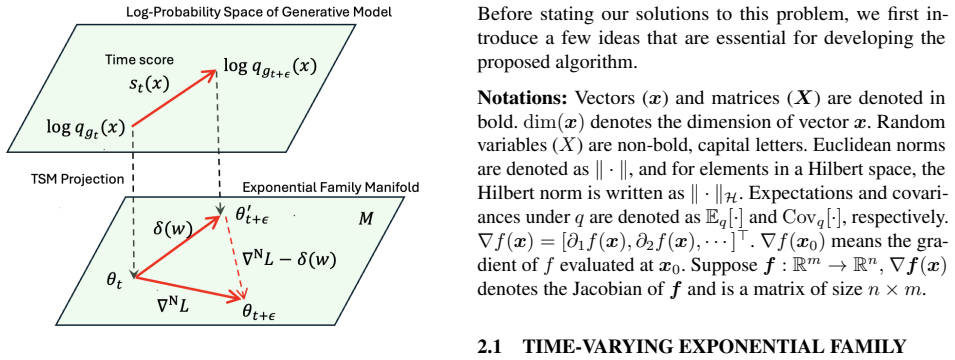
The central claim is that a time-varying generative model $X_t = g(Z,t;w)$ can be guided by the natural gradient of $\mathrm{KL}[p,q_\theta]$ on an exponential-family manifold $\mathcal{M}(T)$, without ever evaluating the likelihood of $q_\theta$. The paper proves that the time score of $g$ can be projected onto $\mathcal{M}(T)$ by minimising a time-score-matching objective, giving the projected velocity $\delta_{t_0}(w) = -\left(\int \lambda_{t_0}(t)\mathrm{Cov}[T(X_t)]\,dt\right)^{-1}\int \partial_t\lambda_{t_0}(t)\,E[T(X_t)]\,dt$ (Theorem 3.1). For drift models $g(X_{t_0},t;w)=X_{t_0}+(t-t_0)h(X_{t_0};w)$, the limit $\sigma\to 0$ yields the closed form $\delta_{t_0}(w)=F_{t_0}^{-1}E[\nabla T(X_{t_0})h(X_{t_0};w)]$, where $F_{t_0}=\mathrm{Cov}[T(X_{t_0})]$ is the Fisher information. Matching this to the Euclidean gradient $\nabla L(\theta_{t_0})$ under the $F^{-1}$ norm gives an objective whose RKHS optimum is $h_{w^*}(x)=E[\nabla T(X)\nabla\nabla k(X,x)]^{\top}\Gamma^{-1}\nabla L(\theta)$, with a neural-tangent analogue; these are closed-form particle updates. The paper calls the general algorithm implicit NGD (iNGD) and the particle versions KiNG and ntKiNG, and validates them on toy, graphical-model, domain-adaptation, and denoising tasks.
Load-bearing premise
The whole scheme rests on the assumption that the generative model's output distribution stays close to the chosen exponential-family distribution throughout training; if it does not, the 'natural gradient' being matched is the gradient of a different, projected model, and the guidance can push samples the wrong way.
Editorial extensions
If this is right
- If the central claim is right, any time-varying generative model—not just drift models—can in principle be trained by matching its projected change to a natural gradient, giving an alternative to adversarial training and to manually constructed diffusion bridges.
- For drift models the particle updates are closed form, so no generative-network fitting is needed at each step; KiNG and ntKiNG are simple to implement and stay stable at step size 1 in the reported experiments.
- The guiding manifold is chosen by the user through $T$; informative sufficient statistics (RBF features, graphical-model edges, pretrained energy-based-model features) accelerate convergence and can recover structure such as a graphical model in far fewer iterations.
- Because the algorithm transports particles to match $\mathrm{KL}[p,q_t]$, it can be used for covariate-shift correction by learning the inverse transport map, and for denoising with a pretrained energy-based model as $T$.
- Algorithm 1 applies to non-particle generative models as well, so the construction is claimed to be more general than particle-based gradient flows.
Reading between the lines
- An implication the paper leaves implicit is that the projection residual $\mathbb{E}[(s_t(X_t)-\langle\delta,T(X_t)-\mathbb{E}[T]\rangle)^2]$ can serve as a diagnostic for whether the exponential-family guide is trustworthy; a large residual means the matched $\delta$ is not the natural gradient of the actual generative distribution, so one could adaptively enrich $T$ until the residual drops.
- Because the projection comes from time score matching, the method is a score-based parametric flow; a testable extension is to replace the Gaussian smoothing kernel with other kernels and check whether the $\sigma\to 0$ limit for drift models is the unique unbiased projection or an artifact of the kernel.
- The closed-form updates define a new class of kernel flows guided by a parametric model; comparing KiNG and ntKiNG with other kernelized gradient-flow samplers on the same targets would clarify whether the benefit comes from the natural-gradient metric or from the exponential-family projection itself.
Editorial analysis
A structured set of objections, weighed in public.
Referee Report
Summary. The paper proposes a framework, implicit NGD (iNGD), for training time-varying generative models by aligning their time-score-matching projection onto an exponential-family manifold with the natural gradient descent update of KL[p, q_theta]. The authors derive a projection formula for general generative models, specialize it to drift-based models where a closed-form limit as the time kernel width tends to zero is obtained, and then derive kernel and neural-tangent-kernel particle-update rules that avoid MCMC. Experiments on toy distributions, graphical model recovery, covariate shift, and image denoising are reported. The central claim is that this projection-matching procedure lets a flexible implicit generative model be guided by a parametric probabilistic model, inheriting the efficiency of NGD while retaining the expressiveness of the generative model.
Significance. If the central assumption were rigorously justified, the paper would offer a practical and conceptually clean way to equip implicit generative models with a natural-gradient-based training signal, with closed-form particle updates for drift models and no need for MCMC or an explicit likelihood. The main strengths are the closed-form expressions in Theorems 4.2 and 4.3, the modular treatment of the sufficient statistic T, and the breadth of experiments, including a domain-adaptation application. The principal weakness is that the correctness of Algorithm 1 depends on an unproven assumption that the generator's output distribution remains exactly on the exponential-family manifold; without a residual bound or diagnostic, the matched quantity can be a self-referential functional of the generator rather than a natural gradient. The proof of Theorem 4.3 also contains an algebraic inconsistency that must be fixed, although the final formula is correct.
major comments (4)
- [Section 3.3, Eq. (6), Algorithm 1] The matching target \nabla_N L(\theta_{t_0}) is estimated using samples from g(Z, t; w_t), but \theta_{t_0} is the parameter of the exponential-family projection, not of the generator. The substitution is justified only by the assumption that q_{g_0} \in M(T) and that the trajectory q_{g_t} is "precisely traced" by the projected updates. When q_{g_t} leaves M(T), E_{q_{g_t}}[T] and Cov_{q_{g_t}}[T] are moments of the generator's distribution, not of any exponential-family q_\theta, so the quantity matched to \delta(w) is not the natural gradient of KL[p, q_\theta] for any well-defined parametric model. The manuscript gives no bound on the projection residual, no consistency argument, and no user-facing diagnostic. Because this assumption underlies the correctness of Algorithm 1, it must either be proved in a meaningful special case or the method must be reframed as a heuristic that guides particles by approximate projections, with the gap made explicit.
- [Appendix C, Eqs. (17) and (18)] The proof of Theorem 4.3 expands Eq. (8) with a linear term -2 \nabla^\top L(\theta_{t_0}) F^{-1}_{t_0} E[T(X_{t_0}) h_w(X_{t_0})], but Eq. (7) requires E[\nabla T(X_{t_0}) h_w(X_{t_0})], where \nabla T is the Jacobian of the sufficient statistic. The same missing Jacobian appears in Eq. (18). The final formula (9) is correct and does match the objective, but the proof as printed is inconsistent with the theorem statement and must be corrected.
- [Section 4.1, Theorem 4.3] The matrices F_{t_0} and \Gamma in Eq. (9) are defined through Cov[T(X_{t_0})] and expectations over X_{t_0} \sim q_{g_t}. If the generator samples are not from an exponential-family member, these objects are not Fisher information matrices or natural-gradient covariances of any q_\theta, and the Woodbury/least-squares derivation does not amount to a natural-gradient step of a parametric model. The failure mode in Figure 3, where particles stop at the best Gaussian fit for a bimodal target, is exactly what one expects when the projection gap, rather than NGD, controls the motion. Please state this limitation in the main text and provide a diagnostic that would tell a user when the projection gap is large, for example an estimate of the TSM projection residual or an MMD between q_{g_t} and its exponential-family projection.
- [Theorem 3.1, Eq. (5) and Appendix A] The invertibility of C = \int \lambda_{t_0}(t) Cov[T(X_t)] dt is asserted in Appendix A to be equivalent to the invertibility of the Fisher information. This equivalence holds only if X_t is distributed according to an exponential-family member with sufficient statistic T; for a general generative model q_{g_t}, no such identification exists. The invertibility condition should be stated as a separate assumption on the generator's distribution, not derived from the Fisher information of a model that the generator does not follow.
minor comments (6)
- [Appendix B, Lemma B.1] The lemma defines \lambda_\sigma with a normalizing constant 1/\sqrt{2\pi\sigma^2}, whereas the main text in Eq. (3) defines \lambda_{t_0}(t) = \exp(-(t-t_0)^2/\sigma^2) without normalization. The normalization cancels in \delta_{t_0}, but the notation should be made consistent to avoid confusion in the proof of Theorem 4.2.
- [Appendix D] The Stein exponential family subsection contains an incomplete citation, "More discussions on the Stein operator could be found in []", and Eq. (22) appears to drop the expectation over p when deriving \nabla_\theta L(\theta) = F^{-1} E_{q_\theta}[S_p f(x)]. Please complete the reference and the derivation.
- [Section 4.2, Remark] The diagonalized scalar-kernel approximation [K(X_{t_0}, X'_{t_0})]_{l,m} = k(X_{t_0}, X'_{t_0}) if l=m and 0 otherwise is introduced without justification; please add a comment on when this approximation is expected to be accurate and what it changes in the interpretation of Eq. (11).
- [Figure 3 caption] The caption says "the initial distribution q_0 is plotted on the left ... while the target distribution p is plotted on the right", but both panels have their own left and right sides; please clarify which panel and which side are meant.
- [Section 5.1] The comparison with reverse-KL Wasserstein gradient flow and MMD flow uses MMD as the evaluation metric, which is the same objective that MMD flow directly minimizes; this potential bias should be discussed when interpreting the ranking in Figure 5.
- [Section 2.4] The paper relies on Williams et al. (2025) for the TSM projection identity, but the provenance is stated only briefly; please make explicit in Section 2.4 which results are imported and which are new to this paper.
Circularity Check
The central projection identity is imported from the authors' own prior work without a self-contained proof, while the §3.3 'precisely traced' assumption is an unverified invariant rather than a constructional circularity.
-
self citation load bearing
[Appendix A; used in Section 3.2, Theorem 3.1 and Eq. (5)]
"Theorem A.1. (Theorem 4.1 in [Williams et al., 2025]) Equation (4) can be rewritten as the following form L(δ) = ∫ λ_{t0}(t) E[⟨δ, T(Xt) − E[T (X′t)]⟩²] dt + 2 ∫ ∂tλ_{t0}(t) E [⟨δ, T(Xt)⟩] dt + const. (12) Notice that Equation (12) is a quadratic minimisation problem."
The paper's central projection δ_{t0}(w), Eq. (5), is the quantity matched to NGD in Eq. (6), and it is the minimizer of Eq. (4). However, the equivalence (4) ↔ (12) that makes this minimizer computable is not derived in this paper: Appendix A simply restates the result as 'Theorem 4.1 in [Williams et al., 2025]' and then differentiates the already-rewritten quadratic (12), so the core TSM-to-projection step is not self-contained. Williams et al. shares two authors with the present paper (Song Liu and Leyang Wang), making this a load-bearing citation to the authors' own prior work rather than an independent derivation. The later drift limit (Theorem 4.2) and the RKHS/NTK updates inherit this unproved equivalence.
full rationale
The paper contains one load-bearing self-citation: the TSM projection identity (Eq. 4 rewritten as Eq. 12) is taken from Williams et al. (2025) with overlapping authorship, and the appendix proves only the minimizer of the already-rewritten quadratic, not the equivalence itself. This raises the circularity score to 4. The §3.3 assumption that q_g0 ∈ M(T) and that the trajectory is 'precisely traced' by projected updates is an acknowledged idealization; it is a correctness gap and an unverified invariant, but it is not by itself an equation-level reduction, so it does not push the score to 6 or above. The paper's closed-form particle updates (Theorems 4.2 and 4.3) are derived from the projection formula and would stand if the Williams result were independently verified, so the central claim retains independent content beyond the citation chain. The authors' own limitations section admits that the benefits of parametric-space guidance 'remain to be clarified,' which is consistent with treating the §3.3 assumption as a limitation rather than as a manufactured circularity.
Assumptions & free parameters
free parameters (6)
- time kernel width σ =
chosen by hand, e.g. 0.1
- RKHS ridge regularization λ =
not specified in the main text
- RBF kernel bandwidth =
median pairwise distance of samples
- step size ϵ =
1 (Sections 5.1, 5.2) or 0.1 (Section 5.3)
- RBF basis count/landmarks for T =
not specified
- pretrained EBM feature extractor =
weights trained by denoising score matching on target samples
assumptions (7)
- standard math TSM projection identity (Theorem A.1, from Williams et al. 2025): J(δ)=∫λ E[⟨δ,B_t⟩²]dt + 2∫∂tλ E[⟨δ,T(X_t)⟩]dt + const.
- standard math Fisher information of an exponential-family distribution equals Cov_qθ[T] and is invertible.
- ad hoc to paper q_g0 ∈ M(T) and the trajectory q_gt is precisely traced by the projected updates, so samples from g(Z,t;w) can be used to approximate E_qθ[T] and Cov_qθ[T].
- ad hoc to paper If T is expressive enough, different time scores do not collapse to the same projection δ_t0.
- standard math For drift models, X_t = X_t0+(t-t0)h(X_t0;w), so the Taylor expansion of E[T(X_t)] has no higher-order terms.
- standard math The RKHS kernel k is twice differentiable and the reproducing property permits interchanging expectations with inner products.
- standard math For the Stein exponential family, E_p[S_p f]=0, allowing natural gradient of KL[p,q] to be expressed with unnormalized p.
Cite this review
Pith. "Pith review of Guiding Time-Varying Generative Models with Natural Gradients on Exponential Family Manifold." pith.science (2026). https://pith.science/paper/HTSPMDU7
@misc{pith2026250207650,
  author       = {Pith},
  title        = {Pith review of: Guiding Time-Varying Generative Models with Natural Gradients on Exponential Family Manifold},
  year         = {2026},
  howpublished = {\url{https://pith.science/paper/HTSPMDU7}},
  note         = {Machine review of arXiv:2502.07650}
}
read the original abstract
Optimising probabilistic models is a well-studied field in statistics. However, its connection with the training of generative models remains largely under-explored. In this paper, we show that the evolution of time-varying generative models can be projected onto an exponential family manifold, naturally creating a link between the parameters of a generative model and those of a probabilistic model. We then train the generative model by moving its projection on the manifold according to the natural gradient descent scheme. This approach also allows us to efficiently approximate the natural gradient of the KL divergence without relying on MCMC for intractable models. Furthermore, we propose particle versions of the algorithm, which feature closed-form update rules for any parametric model within the exponential family. Through toy and real-world experiments, we validate the effectiveness of the proposed algorithms. The code of the proposed algorithms can be found at https://github.com/anewgithubname/iNGD.
Figures


Figures from the paper (5 more)


Reference graph
Works this paper leans on
-
[1]
Natural gradient works efficiently in learning
Shun-Ichi Amari. Natural gradient works efficiently in learning. Neural computation, 10 0 (2): 0 251--276, 1998
1998
-
[2]
Methods of information geometry, volume 191
Shun-ichi Amari and Hiroshi Nagaoka. Methods of information geometry, volume 191. American Mathematical Soc., 2000
2000
-
[3]
Gradient flows: in metric spaces and in the space of probability measures
Luigi Ambrosio, Nicola Gigli, and Giuseppe Savar \'e . Gradient flows: in metric spaces and in the space of probability measures. Springer Science & Business Media, 2008
2008
-
[4]
Kernelized wasserstein natural gradient
M Arbel, A Gretton, W Li, and G Montufar. Kernelized wasserstein natural gradient. In International Conference on Learning Representations, 2020
work page 2020
-
[5]
Kernel conditional exponential family
Michael Arbel and Arthur Gretton. Kernel conditional exponential family. In International Conference on Artificial Intelligence and Statistics, 2018
work page 2018
-
[6]
Maximum mean discrepancy gradient flow
Michael Arbel, Anna Korba, Adil Salim, and Arthur Gretton. Maximum mean discrepancy gradient flow. Advances in Neural Information Processing Systems, 2019
work page 2019
-
[7]
Wasserstein generative adversarial networks
Martin Arjovsky, Soumith Chintala, and L \'e on Bottou. Wasserstein generative adversarial networks. In International Conference on Machine Learning, 2017
work page 2017
-
[8]
Exact natural gradient in deep linear networks and its application to the nonlinear case
Alberto Bernacchia, M \'a t \'e Lengyel, and Guillaume Hennequin. Exact natural gradient in deep linear networks and its application to the nonlinear case. Advances in Neural Information Processing Systems, 2018
work page 2018
Show all 54 references
-
[9]
Diffusion schr\"odinger bridge with applications to score-based generative modeling
Valentin De Bortoli, James Thornton, Jeremy Heng, and Arnaud Doucet. Diffusion schr\"odinger bridge with applications to score-based generative modeling. In Advances in Neural Information Processing Systems, 2021
2021
-
[10]
Statistical inference, 2nd Edition
George Casella and Roger Berger. Statistical inference, 2nd Edition. CRC press, 2024
2024
-
[11]
Neural ordinary differential equations
Ricky TQ Chen, Yulia Rubanova, Jesse Bettencourt, and David K Duvenaud. Neural ordinary differential equations. Advances in Neural Information Processing Systems, 2018
2018
-
[12]
Rethinking the diffusion models for missing data imputation: A gradient flow perspective
Zhichao Chen, Haoxuan Li, Fangyikang Wang, Odin Zhang, Hu Xu, Xiaoyu Jiang, Zhihuan Song, and Hao Wang. Rethinking the diffusion models for missing data imputation: A gradient flow perspective. In Advances in Neural Information Processing Systems, 2024 a
2024
-
[13]
Teng: Time-evolving natural gradient for solving pdes with deep neural nets toward machine precision
Zhuo Chen, Jacob McCarran, Esteban Vizcaino, Marin Soljacic, and Di Luo. Teng: Time-evolving natural gradient for solving pdes with deep neural nets toward machine precision. In International Conference on Machine Learning, 2024 b
2024
-
[14]
Underdamped langevin mcmc: A non-asymptotic analysis
Xiang Cheng, Niladri S Chatterji, Peter L Bartlett, and Michael I Jordan. Underdamped langevin mcmc: A non-asymptotic analysis. In Conference on learning theory, 2018
2018
-
[15]
Log-Concave Sampling
Sinho Chewi. Log-Concave Sampling. 2024
2024
-
[16]
Svgd as a kernelized wasserstein gradient flow of the chi-squared divergence
Sinho Chewi, Thibaut Le Gouic, Chen Lu, Tyler Maunu, and Philippe Rigollet. Svgd as a kernelized wasserstein gradient flow of the chi-squared divergence. In Advances in Neural Information Processing Systems, 2020
2020
-
[17]
Scalable wasserstein gradient flow for generative modeling through unbalanced optimal transport
Jaemoo Choi, Jaewoong Choi, and Myungjoo Kang. Scalable wasserstein gradient flow for generative modeling through unbalanced optimal transport. In International Conference on Machine Learning, 2024
2024
-
[18]
Density ratio estimation via infinitesimal classification
Kristy Choi, Chenlin Meng, Yang Song, and Stefano Ermon. Density ratio estimation via infinitesimal classification. In International Conference on Artificial Intelligence and Statistics, 2022
2022
-
[19]
Optimal transport for domain adaptation
Nicolas Courty, R \'e mi Flamary, Devis Tuia, and Alain Rakotomamonjy. Optimal transport for domain adaptation. IEEE transactions on pattern analysis and machine intelligence, 39 0 (9): 0 1853--1865, 2016
2016
-
[20]
Sparse inverse covariance estimation with the graphical lasso
Jerome Friedman, Trevor Hastie, and Robert Tibshirani. Sparse inverse covariance estimation with the graphical lasso. Biostatistics, 9 0 (3): 0 432--441, 2007
2007
-
[21]
Deep generative learning via variational gradient flow
Yuan Gao, Yuling Jiao, Yang Wang, Yao Wang, Can Yang, and Shunkang Zhang. Deep generative learning via variational gradient flow. In International Conference on Machine Learning, 2019
2019
-
[22]
Fast approximate natural gradient descent in a kronecker factored eigenbasis
Thomas George, C \'e sar Laurent, Xavier Bouthillier, Nicolas Ballas, and Pascal Vincent. Fast approximate natural gradient descent in a kronecker factored eigenbasis. Advances in Neural Information Processing Systems, 2018
2018
-
[23]
Geodesic flow kernel for unsupervised domain adaptation
Boqing Gong, Yuan Shi, Fei Sha, and Kristen Grauman. Geodesic flow kernel for unsupervised domain adaptation. In Conference on Computer Vision and Pattern Recognition, 2012
2012
-
[24]
Generative adversarial nets
Ian Goodfellow, Jean Pouget-Abadie, Mehdi Mirza, Bing Xu, David Warde-Farley, Sherjil Ozair, Aaron Courville, and Yoshua Bengio. Generative adversarial nets. Advances in Neural Information Processing Systems, 2014
2014
-
[25]
Borgwardt, Malte J
Arthur Gretton, Karsten M. Borgwardt, Malte J. Rasch, Bernhard Sch \"o lkopf, and Alexander Smola. A kernel two-sample test. Journal of Machine Learning Research, 13 0 (25): 0 723--773, 2012
2012
-
[26]
A kronecker-factored approximate fisher matrix for convolution layers
Roger Grosse and James Martens. A kronecker-factored approximate fisher matrix for convolution layers. In International Conference on Machine Learning, 2016
2016
-
[27]
Vector quantized diffusion model for text-to-image synthesis
Shuyang Gu, Dong Chen, Jianmin Bao, Fang Wen, Bo Zhang, Dongdong Chen, Lu Yuan, and Baining Guo. Vector quantized diffusion model for text-to-image synthesis. In Conference on Computer Vision and Pattern Recognition, 2022
2022
-
[28]
Posterior sampling based on gradient flows of the MMD with negative distance kernel
Paul Hagemann, Johannes Hertrich, Fabian Altekr \"u ger, Robert Beinert, Jannis Chemseddine, and Gabriele Steidl. Posterior sampling based on gradient flows of the MMD with negative distance kernel. In International Conference on Learning Representations, 2024
2024
-
[29]
Training neural samplers with reverse diffusive kl divergence
Jiajun He, Wenlin Chen, Mingtian Zhang, David Barber, and Jos \'e Miguel Hern \'a ndez-Lobato. Training neural samplers with reverse diffusive kl divergence. arXiv preprint arXiv:2410.12456, 2025
2025 arXiv
-
[30]
Denoising diffusion probabilistic models
Jonathan Ho, Ajay Jain, and Pieter Abbeel. Denoising diffusion probabilistic models. Advances in Neural Information Processing Systems, 2020
2020
-
[31]
Neural tangent kernel: convergence and generalization in neural networks
Arthur Jacot, Franck Gabriel, and Cl\' e ment Hongler. Neural tangent kernel: convergence and generalization in neural networks. In Advances in Neural Information Processing Systems, 2018
2018
-
[32]
Kingma and Max Welling
Diederik P. Kingma and Max Welling. Auto-encoding variational bayes. In International Conference on Learning Representations, 2014
2014
-
[33]
Neural speech synthesis with transformer network
Naihan Li, Shujie Liu, Yanqing Liu, Sheng Zhao, and Ming Liu. Neural speech synthesis with transformer network. In AAAI Conference on Artificial Intelligence, 2019 a
2019
-
[34]
Affine natural proximal learning
Wuchen Li, Alex Tong Lin, and Guido Mont \'u far. Affine natural proximal learning. In International Conference on Geometric Science of Information, 2019 b
2019
-
[35]
Yaron Lipman, Ricky T. Q. Chen, Heli Ben-Hamu, Maximilian Nickel, and Matthew Le. Flow matching for generative modeling. In International Conference on Learning Representations, 2023
2023
-
[36]
Stein variational gradient descent as gradient flow
Qiang Liu. Stein variational gradient descent as gradient flow. In Advances in Neural Information Processing Systems, 2017
2017
-
[37]
Minimizing f -divergences by interpolating velocity fields
Song Liu, Jiahao Yu, Jack Simons, Mingxuan Yi, and Mark Beaumont. Minimizing f -divergences by interpolating velocity fields. In International Conference on Machine Learning, 2024
2024
-
[38]
Flow straight and fast: Learning to generate and transfer data with rectified flow
Xingchao Liu, Chengyue Gong, and qiang liu. Flow straight and fast: Learning to generate and transfer data with rectified flow. In International Conference on Learning Representations, 2023
2023
-
[39]
Optimizing neural networks with kronecker-factored approximate curvature
James Martens and Roger Grosse. Optimizing neural networks with kronecker-factored approximate curvature. In International Conference on Machine Learning, 2015
2015
-
[40]
Sampling in unit time with kernel fisher-rao flow
Aimee Maurais and Youssef Marzouk. Sampling in unit time with kernel fisher-rao flow. In International Conference on Machine Learning, 2024
2024
-
[41]
Alemi, Jascha Sohl-Dickstein, and Samuel S
Roman Novak, Lechao Xiao, Jiri Hron, Jaehoon Lee, Alexander A. Alemi, Jascha Sohl-Dickstein, and Samuel S. Schoenholz. Neural tangents: Fast and easy infinite neural networks in python. In International Conference on Learning Representations, 2020
2020
-
[42]
Dataset shift in machine learning
Joaquin Qui \ n onero-Candela, Masashi Sugiyama, Anton Schwaighofer, and Neil D Lawrence. Dataset shift in machine learning. Mit Press, 2009
2009
-
[43]
Variational inference with normalizing flows
Danilo Jimenez Rezende and Shakir Mohamed. Variational inference with normalizing flows. In International Conference on Machine Learning, 2015
2015
-
[44]
High-resolution image synthesis with latent diffusion models
Robin Rombach, Andreas Blattmann, Dominik Lorenz, Patrick Esser, and Bj \"o rn Ommer. High-resolution image synthesis with latent diffusion models. In Conference on Computer Vision and Pattern Recognition, 2022
2022
-
[45]
How to train your energy-based models
Yang Song and Diederik P Kingma. How to train your energy-based models. arXiv preprint arXiv:2101.03288, 2021
2021 arXiv
-
[46]
Score-based generative modeling through stochastic differential equations
Yang Song, Jascha Sohl-Dickstein, Diederik P Kingma, Abhishek Kumar, Stefano Ermon, and Ben Poole. Score-based generative modeling through stochastic differential equations. In International Conference on Learning Representations, 2021
2021
-
[47]
Density estimation in infinite dimensional exponential families
Bharath Sriperumbudur, Kenji Fukumizu, Arthur Gretton, Aapo Hyv\" a rinen, and Revant Kumar. Density estimation in infinite dimensional exponential families. Journal of Machine Learning Research, 18 0 (57): 0 1--59, 2017
2017
-
[48]
Direct importance estimation with model selection and its application to covariate shift adaptation
Masashi Sugiyama, Shinichi Nakajima, Hisashi Kashima, Paul Buenau, and Motoaki Kawanabe. Direct importance estimation with model selection and its application to covariate shift adaptation. In Advances in Neural Information Processing Systems, 2008
2008
-
[49]
Naturalspeech: End-to-end text-to-speech synthesis with human-level quality
Xu Tan, Jiawei Chen, Haohe Liu, Jian Cong, Chen Zhang, Yanqing Liu, Xi Wang, Yichong Leng, Yuanhao Yi, Lei He, et al. Naturalspeech: End-to-end text-to-speech synthesis with human-level quality. IEEE Transactions on Pattern Analysis and Machine Intelligence, 2024
2024
-
[50]
Graphical models, exponential families, and variational inference
Martin J Wainwright, Michael I Jordan, et al. Graphical models, exponential families, and variational inference. Foundations and Trends in Machine Learning , 1 0 (1--2): 0 1--305, 2008
2008
-
[51]
Diffusion-gan: Training gans with diffusion
Zhendong Wang, Huangjie Zheng, Pengcheng He, Weizhu Chen, and Mingyuan Zhou. Diffusion-gan: Training gans with diffusion. In International Conference on Learning Representations, 2023
2023
-
[52]
Kernel ridge regression
Max Welling. Kernel ridge regression. https://web2.qatar.cmu.edu/ gdicaro/10315-Fall19/additional/welling-notes-on-kernel-ridge.pdf, 2019. Accessed: 2025-02-10
2019
-
[53]
Sampling as optimization in the space of measures: The langevin dynamics as a composite optimization problem
Andre Wibisono. Sampling as optimization in the space of measures: The langevin dynamics as a composite optimization problem. In Conference on Learning Theory, 2018
2018
-
[54]
High-dimensional differential parameter inference in exponential family using time score matching
Daniel J Williams, Leyang Wang, Qizhen Ying, Song Liu, and Mladen Kolar. High-dimensional differential parameter inference in exponential family using time score matching. International conference on artificial intelligence and statistics, 2025
2025
Reviewed August 8, 2026 · model on record in the stance chip above.
Discussion (0). Continue with ORCID to comment.