REVIEW 3 major objections 4 minor 106 references
Revisiting CMSSM with Non-Universal Gaugino Masses under Current Constraints
T0 review · 3 major / 4 minor · reviewed 2026-08-10 · deepseek-v4-flash
Pith's one-line read This paper claims the gluino-SUGRA scenario survives current data only in a narrow Higgs-forced corner, and that HL-LHC plus CLIC1500 can cover it.
desk verdict A credible but over-interpreted rescan of the g~-SUGRA scenario: scan-box boundaries are dressed up as model requirements, and the collider-coverage claim outruns the qualitative evidence. read the letter →
The pith
A machine-rendered reading of the paper's core claim, the machinery that carries it, and where it could break.
The reading
What carries the argument
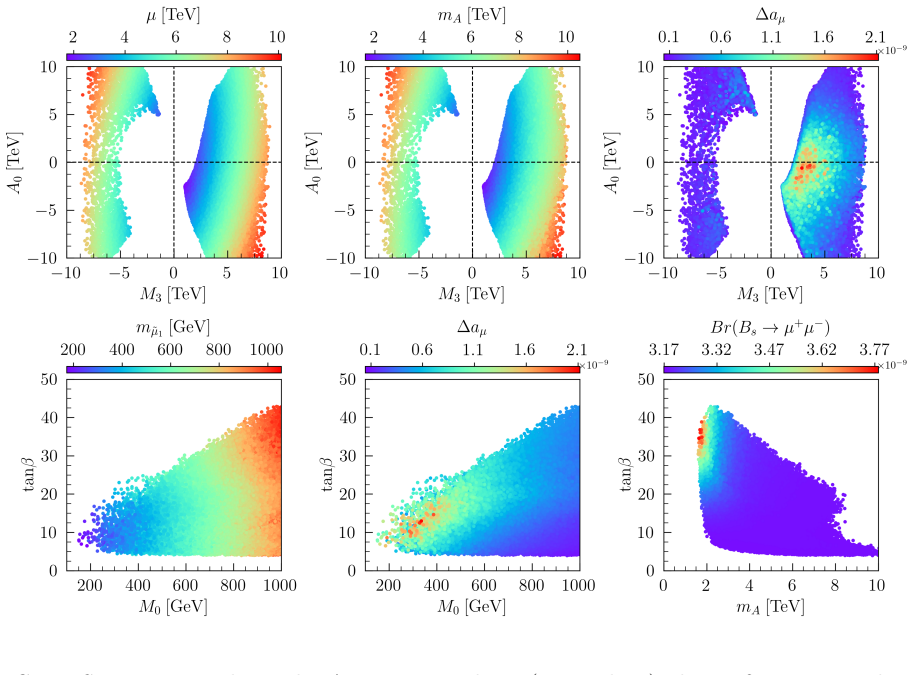
The load-bearing object is the GUT-scale hierarchy $\lvert M_3\rvert \gg \lvert M_1\rvert, \lvert M_2\rvert$, the $\tilde{g}$-SUGRA boundary condition, which feeds through renormalization-group running so that squarks and gluinos become heavy enough to evade LHC mass limits while sleptons and electroweakinos stay light enough to address $(g-2)_\mu$ and dark matter. The second structural relation is the electroweak-symmetry-breaking identity $m_A \approx \mu \approx \lvert M_{H_u}\rvert$ that holds for large $\tan\beta$, together with $M_{H_u}$ being nearly proportional to $M_3$; this ties the Higgsino and pseudoscalar Higgs masses to the gluino input and drives many of the surviving-region correlations.
What would settle it
Run the same scan with $M_0$ and $\lvert M_3\rvert$ extended beyond the stated ranges and recast the HL-LHC and CLIC1500 search channels at detector level for the surviving benchmark points; if any surviving point falls outside the plotted exclusion curves, or if a benchmark inside the claimed covered region has no detectable signal, the paper's coverage claim is refuted.
Extended reading notes
Core claim
On the paper's own terms, the central discovery is that the $\tilde{g}$-SUGRA scenario---defined by $\lvert M_3\rvert \gg \lvert M_1\rvert, \lvert M_2\rvert$ at the GUT scale---remains a viable resolution of the CMSSM's tension with data, but only inside a sharply restricted window. Precise Higgs data alone impose $\tan\beta \gtrsim 5$ and $M_0 \gtrsim 20\,\tan\beta$ GeV, because small $M_0$ or small $\tan\beta$ cannot produce a $125 \pm 2$ GeV SM-like Higgs. The same Higgs constraint makes a large SUSY contribution to $(g-2)_\mu$ difficult: a large contribution wants light sleptons and large $\tan\beta$, while the Higgs mass wants the opposite. Surviving dark matter candidates annihilate through stau co-annihilation, neutralino--chargino co-annihilation, or neutralino annihilation, and most predict spin-independent scattering cross sections below the neutrino floor. The paper concludes that the whole surviving parameter space can be covered by HL-LHC at $3\,\mathrm{ab}^{-1}$ together with CLIC1500 at $2.5\,\mathrm{ab}^{-1}$, giving concrete targets for the next collider runs.
Load-bearing premise
The scan only explores $M_0,\lvert M_1\rvert,\lvert M_2\rvert < 1$ TeV, $1$ TeV $< \lvert M_3\rvert < 10$ TeV, $\lvert A_0\rvert < 10$ TeV and $1 < \tan\beta < 50$; if viable $\tilde{g}$-SUGRA points live outside that box, the claim that future colliders cover the entire parameter space does not follow.
Editorial extensions
If this is right
- Under the paper's coverage claim, a null result at both HL-LHC with $3\,\mathrm{ab}^{-1}$ and CLIC1500 with $2.5\,\mathrm{ab}^{-1}$ would close the scanned $\tilde{g}$-SUGRA window.
- Dark matter direct detection is not a decisive test of this scenario, because many surviving samples predict spin-independent cross sections below the neutrino floor.
- The model predicts compressed electroweakino spectra with the lightest chargino nearly degenerate with the lightest neutralino, making lepton-collider searches a sharper probe than hadron-collider searches.
- Benchmark points in the surviving region give SUSY contributions to $\Delta a_\mu$ of a few $\times 10^{-10}$, so a future measurement tightening the anomaly would test the light-slepton part of the model.
Reading between the lines
- The scan window is not derived from the model, so the 'full coverage' claim applies only to the box actually scanned; extending $M_0$ or $\lvert M_3\rvert$ could in principle uncover viable points outside the future colliders' reach.
- The collider coverage is obtained by overlaying published exclusion curves rather than by simulating this model's own signals; a dedicated detector-level recasting of electroweakino and slepton channels could shift the claimed boundary.
- Because the paper's key Higgs constraint is the $125\pm2$ GeV window applied through current tools, tighter Higgs mass measurements or improved calculations would change the $\tan\beta$ and $M_0$ floor even if the scenario itself is correct.
Editorial analysis
A structured set of objections, weighed in public.
Referee Report
Summary. This paper investigates the g~-SUGRA scenario of the CMSSM with non-universal gaugino masses, in which the GUT-scale gluino mass |M3| is much larger than |M1| and |M2|. The authors scan M0, M1, M2, M3, A0, and tanβ within the ranges specified in Eq. (5) and apply constraints from the measured Higgs mass, LHC and LEP SUSY searches, B-physics observables, the muon g-2 anomaly, dark matter relic density, and direct detection limits using public codes (SuSpect, micrOMEGAs, GM2Calc, HiggsSignals, HiggsBounds, SModelS). They find surviving regions that favor tanβ ≳ 5 and M0 ≳ 20 tanβ GeV, analyze the dominant dark matter annihilation mechanisms, and conclude that while direct detection experiments may not cover the viable space, HL-LHC at 3 ab^-1 and CLIC1500 at 2.5 ab^-1 can comprehensively probe the remaining parameter space.
Significance. If the claimed constraints were truly universal, the paper would significantly narrow the g~-SUGRA parameter space and provide testable collider predictions for a scenario that alleviates the CMSSM tension. The analysis has clear strengths: it employs established public codes, provides detailed classifications of dark matter annihilation channels with explicit benchmark points, and carefully distinguishes surviving regions under multiple constraints. The main value is as a phenomenological map of the scanned region. However, the headline statements in the abstract and conclusions overinterpret finite scan boundaries as model requirements, and the collider coverage claim rests on approximate overlays rather than model-specific simulations; these issues limit the currently supported scope of the conclusions.
major comments (3)
- [§II, Eq. (5); §III, bullet after Fig. 2; Abstract; §IV] The abstract and conclusions state that precise Higgs measurements 'require' tanβ ≳ 5 and M0 ≳ 20 tanβ GeV. This conclusion is drawn from a scan restricted to |M3| < 10 TeV, |A0| < 10 TeV, M0 < 1 TeV, and tanβ < 50. The g~-SUGRA hierarchy |M3| ≫ |M1|,|M2| does not itself impose these boundaries, and the LHC bound in Eq. (6) only requires m_g > 2 TeV. Points with M3 = 20–50 TeV or larger |A0| could yield a 125 GeV SM-like Higgs at lower tanβ through heavier stops, and such points are not excluded by any stated model requirement. The universal 'requires' statements are therefore not justified; at most they characterize the scanned box. Please either extend the scan to cover such points or soften the claim to be explicitly conditional on the range in Eq. (5).
- [§II, Eq. (5); §III] The paper does not report the number of scanned points, the sampling algorithm (e.g., flat versus log, grid versus random), or the density of points in parameter space. Without this information, the absence of surviving points at low tanβ or low M0 cannot be distinguished from a sampling gap. This is particularly relevant for the sharp lower bounds presented in Fig. 2 and the associated bullet. Please report scan statistics and, ideally, demonstrate convergence of the surviving region with increasing scan density.
- [§III, Fig. 7 and surrounding text] The claim that 'when the HL-LHC achieves an integral luminosity of 3 ab−1 and the CLIC 1500 reaches 2.5 ab−1, all surviving samples will be fully covered by these experiments' is based on overlaying exclusion curves from Refs. [99–104] on the (m_{χ̃_1^0}, m_{χ̃_1^±}) plane. This is not a detector-level simulation of the model's signals, and the paper itself notes that hadron colliders have limited sensitivity to compressed spectra. The coverage conclusion is therefore not quantitatively established. Please either perform a more detailed recasting with signal efficiencies, or soften the statement to indicate expected coverage under simplifying assumptions.
minor comments (4)
- [§III, Eqs. (10)–(11)] The derivation of μ ≈ mA contains a sign error: for tanβ ≫ 1, (M_Hd^2 − M_Hu^2 tan^2β)/(tan^2β − 1) is approximately −M_Hu^2, not +M_Hu^2 (unless M_Hu^2 is defined as negative). The physical conclusion μ ≈ |M_Hu| is likely unchanged, but the equations as written are misleading and should be corrected.
- [Table II, Fig. 6] The units for σSI, σSDP, and σSDN are written as cm^-1, but they should be cm^2; please correct the units in Table II and the figure axis labels.
- [Fig. 7 caption] There are several typos in the caption: 'excepted r' should be 'expected r', 'neturalino' should be 'neutralino', and 'compressd' should be 'compressed'.
- [§II, first paragraph after Eq. (5)] The sentence 'We use the SuSpect-2.52 package to implement the theoretical and experimental constraints in our analysis' is imprecise; SuSpect computes the spectrum, while the constraints are implemented with the subsequently listed codes (micrOMEGAs, GM2Calc, HiggsSignals, etc.). Please rephrase.
Circularity Check
No circular reduction: the headline constraints are scan outputs, not fitted inputs, and the self-cited RGE relation is auxiliary rather than load-bearing.
full rationale
The paper's central claims are produced by a numerical scan over the parameter ranges in Eq. (5), followed by application of external constraints: m_h = 125 ± 2 GeV, LHC/LEP mass limits, HiggsSignal/HiggsBounds, micrOMEGAs relic-density upper bound, GM2Calc g-2, SModelS signal strengths, and B-physics measurements. The statements tanβ ≳ 5 and M0 ≳ 20 tanβ GeV are reported as outputs of this scan after imposing the Higgs-mass constraint, not as parameters fitted to data and then relabeled as predictions. No equation in the paper equals its input by construction, and no fitted parameter is renamed as a prediction. The strongest candidate for circularity is the use of the self-cited Ref. [75] to justify the relation μ ≈ mA ∝ M3 ('According to the Eqs.(59) in the Appendix A in Ref. [75], MHu is nearly directly proportional to M3'). However, this is an auxiliary analytic explanation of a correlation already present in the numerical spectra, and the central conclusions about Higgs constraints, dark matter, and collider coverage do not depend on accepting that citation as a premise. The collider-coverage statements are qualitative overlays of published exclusion curves on surviving samples; whether the finite scan range (e.g., |M3| < 10 TeV and |A0| < 10 TeV) limits the generality of the 'require' claims is a sampling-scope concern, not a circularity. Overall, the derivation chain is self-contained against external benchmarks, with only a minor, non-load-bearing self-citation.
Assumptions & free parameters
free parameters (6)
- M0
- M1
- M2
- M3
- A0
- tanβ
assumptions (6)
- domain assumption The MSSM with R-parity conservation and a stable lightest neutralino is assumed.
- domain assumption Non-universal gaugino mass boundary conditions with |M3| >> |M1|, |M2| arise from an SU(5) GUT mechanism.
- domain assumption The sign of the Higgsino mass parameter is fixed to sign(µ)=+1.
- domain assumption The public codes' predictions for mh, Ωh2, Δaμ, B physics, and SUSY signal rates are accurate, and the 125 ± 2 GeV Higgs mass cut is a valid constraint.
- ad hoc to paper The finite scan window in Eq. (5) contains all parameter space relevant for the conclusions.
- domain assumption The relic density constraint is applied only as an upper bound, 0 < Ωh2 < 0.12.
Cite this review
Pith. "Pith review of Revisiting CMSSM with Non-Universal Gaugino Masses under Current Constraints." pith.science (2026). https://pith.science/paper/HTYZRSFW
@misc{pith2026241220003,
  author       = {Pith},
  title        = {Pith review of: Revisiting CMSSM with Non-Universal Gaugino Masses under Current Constraints},
  year         = {2026},
  howpublished = {\url{https://pith.science/paper/HTYZRSFW}},
  note         = {Machine review of arXiv:2412.20003}
}
abstract
To address the longstanding tension between the Constrained Minimal Supersymmetric Standard Model (CMSSM) and recent experimental data, we investigate non-universal gaugino masses within an SU(5) Grand Unified Theory (GUT) framework, focusing on the $\tilde{g}$-SUGRA scenario where $\lvert M_{3} \rvert \gg \lvert M_{1} \rvert, \lvert M_{2} \rvert$. This hierarchy enables a heavier gluino, thereby evading current experimental bounds on supersymmetric particles. Our analysis reveals that precise Higgs measurements place stringent constraints on the model, requiring $\tan\beta \gtrsim 5$ and $ M_{0} \gtrsim 20 \, \tan\beta \,\text{GeV}$. Although the $\tilde{g}$-SUGRA scenario can help reconcile the persistent $(g-2)_\mu$ anomaly, the Higgs constraints significantly restrict its parameter space, making a large contribution to $(g-2)_{\mu}$ challenging. We also assess the discovery prospects in upcoming dark matter direct detection experiments, including PandaX-xT (200 t.y.), LZ (projected), and XENONnT (20 t.y.), which may not fully cover the viable parameter space. In contrast, future collider experiments$-$such as the High-Luminosity LHC at $3\,\mathrm{ab}^{-1}$ and $\mathrm{CLIC}_{1500}$ at $2.5\,\mathrm{ab}^{-1}$$-$can comprehensively probe the remaining regions. These findings highlight $\tilde{g}$-SUGRA as a promising solution to the CMSSM tension and offer clear, testable predictions for upcoming collider searches.
Figures


Figures from the paper (4 more)


Reference graph
Works this paper leans on
-
[75]
F. Wang, L. Wu, Y. Xiao, J. M. Yang, and Y. Zhang, Nucl. Phys. B 970, 115486 (2021), arXiv:2104.03262 [hep-ph]
arXiv 2021
-
[1]
Since ˜ τ1 is only slightly heavier than ˜ χ0 1, the annihilation process occurs relatively slowly, allowing for the accumulation of a sufficient relic density
When ˜χ0 1 is bino-like, its annihilation may be primarily mediated by interactions with ˜τ1. Since ˜ τ1 is only slightly heavier than ˜ χ0 1, the annihilation process occurs relatively slowly, allowing for the accumulation of a sufficient relic density. • From the lower left and right panels of Fig. 3, it can be observed that when M1/M2 ≳ 1.5, the mass o...
2022
-
[2]
S. Chatrchyan et al. (CMS), Phys. Lett. B 716, 30 (2012), arXiv:1207.7235 [hep-ex]
arXiv 2012
- [3]
-
[4]
A. Tumasyan et al. (CMS), Nature 607, 60 (2022), [Erratum: Nature 623, (2023)], arXiv:2207.00043 [hep-ex]
arXiv 2022
- [5]
-
[6]
T. Aoyama et al., Phys. Rept. 887, 1 (2020), arXiv:2006.04822 [hep-ph]
arXiv 2020
-
[7]
D. P. Aguillard et al. (Muon g-2), Phys. Rev. Lett. 131, 161802 (2023), arXiv:2308.06230 [hep-ex]
arXiv 2023
Show all 106 references
-
[8]
G. W. Bennett et al. (Muon g-2), Phys. Rev. D 73, 072003 (2006), arXiv:hep-ex/0602035
2006 arXiv
-
[9]
Abi et al
B. Abi et al. (Muon g-2), Phys. Rev. Lett. 126, 141801 (2021), arXiv:2104.03281 [hep-ex]
2021
-
[10]
Navas et al
S. Navas et al. (Particle Data Group), Phys. Rev. D 110, 030001 (2024)
2024
-
[11]
Aghanim et al
N. Aghanim et al. (Planck), Astron. Astrophys.641, A6 (2020), [Erratum: Astron.Astrophys. 652, C4 (2021)], arXiv:1807.06209 [astro-ph.CO]
2020 arXiv
-
[12]
Chattopadhyay and P
U. Chattopadhyay and P. Nath, Phys. Rev. D 53, 1648 (1996), arXiv:hep-ph/9507386
1996 arXiv
-
[13]
S. Baek, N. G. Deshpande, X. G. He, and P. Ko, Phys. Rev. D 64, 055006 (2001), arXiv:hep- ph/0104141. 22
2001
-
[14]
Chattopadhyay and P
U. Chattopadhyay and P. Nath, Phys. Rev. Lett. 86, 5854 (2001), arXiv:hep-ph/0102157
2001 arXiv
-
[15]
P. Cox, C. Han, and T. T. Yanagida, Phys. Rev. D 104, 075035 (2021), arXiv:2104.03290 [hep-ph]
2021 arXiv
-
[16]
Dermisek, K
R. Dermisek, K. Hermanek, and N. McGinnis, Phys. Rev. D 104, 055033 (2021), arXiv:2103.05645 [hep-ph]
2021 arXiv
-
[17]
K. Wang, J. Zhu, and Q. Jie, Chin. Phys. C 45, 041003 (2021), arXiv:2011.12848 [hep-ph]
2021 arXiv
- [18]
-
[19]
J. M. Yang and Y. Zhang, Sci. Bull. 67, 1430 (2022), arXiv:2204.04202 [hep-ph]
2022 arXiv
-
[20]
Kawamura, S
J. Kawamura, S. Okawa, and Y. Omura, Phys. Rev. D 106, 015005 (2022), arXiv:2204.07022 [hep-ph]
2022 arXiv
-
[21]
Chakraborti, S
M. Chakraborti, S. Iwamoto, J. S. Kim, R. Mase lek, and K. Sakurai, JHEP 08, 124 (2022), arXiv:2202.12928 [hep-ph]
2022 arXiv
-
[22]
Iguro, T
S. Iguro, T. Kitahara, M. S. Lang, and M. Takeuchi, Phys. Rev. D 108, 115012 (2023), arXiv:2304.09887 [hep-ph]
2023 arXiv
-
[23]
W. Li, H. Qiao, K. Wang, and J. Zhu, (2023), arXiv:2312.17523 [hep-ph]
2023 arXiv
-
[24]
Wang and J
K. Wang and J. Zhu, Chin. Phys. C 47, 013107 (2023), arXiv:2112.14576 [hep-ph]
2023 arXiv
-
[25]
Wang and J
K. Wang and J. Zhu, Phys. Rev. D 101, 095028 (2020), arXiv:2003.01662 [hep-ph]
2020 arXiv
-
[26]
M. Dine, A. E. Nelson, and Y. Shirman, Phys. Rev. D 51, 1362 (1995), arXiv:hep- ph/9408384
1995
-
[27]
Jungman, M
G. Jungman, M. Kamionkowski, and K. Griest, Phys. Rept. 267, 195 (1996), arXiv:hep- ph/9506380
1996
-
[28]
J. M. Maldacena, Adv. Theor. Math. Phys. 2, 231 (1998), arXiv:hep-th/9711200
1998 arXiv
-
[29]
H. E. Haber, Nucl. Phys. B Proc. Suppl. 101, 217 (2001), arXiv:hep-ph/0103095
2001 arXiv
-
[30]
Aad et al
G. Aad et al. (ATLAS), Eur. Phys. J. C 83, 515 (2023), arXiv:2204.13072 [hep-ex]
2023 arXiv
- [31]
-
[32]
Carena, M
M. Carena, M. Quiros, and C. E. M. Wagner, Nucl. Phys. B 461, 407 (1996), arXiv:hep- ph/9508343
1996
-
[33]
H. E. Haber, Nucl. Phys. B Proc. Suppl. 62, 469 (1998), arXiv:hep-ph/9709450
1998 arXiv
-
[34]
Djouadi et al
A. Djouadi et al. (MSSM Working Group), inGDR (Groupement De Recherche) - Supersymetrie (1998) arXiv:hep-ph/9901246
1998 arXiv
-
[35]
G. F. Giudice, A. Notari, M. Raidal, A. Riotto, and A. Strumia, Nucl. Phys. B 685, 89 23 (2004), arXiv:hep-ph/0310123
2004 arXiv
-
[36]
Cao, Z.-X
J.-J. Cao, Z.-X. Heng, J. M. Yang, Y.-M. Zhang, and J.-Y. Zhu, JHEP 03, 086 (2012), arXiv:1202.5821 [hep-ph]
2012 arXiv
-
[37]
Arbey, M
A. Arbey, M. Battaglia, A. Djouadi, and F. Mahmoudi, JHEP 09, 107 (2012), arXiv:1207.1348 [hep-ph]
2012 arXiv
-
[38]
T. Hahn, S. Heinemeyer, W. Hollik, H. Rzehak, and G. Weiglein, Phys. Rev. Lett. 112, 141801 (2014), arXiv:1312.4937 [hep-ph]
2014 arXiv
-
[39]
Carena, S
M. Carena, S. Heinemeyer, O. St ˚ al, C. E. M. Wagner, and G. Weiglein, Eur. Phys. J. C73, 2552 (2013), arXiv:1302.7033 [hep-ph]
2013 arXiv
-
[40]
Beneke, A
M. Beneke, A. Bharucha, F. Dighera, C. Hellmann, A. Hryczuk, S. Recksiegel, and P. Ruiz- Femenia, JHEP 03, 119 (2016), arXiv:1601.04718 [hep-ph]
2016 arXiv
-
[41]
Khachatryan et al
V. Khachatryan et al. (CMS), JHEP 10, 129 (2016), arXiv:1606.03577 [hep-ex]
2016 arXiv
-
[42]
Dugan, B
M. Dugan, B. Grinstein, and L. J. Hall, Nucl. Phys. B 255, 413 (1985)
1985
-
[43]
J. A. Bagger, T. Moroi, and E. Poppitz, JHEP 04, 009 (2000), arXiv:hep-th/9911029
2000 arXiv
-
[44]
J. R. Ellis, T. Falk, G. Ganis, K. A. Olive, and M. Srednicki, Phys. Lett. B 510, 236 (2001), arXiv:hep-ph/0102098
2001 arXiv
-
[45]
Bechtle et al., PoS EPS-HEP2013, 313 (2013), arXiv:1310.3045 [hep-ph]
P. Bechtle et al., PoS EPS-HEP2013, 313 (2013), arXiv:1310.3045 [hep-ph]
2013 arXiv
-
[46]
Han, K.-i
C. Han, K.-i. Hikasa, L. Wu, J. M. Yang, and Y. Zhang, Phys. Lett. B 769, 470 (2017), arXiv:1612.02296 [hep-ph]
2017 arXiv
-
[47]
B´ elanger, J
G. B´ elanger, J. Da Silva, and H. M. Tran, Phys. Rev. D95, 115017 (2017), arXiv:1703.03275 [hep-ph]
2017 arXiv
-
[48]
Athron et al
P. Athron et al. (GAMBIT), Eur. Phys. J. C 77, 879 (2017), arXiv:1705.07917 [hep-ph]
2017 arXiv
-
[49]
J. Cao, Z. Heng, D. Li, and J. M. Yang, Phys. Lett. B 710, 665 (2012), arXiv:1112.4391 [hep-ph]
2012 arXiv
-
[50]
Bechtle et al., Eur
P. Bechtle et al., Eur. Phys. J. C 76, 96 (2016), arXiv:1508.05951 [hep-ph]
2016 arXiv
-
[51]
Ellis and K
J. Ellis and K. A. Olive, Eur. Phys. J. C 72, 2005 (2012), arXiv:1202.3262 [hep-ph]
2012 arXiv
-
[52]
Ghosh, M
D. Ghosh, M. Guchait, S. Raychaudhuri, and D. Sengupta, Phys. Rev. D 86, 055007 (2012), arXiv:1205.2283 [hep-ph]
2012 arXiv
-
[53]
H. P. Nilles, Phys. Rept. 110, 1 (1984)
1984
-
[54]
A. H. Chamseddine, R. L. Arnowitt, and P. Nath, Phys. Rev. Lett. 49, 970 (1982)
1982
-
[55]
Barbieri, S
R. Barbieri, S. Ferrara, and C. A. Savoy, Phys. Lett. B 119, 343 (1982). 24
1982
-
[56]
L. J. Hall, J. D. Lykken, and S. Weinberg, Phys. Rev. D 27, 2359 (1983)
1983
-
[57]
Bagnaschi et al., Eur
E. Bagnaschi et al., Eur. Phys. J. C 77, 268 (2017), arXiv:1612.05210 [hep-ph]
2017 arXiv
-
[58]
Khachatryan et al
V. Khachatryan et al. (CMS), Eur. Phys. J. C 75, 325 (2015), arXiv:1502.02522 [hep-ex]
2015 arXiv
- [59]
-
[60]
K. I. Izawa, Y. Nomura, K. Tobe, and T. Yanagida, Phys. Rev. D 56, 2886 (1997), arXiv:hep- ph/9705228
1997
-
[61]
Y. Kats, P. Meade, M. Reece, and D. Shih, JHEP 02, 115 (2012), arXiv:1110.6444 [hep-ph]
2012 arXiv
-
[62]
Akula, B
S. Akula, B. Altunkaynak, D. Feldman, P. Nath, and G. Peim, Phys. Rev. D 85, 075001 (2012), arXiv:1112.3645 [hep-ph]
2012 arXiv
-
[63]
Akula, P
S. Akula, P. Nath, and G. Peim, Phys. Lett. B 717, 188 (2012), arXiv:1207.1839 [hep-ph]
2012 arXiv
-
[64]
Anderson, H
G. Anderson, H. Baer, C.-h. Chen, and X. Tata, Phys. Rev. D 61, 095005 (2000), arXiv:hep- ph/9903370
2000
-
[65]
Chamoun, C.-S
N. Chamoun, C.-S. Huang, C. Liu, and X.-H. Wu, Nucl. Phys. B 624, 81 (2002), arXiv:hep- ph/0110332
2002
-
[66]
Chakrabortty and A
J. Chakrabortty and A. Raychaudhuri, Phys. Lett. B 673, 57 (2009), arXiv:0812.2783 [hep- ph]
2009 arXiv
-
[67]
Antusch and M
S. Antusch and M. Spinrath, Phys. Rev. D 79, 095004 (2009), arXiv:0902.4644 [hep-ph]
2009 arXiv
-
[68]
Antusch, L
S. Antusch, L. Calibbi, V. Maurer, M. Monaco, and M. Spinrath, JHEP 01, 187 (2013), arXiv:1207.7236 [hep-ph]
2013 arXiv
-
[69]
S. P. Martin, Phys. Rev. D 89, 035011 (2014), arXiv:1312.0582 [hep-ph]
2014 arXiv
-
[70]
Kawamura and Y
J. Kawamura and Y. Omura, Phys. Rev. D 93, 055019 (2016), arXiv:1601.03484 [hep-ph]
2016 arXiv
-
[71]
A. S. Belyaev, S. F. King, and P. B. Schaefers, Phys. Rev. D 97, 115002 (2018), arXiv:1801.00514 [hep-ph]
2018 arXiv
-
[72]
Akula and P
S. Akula and P. Nath, Phys. Rev. D 87, 115022 (2013), arXiv:1304.5526 [hep-ph]
2013 arXiv
-
[73]
Aboubrahim, M
A. Aboubrahim, M. Klasen, and P. Nath, Phys. Rev. D 104, 035039 (2021), arXiv:2104.03839 [hep-ph]
2021 arXiv
-
[74]
Ellis, K
J. Ellis, K. A. Olive, and V. C. Spanos, Eur. Phys. J. C 84, 1121 (2024), arXiv:2407.08679 [hep-ph]
2024 arXiv
-
[76]
F. Wang, K. Wang, J. M. Yang, and J. Zhu, JHEP 12, 041 (2018), arXiv:1808.10851 [hep-ph]. 25
2018 arXiv
-
[77]
Djouadi, J.-L
A. Djouadi, J.-L. Kneur, and G. Moultaka, Comput. Phys. Commun. 176, 426 (2007), arXiv:hep-ph/0211331
2007 arXiv
- [78]
-
[79]
Khachatryan et al
V. Khachatryan et al. (CMS), Eur. Phys. J. C 75, 212 (2015), arXiv:1412.8662 [hep-ex]
2015 arXiv
-
[80]
A. M. Sirunyan et al. (CMS), JHEP 10, 019 (2017), arXiv:1706.04402 [hep-ex]
2017 arXiv
-
[81]
Schael et al
S. Schael et al. (ALEPH, DELPHI, L3, OPAL, SLD, LEP Electroweak Working Group, SLD Electroweak Group, SLD Heavy Flavour Group), Phys. Rept. 427, 257 (2006), arXiv:hep- ex/0509008
2006
-
[82]
Bechtle, S
P. Bechtle, S. Heinemeyer, T. Klingl, T. Stefaniak, G. Weiglein, and J. Wittbrodt, Eur. Phys. J. C 81, 145 (2021), arXiv:2012.09197 [hep-ph]
2021 arXiv
-
[83]
Bechtle, D
P. Bechtle, D. Dercks, S. Heinemeyer, T. Klingl, T. Stefaniak, G. Weiglein, and J. Wittbrodt, Eur. Phys. J. C 80, 1211 (2020), arXiv:2006.06007 [hep-ph]
2020 arXiv
-
[84]
Aalbers et al
J. Aalbers et al. (LZ), Phys. Rev. Lett. 131, 041002 (2023), arXiv:2207.03764 [hep-ex]
2023 arXiv
-
[85]
Belanger, F
G. Belanger, F. Boudjema, A. Pukhov, and A. Semenov, Comput. Phys. Commun. 149, 103 (2002), arXiv:hep-ph/0112278
2002 arXiv
-
[86]
Belanger, F
G. Belanger, F. Boudjema, A. Pukhov, and A. Semenov, Nuovo Cim. C 033N2, 111 (2010), arXiv:1005.4133 [hep-ph]
2010 arXiv
-
[87]
Athron, M
P. Athron, M. Bach, H. G. Fargnoli, C. Gnendiger, R. Greifenhagen, J.-h. Park, S. Paßehr, D. St¨ ockinger, H. St¨ ockinger-Kim, and A. Voigt, Eur. Phys. J. C 76, 62 (2016), arXiv:1510.08071 [hep-ph]
2016 arXiv
-
[88]
Athron, C
P. Athron, C. Balazs, A. Cherchiglia, D. H. J. Jacob, D. St¨ ockinger, H. St¨ ockinger-Kim, and A. Voigt, Eur. Phys. J. C 82, 229 (2022), arXiv:2110.13238 [hep-ph]
2022 arXiv
-
[89]
Kraml, S
S. Kraml, S. Kulkarni, U. Laa, A. Lessa, W. Magerl, D. Proschofsky-Spindler, and W. Wal- tenberger, Eur. Phys. J. C 74, 2868 (2014), arXiv:1312.4175 [hep-ph]
2014 arXiv
-
[90]
Ambrogi, S
F. Ambrogi, S. Kraml, S. Kulkarni, U. Laa, A. Lessa, V. Magerl, J. Sonneveld, M. Traub, and W. Waltenberger, Comput. Phys. Commun. 227, 72 (2018), arXiv:1701.06586 [hep-ph]
2018 arXiv
-
[91]
Alguero, J
G. Alguero, J. Heisig, C. K. Khosa, S. Kraml, S. Kulkarni, A. Lessa, H. Reyes-Gonz´ alez, W. Waltenberger, and A. Wongel, JHEP 08, 068 (2022), arXiv:2112.00769 [hep-ph]
2022 arXiv
-
[92]
Moroi, Phys
T. Moroi, Phys. Rev. D 53, 6565 (1996), [Erratum: Phys.Rev.D 56, 4424 (1997)], arXiv:hep- ph/9512396
1996
-
[93]
M. Endo, K. Hamaguchi, T. Kitahara, and T. Yoshinaga, JHEP 11, 013 (2013), 26 arXiv:1309.3065 [hep-ph]
2013 arXiv
- [94]
-
[95]
D. S. Akerib et al. (LZ), Phys. Rev. D 101, 052002 (2020), arXiv:1802.06039 [astro-ph.IM]
2020 arXiv
-
[96]
Aprile et al
E. Aprile et al. (XENON), JCAP 11, 031 (2020), arXiv:2007.08796 [physics.ins-det]
2020 arXiv
-
[97]
Billard, L
J. Billard, L. Strigari, and E. Figueroa-Feliciano, Phys. Rev. D 89, 023524 (2014), arXiv:1307.5458 [hep-ph]
2014 arXiv
-
[98]
Wang and J
K. Wang and J. Zhu, Chin. Phys. C 48, 113101 (2024), arXiv:2406.15939 [hep-ph]
2024 arXiv
-
[99]
J. Zhao, J. Zhu, P. Zhu, and R. Zhu, Phys. Rev. D 107, 055030 (2023), arXiv:2211.14587 [hep-ph]
2023 arXiv
-
[100]
Aaboud et al
M. Aaboud et al. (ATLAS), Phys. Rev. D 97, 112001 (2018), arXiv:1712.02332 [hep-ex]
2018 arXiv
-
[101]
Khachatryan et al
V. Khachatryan et al. (CMS), Eur. Phys. J. C 77, 294 (2017), arXiv:1611.00338 [hep-ex]
2017 arXiv
-
[102]
Aaboud et al
M. Aaboud et al. (ATLAS), ATL-PHYS-PUB-2014-010 (2014)
2014
-
[103]
Berggren, in International Workshop on Future Linear Colliders (2020) arXiv:2003.12391 [hep-ph]
M. Berggren, in International Workshop on Future Linear Colliders (2020) arXiv:2003.12391 [hep-ph]
2020 arXiv
-
[104]
Cid Vidal et al., CERN Yellow Rep
X. Cid Vidal et al., CERN Yellow Rep. Monogr. 7, 585 (2019), arXiv:1812.07831 [hep-ph]
2019 arXiv
-
[105]
de Blas et al
J. de Blas et al. (CLIC), 3/2018 (2018), 10.23731/CYRM-2018-003, arXiv:1812.02093 [hep- ph]
2018 arXiv
-
[106]
R. K. Ellis et al., CERN-ESU-004 (2019), arXiv:1910.11775 [hep-ex]. 27
2019 arXiv
Reviewed August 10, 2026 · model on record in the stance chip above.
Discussion (0). Continue with ORCID to comment.