REVIEW 4 major objections 3 minor 49 references
SNARKChain: Proof-of-Useful-Work Blockchain Consensus with General-Purpose SNARK Marketplace
T0 review · 4 major / 3 minor · reviewed 2026-08-04 · deepseek-v4-flash
Pith's one-line read SNARKChain proposes a Proof-of-Useful-Work consensus in which mining consists of generating client-requested zk-SNARK proofs, and claims this is the first such protocol to meet all standard PoW security properties.
desk verdict The base PoUW design is genuinely novel, but the private-input extension is internally inconsistent and the security claims are asserted rather than proven; send to peer review with major revisions expected. read the letter →
The pith
A machine-rendered reading of the paper's core claim, the machinery that carries it, and where it could break.
The reading
What carries the argument
The proof chain and the integrity parameter carry the protocol. Each circuit is modified to accept a public integrity value η derived from the current block header, the coin transactions, and the previous proofs in the block; altering η invalidates the proof, so a solution cannot be transplanted to another block. The lottery is drawn with probability C_i/κ for each completed proof, making circuit complexity the difficulty metric and giving progress-free, Poisson-like mining. For the private-input extension, the mechanism is witness obfuscating outsourcing (WOO): the client samples a random additive mask, publishes the masked witness, and compiles the circuit with a hard-coded unmasking step,
What would settle it
Compile a small circuit with a known hard-coded additive mask, generate its Groth16 proving key, and attempt to recover the mask from the key alone. If the mask is found, the WOO confidentiality claim is refuted; if it cannot be recovered, the claim survives this test.
Extended reading notes
Core claim
The central claim is that zk-SNARK proof generation is a suitable PoW puzzle: it is asymmetric (mining hard, verification millisecond-fast), adjustable via circuit complexity and a target κ, amortization-free and independent because each proof differs by an integrity parameter, and progress-free because a lottery is held after every completed proof. The protocol binds proof transactions and coin transactions in one block; a block wins when the hash of the accumulated block falls below κ times the complexity of the latest proof. The paper further claims that its private-input extension, based on additive masking, lets clients outsource proofs over secret witnesses while preserving zero knowle
Load-bearing premise
The private-input scheme assumes that handing a worker the proving key hides the secret mask baked into it, even though the proving key is generated from the circuit that contains that mask.
Editorial extensions
If this is right
- If the protocol is sound, miners can secure a PoW-style chain while producing Groth16 proofs that clients would otherwise purchase on an external market; the electricity buys useful cryptographic output.
- Because every proof embeds an integrity parameter derived from the block content, a mined proof cannot be replayed or transplanted to another block, addressing the freshness gap that has sunk earlier PoUW designs.
- Circuit complexity acts as a deterministic difficulty metric, so block time can be calibrated by adjusting the target κ while preserving a fair link between mining power and block rewards.
- Proof generation becomes a general-purpose consensus-layer marketplace: any registered arithmetic circuit with a trusted setup can produce work, unlike prior consensus-layer SNARK systems limited to a single fixed circuit.
- The WOO private-input variant would let clients hide witnesses from the workers who compute their proofs, extending the marketplace to privacy-preserving applications while keeping proof verification unchanged on-chain.
Reading between the lines
- The paper leaves implicit that the lottery mechanism could, in principle, be repurposed for any computation with a fast verifier and a predictable cost metric, not only SNARKs.
- A testable consequence of the private-input extension: if the additive mask is recoverable from the proving key, the confidentiality claim fails while the public-parameter marketplace would still stand.
- One operational risk the paper does not fully address is circuit authenticity: clients cannot tell a correct proof from a proof for a subtly different circuit unless the registry is publicly auditable; staking reduces the incentive but does not eliminate the risk.
- A direct way to stress-test the design is to simulate the lottery under adversarial transaction selection, checking whether the claimed Poisson fairness holds when miners can choose which proof requests to include.
Signed reviews
Editorial analysis
A structured set of objections, weighed in public.
Referee Report
Summary. The paper proposes SNARKChain, a Proof-of-Useful-Work (PoUW) consensus protocol in which miners' puzzle work is the generation of Groth16 zk-SNARK proofs for client-outsourced circuits. Blocks contain both coin transactions and proof transactions; miners build a proof chain and, after each proof, run a lottery whose winning probability is claimed to be proportional to the circuit complexity (Eq. 1), optionally modified by accumulated work via the parameter ψ (Eq. 2). An integrity parameter is injected into each circuit to bind the proof to the in-progress block, and a circuit-registry subnetwork stores circuits and performs MPC-based trusted setup. Appendix B extends the scheme to private inputs through "witness obfuscating outsourcing," in which the client additively masks private inputs and hard-codes the masks into the circuit. The paper evaluates fairness and wasted work using a stochastic Petri-net model and claims to be the first general-purpose zk-SNARK marketplace operating at the consensus layer while meeting all necessary properties of PoW.
Significance. If the design were sound, this would be a significant contribution: it targets a real gap in PoUW by coupling consensus security to a practically valuable computation, and it provides a concrete property checklist, algorithms, and reproducible simulation scaffolding. The paper's strengths include the clear articulation of the PoW requirements, the proof-chain binding idea in Section 4.3, the concrete pseudocode in Algorithm 2, and the use of Groth16's linear proving-time benchmarks from the literature. However, the central claims are not established: the private-input extension is internally inconsistent and cannot be executed as described, the pseudocode for the lottery threshold contradicts the stated winning probability, and the security properties are asserted rather than proven. As presented, the paper does not meet the bar for a serious journal publication.
major comments (4)
- [Appendix B (B.2-B.4), Eq. (4)-(5), Algorithm 2] The WOO private-input extension is unsound. B.3 claims that only the proving key and obfuscated witness are sent to the worker and that the R1CS and masks remain private. But a Groth16 prover cannot generate a proof from a proving key alone: it must evaluate the R1CS to assign all intermediate wires and compute the h(x) polynomial. The circuit registry, as specified in Section 4.4 and used in Algorithm 2's genProof, stores and serves the circuit source/R1CS; once the circuit is available, the client-specific mask r_in hard-coded into the circuit (B.2, Eq. (5)) is visible, and any worker can compute s_in = s_hat_in - r_in. If the R1CS is withheld instead, the worker cannot compute the proof at all. There is no coherent mode in which the worker can both generate a valid Groth16 proof and remain ignorant of the private inputs.
- [Algorithm 2 vs. Eq. (1)] The lottery check in Algorithm 2, `blkHash < κ * proofTx.complexity`, is inconsistent with Eq. (1), which defines Pwin(i) = Ci/κ. If the hash is normalized to [0,1), the winning condition should be proportional to Ci/κ, not κ*Ci. As written, increasing the difficulty parameter κ makes winning easier, and the implied winning probability is κ*Ci rather than Ci/κ. This is not a mere typo: it changes the meaning of the difficulty parameter and invalidates the block-time calibration and fairness arguments built on Eq. (1). The pseudocode and the formula must be reconciled and stated with an explicit hash-to-target mapping.
- [Section 6, "Puzzle Condition Analysis"] The required PoW properties are asserted as bullet points rather than proven. There is no adversarial model, no theorem or lemma, no quantification of adversary hashrate, and no failure-probability analysis. The Unforgeability bullet, for example, only argues that proofs cannot be precomputed before the previous block hash is known; it does not address a miner registering a self-dealing circuit through the open registration procedure of Section 4.4, nor the effect of such circuits on the lottery and on the marketplace's usefulness. Similarly, the Freshness and Amortization-freeness arguments are one-sentence claims. Since the paper's headline claim is that the protocol "meets all the necessary properties of PoW," this is a load-bearing gap.
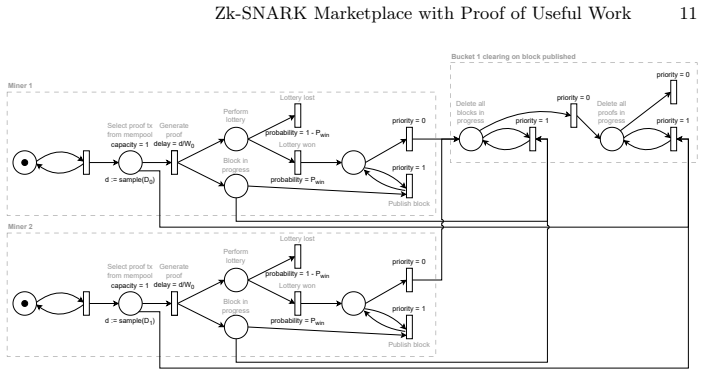
- [Section 5, Figure 5] The Petri-net evaluation does not independently validate the fairness hypotheses. The model in Figure 5 encodes the protocol's own lottery probability Pwin as a transition probability and uses the same gate-count complexity measure as the design. Figures 6-8 therefore largely reproduce algebraic consequences of Eq. (1)-(2) rather than providing external evidence. The model also contains no adversarial miners, no network delays, and no miner misbehavior. Consequently, the experimental claims for H1-H4 do not support the protocol's security or fairness in an adversarial setting beyond what is already assumed by the formulas.
minor comments (3)
- [Section 5 / Figure 11] The STCPN experiments and the WOO benchmark lack details needed for reproducibility: no number of replications, no error bars or confidence intervals, and no description of the circuits used in Figure 11 beyond constraint counts. The claim that WOO overhead remains below 0.1 s should be substantiated with more complete experimental reporting.
- [Section 6, "Amortization-freeness"] The claim that no batching techniques exist for Groth16 proving is presented as a permanence statement. It would be more accurate to say that no practical batching method is known or used in the paper's setting; the argument should be framed as a current limitation rather than an intrinsic property.
- [Section 4.4 / Algorithm 2] The circuit registry's `getCircuit` returns both `circuit` and `provingKey`, but the paper does not specify whether the returned circuit is source code, compiled R1CS, or a prover-ready object. This ambiguity is directly tied to the private-input flaw and should be clarified in any revision.
Circularity Check
No significant circularity: the PoUW lottery and marketplace claims are design proposals/novelty assertions, not derivations that reduce to their own inputs; the evaluation is an internal-consistency simulation, and the WOO concern is a correctness issue rather than a circular step.
full rationale
The paper's central derivation chain is not circular. The lottery rule P_win(i) = C_i/kappa is introduced as a design choice in Section 4.2, with C_i defined as the circuit's gate/constraint count; the paper does not claim to derive this relation from data or from an external first-principles result. The Groth16 linear proving-time assumption is supported by external benchmarking sources ([19], [20], zk-bench), not by values fitted in this paper. The Section 5 Petri-net simulation instantiates the proposed lottery equations directly, so the H1-H4 results are best read as internal-consistency checks of the design rather than independent empirical validation; however, no parameter is fitted to a subset of data and then presented as a prediction of a closely related quantity, and no result is identical by construction to its input. There are no load-bearing self-citations: the WOO technique is attributed to Nakamura et al. [37], and the paper explicitly acknowledges the trade-off of reduced circuit reusability. The Appendix B statement that 'the R1CS and masks are kept private' while 'only the proving key and obfuscated witness are sent to the worker' raises a genuine feasibility/security concern for Groth16, since a prover normally needs the R1CS to compute the witness and h(x); but that is a correctness/soundness issue, not a circularity in the claimed derivation chain, so it is not scored here. The strongest claim, being the first PoUW marketplace meeting all PoW properties, is a comparative novelty assertion rather than a derivation and does not reduce to the paper's own equations.
Assumptions & free parameters
free parameters (3)
- block difficulty κ =
periodically adjusted after fixed epochs
- lottery chain-preference coefficient ψ =
in [0,1]; tested over 0–0.5 in Figure 8
- number of buckets / hash-prefix length =
dynamically adjusted based on pending transaction count
assumptions (8)
- domain assumption Groth16 proving time grows linearly with constraint count.
- domain assumption Each completed proof yields an independent Bernoulli lottery chance Pwin = C_i/κ, and the process is Poisson/progress-free.
- standard math Hash functions behave as random oracles and cannot be optimized by miners.
- domain assumption At least one circuit-registry node is honest during SMPC trusted setup.
- domain assumption No meaningful amortization exists across proof generations for the same circuit.
- ad hoc to paper A circuit-specific Groth16 proving key can be given to workers without revealing the circuit or mask constants.
- domain assumption Miners select proof transactions uniformly at random and clients cannot bias hash prefixes.
- ad hoc to paper The dummy assert on the integrity parameter keeps it non-optimizable and cryptographically bound.
invented entities (1)
-
Circuit registry subnetwork
Cite this review
Pith. "Pith review of SNARKChain: Proof-of-Useful-Work Blockchain Consensus with General-Purpose SNARK Marketplace." pith.science (2026). https://pith.science/paper/HU3O7UA2
@misc{pith2026251009729,
  author       = {Pith},
  title        = {Pith review of: SNARKChain: Proof-of-Useful-Work Blockchain Consensus with General-Purpose SNARK Marketplace},
  year         = {2026},
  howpublished = {\url{https://pith.science/paper/HU3O7UA2}},
  note         = {Machine review of arXiv:2510.09729}
}
read the original abstract
Proof of Work (PoW) is widely regarded as the most secure permissionless blockchain consensus protocol. However, its reliance on computationally intensive yet externally useless puzzles results in excessive electric energy wasting. To alleviate this, Proof of Useful Work (PoUW) has been explored as an alternative to secure blockchain platforms while also producing real-world value. Despite this promise, existing PoUW proposals often fail to embed the integrity of the chain and the identity of the miner into the puzzle solutions, not meeting the necessary requirements for PoW and thus rendering them vulnerable. In this work, we propose a PoUW consensus protocol that computes client-outsourced SNARK proofs as a byproduct, which are simultaneously used to secure the consensus protocol. We further leverage this mechanism to design a decentralized marketplace for outsourcing SNARK proof generation, which is, to the best of our knowledge, the first such marketplace operating at the consensus layer while meeting all necessary properties of PoW.
Figures


Figures from the paper (8 more)



Reference graph
Works this paper leans on
-
[1]
0KIMS Association: Circom: A high-level language for zk-snark circuits (2021), https://github.com/iden3/circom, accessed: 2025-01-08
2021
-
[2]
Ali, I.M., Caprolu, M., Pietro, R.D.: Foundations, properties, and security ap- plications of puzzles: A survey. ACM Comput. Surv.53(4) (Aug 2020).https: //doi.org/10.1145/3396374,https://doi.org/10.1145/3396374
-
[3]
In: 2018 IEEE 17th International Symposium on Network Computing and Applications (NCA)
Anceaume, E., Guellier, A., Ludinard, R., Sericola, B.: Sycomore: A permissionless distributed ledger that self-adapts to transactions demand. In: 2018 IEEE 17th International Symposium on Network Computing and Applications (NCA). pp. 1– 8 (2018).https://doi.org/10.1109/NCA.2018.8548053
arXiv 2018
-
[4]
Entropy21(8) (2019).https://doi.org/10
Baldominos, A., Saez, Y.: Coin.ai: A proof-of-useful-work scheme for blockchain- based distributed deep learning. Entropy21(8) (2019).https://doi.org/10. 3390/e21080723,https://www.mdpi.com/1099-4300/21/8/723
2019
-
[5]
Cryptology ePrint Archive, Paper 2017/203 (03 2017),https://eprint.iacr.org/2017/203
Ball, M., Rosen, A., Sabin, M., Vasudevan, P.N.: Proofs of useful work. Cryptology ePrint Archive, Paper 2017/203 (03 2017),https://eprint.iacr.org/2017/203
2017
-
[6]
In: Proceedings of the 23rd USENIX Conference on Security Symposium
Ben-Sasson, E., Chiesa, A., Tromer, E., Virza, M.: Succinct non-interactive zero knowledge for a von neumann architecture. In: Proceedings of the 23rd USENIX Conference on Security Symposium. p. 781–796. SEC’14, USENIX Association, USA (2014)
2014
-
[7]
Cryptology ePrint Archive, Paper 2010/040 (2010),https: //eprint.iacr.org/2010/040
Blazy, O., Fuchsbauer, G., Izabachène, M., Jambert, A., Sibert, H., Vergnaud, D.: Batch groth-sahai. Cryptology ePrint Archive, Paper 2010/040 (2010),https: //eprint.iacr.org/2010/040
2010
-
[8]
Bonneau, J., Meckler, I., Rao, V., Shapiro, E.: Mina: Decentralized cryptocurrency at scale. Tech. rep., O(1) Labs (2020),https://minaprotocol.com/wp-content/ uploads/technicalWhitepaper.pdf Zk-SNARK Marketplace with Proof of Useful Work 17
2020
Show all 49 references
-
[9]
In: 2023 IEEE 22nd International Conference on Trust, Security and Privacy in Computing and Communications (TrustCom)
Chatterjee, D., Banerjee, P., Mazumdar, S.: Chrisimos: A useful proof-of-work for finding minimal dominating set of a graph. In: 2023 IEEE 22nd International Conference on Trust, Security and Privacy in Computing and Communications (TrustCom). pp. 1332–1339 (2023).https://doi....
2023
-
[10]
In: 2021 IEEE In- ternational Conference on Blockchain (Blockchain)
Chaurasia, Y., Subramanian, V., Gujar, S.: Pupow: A framework for designing blockchains with practically-useful-proof-of-work & vanitycoin. In: 2021 IEEE In- ternational Conference on Blockchain (Blockchain). pp. 122–129 (2021).https: //doi.org/10.1109/Blockchain53845.2021.00026
2021
-
[11]
In: Proceedings of the 7th Asia- Pacific Workshop on Networking
Chen, C., Cheng, Z., Qu, S., Fang, Z.: Crowdsourcing work as mining: A de- centralized computation and storage paradigm. In: Proceedings of the 7th Asia- Pacific Workshop on Networking. p. 174–175. APNet ’23, Association for Comput- ing Machinery, New York, NY, USA (2023).http...
2023
-
[12]
arXivabs/2101.11134(2021),https://arxiv.org/ abs/2101.11134, accessed: 2025-03-09
Chiesa,A.,Koutsou,E.,Williams,D.:zk-rollups:Scalableprivacy-preservinglayer- 2 solutions for blockchain. arXivabs/2101.11134(2021),https://arxiv.org/ abs/2101.11134, accessed: 2025-03-09
2021 arXiv
-
[13]
Costan, V., Devadas, S.: Intel SGX explained. Tech. Rep. 2016/086, IACR Cryp- tology ePrint Archive (2016),https://eprint.iacr.org/2016/086
2016
-
[14]
In: 2022 Fourth International Conference on Blockchain Computing and Ap- plications (BCCA)
Davidović, T., Todorović, M., Ramljak, D., Krüger, T.J., Matijević, L., Jovanović, D., Urošević, D.: Cocp: Blockchain proof-of-useful-work leveraging real-life applica- tions. In: 2022 Fourth International Conference on Blockchain Computing and Ap- plications (BCCA). pp. 107–1...
2022
-
[15]
Domenech, A.A., Heiss, J., Tai, S.: Servicifying zk-snarks execution for verifiable off-chain computations (2024),https://arxiv.org/abs/2404.16915
2024 arXiv
-
[16]
Dong, Z., Lee, Y.C., Zomaya, A.Y.: Proofware: Proof of useful work blockchain consensus protocol for decentralized applications (2019),https://arxiv.org/abs/ 1903.09276
2019 arXiv
-
[17]
Dotan, M., Tochner, S.: Proofs of useless work – positive and negative results for wasteless mining systems (2021),https://arxiv.org/abs/2007.01046
2021 arXiv
-
[18]
In: 2024 IEEE International Conference on Blockchain (Blockchain)
Ebrahimi, E., Sober, M., Hoang, A.T., Ileri, C.U., Sanders, W., Schulte, S.: Blockchain-based federated learning utilizing zero-knowledge proofs for verifiable training and aggregation. In: 2024 IEEE International Conference on Blockchain (Blockchain). pp. 54–63 (2024).https:/...
2024
-
[19]
Information 15(8) (2024).https://doi.org/10.3390/info15080463,https://www.mdpi.com/ 2078-2489/15/8/463
El-Hajj, M., Oude Roelink, B.: Evaluating the efficiency of zk-snark, zk- stark, and bulletproof in real-world scenarios: A benchmark study. Information 15(8) (2024).https://doi.org/10.3390/info15080463,https://www.mdpi.com/ 2078-2489/15/8/463
2024 doi
-
[20]
Cryptology ePrint Archive, Paper 2023/1503 (2023),https://eprint.iacr.org/2023/1503
Ernstberger, J., Chaliasos, S., Kadianakis, G., Steinhorst, S., Jovanovic, P., Ger- vais, A., Livshits, B., Orrù, M.: zk-bench: A toolset for comparative evaluation and performance benchmarking of SNARKs. Cryptology ePrint Archive, Paper 2023/1503 (2023),https://eprint.iacr.or...
2023
-
[21]
Birkhäuser Basel (2013),https://books.google.ca/books?id=LIP1BwAAQBAJ
Falk, M., Hüsler, J., Reiss, R.: Laws of Small Numbers: Extremes and Rare Events. Birkhäuser Basel (2013),https://books.google.ca/books?id=LIP1BwAAQBAJ
2013
-
[22]
In: Dodis, Y., Shrimpton, T
Fitzi, M., Kiayias, A., Panagiotakos, G., Russell, A.: Ofelimos: Combinatorial op- timization via proof-of-useful-work. In: Dodis, Y., Shrimpton, T. (eds.) Advances in Cryptology – CRYPTO 2022. pp. 339–369. Springer Nature Switzerland, Cham (2022) 18 S. Oleksak et al
2022
-
[23]
Dissertation, Stanford Uni- versity (2009),https://crypto.stanford.edu/craig/craig-thesis.pdf
Gentry, C.: A Fully Homomorphic Encryption Scheme. Dissertation, Stanford Uni- versity (2009),https://crypto.stanford.edu/craig/craig-thesis.pdf
2009
-
[24]
SIAM Journal on Computing18(6), 186–208 (1985)
Goldwasser, S., Micali, S., Rackoff, C.: Knowledge complexity of interactive proof- systems. SIAM Journal on Computing18(6), 186–208 (1985)
1985
-
[25]
In: Fischlin, M., Coron, J.S
Groth, J.: On the size of pairing-based non-interactive arguments. In: Fischlin, M., Coron, J.S. (eds.) Advances in Cryptology – EUROCRYPT 2016. pp. 305–326. Springer Berlin Heidelberg, Berlin, Heidelberg (2016)
2016
-
[26]
In: Advances in Cryptology – EUROCRYPT 2016
Groth, J.: On the size of pairing-based non-interactive arguments. In: Advances in Cryptology – EUROCRYPT 2016. pp. 305–326. Springer Berlin Heidelberg, Berlin, Heidelberg (2016).https://doi.org/10.1007/978-3-662-49896-5_11,https:// doi.org/10.1007/978-3-662-49896-5_11
2016 doi
-
[27]
In: Jacobson, M., Lo- casto, M., Mohassel, P., Safavi-Naini, R
Henry, R., Goldberg, I.: Batch proofs of partial knowledge. In: Jacobson, M., Lo- casto, M., Mohassel, P., Safavi-Naini, R. (eds.) Applied Cryptography and Network Security. pp. 502–517. Springer Berlin Heidelberg, Berlin, Heidelberg (2013)
2013
-
[28]
Hess, Z., Malahov, Y., Pettersson, J.: Æternity blockchain. Tech. rep. (2017),https://blockchainlab.com/pdf/%91ternity-blockchain-whitepaper. pdf, version 0.1
2017
-
[29]
CoRR abs/1602.03031(2016),http://arxiv.org/abs/1602.03031
Ileri, A.M., Ozercan, H.I., Gundogdu, A., Senol, A.K., Özkaya, M.Y., Alkan, C.: Coinami: A cryptocurrency with DNA sequence alignment as proof-of-work. CoRR abs/1602.03031(2016),http://arxiv.org/abs/1602.03031
2016 arXiv
-
[30]
Jin, Y., Wang, T., Yang, Q., Shi, L., Zhang, S.: Zero-knowledge federated learning: A new trustworthy and privacy-preserving distributed learning paradigm (2025), https://arxiv.org/abs/2503.15550
2025
-
[31]
Cryptology ePrint Archive, Paper 2020/190 (2020),https: //eprint.iacr.org/2020/190
Kattis, A., Bonneau, J.: Proof of necessary work: Succinct state verification with fairness guarantees. Cryptology ePrint Archive, Paper 2020/190 (2020),https: //eprint.iacr.org/2020/190
2020
-
[32]
King, S.: Primecoin: Cryptocurrency with prime number proof-of-work.https: //primecoin.io/primecoin-paper.pdf(2013)
2013
-
[33]
Komargodski, I., Schen, I., Weinstein, O.: Proofs of useful work from arbitrary matrix multiplication (2025),https://arxiv.org/abs/2504.09971
2025
-
[34]
Komarov, M.: =nil; proof market.https://nil.foundation/blog/post/ proof-market(Jan 2023), accessed: 2025-07-18
2023
-
[35]
Mina Foundation: What are snark workers and the snarketplace?https: //minaprotocol.com/blog/what-are-snark-workers-and-the-snarketplace (Aug 2021), accessed: 2025-07-18
2021
-
[36]
bitcoin.org/bitcoin.pdf
Nakamoto, S.: Bitcoin: A peer-to-peer electronic cash system (2008),http://www. bitcoin.org/bitcoin.pdf
2008
-
[37]
Journal of Information Processing 30, 151–154 (02 2022).https://doi.org/10.2197/ipsjjip.30.151
Nakamura, M., Miyamae, T., Morinaga, M.: A privacy-preserving outsourcing scheme for zero-knowledge proof generation. Journal of Information Processing 30, 151–154 (02 2022).https://doi.org/10.2197/ipsjjip.30.151
2022 doi
-
[38]
Orlicki, J.I.: Pogo: A scalable proof of useful work via quantized gradient descent and merkle proofs (2025),https://arxiv.org/abs/2504.07540
2025 arXiv
-
[39]
In: Proceedings of the 2009 BSDCan Conference (May 2009),https://www.tarsnap
Percival, C.: Stronger key derivation via sequential memory-hard functions. In: Proceedings of the 2009 BSDCan Conference (May 2009),https://www.tarsnap. com/scrypt/scrypt.pdf
2009
-
[40]
RISC Zero: Bonsai network blockchain litepaper.https://dev.risczero.com/ litepaper, accessed: 2025-07-18
2025
-
[41]
Communications of the ACM22(11), 612–613 (1979).https://doi.org/10.1145/359168.359176,https://doi.org/10.1145/ 359168.359176 Zk-SNARK Marketplace with Proof of Useful Work 19
Shamir, A.: How to share a secret. Communications of the ACM22(11), 612–613 (1979).https://doi.org/10.1145/359168.359176,https://doi.org/10.1145/ 359168.359176 Zk-SNARK Marketplace with Proof of Useful Work 19
1979
-
[42]
Symmetry14(9) (2022).https://doi.org/ 10.3390/sym14091831,https://www.mdpi.com/2073-8994/14/9/1831
Todorović, M., Matijević, L., Ramljak, D., Davidović, T., Urošević, D., Jakšić Krüger, T., Jovanović, D.: Proof-of-useful-work: Blockchain mining by solv- ing real-life optimization problems. Symmetry14(9) (2022).https://doi.org/ 10.3390/sym14091831,https://www.mdpi.com/2073-8...
2022 doi
-
[43]
com/tornadocash/tornado-core, accessed: 2025-03-09
TornadoCash:Tornadocash:Aprivacytoolforethereum(2021),https://github. com/tornadocash/tornado-core, accessed: 2025-03-09
2021
-
[44]
de Vries, A., Gallersdörfer, U., Klaaßen, L., Stoll, C.: Revisiting bitcoin’s carbon footprint (02 2022).https://doi.org/10.1016/j.joule.2022.02.005
2022 doi
-
[45]
In: IEEE Security & Privacy on the Blockchain (IEEE S&B
Westerkamp, M., Eberhardt, J.: zkrelay: Facilitating sidechains using zksnark- based chain-relays. In: IEEE Security & Privacy on the Blockchain (IEEE S&B
-
[46]
In: Proceedings of the 2022 ACM SIGSAC Conference on Computer and Communications Secu- rity (CCS)
Xie, T., Zhang, J., Cheng, Z., Zhang, F., Zhang, Y., Jia, Y., Boneh, D., Song, D.: zkbridge: Trustless cross-chain bridges made practical. In: Proceedings of the 2022 ACM SIGSAC Conference on Computer and Communications Secu- rity (CCS). pp. 3003–3017 (2022).https://doi.org/10...
2022
-
[47]
In: 27th Annual Symposium on Foundations of Computer Science (FOCS ’86)
Yao, A.C.: How to generate and exchange secrets. In: 27th Annual Symposium on Foundations of Computer Science (FOCS ’86). pp. 162–167. IEEE Computer Society, Washington, DC, USA (1986).https://doi.org/10.1109/SFCS.1986.25, https://doi.org/10.1109/SFCS.1986.25
1986 doi
-
[48]
Oleksak et al
ZoKrates Team: ZoKrates: A toolbox for zkSNARKs on Ethereum (11 2023), https://zokrates.github.io/, accessed: 2024-05-08, version 0.8.8 20 S. Oleksak et al. A Block Production and Verification Pseudocode Algorithm 2 shows pseudocode of the most important functions for block ge...
2023
-
[2020]
(2020),https://eprint.iacr.org/2020/433
2020
Reviewed August 4, 2026 · model on record in the stance chip above.
Discussion (0). Continue with ORCID to comment.