REVIEW 2 major objections 6 minor 79 references
Secondary Stakeholders in AI: Fighting for, Brokering, and Navigating Agency
T0 review · 2 major / 6 minor · reviewed 2026-08-07 · deepseek-v4-flash
Pith's one-line read The paper claims that meaningful participation with AI for secondary stakeholders requires three cumulative ideals — informedness, consent, and agency — and that 12 interviews reveal three archetypes of stakeholders who cannot fully reach…
desk verdict A useful and honest qualitative framework for indirect AI stakeholders, with a real definitional mismatch between the working construct and the recruited sample that a revision can fix. read the letter →
The pith
A machine-rendered reading of the paper's core claim, the machinery that carries it, and where it could break.
The reading
What carries the argument
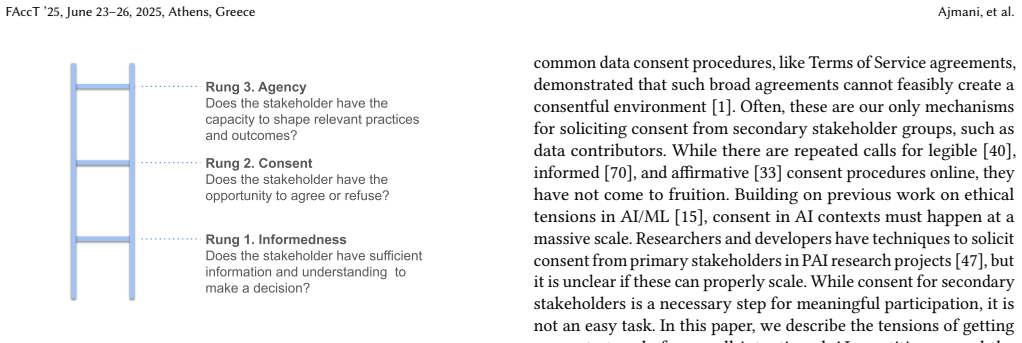
The key machinery is the meaningful participation ladder, adapted from the civic-engagement ladder of participation. It names three participatory ideals — informedness (having enough understanding to decide), consent (being able to agree or refuse free of coercion), and agency (having the capacity to shape the outcomes of participation) — and asserts that each higher rung depends on the lower one. The ladder does the theoretical work of defining what meaningful means, while the three archetypes (reluctant data contributor, AI activist, and well-intentioned practitioner) do the empirical work of showing where, for different secondary stakeholders, the climb stalls.
What would settle it
A large-scale survey of people whose data trains AI that measures informedness, consent, and agency separately could test whether the rungs actually order: finding people who report agency over their data while lacking informedness or consent would break the ladder's cumulative claim.
Extended reading notes
Core claim
The central discovery is that meaningful AI participation cannot be understood as a single act or a binary of included versus excluded; it is a step-by-step process of building informed, consensual, and agentic relationships, and the lower rungs must come first. The paper shows empirically that secondary stakeholders realize these rungs incompletely and unevenly. Reluctant data contributors tend to be informed or uninformed but non-consenting, with only leave-the-platform as recourse; AI activists fight for informedness, consent, and agency on behalf of themselves and others but are unsupported; well-intentioned practitioners broker these ideals in human-centered settings but cannot scale them to data-centered participation. On the paper's account, the barriers are not just individual failures but systemic: without regulation and platform-level redesign, secondary stakeholders hit an ethical glass ceiling where incremental progress is possible but transformative agency is not.
Load-bearing premise
The entire framework hangs on a clean working line between secondary stakeholders — people who influence AI broadly without a direct contract — and everyone else, a line the paper admits blurs when a paid moderator does not know her work trains an AI.
Editorial extensions
If this is right
- If meaningful participation requires the lower rungs first, then current data consent mechanisms like Terms of Service cannot satisfy the consent rung because they do not produce informedness.
- Practitioners can broker informedness, consent, and agency in human-centered settings such as workshops and studies, but the same methods do not scale to data-centered participation.
- Reluctant data contributors, if given real agency, would often choose to withdraw their data from AI training; the paper's evidence suggests current opt-out-as-leave-platform designs block that choice.
- Activists fight on two fronts — informing the public and practitioners, and building better consent and coercion evaluation — but need support from researchers and designers to make change.
- Realizing these ideals is structurally blocked without regulation, platform redesign, and longer project timelines, which the paper describes as an ethical glass ceiling.
Reading between the lines
- Beyond the paper: if the ladder is cumulative, then interventions that hand stakeholders more control without first fixing informedness and consent would not produce meaningful participation; they would just create new surface-level engagement.
- Beyond the paper: the archetypes could be turned into testable design personas — toolkits that treat reluctant data contributors as needing low-effort, concise consent, activists as needing structured multi-stakeholder support, and practitioners as needing longer timelines and platform-level consent infrastructure.
- Beyond the paper: the contract-based definition suggests a possible continuum rather than a binary, and future work could map where along a contract-and-influence spectrum different experiences of non-consensual data use arise.
- Beyond the paper: because scale is the bottleneck practitioners keep hitting, platform-level defaults such as opt-in data-use design would likely do more for secondary stakeholders than individual researcher efforts.
Editorial analysis
A structured set of objections, weighed in public.
Referee Report
Summary. This paper extends participatory AI ideals to secondary AI stakeholders, defined as individuals who influence AI systems broadly but lack a direct contract with an AI system. The authors propose a "meaningful participation ladder" with three ordered rungs—informedness, consent, and agency—drawing on Arnstein's ladder and prior FAccT work on data agency. They report semi-structured interviews with 12 AI researchers, developers, activists, and data workers, and from these interviews construct three archetypes: the reluctant data contributor, the AI activist, and the well-intentioned practitioner. The paper argues that these stakeholders realize participatory ideals only incompletely because of scale and systemic barriers, and it offers recommendations for practitioners and for future PAI work. The methods are interpretivist, with purposive stratified sampling, open coding, member checking, and an explicit limitation to transferability rather than generalizability.
Significance. If the empirical claims hold, the paper makes a timely contribution by broadening participatory AI's stakeholder focus beyond primary stakeholders such as end-users. The three archetypes are a usable, persona-like synthesis that can help practitioners and researchers reason about under-served stakeholder positions, and the ladder offers a simple normative vocabulary. The paper is transparent about its qualitative scope and includes useful ethical and positionality statements. Its main scientific value lies in the transferable characterizations of how data contributors, activists, and practitioners experience informedness, consent, and agency, and in the explicit attention to systemic barriers that individual practitioners cannot overcome alone.
major comments (2)
- [§5 (definition) vs. §3.1 (recruitment), with §5.2.2 (Falen and Fiona)] The working definition of a secondary stakeholder as someone who "lack[s] a direct contract with an AI system" is not aligned with the eligibility criteria used to recruit the sample. Section 3.1 screened participants by occupational role ('AI researcher, developer, advocate, or data contributor'), not by contract status, and the reported sample includes people who appear to have direct contracts to AI training work. Falen is described in §5.2.2 as an expert data annotator for a mental-health AI company who "was hired to train a model," which fits the paper's own primary-stakeholder criterion (direct contract with an AI system) more naturally than the secondary-stakeholder criterion. Fiona likewise had a paid moderation contract, and her classification depends on her subjective lack of awareness that her work trained an AI, not on whether a direct contract existed. Because the central empirical claim is about secondary stakeholders specifically, this mismatch means the three archetypes and the claim that secondary stakeholders realize participatory ideals incompletely are not cleanly supported by the data as presented. The paper notes the definition is "complicated," but it never reconciles the recruitment procedure with the definition or reports per-participant contract status. A revision should either re-operationalize the definition, justify the inclusion of contract-holding participants as secondary stakeholders (e.g., by distinguishing contracts with an AI system from contracts with a human employer and stating that distinction explicitly), or re-analyze the archetypes on a sample that consistently satisfies the stated definition.
- [§4 (ladder ordering) and §5.2.3 (Katie)] The paper presents the ladder as an ordered requirement: "you cannot reach a higher rung without establishing the lower rungs first." This ordering is asserted as part of the theoretical framework, but the empirical material is not systematically analyzed against it. For example, Katie in §5.2.3 reports that she had the de facto ability to stop an annotation task yet lacked sufficient informedness at the time, which illustrates that agency can exist in a minimal sense without informedness, even if the authors would deem such agency non-meaningful. The paper does not specify what evidence would count against the ordering claim, and it does not show that participants who reached agency always had informedness and consent. Because the ordering is a load-bearing element of the framework, the authors should either explicitly treat it as a normative/theoretical postulate (and say so), or provide a more systematic mapping of interview evidence to the claimed ladder structure, including negative cases.
minor comments (6)
- [§5.4.2] The text contains a typo, "unsovled," which should read "unsolved."
- [Abstract and §5.3] The abstract and introduction use the name "unsupported activist" for one archetype, while §5.3 is titled "The AI Activist." Please standardize the terminology.
- [Figure 1] Figure 1 is referenced in the text, but the figure content is not visible in the provided manuscript; please ensure the ladder figure is included and legible.
- [Header/page 1] The line "Please use nonacm option or ACM Engage class to enable CC licenses" appears to be a LaTeX template instruction that was accidentally left in the manuscript and should be removed.
- [References] Reference [72] has the title "undefined"; please complete the bibliographic entry.
- [§5 intro] The term "HCAI" is used in the section introduction but is not defined; please spell out the abbreviation on first use and clarify whether it refers to human-centered AI or human–computer interaction.
Circularity Check
No circular derivation: interview-derived archetypes are independent of the prior theoretical lens, and no fitted parameter or equation is renamed as a prediction.
full rationale
The paper makes a qualitative, not formal, contribution. Section 4 constructs a 'meaningful participation ladder' by synthesis of Arnstein and prior work, including the authors' own Ajmani et al. (2024) data-agency theory; that ladder is an interpretive lens, not a quantity derived from the data. The empirical claims, namely the three archetypes in Section 5, are presented as products of semi-structured interviews and stratified open coding (Section 3.2), with participant quotes as evidence. Nothing in the archetype synthesis is a fitted parameter or a prediction forced by the definition of the ladder. The definitional complication around 'secondary stakeholder' (Section 5, including Falen's direct annotation contract, and Section 3.1 role-based screening) is a construct-validity issue rather than circular reasoning: the category is not defined in terms of the empirical findings it is used to explain. Self-citations to Ajmani et al. (2024) and Chancellor et al. (2019) are present but are used as prior theoretical grounding, not as evidence that the interview themes must emerge in a particular way. Limitations about sample size and transferability (Section 7) further acknowledge the interpretive character of the results. No equation or derivation in the paper reduces by construction to its own inputs.
Assumptions & free parameters
assumptions (4)
- domain assumption Interview responses are treated as valid accounts of lived experience that can be inductively coded into shared themes.
- domain assumption Arnstein's ladder of citizen participation transfers to AI stakeholder relationships.
- domain assumption The definition of secondary stakeholders as influencing AI systems without a direct contract is coherent and can guide participant selection.
- domain assumption Thematic saturation is reached with 12 participants (three per role group).
invented entities (4)
-
The meaningful participation ladder (informedness, consent, agency)
-
The reluctant data contributor archetype
-
The AI activist archetype (also called the unsupported activist)
-
The well-intentioned practitioner archetype
Cite this review
Pith. "Pith review of Secondary Stakeholders in AI: Fighting for, Brokering, and Navigating Agency." pith.science (2026). https://pith.science/paper/HU4G6R5X
@misc{pith2026250607281,
  author       = {Pith},
  title        = {Pith review of: Secondary Stakeholders in AI: Fighting for, Brokering, and Navigating Agency},
  year         = {2026},
  howpublished = {\url{https://pith.science/paper/HU4G6R5X}},
  note         = {Machine review of arXiv:2506.07281}
}
read the original abstract
As AI technologies become more human-facing, there have been numerous calls to adapt participatory approaches to AI development -- spurring the idea of participatory AI. However, these calls often focus only on primary stakeholders, such as end-users, and not secondary stakeholders. This paper seeks to translate the ideals of participatory AI to a broader population of secondary AI stakeholders through semi-structured interviews. We theorize that meaningful participation involves three participatory ideals: (1) informedness, (2) consent, and (3) agency. We also explore how secondary stakeholders realize these ideals by traversing a complicated problem space. Like walking up the rungs of a ladder, these ideals build on one another. We introduce three stakeholder archetypes: the reluctant data contributor, the unsupported activist, and the well-intentioned practitioner, who must navigate systemic barriers to achieving agentic AI relationships. We envision an AI future where secondary stakeholders are able to meaningfully participate with the AI systems they influence and are influenced by.
Figures
Reference graph
Works this paper leans on
-
[1]
Leah Ajmani, Logan Stapleton, Mo Houtti, and Stevie Chancellor. 2024. Data agency theory: A precise theory of justice for AI applications. InThe 2024 ACM Conference on Fairness, Accountability, and Transparency (FAccT ’24). ACM, New York, NY, USA, 631–641
work page 2024
-
[2]
Sherry R Arnstein. 1969. A ladder of citizen participation.J. Am. Inst. Plann.35, 4 (July 1969), 216–224
work page 1969
-
[3]
Solon Barocas and Helen Nissenbaum. 2009. On notice: The trouble with notice and consent. InProceedings of the engaging data forum: The first international forum on the application and management of personal electronic information. papers.ssrn.com
work page 2009
-
[4]
Solon Barocas and H Nissenbaum. 2014. Big data’s end run around anonymity and consent.Book of Anonymity(June 2014)
work page 2014
-
[5]
Melanie A Beres. 2007. ‘spontaneous’ sexual consent: An analysis of sexual consent literature.Fem. Psychol.17, 1 (Feb. 2007), 93–108
work page 2007
-
[6]
Maalvika Bhat and Duri Long. 2024. Designing interactive explainable AI tools for algorithmic literacy and transparency. InDesigning Interactive Systems Conference. ACM, New York, NY, USA
work page 2024
-
[7]
Christian Bird, Denae Ford, Thomas Zimmermann, Nicole Forsgren, Eirini Kalliamvakou, Travis Lowdermilk, and Idan Gazit. 2022. Taking Flight with Copilot: Early insights and opportunities of AI-powered pair-programming tools. ACM Queue20, 6 (Dec. 2022), 35–57
work page 2022
-
[8]
Abeba Birhane, William Isaac, Vinodkumar Prabhakaran, Mark Diaz, Madeleine Clare Elish, Iason Gabriel, and Shakir Mohamed. 2022. Power to the people? Opportunities and challenges for participatory AI. InEquity and Access in Algorithms, Mechanisms, and Optimization. ACM, New York, NY, USA
work page 2022
Show all 79 references
-
[9]
Elizabeth Bondi, Lily Xu, Diana Acosta-Navas, and Jackson A Killian. 2021. Envisioning communities: A participatory approach towards AI for social good. InProceedings of the 2021 AAAI/ACM Conference on AI, Ethics, and Society. ACM, New York, NY, USA
2021
-
[10]
Virginia Braun and Victoria Clarke. 2006. Using thematic analysis in psychology. Qual. Res. Psychol.3, 2 (Jan. 2006), 77–101
2006
-
[11]
Anna Brown, Alexandra Chouldechova, Emily Putnam-Hornstein, Andrew Tobin, and Rhema Vaithianathan. 2019. Toward algorithmic accountability in public services: A qualitative study of affected community perspectives on algorithmic decision-making in child welfare services. InPro...
2019
-
[12]
Mark Anthony Camilleri. 2024. Artificial intelligence governance: Ethical considerations and implications for social responsibility.Expert Syst.41, 7 (July Secondary AI Stakeholders FAccT ’25, June 23–26, 2025, Athens, Greece 2024), e13406
2024
-
[13]
Stevie Chancellor. 2023. Toward practices for human-centered machine learning. Commun. ACM66, 3 (March 2023), 78–85
2023
-
[14]
Stevie Chancellor, Eric P S Baumer, and Munmun De Choudhury. 2019. Who is the “human” in human-centered Machine Learning: The case of predicting mental health from Social Media.Proc. ACM Hum. Comput. Interact.3, CSCW (Nov. 2019), 1–32
2019
-
[15]
Stevie Chancellor, Michael L Birnbaum, Eric D Caine, Vincent M B Silenzio, and Munmun De Choudhury. 2019. A taxonomy of ethical tensions in inferring mental health states from social media. InProceedings of the Conference on Fairness, Accountability, and Transparency (FAT* ’19...
2019
-
[16]
Max E Clarkson. 1995. A stakeholder framework for analyzing and evaluating corporate social performance.Acad. Manage. Rev.20, 1 (Jan. 1995), 92–117
1995
-
[17]
Ned Cooper and Alexandra Zafiroglu. 2024. From fitting participation to forging relationships: The art of participatory ML. InProceedings of the CHI Conference on Human Factors in Computing Systems, Vol. 19. ACM, New York, NY, USA, 1–9
2024
-
[18]
Eric Corbett, Emily Denton, and Sheena Erete. 2023. Power and Public Partici- pation in AI. InEquity and Access in Algorithms, Mechanisms, and Optimization. ACM, New York, NY, USA, 1–13
2023
-
[19]
Natalie Cunningham and Teresa Carmichael. 2017. Sampling, interviewing and coding: Lessons from a constructivist grounded theory study. InEuro- pean conference on research methodology for business and management studies. books.google.com, 78–85
2017
-
[20]
Christopher A Le Dantec and Carl DiSalvo. 2013. Infrastructuring and the formation of publics in participatory design.Soc. Stud. Sci.43, 2 (April 2013), 241–264
2013
-
[21]
Janet Davis, Lisa P Nathan, and Others. 2015. Value sensitive design: Applications, adaptations, and critiques.Handbook of ethics, values, and technological design: Sources, theory, values and application domains(2015), 11–40
2015
-
[22]
Fernando Delgado, Stephen Yang, Michael Madaio, and Qian Yang. 2023. The participatory turn in AI design: Theoretical foundations and the current state of practice. InEquity and Access in Algorithms, Mechanisms, and Optimization (EAAMO ’23, Article 37). ACM, New York, NY, USA, 1–23
2023
-
[23]
Sergiy D Dmytriyev, R Edward Freeman, and Jacob Hörisch. 2021. The relation- ship between stakeholder theory and corporate social responsibility: Differences, similarities, and implications for social issues in management.J. Manag. Stud. 58, 6 (Sept. 2021), 1441–1470
2021
-
[24]
Susanna Doyle. 2007. Member checking with older women: a framework for negotiating meaning.Health Care Women Int.28, 10 (Nov. 2007), 888–908
2007
-
[25]
Christopher Frauenberger, Judith Good, Geraldine Fitzpatrick, and Ole Sejer Iversen. 2015. In pursuit of rigour and accountability in participatory design.Int. J. Hum. Comput. Stud.74 (Feb. 2015), 93–106
2015
-
[26]
2010.Strategic Management: A Stakeholder Approach
R Edward Freeman. 2010.Strategic Management: A Stakeholder Approach. Cambridge University Press, Cambridge, England
2010
-
[27]
Batya Friedman. 1996. Value-sensitive design.Interactions3, 6 (Dec. 1996), 16–23
1996
-
[28]
2019.Yes Means Yes!: Visions of female sexual power and a world without rape
Jaclyn Friedman and Jessica Valenti. 2019.Yes Means Yes!: Visions of female sexual power and a world without rape. Seal Press, Seattle, WA
2019
-
[29]
Archon Fung and Erik Olin Wright. 2001. Deepening Democracy: Innovations in Empowered Participatory Governance.Polit. Soc.29, 1 (March 2001), 5–41
2001
-
[30]
Sucheta Ghoshal, Rishma Mendhekar, and Amy Bruckman. 2020. Toward a Grassroots Culture of Technology Practice.Proc. ACM Hum.-Comput. Interact.4, CSCW1 (May 2020), 1–28
2020
-
[31]
Gail E Henderson. 2011. Is informed consent broken?Am. J. Med. Sci.342, 4 (Oct. 2011), 267–272
2011
-
[32]
Naja Holten Møller, Irina Shklovski, and Thomas T Hildebrandt. 2020. Shifting concepts of value: Designing algorithmic decision-support systems for public services. InProceedings of the 11th Nordic Conference on Human-Computer Interaction: Shaping Experiences, Shaping Society....
2020
-
[33]
Jane Im, Jill Dimond, Melody Berton, Una Lee, Katherine Mustelier, Mark S Ackerman, and Eric Gilbert. 2021. Yes: Affirmative consent as a theoretical framework for understanding and imagining social platforms. InProceedings of the 2021 CHI Conference on Human Factors in Comput...
2021
-
[34]
F Kensing and J Blomberg. 1998. Participatory design: Issues and concerns. Comput. Support. Coop. Work(1998)
1998
-
[35]
Tzu-Sheng Kuo, Aaron Lee Halfaker, Zirui Cheng, Jiwoo Kim, Meng-Hsin Wu, Tongshuang Wu, Kenneth Holstein, and Haiyi Zhu. 2024. Wikibench: Community- driven data curation for AI evaluation on Wikipedia. InProceedings of the CHI Conference on Human Factors in Computing Systems, ...
2024
-
[36]
Min Hun Lee, Daniel P Siewiorek, Asim Smailagic, Alexandre Bernardino, and Sergi Bermúdez i Badia. 2020. Co-design and evaluation of an intelligent decision support system for stroke rehabilitation assessment.Proc. ACM Hum. Comput. Interact.4, CSCW2 (Oct. 2020), 1–27
2020
-
[37]
Min Kyung Lee, Daniel Kusbit, Anson Kahng, Ji Tae Kim, Xinran Yuan, Allissa Chan, Daniel See, Ritesh Noothigattu, Siheon Lee, Alexandros Psomas, and Ariel D Procaccia. 2019. WeBuildAI: Participatory framework for algorithmic governance.Proc. ACM Hum. Comput. Interact.3, CSCW (...
2019
-
[38]
Hanlin Li, Nicholas Vincent, Stevie Chancellor, and Brent Hecht. 2023. The Di- mensions of Data Labor: A Road Map for Researchers, Activists, and Policymakers to Empower Data Producers. In2023 ACM Conference on Fairness, Accountability, and Transparency (FAccT ’23). ACM, New Y...
2023
-
[39]
1985.Naturalistic Inquiry
Yvonna S Lincoln and Egon G Guba. 1985.Naturalistic Inquiry. SAGE
1985
-
[40]
Ewa Luger, Stuart Moran, and Tom Rodden. 2013. Consent for all: revealing the hidden complexity of terms and conditions. InProceedings of the SIGCHI Conference on Human Factors in Computing Systems (CHI ’13). ACM, New York, NY, USA, 2687–2696
2013
-
[41]
Cormac McGrath, Per J Palmgren, and Matilda Liljedahl. 2019. Twelve tips for conducting qualitative research interviews.Med. Teach.41, 9 (Sept. 2019), 1002–1006
2019
-
[42]
Michael J Muller and Sarah Kuhn. 1993. Participatory design.Commun. ACM36, 6 (1993), 24–28
1993
-
[43]
Naja Holten Møller, Claus Bossen, Kathleen H Pine, Trine Rask Nielsen, and Gina Neff. 2020. Who does the work of data?Interactions27, 3 (April 2020), 52–55
2020
-
[44]
Terrence Neumann, Maria De-Arteaga, and Sina Fazelpour. 2022. Justice in misinformation detection systems: An analysis of algorithms, stakeholders, and potential harms. In2022 ACM Conference on Fairness, Accountability, and Transparency (FAccT ’22). ACM, New York, NY, USA, 1504–1515
2022
-
[45]
Davy Tsz Kit Ng, Jac Ka Lok Leung, Samuel Kai Wah Chu, and Maggie Shen Qiao. 2021. Conceptualizing AI literacy: An exploratory review.Computers and Education: Artificial Intelligence2, 100041 (2021), 100041
2021
-
[46]
2019.Personas - user focused design(2 ed.)
Lene Nielsen. 2019.Personas - user focused design(2 ed.). Springer, London, England
2019
-
[47]
Office for Human Research Protections (OHRP). 2010. Informed Consent Checklist (1998). https://www.hhs.gov/ohrp/regulations-and-policy/guidance/ checklists/index.html. Accessed: 2024-7-3
1998
-
[48]
Ihudiya Finda Ogbonnaya-Ogburu, Angela D R Smith, Alexandra To, and Kentaro Toyama. 2020. Critical Race Theory for HCI. InProceedings of the 2020 CHI Conference on Human Factors in Computing Systems (CHI ’20). ACM, New York, NY, USA, 1–16
2020
-
[49]
Anthony J Onwuegbuzie and Nancy L Leech. 2007. A call for qualitative power analyses.Qual. Quant.41, 1 (Feb. 2007), 105–121
2007
-
[50]
Kari Paul. 2023. How social media’s biggest user protest rocked Reddit.The Guardian(Dec. 2023)
2023
-
[51]
Jennifer Pierre, Roderic Crooks, Morgan Currie, Britt Paris, and Irene Pasquetto
-
[52]
Alun Preece, Dan Harborne, Dave Braines, Richard Tomsett, and Supriyo Chakraborty. 2018. Stakeholders in Explainable AI.arXiv [cs.AI](Sept. 2018)
2018
-
[53]
Organizers Of Queerinai, Anaelia Ovalle, Arjun Subramonian, Ashwin Singh, Claas Voelcker, Danica J Sutherland, Davide Locatelli, Eva Breznik, Filip Klubicka, Hang Yuan, J Hetvi, Huan Zhang, Jaidev Shriram, Kruno Lehman, Luca Soldaini, Maarten Sap, Marc Peter Deisenroth, Maria ...
2023
-
[54]
Oliver C Robinson. 2014. Sampling in Interview-Based Qualitative Research: A Theoretical and Practical Guide.Qual. Res. Psychol.11, 1 (Jan. 2014), 25–41
2014
-
[55]
Janet Salmons. 2017. Getting to Yes: Informed Consent in Qualitative Social Media Research. InThe Ethics of Online Research, Woodfield Kandy (Ed.). Advances in Research Ethics and Integrity, Vol. 2. Emerald Publishing Limited, 109–134
2017
-
[56]
Everyone wants to do the model work, not the data work
Nithya Sambasivan, Shivani Kapania, Hannah Highfill, Diana Akrong, Praveen Paritosh, and Lora M Aroyo. 2021. “Everyone wants to do the model work, not the data work”: Data Cascades in High-Stakes AI. InProceedings of the 2021 CHI Conference on Human Factors in Computing System...
2021
-
[57]
Elizabeth B-N Sanders. 2002. From user-centered to participatory design approaches. InDesign and the social sciences. CRC Press, 18–25
2002
-
[58]
Devansh Saxena, Karla Badillo-Urquiola, Pamela J Wisniewski, and Shion Guha
-
[59]
Mona Sloane, Emanuel Moss, Olaitan Awomolo, and Laura Forlano. 2022. Partici- pation is not a design fix for machine learning. InEquity and Access in Algorithms, Mechanisms, and Optimization (EAAMO ’22, Article 1). ACM, New York, NY, USA, 1–6
2022
-
[60]
C Estelle Smith, Bowen Yu, Anjali Srivastava, Aaron Halfaker, Loren Terveen, and Haiyi Zhu. 2020. Keeping community in the loop: Understanding Wikipedia FAccT ’25, June 23–26, 2025, Athens, Greece Ajmani, et al. stakeholder values for machine learning-based systems. InProceedi...
2020
-
[61]
Robert Soden, Austin Toombs, and Michaelanne Thomas. 2024. Evaluating interpretive research in HCI.Interactions31, 1 (Jan. 2024), 38–42
2024
-
[62]
Logan Stapleton, Min Hun Lee, Diana Qing, Marya Wright, Alexandra Choulde- chova, Ken Holstein, Zhiwei Steven Wu, and Haiyi Zhu. 2022. Imagining new futures beyond predictive systems in child welfare: A qualitative study with impacted stakeholders. In2022 ACM Conference on Fai...
2022
-
[63]
Harini Suresh, Steven R Gomez, Kevin K Nam, and Arvind Satyanarayan. 2021. Beyond expertise and roles: A framework to characterize the stakeholders of interpretable machine learning and their needs. InProceedings of the 2021 CHI Conference on Human Factors in Computing Systems...
2021
-
[64]
Harini Suresh, Rajiv Movva, Amelia Lee Dogan, Rahul Bhargava, Isadora Cruxen, Angeles Martinez Cuba, Guilia Taurino, Wonyoung So, and Catherine D’Ignazio
-
[65]
Harini Suresh, Emily Tseng, Meg Young, Mary Gray, Emma Pierson, and Karen Levy. 2024. Participation in the age of foundation models. InThe 2024 ACM Conference on Fairness, Accountability, and Transparency. ACM, New York, NY, USA
2024
-
[66]
Ningjing Tang, Jiayin Zhi, Tzu-Sheng Kuo, Calla Kainaroi, Jeremy J Northup, Kenneth Holstein, Haiyi Zhu, Hoda Heidari, and Hong Shen. 2024. AI failure cards: Understanding and supporting grassroots efforts to mitigate AI failures in homeless services. InThe 2024 ACM Conference...
2024
-
[67]
The White House. 2022. Blueprint for an AI Bill of Rights. https://www. whitehouse.gov/ostp/ai-bill-of-rights/. Accessed: 2024-7-3
2022
-
[68]
David R Thomas. 2003. A general inductive approach for qualitative data analysis. (2003)
2003
-
[69]
Kristin Undheim, Truls Erikson, and Bram Timmermans. 2023. True uncertainty and ethical AI: regulatory sandboxes as a policy tool for moral imagination.AI Ethics3, 3 (Aug. 2023), 997–1002
2023
-
[70]
Christine Utz, Martin Degeling, Sascha Fahl, Florian Schaub, and Thorsten Holz
-
[71]
John Vines, Rachel Clarke, Peter Wright, John McCarthy, and Patrick Olivier. 2013. Configuring participation: on how we involve people in design. InProceedings of the SIGCHI Conference on Human Factors in Computing Systems. ACM, New York, NY, USA
2013
-
[72]
Alissa Wilkinson. 2023. The looming threat of AI to Hollywood, and why it should matter to you. undefined. Accessed: 2023-7-26
2023
-
[73]
Stephen Tze-Inn Wu, Daniel Demetriou, and Rudwan Ali Husain. 2023. Honor ethics: The challenge of globalizing value alignment in AI. In2023 ACM Conference on Fairness, Accountability, and Transparency. ACM, New York, NY, USA
2023
-
[74]
Angie Zhang, Alexander Boltz, Jonathan Lynn, Chun-Wei Wang, and Min Kyung Lee. 2023. Stakeholder-centered AI design: Co-designing worker tools with gig workers through data probes. InProceedings of the 2023 CHI Conference on Human Factors in Computing Systems (CHI ’23, Article...
2023
-
[75]
Haiyi Zhu, Bowen Yu, Aaron Halfaker, and Loren Terveen. 2018. Value-Sensitive Algorithm Design: Method, case study, and lessons.Proc. ACM Hum. Comput. Interact.2, CSCW (Nov. 2018), 1–23. Secondary AI Stakeholders FAccT ’25, June 23–26, 2025, Athens, Greece A PARTICIPANT DEMOGR...
2018
-
[2019]
In Proceedings of the 2019 ACM SIGSAC Conference on Computer and Communications Security (CCS ’19)
(Un)informed consent: Studying GDPR consent notices in the field. In Proceedings of the 2019 ACM SIGSAC Conference on Computer and Communications Security (CCS ’19). ACM, New York, NY, USA, 973–990
2019
-
[2020]
child welfare system
A human-centered review of algorithms used within the U.s. child welfare system. InProceedings of the 2020 CHI Conference on Human Factors in Computing Systems. ACM, New York, NY, USA, 1–15
2020
-
[2021]
InProceedings of the 2021 CHI Conference on Human Factors in Computing Systems(Yokohama Japan)(CHI ’21, Article 406)
Getting Ourselves Together: Data-centered participatory design research & epistemic burden. InProceedings of the 2021 CHI Conference on Human Factors in Computing Systems(Yokohama Japan)(CHI ’21, Article 406). ACM, New York, NY, USA, 1–11
2021
-
[2022]
In2022 ACM Conference on Fairness, Accountability, and Transparency (FAccT ’22)
Towards Intersectional Feminist and Participatory ML: A Case Study in Supporting Feminicide Counterdata Collection. In2022 ACM Conference on Fairness, Accountability, and Transparency (FAccT ’22). ACM, New York, NY, USA, 667–678
Reviewed August 7, 2026 · model on record in the stance chip above.
Discussion (0). Sign in to comment.