REVIEW 3 major objections 5 minor 28 references
The Kelvin-Helmholtz instability and smoothed particle hydrodynamics
T0 review · 3 major / 5 minor · reviewed 2026-08-14 · deepseek-v4-flash
Pith's one-line read Standard smoothed particle hydrodynamics, with a physical viscosity and thermal conductivity, converges to a high-resolution spectral reference solution for the Kelvin-Helmholtz instability.
desk verdict A valuable, honest SPH convergence study for the Lecoanet et al. KH test, but the abstract's 'converge' claim is stronger than the evidence: at the highest resolution artificial dissipation is still comparable to physical viscosity, and late-time convergence is sublinear with a possible nonzero offset. read the letter →
The pith
A machine-rendered reading of the paper's core claim, the machinery that carries it, and where it could break.
The reading
What carries the argument
The argument is carried by four coupled pieces. (1) The smooth test initial conditions: tanh interfaces and a seeded velocity perturbation, which remove the discontinuous-contact pathology that made earlier SPH tests unconverged. (2) Physical dissipation terms: Navier-Stokes viscosity, thermal conductivity, and colour diffusion with equal coefficients, so that dissipation is resolution-independent and selects a unique non-linear solution. (3) A high-order kernel, the septic (M8) B-spline from the B-spline family, which is needed to capture the amplitude of the initial velocity perturbation and suppress spurious mode growth. (4) The diagnostic machinery: linear mode amplitude measurement, total colour entropy $S = \int \rho s\, dV$ with $s = -c\ln c$, and an $L_2$ error computed against the gridded reference solution, together with standard SPH using artificial viscosity with a limiter.
What would settle it
Run the same smooth test problem with an independent high-resolution method, such as a grid code at twice the reference resolution, and check whether the reference solution changes by more than the SPH error at its highest resolution; if it does, the convergence claim fails.
Extended reading notes
Core claim
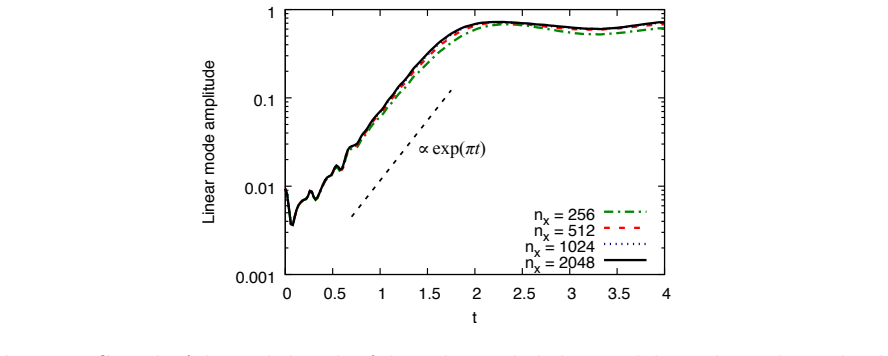
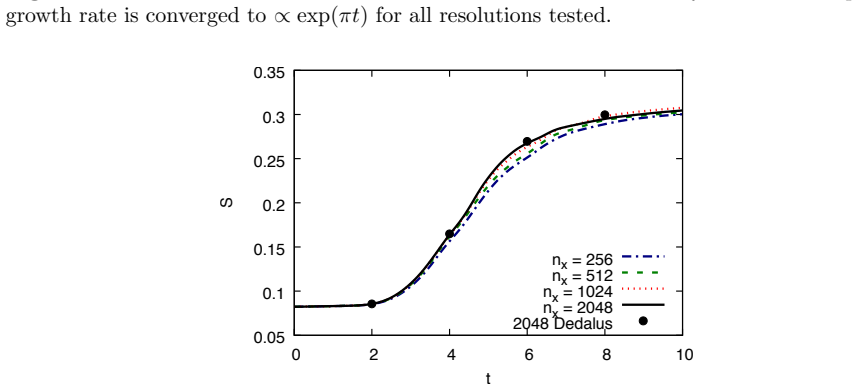
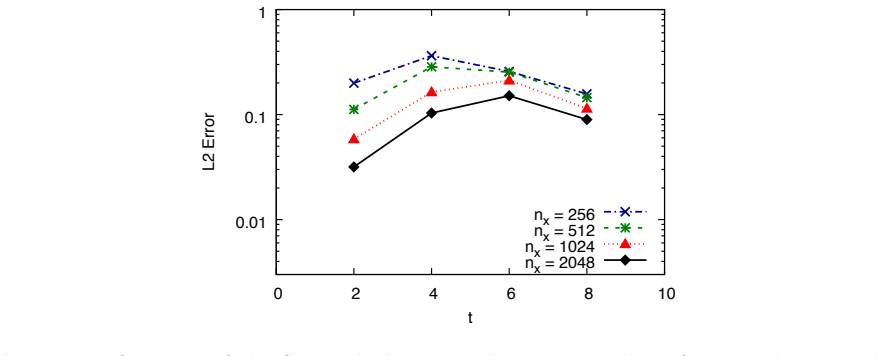
The central claim is that SPH solutions converge to the reference solution of the Kelvin-Helmholtz instability in both the linear and non-linear regimes. Using the smooth test initial conditions, the measured growth rate of the seeded mode is converged to $\propto \exp(\pi t)$ at all resolutions tested, and the total colour entropy, a mixing measure, matches the reference curve. Quantitative convergence is achieved by making the dissipation resolution-independent: physical Navier-Stokes viscosity, thermal conductivity, and colour diffusion with $\nu = \chi = \nu_c = 2\times 10^{-5}$ replace purely numerical smoothing, so the strongly non-linear evolution is forced toward a single solution. The $L_2$ error relative to the high-resolution reference decreases with resolution at every time, with convergence rates of $\Gamma = 0.89$ at $t=2$ and sub-linear rates later. The paper concludes that standard SPH with an artificial viscosity can correctly capture the Kelvin-Helmholtz instability, with the only special requirement being a high-order (septic) smoothing kernel to resolve the initial perturbation.
Load-bearing premise
The claim rests on trusting the high-resolution reference solution as the true answer, but the paper does not independently verify that this reference is itself converged.
Editorial extensions
If this is right
- Standard SPH, of the kind used for decades, can reproduce the Kelvin-Helmholtz instability and its non-linear mixing when dissipation is specified physically.
- Earlier conclusions that SPH has fundamental shortcomings on mixing instabilities are not supported once smooth initial conditions and physical dissipation are used.
- Formal convergence studies of SPH on this instability require smooth initial conditions; discontinuous interfaces excite all wavenumbers and prevent convergence.
- SPH converges more slowly than grid-based methods on this problem (roughly first-order in the linear regime and sub-linear later), so more resolution is needed for comparable accuracy.
- The septic spline is the minimum kernel order that avoids dominating the error; lower-order cubic and quartic splines visibly distort the vortex evolution.
Reading between the lines
- Because the quantitative comparison uses a single high-resolution reference run, the convergence claim is conditional on that run being itself converged; a yet-higher-resolution independent run would test this directly.
- Running the same setup without the imposed physical diffusion would isolate how much of the late-time mixing is resolved instability versus imposed dissipation, a separation the paper's design does not make.
- In astrophysical flows the effective Reynolds number is far larger, so the strategy of fixing a finite Reynolds number to enforce convergence does not carry over directly; the required high-order kernel also hints that resolution demands will be stiff in practice.
- The colour-entropy mixing diagnostic could serve as a standard quantitative convergence metric for other mixing problems, even without a reference solution.
Signed reviews
Editorial analysis
A structured set of objections, weighed in public.
Referee Report
Summary. The paper studies whether standard smoothed particle hydrodynamics with artificial viscosity can correctly capture the Kelvin-Helmholtz instability. Using the smooth initial conditions proposed by Lecoanet et al. (2016), the author adds physical Navier-Stokes viscosity, thermal conductivity, and passive-scalar diffusion so that the dissipation is resolution-independent, and evolves four resolutions (nx = 256, 512, 1024, 2048) with a high-order septic kernel. The SPH colour fields are compared visually and quantitatively with the pseudospectral Dedalus D2048 reference solution. The paper reports that the linear-mode amplitude converges to exp(pi t) at all resolutions, that the total colour entropy tracks the reference, and that the L2 error decreases with resolution at t = 2, 4, 6 and 8, with fitted exponents Gamma = 0.89, 0.62, 0.26 and 0.28. The central claim is that SPH solutions converge to the reference solution in both the linear and strongly non-linear regimes.
Significance. If fully established, the result would be a significant positive result for SPH in a problem where SPH has been repeatedly criticized. The study is well designed: it uses smooth, well-posed initial conditions; adds physical dissipation terms to fix the target solution; includes a passive scalar for mixing diagnostics; compares against an external high-order reference; and reports limitations explicitly. The linear-regime mode-amplitude convergence and the qualitative agreement in Fig. 1 are convincing, and the total colour entropy agreement (Fig. 3) is a good macroscopic check. The main weakness is that quantitative convergence in the strongly non-linear regime rests on extrapolating very slow error decreases to infinite resolution, with no evidence that the asymptotic regime has been reached. The paper is therefore a strong, honest convergence study whose central claim is plausible but not yet conclusively demonstrated.
major comments (3)
- [Section 4, Figure 4 and Table 1] The claim that the SPH solutions converge in the strongly non-linear regime is not supported by the measured rates at late times. At t = 6 and t = 8 the fitted exponents are only Gamma = 0.26 and 0.28, and the L2 errors are of order 10^-1; these numbers are consistent with an error that is decreasing too slowly to warrant the statement 'we demonstrate convergence' without an explicit demonstration that the trend continues. In the same section the paper states that even at nx = 2048 the artificial-viscosity dissipation of kinetic energy remains comparable to the physical Navier-Stokes dissipation. Consequently, at the resolutions presented, the SPH calculations are not yet solving the same dissipation problem as the Dedalus reference, and the observed error decrease cannot yet be identified with convergence to D2048.
- [Section 4, pressure-gradient error discussion] The paper attributes the sub-linear convergence in the non-linear regime to 'errors in the pressure gradient, which scale as O(1) with respect to resolution'. A resolution-independent error source of this kind implies that the L2 error may tend to a non-zero offset rather than to zero as nx increases. To support the convergence claim, the paper would need to show that the prefactor of this term diminishes with increasing kernel order or resolution (or otherwise quantify the asymptotic behavior); absent that, the statement that the errors are 'converging to the reference solution' is an extrapolation.
- [Section 4, reference solution] The convergence analysis is performed entirely with respect to the Dedalus D2048 solution, and no independent evidence is given in this paper that D2048 is itself converged. This is acceptable for a benchmark-comparison study and the citation to Lecoanet et al. (2016) is appropriate, but it limits the interpretation: the results establish consistency with a particular reference calculation, not convergence to the 'true physical answer' invoked in the Introduction. If the authors intend the stronger claim, they should include a convergence check of the reference solution or soften the language.
minor comments (5)
- [Sections 2 and 4, typos] There are several typographical errors, e.g. 'permit the calculations to convergence in resolution' (Section 2) and 'The is degree is mixing' (Section 4).
- [Figure 4 caption] The caption says the L2 error is 'converging to the reference solution'; given the slow late-time rates, a more neutral phrasing such as 'decreasing with resolution' would be more accurate.
- [Section 3, numerical parameters] The paper does not list the numerical values of the artificial-viscosity coefficients (Morris & Monaghan limiter parameters) or the kernel support radius; including these would improve reproducibility.
- [Section 4, Athena comparison] The comparison with the Athena errors from Lecoanet et al. (2016) is informative, but the resolutions of Athena and SPH are not directly equivalent; a sentence clarifying that the comparison is illustrative would avoid over-interpretation.
- [Equation (14), interpolation details] The summation over grid cells after SPH interpolation is clear, but the interpolation kernel used to map particles to the grid is not described.
Circularity Check
No significant circularity: SPH convergence is measured against an independent external reference solution (D2048, Dedalus), and the physical dissipation parameters are set by the problem definition, not fitted.
full rationale
The paper's central claim is that SPH solutions converge to the reference solution of Lecoanet et al. (2016) on the Kelvin-Helmholtz test problem. The reference solution is external to this paper: it was produced with the pseudospectral Dedalus code by Lecoanet et al. and was not generated or fitted by the present author. No parameter is tuned to minimize the L2 error against D2048. The Reynolds number (Re = 1e5) and the physical dissipation coefficients (nu = chi = nu_c = 2e-5) are fixed by the problem definition, not by matching the reference solution. The artificial viscosity coefficients are standard Morris & Monaghan SPH terms and are not calibrated to the benchmark. The only post-hoc methodological choice is the selection of the septic spline kernel, which the paper explicitly justifies by the need to capture the initial velocity perturbation amplitude and to suppress spurious mode growth; this is a standard numerical practice and is verified by comparison among spline orders, not by construction. The weak, sub-linear convergence rates and the paper's admission that artificial dissipation remains comparable to physical viscosity at the highest resolution are legitimate concerns about the strength of the convergence claim, but they are correctness and validation risks, not circularity. There is no self-citation chain carrying a load-bearing argument, no uniqueness theorem imported from the authors' own prior work, and no quantity defined in terms of the target result. The comparison metric (L2 error relative to D2048) is by definition relative to an external benchmark, which is exactly what a convergence test should be.
Assumptions & free parameters
assumptions (2)
- domain assumption The smooth initial conditions of Lecoanet et al. (2016) define a well-posed problem whose reference solution can be computed by independent methods.
- domain assumption The physical Navier-Stokes viscosity and thermal conductivity (Re=1e5, nu=chi=nu_c) represent the correct physical dissipation for the problem.
Cite this review
Pith. "Pith review of The Kelvin-Helmholtz instability and smoothed particle hydrodynamics." pith.science (2026). https://pith.science/paper/HUEU3VMR
@misc{pith2026190804893,
  author       = {Pith},
  title        = {Pith review of: The Kelvin-Helmholtz instability and smoothed particle hydrodynamics},
  year         = {2026},
  howpublished = {\url{https://pith.science/paper/HUEU3VMR}},
  note         = {Machine review of arXiv:1908.04893}
}
read the original abstract
There has been interest in recent years to assess the ability of astrophysical hydrodynamics codes to correctly model the Kelvin-Helmholtz instability. Smoothed particle hydrodynamics (SPH), in particular, has received significant attention, though there has yet to be a clear demonstration that SPH yields converged solutions that are in agreement with other methods. We have performed SPH simulations of the Kelvin-Helmholtz instability using the test problem put forward by Lecoanet et al (2016). We demonstrate that the SPH solutions converge to the reference solution in both the linear and non-linear regimes. Quantitative convergence in the strongly non-linear regime is achieved by using a physical Navier-Stokes viscosity and thermal conductivity. We conclude that standard SPH with an artificial viscosity can correctly capture the Kelvin-Helmholtz instability.
Figures

Figures from the paper (2 more)

Reference graph
Works this paper leans on
-
[1]
Lucy L B 1977 AJ 82 1013–1024
work page 1977
-
[2]
Gingold R A and Monaghan J J 1977 MNRAS 181 375–389
work page 1977
-
[3]
Springel V 2010 ARA&A 48 391–430 (Preprint 1109.2219)
arXiv 2010
-
[4]
Heß S and Springel V 2010 MNRAS 406 2289–2311 (Preprint 0912.0629)
work page Pith review arXiv 2010
-
[5]
Bauer A and Springel V 2012 MNRAS 423 2558–2578 (Preprint 1109.4413)
work page Pith review arXiv 2012
-
[6]
Sijacki D, Vogelsberger M, Kereˇ s D, Springel V and Hernquist L 2012 MNRAS 424 2999–3027 ( Preprint 1109.3468)
work page Pith review arXiv 2012
-
[7]
Hopkins P F 2013 MNRAS 428 2840–2856 (Preprint 1206.5006)
arXiv 2013
-
[8]
Hopkins P F 2015 MNRAS 450 53–110 (Preprint 1409.7395)
arXiv 2015
Show all 28 references
-
[9]
Agertz O, Moore B, Stadel J, Potter D, Miniati F, Read J, Mayer L, Gawryszczak A, Kravtsov A, Nordlund ˚A, Pearce F, Quilis V, Rudd D, Springel V, Stone J, Tasker E, Teyssier R, Wadsley J and Walder R 2007 MNRAS 380 963–978 (Preprint astro-ph/0610051)
2007 arXiv
-
[10]
Price D J 2008 J. Comput. Phys. 227 10040–10057 (Preprint 0709.2772)
2008 arXiv
-
[11]
Wadsley J W, Veeravalli G and Couchman H M P 2008 MNRAS 387 427–438
2008
-
[12]
Chandrasekhar S 1961 Hydrodynamic and hydromagnetic stability
1961
-
[13]
Springel V 2010 MNRAS 401 791–851 (Preprint 0901.4107)
2010 arXiv
-
[14]
Robertson B E, Kravtsov A V, Gnedin N Y, Abel T and Rudd D H 2010 MNRAS 401 2463–2476 (Preprint 0909.0513)
2010 arXiv
-
[15]
McNally C P, Lyra W and Passy J C 2012 ApJS 201 18 (Preprint 1111.1764)
2012 arXiv
-
[16]
Lecoanet D, McCourt M, Quataert E, Burns K J, Vasil G M, Oishi J S, Brown B P, Stone J M and O’Leary R M 2016 MNRAS 455 4274–4288 (Preprint 1509.03630)
2016 arXiv
-
[17]
Stone J M, Gardiner T A, Teuben P, Hawley J F and Simon J B 2008ApJS 178 137–177 (Preprint 0804.0402)
-
[18]
Monaghan J J 2005 Rep. Progr. Phys. 68 1703–1759
2005
-
[19]
Price D J 2012 J. Comput. Phys. 231 759–794 (Preprint 1012.1885)
2012 arXiv
-
[20]
Morris J P and Monaghan J J 1997 J. Comput. Phys. 136 41–50
1997
-
[21]
Schoenberg I J 1946 Q. Appl. Math. 4 45–99 ISSN 0033569X, 15524485 URLhttp://www.jstor.org/stable/ 43633538
1946
-
[22]
Flebbe O, Muenzel S, Herold H, Riffert H and Ruder H 1994 ApJ 431 754–760
1994
-
[23]
Watkins S J, Bhattal A S, Francis N, Turner J A and Whitworth A P 1996 A&AS 119 177–187
1996
-
[24]
Sijacki D and Springel V 2006 MNRAS 371 1025–1046 (Preprint astro-ph/0605301)
2006 arXiv
-
[25]
Brookshaw L 1985 PASA 6 207–210
1985
-
[26]
Cleary P W and Monaghan J J 1999 J. Comput. Phys. 148 227–264
1999
-
[27]
Plasmas 17 042103
Wang L F, Ye W H and Li Y J 2010 Phys. Plasmas 17 042103
2010
-
[28]
Monaghan J J 1992 ARA&A 30 543–574
1992
Reviewed August 14, 2026 · model on record in the stance chip above.
Discussion (0). Continue with ORCID to comment.