REVIEW 2 major objections 1 minor 1 cited by
Ferroelectric transmon
T0 review · 2 major / 1 minor · reviewed 2026-07-01 · grok-4.3
Pith's one-line read A ferroelectric capacitor shunting a Josephson junction supplies an extra parameter for tuning transmon anharmonicity while remaining insensitive to charge noise.
desk verdict The ferroelectric transmon is a clean conceptual proposal for an extra tuning knob, but the abstract supplies no calculation to show the voltage-dependent capacitance actually preserves exponential charge insensitivity. read the letter →
The pith
A machine-rendered reading of the paper's core claim, the machinery that carries it, and where it could break.
The reading
What carries the argument
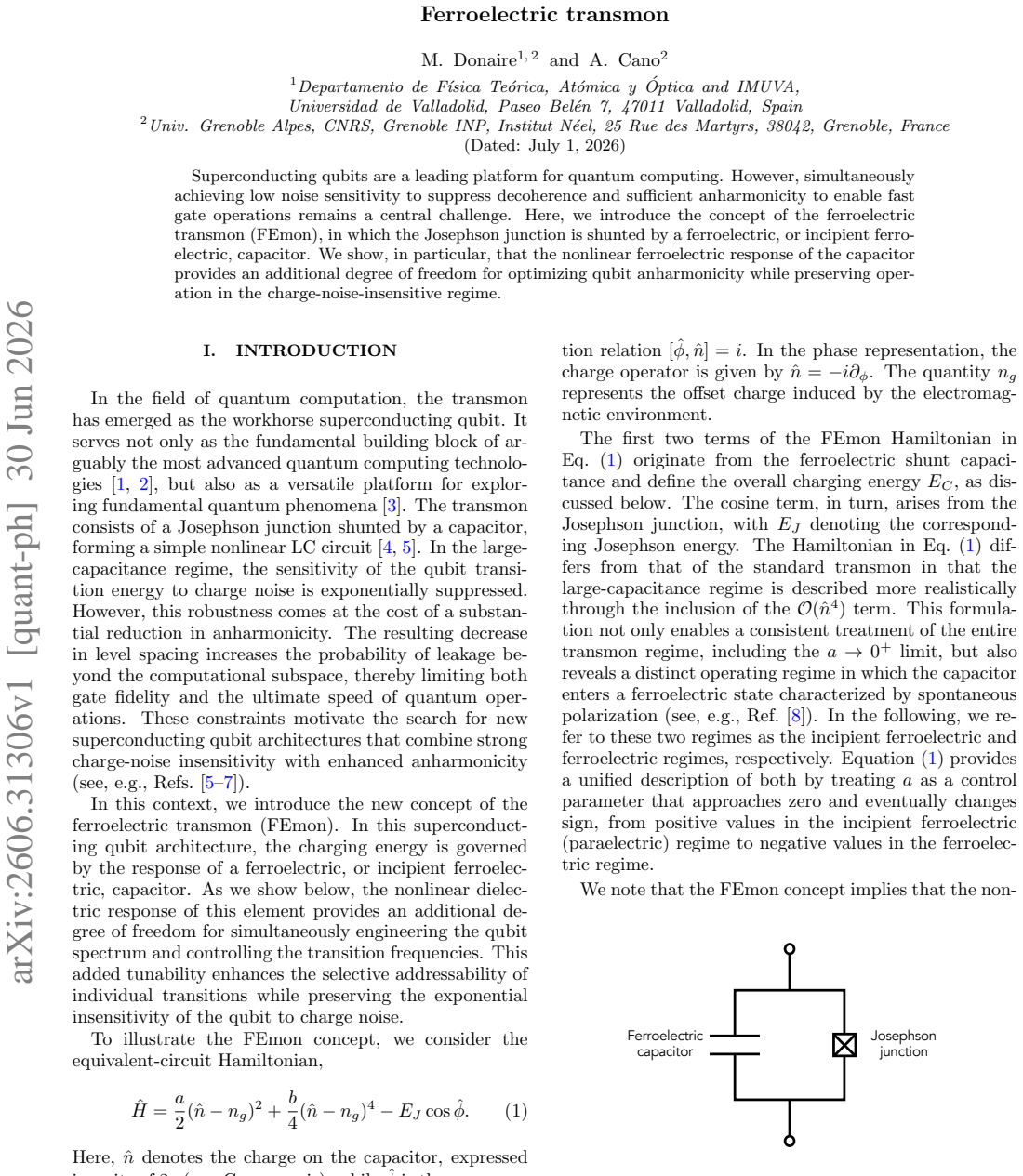
The ferroelectric or incipient-ferroelectric capacitor that shunts the Josephson junction, whose voltage-dependent permittivity alters the effective circuit parameters.
What would settle it
Fabricate a device with a ferroelectric shunt capacitor and measure its charge dispersion and anharmonicity to check if anharmonicity rises while charge noise sensitivity stays low.
Extended reading notes
Core claim
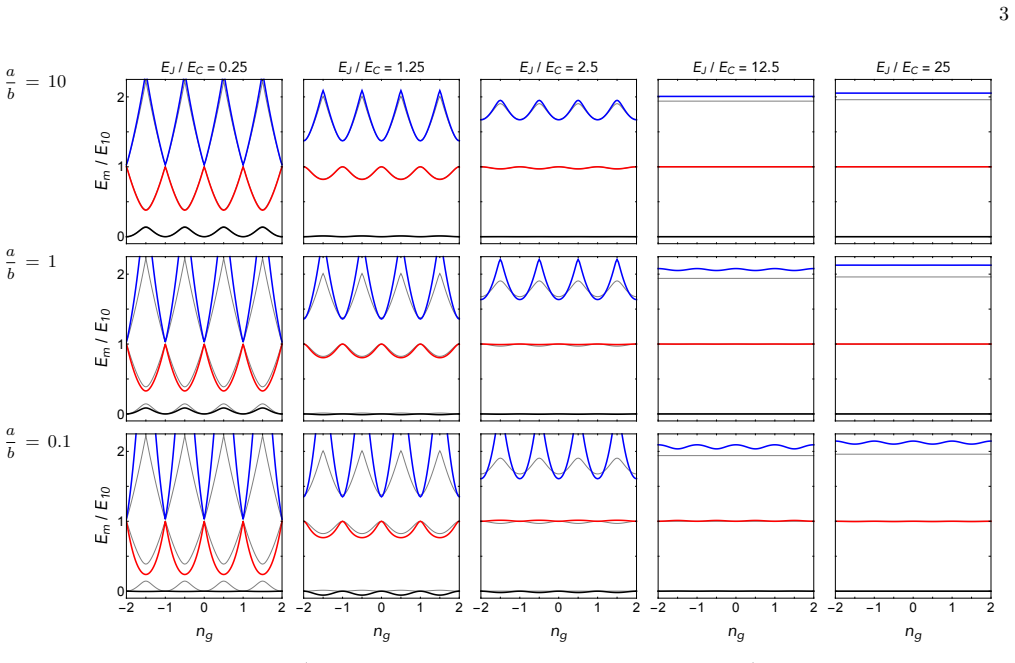
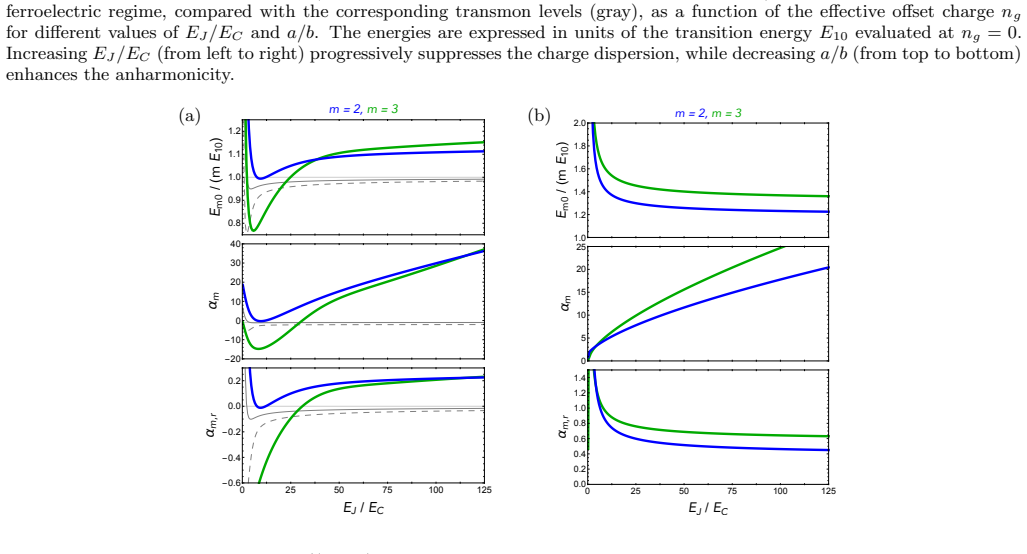
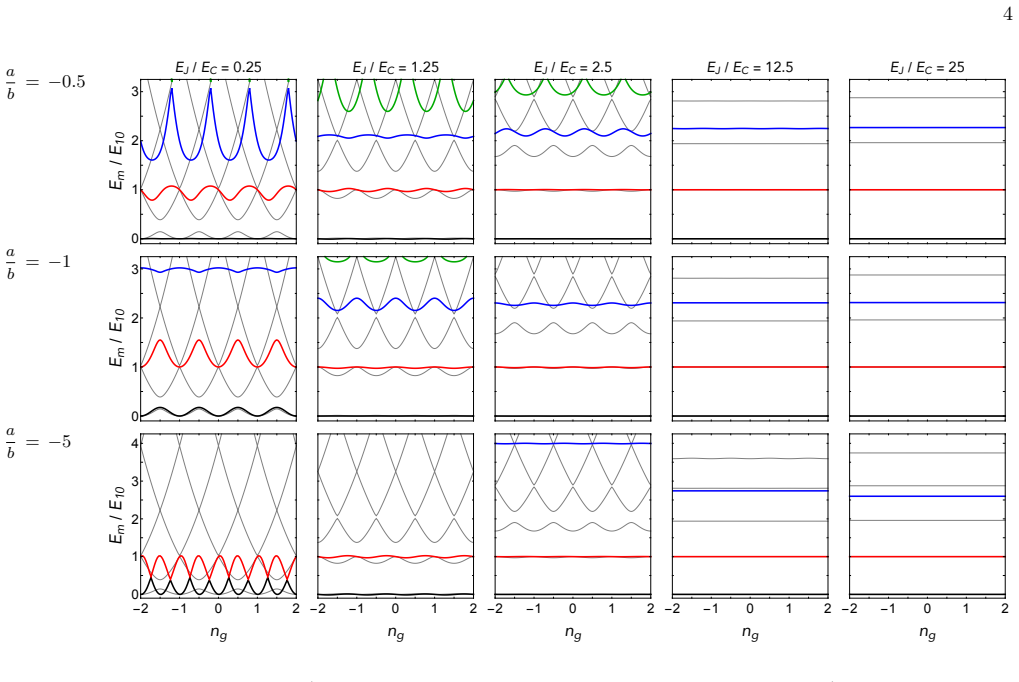
The nonlinear ferroelectric response of the capacitor provides an additional degree of freedom for optimizing qubit anharmonicity while preserving operation in the charge-noise-insensitive regime.
Load-bearing premise
A ferroelectric capacitor can be integrated with a Josephson junction without introducing new sources of decoherence or charge noise beyond those in conventional transmons.
Editorial extensions
If this is right
- The anharmonicity can be increased without raising sensitivity to charge fluctuations.
- Gate speeds can improve while coherence times remain comparable to standard transmons.
- The design opens a new materials-based route to qubit optimization.
- The same principle may apply to other superconducting qubit architectures that rely on shunt capacitors.
Reading between the lines
- Materials scientists could search for ferroelectrics compatible with superconducting circuits to test the concept.
- If successful, this might reduce the need for complex circuit designs to achieve high anharmonicity.
- Incumbent transmon fabrication processes would need modification to incorporate the ferroelectric layer.
Signed reviews
Editorial analysis
A structured set of objections, weighed in public.
Referee Report
Summary. The manuscript proposes the ferroelectric transmon (FEmon), in which a Josephson junction is shunted by a ferroelectric or incipient-ferroelectric capacitor. The central claim is that the nonlinear voltage dependence of the ferroelectric capacitance supplies an additional degree of freedom for optimizing qubit anharmonicity while the device remains in the charge-noise-insensitive regime (E_J ≫ E_C).
Significance. If the claim is substantiated by an explicit Hamiltonian treatment, the result would be significant for superconducting qubit design because it introduces a new tunable nonlinearity without sacrificing the exponential charge-noise suppression that defines the transmon architecture. The manuscript currently offers only a qualitative design suggestion with no equations, parameter values, or comparisons, so the practical advantage over existing anharmonicity-engineering approaches remains unquantified.
major comments (2)
- Abstract: the claim that the nonlinear ferroelectric response optimizes anharmonicity while preserving the charge-insensitive regime is stated at a high level but is unsupported by any derivation, effective Hamiltonian, or numerical diagonalization.
- Main text (Hamiltonian discussion): because the shunt capacitance is voltage-dependent, the instantaneous charging energy is operator-valued. This can couple charge fluctuations to the nonlinear term and potentially restore charge dispersion that is not exponentially suppressed. The manuscript must diagonalize the Hamiltonian with a realistic C(V) (e.g., Landau-Devonshire) to confirm that the n_g = 0 to n_g = 0.5 splitting remains negligible at the operating point.
minor comments (1)
- Abstract: a single quantitative metric (e.g., expected anharmonicity improvement or comparison to a standard transmon) would clarify the claimed advantage.
Simulated Author's Rebuttal
We thank the referee for their detailed and constructive report on our manuscript proposing the ferroelectric transmon. The comments correctly identify that the current version remains largely conceptual and lacks the quantitative Hamiltonian analysis needed to substantiate the central claims. We address each point below and commit to a major revision that incorporates the requested derivations and numerical checks.
read point-by-point responses
-
Referee: Abstract: the claim that the nonlinear ferroelectric response optimizes anharmonicity while preserving the charge-insensitive regime is stated at a high level but is unsupported by any derivation, effective Hamiltonian, or numerical diagonalization.
Authors: We agree that the abstract presents the claim at a conceptual level without supporting calculations. The main text provides only a qualitative argument based on the voltage dependence of the shunt capacitance. In the revised manuscript we will add an explicit effective-Hamiltonian derivation that incorporates a nonlinear C(V) into the charging term and shows how the resulting anharmonicity can be tuned independently of the exponential charge-noise suppression. The abstract will be updated to reference this new section. revision: yes
-
Referee: Main text (Hamiltonian discussion): because the shunt capacitance is voltage-dependent, the instantaneous charging energy is operator-valued. This can couple charge fluctuations to the nonlinear term and potentially restore charge dispersion that is not exponentially suppressed. The manuscript must diagonalize the Hamiltonian with a realistic C(V) (e.g., Landau-Devonshire) to confirm that the n_g = 0 to n_g = 0.5 splitting remains negligible at the operating point.
Authors: This is a substantive and valid concern. Because C depends on voltage, the charging energy becomes an operator, and additional terms could in principle appear that affect charge dispersion. While we expect the transmon regime (E_J ≫ E_C) to keep dispersion exponentially small, a rigorous confirmation requires numerical diagonalization. We will add such a calculation in the revision, using a realistic Landau-Devonshire model for C(V) with parameters appropriate for an incipient ferroelectric (e.g., SrTiO3), and will explicitly report the n_g = 0 to n_g = 0.5 energy splitting at the chosen operating point. revision: yes
Circularity Check
No circularity: high-level conceptual proposal only
full rationale
The manuscript introduces the ferroelectric transmon as a design concept. The abstract and provided text contain no equations, no fitted parameters, no derivation chain, and no self-citations that bear load on a claimed result. The central statement is a qualitative suggestion that nonlinear C(V) supplies an extra tuning knob while preserving the E_J ≫ E_C regime; this is not obtained by reducing any input to itself via definition, fitting, or prior self-work. No steps match any enumerated circularity pattern, so the finding is the default non-finding of a self-contained proposal.
Assumptions & free parameters
Cite this review
Pith. "Pith review of Ferroelectric transmon." pith.science (2026). https://pith.science/paper/HUHLOCA2
@misc{pith2026260631306,
  author       = {Pith},
  title        = {Pith review of: Ferroelectric transmon},
  year         = {2026},
  howpublished = {\url{https://pith.science/paper/HUHLOCA2}},
  note         = {Machine review of arXiv:2606.31306}
}
read the original abstract
Superconducting qubits are a leading platform for quantum computing. However, simultaneously achieving low noise sensitivity to suppress decoherence and sufficient anharmonicity to enable fast gate operations remains a central challenge. Here, we introduce the concept of the ferroelectric transmon (FEmon), in which the Josephson junction is shunted by a ferroelectric, or incipient ferroelectric, capacitor. We show, in particular, that the nonlinear ferroelectric response of the capacitor provides an additional degree of freedom for optimizing qubit anharmonicity while preserving operation in the charge-noise-insensitive regime.
Figures
Figures from the paper (1 more)
Forward citations
Cited by 1 Pith paper
-
Pseudo-superconducting-diode effect in ferroelectric Josephson junctions
Polarization switching in inversion-asymmetric ferroelectric Josephson junctions produces history-dependent asymmetric critical and retrapping currents, a magnetic-field-free pseudo-superconducting-diode effect.
Reference graph
Works this paper leans on
- [1]
-
[2]
J. Van Damme, S. Massar, R. Acharya, T. Ivanov, D. Perez Lozano, Y. Canvel, M. Demarets, D. Van- goidsenhoven, Y. Hermans, J. Lai, A. M. Vadiraj, M. Mongillo, D. Wan, J. De Boeck, A. Potoˇ cnik, and K. De Greve, Advanced cmos manufacturing of super- conducting qubits on 300 mm wafers, Nature633, 103 (2024)
work page 2024
-
[3]
M. Leib and M. J. Hartmann, Bose–hubbard dynamics of polaritons in a chain of circuit quantum electrodynamics cavities, New Journal of Physics12, 093031 (2010)
work page 2010
-
[4]
J. Koch, T. M. Yu, J. Gambetta, A. A. Houck, D. I. Schuster, J. Majer, A. Blais, M. H. Devoret, S. M. Girvin, and R. J. Schoelkopf, Charge-insensitive qubit design de- rived from the cooper pair box, Phys. Rev. A76, 042319 (2007)
work page 2007
-
[5]
G. Wendin, Quantum information processing with su- perconducting circuits: a review, Reports on Progress in Physics80, 106001 (2017)
work page 2017
-
[6]
F. Bao, H. Deng, D. Ding, R. Gao, X. Gao, C. Huang, X. Jiang, H.-S. Ku, Z. Li, X. Ma, X. Ni, J. Qin, Z. Song, H. Sun, C. Tang, T. Wang, F. Wu, T. Xia, W. Yu, F. Zhang, G. Zhang, X. Zhang, J. Zhou, X. Zhu, Y. Shi, J. Chen, H.-H. Zhao, and C. Deng, Fluxonium: An alter- native qubit platform for high-fidelity operations, Phys. Rev. Lett.129, 010502 (2022)
work page 2022
-
[7]
E. Hyypp¨ a, S. Kundu, C. F. Chan, A. Gunyh´ o, J. Ho- tari, D. Janzso, K. Juliusson, O. Kiuru, J. Kotilahti, A. Landra, W. Liu, F. Marxer, A. M¨ akinen, J.-L. Or- giazzi, M. Palma, M. Savytskyi, F. Tosto, J. Tuorila, V. Vadimov, T. Li, C. Ockeloen-Korppi, J. Heinsoo, K. Y. Tan, J. Hassel, and M. M¨ ott¨ onen, Unimon qubit, Nature Comm.13, 6895 (2022)
work page 2022
-
[8]
A. Levanyuk, B. Strukov, and A. Cano, Ferroelectric- ity, inEncyclopedia of Condensed Matter Physics (Sec- ond edition), Vol. 3 (Elsevier, 2024) pp. 284–296
work page 2024
Show all 12 references
-
[9]
Setter, D
N. Setter, D. Damjanovic, L. Eng, G. Fox, S. Gevorgian, S. Hong, A. Kingon, H. Kohlstedt, N. Park, G. Stephen- son,et al., Ferroelectric thin films: Review of materials, properties, and applications, Journal of Applied Physics 100, 051606 (2006)
2006
-
[10]
M. H. Park, Y. H. Lee, T. Mikolajick, U. Schroeder, and C. S. Hwang, Review and perspective on ferroelec- tric hfo2-based thin films for memory applications, MRS Communications8, 795 (2018)
2018
-
[11]
Mikolajick, S
T. Mikolajick, S. Slesazeck, H. Mulaosmanovic, M. H. Park, S. Fichtner, P. D. Lomenzo, M. Hoffmann, and U. Schroeder, Next generation ferroelectric materials for semiconductor process integration and their applications, Journal of Applied Physics129, 100901 (2021)
2021
-
[12]
Chandra, G
P. Chandra, G. G. Lonzarich, S. Rowley, and J. Scott, Prospects and applications near ferroelectric quantum phase transitions: a key issues review, Reports on Progress in Physics80, 112502 (2017)
2017
Reviewed July 1, 2026 · model on record in the stance chip above.
Discussion (0). Continue with ORCID to comment.